

Note: This article contains affiliate links. If you click on these links and make a purchase, I may earn a small commission at no extra cost to you. This helps support my research and content. Read my full affiliate disclosure here.
If ants are appearing on countertops, you need a solution that removes the pests quickly while keeping food prep areas safe. Kitchen countertops demand products that limit residue, have low acute toxicity where possible, and provide enough persistence to stop repeat trails. This guide highlights the top shortlisted ant killers for kitchen counter use and explains how each was evaluated for safety, speed, and cleanup. Below we cover practical performance factors gardeners and homeowners should care about, then summarize what to expect from the best options for countertop ant control.
Top Picks at a Glance
| Best Overall The best all-around choice for most situations | TERRO Liquid Ant Killer Bait Stations, 18-Count (3 Pack) |  |
| Best Quality Built to a higher standard if you want something more solid | Syngenta Advion Ant Gel Bait (4 tubes, 30 g each) |  |
| Best Value The sweet spot between price and what you get | TERRO Liquid Ant Killer 3-Pack (T200-3SR) |  |
| Best Budget The cheapest option that still gets the job done reliably | Raid Ant Killer Baits, 8 Count (Child-Resistant) |  |
| Highest Rated A top-rated pick with lots of positive feedback | NCSIFDD Ant Away Repellent Precision Applicator, 6-Pack |  |
| Most Popular A crowd favorite that many people choose with confidence | TERRO Liquid Ant Killer Bait Stations, 12-Pack |  |
TERRO Liquid Ant Killer Bait Stations, 18-Count (3 Pack)

| Unit Count | 18 Count |
|---|---|
| Item Form | Liquid |
| Target Species | Insects |
| Liquid Volume | 6.6 fluid ounces |
| Active Ingredients | Sodium Tetraborate Decahydrate (Borax) |
TERRO Liquid Ant Bait stations are small, ready-to-use trays filled with a sweet liquid bait containing borax that worker ants take back to the nest to kill the colony. They are intended for indoor placement along baseboards, in corners, on counters, and under appliances where ants are active. Key features include compact, sealed stations that help prevent drying and allow continuous access for ants, an EPA-recognized formulation with sodium tetraborate decahydrate, and multiple placements per pack to cover trouble spots. In practice they are easy to deploy: open the tab, set on a level surface, and monitor until bait is gone. Benefits are targeted control of sweet-seeking household ants and reduced need for sprays that only kill visible workers. Important limitations are that they work slowly by design so complete control can take up to two to four weeks and they require placement away from children and pets and from areas previously treated with insecticide. For kitchen counters they perform well if competing food sources are removed and multiple stations are used where ants are seen.
Best for: Home cooks and householders who want a low-effort, indoor solution for ants on kitchen counters and along baseboards and who are willing to monitor placements until the colony is controlled.
Less Ideal for: Homes with unsupervised young children or pets that may access bait stations or situations needing immediate knockdown where aerosol sprays or professional services are preferred.
- Ready-to-use stations require no mixing or setup
- Liquid bait formulation stays available to ants and resists drying
- Designed for indoor placement in tight spots like baseboards and under appliances
- EPA-recognized active ingredient (sodium tetraborate decahydrate)
- Not an instantaneous knockdown; full colony control can take several weeks
- Requires keeping stations out of reach of children and pets
Verdict: If you want an easy, no-mess indoor bait that worker ants will carry back to the nest, these ready-to-use liquid stations are an effective choice for controlling kitchen counter ant problems.
Syngenta Advion Ant Gel Bait (4 tubes, 30 g each)

| Unit Count | 4.23 Ounce |
|---|---|
| Included Components | 4 Tubes x 30-Grams, 1 Plunger and 2 Tips |
| Item Form | Gel |
| Active Ingredients | 0.05% indoxacarb |
Advion Ant Gel is a professional-style gel bait intended to eliminate ant colonies by having worker ants carry attractive bait back to the nest. Use the included plunger and tips to place small dots or short lines in cracks, along baseboards, behind appliances, and on kitchen counters near trails but out of direct food contact. The gel’s non-repellent formulation and MetaActive effect make it highly attractive to sugar-seeking and many common species such as Argentine and carpenter ants, and the low-dose active ingredient is designed for transfer within the colony for broader control. Practical benefits include easy, targeted application, an odorless matrix that does not disturb food areas when applied carefully, and compact syringes for storage. Important limitations are that it is a bait rather than a surface spray so results depend on ants taking the gel back to the nest, and it must be placed where pets and children cannot access it. For a performance-oriented buyer focusing on kitchen counters, it performs well when applied precisely to trails and hidden spots rather than smeared on open food prep surfaces.
Best for: Buyers who want a high-performance, targeted solution to eliminate ant colonies on kitchen counters and along indoor trails and who are comfortable placing baits in concealed spots for maximum effect.
Less Ideal for: People looking for immediate knockdown on visible ants without follow-up baiting or those who cannot safely place products out of reach of children and pets.
- Non-repellent gel that encourages foragers to feed and transfer bait to the nest
- Includes plunger and application tips for precise placement
- Odorless formulation suitable for use near indoor food preparation areas when applied correctly
- Targets a broad range of common ant species and is designed for colony-level control
- Requires ants to actively take the bait back to the nest so speed of control can vary
- Contains a pesticide active ingredient and must be kept away from children and pets
Verdict: If you need a performance-focused, discreet bait to eliminate ant colonies from kitchen trails, Advion Ant Gel delivers targeted, professional-grade control when applied correctly.
TERRO Liquid Ant Killer 3-Pack (T200-3SR)

| Item Form | Liquid |
|---|---|
| Target Species | Insects |
| Active Ingredients | Sodium Tetraborate Decahydrate (Borax) 5.40% |
| Unit Count | 1 Count |
| Specification Met | EPA |
TERRO Liquid Ant Killer is a simple indoor ant bait system that uses a borax-based liquid to attract worker ants, which carry the bait back to the nest to kill the queen and colony. Use it by applying drops onto the included cardboard tiles and placing them along kitchen counters, baseboards, and ant trails; the bottles are small and easy to position in corners and near food prep areas. Its main strength is the baiting approach: visible ant activity often decreases within a few days because the active ingredient is shared among colony members rather than just killing foraging ants. The 3-pack gives enough stations for multiple hotspots or to spread across a larger kitchen. Limitations include that it works only where ants are feeding on sweet baits and requires leaving stations undisturbed while ants are active. It is not an instant-spray solution for exposed nests and must be used according to directions to keep kids and pets safe.
Best for: Home cooks and householders who need a low-effort, targeted solution for ant activity on kitchen counters and want to eliminate infestations at the colony level rather than just repel visible ants.
Less Ideal for: People needing a fast-contact kill for visible ants or for infestations outdoors or of ant species that do not take sweet baits should consider alternative control methods.
- Targets colony by letting worker ants carry borax bait back to nest for broader control
- Includes three 2 oz bottles and cardboard tiles to treat multiple problem spots
- Easy to place drops on tiles and position along counters and baseboards
- Borax-based formula is EPA-specified and effective against common household ants
- Only effective on ants attracted to sweet liquid baits, so species with different preferences may ignore it
- Requires undisturbed feeding time and patience; not an immediate spray kill
Verdict: Choose this if you want an easy, place-and-forget indoor bait that eliminates kitchen ant colonies by letting workers carry borax back to the nest.
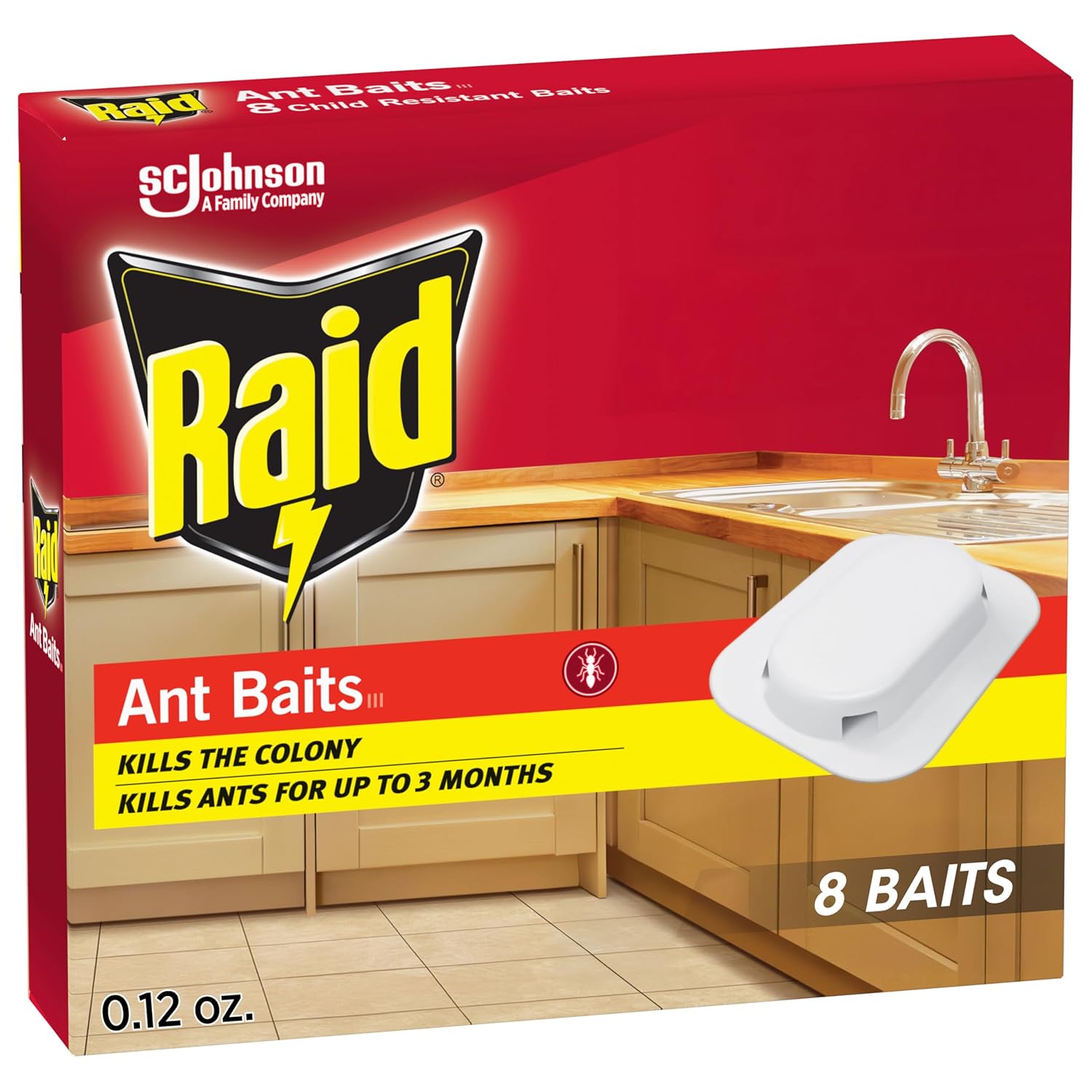
Raid Ant Killer Baits, 8 Count (Child-Resistant)
| Count | 8 count |
|---|---|
| Intended use | Indoor |
| Child-resistant | Yes |
| Residual claim | Up to 3 months |
These Raid Ant Killer Baits are ready-to-use bait stations intended for indoor placement along walls, in corners, and near entry points where ants travel. The bait attracts worker ants, which carry poisoned food back to the colony and share it, helping to eliminate the nest over time; the product claims control for up to three months. Practical benefits include simple placement with no mixing or spraying and a child-resistant design that reduces accidental access. The compact pods sit unobtrusively on kitchen counters or baseboards and work quietly in the background while you focus on cleanliness and sealing entry routes. Limitations are that results are not immediate and will depend on ants finding and taking the bait, and heavy or multiple infestations may need additional stations or a different method. This is a low-effort, maintenance-free option for routine indoor ant control when used as part of general sanitation and exclusion practices.
Best for: Ideal for budget-minded homeowners or renters who want a low-effort, safe indoor ant control product to place along counters, baseboards, and entryways.
Less Ideal for: Not the best choice for people facing very large or active infestations that require rapid knockdown or professional-grade treatment.
- Ready-to-use bait stations require no mixing or application tools
- Child-resistant design reduces accidental access by children
- Works by transfer to the colony for broader control rather than only killing workers
- Compact form fits along walls, corners, and near kitchen entry points
- Claims residual effect for up to three months under typical indoor conditions
- Not an instant knockdown; may take days to affect the colony
- Effectiveness depends on ants actually taking the bait and may vary by species
Verdict: A simple, child-resistant indoor bait option that quietly targets and reduces household ant colonies with minimal cost and effort.
NCSIFDD Ant Away Repellent Precision Applicator, 6-Pack

| Unit Count | 12 Count |
|---|---|
| Manufacturer | NCSIFDD |
| Model Number | ANT |
| Number of Pieces | 1 |
This ant repellent is a squeeze-gel in a precision applicator meant for spot treatment where ants are active. Users apply pea-sized drops along baseboards, window frames, cabinet edges, and known trails; the manufacturer says you may see increased activity for 3–5 days while the treatment works through the colony. The applicator makes it easy to place small amounts into tight cracks without a messy spread, and the formula is advertised for indoor and outdoor use with up to 60 days of effectiveness per application. Practical benefits include targeted placement that keeps counters and cabinets tidy and a family- and pet-safe formulation when used as directed. Limitations are that it is a localized repellent rather than a broadcast treatment for large infestations, and it requires repeating spot applications if new trails appear. Expect a short delay before colony-level control becomes noticeable, so plan treatments accordingly.
Best for: Homeowners who prioritize reliable, targeted control of ants on counters and around cabinets and who prefer a low-mess, safety-conscious product for spot treatments.
Less Ideal for: People facing large-scale infestations who need fast whole-house or outdoor perimeter treatments should consider professional services or broader-spectrum solutions.
- Precision applicator for accurate, low-mess placement in cracks and along baseboards
- Suitable for both indoor and outdoor targeted use around entry points
- Advertised family and pet safe when used as directed
- Each pack contains multiple tubes for repeat spot treatments
- Not intended as a single-step solution for large or widespread infestations
- Requires several days before colony-level reduction is observed
Verdict: Choose this precision gel when you want low-mess, targeted ant control around kitchen counters and entry points with a safety-focused formulation.
TERRO Liquid Ant Killer Bait Stations, 12-Pack

| Unit Count | 12 Count |
|---|---|
| Item Form | Liquid |
| Target Species | Insects |
| Active Ingredients | Sodium Tetraborate Decahydrate (Borax) 5.40% |
TERRO Liquid Ant Killer bait stations are small, ready-to-use traps designed for indoor use on kitchen counters, along baseboards, and in other places where ants trail. Each station contains a sweet liquid bait formulated with borax that worker ants consume and transport to the nest, which targets the whole colony rather than just visible workers. Typical use is simple: open the tab and place stations in areas of ant activity, then monitor and replace as the bait is consumed. Notable features include the pre-filled liquid formula, compact tamper-resistant design, and 12-pack coverage for multi-room placement. The practical benefits are fast attraction of sugar-seeking ants, multi-week persistence while ants continue to visit, and the potential to eliminate colonies over 2 to 4 weeks. Limitations are that it is meant for indoor sugar-loving ants specifically and will be less effective if competing food sources remain or if insecticides have been recently applied nearby. Users should keep stations out of reach of children and pets and be prepared to use multiple placements for larger infestations.
Best for: Buyers who want a low-effort, evidence-backed solution to stop ant trails on kitchen counters and who prefer products with clear user feedback and established performance.
Less Ideal for: Not a good fit for homeowners looking for a broad-spectrum outdoor or non-sugar-ant treatment or for those needing an immediate kill of exposed ants without colony control.
- Ready-to-use liquid bait that requires no mixing or setup
- Targets entire colony by having worker ants carry bait back to the nest
- Compact stations are easy to place discreetly on counters or along baseboards
- 12-count package provides coverage for multiple rooms or repeated placements
- Formulation is optimized for sugar-loving household ants and may be less effective on non-sugar-preferring species
Verdict: A dependable, ready-to-use bait pack that quietly eliminates sugar-seeking ants at the colony level, making it a practical choice for kitchen counter infestations.
Choosing the Right Ant Killer for Kitchen Counter: Key Factors to Consider
Toxicity And Food-Safety Labeling
Products used on kitchen counters should have clear labeling about food-contact surfaces and human safety. Look for formulations with lower acute toxicity and explicit instructions for how long to wait before wiping or placing food back on treated surfaces.
Manufacturers often specify whether a product leaves a removable residue and whether treated surfaces need rinsing. If the label lacks this information, the product is less appropriate for counters where food is prepared.
Formulation Type And Mode Of Action
Ant killers come as baits, sprays, aerosols, or gels. Baits rely on worker ants carrying toxicant back to the colony and are generally safer for direct-contact areas when used in tamper-resistant bait stations. Sprays and aerosols produce immediate knockdown but can leave residues that require wiping.
Understanding the active ingredient class helps predict speed and persistence. Fast-acting contact insecticides stop visible ants quickly, while slower toxic baits reduce colony pressure over days to weeks. Choose the mode consistent with how quickly you need control and how comfortable you are with treating food-prep zones.
Residue Visibility And Cleanability
Countertops see spills and frequent wiping, so residue visibility and removability matter. Some formulations leave sticky or oily films that trap dirt and are hard to remove, while others dry to an inconspicuous finish that can be wiped away with detergent and water.
Consider the countertop material: porous natural stone can absorb some liquids, increasing the need for formulations with clear rinse instructions. Always follow label directions for cleaning after treatment to reduce incidental exposure.
Placement Options And Application Control
Targeted application reduces unnecessary exposure. Gel pens, bait stations, and precision applicators let you place product directly on ant trails or in cracks rather than broadly treating the entire counter surface. Sprays with adjustable nozzles or trigger applicators offer control but may overspray if used carelessly.
Choose packaging that matches how you will use the product. For households with children or pets, tamper-resistant baits or applicators that hide the product from direct access are safer choices.
Attractiveness To Kitchen Ant Species
Different ant species prefer different food types. Many kitchen-invading ants forage for sugars and proteins, so bait attractiveness impacts how well the product disrupts foraging and reduces colony numbers. Products formulated to attract sweet-feeding ants may perform poorly against species that prefer greasy or protein-rich foods.
When species identification is uncertain, choose bait formulations that cover common kitchen preferences or pair a fast-contact option with a bait strategy to address immediate and long-term control.
Longevity And Frequency Of Reapplication
Kitchen counters get regular cleaning, which shortens the effective life of surface treatments. Residual products that can withstand light wiping or that adhere in small, targeted spots will last longer between applications.
Consider how often you are willing to reapply. Baits usually need less frequent replacement but take longer to eliminate colonies, while sprays provide instant control but may require repeat treatments after cleaning or heavy use.
Identifying Ant Activity On Counters
Spotting the source of ant activity makes treatment more effective. Watch where ants are most concentrated, follow their trails back to entry points, and check seams, grout lines, and appliance perimeters for nests or columns of traffic. Kitchen counters often serve as transit routes between a food source and a nearby nest rather than the nest site itself.
Knowing whether ants are attracted to sweet residues, crumbs, or water dramatically changes what product and placement will work best. A quick inspection will tell you whether to prioritize sweet baits, protein-based baits, or a contact option to interrupt foraging while baits take effect.
- Follow the trail to find entry points near windows, plumbing, or cabinet seams.
- Note time of day when ants are most active; some species forage at night.
- Check beneath small appliances and around drains where crumbs accumulate.
Safe Application Practices In Food-Prep Areas
Treat only targeted spots whenever possible and avoid broad spraying across the entire counter. If you must spray, remove dishes and food first, ventilate the area briefly, and wipe treated surfaces according to label instructions before resuming food prep.
Use bait stations or gel in hard-to-reach cracks where pets and children cannot access them. Store unused product out of reach and always wash hands after applying treatments. If a product requires a waiting period before contact with food, respect that interval to reduce exposure risk.
- Remove food and utensils from the immediate area before treatment.
- Keep pets and children out of the treated room until it is safe.
- Have cleaning supplies ready to remove any excess residue if the label recommends it.
Combining Immediate Control With Long-Term Management
For many kitchen ant problems, pairing a fast-acting contact product to stop visible foragers with a slow-acting bait to reduce the colony gives both immediate relief and lasting control. Immediate products reduce contamination and nuisance from active ants, while baiting addresses the source over days to weeks.
Avoid overusing contact sprays that kill workers but leave the colony intact, since that can push ants to forage elsewhere. An integrated approach that includes sanitation, sealing entry points, and targeted use of both contact agents and baits typically performs best.
- Start with targeted contact control when ants are abundant.
- Deploy baits along trails and refill according to label guidance.
- Seal obvious entry points after activity decreases to prevent reinfestation.
Cleaning And Preventing Future Infestations
Regular cleaning eliminates the food cues that attract ants. Wipe counters daily, clean spills promptly, store food in sealed containers, and keep pet food dishes tidy. Removing attraction sources makes any ant-killing strategy much more durable.
Inspect and repair small gaps around plumbing, windows, and baseboards. Weatherstripping and caulking reduce entry opportunities. Remember that ants will exploit tiny cracks, so comprehensive sealing coupled with sanitation reduces the need for repeated chemical treatments.
- Wipe sticky spills and crumbs immediately with soapy water.
- Store pantry items in airtight containers.
- Check exterior landscaping and mulch near foundations; move sweet-smelling plants away from entry points when possible.
When To Call A Professional
If ant activity persists after consistent baiting, sanitation, and targeted treatments, or if you observe large numbers of ants emerging from structural voids, professional help may be warranted. Pest specialists can identify species, locate nests inside walls or under slabs, and recommend treatments licensed for indoor use in food-prep areas.
Professionals can also advise on nonchemical exclusion methods and provide targeted treatments that minimize indoor residue while addressing colonies that are hard to reach with consumer products.
- Look for signs of nest activity inside walls or under flooring.
- Consider professional evaluation for recurring, large-scale infestations.
- Ask about reduced-residue application options if indoor safety is a priority.
How We Chose the Best Ant Killer for Kitchen Counter
We prioritized products designed for indoor food-preparation surfaces and evaluated each option across multiple concrete dimensions relevant to kitchens. Key criteria included speed of knockdown, because fast interruption of foraging reduces contamination risk; residual effectiveness on nonporous surfaces, since countertops vary from laminate to stone; label safety and low-toxicity formulations that minimize harm to people and pets; ease of application and cleanup, including whether residues can be wiped away; bait attractiveness for typical kitchen ant species; and packaging that supports targeted placement rather than broad spraying. We excluded outdoor-only formulations, broad-spectrum garden sprays, and products labeled for structural use only that did not include clear directions for countertop or indoor food-prep zones. We also filtered out options with unclear ingredient lists or lacking basic safety instructions. The final shortlist reflects products that meet indoor safety expectations while offering practical performance for kitchen counters.
FAQ
Are ant baits safe to use on kitchen counters?
Baits placed inside tamper-resistant stations or applied in small gel dots are commonly used near counters and can be safe when labels allow indoor food-prep area use. Follow instructions about placement and keep baits out of reach of children and pets.
How long after treatment can I use the counter for food prep?
Wait times vary by product. Some formulations recommend wiping treated surfaces after a short drying period while others require a specified delay. Always follow the product label for reentry or cleaning intervals to ensure food safety.
Will sprays leave a residue I need to worry about?
Some sprays dry clear and leave minimal residue, while oil-based or sticky formulations can leave films that collect dirt. Read label directions on cleaning and only use sprays labeled for indoor food-prep areas if you plan to treat counters.
Can I use outdoor ant products on kitchen counters in a pinch?
Outdoor-only products are often formulated and labeled for different uses and may leave residues or use actives not intended for indoor food areas. It is better to use products explicitly labeled for indoor or countertop use to avoid unintended exposure.
How do I know if baiting or spraying is the better first step?
If you need immediate interruption of foraging on counters, a targeted contact option can quickly reduce visible ants. If you prefer a lower-exposure strategy and can wait for colony reduction, baits placed along trails are usually the better long-term approach.
Will kitchen cleaning remove the effect of residual products?
Frequent cleaning can reduce residual activity, especially if you use strong detergents or abrasives. For persistent control, use targeted placement that is less likely to be cleaned away or follow reapplication guidance provided on the product label.
Final Verdict
Choose ant control strategies for kitchen counters by balancing immediate reduction of visible ants with long-term colony management and minimizing residues on food-prep surfaces. Prioritize products with clear food-surface labeling, targeted application options, and bait attractiveness that matches the ants present. If safety around children, pets, or food is the main concern, favor tamper-resistant baits and targeted applicators. For urgent interruptions of heavy foraging, pair a brief, targeted contact treatment with follow-up baiting and improved sanitation to prevent recurrence.
