

Note: This article contains affiliate links. If you click on these links and make a purchase, I may earn a small commission at no extra cost to you. This helps support my research and content. Read my full affiliate disclosure here.
If ants are creating mounds, trails, or damage in your turf, choosing the right ant pesticide for lawns makes a real difference to lawn health and usability. You need a product that eliminates colonies or repels foragers without stressing grass, harming nearby plants, or leaving long-lasting residues where children or pets play. This guide covers seven top options shortlisted for lawn use and compares them on the practical factors that matter to home gardeners. We evaluate each pick for how it performs on turf, how easy it is to apply, safety considerations, and how quickly you see results. Read on to find which type of lawn ant treatment best fits your yard and maintenance routine.
Top Picks at a Glance
| Best Overall The best all-around choice for most situations | Spectracide Triazicide Large-Plot Insect Killer Concentrate, 1 Gallon |  |
| Best Quality Built to a higher standard if you want something more solid | Talstar One Insecticide Concentrate, 1 Gallon |  |
| Best Value The sweet spot between price and what you get | Ortho BugClear Lawn Insect Killer, 10 lb. granules |  |
| Best Budget The cheapest option that still gets the job done reliably | Spectracide Triazicide Insect Killer for Lawns & Landscapes, 32 oz |  |
| Highest Rated A top-rated pick with lots of positive feedback | Ortho Fire Ant Killer Mound Treatment, 3 lb. |  |
| Most Popular A crowd favorite that many people choose with confidence | Amdro Ant Killer for Outdoor Home Perimeter, 12 oz |  |
| Best Seller A high-volume bestseller chosen again and again | Atticus Talak 7.9% Bifenthrin Indoor/Outdoor Insecticide Concentrate (32 oz) |  |
Spectracide Triazicide Large-Plot Insect Killer Concentrate, 1 Gallon

| Item Form | Spray |
|---|---|
| Target Species | Insects |
| Liquid Volume | 1 gallons |
| Unit Count | 128 Fluid Ounces |
This Spectracide Triazicide concentrate is designed for treating large lawns and landscape areas; you mix it with water and apply with a tank sprayer to target surface and foliar pests. It kills ants plus a long list of insects on contact and claims residual protection for up to two months, which makes it useful for seasonal perimeter treatments and spot applications around trees, shrubs, flower beds and vegetable gardens when label directions allow. The concentrate format lets you cover very large areas from a single gallon and the label notes it is non‑staining when used correctly. Important practical points are that it must be diluted and applied with separate sprayer equipment, and standard PPE and label precautions are required to protect people, pets and desirable plants. It is best suited for homeowners managing broad pest problems across turf and planting beds who want a single, high‑coverage product rather than many targeted sprays.
Best for: Homeowners who want a single, high‑coverage insecticide to manage ants and mixed insect problems across lawns and landscapes rather than spot treatments.
Less Ideal for: People who prefer ready‑to‑use sprays, those without sprayer equipment, or gardeners who need insecticides labeled for continuous use on edible crops without restrictions.
- Broad spectrum that lists 180+ target pests including ants and common lawn insects
- Concentrate formula covers large areas from one gallon, reducing trips to buy more product
- Provides up to two months of residual control when applied according to the label
- Non-staining when used as directed, suitable for use around many landscape surfaces
- Requires a separate tank sprayer and mixing, which adds setup time and equipment
- Contains pesticides that require protective clothing and careful handling to avoid exposure
Verdict: A single 1‑gallon concentrate that delivers broad, long‑lasting control for ants and many other lawn pests over large properties.
Talstar One Insecticide Concentrate, 1 Gallon

| Active ingredient | Bifenthrin 7.9% |
|---|---|
| Formulation | Concentrate, water-based |
| Intended use | Indoor and outdoor perimeter, structural, lawn and ornamental use |
Talstar One is a concentrated bifenthrin insecticide designed for perimeter, structural, and spot treatments on lawns and around homes. It mixes with water for use through pump sprayers to create a residual barrier around foundations, doors, and exterior surfaces or for targeted crack and crevice indoor treatments. The formula is water-based, low-odor, and dries clear, which makes it suitable for treated outdoor living areas and visible lawn edges. Notable features include broad-spectrum control listed for over 75 pests and a long-lasting residual effect that can reduce the need for frequent reapplication across large properties. Because it is a concentrate, it delivers good coverage and value when applied correctly but requires proper dilution and application equipment and adherence to label directions. Users should plan for careful handling and follow safety instructions to protect non-target plants, pets, and beneficial insects.
Best for: Homeowners and property managers who prioritize reliable, professional-strength pest control for lawns and perimeters and who are comfortable using concentrated treatments and sprayer equipment.
Less Ideal for: Those who prefer organic or non-chemical ant control methods or who need a ready-to-use product without mixing and equipment setup.
- Broad-spectrum bifenthrin formula effective against ants and over 75 listed pests
- Concentrate mixes with water for economical coverage of large lawns and perimeters
- Low-odor, water-based formula that dries clear for use near outdoor living spaces
- Provides residual control to reduce frequency of reapplications
- Requires dilution and sprayer equipment, which adds setup time and complexity
- Chemical insecticide that can harm beneficial insects and requires careful use around gardens and pets
Verdict: Choose Talstar One when you need a professional-strength, concentrated insecticide that delivers long-lasting ant and perimeter control across lawns and structures.
Ortho BugClear Lawn Insect Killer, 10 lb. granules

| Unit Count | 160 Ounce |
|---|---|
| Item Form | Granules |
| Target Species | Insects |
| Coverage | Up to 16,500 sq ft |
Ortho BugClear Lawn Insect Killer is a granular pesticide intended for broadcast application to lawns, ornamental beds, and around home perimeters to control ants, ticks, fleas, grubs, armyworms, spiders and other listed pests. You apply it with a compatible spreader, water it in immediately, and people and pets can re-enter treated areas once dry. The formula starts killing by contact within minutes for most pests and claims up to six months of residual ant control and three months against many other insects, which makes it useful as a seasonal preventive treatment. The product covers a large area per bag, so it is practical for medium to large yards and for homeowners who prefer periodic, low-effort pest management. Limitations to note are that it excludes some ant species from the six-month claim and it is a broad-spectrum chemical treatment so it should be used only where necessary and according to label precautions; it also requires a spreader and immediate watering to activate best results.
Best for: Homeowners who want a straightforward, infrequent treatment to reduce common lawn insect populations across medium to large yards and value coverage and residual control.
Less Ideal for: People managing very small lawns or those seeking organic or non-chemical pest control methods should consider alternative products or cultural controls.
- Fast contact kill for many listed lawn pests
- Provides long residual control for ants up to six months
- Covers a large area from a single 10 lb. bag
- Easy to apply with a standard broadcast spreader and then water in
- Does not cover certain ant species under the six-month protection claim
- Requires immediate watering after application for best effectiveness
Verdict: A practical, large‑coverage granular treatment that delivers quick knockdown and months of residual ant and lawn pest control.
Spectracide Triazicide Insect Killer for Lawns & Landscapes, 32 oz
| Unit Count | 32 Ounce |
|---|---|
| Item Form | Spray (concentrate) |
| Target Species | Insects |
| Active Ingredients | Gamma-Cyhalothrin (0.08%) |
| Liquid Volume | 32 fluid ounces |
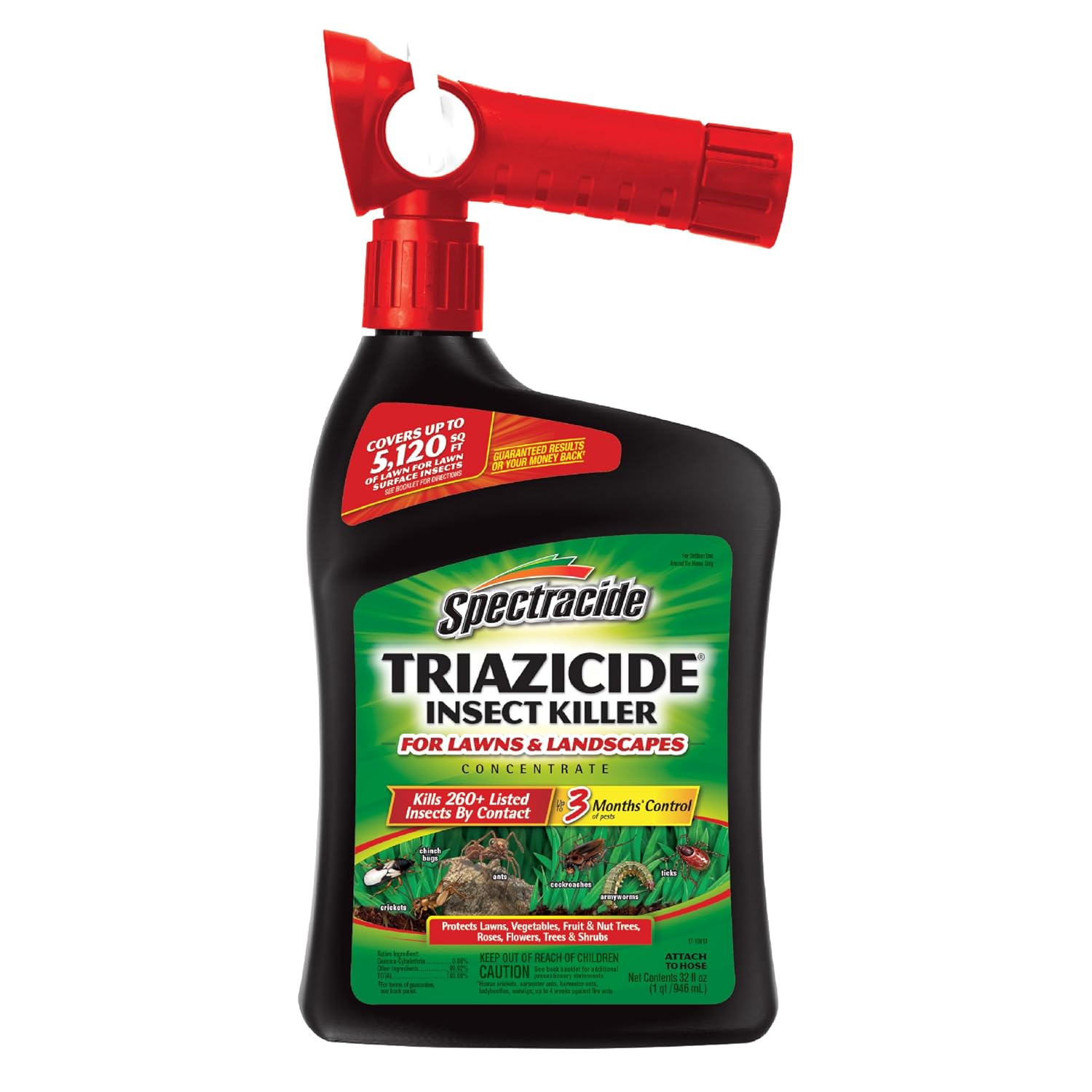
Spectracide Triazicide is a concentrate designed to be mixed with water and applied with a tank sprayer or hose-end applicator to control surface and soil-dwelling insects on lawns and around landscape plants. The formula lists gamma-cyhalothrin as the active ingredient and claims contact kill for more than 260 insect species including ants, fleas, ticks and Japanese beetles. In practice it is used by diluting per the label and treating problem areas or whole lawns; it can also be applied to flower beds, trees and shrubs. Notable features include broad-spectrum control, an option to treat fire ant mounds directly, and non-staining claims when used as directed. Practical benefits are fast knockdown (claims control within 24 hours), long residual protection for several weeks depending on conditions, and coverage for large areas when mixed correctly. Important limitations are that it is highly toxic to fish and bees so care is required to avoid water and blooming plants, and users must follow safety directions to minimize risk to people and pets. The concentrate format also requires measuring and a sprayer, which may be less convenient than pre-mixed products for small yards.
Best for: Buyers looking to protect medium to large lawns on a budget who are willing to mix a concentrate and follow label safety steps for broad, economical insect control.
Less Ideal for: People with small yards who prefer ready-to-use sprays or those who need a treatment that is safe to apply near ponds, pollinator-attractive blooms, or without protective precautions.
- Broad-spectrum control covering 260+ listed insects including ants, fleas, ticks and Japanese beetles.
- Concentrate format treats large areas when mixed properly, making it economical for bigger lawns.
- Works by contact with rapid knockdown and residual protection for up to several weeks.
- Includes label instructions for treating fire ant mounds and use on lawns, shrubs, trees and garden areas.
- Extremely toxic to aquatic life and harmful to bees, requiring careful application to avoid runoff and blooming plants.
- Requires mixing and application equipment which adds setup time and potential for dosing errors.
Verdict: If you need an affordable, concentrated insecticide to treat large lawns and landscapes for ants and many other pests, this product delivers broad, cost-effective control.
Ortho Fire Ant Killer Mound Treatment, 3 lb.

| Item Form | Granules |
|---|---|
| Target Species | Insects |
| Item Type Name | Mound Treatment |
| Unit Count | 1 Count |
Ortho Fire Ant Killer Mound Treatment is a granular, outdoor pest-control product made for treating active fire ant mounds on residential lawns and around ornamentals. You apply about two thirds of a cup over each mound covering a roughly 3-foot diameter, then drench the treated area with about two gallons of water to activate the granules. The formula begins killing ants in about 15 minutes and claims to eliminate the colony including the queen within 12 hours, which makes it useful for quick spot control of visible mounds. The label gives clear timing guidance — apply when temperatures are 65°F to 80°F and avoid rain — and warns to keep people and pets away until the area has dried after watering in. Practical benefits include rapid action, straightforward per-mound dosing, and suitability for lawns and ornamental garden beds. Important limitations: it is for outdoor mound treatment only, does not apply to vegetables, and safety precautions are needed to avoid eye or skin contact and accidental ingestion.
Best for: Buyers who want a dependable, no-nonsense solution for eliminating individual fire ant mounds on lawns and garden beds and prefer a product with clear, repeatable instructions.
Less Ideal for: People seeking a preventive whole-yard broadcast treatment or a product labeled for use on edible vegetable gardens should consider other options.
- Fast action with visible ant kill reported in about 15 minutes
- Kills the colony including the queen for more complete mound elimination
- Simple, per-mound application and clear water-in instructions
- Intended for use on lawns and around ornamentals, not just broad broadcast use
- Not suitable for indoor use or on vegetable gardens
- Requires watering in and dry conditions before reentry which delays area use
Verdict: Choose this product if you need a fast, reliable per-mound treatment that kills the colony and queen for spot control of fire ants on lawns and ornamentals.
Amdro Ant Killer for Outdoor Home Perimeter, 12 oz

| Item Form | Granules |
|---|---|
| Target Species | Ant |
| Included Components | Ant Bait Granules |
| Unit Count | 12 Ounce |
Amdro Ant Killer for Outdoor Home Perimeter is a granular bait designed to be applied as a 1-foot band around a house foundation, lawn edge, or landscaped areas to reduce outdoor ant pressure before they enter the home. You shake the granules along the perimeter where foraging worker ants pick them up and carry them back to the nest, which helps kill the colony including the queen over time. The product claims protection for up to three months and lists control for many common ant species, making it a convenient seasonal treatment for spring and summer. It is simple to apply without specialized equipment and works best when applied in cool parts of the day to dry ground. Limitations are that it is intended only for outdoor perimeter use, must not be applied to wet grass or when rain is expected, and effectiveness depends on ants finding and sharing the bait which can take days to weeks.
Best for: Homeowners who want a low-effort seasonal perimeter treatment to reduce ant incursions and prefer proven, widely used products with documented species coverage.
Less Ideal for: People seeking immediate indoor knockdown or rapid visual elimination of foraging ants should choose an indoor spray or contact insecticide instead.
- Granular bait attracts worker ants to carry toxin back to the colony
- Provides up to three months of perimeter protection per application
- Covers a long linear distance when applied in a 1 ft band around the home
- Simple shake-on application requires no special tools or mixing
- Only for outdoor perimeter use and not suitable for direct indoor treatment
- Must be applied to dry ground with no rain expected for 24 hours to be effective
Verdict: Amdro provides an easy, season-long outdoor perimeter bait that reduces lawn and foundation ant colonies so fewer ants reach your home.
Atticus Talak 7.9% Bifenthrin Indoor/Outdoor Insecticide Concentrate (32 oz)

| Liquid Volume | 32 fluid ounces |
|---|---|
| Item Form | Liquid |
| Active Ingredients | Bifenthrin |
| Specification Met | EPA |
Talak 7.9% is a liquid concentrate that uses bifenthrin to control more than 75 indoor and outdoor insect pests on lawns, landscapes and around structures. You dilute the concentrate with water and apply it with a pump sprayer to turf, shrubs, tree trunks, patios, eaves and interior perimeter areas such as baseboards and cabinets. Notable features include a water-based formula that dries clear with minimal odor, pre-marked pour sections on the bottle for easier measuring and label rates for different uses from turf to perimeter barriers. In practice it delivers fast knockdown on contact and provides residual activity for up to three months in barrier applications, which can reduce how often you need to spray. Important limitations are that diluted solution should be used the same day and it is not registered for sale in a few states, so check local rules before buying. As with any synthetic insecticide, follow label safety instructions and keep pets and people away until treated surfaces are fully dry.
Best for: Buyers who want a reliable, long-lasting perimeter and lawn treatment that reduces repeat applications and prefer following proven label directions to manage common yard ants and other pests safely.
Less Ideal for: People who want ready-to-use sprays or nonchemical control methods, or those who cannot apply mixed concentrates themselves.
- Broad-spectrum control for 75+ listed pests, including ants and fire ant mound drench use
- Water-based formula that dilutes with water, dries clear and is low-odor
- Residual control lasting up to three months for perimeter and landscape treatments
- Flexible label rates for lawns, landscapes, and indoor perimeter applications
- Concentrate must be mixed and used the same day and cannot be stored once diluted
- Not approved for sale in some states, so availability is region-dependent
Verdict: Choose Talak 7.9% when you want a proven, water-based bifenthrin concentrate that gives fast knockdown and up to three months of residual control for ant and perimeter treatments.
Choosing the Right Ant Pesticide for Lawns: Key Factors to Consider
Turf Safety and Grass Species Compatibility
Different pesticides can react with turf species or with fertilizers and herbicides in ways that stress grass. Knowing whether a product is labeled safe for cool-season and warm-season grasses is crucial because application windows and heat stress change injury risk.
Look for guidance about mixing with other lawn inputs and recommended watering or mowing intervals after treatment. Turf injury can take days to show, so choosing a product with an established record of gentle treatment on common lawn grasses reduces the chance of brown patches or slowed recovery.
Targeting Whole Colonies Versus Foragers
Some treatments rapidly kill visible ants but do not affect the nest, allowing colonies to rebound. For lawns, a product that either carries bait into the nest or delivers a soil-active residual can cut off the colony rather than only reducing surface activity.
Consider whether you need immediate surface reduction for aesthetics or longer-term colony suppression. For extensive mound infestations, systemic or bait-based approaches that reach the queen are often more effective than short-lived contact sprays.
Application Method and Coverage Control
How you apply a lawn ant pesticide determines both effectiveness and the chance of turf harm. Granules, ready-to-use sprays, hose-end treatments, and concentrate-to-sprayer mixes each have advantages and limitations for coverage, drift potential, and uniformity.
Granules are easy to broadcast but need correct calibration to avoid over-application. Hose-end and pump sprayers offer quick coverage but can cause uneven dosing if not walked at a steady pace. Choose a method that matches the size of your lawn and your comfort level handling application equipment.
Residual Activity and Reapplication Intervals
Residual duration affects how often you need to reapply and how long the lawn remains protected. Longer residuals reduce revisit frequency but may increase non-target exposure. Short residuals require more frequent treatments but can be timed around other lawn care tasks and reduce cumulative chemical load.
Look at label guidance for how long activity persists in dry versus wet conditions and whether irrigation or rainfall reduces effectiveness. Effective scheduling considers seasonal ant activity peaks and typical local precipitation patterns.
Pet and Family Safety Around Play Areas
Lawns are high-contact spaces for pets and children, so understand re-entry intervals, surface residue concerns, and any specific restrictions on pet access after treatment. Some formulations have rapid re-entry once surfaces are dry, while others require longer wait times or temporary containment of pets.
Also consider if the product leaves residues that can transfer to paws or play equipment. Choosing options with clear, conservative safety instructions and minimal off-target mobility reduces risk in family-use lawns.
Environmental Impact and Non-target Considerations
Products used on lawns can move off-target through runoff, drift, or pollinator exposure at lawn edges. Pay attention to whether labels advise buffer zones near flowering plants, water bodies, or vegetable gardens. Some active ingredients are more persistent in soil or harmful to beneficial insects.
Selecting a formulation with lower aquatic toxicity and clear guidance for avoiding pollinator exposure helps protect the broader yard ecosystem. Good lawn practices like avoiding application to saturated soil and respecting label buffer zones minimize unintended impacts.
When to Treat Ants in the Lawn
Treating ants in the lawn is often about timing as much as the product. Early spring and late summer are typical activity peaks for many species, so plan treatments for when ants are actively foraging for the best bait uptake or when soil-applied residues will intercept returning workers.
If you are dealing with a handful of mounds and you want rapid improvement in appearance, a contact treatment will reduce visible activity quickly. For long-term suppression, schedule treatments when colonies are most active so colony-level control measures are more likely to succeed.
- Treat during moderate temperatures for better product stability and ant activity.
- Avoid application immediately before heavy rain to prevent runoff and loss of effectiveness.
- Coordinate with aeration, overseeding, or fertilizer schedules to minimize turf stress.
Granules Versus Liquid Treatments
Granules are simple to broadcast and reduce drift, making them a good fit for windy conditions or for gardeners who prefer an easy spreader application. They can provide even coverage but need correct calibration to avoid over-application and may require incorporation with light irrigation.
Liquid treatments, including hose-end and pump sprayer applications, can deliver faster knockdown and more precise placement around mounds or problem areas. They allow mixing of lower rates over large areas but require careful walking pace and nozzle choice to ensure even coverage.
- Granules: low drift, easy broadcast, watch spreader settings.
- Liquids: targeted coverage, faster results, greater risk of uneven dosing.
Safety Tips for Pets and Children
Read and follow re-entry intervals listed on product labels. Many lawn pesticides are safe once residues dry, but others recommend longer exclusion periods. Keep pets off treated areas until the surface is dry or until the label permits activity.
If treating areas near play equipment, plan applications on days when children are less likely to use the yard and rinse toys or seating surfaces if labeled instructions suggest it. Store concentrates and never leave application tools or leftover product accessible to children or animals.
- Wait for surfaces to dry when labels permit.
- Avoid treating areas where pets frequently dig or roll.
- Follow mixing and disposal guidance to prevent accidental exposure.
Integrating Ant Control Into Lawn Care
Treat ant issues as part of an overall lawn health plan. Dense, healthy turf can reduce exposed soil and discourage some nesting, while thatch and soil compaction can create inviting sites for colonies. Addressing cultural practices like aeration and overseeding reduces the likelihood of repeat infestations.
Use non-chemical options in combination when practical, such as raking out small mounds, reducing bare patches, and improving drainage. When chemical control is needed, time treatments to avoid interfering with seed germination or stress from heat and drought.
- Coordinate treatments with aeration and overseeding schedules.
- Repair bare patches promptly to reduce future nesting sites.
- Monitor treated areas and reapply according to label guidance if activity returns.
Common Mistakes to Avoid
Over-application is a frequent error that can harm grass and increase environmental risk without improving control. Always follow label rates and calibrate spreaders or sprayers. Misreading a label about turf compatibility or re-entry intervals can lead to unnecessary turf injury or exposure risks.
Relying solely on quick knockdown methods for long-term control often results in repeated treatments. Combine immediate-reduction tactics with strategies aimed at colony suppression and turf improvement to reduce repeat infestations.
- Do not exceed recommended rates to try to get faster results.
- Avoid treating during peak heat stress or drought.
- Do not mix incompatible products without label permission.
How We Chose the Best Ant Pesticide for Lawns
Our selection process prioritized formulations and application methods suited specifically to turf situations. We looked for products designed to treat soil and surface ant activity without causing discoloration, burn, or lingering phytotoxicity on common lawn species. Practical application factors were essential: we favored products with clear spreader or hose-end compatibility, predictable coverage rates, and straightforward re-entry or watering instructions. Efficacy against common outdoor ant species and the ability to impact whole colonies rather than only foragers were key. Residual activity that balances lasting control with low environmental persistence around lawn areas was considered. Safety for family members, pets, beneficial pollinators near turf edges, and local microbial life informed our exclusions. We excluded any product labels that explicitly prohibited turf use or required professional-only application. Testing and published label data were used to verify claims about curative versus preventive control, recommended application timing, and compatibility with typical lawn care tasks such as overseeding and fertilization.
FAQ
How long after treatment can kids and pets use the lawn?
Re-entry times vary by product and formulation. Many treatments are safe once the surface is dry, but check the label for specific intervals and any additional precautions for pets. If in doubt, restrict access until the recommended time has passed.
Will a treatment that kills visible ants stop new mounds from appearing?
Not always. Contact sprays reduce visible ants quickly but may not reach the queen or deeper colony members. Baits or soil-active treatments timed when ants are actively foraging are more likely to reduce the chance of new mounds forming.
Can I use ant pesticide on freshly seeded or overseeded lawn areas?
Many products advise against treating freshly seeded turf until seedlings are established. Check label guidance for recommended wait times after seeding or overseeding to avoid harming germination and young grass.
Is it better to treat individual mounds or broadcast the whole lawn?
Treating individual mounds can be efficient for localized infestations and minimizes overall chemical use. Broadcast treatments offer broader protection against wandering foragers but require correct application rates and consideration of non-target areas.
How does rain affect ant treatments on lawns?
Rain shortly after application can reduce effectiveness by washing away surface residues or diluting baits. Labels typically provide guidance on how long to wait before watering or how heavy rainfall affects residual activity.
Are granular products safer than liquids for home lawns?
Granules reduce drift and are less likely to contact non-target plants, but safety depends on the active ingredient and label instructions. Granules still require correct spreading and proper storage to avoid accidental exposure.
Final Verdict
Selecting an ant pesticide for lawns is about balancing effective colony control with turf safety and household concerns. Prioritize products labeled for the specific grass types in your yard, choose an application method you can apply accurately, and pay attention to residual duration and re-entry guidance. For most gardeners, combining targeted application with habitat improvements and correct timing yields the best long-term results. Focus on solutions that address colonies rather than only visible workers, and follow label instructions to protect your lawn, family, and local environment.
