

Note: This article contains affiliate links. If you click on these links and make a purchase, I may earn a small commission at no extra cost to you. This helps support my research and content. Read my full affiliate disclosure here.
Outdoor ant pressure is a different problem from indoor infestations. You need stations that survive rain, sun, and active wildlife while keeping bait attractive long enough to recruit worker ants and reach the colony. This guide covers seven shortlisted ant traps for outdoors and explains how we evaluated durability, bait longevity, and field performance across real yard and garden situations. Read on to understand the tradeoffs between visibility, durability, and how long a trap will remain effective in common outdoor conditions.
Top Picks at a Glance
| Best Overall The best all-around choice for most situations | Spectracide Ant Shield Outdoor Killing Stakes, 6 Count |  |
| Best Quality Built to a higher standard if you want something more solid | Terro Outdoor Liquid Ant Baits, 6-Count |  |
| Best Value The sweet spot between price and what you get | Terro Perimeter Ant Bait Plus Granules, 2-Pack Shaker Canisters |  |
| Best Budget The cheapest option that still gets the job done reliably | HOME PLUS Ant Killer Bait Stations, 4 Metal Child-Resistant Stations with Abamectin B1 |  |
| Highest Rated A top-rated pick with lots of positive feedback | Terro Outdoor Liquid Ant Bait Stakes, 12-Pack |  |
| Most Popular A crowd favorite that many people choose with confidence | Amdro Ant Killer for Outdoor Home Perimeter, 12 oz |  |
| Best Seller A high-volume bestseller chosen again and again | TERRO Outdoor Liquid Ant Bait Stakes (2 Pack) |  |
Spectracide Ant Shield Outdoor Killing Stakes, 6 Count

| Unit Count | 6 Count |
|---|---|
| Target Species | Ant |
| Liquid Volume | 6 fluid ounces |
Spectracide Ant Shield Outdoor Killing Stakes are ground-in bait stations designed to control ant colonies around the exterior of a home. You push the stake into soil along ant trails, where foraging ants enter the weather-resistant station, eat the bait, and carry it back to the colony to kill the queen and other ants. The stakes are child-resistant and formulated to start killing within hours and remain effective for up to three months under normal outdoor conditions. They are simple to deploy in multiple locations and can be replaced every three months or sooner for heavy infestations. Limitations to keep in mind are that stakes must be placed where children, pets, and non-target animals cannot access them and larger properties may need multiple stakes for full control. These are a straightforward, low-effort option for exterior ant control when you want a long-lasting, ready-to-use bait rather than repeated sprays or traps.
Best for: Budget-minded homeowners who want an easy, low-effort way to reduce outdoor ant activity without frequent reapplication. Good for people who prefer set-and-forget solutions for perimeter ant control.
Less Ideal for: Indoor ant problems or situations where pets and children freely access yard areas; those users should choose targeted indoor products or professional services instead.
- Long-lasting bait that can remain effective up to three months
- Weather-resistant stations suitable for outdoor placement
- Targets the colony by killing foragers and the queen rather than only visible ants
- Simple stake format makes placement quick and low-effort
- Must be placed out of reach of children and pets limiting placement options
- Heavily infested or large properties may require multiple packs for full control
Verdict: An inexpensive, easy-to-deploy outdoor bait stake that gives months of colony-level ant control with minimal effort.
Terro Outdoor Liquid Ant Baits, 6-Count

| Unit Count | 6 Count |
|---|---|
| Target Species | Ant |
| Power Source | Manual |
Terro Outdoor Liquid Ant Baits are ready-to-use, prefilled stations designed for outdoor ant control. You place the bait stations near visible ant trails, stake them into soil or set them on decks and in garages, and ants feed on the borax-based liquid which they carry back to the colony. The product’s patented station protects the bait from rain and prevents it from drying out, so it provides a continuous food source day and night. The six-count pack makes it simple to cover multiple activity points around a yard or entryway. Because the bait is liquid and contains sodium tetraborate decahydrate, it targets sugar-preferring species and works through colony-level transfer rather than just killing workers on contact. The main limitation is that it is specific to ants that accept sweet liquid baits, so it may be less effective on species that prefer protein or greasy foods, and it requires placement along active trails for best results.
Best for: Gardeners and homeowners who need a reliable, maintenance-light solution to reduce outdoor ant infestations and prefer products that work by colony transfer rather than spot-killing workers.
Less Ideal for: People dealing primarily with ants that ignore sweet baits or those who need immediate knockdown of visible workers rather than a longer-term colony control approach.
- Pre-filled, ready-to-use stations save setup time and reduce handling of bait
- Patented station design protects liquid bait from rain and prevents drying out
- Six stations allow coverage of multiple ant trails and hotspots
- Liquid borax formula enables colony-level control by allowing ants to carry bait back to the nest
- Formulated for sweet-feeding ants and may not attract protein-preferring species
- Contains borax so stations need careful placement away from children and pets
Verdict: A low-effort, weather-resistant liquid bait pack that provides colony-level control of sweet-feeding outdoor ants.
Terro Perimeter Ant Bait Plus Granules, 2-Pack Shaker Canisters

| Unit Count | 2 Count |
|---|---|
| Item Form | Granules |
| Target Species | Insects |
| Active Ingredients | Orthoboric Acid 5% |
| Specification Met | EPA |
Terro Perimeter Ant Bait Plus is a granular bait sold in easy-to-use shaker canisters intended for outdoor perimeter treatments and localized nest applications. You sprinkle a 2 to 4 foot band around structures, trees, stumps, firewood piles, or directly into cavities to target carpenter ants and other crawling pests. The active ingredient is orthoboric acid at 5% in weather-resistant granules, which lets it remain effective through light rain and provides protection for up to four weeks between applications. The shaker format makes spot treatment simple without a spreader, and the product description and directions include guidance for rates and repeat timing for gardens, yards, attics, and crawl spaces. Limitations to note are that it is a slow-acting bait, so visible results can take days as worker ants return to the colony, and it is for outdoor and perimeter use rather than direct indoor broadcast. Also follow safety directions carefully to avoid accidental exposure to people or pets.
Best for: Buyers who want a straightforward, low-maintenance perimeter bait to reduce carpenter ant activity before colonies establish indoors and who prefer a product with clear application instructions.
Less Ideal for: People seeking an immediate knockdown solution or indoor-wide broadcast treatment should look at fast-acting insecticides or indoor-specific baits instead.
- Weather-resistant granules provide up to four weeks of outdoor protection
- Easy-to-use shaker canister allows targeted perimeter bands and spot treatments
- Active orthoboric acid bait works slowly so worker ants can carry bait back to the colony
- Also labeled to control other outdoor pests such as cockroaches, earwigs, slugs, and snails
- Slow-acting method can take several days to reduce visible ant activity
- Not intended for broad indoor broadcast use; designed for perimeter and localized applications
Verdict: A simple, weather-resistant granular bait that is well suited for cautious homeowners who want to bait carpenter ants at the perimeter and target nests before they move indoors.
HOME PLUS Ant Killer Bait Stations, 4 Metal Child-Resistant Stations with Abamectin B1

| Unit Count | 4 Count |
|---|---|
| Active Ingredients | Abamectin B1 |
| Liquid Volume | 0.42 fluid ounces |
| Specification Met | EPA |
These HOME PLUS bait stations are a straightforward, budget-friendly option for controlling common household and yard ants. Each pack includes four metal, tamper-resistant stations prefilled with a food-based bait that worker ants carry back to the nest, which helps eliminate the queen and reduce colonies. Typical use is to place stations along ant trails, near foundations, patios, garage edges, or under eaves; no mixing or activation is required and they begin working within about 24 hours. Notable features are the child-resistant metal housings, four distinct attractants to appeal to multiple species, and EPA specification compliance. In practice the stations are discreet and weather-resistant enough for typical outdoor placement, and metal housings are more durable than plastic. Limitations are that the bait excludes carpenter, harvester, and fire ants and the active ingredient may be too slow for very large, aggressive infestations; periodic replacement and correct placement are needed for best results. For shoppers on a tight budget this provides an easy, low-effort way to reduce ant activity around outdoor living spaces.
Best for: Homeowners or renters who need an affordable, low-effort solution to reduce common outdoor and perimeter ant activity and prefer ready-to-use, tamper-resistant placements.
Less Ideal for: People facing infestations of carpenter, fire, or harvester ants or those who need immediate knockdown of very large colonies should consider professional treatment or specialized products.
- Prefilled, ready-to-use stations require no setup or mixing
- Child-resistant metal housings offer tamper resistance and greater durability outdoors
- Four food attractants increase likelihood of appealing to multiple ant species
- Designed to be carried back to the nest so treatment targets the colony rather than only visible workers
- Not labeled for carpenter, harvester, or fire ant control
- May require repeated placement and time to eliminate large or established colonies
Verdict: A cost-effective, ready-to-use metal bait station pack that delivers simple, colony-targeted outdoor ant control for common household species.
Terro Outdoor Liquid Ant Bait Stakes, 12-Pack

| Unit Count | 12 Count |
|---|---|
| Material Type | Plastic |
| Target Species | Ant |
| Power Source | manual |
These Terro Outdoor Liquid Ant Bait Stakes are simple, low-effort bait stations designed to intercept ant colonies outdoors before they reach the house. Each stake contains a sweet liquid bait with borax that worker ants feed on and carry back to the nest, which can eliminate the queen and much of the colony over a 2 to 4 week period. They are weather-resistant, see-through so you can monitor bait consumption, and install by cutting a tab and pushing the stake into soil or mulch near ant trails. For homeowners dealing with small common species such as little black, odorous house, pavement, and ghost ants, the stakes provide targeted perimeter protection without sprays or direct contact. Limitations are that baiting takes days to weeks to fully work and you may see increased ant activity at first as foragers discover the bait. Also they must be placed where children and pets cannot access them and replaced periodically to maintain protection.
Best for: Homeowners who want a low-effort, evidence-based way to stop small common outdoor ants at the source and prefer baiting over sprays, using visual confirmation of activity before replacing units.
Less Ideal for: People needing an immediate knockdown or single-visit solution for heavy indoor infestations or those who cannot place bait stations out of reach of children and pets.
- Colony-level control via borax bait that foraging ants share with the nest
- Ready-to-use stakes are easy to deploy by cutting the tab and inserting in soil
- See-through design lets you monitor bait consumption and know when to replace
- Weather-resistant stations suitable for yards, patios, and garden perimeters
- Works gradually and can take 2–4 weeks for complete colony control
- Not child- or pet-proof if placed in accessible areas and requires careful placement
Verdict: A practical, easy-to-use baiting solution that stops small outdoor ant colonies by getting worker ants to carry borax bait back to the nest.
Amdro Ant Killer for Outdoor Home Perimeter, 12 oz

| Unit Count | 12 Ounce |
|---|---|
| Item Form | Granules |
| Target Species | Ant |
| Special Features | Ant Killer for Outdoor Home Perimeter |
Amdro Ant Killer for Outdoor Home Perimeter is a granular bait you shake around a building to create a 1-foot protective band that attracts worker ants and carries the poison back to the colony. It is typically used on lawns, around foundations and in landscaped beds during the spring and summer when ants are active. The formulation claims to work on 25 common ant species and continues to be effective for up to three months, which reduces how often you need to reapply. Practical benefits include easy application with no equipment, visible reduction in ant activity within a week, and suitability for broad perimeter treatment of larger yards. Limitations are that it must be applied to dry ground and not before rain or freezing temperatures, and it targets outdoor activity only so indoor infestations may require separate treatment. This product is best treated as a preventive or colony-control solution for routine lawn maintenance rather than a rapid indoor knockdown.
Best for: Homeowners who want an affordable, low-effort way to reduce ant pressure around lawns and landscaped perimeters and prefer a preventive, long-lasting perimeter treatment.
Less Ideal for: People needing immediate indoor ant control, emergency knockdown, or solutions for wet or shaded yards where repeated wetting makes granular application impractical.
- Granular bait that workers carry back to the colony to target queens and nests
- Claims control of up to 25 ant species common in lawns and landscapes
- Long residual action up to three months reduces reapplication frequency
- Simple shake-on application requires no special tools
- Must be applied to dry ground and avoided before rain or when temperatures are below 50°F
- Designed for outdoor perimeter use only and will not treat interior infestations directly
Verdict: Amdro provides a budget-friendly, long-lasting granular perimeter bait that makes routine lawn and foundation ant control simple and low maintenance.
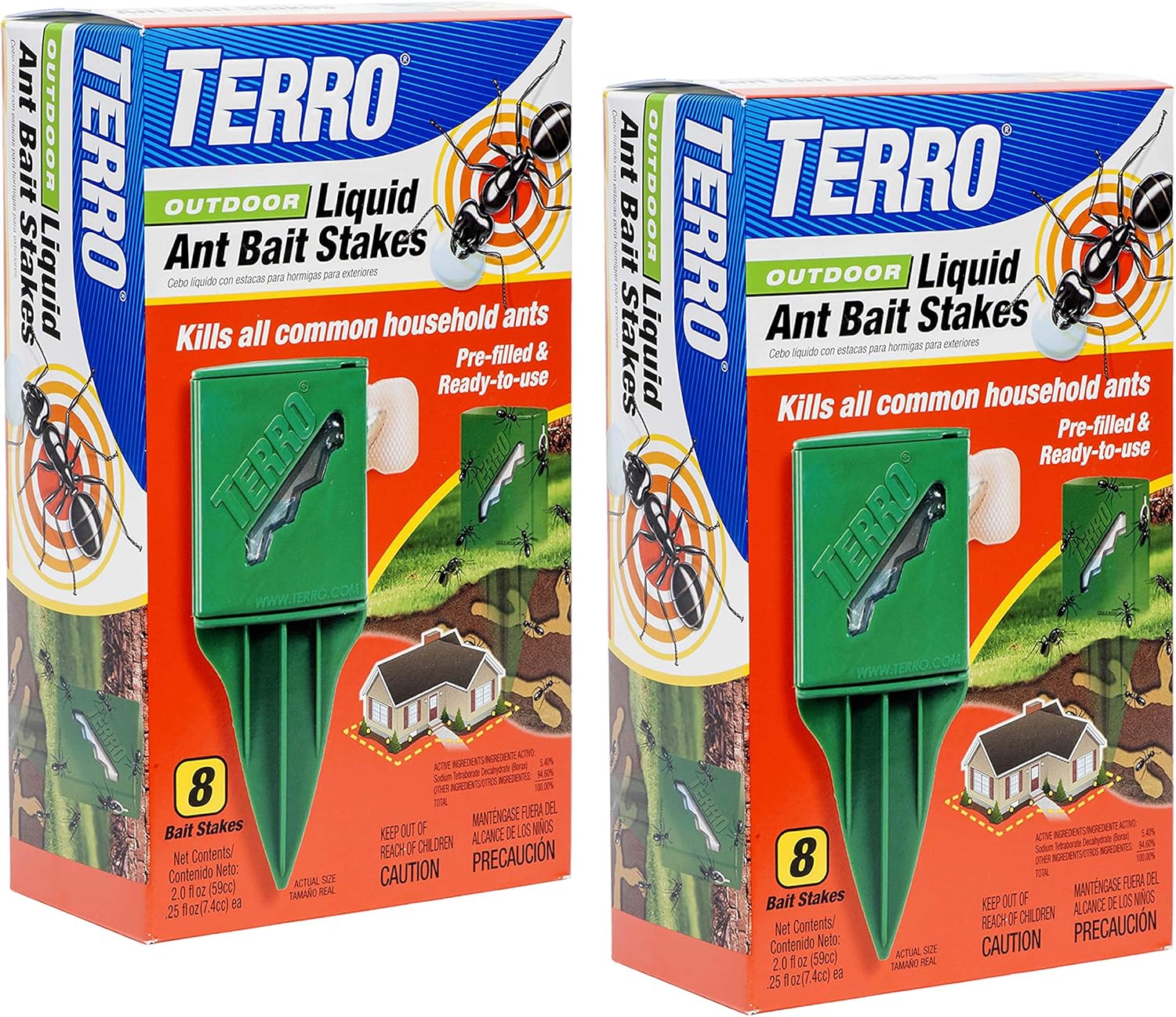
TERRO Outdoor Liquid Ant Bait Stakes (2 Pack)
| Unit Count | 16 Count |
|---|---|
| Target Species | Ant |
| Included Components | Terro – T1813 – 2 pack |
| Manufacturer | Woodstream Corporation |
TERRO Outdoor Liquid Ant Bait Stakes are ready-to-use, weatherproof stakes designed to intercept ants outdoors before they enter the house. You break the tab to expose the sweet liquid bait, push the stake into soil or mulch near ant trails or nest entrances, and leave it undisturbed while ants feed. The borax-based formula works slowly so foraging ants transfer the bait to the colony, which can reduce visible activity in a few days and often provides broader colony control over 2 to 4 weeks. The clear monitor window makes it simple to see when the bait is being used and when it needs replacement. Because these are bait stakes, you may initially see more ants while the colony takes the bait, and complete eradication requires patience and correct placement. They require routine replacement (manufacturer suggests about every three months) to maintain protection. These stakes are focused on common sweet-attracted species and are a practical, low-effort option for treating outdoor ant problems without sprays or baiting stations that need frequent attention.
Best for: Homeowners who prefer a low-effort, low-risk approach to outdoor ant control and want a product that targets colonies without broadcast sprays.
Less Ideal for: People who need immediate knockdown of heavy infestations or who require solutions for species not attracted to sweet baits should consider other methods.
- Ready to use with simple stake insertion for quick deployment
- See-through bait monitor lets you check activity without opening the station
- Weatherproof design suitable for outdoor placement in soil, mulch, and near foundations
- Slow-acting borax formula allows worker ants to carry bait back to the colony for wider control
- Works only on sweet-attracted ant species and may be less effective on bait-averse colonies
- Takes days to weeks for full colony control so not an instant knockdown
Verdict: Use these ready-to-use, weatherproof bait stakes to quietly eliminate outdoor ant colonies by letting foragers carry borax bait back to the nest.
Choosing the Right Ant Trap for Outdoors: Key Factors to Consider
Weather Resistance and Water Protection
Outdoor traps face rain, irrigation, and dew. A trap that allows water to reach the bait will dilute or wash away active ingredients and dramatically shorten service life. Look for housings with tight lids, raised internal bait wells, or built-in drainage patterns that keep bait dry while still allowing ants to access it.
Weather resistance also means UV stability. Plastics exposed to sun can become brittle and crack, creating openings for water and non-target animals. Consider materials and protective design features when you plan placement in sunny beds or exposed patios.
Bait Longevity and Replacement Interval
How long bait remains effective outdoors determines how often you must check and replace traps. Baits that dry out, crystallize, or get diluted by moisture lose attractiveness quickly. For high-traffic ant areas, traps with sealed bait reservoirs or slow-release gels can maintain potency longer and reduce maintenance visits.
Also consider how easy it is to refresh bait without disturbing placement. Removable cartridges or refill packs speed maintenance and reduce the chance of incorrect reloading that lowers efficacy.
Attractiveness to Local Ant Species
Not all baits appeal equally across ant species. Outdoor colonies may prefer sugary fluids, protein-based baits, or fatty baits depending on season and colony needs. Choose traps that accept a range of bait types or that come with attractants suited to common outdoor species in your region.
Seasonality matters. In warm months, sugar-based baits often work best, while protein or grease baits may be more effective in spring or when colonies are rearing brood. If you can swap bait types, you can adapt to changing forager preferences.
Non-Target Safety and Wildlife Resistance
Outdoor placement increases the chance of contact by pets, birds, and beneficial insects. A good outdoor ant trap limits access to bait by larger animals and pollinators while still allowing small worker ants to enter. Features such as narrow entry tunnels, buried placement options, or lockable lids reduce non-target exposure.
Consider whether the trap can be secured or camouflaged to keep curious wildlife away. Traps that require frequent checking should be positioned to reduce accidental disturbance by children or pets.
Durability and Materials
Outdoor traps need sturdier construction than indoor units. Hard plastics with UV stabilizers, corrosion-resistant fasteners, and compact, crush-resistant shapes hold up better in garden traffic and seasonal weather. Fragile thin shells may warp in heat or crack in cold, opening the bait to moisture and contaminants.
Also consider the longevity of bait cartridges or removable components. Replaceable inserts should be dimensionally stable and affordable to maintain long-term use without wasting the housing.
Ease of Placement and Monitoring
Placement flexibility affects effectiveness. Traps that are easy to hide near ant trails, tuck under mulch, or stake into the ground are more likely to be frequented by foragers. Clear visual indicators of bait level or activity help you monitor performance without disturbing the colony.
Practical features include stake mounts, flat profiles for foundation edges, and transparent windows to check bait without opening. These reduce labor and improve the chances the colony will feed long enough for a control strategy to work.
How Outdoor Ant Traps Work in the Garden
Outdoor ant traps rely on worker ants to find bait, carry it back to the nest, and feed it to other colony members. In an outside setting, forager behavior can be dispersed across many micro-pathways, so placement along active trails, near nest entrances, or by food sources increases the odds of recruitment.
Because the goal is colony-level control, a successful trap must balance being accessible to workers while protected from rain and non-target visitors. In many yards you will need multiple traps spread across different zones to intercept foragers from satellite nests.
- Place traps along visible ant trails or near moisture sources where ants travel
- Multiple traps increase coverage in larger yards or complex landscaping
- Check traps periodically for carrier activity and bait condition
Best Placement Strategies for Different Outdoor Areas
Placement depends on the environment. Along foundations and patios, position traps in narrow gaps and near baseboards where trails run. In garden beds, tuck traps under mulch or next to plant pots so they are shielded from direct irrigation but still within walking paths of ants.
For lawns or open areas, move traps near tree bases, under stepping stones, or beside landscape edging where colonies are likely to establish. If you suspect a nest location, place several traps in a semicircle to intercept outbound foragers.
- Avoid placing traps where irrigation spray will hit them directly
- Keep traps out of direct sunlight when possible to extend bait life
- Use multiple traps around suspected nest areas to increase bait uptake
Maintenance Tips to Keep Traps Effective
Check traps on a regular schedule based on bait longevity and recent weather. After heavy rain or sprinkler cycles, inspect traps for dilution or contamination. Replace or refresh bait if it has become visibly wet, crusted, or has mold growth.
Clean housing periodically to remove debris and dead ants that can deter further feeding. When refilling, follow label guidance on bait amounts and spacing to avoid overloading which can discourage foragers.
- Inspect traps weekly in active seasons, less often in colder months
- Refresh bait cartridges as recommended or when activity declines
- Clean housing with water only and allow to dry completely before refilling
Combining Traps with Cultural Controls
Traps are most effective as part of an integrated approach. Reduce outdoor attractants by sealing garbage, cleaning pet feeding areas, and minimizing spilled sweet or greasy residues. Changing landscaping practices to reduce excessive moisture can make the environment less appealing to ants.
Physical exclusion, such as sealing small foundation gaps and removing wood mulch close to structural walls, helps reduce the number of nests near high-use areas. Traps then act as a targeted method to reduce remaining forager populations.
- Limit food and moisture sources to make baiting more attractive
- Seal easy entry points to buildings to reduce indoor incursions
- Use traps to reduce colony pressure while you implement habitat changes
When to Consider Professional Help
If ant activity persists despite well-placed and well-maintained traps, or if you suspect multiple large colonies are present across a property, consult a pest management professional familiar with outdoor strategies. Professionals can help identify species, assess nesting patterns, and suggest treatments that complement traps.
For sensitive areas like vegetable gardens, play areas, or where children and pets have frequent access, a professional can advise on safe bait choices and alternative control measures to reduce non-target risks.
- Consider professional assessment for persistent, widespread infestations
- Ask for species identification to tailor bait type and placement
- Request advice on child- and pet-safe strategies in high-use areas
How We Chose the Best Ant Trap for Outdoors
We selected products that are specifically suited to outdoor use and that address the practical challenges gardeners face when managing ant activity outside. Key evaluation criteria included bait longevity under exposed conditions, enclosure and lid design to resist rain and non-target disturbance, bait palatability to common outdoor ant species, build materials and UV resistance, and ease of placement and bait replacement in garden beds and around foundations. We favored solutions that balance discrete placement with easy monitoring and that provide clear instructions for safe, outdoor deployment. We excluded traps designed only for indoor use, disposable sticky traps that are ineffective outdoors, and products intended primarily for crawling-insect monitoring rather than active colony control. We also excluded traps lacking clear instructions for outdoor baiting or those with materials prone to quick degradation in sun and wet conditions.
FAQ
How long should an outdoor ant trap remain in place before replacing the bait?
It depends on bait type and weather. Many baits last one to four weeks outdoors; water exposure shortens that time. Check weekly during active seasons and replace bait when it looks diluted, crusted, or when activity drops off.
Can I bury outdoor traps to protect them from rain and wildlife?
Partially burying or tucking traps under mulch can protect them from direct spray and reduce wildlife access. Ensure the entrance remains clear so ants can find the bait and avoid creating a sealed environment that traps moisture.
Are outdoor ant traps safe around pets and pollinators?
Safety varies by design. Choose traps that limit access to bait by larger animals and that do not expose open, sugary baits to bees. Position traps where pets cannot reach them and avoid placing sugary baits where pollinators forage.
Will one trap be enough for a medium backyard?
Usually not. A medium backyard typically requires several traps placed near trails, foundations, and moisture sources to intercept foragers from satellite nests. Multiple, well-placed traps increase the chance of colony-level impact.
What bait types work best outdoors?
Sugar-based baits are often effective in warm months when ants forage for carbohydrates. Protein or grease-based baits may work better in spring or when colonies are feeding brood. Having traps that accept different bait types helps adapt to seasonal shifts.
Final Verdict
When choosing an ant trap for outdoors, prioritize weather resistance, bait longevity, and a design that limits non-target access. Durable housings and refillable bait options reduce maintenance and increase the chance of colony-level control in varied yard conditions. Balance placement and maintenance with cultural changes such as reducing food and moisture sources to improve long-term results and select traps that fit your garden layout and monitoring habits.
