

Note: This article contains affiliate links. If you click on these links and make a purchase, I may earn a small commission at no extra cost to you. This helps support my research and content. Read my full affiliate disclosure here.
If you want to control common garden pests without harming pollinators, choosing a bee safe insecticide matters. These products aim to suppress damaging insects while minimizing risks to bees and other beneficials in flower beds, vegetable plots, and container gardens. You will find a shortlist of the top contenders that balance effectiveness with pollinator safety. Each pick was evaluated for how well it knocks back pests, how it affects bees and beneficial insects, and how practical it is to apply in a home garden. Below are the top-rated Bee Safe Insecticides for backyard and patio use, with the criteria gardeners rely on to decide which option fits their plot and planting style.
Top Picks at a Glance
| Best Overall The best all-around choice for most situations | Arber Organic Ready-to-Spray Insecticide for Roses and Flowers, 16 oz |  |
| Best Quality Built to a higher standard if you want something more solid | Southern Ag Thuricide BT Caterpillar Control Concentrate, 16 oz |  |
| Best Value The sweet spot between price and what you get | Bonide Captain Jack's Deadbug Brew 16 oz Concentrate |  |
| Best Budget The cheapest option that still gets the job done reliably | STEM Plant-Based Bug Spray for Ants, Roaches and Flies, 12 fl oz |  |
| Most Popular A crowd favorite that many people choose with confidence | Bonide Insecticidal Soap Ready-to-Use Spray, 32 oz |  |
Arber Organic Ready-to-Spray Insecticide for Roses and Flowers, 16 oz

| Volume | 16 oz |
|---|---|
| Coverage | Up to 2,500 sq ft (manufacturer claim) |
| Application | Hose-end ready-to-spray |
| Reapplication interval | Every 7–14 days or as needed |
This ready-to-spray insecticide attaches to a standard garden hose and delivers a measured spray to knock down aphids, thrips, spider mites, mealybugs and beetles on roses and ornamentals. It is formulated from naturally derived actives and labeled as safe for bees and other pollinators when applied at dawn or dusk and not sprayed onto open blooms. Typical use is simple: shake, connect the hose, and spray foliage tops and undersides every 7 to 14 days or after heavy rain. The hose-end bottle makes coverage quick for beds, borders and containers without mixing or extra equipment, and the 16 oz bottle claims coverage up to about 2,500 sq ft. Limitations to expect are that it works as a contact spray so thorough coverage is required to hit pests hiding under leaves and that repeat applications are necessary as new insects hatch. Also follow label timing to avoid exposing foraging pollinators and to prevent leaf burn in direct sun.
Best for: Gardeners who want an easy, pollinator-conscious way to manage common pests on roses and flowering ornamentals without mixing chemicals and who prioritize convenience and safer actives.
Less Ideal for: People who need systemic residual control or who prefer granular or trap-based pest management should look elsewhere, as this is a contact hose-end spray.
- Ready-to-spray hose-end bottle for fast, no-mix application
- Targets a wide range of common rose and flower pests including aphids, thrips and Japanese beetles
- Formulated with naturally derived actives and labeled safe for bees when used according to directions
- Covers large areas (manufacturer states up to ~2,500 sq ft) suitable for beds, borders and containers
- Contact-only formula requires thorough spray coverage including leaf undersides to be effective
- Must be reapplied periodically and after rain to control new generations of pests
Verdict: An easy-to-use, bee-safe hose-end spray that quickly treats common rose and flower pests without mixing, ideal for gardeners who value convenience and pollinator safety.
Southern Ag Thuricide BT Caterpillar Control Concentrate, 16 oz
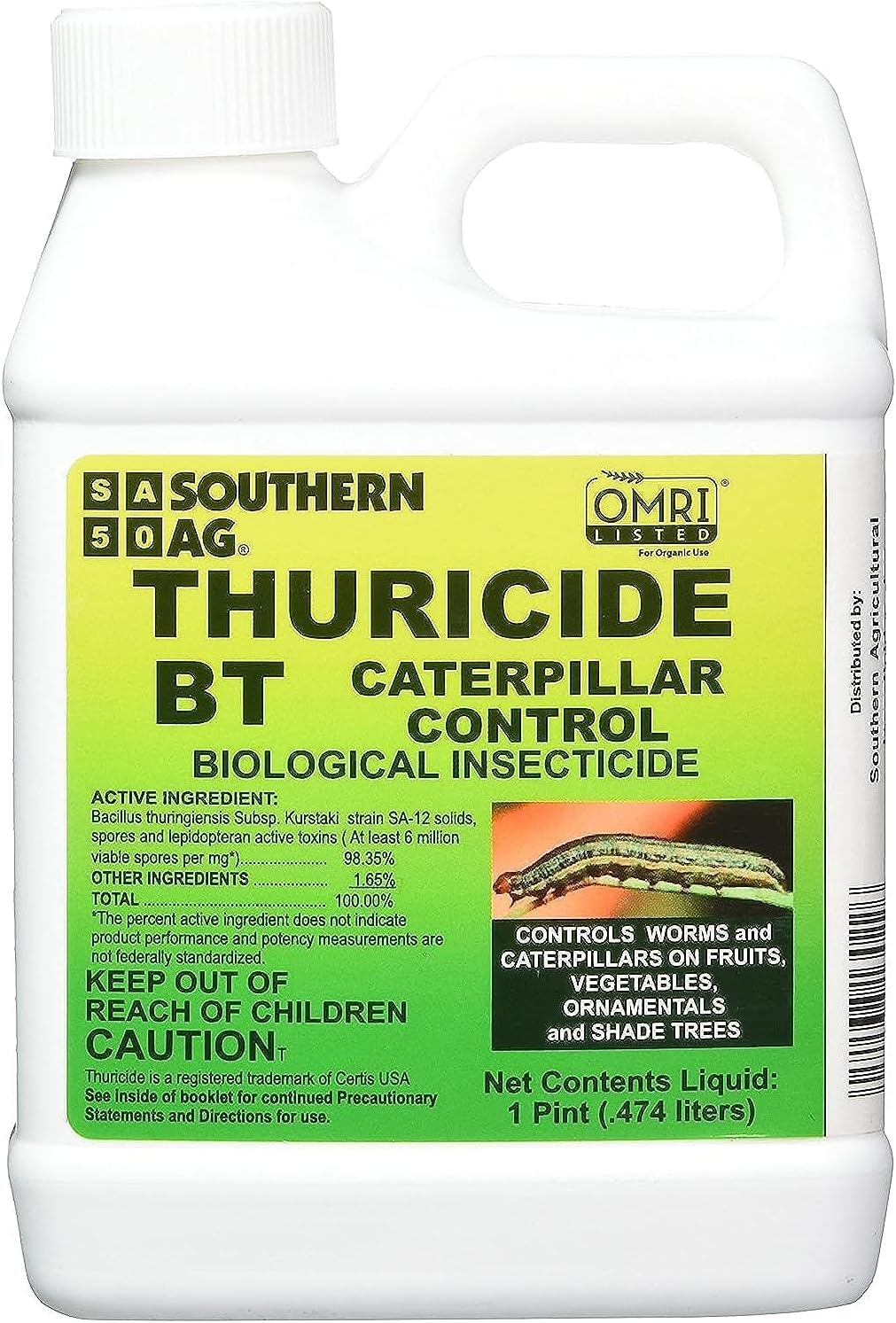
| Item Form | Liquid |
|---|---|
| Target Species | Caterpillar |
| Liquid Volume | 16 fluid ounces |
| Specification Met | OMRI |
| Active Ingredients | Bacillus Thuringiensis Subsp Kurstaki |
Southern Ag Thuricide is a concentrated, biological caterpillar control that uses Bacillus thuringiensis kurstaki (BTk) to target lepidopteran larvae while sparing most beneficial insects when applied correctly. You mix 2 to 4 teaspoons per gallon, add a spreader-sticker and spray thoroughly over foliage of vegetables, citrus, nuts, shrubs and trees. Its low toxicity to people and pets and OMRI listing make it suitable for organic gardens and for situations where pollinator safety is a priority. Because BT acts only when larvae eat treated foliage it works best when applied at first signs of caterpillar damage or on young instars and requires reapplication after rain or as new foliage emerges. It will not control non-lepidopteran pests and needs careful timing and thorough coverage to be effective. For growers wanting a targeted, bee-safer option against worms and loopers, Thuricide delivers predictable biological control when used as part of a monitoring and spray schedule.
Best for: Gardeners and small-scale growers who prioritize effective, targeted caterpillar control while minimizing harm to people, pets and pollinators and who are willing to monitor pests and time applications.
Less Ideal for: Those needing a fast-contact broad-spectrum insecticide or control of non-caterpillar pests should choose a different product.
- OMRI-approved biological active ingredient effective against caterpillars
- Low toxicity to humans and pets, suitable for organic use
- Concentrated liquid that allows adjustable mixing rates for coverage
- Works on a wide range of lepidopteran larvae across vegetables, fruit trees and ornamentals
- Must be ingested by larvae so requires early application and good coverage
- Breaks down after rain and may need frequent reapplication
Verdict: Buy this if you want a proven, bee-safer biological concentrate specifically for controlling caterpillars in organic and pollinator-conscious gardens.
Bonide Captain Jack's Deadbug Brew 16 oz Concentrate

| Unit Count | 16 Ounce |
|---|---|
| Item Form | Spray |
| Target Species | Insects |
| Active Ingredients | Spinosad (Mixture of Spinosyn A and Spinosad D) |
Bonide Captain Jack's Deadbug Brew is a concentrated spinosad insecticide designed for use on vegetables, fruits, ornamentals, and other garden plants. You mix the 16 fl oz concentrate with water and apply it with a trigger, hand-held, backpack, or hose-end sprayer to target caterpillars, beetles, borers, leaf miners, and similar chewing pests. Because the active ingredient is spinosad, the product is approved for organic gardening and is selective enough that it does not significantly impact many predatory beneficial insects and mites when used as directed. In practical use it provides quick knockdown of listed pests and is suitable for protecting squash and other cucurbits from feeding damage. The main limitations are that it must be mixed and applied correctly following label rates and safety instructions and that repeated broad use can still affect non-target insects if timing and coverage are not careful. For gardeners focused on protecting food crops, it is a straightforward, effective option when integrated with scouting and spot treatments.
Best for: Gardeners who prioritize practical, effective pest control for edible gardens and want an organic-approved concentrate they can mix and apply themselves to protect squash and other crops.
Less Ideal for: Gardeners seeking a ready-to-use spray or those unwilling to follow label mixing and safety instructions should consider alternative formats or professional application.
- Contains spinosad, an active ingredient approved for organic gardening and effective against caterpillars and beetles
- Concentrate mixes with water for use with trigger, backpack, hand-held, or hose‑end sprayers
- Labeled for use on a wide range of vegetables, fruits, and ornamentals including cucurbits
- Designed to minimize impact on many predatory beneficial insects and mites when used as directed
- Requires careful mixing and application per label to avoid harming non-target insects
- Not a residual solution for all pests so repeat applications or scouting are often necessary
Verdict: A practical, organic-approved spinosad concentrate that reliably controls chewing pests on squash and other garden crops when mixed and applied correctly.
STEM Plant-Based Bug Spray for Ants, Roaches and Flies, 12 fl oz

| Active ingredients | Geraniol 6.2%, Lemongrass Oil 0.5% |
|---|---|
| Other ingredients | White Mineral Oil, Isopropyl Myristate, (+)-Ethyl Lactate 93.9% |
| Form | Trigger spray |
| Use | Indoor and outdoor spot treatments |
This STEM bug spray is a trigger-spray insecticide formulated with plant-derived actives such as geraniol and lemongrass oil to kill ants, roaches and flies on contact. It is intended for targeted indoor and outdoor spot treatments: shake, hold about a foot from the insect and spray directly on or where insects congregate. The product’s botanical formula and absence of added dyes or strong chemical fragrances make it a reasonable choice for homes where users prefer less synthetic-smelling options. The trigger bottle gives control for spot application and repeated short bursts, and the directions note it is oil-based so spills should be cleaned promptly. Important limitations are that it is not for spraying on people, pets or plants and requires direct hits for best effect rather than long-range fogging. For persistent infestations you may need supplemental measures because this is designed for surface and contact kills rather than residual baiting or area-wide control.
Best for: Buyers who want an affordable, low-odor botanical spray for quick spot control of common household pests and who prioritize a simple, easy-to-use trigger bottle for targeted treatments.
Less Ideal for: People facing large or hidden infestations who need long-lasting residual control or bait-style solutions should consider professional products or integrated pest control approaches.
- Plant-based active ingredients (geraniol and lemongrass oil) that reduce strong chemical odor
- Trigger-spray bottle for controlled, targeted application
- Labeled for both indoor and outdoor spot treatments when used as directed
- No added dye or fragrance listed, which minimizes residue and scent
- Oil-based formula can leave slippery residue if spilled
- Requires direct spraying of insects for effectiveness and offers limited residual control
- Not safe to spray on people, pets or plants
Verdict: A budget-friendly, low-odor plant-based trigger spray that provides quick, targeted kills of ants, roaches and flies for everyday spot treatments.
Bonide Insecticidal Soap Ready-to-Use Spray, 32 oz

| Unit Count | 32 Ounce |
|---|---|
| Item Form | Spray |
| Target Species | Insects |
| Active Ingredients | Potassium salt of fatty acids |
This ready-to-use insecticidal soap spray kills soft-bodied insects on contact using potassium salts of fatty acids derived from plants, making it suitable for organic vegetable beds and container vegetables. It is applied with the built-in spray nozzle directly to affected foliage to control aphids, mites, caterpillars, whiteflies and other listed pests; the label allows use up to the day of harvest on many food crops. Practical benefits include an easy spray application with no mixing, low residual toxicity compared with conventional insecticides, and a broad list of target species for small-scale home gardens and greenhouses. Important limitations are that it works by contact so complete coverage is required and it will not control pests hidden inside fruit or stems; repeated applications may be necessary for heavy infestations. Users should follow label safety directions and test on a few plants first since some sensitive foliage can show damage under hot conditions.
Best for: Gardeners who prioritize simple, low-residue organic solutions for vegetables and want a no-mix spray they can use quickly on affected plants.
Less Ideal for: Large-scale growers who need systemic or long‑residual control or anyone needing a product to reach pests hidden inside fruit or stems.
- Ready-to-use spray with an easy nozzle for immediate application
- Active ingredient is a plant-derived potassium salt suitable for organic gardening
- Labeled for use on a wide range of vegetables, herbs, ornamentals and houseplants
- Low residual toxicity compared with synthetic insecticides
- Kills only on contact so full coverage and repeat treatments are often required
- May cause phytotoxicity on some sensitive plants or under high heat if not spot-tested
Verdict: A convenient, ready-to-use organic spray that gives practical contact control of common vegetable garden pests with minimal residual impact.
Choosing the Right Bee Safe Insecticide: Key Factors to Consider
Active Ingredient and Mode of Action
The active ingredient determines which pests the insecticide controls and how it interacts with pollinators. Some actives are contact-only and break down quickly on plant surfaces, which reduces the window when pollen and nectar are hazardous. Others are systemic and move through plant tissues, making nectar and pollen potentially unsafe for an extended period. Knowing the mode of action helps you match a product to the pest and to your pollinator protection goals.
Review label details for specific pest targets and restrictions. For flowering plants, favor contact or naturally derived actives with short residual activity rather than long-lasting systemic chemistries. Rotate modes of action when managing resistance, but keep pollinator exposure top of mind when selecting rotation partners.
Pollinator Exposure Window
Understand how long treated plants remain risky to bees and other beneficial insects. Exposure windows depend on formulation, weather, and whether the insecticide is systemic. A short exposure window lets you treat in the early morning or late evening with minimal impact, while long residuals require you to avoid spraying during bloom entirely.
Labels often list restricted entry intervals and guidance on spraying timing relative to bloom. For fruit trees and ornamentals that bloom for several weeks, select products with brief residual activity or plan applications for non-bloom periods to protect pollinators.
Target Pest Spectrum
Different insecticides vary in their effectiveness across pest types. Some are broad-spectrum and hit many pests but also harm non-target insects. Others are more selective, controlling soft-bodied pests like aphids and whiteflies while sparing predators and pollinators when used correctly. Match the target spectrum to the pests you actually have to avoid unnecessary harm.
Scout regularly to identify the pest and life stage before treating. Using a narrow-spectrum option reduces collateral damage and helps preserve beneficial insect populations that provide natural pest control.
Application Method and Equipment
How you apply the product affects both effectiveness and pollinator safety. Spray formulations, hose-end mixes, and ready-to-use bottles each have different drift potential and coverage characteristics. Thorough coverage of the pest hiding spots is important for control, but avoid drift onto adjacent flowering plants. Equipment that produces coarse droplets reduces off-target movement.
Consider ease of use for the size of your garden. Handheld sprayers work for containers and beds, while larger plots may need a pump sprayer. Choose an application method that allows targeted treatments to minimize pollinator exposure.
Residue and Reentry on Edible Plants
If you grow fruits, herbs, or vegetables, harvest interval and residue persistence matter. Labels state pre-harvest intervals and safe handling times after application. Short pre-harvest intervals are useful for edible crops and let you treat pests without long waits to harvest.
Also check whether the active ingredient can translocate into fruits, leaves, or nectar. For herbs and salad greens that you pick frequently, select products with minimal residue risk and follow label directions carefully to protect both pollinators and consumers.
Environmental Fate and Non-Target Effects
Consider how the product breaks down in soil and on foliage, and whether it harms aquatic life or soil organisms. Some formulations degrade quickly under sunlight and rain, while others resist breakdown and can affect nearby waterways or beneficial ground insects.
Avoid products with known high toxicity to aquatic invertebrates when your garden drains into ponds or wetlands. Favor options with lower non-target impacts and clear guidance for safe disposal and storage.
When to Spray to Minimize Bee Risk
Timing applications reduces direct contact with foraging bees. Apply in the early morning before flowers open or late in the evening after pollinators have stopped visiting. Avoid spraying when plants are in full bloom unless the product label explicitly permits safe use during bloom.
Monitor local bee activity for a few mornings to learn peak foraging times in your garden. On hot, sunny days bees tend to be active earlier, while cooler weather shifts activity. Adjust spray timing seasonally to keep exposure low.
- Check label for application timing and restricted entry intervals
- Avoid windy days to reduce drift to nearby flowers
- Remove or cover nearby blooming plants if a daytime treatment is unavoidable
Integrating Insecticide Use with Cultural Controls
Insecticides are most effective when combined with cultural and mechanical controls. Regular pruning, hand removal of heavily infested foliage, and using physical barriers can reduce pest pressure and limit the number of treatments needed.
Encourage natural enemies by planting diverse flowering species and providing habitat. Predators and parasitoids can reduce pest populations so you can rely less on chemical controls and lower overall risk to pollinators.
- Use traps and sticky cards to monitor pest levels before applying products
- Rotate crops and avoid over-fertilizing, which attracts soft-bodied pests
Spot Treatment and Targeted Applications
Treat only the affected areas instead of blanket-spraying entire beds. Spot treatment concentrates insecticide where it is needed and leaves more forage available for pollinators. Focus on underleaf surfaces and the undersides of flowers where pests hide while avoiding open blooms.
For container gardens, remove the plant from a pollinator-rich area before treatment and let residue dry completely before returning plants to shared spaces.
- Isolate heavily infested plants for treatment
- Use a handheld sprayer to limit overspray
Reading and Following the Label
The product label is the legal and practical guide to safe use. Pay attention to statements about pollinator protection, application rates, pre-harvest intervals, and required personal protective equipment. Labels often include mitigation measures such as avoiding applications to blooming plants or specific instructions to protect bees.
If label guidance conflicts with your garden situation, choose an alternative approach rather than stretching instructions. Following the label helps protect pollinators, your family, and the wider environment.
- Observe all reentry and harvest intervals stated on the label
- Follow mixing and disposal instructions to avoid contamination
Planning Treatments Around Bloom Cycles
Map your garden's bloom schedule to identify windows when plants are not flowering. Many gardeners spray early leaf-out or after petals have dropped to avoid harming pollinators. For multi-week bloom periods, consider non-chemical options or products with very short residual life.
If you must treat during extended bloom, restrict applications to late evening and choose contact products that dry quickly to shorten the period of hazard.
- Stagger plantings to create continuous but staggered bloom, reducing the need for broad treatments
- Use bloom maps to coordinate safe application timing
How We Chose the Best Bee Safe Insecticide
We focused on practical, garden-centered criteria that matter when using insecticides where pollinators visit. Products were included only if they advertise low toxicity to bees or contain active ingredients and formulations that reduce pollinator exposure. We excluded broad-spectrum, long-residual insecticides and any formulation primarily intended for agricultural bulk use. Evaluation criteria covered efficacy against common garden pests such as aphids, whiteflies, and caterpillars; documented pollinator safety including label instructions and toxicity data; application practicality for small-scale gardens including sprayability and reentry intervals; persistence and residual activity to understand how long blooms remain risky; and environmental profile including biodegradability and non-target impacts. We also considered safety information for edible crops where home gardeners need short harvest intervals. The final list reflects products that balance pest control with minimized pollinator risk, suitable for backyard beds, containers, and small orchards. Products that failed to demonstrate pollinator-aware labeling or that rely on long-lived systemic chemistries were excluded.
FAQ
Are Bee Safe Insecticides completely harmless to bees?
Not necessarily. Bee Safe products aim to reduce risk but may still pose hazards if used incorrectly. Risk depends on active ingredient, formulation, timing of application, and whether bees are actively foraging. Always follow label instructions to minimize exposure.
Can I use Bee Safe Insecticide on flowering vegetables and herbs?
Sometimes. Labels will state whether use on flowering edibles is permitted and list any harvest intervals. For frequently harvested herbs and salad greens, choose products with short residual activity and adhere to pre-harvest guidance.
How long after spraying will treated flowers be unsafe for pollinators?
That depends on the product and environmental conditions. Some contact-based formulations dry within hours and present minimal risk after drying, while systemic or long-residual products can pose a hazard for days to weeks. Check the label for reentry and pollinator safety guidance.
Will spot treatments protect nearby pollinator-friendly plants?
Yes. Targeted spot applications reduce off-target exposure if you avoid drift and treat only non-blooming foliage. Isolating treated plants until residues dry further reduces risk to nearby flowers.
What non-chemical options work alongside Bee Safe products?
Cultural controls, mechanical removal, and encouraging natural enemies are effective complements. Practices like pruning, hand-picking pests, using row covers early in the season, and planting habitat for predators reduce pest pressure and the need for chemical controls.
Final Verdict
When choosing a Bee Safe Insecticide, prioritize pollinator safety and match the active ingredient to the pest you need to control. Short-residual, contact-based formulations and careful timing around bloom will reduce harm to bees while still managing damaging insects. Balance application practicality with environmental considerations and follow label instructions closely. If pollinators are abundant in your garden, favor targeted treatments and cultural controls first, using insecticides as a focused supplement only when necessary.
