

Note: This article contains affiliate links. If you click on these links and make a purchase, I may earn a small commission at no extra cost to you. This helps support my research and content. Read my full affiliate disclosure here.
Choosing the right broadcast weed killer for lawn use changes how your turf looks and recovers after treatment. The wrong spread pattern or too-strong formulation can scorch grass or miss problem areas, while the right product gives even coverage, predictable weed control, and minimal stress to desirable turf. This guide covers six shortlisted broadcast options selected for lawn use and explains the decision factors gardeners should weigh. We evaluate each pick for application control and turf safety, plus how ease of mixing, active ingredients, and environmental precautions affect results. Read on to understand which features matter most for your lawn and why each shortlisted product made the cut.
Top Picks at a Glance
| Best Overall The best all-around choice for most situations | Ortho WeedClear Lawn Weed Killer Ready-to-Spray, 32 fl. oz. |  |
| Best Quality Built to a higher standard if you want something more solid | Roundup for Lawns Ready-to-Use with Extend Wand, 1.33 gal |  |
| Best Value The sweet spot between price and what you get | Scotts Weed Control for Lawns, 14 lb. Granules |  |
| Best Budget The cheapest option that still gets the job done reliably | Spectracide Weed Stop for Lawns Concentrate, 32 oz Ready-to-Spray |  |
| Highest Rated A top-rated pick with lots of positive feedback | T-Zone Turf Herbicide (1 Quart) by PBI Gordon |  |
| Most Popular A crowd favorite that many people choose with confidence | Scotts Turf Builder Weed & Feed 3, Granular Lawn Fertilizer and Weed Killer, 14.29 lb |  |
Ortho WeedClear Lawn Weed Killer Ready-to-Spray, 32 fl. oz.

| Coverage | 5000 square_feet |
|---|---|
| Item Form | Spray |
| Liquid Volume | 32 fluid ounces |
| Active Ingredients | 2,4-D; Quinclorac; Dicamba |
Ortho WeedClear Ready-to-Spray is a hose-attached weed killer made for treating common lawn weeds without mixing concentrates. Attach the sprayer to a garden hose, switch it on, and spray evenly until the lawn surface is wet; the formula is rainproof in about an hour and claims visible results within hours. It lists active ingredients including 2,4-D, quinclorac, and dicamba, which target broadleaf species such as dandelion, clover, chickweed and creeping charlie as well as some grassy weeds like crabgrass. The product covers up to 5,000 sq. ft. from a 32 fl. oz. bottle, so one container treats a typical medium lawn in a single pass. Practical benefits are ease of use, fast action, and compatibility with many northern lawn grasses when used as directed. Important limits are that it is not labeled for several turf types (for example St. Augustine and centipedegrass) and there are temperature restrictions for safe bermudagrass use; following safety directions to keep people and pets off treated areas until dry is necessary. For persistent infestations multiple applications or a targeted spot treatment may still be needed.
Best for: Homeowners who want a simple, ready-to-use spray to quickly knock back creeping charlie and other broadleaf weeds across a typical lawn and prefer an easy hose-end application.
Less Ideal for: People with warm-season lawns not listed on the label, organic-only gardeners, or those wanting a long-term preemergent solution should consider other approaches.
- Ready-to-use hose-end applicator for quick, no-mixing treatment
- Fast-acting formula that becomes rainproof within about one hour
- Targets common broadleaf weeds including creeping charlie and crabgrass
- Covers up to 5,000 sq. ft. from a single 32 fl. oz. bottle
- Works on many northern lawn grasses when directions are followed
- Not safe for several turf types and restricted on some grasses like St. Augustine and centipedegrass
- Contains synthetic herbicides requiring careful handling and keeping people and pets off until dry
- May require repeat or spot treatments for heavy or mature infestations
Verdict: If you need a fast, no-mix hose-end spray to reduce creeping charlie and common broadleaf weeds across a medium lawn, this product delivers quick, easy coverage.
Roundup for Lawns Ready-to-Use with Extend Wand, 1.33 gal

| Coverage | 5,000 square feet |
|---|---|
| Item Form | Liquid |
| Liquid Volume | 1.33 gallons |
| Active Ingredients | Mcpa, Dimethylamine Salt, Quinclorac, Dicamba, Satrentrazone |
Roundup for Lawns Ready-to-Use is intended as a homeowner spot-treatment herbicide for northern turf grasses. The 1.33 gallon jug includes an extendable spray wand and continuous spray delivery so you can treat patches of clover, dandelions, crabgrass and many other listed weeds without mixing. It starts working quickly with visible effects in hours and is rainproof in about three hours, which helps when weather windows are short. The formula is labeled for use on common northern grasses such as Kentucky bluegrass, perennial ryegrass, fescues and zoysiagrass and claims up to three months of control on certain weeds when used as directed. Practical limits are that it is for spot applications rather than blanket lawn renovation, and it should only be used when weeds are actively growing and daytime temperatures are within the labeled range. Users must keep people and pets off treated areas until sprays have dried and follow the included weed list and directions for repeat treatments if needed.
Best for: Homeowners with northern cool-season lawns who want an easy, targeted solution to remove clover and other common lawn weeds without mixing concentrate.
Less Ideal for: People seeking an all-purpose product for southern warm-season turf or those wanting to treat an entire lawn uniformly should consider a different approach or professional options.
- Ready-to-use formulation requires no mixing for quick spot treatments
- Extendable spray wand and continuous spray make targeted application easier
- Starts working quickly and becomes rainproof in about three hours
- Labeled for control of many broadleaf and grassy weeds commonly found in northern lawns
- Designed for spot treatment rather than full-lawn broadcast application
- Restricted to listed northern grass types and specific temperature windows
Verdict: A convenient ready-to-use spot-treatment that effectively targets clover and other common weeds in northern cool-season lawns with minimal prep.
Scotts Weed Control for Lawns, 14 lb. Granules

| Item Form | Granule |
|---|---|
| Coverage | 5000 square_feet |
| Active Ingredients | 1.108% 2,4-D, 0.167% Mecoprop-p, 0.071% Dicamba |
Scotts Weed Control for Lawns is a ready-to-use granular broadleaf weed killer intended for residential turf. You broadcast it over actively growing weeds in spring or early fall using a spreader, avoid watering for 1 to 2 days so the granules contact leaves, then water thoroughly to move the product into the root zone. The formula contains 2,4-D, Mecoprop-p, and Dicamba and is labeled to control common targets such as dandelion, clover, chickweed, and ground ivy. Practical benefits include easy application with a recommended Scotts spreader, single-bag coverage of 5,000 sq. ft., and a fast contact action that works down to the root. Important limitations are the species exclusions and turf cautions — it must not be used on certain grasses (Dichondra, Carpetgrass, Floratam St. Augustine, Creeping Bentgrass) or where desirable clover grows, and care is needed to follow spreader settings and post-application watering instructions. For a balanced homeowner wanting straightforward, granular broadleaf control on compatible lawns, this is a convenient option.
Best for: Homeowners who want a simple, granular solution to reduce common broadleaf weeds across a medium-sized lawn and prefer an easy spreader-applied product.
Less Ideal for: People managing sensitive turf varieties listed on the label or those who need a weed product safe for lawns with desirable clover or specialized grass species.
- Controls over 200 broadleaf weed species including dandelion and clover
- Covers up to 5,000 sq. ft. from a single 14 lb. bag
- Granular form is easy to apply with a spreader and avoids mixing
- Starts working on contact and is formulated to kill to the root
- Not safe for several turf types and must be avoided where desirable clover exists
- Requires careful timing, spreader settings, and 1–2 days without rain or watering after application
Verdict: A convenient, spreader-ready granular formula for homeowners who need reliable broadleaf weed control on compatible lawns up to 5,000 sq. ft.
Spectracide Weed Stop for Lawns Concentrate, 32 oz Ready-to-Spray

| Coverage | 8,000 square feet |
|---|---|
| Liquid Volume | 32 fluid ounces |
| Item Form | Liquid |
| Active Ingredients | 2,4-D, Mecoprop-P, Dicamba, Sulfentrazone |
Spectracide Weed Stop for Lawns is a hose-attach ready-to-spray concentrate designed to control broadleaf weeds across common turf types. It kills by contact and down to the root, listing over 460 weeds such as clover, dandelion and chickweed, and promises visible browning in around three hours. The QuickFlip sprayer makes treatment fast for larger yards and the formula is labeled for use on bluegrass, fescue, Bermuda and perennial rye, though you should avoid zoysiagrass coming out of dormancy and not spray above 90°F. Practical benefits include quick application without mixing and one-hour rainproofing so treatments are less weather-dependent. Important limitations are temperature restrictions for safe use, the need to keep people and pets off the lawn until dry, and the usual reseeding wait time of three to four weeks. For homeowners focused on routine clover control, this product offers a straightforward, time-saving option, but follow label directions closely to protect desirable turf and nearby plants.
Best for: Homeowners who want an inexpensive, no-mix solution to knock back clover and other broadleaf weeds quickly across a typical lawn and value fast application.
Less Ideal for: Gardens that need constant reseeding, very young lawns or yards with delicate ornamentals close to treatment areas should consider more targeted options.
- Ready-to-spray QuickFlip hose attachment speeds up application for medium to large lawns
- Kills broadleaf weeds including clover, dandelion and chickweed with visible results in about three hours
- Rainproof in one hour which reduces the chance of losing treatment to light rain
- Works on a variety of common turf types when used as directed
- Should not be applied when daytime temperatures exceed 90°F which limits use in hot weather
- Requires waiting 3–4 weeks before reseeding treated areas
Verdict: A convenient ready-to-spray concentrate that quickly controls clover and other broadleaf weeds for budget-minded homeowners who want fast, low-effort treatments.
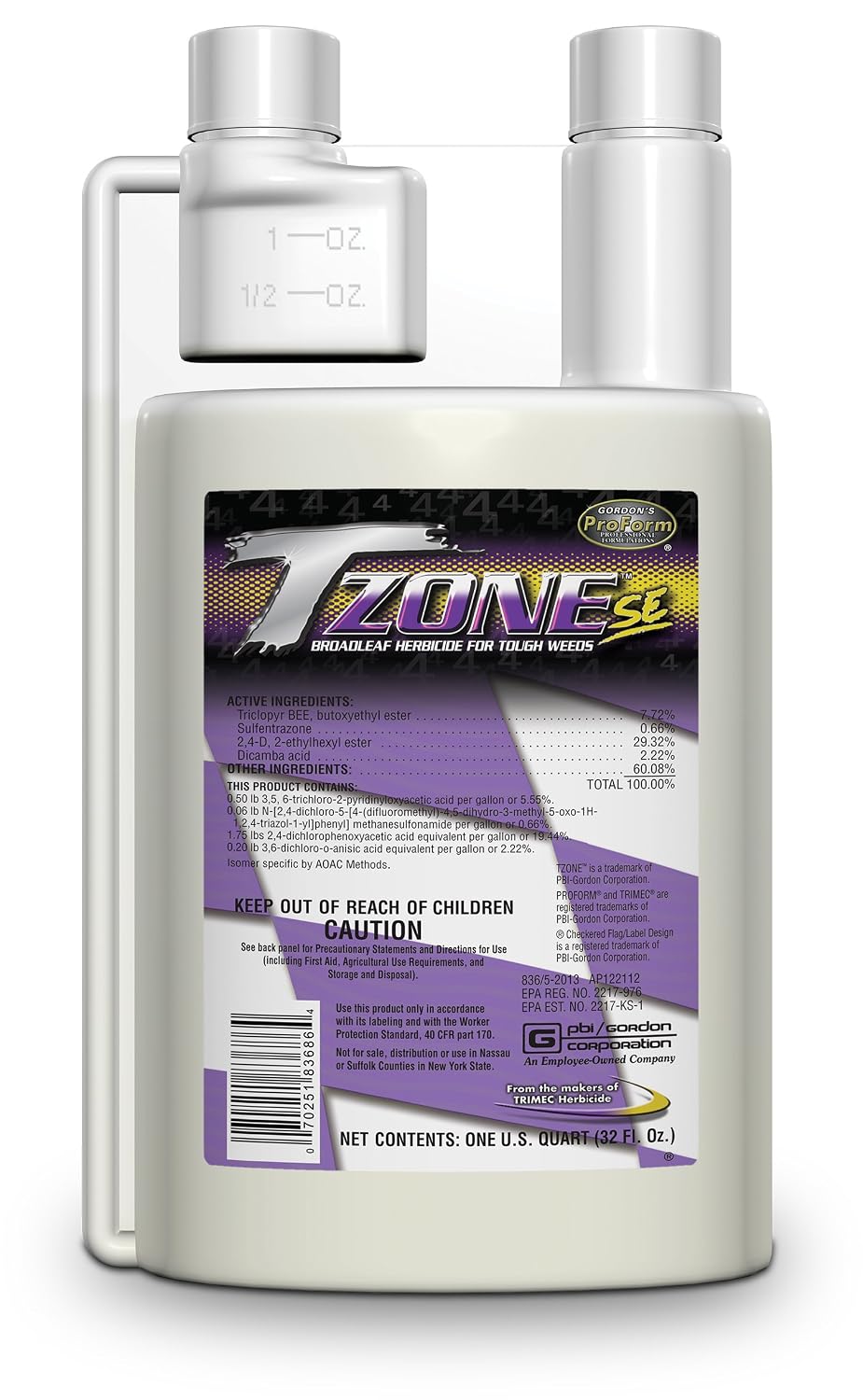
T-Zone Turf Herbicide (1 Quart) by PBI Gordon
| Unit Count | 32 Fluid Ounces |
|---|---|
| Item Form | Liquid |
| Coverage | broad-leaf weeds, grassy weeds |
| Active Ingredients | Dicamba, triclopyr, others |
T-Zone Turf Herbicide is a concentrated liquid formula intended for spot and broadcast treatment of tough broadleaf and grassy weeds in lawns and turf areas. It contains multiple active ingredients including triclopyr and dicamba that give a fast visual response and help suppress difficult targets such as yellow nutsedge and oxalis when used according to label directions. Typical use is mixing to label rates and applying with a handheld sprayer or professional equipment on cool, calm days to avoid off-target movement. Notable features include suitability for residential, commercial, and golf sites and effectiveness at lower temperatures down to about 50°F. Practical benefits are reliable performance on persistent broadleaf weeds and a multi-ingredient formula that reduces the need for repeat applications. Important limitations are the need for protective gear during handling, restrictions and careful timing to prevent damage to desirable plants, and the potential for off‑target drift, so precise application technique is required.
Best for: Buyers who prioritize reliable, professional-strength control of persistent lawn weeds and who are comfortable following label directions and using proper protective equipment. Ideal for property owners or groundskeepers who need a solution that performs in cool weather and on challenging species.
Less Ideal for: Casual gardeners who want an all‑purpose, low‑risk product for mixed plantings or those unwilling to follow pesticide safety practices should consider gentler, selective options.
- Multi‑ingredient formulation targets a broad spectrum of stubborn broadleaf and grassy weeds
- Works in cool conditions (around 50°F) so seasonal timing is more flexible
- Fast visible weed control that can reduce repeat treatments
- Suitable for use on residential, commercial, and golf turf sites
- Contains potent active herbicides that require careful handling and PPE
- Risk of off‑target movement means application must be precise and weather‑aware
Verdict: Choose T-Zone when you need a dependable, professional-strength herbicide to knock back stubborn oxalis and other persistent turf weeds.
Scotts Turf Builder Weed & Feed 3, Granular Lawn Fertilizer and Weed Killer, 14.29 lb

| Item Form | Granule |
|---|---|
| Coverage | 5000 square_feet |
| Active Ingredients | 2,4-D 1.220%, Mecoprop 0.081% |
Scotts Turf Builder Weed & Feed3 is a granular lawn product that combines a fertilizer with broadleaf weed control for routine lawn maintenance. It is applied with a broadcast or drop spreader to a wet lawn when daytime temperatures are between 60 and 90°F, and it uses WeedGrip technology to help granules stick to weed leaves for better uptake. In practice it kills common weeds such as dandelion and clover while delivering nutrients to thicken grass, so treated areas often green up and look fuller over a few weeks. The package covers about 5,000 sq. ft. and manufacturer instructions recommend avoiding certain grass types and keeping people and pets off the lawn until dust settles. Important limitations are that it is not safe for some turf species and must not be watered for 24 hours after application; timing and correct spreader settings affect results. For homeowners wanting a combined feed-and-weed treatment for standard lawns, it simplifies two tasks into one application, but it requires following the label closely for safe and effective use.
Best for: Homeowners seeking a straightforward, combined fertilizer and weed-control treatment to maintain and thicken common cool- and warm-season turf in a typical yard.
Less Ideal for: Specialist turf managers, owners of sensitive turf varieties (listed on the label), or those who need spot treatment only rather than whole-lawn applications.
- Combines fertilizer and broadleaf weed control in one granular product
- WeedGrip formulation helps granules adhere to weed leaves for improved herbicide contact
- Covers approximately 5,000 sq. ft. per 14.29 lb bag, suitable for many small to medium lawns
- Clear application guidance for use with common spreaders and specific temperature/wetting windows
- Contains active herbicide ingredients not appropriate for all turf types and must be avoided on listed grasses
- Requires strict timing and no watering for 24 hours after application to be effective and safe
Verdict: A practical one-step weed-and-feed for typical lawns that feeds turf while targeting common broadleaf weeds across a 5,000 sq. ft. area.
Choosing the Right Broadcast Weed Killer for Lawns: Key Factors to Consider
Application Evenness and Spread Pattern
A broadcast product must deliver a consistent spread pattern to avoid stripes and missed patches. Evenness depends on granule size and formulation, how the spreader meter reacts to the material, and whether the product resists clumping in humid conditions.
Uneven application can leave dense weed patches or cause overapplication bands that stress grass. Check label guidance on hopper settings and recommended walking speed, and consider products that include calibration tips. When treating slopes or edges, choose products that maintain a predictable overlap to avoid visible transitions in turf color and texture.
Turf Safety Across Grass Types
Turf safety is critical because lawns contain many grass species with varying tolerance to herbicides and formulations. Some active ingredients or high-concentration granular carriers can burn sensitive grasses, especially during heat stress or drought.
Read label directions for use on cool-season and warm-season grasses, and note any temperature or moisture restrictions. Plan treatments for the cooler part of the day and follow recommended post-application care to minimize stress. Products labeled for a wide range of turf species give more flexibility for mixed-species lawns.
Weed Spectrum and Targeted Control
Different broadcast weed killers control different groups of weeds. Some are broad-spectrum herbicides that suppress many broadleaf weeds, while others target grassy weeds or only a handful of common lawn invaders.
Match the product to the weeds you regularly see. For example, dandelions and clover often require different active ingredients than grassy weeds like crabgrass. Using a product mismatched to your weed profile can mean wasted applications and slower improvement in lawn appearance.
Mixing, Handling, and Application Convenience
Ease of mixing and handling affects how likely you are to follow label directions and apply the product correctly. Granular products that flow well and do not require complex dilution are easier to calibrate on push or tow-behind spreaders.
Look for clear mixing instructions, compatible spreader settings, and packaging that reduces spills. Consider how long the product keeps in storage without caking, and whether it requires additional tools for broadcast application. Simpler logistics mean fewer application errors in everyday lawn care.
Environmental and Safety Considerations
Consider runoff potential, impact on nearby plants, and safety for children and pets when choosing a broadcast herbicide. Some formulations have longer re-entry intervals or stricter watering and rain-delay windows.
Check label language about buffer zones near water features, safe handling practices, and what to do in case of accidental exposure. Products with lower off-target movement risk and clear disposal guidance reduce environmental concerns and simplify responsible lawn management.
Timing Treatments for Best Results
Timing your broadcast treatment to the weed life cycle and lawn condition makes a major difference. Apply pre-emergent-style products in early spring for annual grassy weeds before they germinate. Post-emergent granular options work best on actively growing broadleaf weeds in spring and fall when plants are pulling nutrients from roots.
- Avoid treating during extreme heat or drought when turf is stressed
- Wait until weeds are actively growing for best uptake
- Follow label recommendations on mowing and irrigation windows before and after application
Calibrating Your Spreader
Calibration ensures the spreader delivers the rate printed on the herbicide label. Use a simple catch-and-weigh method across a set distance or time to confirm settings, then adjust to match the label rate. A well-calibrated spreader prevents both under-treatment and turf damage from overapplication.
- Perform calibration on level ground with an empty bag of the product
- Repeat calibration if you change spreader settings or use a different formulation
- Record settings for future treatments to save time and reduce error
Integrating Broadcast Treatments with Cultural Care
Broadcast weed control is most effective when combined with good cultural practices. Proper mowing height, balanced fertilization, and adequate irrigation keep desirable turf dense and competitive, reducing the number of weeds that establish. Use broadcast products as part of a seasonal lawn care plan rather than a one-off fix.
- Increase mowing frequency instead of scalping to maintain turf vigor
- Apply fertilizer according to soil test recommendations to avoid excess growth spurts
- Water deeply and infrequently to encourage deep rooting and competitive turf
Safety and Storage Best Practices
Store broadcast herbicides in a cool, dry place away from direct sunlight and out of reach of pets and children. Keep the original label and never mix leftover product with other chemicals. Clean application equipment thoroughly after each use to avoid cross-contamination with other lawn products.
- Use protective gloves and eye protection when handling concentrated materials
- Dispose of empty bags according to local regulations and label instructions
- Do not store near food, feed, or animal bedding
How We Chose the Best Broadcast Weed Killer for Lawns
We chose products by focusing on factors that matter in routine lawn weed control rather than one-off or specialty uses. Primary evaluation criteria included application control to ensure even distribution from broadcast equipment, turf safety across common grass types, and the spectrum of weeds controlled. We also checked mixing and handling ease, and formulation stability for consistent dosing. We excluded specialty agricultural herbicides, broadcast formulations intended only for industrial or non-turf settings, and products with unclear labeling for homeowner lawn applications. We prioritized formulations and delivery formats that work with common push and tow-behind spreaders and those with clear turf-use instructions. Practical considerations such as re-entry interval and required watering or mowing windows were part of the selection, as were labels that list common turf grasses and weeds. The result is a list of broadly applicable broadcast options appropriate for typical home lawns under the scope of "For Lawns."
FAQ
Can I use a broadcast weed killer on newly seeded lawn areas?
Usually you should wait until new grass has established and passed the label-specified establishment period. Many broadcast formulations can damage seedlings, so follow the product label for recommended wait times before applying to new seed.
How soon can I mow after applying a broadcast granule herbicide?
Mowing intervals depend on the product label, but many granular herbicides recommend waiting 24 to 48 hours or until granules are dispersed and surface residue is minimal. Always check label directions for specific mowing windows.
Will a broadcast weed killer harm nearby flower beds or vegetable gardens?
Drift and runoff are the main risks to nearby plants. Maintain recommended buffer zones, avoid application before heavy rain, and clean equipment before using it near sensitive beds. Some formulations have higher off-target movement risk, so read environmental precautions.
How often should I reapply a broadcast weed control product?
Reapplication frequency depends on the active ingredient and the product label. Some products are designed for single seasonal applications, while others allow repeat treatments at specific intervals for persistent weed pressure. Follow label limits to avoid turf stress.
Is a broadcast product effective against crabgrass and other grassy weeds?
Some broadcast formulations include pre-emergent ingredients effective against crabgrass, while others target broadleaf weeds and have limited grassy weed control. Check the label for lists of controlled weeds to confirm effectiveness.
Are granular broadcast herbicides safe for pets?
Safety depends on the formulation and label directions. Many labels provide specific guidance on re-entry intervals for pets and people. Keep pets off treated areas until the product has settled, and follow any watering or re-entry instructions on the label.
Final Verdict
Start by prioritizing application evenness and turf safety when selecting a broadcast weed killer for lawn use. Match the product to the weeds you need to control and the grass species in your yard, and plan timing to coincide with active weed growth or pre-emergent windows. Balance ease of handling and environmental precautions against the desired control spectrum. With those tradeoffs in mind, choose a broadcast option that fits your spreader, your lawn type, and the seasonal schedule you follow to get the most consistent, turf-safe results.
