

Note: This article contains affiliate links. If you click on these links and make a purchase, I may earn a small commission at no extra cost to you. This helps support my research and content. Read my full affiliate disclosure here.
If you need a reliable, low-cost way to split firewood without the noise and maintenance of a gas splitter, a budget electric log splitter can make the chore faster and safer. These units are designed for homeowners and small-scale users who want consistent splitting force, easier storage, and simpler maintenance. This guide reviews seven top shortlisted options and explains the practical features that matter most in the yard. We evaluate motor and ram power, safety systems, duty cycle and runtime, plus portability and storage. Use this guide to find a compact, dependable splitter that matches your wood size and seasonal workload.
Top Picks at a Glance
| Best Overall The best all-around choice for most situations | VEVOR 6.5 Ton Electric Log Splitter with 15A Motor |  |
| Best Quality Built to a higher standard if you want something more solid | PPOLB 7-Ton Electric Hydraulic Log Splitter, 15A Portable Horizontal Wood Splitter |  |
| Best Value The sweet spot between price and what you get | PowerSmart 6.5-Ton Electric Log Splitter with 15A Motor |  |
| Best Budget The cheapest option that still gets the job done reliably | DnyioVpl 110V Electric Log Splitter with 3.3 kW Pure Copper Motor |  |
| Highest Rated A top-rated pick with lots of positive feedback | GasXcel 16-Ton Electric Hydraulic Log Splitter, 1600W |  |
| Most Popular A crowd favorite that many people choose with confidence | Sun Joe LJ602E 15-Amp 5-Ton Electric Log Splitter |  |
| Best Seller A high-volume bestseller chosen again and again | Boss Industrial 7-Ton Electric Hydraulic Log Splitter |  |
VEVOR 6.5 Ton Electric Log Splitter with 15A Motor

| Splitting force | 6.5 tons |
|---|---|
| Motor current | 15 A |
| Ram speed | 3,400 RPM |
| Max log diameter | 9.8 inches |
| Max log length | 20 inches |
The VEVOR 6.5 Ton Electric Log Splitter is a straightforward, electrically powered machine aimed at homeowners who need to process firewood without gas fumes. It uses a 15 amp motor and hydraulic ram to produce up to 6.5 tons of splitting force at 3,400 RPM, letting you split logs up to about 9.8 inches in diameter and 20 inches long. Typical use is horizontal splitting on a driveway or yard; two-hand operation and a power switch promote safer handling while the rapid reset of the ram helps when working through multiple logs. The unit is fairly portable for its class thanks to 5.7 to 6 inch transport wheels and ergonomic handles, so you can move it across gravel or grass. Benefits include quieter, cleaner operation compared with gas models and consistent splitting power for hardwoods and softwoods alike. Important limitations are that it requires mains power and a heavy extension cord for remote locations, and it is designed for homeowner workloads rather than continuous commercial use.
Best for: Homeowners who want an easy-to-use, low-maintenance electric splitter to prepare a few cords of firewood each season without dealing with gas engines or excessive noise.
Less Ideal for: People who need a splitter for daily commercial use or operations far from electrical outlets should consider heavier-duty gas or larger electric models with higher duty cycles.
- Delivers up to 6.5 tons of splitting force for effective splitting of hardwoods and softwoods
- Electric motor provides quieter operation and zero on-site emissions compared with gas models
- Hydraulic ram with quick reset speeds up repetitive splitting tasks
- Compact frame with transport wheels and handles makes it reasonably portable for yard use
- Requires a mains power source and suitable heavy-duty extension cord for remote use
- Built for homeowner volumes rather than heavy commercial or continuous operation
Verdict: A practical, cleaner alternative to gas splitters for homeowners who need reliable, reasonably portable splitting power for seasonal firewood prep.
PPOLB 7-Ton Electric Hydraulic Log Splitter, 15A Portable Horizontal Wood Splitter

| Splitting force | 7 ton |
|---|---|
| Power source | corded electric |
| Motor | 1500W / 15Amp |
| Manufacturer | PPOLB |
The PPOLB 7-ton electric wood splitter is built to deliver consistent splitting power for home firewood needs. It uses a 15A (about 1500W) copper motor driving a hydraulic ram that produces seven tons of force, making it capable of splitting denser hardwoods and larger rounds up to the stated capacity. Setup and use are straightforward: position the log horizontally, engage the two-hand safety controls and press the switch to cycle the piston. The reinforced steel frame and durable wedge give it the heft to handle repeated cycles, while the included transport wheels and compact footprint make it easy to move and store in a garage or yard. Safety features such as two-hand operation and overload protection reduce the risk of accidents and motor strain during heavy runs. Expect steady, efficient performance for heating-season workloads, but note that its electric motor limits use to locations with access to mains power and it is not as fast as some larger gas models for continuous commercial-duty splitting.
Best for: Buyers who want a performance-focused, gas-free splitter for home heating and seasonal heavy use and who value consistent splitting force and durable construction.
Less Ideal for: Users who need a cordless solution, remote-field operation, or high-volume commercial splitting should consider larger gas models or industrial electric units.
- 7 tons of hydraulic splitting force suitable for hardwoods and large rounds
- 1500W/15A copper motor provides steady torque without gas or fumes
- Reinforced steel frame and durable wedge for repeated household use
- Portable design with transport wheels for easier positioning and storage
- Two-hand safety controls and overload protection for safer operation
- Requires mains power so operation is limited by cord length and outlet access
- Not as fast or continuous-duty capable as larger gas-powered commercial splitters
Verdict: A compact, durable electric splitter that delivers strong 7-ton force for reliable home firewood performance without gas.
PowerSmart 6.5-Ton Electric Log Splitter with 15A Motor

| Splitting force | 6.5 Tons |
|---|---|
| Motor | 120V, 15A, 1.75 HP |
| Cycle time | 21 Seconds |
| Log capacity | Up to 20" length, 10" diameter |
This PowerSmart electric log splitter is a straightforward machine for homeowners who need a safer, faster alternative to an axe. It uses a 15 amp, 120V induction motor and a 6.5-ton hydraulic system to split logs up to 20 inches long and 10 inches in diameter with a roughly 20 to 21 second cycle time. The stainless steel wedge and 40 degree angle are built for accurate splits while the double-rail leg and wide rear wheels make it reasonably stable and portable around a yard. Practical touches include easy push-button operation and a modest hydraulic tank that accepts AW32 or automatic transmission fluid depending on temperature. The unit is intended for light-duty seasonal firewood prep rather than commercial workloads; expect slower performance on very knotty hardwood and you may need to refill or service hydraulic fluid over time. At about 100 pounds it is mobile for one or two people but not truly handheld. For routine homeowner use it reduces physical strain and speeds splitting, though heavy or continuous professional work will demand a larger machine.
Best for: Homeowners who want a reliable, low-effort way to process seasonal firewood and prioritize ease of use and portability over commercial throughput.
Less Ideal for: Contractors or buyers who need continuous, heavy-duty splitting for large-volume or industrial jobs should choose a larger-capacity, professional unit instead.
- 6.5 tons of hydraulic force handles typical homeowner logs up to 20" long
- 15A induction motor with 21 second cycle time for quick, repeatable splits
- Stainless steel 40° wedge provides accurate splitting
- Wide rear wheels and compact footprint make it easier to move and store
- Designed for light-duty use and can struggle or slow down on very knotty or large hardwoods
- At about 100 pounds it requires effort or a second person to relocate frequently
Verdict: A practical, easy-to-use electric splitter that gives homeowners fast, low-effort firewood processing for typical seasonal needs.
DnyioVpl 110V Electric Log Splitter with 3.3 kW Pure Copper Motor

| Power source | Corded Electric (110V/50Hz) |
|---|---|
| Load power | 3.3KW |
| Rated power | 2.3KW |
| Speed | 450rpm |
| Applicable wood diameter | Within 24cm/9.45in |
This electric log splitter is a corded 110V machine that converts motor torque through an external gear three-stage reduction to push logs through a hardened splitting wedge. Typical use is domestic firewood preparation and light commercial tasks such as small wood mills or forestry harvesting where logs are up to roughly 9.45 inches in diameter. The unit’s pure copper motor and reported 3.3 kW load power with 450 rpm promise robust splitting force, while the reinforced rectangular base and tubing aim to keep the machine stable during operation. Ventilation apertures and a short-circuit protector contribute to safer continuous use. Because it is corded electric there are no petrol fumes and maintenance is simpler than gas models. Limitations are the corded power requirement and the specified maximum log diameter, so it is not suited for very large rounds or remote sites without mains power. Assembly is not required which gets you working quickly but the machine’s 44 lb weight means it is better for a semi-permanent spot than frequent transport.
Best for: Buyers who need a cost-effective, mains-powered splitter for regular home firewood cutting and light commercial tasks and who prioritize ease of use and lower operating maintenance over portability.
Less Ideal for: People who need a splitter for very large logs, heavy industrial use, or work sites without access to 110V mains should consider other options.
- Powerful pure copper motor with 3.3 kW load power for efficient splitting
- Three-stage external gear reduction that increases torque for tougher logs
- Designed ventilation and short-circuit protection to aid safer operation
- Freestanding reinforced base and tubing for improved stability during use
- Requires mains power so it is not usable off-grid
- Maximum recommended log diameter (~9.45 in) limits use on large rounds
Verdict: A budget-friendly, mains-powered electric splitter that delivers strong, low-maintenance performance for home and light commercial firewood work.
GasXcel 16-Ton Electric Hydraulic Log Splitter, 1600W

| Splitting force | 16 tons |
|---|---|
| Motor power | 1600W 17.5A |
| Log capacity | Up to 21" long and 16" diameter |
| Cycle time | Approximately 18 seconds |
The GasXcel 16-ton electric log splitter is built to handle tough hardwoods with minimal fuss by combining a 1600W brushless motor and a two-stage hydraulic gear pump. It is used horizontally: place a log on the steel beam, engage the controls, and the hardened steel wedge splits logs up to about 21 inches long and 16 inches in diameter. The splitter runs a roughly 18-second cycle with an auto-return, which keeps throughput steady during seasonal batches. Being electric, it eliminates fuel handling and runs at about 65 dB, making it suitable for yards, garages, and neighborhoods where noise and fumes matter. Mobility is practical for yard use thanks to 8-inch transport wheels and a compact frame. Built-in overload protection helps prevent motor damage during heavy sessions and can be reset after cooling. Important limitations are its weight and footprint that make it less convenient for very tight storage, and as with any residential electric splitter it needs a suitable power outlet and may not match a commercial gasoline unit for continuous industrial use.
Best for: Homeowners who need a dependable, lower-noise splitter for seasonal firewood prep and who prioritize durable, protective electrical components over portable gas engines.
Less Ideal for: Contractors or users who need a lightweight, highly portable unit or continuous high-volume commercial splitting should consider commercial gas-powered models instead.
- High 16-ton splitting force driven by a 1600W brushless motor for handling hardwoods
- Two-stage hydraulic gear pump and 18-second cycle deliver consistent, efficient splitting
- Electric operation at approximately 65 dB reduces noise and eliminates fuel and exhaust
- Built-in overload protection helps safeguard the motor during heavy use
- 8-inch transport wheels and a compact horizontal design allow easier positioning outdoors
- Heavy and relatively large, requiring significant storage space and potentially two people to lift
- Requires a suitable power outlet and is not optimized for continuous industrial workloads
Verdict: Choose this electric splitter if you want a powerful, quiet, and protection-minded machine for reliable residential firewood production.
Sun Joe LJ602E 15-Amp 5-Ton Electric Log Splitter

| Power | 15-amp motor |
|---|---|
| Max splitting force | 5 tons |
| Max log capacity | Up to 20.5 in long x 10 in wide |
| Power source | Corded electric |
The Sun Joe LJ602E is a compact, corded electric log splitter intended for home use and small batches of firewood. It uses a 15-amp motor driving a hydraulic ram to produce up to 5 tons of force, enough to split typical logs up to 20.5 inches long and 10 inches wide. The steel frame and hydraulic design let you split rounds with minimal physical strain compared with an axe. Built-in safety features include a dual-handed safety switch and an overload circuit reset, and rear wheels make it easy to move around the yard. Practical benefits are straightforward: faster, more consistent splitting for homeowners who need seasonable firewood without renting larger equipment. Limitations are its light-duty focus and corded power requirement, which restricts use to accessible outdoor outlets and means it is not suited for heavy commercial workloads or very large hardwood rounds. Assembly and periodic hydraulic maintenance are required to keep it functioning reliably.
Best for: Homeowners who want an affordable, no-fuss electric splitter to process seasonal firewood without renting a gas unit and who prioritize safety and ease of use backed by user feedback.
Less Ideal for: Commercial users or anyone who needs to split large volumes of oversized, very hard logs or who requires cordless operation for remote sites.
- 15-amp motor with approximately 5 tons of splitting force for consistent splitting of standard firewood sizes
- Splits logs up to 20.5 inches long by 10 inches wide to handle common home firewood
- Dual-handed safety switch and overload reset for safer operation
- Steel frame and hydraulic ram provide durability and reduced physical effort
- Rear wheels improve portability around the yard
- Corded power limits use to areas with an electrical outlet and extension management
- Designed for light to medium duty so it can struggle with very large or extremely dense hardwood logs
Verdict: A budget-friendly, safety-minded electric splitter that reliably handles typical home firewood without the hassle of gas engines.
Boss Industrial 7-Ton Electric Hydraulic Log Splitter
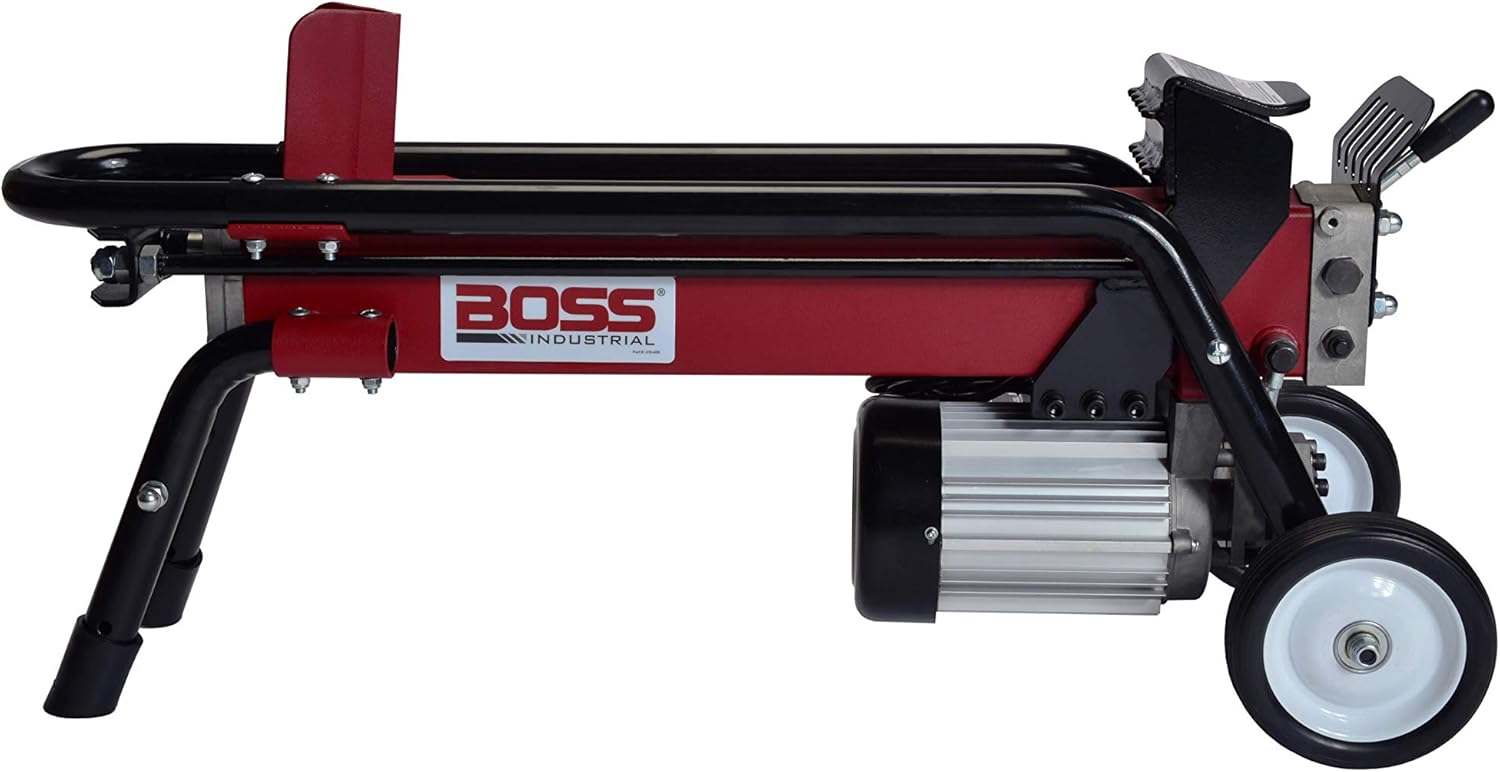
| Splitting force | 7 tons |
|---|---|
| Hydraulic pressure | 3700 PSI |
| Motor power | 2 horsepower |
| Cycle time | 14 seconds |
| Oil capacity | 4 quarts |
The Boss Industrial 7-ton electric hydraulic log splitter is a straightforward, user-friendly machine for splitting firewood at home, in the garage, or at a cabin. It uses a 2-horsepower electric motor and hydraulic system rated at 3700 PSI to push logs into a 5-inch steel wedge, splitting rounds up to 10 inches in diameter and 20.5 inches long. Single-handed operation with a self-return lever makes repeated cycles simple and safer for casual users, while rubber rear wheels and a front handle let you move the unit around the yard or store it in a shed. Built-in side rails stabilize logs during the cut and the 14-second cycle time keeps work moving without long waits. The machine is heavier than small manual tools but lighter than many gas units, and its electric motor means no fumes or pull-start hassle. Limitations are its maximum log diameter and length, so it is not suited for very large hardwood rounds, and it requires an outdoor or garage outlet for power.
Best for: Buyers who want a low-fuss, reliable electric splitter for routine household firewood with emphasis on ease of use and safe operation.
Less Ideal for: People who need to split oversized hardwood rounds frequently or who work far from electrical power should consider heavier-duty or gas-powered alternatives.
- 7 tons of hydraulic splitting force with 3700 PSI for effective splitting of typical firewood
- Electric 2 HP motor provides push-button starting with no fumes or pull-starting
- Single-handed control with self-return lever improves ease of use and safety
- Rubber wheels and front handle make the unit reasonably portable for yard storage
- Maximum log diameter of 10 inches and length of 20.5 inches limits use on very large rounds
- Requires an electrical outlet so not ideal for remote locations without power
Verdict: A dependable, easy-to-use electric splitter that delivers 7 tons of force for homeowners who want a low-maintenance way to produce firewood.
Choosing the Right Budget Electric Log Splitter: Key Factors to Consider
Splitting Force and Log Capacity
Splitting force determines what size and species of wood the machine can handle. Hardwoods like oak and ash require more tons of force than softwoods. Pay attention to the published tonnage and the maximum log diameter and length the unit is designed to accept.
If you mostly split small to medium logs for occasional home use, a lower-tonnage splitter with a longer duty cycle can be a better match than a high-tonnage tool that requires long cool-downs. Conversely, if you plan to process large rounds or dense hardwood, prioritize higher rated force and a design that supports those diameters safely.
Motor Type, Duty Cycle, and Power Delivery
A unit's motor type and duty cycle determine how long it can run before needing a rest period. Electric motors typically offer quieter operation and simpler maintenance than gas engines, but they vary in how much continuous work they can handle. Duty cycle is often expressed in minutes of operation per hour or as continuous/limited-run ratings; choose a specification that matches your typical splitting session length.
Power delivery matters for consistent splits. Machines with steady hydraulic pressure or screw-driven rams tend to give more controlled splitting action. Also check whether the unit has motor protection features such as thermal cutoff or overload protection to prevent damage during heavy use.
Safety Features and Operator Controls
Because log splitters exert extreme force, safety features are essential. Look for two-handed controls or guarded switches that prevent accidental engagement, and consider mechanical shields or wedge guards that keep hands clear of moving parts. Emergency stop options and automatic shutoffs when the ram returns are helpful additions.
Stable base design, secure log stops, and clear operator ergonomics reduce the chance of mishandling. Electrical safety features like GFCI protection or a serviceable fuse help when working outdoors where moisture and variable grounding are concerns.
Portability, Storage Footprint, and Setup
A budget electric splitter for a homeowner should be easy to move, position, and store. Consider the unit's weight, whether it has wheels or a folding handle, and how compact it is for garage or shed storage. Lightweight models are easier to reposition on uneven ground but may trade off some stability.
Setup time matters: quicker assembly and simple connections to power let you start splitting sooner. Also check whether the product requires a dedicated higher-voltage outlet or will run from a standard household circuit, since that affects where you can safely operate it.
Build Materials and Serviceability
Frame construction, quality of hydraulic or mechanical components, and accessibility for maintenance affect how long a splitter will remain useful. Steel frames with corrosion-resistant finishes last longer in outdoor settings. Look for serviceable parts: accessible hydraulic fittings, replaceable seals, and clear access to the motor or gearbox.
Even on budget models, easier-maintenance designs save time and money over seasons. Consider how spare parts or generic replacement components might be sourced and whether routine lubrication points are exposed for straightforward upkeep.
Understanding Tonnage Ratings
Tonnage is one of the most cited specs but it can be misleading without context. Rating indicates peak force at the wedge, not how quickly a machine will split a cord. A lower-tonnage machine with consistent power and a good wedge geometry can outperform a higher-tonnage unit with poor ergonomics or a weak duty cycle.
When reading tonnage numbers, pair that figure with the stated log diameter and length limits. Also note whether the spec is measured at hydraulic peak or averaged; manufacturers vary in reporting practices, so focus on how that number matches the wood you usually handle.
- Compare tonnage against typical log species and diameters
- Watch for vague ratings that omit log size or duty cycle
- Remember wedge design affects real-world splitting efficiency
Power Source and Electrical Requirements
Most budget electric splitters run on standard household current, but some require a 240V circuit for higher power. Check your workshop or outdoor outlet availability before choosing a unit. If you plan to use an extension cable, choose one rated for the motor amperage and keep runs short to avoid voltage drop.
Motor protection features such as thermal cutoff and overload sensors reduce the risk of motor burnout during heavy use. These safety devices are particularly useful when splitting dense hardwoods or when the splitter may be used in longer sessions.
- Confirm voltage and amperage requirements
- Use heavy-duty, appropriately rated extension cords if needed
- Prefer units with thermal or overload protection
Setup, Operation, and Common Mistakes
Proper setup and safe operation reduce accidents and improve throughput. Position the splitter on level ground, secure the base if recommended, and stage logs so you do not reach across the wedge. Use gloves and eye protection; do not wear loose clothing that could catch on components.
A common mistake is trying to force oversized or knotty logs beyond the rated capacity. This strains the motor and hydraulic system and often leads to stalled cycles. Feed logs centered on the cradle and let the machine complete its full stroke before repositioning a piece.
- Work on a level, stable surface
- Center logs and avoid forcing oversized rounds
- Keep bystanders well clear during operation
Maintenance Tips for Longevity
Routine maintenance keeps a splitter operating safely. For hydraulic machines, check fluid levels and look for leaks at fittings. For mechanical screw-drive units, keep threads clean and lightly greased. Inspect the wedge edge and touch it up if it becomes badly nicked.
Store the unit in a dry place and cover it to protect exposed metal. Periodically test safety features to ensure switches and guards function as intended. Address any unusual noises or slow cycles promptly to avoid compounding a small issue into a major repair.
- Check hydraulic fluid and fittings regularly
- Lubricate moving parts and protect the wedge
- Test safety interlocks and electrical protection often
When to Consider Renting or Professional Splitting
If you have an unusually large volume of hardwood or many oversized rounds, renting a higher-capacity machine or using a professional service may be more efficient than buying a budget unit. Renting avoids long-term storage and maintenance for equipment you need only occasionally.
Weigh the time you will spend splitting, the effort required, and the storage implications. For seasonal, small-scale needs a budget electric splitter often makes sense; for multi-day high-volume jobs a bigger, more rugged solution can save time and wear on a household machine.
- Estimate total cordage and log sizes before deciding
- Consider the time cost of many small splitting sessions
- Account for storage and maintenance if purchasing
How We Chose the Best Budget Electric Log Splitter
We started by focusing on units intended for home and small-scale use that advertise an electric motor and a budget-friendly positioning. From that pool we prioritized products that offer measurable splitting force, a clear duty cycle or runtime rating, and documented safety controls. Durability cues such as solid frame construction, quality hydraulic components or screw-driven rams, and reliable electrical protection were weighed heavily. We excluded industrial or heavy-duty commercial machines, gasoline-powered splitters, and models without clear specs on splitting force or duty cycle. Our selection emphasized practical garden use: reasonable log length and diameter capacity, easy setup, accessible maintenance, and features that reduce risk during operation. We also considered portability features and storage footprint because many homeowners need to stow the unit in a garage or shed. The final short list balances raw splitting capability with real-world usability: safety features, motor protection, duty cycle, and form factor dictated inclusion. Units that lacked clear safety interlocks, adequate duty-cycle information, or basic protective electrical features were not considered.
FAQ
What size logs can a budget electric splitter typically handle?
Most budget electric splitters handle logs in the small-to-medium diameter range commonly used for home heating. Exact limits vary by model, so check published maximum diameter and length. Expect reduced performance or stalls on very large or knotty rounds.
Can I run a budget electric splitter from a standard household outlet?
Many units are designed for standard 120V outlets, but some higher-powered models require 240V. Always verify the electrical requirements and ensure your circuit can support the motor amperage to avoid tripping breakers or overheating wiring.
How often should I service the hydraulic system?
Inspect hydraulic fluid and fittings before each splitting season and after heavy use. Replace fluid and seals according to the manufacturer's maintenance interval or if you notice contamination or leaks. Regular quick checks will prevent most operational problems.
Are two-handed controls necessary for safety?
Two-handed controls are a common and effective safety feature because they reduce the chance of a hand being near the wedge during operation. While not always mandatory, they are recommended for household machines to minimize operator risk.
What maintenance extends the life of a budget unit?
Regular cleaning, lubrication of moving parts, checking hydraulic fittings, and storing the splitter in a dry location will extend service life. Attend to unusual noises or slower cycles early to prevent small issues from becoming major repairs.
Final Verdict
A budget electric log splitter is a practical choice for homeowners who need a quieter, lower-maintenance way to produce firewood. Prioritize splitting force and duty cycle that match the species and sizes of wood you handle most often. Equally important are safety controls and a build that supports routine maintenance. Balance portability and storage needs against the expected workload. If you split small to medium logs seasonally, choose a unit with solid safety features, clear electrical protection, and an accessible maintenance layout to get the best long-term value.
