

Note: This article contains affiliate links. If you click on these links and make a purchase, I may earn a small commission at no extra cost to you. This helps support my research and content. Read my full affiliate disclosure here.
When you need to feed a lawn or garden without overspending, the right budget fertilizer spreader makes application faster, more uniform, and less messy. A well-chosen spreader helps you avoid bare patches, wasted product, and uneven growth by delivering granules at a steady rate across beds, turf, or seeded areas. This guide covers six top picks shortlisted for affordability, durable construction, and reliable spread patterns. We explain the practical tradeoffs gardeners face and the performance dimensions that mattered when evaluating these budget options so you can pick the one that fits your yard and routine.
Top Picks at a Glance
| Best Overall The best all-around choice for most situations | Brinly 5 lb. Handheld Broadcast Spreader |  |
| Best Value The sweet spot between price and what you get | PERSZEN Handheld 3-in-1 Spreader for Seed, Fertilizer and Ice Melt (84 oz) |  |
| Best Budget The cheapest option that still gets the job done reliably | CHAPIN 8740A 64 oz Hand Shaker Spreader |  |
| Highest Rated A top-rated pick with lots of positive feedback | Scotts Whirl Hand-Powered Spreader |  |
| Most Popular A crowd favorite that many people choose with confidence | Scotts Turf Builder EdgeGuard Mini Broadcast Spreader |  |
| Best Seller A high-volume bestseller chosen again and again | Scotts Whirl Hand-Powered Handheld Spreader |  |
Brinly 5 lb. Handheld Broadcast Spreader

| Capacity | 5 lb / 0.5 gal / 2 L |
|---|---|
| Use cases | Seed, fertilizer, ice melt, salt |
| Spread distance | Up to 5 ft (variable) |
| Construction | Poly hopper with enclosed gears and steel-plated hardware |
The Brinly 5 lb. handheld spreader is built for quick, accurate spot work around walkways, flower beds, and small lawns. You fill the funnel-shaped hopper by scooping, use the ergonomic trigger and extra-long crank to broadcast material, and adjust the flow gate knob to control spread rate and distance (manufacturer claims up to about 5 feet). The reinforced contoured lip makes loading easier than a flat-top shaker, and the rotary broadcast design gives a more even distribution than hand-scattering. Tough poly construction, enclosed gears, and steel-plated hardware make it feel durable for repeated seasonal use, and the 5 lb capacity keeps the tool light while covering small plots. It is not intended for large lawns where a wheeled spreader is faster, and very fine powders may need careful flow adjustment to avoid clumping. For targeted de-icing, spot-seeding, and small-scale fertilizing this spreader balances control and durability in a compact package.
Best for: Buyers who prioritize precise, reliable performance for spot-seeding, small-plot fertilizing, or targeted de-icing and who want a durable handheld tool rather than a larger wheeled spreader.
Less Ideal for: Not a good fit for users needing to cover large lawns quickly or landscapers who prefer high-capacity wheeled spreaders for commercial work.
- Compact 5 lb capacity is easy to carry and ideal for spot work
- Funnel-shaped hopper and contoured lip speed filling and reduce spills
- Adjustable flow gate and ergonomic trigger provide good control over spread rate
- Rotary broadcast design yields more even distribution than hand-shaking
- Durable poly hopper with enclosed gears and steel-plated hardware for season-to-season use
- Small capacity makes it inefficient for large lawns or full-property coverage
- May require careful adjustment for very fine or damp materials to prevent clogging
Verdict: If you need a compact, durable handheld spreader that delivers controlled, even broadcasts for spot-seeding and small-area fertilizing, this Brinly 5 lb model is a practical choice.
PERSZEN Handheld 3-in-1 Spreader for Seed, Fertilizer and Ice Melt (84 oz)

| Capacity | 84 oz (2.5 L) |
|---|---|
| Flow settings | 3 (small, medium, large) |
| Material | Plastic |
The PERSZEN handheld spreader is a simple, multi-use tool for small to medium lawns and driveways. It holds about 84 ounces of material and offers three flow settings so you can switch between fine seed, granular fertilizer, and ice-melt salt without swapping tools. The plastic construction keeps it light and corrosion-resistant against fertilizers and salt, and the ergonomic non-slip handle plus included scoop make filling and carrying straightforward. In practice it delivers even coverage when set correctly, and the larger hopper reduces refill frequency compared with very small hand spreaders. The main compromises are that plastic parts are less impact-resistant than metal and the manual control can require a steady walk and occasional calibration for very coarse or very fine materials. For routine seasonal tasks where portability and minimal storage are priorities, this spreader is an efficient, no-frills choice.
Best for: Buyers who want a compact, easy-to-store spreader that handles seasonal tasks efficiently and values portability and straightforward operation over heavy-duty construction.
Less Ideal for: People who need a heavy-duty, long-lasting metal spreader for very large properties or commercial use should look at larger tow-behind or metal broadcast models.
- Three adjustable flow settings for matching different material sizes
- Large 84 oz hopper reduces the need for frequent refills
- Lightweight, rust-resistant plastic construction for easy handling
- Ergonomic non-slip handle and included scoop improve usability
- Plastic construction is less durable against impacts than metal alternatives
- Manual flow control needs careful walking speed to ensure perfectly even coverage
Verdict: A practical, lightweight 3-in-1 handheld spreader that makes seasonal seed, fertilizer, and ice-melt tasks quicker with minimal storage and fuss.
CHAPIN 8740A 64 oz Hand Shaker Spreader

| Capacity | 1.8 kg |
|---|
The CHAPIN 8740A is a straightforward hand shaker that makes targeted spreading tasks quick and low-effort. Fill the 64-ounce poly bottle through a wide screw-top, select one of three lid openings by twisting for fine, medium, or wide flow, and apply product with one hand while walking small areas like sidewalks, steps, lawn patches or garden beds. The large handle and glove-friendly design make scooping and pouring easier in cold weather. Because it uses no motors or complex parts it is extremely durable and inexpensive to maintain, and it can stand upright on a shelf even with material inside. The trade-offs are its manual operation and limited reach compared with broadcast or wheeled push spreaders, so it is best for spot jobs rather than treating an entire lawn. Plastic construction keeps it lightweight but means it is less robust than metal tools for heavy-duty commercial use.
Best for: Small‑scale homeowners or renters who need an affordable, no-fuss tool for spot seeding, fertilizing, or deicing around walkways and small lawn areas.
Less Ideal for: Those who need to cover large lawns, commercial properties, or want a precise motorized broadcast spreader for even whole‑lawn applications.
- High 64-ounce capacity reduces refills for small jobs
- Three twist-select lid openings for fine, medium and wide distribution
- Large, glove-friendly handle that is easy to scoop and operate one-handed
- Simple, no-maintenance plastic design that stores upright with contents inside
- Manual operation limits speed and is inefficient for large yards
- Plastic construction is less durable under heavy commercial use
Verdict: A cheap, durable hand shaker perfect for budget-minded gardeners who need an easy, no-frills tool for spot spreading tasks.
Scotts Whirl Hand-Powered Spreader

| Material Type | Metal, Plastic |
|---|---|
| Handle Material | Rubber |
| Capacity Coverage | Up to 1,500 sq. ft. |
| Additional Features | Adjustable Arm Support, Smooth Even Coverage |
The Scotts Whirl is a compact, hand-powered spreader built for small lawns and spot treatments. It comes ready to use and is designed to distribute grass seed, granular fertilizer, ice melt, or salt with an agitator that promotes smooth, even coverage. Its adjustable arm support and light weight make it comfortable for short jobs like overseeding patches, treating narrow strips, or spreading ice melt on walkways. Because it is hand-held and intended for up to 1,500 square feet, it delivers control and reduced waste compared with tossing product by hand. The main limitation is capacity and speed: for larger lawns you will need a wheeled spreader or multiple refills, and fine-tuning the setting for very light seed rates can take a few test passes. Materials are basic metal and plastic with a rubber handle, so it is practical for seasonal use rather than heavy commercial work.
Best for: Homeowners with small lawns or those who need precise control for patch seeding, fertilizing, or winter ice-melting, who prioritize reliability and simplicity over high capacity.
Less Ideal for: Owners of medium to large lawns who need fast coverage or professional users who require higher durability and throughput.
- Compact handheld design ideal for small yards and spot treatments
- Engineered to deliver smooth, even product coverage across application area
- Adjustable arm support increases comfort during use
- Ready to use out of the box with simple hand-powered operation
- Limited capacity suitable only up to about 1,500 sq. ft., requiring frequent refills for larger lawns
- Not ideal for high-volume or commercial spreading tasks
Verdict: A simple, reliable handheld spreader that gives risk-averse homeowners controlled, even application for small lawns and spot jobs.
Scotts Turf Builder EdgeGuard Mini Broadcast Spreader
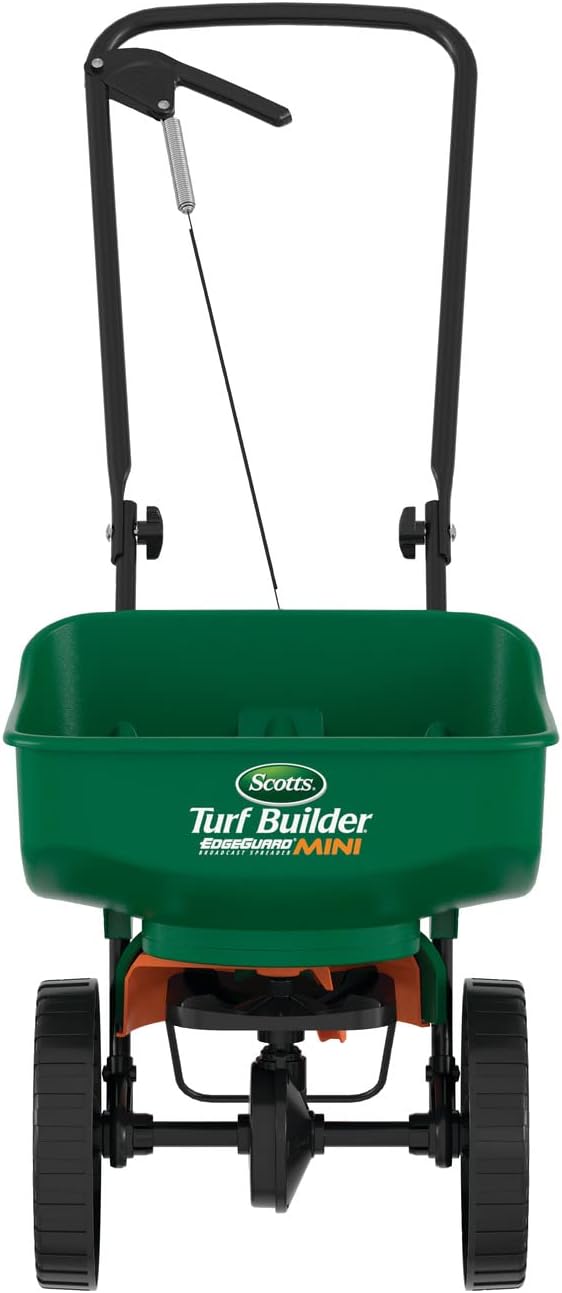
| Capacity | Up to 5,000 sq. ft. |
|---|---|
| Usage | Applies fertilizer, seed, granular weed control, salt, ice melt |
| Features | EdgeGuard side shield; dual-bladed agitator; fold-down handle |
The Scotts Turf Builder EdgeGuard Mini is a ready-to-use broadcast spreader aimed at smaller lawns and targeted spot work. It comes pre-calibrated so you set the dial to the recommended setting, pour in fertilizer, seed, ice melt, or granular weed control, and walk the lawn for even coverage. The hopper and dual-bladed agitator are redesigned to funnel product smoothly and reduce clogging, while open-spoke wheels and a fold-down handle make it easy to maneuver and store. Scotts' EdgeGuard feature blocks product on the right side of the pattern, which helps avoid deposits on sidewalks and landscape beds when edging. Capacity is geared to yards up to about 5,000 sq ft, so it handles typical small properties without being bulky. The main limitations are its smaller coverage area and basic mechanical design compared with larger, more precise spreaders, so it may require more passes on bigger lawns and offers fewer fine-control adjustments for professional users.
Best for: Buyers who want a simple, reliable spreader for small to medium yards and who prioritize ease of use and avoiding overspread onto hard surfaces.
Less Ideal for: Professional landscapers or owners of large properties who need higher capacity and finer control should consider larger commercial-style spreaders.
- Pre-calibrated and ready to use for quick setup
- EdgeGuard side shield reduces product on driveways and sidewalks
- Redesigned hopper and dual-blade agitator for consistent flow
- Fold-down handle and compact size for easy storage and maneuvering
- Smaller capacity suited for lawns up to about 5,000 sq ft so larger lawns need more refills or a larger spreader
- Limited fine adjustment compared with premium or professional models
Verdict: A user-friendly mini broadcast spreader that delivers even coverage for small lawns while keeping product off sidewalks and driveways.
Scotts Whirl Hand-Powered Handheld Spreader

| Material Type | Poly |
|---|---|
| Capacity coverage | Up to 1,500 sq. ft. |
| Included Components | Scotts – 71060 |
The Scotts Whirl is a simple, hand-powered spreader designed for small yards and spot treatments. It delivers smooth, even coverage of grass seed, fertilizer, salt, or ice melt by turning a small spreader wheel as you walk. Its ergonomic, adjustable arm support makes repeated passes more comfortable than basic handheld scoops, and the unit arrives fully assembled so you can use it right away. With a capacity rated up to 1,500 square feet it is best for modest lawns, beds, and patch repairs rather than large properties. Construction is lightweight poly, which keeps it easy to carry and maneuver but means it is not as rugged as metal commercial units. The straightforward mechanical design keeps maintenance trivial and there are no batteries or power hooks to worry about. If you want a low-cost, low-effort tool to improve distribution and avoid clumping during seeding or fertilizing, this does the job well, but those needing heavy-duty durability or very large coverage will want a larger tow-behind or broadcast spreader.
Best for: Buyers who want a practical, no-frills tool to improve distribution for routine lawn care on small to medium yards and value ease of use and low maintenance.
Less Ideal for: Homeowners with large lawns, commercial landscapers, or anyone needing a heavy-duty, high-capacity spreader should consider larger tow-behind or broadcast models.
- Provides smooth, even coverage for seed, fertilizer, salt, and ice melt
- Ergonomic adjustable arm support for more comfortable use during extended passes
- Lightweight poly construction makes it easy to carry and maneuver
- Comes fully assembled so it is ready to use out of the box
- Poly construction is less durable than metal alternatives for heavy or commercial use
- Capacity is limited to small lawns and spot treatments, not appropriate for large properties
Verdict: A lightweight, ready-to-use handheld spreader that delivers even coverage for small lawns and routine spot treatments.
Choosing the Right Budget Fertilizer Spreader: Key Factors to Consider
Hopper Capacity and Material
Hopper size determines how much product you can carry between refills. For small lawns a compact hopper is easier to store and lighter to push, while larger yards benefit from higher capacity that reduces the number of stops.
Material matters because thinner plastics can crack or warp over seasons of sun and fertilizer exposure. Choose hoppers with UV-resistant plastics or reinforced rims if you expect frequent use; metal hoppers resist abrasion but can corrode if not coated or rinsed after contact with fertilizer.
Spread Pattern and Adjustment Controls
Even distribution is the point of a spreader. Look for units with clear, graduated settings and a simple gate mechanism that you can fine-tune for different granule sizes. A consistent pattern avoids streaks and prevents hotspots of overapplied fertilizer that can scorch turf or cause nutrient runoff.
Also consider whether the spreader offers directional control or deflectors to protect beds and borders. A spread pattern that can be narrowed or shielded helps when working near flower beds, walkways, or water features.
Drive System and Ground Contact
How the spreader moves affects its output. Push spreaders rely on operator speed for distribution rate, while wheeled, ground-driven mechanisms link wheel rotations to feed rate for steadier application. For uneven ground, larger wheels maintain consistent travel and reduce bouncing that causes erratic spreading.
Check axle and wheel attachment quality; loose or wobbling wheels change feed rates. For sloped or rough terrain, heavier-duty axles and treaded wheels improve control and reduce drift.
Durability and Serviceability
Budget models vary widely in how they stand up to season after season. Assess connection points, axle mounts, and gate linkages for robust design. Units with common fasteners and replaceable parts are easier to repair than those that are glued or permanently riveted.
Maintenance needs matter: rinsing after use, lubricating moving parts, and storing out of direct sun will extend service life. Consider how easy it is to access and clean the hopper and spreader plate to prevent caking and corrosion.
Calibration Versatility for Different Granules
Fertilizer, seed, and deicing salts have different grain sizes and flow characteristics. A spreader that lets you adjust the opening in small increments will perform better across materials, reducing waste and ensuring accurate application rates.
Calibration instructions that reference application rates in pounds per 1,000 square feet or provide a simple chart are especially useful for achieving target nutrient levels without guesswork.
Storage, Weight, and Ergonomics
A lightweight unit is easier to lift into a shed or trunk, but too-light construction can feel flimsy during use. Consider weight in the context of handle height, grip comfort, and whether the handle folds for compact storage.
Ergonomic features like a padded handle, single-handed controls, or easy-release hopper lids make repeated passes less tiring and speed up the chore on large properties.
Using a Budget Spreader Effectively
Set the spreader to the recommended opening for your product and walk at a steady pace to maintain a consistent application rate. Overlapping slightly at the edges helps avoid missed strips, but avoid heavy double coverage that can damage grass. For seeded areas, use a lower setting and consider two passes at perpendicular angles to even out distribution.
- Calibrate on a small test plot before treating the whole yard
- Keep a steady walking speed and avoid sudden stops and starts
- Rinse and dry the hopper after use to prevent caking
Common Maintenance Tasks
Regular maintenance keeps even inexpensive spreaders working for multiple seasons. After each use, tip out any leftover product, rinse the hopper and spread plate, and let parts dry before storage. Lubricate wheel axles and pivot points once a season to prevent binding and check hardware for tightness.
If the spreader develops a clog, remove the spread plate and clean with a brush rather than forcing the gate. Replace worn gate springs or cotter pins promptly to retain consistent feed rates.
- Inspect wheels and axles for wear every season
- Store indoors or under cover to protect plastics from UV damage
- Carry basic spare parts like cotter pins and gate springs if you use the spreader frequently
Best Practices for Different Materials
Not all granules flow the same. Coarse, irregular seed mixes need a wider gate than fine fertilizer grit. When switching materials, empty and clean the hopper first, then test a small area to confirm spread width and rate. Deicing salt and pelletized lime are abrasive and can accelerate wear, so rinse thoroughly after using those products.
For small ornamental beds, use shielding or smaller passes to avoid drift. When treating turf, apply during calm weather to minimize wind loss and water in when appropriate to activate fertilizer nutrients.
- Always consult the product application rate to set the gate correctly
- Test settings on a driveway to measure spread before treating planted areas
- Rinse after abrasive materials to reduce wear
Storage and Off-Season Care
Proper off-season storage preserves functionality. Clean the spreader completely and allow it to dry to avoid corrosion. Store indoors or under a tarp in a dry place and lift the wheels off wet ground if possible.
Before the next season, cycle the gate and check adjustment markings. Replace any cracked plastic or rusty fasteners and apply a light coat of lubricant to moving metal parts to make spring commissioning easier.
- Remove remaining product from the hopper before storing
- Cover or hang to save floor space and prevent pest nesting
- Check calibration markings each spring before first use
How We Chose the Best Budget Fertilizer Spreader
We focused on practical performance for gardeners who need reliable fertilizing on a limited budget. Selection filters began with construction and mechanics: spreaders had to use common, serviceable drive or push mechanisms and standard hopper and broadcast designs that handle typical lawn and garden granules. Key evaluation criteria included hopper capacity and material durability, spread pattern consistency across different granule sizes, ease of calibration and adjustment, and how simple the unit is to operate and maintain. We also weighed maneuverability and wheel/drive quality for even application across varying lawn textures. Noise and debris control were considered for user comfort. Products with fragile plastics, nonstandard replacement parts, or poor user-adjustment mechanisms were excluded. We did not include specialty liquid applicators or large commercial broadcast rigs that exceed typical homeowner scale. The final list balances inexpensive construction with the features that most affect real-world fertilizer distribution.
FAQ
Can a budget spreader handle both fertilizer and grass seed?
Often yes. Many budget spreaders have adjustable gates that handle a range of granule sizes, but you should calibrate between materials. Test on a small area to confirm coverage and avoid overapplying seed or fertilizer.
How do I calibrate a spreader without fancy tools?
A simple calibration method uses a measured area and a scale or known product weight. Apply product over the area at a chosen setting, collect and weigh the leftovers, and adjust until the applied weight matches the recommended rate. Testing on a driveway with a guard or tarp makes cleanup easy.
Will fertilizer damage a plastic spreader if I leave it in the sun?
Prolonged sun exposure can weaken or fade plastics and make them more brittle over time. Rinse residues off and store the unit under cover or indoors to reduce UV-related deterioration and prolong the spreader lifespan.
Is a wheeled drive system better than a push gate for consistency?
Wheeled, ground-driven feed systems generally provide steadier output because the feed is tied to wheel rotation, reducing dependence on walking speed. However, a well-calibrated push gate can still produce good results for small lawns if you maintain a steady pace.
How often should I replace the spreader plate or gate parts?
Replacement frequency depends on use and materials. After several seasons of frequent use, especially with abrasive materials, check for thinning or wear. Replace parts when you notice inconsistent flow, visible wear, or damaged adjustment teeth.
Can I use a budget spreader on sloped lawns?
You can, but expect more variation in distribution due to speed changes and the tendency to drift downhill. Use larger wheels to stabilize travel and slow your pace to maintain even output. For steep or very uneven terrain, consider lighter, more maneuverable units or multiple short passes.
Final Verdict
For gardeners on a tight budget, the best choice balances enough capacity and an adjustable gate with durable wheels and serviceable parts. Prioritize consistent spread pattern and simple calibration controls since those factors most affect application accuracy and plant health. Accept some tradeoffs in construction if the spreader offers easy maintenance, replaceable parts, and a reliable wheel-driven feed. With proper calibration and routine care, a budget fertilizer spreader can deliver professional-looking results across lawns and garden beds.
