

Note: This article contains affiliate links. If you click on these links and make a purchase, I may earn a small commission at no extra cost to you. This helps support my research and content. Read my full affiliate disclosure here.
If you manage regular pruning, storm cleanup, or seasonal trimming, a garden wood chipper can turn bulky branches into usable mulch and make disposal far easier. Picking the right chipper matters because feed throat size, cutting system, and engine or motor type determine what you can process safely and how quickly the work goes. This guide sorts the top shortlisted options for home yards and small acreage, focusing on the features that affect daily use, maintenance, and material handling. Below you'll find clear criteria we used to evaluate each option and practical notes to help you match a chipper to your typical yard tasks.
Top Picks at a Glance
| Best Overall The best all-around choice for most situations | Sun Joe CJ603E Electric Wood Chipper Shredder (15-Amp, 1.7" Cutting) |  |
| Best Quality Built to a higher standard if you want something more solid | MechMaxx 6" Gas-Powered Wood Chipper with Briggs & Stratton 408cc Engine |  |
| Best Value The sweet spot between price and what you get | Yeryork Electric Wood Chipper Shredder, 1.8" Cutting Capacity |  |
| Best Budget The cheapest option that still gets the job done reliably | SEYVUM 15-Amp Electric Wood Chipper and Shredder |  |
| Highest Rated A top-rated pick with lots of positive feedback | Steelite 15 Amp Electric Wood Chipper with 50L Collection Bin |  |
| Most Popular A crowd favorite that many people choose with confidence | Earthwise GS70015 15-Amp Corded Electric Chipper with Collection Bin |  |
Sun Joe CJ603E Electric Wood Chipper Shredder (15-Amp, 1.7" Cutting)

| Power Source | Corded Electric |
|---|---|
| Cut Type | Cross Cut |
| Audible Noise | 94 db |
| Operation Mode | Manual |
| Built-In Media | Feeding Paddle, Hopper, 6 in Wheels |
The Sun Joe CJ603E is a homeowner-focused electric wood chipper and shredder designed for routine yard cleanup. It accepts branches up to about 1.7 inches in diameter and uses a 15-amp motor with cross-cut blades to reduce material into mulch suitable for composting or spreading. Typical use is feeding pruned branches, twigs, and leaves through the hopper while the integrated feeding paddle helps draw material into the cutting chamber; a forward and reverse switch helps clear jams. The unit is corded so it starts instantly with no fuel or emissions and includes a safety lock and hopper lock to stop the machine when opened. Practical benefits are low maintenance compared with gas models, quieter operation for neighborhood use, and 7-inch wheels that make it reasonably portable for moving around a yard. Limitations to expect are the restrictive 1.7-inch maximum branch size and the need for extension power outdoors, which means heavier pruning or larger limbs require a larger or gas-powered chipper.
Best for: Homeowners who want a low-maintenance, no-fuss machine for routine pruning, leaf cleanup, and small-branch mulching and who prioritize safety and quiet operation.
Less Ideal for: Landscape contractors or homeowners who regularly chip large-diameter limbs or need untethered operation should consider more powerful gas or commercial models.
- 15-amp motor and cross-cut blades effectively reduce small branches and leaves into usable mulch
- Corded electric power gives instant start with no fuel, emissions, or spark-plug maintenance
- Safety features include an integrated hopper lock and safety switch to stop operation when opened
- Forward and reverse switch and feeding paddle help clear jams and feed material reliably
- Compact, wheeled design is easy to move and store in typical home yards
- Maximum branch capacity is limited to about 1.7 inches, so larger limbs must be pre-cut or handled separately
- Requires a nearby power outlet or heavy-duty extension cord for outdoor use
Verdict: A user-friendly corded electric chipper that safely and quietly turns routine yard trimmings into mulch, ideal for risk-averse homeowners doing regular small-branch cleanup.
MechMaxx 6" Gas-Powered Wood Chipper with Briggs & Stratton 408cc Engine
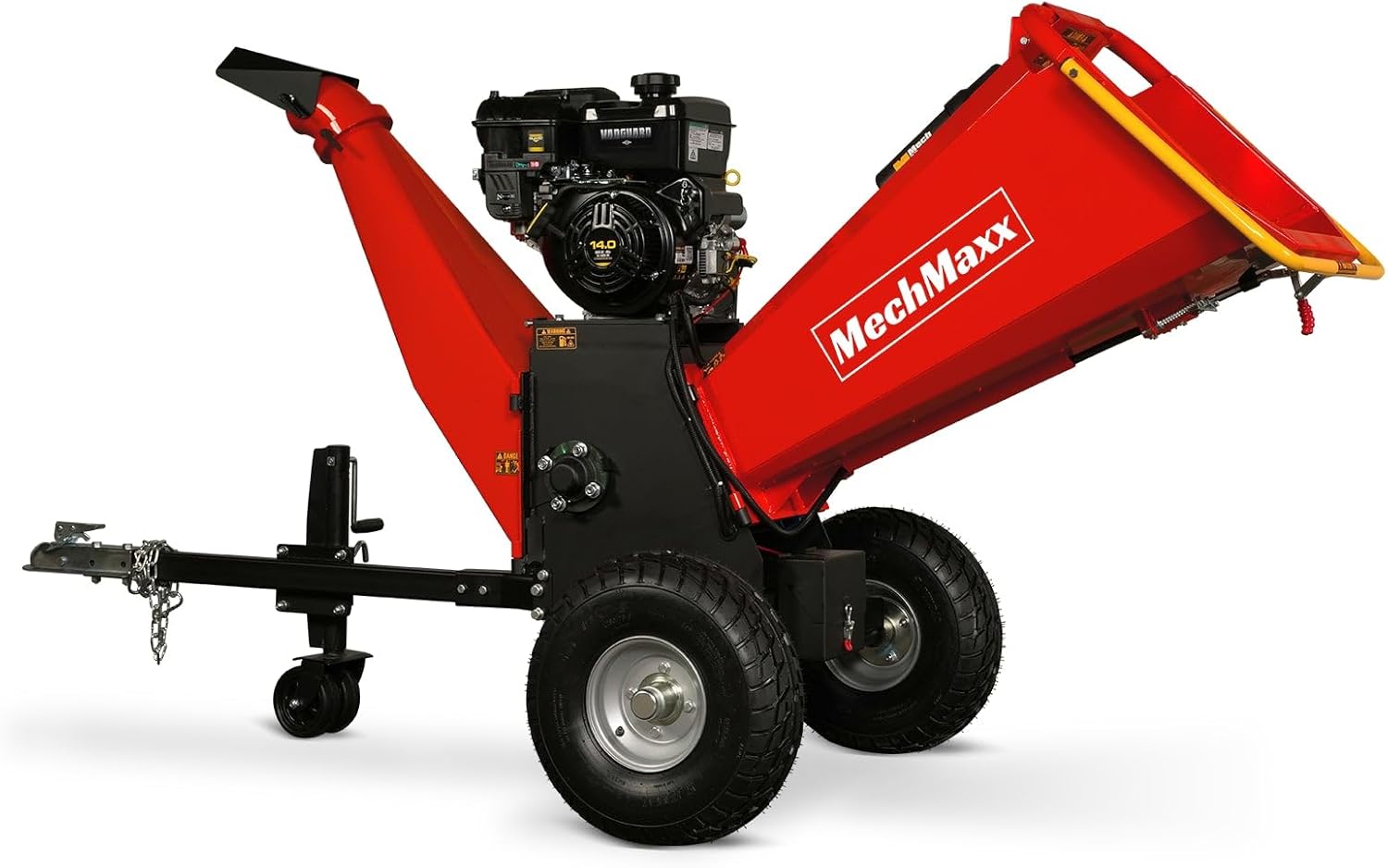
| Engine | BRIGGS & STRATTON Vanguard 408cc, 14 HP |
|---|---|
| Start | Electric start (12V 20Ah battery) |
| Max. Chipping Dia. | 6 in |
| Blades | 2 blades + 1 anvil, A8 (5Cr8MoVSi) alloy |
| Discharge | 360 degree rotating chute |
This MechMaxx 6-inch wood chipper is a towable, gas-powered unit built around a Briggs & Stratton Vanguard 408cc, 14 HP engine with electric start. It is designed to chip branches up to about 6 inches using a drum with two A8 alloy double-edge blades and a single anvil, and it discharges through a 360 degree rotating chute for flexible placement of chipped material. The machine uses a Kevlar V-belt drive and a 20:1 reduction ratio intended to deliver steady torque and reduce belt wear, while an emergency stop button and press bar give convenient operator safety. Typical use is treating moderate volumes of green and soft wood on a property, then spreading or composting the chips. Important limitations are that very hard or dry hardwoods will not shred as finely as softer branches and the unit is heavy and sized for towable use rather than handheld or highly mobile garden work. Service items like spare belts and blades are available but will be needed over time for sustained, heavy use.
Best for: Buyers who need a robust, towable 6-inch chipper for managing moderate volumes of green branches and yard waste on small farms, large gardens, or properties and who value reliable engine power and durable drive components.
Less Ideal for: People who only need occasional, very light chipping around tight urban yards or who plan to process large quantities of very hard, dry hardwood should consider smaller electric models or larger industrial chippers respectively.
- Powerful Briggs & Stratton 408cc 14 HP engine with electric start for reliable startup and sustained power
- Drum with double-edge A8 alloy blades plus anvil produces consistent chipping up to 6-inch branches
- Kevlar V-belts and 20:1 reduction ratio improve durability and torque for heavier loads
- 360 degree rotating discharge chute and tow bar make placement and transport straightforward
- Safety features include an upper emergency stop button and lower press bar for quick shutdown
- Performance drops on very dry or dense hardwoods, producing larger-than-advertised pieces
- Unit is heavy and built for towable use so it is not ideal for tight or highly mobile garden jobs
Verdict: A solid, towable 6-inch chipper that pairs a reliable Briggs & Stratton engine with durable drive components for homeowners and small-farm users who need consistent, day-to-day chipping of green branches.
Yeryork Electric Wood Chipper Shredder, 1.8" Cutting Capacity

| Cutting capacity | 1.8 inches |
|---|---|
| Motor | 15A, 4000 RPM |
| Blade material | SK5 high-carbon steel, reversible |
| Reduction ratio | 21:1 |
| Ingress protection | IPX4 water resistant |
This Yeryork electric wood chipper is designed for homeowners who want a compact, low-maintenance way to reduce branches and yard waste for compost or mulch. The 15A motor runs at 4000 RPM and the dual-chute hopper makes feeding different-sized branches straightforward while the machine draws material in to minimize jams. SK5 high-carbon reversible blades accept limbs up to 1.8 inches and can be flipped when dull, which stretches blade life and lowers replacement frequency. The unit offers a 21:1 reduction ratio so you end up with far less volume to bag or compost. Built-in protections cut power on overload or overheating and a safety interlock prevents accidental starts during maintenance. The polypropylene housing with IPX4 splash resistance helps it stand up to outdoor use. Expect reliable performance for fresh branches and typical yard pruning, but avoid feeding leaves, roots, bamboo, frozen material, or very dry fibrous matter because those materials can clog or damage the cutter system.
Best for: Buyers who want an efficient, low-fuss solution to convert regular pruning debris into usable mulch or compost-ready chips and who prioritize uptime and low long-term blade cost.
Less Ideal for: People needing to process large logs, commercial-scale volumes, or fibrous and frozen materials should look to more heavy-duty or specialized equipment.
- Handles branches up to 1.8 inch diameter with reversible SK5 high-carbon blades
- 15A motor at 4000 RPM provides steady pulling power and smooth feeding
- 21:1 reduction ratio significantly reduces yard waste volume for composting or disposal
- Safety features include overload/overheat cutoff and a maintenance interlock
- Impact-resistant polypropylene housing with IPX4 splash resistance for outdoor durability
- Not suitable for leaves, old roots, bamboo, dry hay, straw, or frozen branches
- Limited to relatively small-diameter branches so larger limbs require prior cutting
Verdict: A compact, safety-focused electric chipper that turns routine pruning into usable mulch while keeping maintenance and blade costs low.
SEYVUM 15-Amp Electric Wood Chipper and Shredder

| Motor | 15 Amp / 2800W |
|---|---|
| Blade type | Dual-sided SK5 steel blades |
| Collection bag | 45 L capacity |
| Reduction ratio | 18:1 |
This SEYVUM electric wood chipper is a budget-friendly, plug-in machine for turning small branches, twigs, and leaves into mulch. It uses a 15-amp (about 2800W) motor running at high RPM to feed material through dual-sided SK5 steel blades that can be flipped when one edge dulls, extending blade life. Typical use is straightforward: feed yard waste with the push paddle, collect shredded material in the 45 L bag, then wheel the 22.8 lb chassis to storage with its 7-inch wheels. The unit delivers a high reduction ratio so output is suitable for spreading around garden beds or composting. Practical benefits include low maintenance compared with gas units, no fuel handling, and a lightweight, portable design that suits small yards. Important limitations are its cutting diameter and power constraints which make it best for small branches and light pruning rather than large trunks, and the electric cord limits range unless you use a heavy-duty extension cord rated for outdoor power tools.
Best for: Gardeners on a tight budget who need an easy-to-use, electric solution for shredding small branches, pruning waste, and leaves around a small to medium yard.
Less Ideal for: Property owners who need to chip large-diameter logs or who require long continuous run times for heavy-duty land clearing should look at higher-powered gas or commercial machines.
- 15-amp (approximately 2800W) motor provides consistent electric power without fuel
- Dual-sided SK5 blades can be flipped to double usable blade life
- 45 L collection bag keeps shredded material contained for easy transport
- Lightweight chassis with 7-inch wheels for easier moving and storage
- Not intended for large trunks or heavy-duty commercial shredding
- Requires an outdoor-rated extension cord for distant work areas
Verdict: A cost-conscious, lightweight electric chipper that converts small yard waste into usable mulch for gardeners with modest chipping needs.
Steelite 15 Amp Electric Wood Chipper with 50L Collection Bin

| Motor | 15 Amp, up to 4000 RPM |
|---|---|
| Blade type | Dual SK5 steel blades |
| Collection bin capacity | 50 L |
| Branch capacity | 0.9 to 1.8 inch |
This Steelite electric wood chipper is designed for homeowners who need a reliable way to reduce small branches and yard debris into usable mulch. It runs on a 15 amp motor with up to 4000 RPM and uses dual SK5 steel blades to process branches roughly 0.9 to 1.8 inches thick. The machine feeds though dual chutes, includes a feeding paddle and safety interlock, and automatically stops if the detachable 50 L collection bin is removed. In practice it converts many bags of bulky twigs into one compact bin thanks to a high reduction ratio, and the included wheels and straightforward assembly make it easy to move and store. Important limitations are that it is intended for small to medium branches rather than large logs and some wet or very fibrous material may require patience or clearing if chips build up. Routine cleaning of blades and the hopper will keep performance consistent over time.
Best for: Homeowners who prioritize a dependable, safety-minded machine to turn pruning waste into mulch for regular yard maintenance.
Less Ideal for: Landscapers or users who need to process large-diameter wood or high-volume commercial debris should choose a heavier duty model.
- 15 amp motor with up to 4000 RPM for consistent cutting power
- Dual SK5 steel blades for effective shredding of small branches
- Detachable 50 L collection bin with auto shut-off for safer, cleaner chip collection
- Built-in safety features including a feeding paddle and interlock to reduce operator risk
- Wheels and simple assembly make it easy to move and store between uses
- Not suited for large logs or branches thicker than the stated 1.8 inch capacity
- May require more frequent clearing or slower feeding with very wet or fibrous material
Verdict: Choose this chipper if you want a dependable, safety-focused electric shredder that turns routine pruning and small branches into tidy mulch with minimal fuss.
Earthwise GS70015 15-Amp Corded Electric Chipper with Collection Bin

| Motor | 15 Amp |
|---|---|
| Max branch diameter | Up to 1.75 inches |
| Blade material | Heat-treated SK5 steel |
| Collection bag capacity | 10.5 gallons |
The Earthwise GS70015 is a plug-in electric chipper intended for homeowners who need a gas-free way to reduce sticks, brush, and yard waste into compostable mulch. Its 15-amp motor and heat-treated SK5 steel blade handle dry, seasoned branches up to about 1.5 to 1.8 inches thick and will noticeably reduce material for easier composting. The unit is designed for yard use with rear transport wheels and a 10.5 gallon collection bag so you can move it across the lawn and collect chips without a separate bin. Built-in overload protection and an interlock safety switch help protect the motor and user if the machine jams. Expect diminished performance with green or very wet material and plan to use a heavy-gauge extension cord to avoid voltage drop when running on longer leads. The chipper is not intended for leaves or fibrous stalks and its collection capacity is modest, so frequent emptying may be needed during larger cleanups.
Best for: Homeowners who want an easy-to-use, lower-maintenance electric chipper for regular seasonal cleanup and compost prep and who prioritize safer, quieter operation over commercial power.
Less Ideal for: People with large properties, frequent heavy pruning, or who need to process green, wet, or very thick limbs should consider heavier gas or larger-capacity chippers.
- 15-amp electric motor provides consistent power without gas or fumes
- Heat-treated SK5 steel blade for reliable cutting of dry branches
- Compact, wheel-mounted design with a 10.5 gallon collection bag for easy transport and cleanup
- Safety features include overload shutoff and an interlock switch to protect the motor and operator
- Limited to processing dry or seasoned material and not designed for leaves or fibrous plants
- Maximum branch capacity around 1.75 inches limits use on larger limbs
- Collection bag capacity is relatively small for big cleanups so frequent emptying may be required
Verdict: A convenient, gas-free electric chipper that reliably turns dry small branches into compostable mulch for homeowners doing routine yard cleanup.
Choosing the Right Garden Wood Chipper: Key Factors to Consider
Feed Throat Size and Orientation
Throat size dictates the largest branch diameter you can process without pre-cutting. A wider throat and a vertically oriented feed let you handle thicker limbs safely and reduce time spent trimming material to fit. For garden use, consider the mix of branch sizes you typically create during pruning and storm cleanup. If you mostly trim small ornamental branches, a compact throat will be fine. If you frequently limb out trees or remove larger shrubs, prioritize a larger throat or a unit that handles tougher wood.
Cutting Mechanism and Replaceable Parts
Chippers use different cutting systems such as rotating blades, fixed knives, or hammer-and-anvil setups. Blade systems typically produce more uniform chips but need periodic sharpening or replacement. Hammer systems tolerate knots and dirt better but can produce coarser mulch. Check how accessible cutting parts are for inspection and replacement; quicker access reduces downtime during the season. Also evaluate whether replacement blades or hammers are standard sizes and how easily you can source them from local suppliers or general garden centers.
Power Source and Torque Characteristics
Garden chippers come with electric motors or small gas engines. Electric models are quieter, require less maintenance, and are ideal if you have easy access to power and mostly thin branches. Gas engines give more torque for thicker, wetter, or denser wood and are better for larger properties or extended jobs. Consider start method, choke tuning, and overall torque at low RPM since pushing through wet or knotty branches requires steady pulling power rather than just high top speed.
Safety Features and Feed Controls
Because chippers remove material from live hands and feed moving blades, safety features are essential. Look for an effective feed control system such as a reversible feed or a pull-stop that prevents jams from escalating. Guards and shields should keep debris from ejecting toward the operator and bystanders. A clearly located emergency stop and stable hopper or stand cut down on user error. For garden settings where helpers or pets may be nearby, these features materially reduce accident risk.
Maintenance Accessibility and Routine Service
Routine tasks include checking and changing blades or hammers, cleaning out chaff, inspecting belts or reduction gear, and draining fuel or checking spark plugs on engines. Machines with hinged access panels, tool-free fasteners, and clear service points save time and reduce the chance of missed checks. Consider how often parts are expected to wear under normal backyard use and whether routine service can be done with basic tools in a garage.
Mobility, Storage Footprint, and Noise
You will move the chipper between jobs, into storage, and perhaps to a curb for pickup. Lighter units with wheels or simple tow couplers are easier for a single person to reposition. Storage footprint matters if you keep equipment in a shed or garage. Noise level is also a practical concern for neighborhood use and local regulations; electric models are typically quieter and may be allowed in closer residential settings. Consider the tradeoff: more mobile and quiet units often accept smaller branches.
Matching Chipper Type to Yard Size
Small urban yards with ornamental trees often do best with compact electric chippers that handle thinner branches and produce fine mulch you can reuse directly in beds. These units are easy to store and quieter for close neighbors.
For suburban properties or small-acre lots where you deal with thicker limbs, a more powerful gas-driven unit or a heavier-duty drum-style chipper provides the extra torque needed to avoid frequent jams. Think about how often you will use the machine and whether occasional heavier tasks justify the larger footprint and maintenance.
- Electric chippers: quieter, lower maintenance, best for branches under specified throat size
- Gas chippers: greater torque and longer run times, better for thicker or wet wood
- Drum-style vs blade-style: drum for throughput and tougher wood, blade for uniform chips
Preparing Material Safely to Avoid Jams
Properly staging branches reduces the chance of jammed feed and protects cutting parts. Remove excessive leaves, long vines, and nails or wire from yard debris before feeding. Cutting very long limbs into manageable lengths helps maintain steady feed and prevents the motor from lugging.
Feed at a steady, controlled pace and avoid forcing oversized pieces. If the machine stalls, use designed feed-reverse functions or the recommended clearing procedures instead of trying to extract material by hand.
- Trim long pieces into the manufacturer-recommended length
- Remove non-wood materials and heavy dirt from branches
- Feed consistent sizes rather than random, mixed-diameter bundles
Mulch Use and Output Control
Consider how you plan to use the chipper output. Finer chips are better for topdressing and rapid decomposition in flower beds. Coarser chips are good for pathways and weed suppression, but they break down more slowly and can rob nitrogen from soil as they decompose.
Some chippers allow you to change cutting patterns or use different blades to influence chip size. If you want reusable mulch for planting beds, prioritize a system that produces smaller, more uniform chips.
- Fine chips: better for bed mulch and faster composting
- Coarse chips: good for paths and structural mulch
- Adjust blades or screen output when available to tune chip size
Storage, Winterizing, and Off-Season Care
Store the chipper in a dry, covered spot to protect metal parts from corrosion and to extend belt and engine life. For gas engines, follow recommended fuel-stabilizing or draining procedures before long storage to avoid carburetor and fuel line problems.
Regularly clean the hopper and chip path to remove built-up sap and residue that attract pests or freeze in cold weather. Lubricate pivot points and check fasteners before storing and again before the first use of the season.
- Drain or stabilize fuel for winter storage
- Clean chaff and sap from cutting areas
- Inspect belts, blades, and fasteners before seasonal use
Transport Considerations and Local Rules
Think about how you will move the chipper between properties or to a curbside pickup. Some garden chippers are lightweight and hand-pulled while others require a trailer or vehicle for transport. Match the mobility features to how often you will relocate the machine.
Also check local noise ordinances and HOA rules before planning late-afternoon or weekend chipping sessions. A quieter electric unit can avoid neighborhood conflicts even if it means accepting a smaller feed capacity.
- Confirm towing or wheel options for your typical transport needs
- Check local noise rules when scheduling use
- Plan single-person vs two-person handling depending on unit weight
How We Chose the Best Garden Wood Chipper
We evaluated machines that are designed for home yards and small-acre properties and prioritized attributes that affect real-world gardening tasks. Key evaluation criteria included feed throat capacity and type, because that determines the maximum branch diameter and what you can process without pre-cutting. We assessed cutting system design and blade or hammer construction, since these influence chip consistency and how often cutting parts need attention. Power delivery and drivetrain were considered so machines can handle wet or fibrous wood common in garden pruning. We reviewed ease of maintenance, including access for blade changes, belt routing, and debris cleaning to reflect typical homeowner service capabilities. Mobility and footprint were judged for storage and towing or carting around a yard. Safety features such as feed control, guards, and emergency stops were also required for inclusion. Products were excluded if they were industrial-sized units intended for commercial logging, if they required commercial-grade fuel systems, or if they lacked basic homeowner safety protections. The shortlist favors chippers built for garden use that balance feed capacity with manageable size and routine maintenance needs.
FAQ
What branch diameter should a garden chipper handle for home pruning?
It depends on the model, but garden chippers commonly specify a maximum throat diameter. For routine pruning most homeowners will be fine with chippers rated for small to medium branches. If you regularly remove tree limbs, choose a unit with a larger throat and more torque.
Are electric chippers powerful enough for wet or knotty wood?
Electric models work well for thin, dry branches and frequent light-duty tasks. Wet or knotty wood demands higher torque, and gas or heavier drum-style units usually manage those conditions with fewer stalls.
How often do blades or hammers need servicing?
Service intervals vary with use and material. Under typical backyard use expect blade sharpening or replacement once a season or after several hours of heavy use. Regular inspection and cleaning will extend service intervals and reveal wear before it causes performance loss.
Can chipper output be used directly as garden mulch?
Yes, chipper output can serve as mulch, but suitability depends on chip size and wood type. Finer, uniform chips decompose faster and are better for beds; very coarse or high-tannin wood may need additional composting or mixing before use.
What safety gear should I use when operating a chipper?
Wear eye and ear protection, sturdy gloves, and close-toed footwear. Avoid loose clothing and use a face shield if available. Always keep bystanders and pets well away from the operating area.
How can I reduce the chance of jams during use?
Feed material in consistent sizes, remove non-wood items, and avoid overloading the throat. Use the machine's reverse or clearing procedures when a jam starts and stop the engine before attempting manual clearing.
Final Verdict
Choosing the right garden wood chipper is a balance between what you need to process and how much maintenance and storage you can manage. Prioritize throat capacity and torque if you handle thicker limbs, or favor electric compact units for lighter, quieter yard work. Also weigh safety features and maintenance accessibility, since ease of service and reliable feed control will determine how often you actually use the machine. With the criteria above in mind, pick the unit that matches your yard's typical debris size and your tolerance for upkeep so you get consistent, usable mulch and less time hauling waste.
