

Note: This article contains affiliate links. If you click on these links and make a purchase, I may earn a small commission at no extra cost to you. This helps support my research and content. Read my full affiliate disclosure here.
If ants are marching through your kitchen, patio, or garden beds, picking the right bug spray for ants changes how quickly you regain control. The right product acts at entry points, leaves an effective residual barrier, and suits the spaces you need treated whether inside cupboards or around foundation lines. This guide presents our six shortlisted options chosen for different ant problems and application spots. We evaluated each choice on knockdown speed, residual longevity, safety for treated areas, and ease of application to help you pick a solution that works in real gardening and home settings.
Top Picks at a Glance
| Best Overall The best all-around choice for most situations | Ortho Home Defense Max Indoor Insect Barrier, Wand, 1 gal. |  |
| Best Quality Built to a higher standard if you want something more solid | Ortho Home Defense Insect Killer Refill, 1.33 gal. |  |
| Best Value The sweet spot between price and what you get | Spectracide Bug Stop Home Barrier Ready-to-Use Spray, 32 oz (3 Pack) |  |
| Best Budget The cheapest option that still gets the job done reliably | Raid Ant & Roach Killer Fragrance Free, 17.5 oz |  |
| Highest Rated A top-rated pick with lots of positive feedback | Raid Ant & Roach Killer Spray, Outdoor Fresh Scent, 17.5 oz |  |
| Most Popular A crowd favorite that many people choose with confidence | Ortho Home Defense Insect Killer for Indoor & Perimeter, 1.33 gal. with Comfort Wand |  |
Ortho Home Defense Max Indoor Insect Barrier, Wand, 1 gal.

| Unit Count | 128 Fluid Ounces |
|---|---|
| Item Form | Spray |
| Target Species | Insects |
| Active Ingredients | bifenthrin 0.05% |
Ortho Home Defense Max is a one-gallon ready-to-use indoor insect barrier designed to kill ants, roaches, spiders, fleas, ticks and other common household pests and to prevent reinfestation. It is applied with the included Extended Reach Comfort Wand so you can treat baseboards, door and window perimeters, and foundation lines without bending. The formula contains bifenthrin 0.05% and is fast-drying, low-odor, and non-staining, so treated areas can be reoccupied once dry. Manufacturer guidance calls for a narrow treated band indoors and a wider perimeter outdoors, and repeat outdoor applications every three months for upkeep. Practical benefits include a large volume for multiple treatments and a wand that improves accuracy around entry points where ants travel. Limitations to consider are that it is a chemical contact and residual barrier product suited to surfaces rather than crack-and-crevice baiting, and users should follow safety directions to keep children and pets away until sprays dry.
Best for: Homeowners who want a dependable, easy-to-apply indoor perimeter spray to reduce ant activity and stop common household insects at entry points without complicated mixing.
Less Ideal for: People seeking non-chemical or bait-based ant colony elimination methods or those who need targeted crack-and-crevice treatments rather than surface barriers.
- Ready-to-use 1 gallon volume supports multiple applications without mixing
- Extended Reach Comfort Wand makes treating baseboards and foundations easier
- Fast-drying, low-odor, non-staining formula allows people and pets to re-enter after drying
- Provides up to 12 months indoor protection against ants, roaches and spiders when applied as directed
- Contains a chemical insecticide and is intended for surface barrier treatments rather than baiting inside nests
- Requires repeat outdoor applications every three months for continued perimeter protection
Verdict: A large ready-to-use indoor spray with an extended wand that makes creating an effective perimeter barrier against ants and other household insects simple and practical.
Ortho Home Defense Insect Killer Refill, 1.33 gal.

| Unit Count | 170.24 Fluid Ounces |
|---|---|
| Liquid Volume | 1.33 gallons |
| Item Form | Spray |
| Target Species | Insects |
This 1.33-gallon Ortho Home Defense refill is formulated for both indoor use and perimeter treatments to control ants, roaches, spiders and other common household pests. It is meant to be mixed with and used in the brand’s Comfort Wand applicator or transferred to a ready-to-use sprayer, letting you apply a 4-inch indoor band or a wider perimeter band outside. The formula advertises Invisi-Shield Technology so it dries clear, gives off no fumes, and leaves a residual barrier that can protect against ants, roaches and spiders for up to 12 months on non-porous indoor surfaces. For performance-minded users this refill reduces trips to buy small cans and supports repeated, targeted treatments around doors, windows, foundations and garages. Important limitations are that the long residual claim applies specifically to ants, roaches and spiders on non-porous surfaces and that wet application instructions require avoiding over-saturation. You should also follow label directions for re-entry times and targeted placement to get durable control without unnecessary exposure.
Best for: Buyers focused on long-term, high-performance pest control who want a refillable solution for regular indoor treatments and perimeter barrier applications.
Less Ideal for: Casual users who only need occasional spot treatments or those who prefer fragrance-free or non-chemical pest control methods.
- Large 1.33 gallon refill reduces frequency of repurchasing and is economical for whole-house perimeter treatments
- Formulated to dry clear with minimal fumes for discreet indoor use
- Designed for use with a Comfort Wand for continuous spray and reduced hand fatigue during application
- Provides a residual barrier claimed to last up to 12 months against ants, roaches and spiders on appropriate surfaces
- 12-month residual protection is limited to ants, roaches and spiders on non-porous indoor surfaces and may not apply outdoors or to all species
- Requires correct application technique to avoid soaking surfaces and to achieve the advertised residual effect
Verdict: Choose this refill if you want a refillable, high-capacity spray that supports long-lasting barrier protection against ants, roaches and spiders indoors.
Spectracide Bug Stop Home Barrier Ready-to-Use Spray, 32 oz (3 Pack)

| Item Form | Spray |
|---|---|
| Target Species | Ants, Roaches, Spiders, Fleas, Ticks & More |
| Liquid Volume | 32 fluid ounces |
| Active Ingredients | Gamma-Cyhalothrin |
Spectracide Bug Stop Home Barrier is a water-based, ready-to-use spray formulated to kill ants, roaches, spiders, fleas, ticks and other common insects on contact and to provide extended control on nonporous surfaces. It is used as an indoor crack-and-crevice treatment along baseboards and under appliances or applied outside around door and window frames, screens and foundation perimeters. The clear, low-odor formula leaves no oily residue and claims up to 12 months of control for cockroaches on nonporous surfaces, which reduces repeat applications in treated areas. Active ingredient gamma-cyhalothrin is a fast-acting synthetic pyrethroid, so expect quick knockdown of crawling pests. Limitations include the need to follow label directions for indoor use and that long-term residual claims apply to specific surfaces and pests rather than every situation. This product is best for targeted perimeter and spot treatments rather than blanket indoor fogging or nonchemical prevention strategies.
Best for: Buyers who want a practical, low-fuss solution to stop ants and other crawling insects around entry points and indoor hiding spots, prioritizing quick application and lasting perimeter control.
Less Ideal for: People seeking an all-natural pest control method or those who need whole-home fogging or nonchemical preventative measures should consider other options.
- Ready-to-use spray requiring no mixing for quick application
- Water-based, clear formula with low odor and no oily residue
- Broad target list including ants, roaches, spiders, fleas and ticks
- Provides long residual control on nonporous surfaces for reduced retreatment
- Active ingredient is a synthetic pyrethroid which requires careful indoor use around people and pets
- Residual effectiveness varies by surface and may be shorter on porous or exposed outdoor areas
Verdict: A convenient, low-odor ready-to-use spray that stops ants at entry points and delivers long-lasting control on nonporous surfaces.
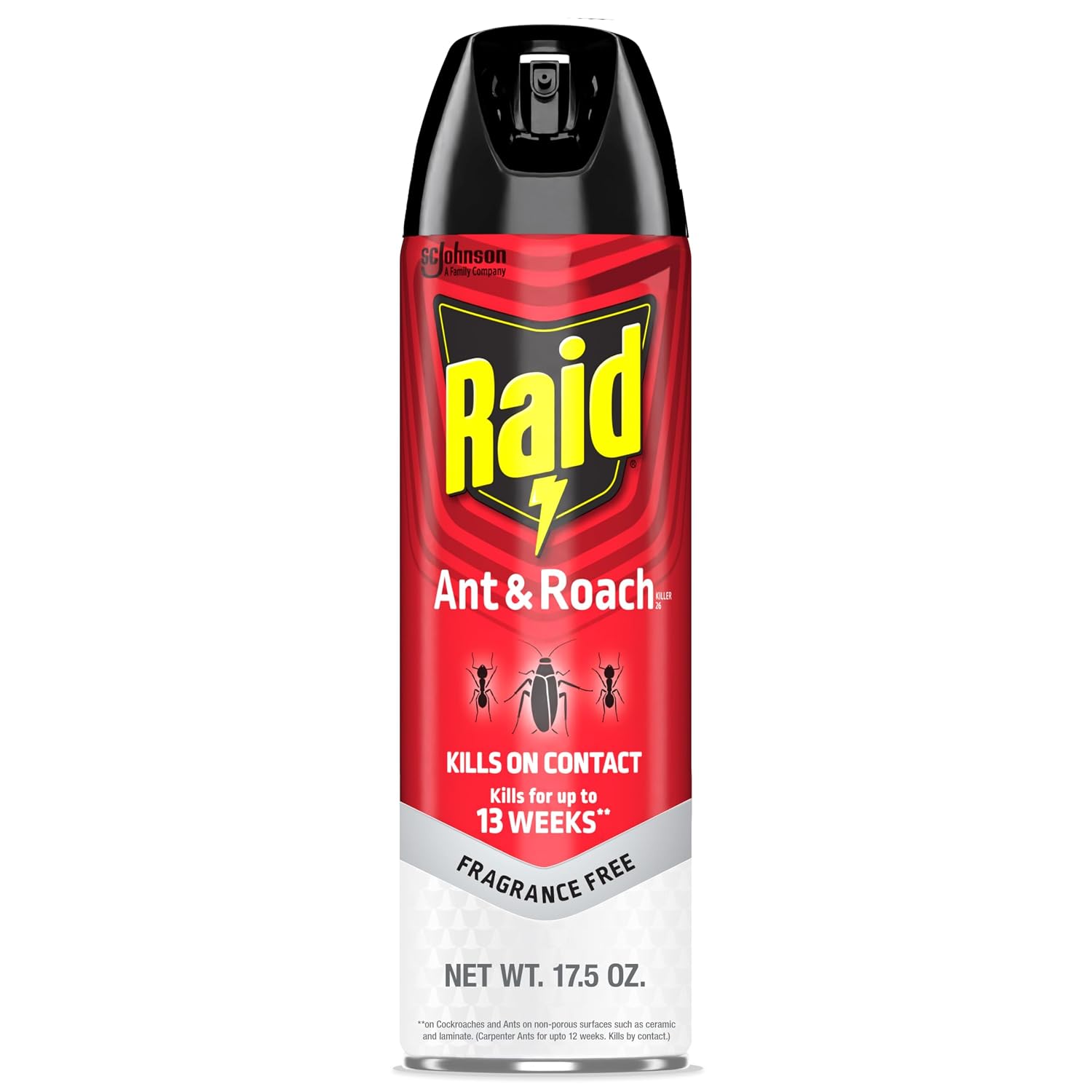
Raid Ant & Roach Killer Fragrance Free, 17.5 oz
| Unit Count | 17.5 Ounce |
|---|---|
| Item Form | LIQUID |
| Target Species | Insects |
| Liquid Volume | 1 deciliters |
This Raid Ant & Roach Killer is a fragrance-free aerosol designed for indoor use on floors, baseboards and other infested surfaces. It sprays on contact to kill ants and roaches and lists a broad set of target pests from silverfish to crickets and spiders. The formula claims residual control that can keep insects away for weeks, so a single application to entry points, garbage areas and under sinks can reduce repeat treatments. The aerosol form makes spot treatments fast and easy to direct into cracks and along baseboards. Important limitations are the usual safety considerations for pressurized, flammable aerosols and the need to follow label directions for indoor use around people and pets. This product does not replace integrated prevention steps like sealing entry points or removing food sources, but it is a straightforward, no-fragrance option for quick knockdown and short-term perimeter control.
Best for: Buyers who want an affordable, no-fragrance spray for quick, targeted control of ants and other common crawling pests in indoor spaces.
Less Ideal for: People seeking non-chemical or long-term preventive systems should consider baits, traps, or exclusion methods instead.
- Fragrance-free formula avoids lingering odor after application
- Aerosol spray provides quick knockdown and easy spot application
- Claims residual control for up to 13 weeks on treated surfaces
- Effective against a wide range of common household crawling insects
- Pressurized and flammable aerosol requires careful storage and use
- Not a standalone long-term solution without exclusion and sanitation measures
Verdict: A budget-friendly, fragrance-free aerosol that delivers fast knockdown and weeks of residual control for indoor ant and roach problems.
Raid Ant & Roach Killer Spray, Outdoor Fresh Scent, 17.5 oz

| Item Form | Aerosol |
|---|---|
| Target Species | Insects |
| Liquid Volume | 17.5 |
| Active Ingredients | Imiprothrin 0.060% · Cypermethrin 0.100% |
Raid Ant & Roach Killer is an aerosol spray formulated to kill common household insects on contact and provide residual protection for up to 13 weeks. Use it to treat floors, baseboards, garbage cans, under sinks, garages and other areas where ants and roaches travel; application is simple — shake, hold about 18 inches from the surface, and spray until wet. The formula lists active ingredients (imiprothrin and cypermethrin) that dispatch a broad range of pests including cockroaches, ants, silverfish and crickets, and the product is labeled as effective against a number of other household invaders. Practical benefits include fast knockdown, targeted surface application so you avoid treating whole rooms, and a scent described as outdoor fresh rather than a lingering chemical odor. Important limitations are that it is a flammable aerosol and contains petroleum distillates so it must be used with care around children, pets and food prep areas, and it cannot be applied to edible plants or food-contact surfaces without proper covering. Reapplication every few months is recommended to maintain control.
Best for: Buyers who prioritize dependable, fast-acting pest control for indoor perimeter and spot treatments and want a product that provides measurable residual protection.
Less Ideal for: People seeking non-chemical or organic pest control methods or those needing treatments safe for direct application on edible plants or uncovered food areas should choose alternatives.
- Kills on contact and lists residual control up to 13 weeks
- Broad-spectrum activity covers ants, roaches and several other common household insects
- Easy, targeted aerosol application for spot treatments
- Formula marketed with a milder outdoor-fresh scent vs strong chemical odor
- Flammable aerosol containing petroleum distillates requiring careful handling and storage
- Not suitable for direct use on food-contact surfaces or edible plants
Verdict: Choose this spray if you want a reliable, fast-contact insect killer that also leaves weeks-long residual protection for indoor spot and perimeter treatments.
Ortho Home Defense Insect Killer for Indoor & Perimeter, 1.33 gal. with Comfort Wand

| Item Form | Spray |
|---|---|
| Target Species | Insects |
| Liquid Volume | 1.33 gallons |
| Active Ingredients | Bifenthrin 0.05%, Zeta-Cypermethrin 0.0125% |
The Ortho Home Defense Insect Killer is a ready-to-use spray for treating indoor surfaces and the exterior perimeter to reduce ant and other insect activity. It is applied with the included battery-powered Comfort Wand that gives a continuous spray, which helps cover baseboards, door frames and foundation edges without bending or pumping. The formula lists bifenthrin and zeta-cypermethrin as active ingredients and is intended to kill and prevent ants, roaches, spiders and many other listed insects, with claim of up to 12 months barrier protection on non-porous indoor surfaces. In practice this makes it a good option for routine perimeter treatments around patios, garages and entry points as well as spot treatments indoors. Expect quick-drying, clear residue and straightforward directions for a 4-inch indoor band or 12-inch outdoor band. Important limitations are that it is a chemical insecticide so users should follow all safety guidance around children and pets and it is not labeled for porous indoor surfaces or direct use on food-contact areas.
Best for: Buyers who want a proven, easy-to-use perimeter and indoor spray to reduce ant activity and prefer a product with broad customer adoption and clear, repeatable application steps.
Less Ideal for: People seeking organic or non-chemical options or those who need a product labeled for direct use on food-preparation surfaces should consider alternatives.
- Ready-to-use with large 1.33 gallon volume for multiple treatments
- Comfort Wand provides continuous spray for easier, less-fatiguing application
- Claims up to 12 months barrier protection on indoor non-porous surfaces for ants, roaches and spiders
- Clear, fast-drying formula that leaves no visible residue
- Contains synthetic pyrethroid active ingredients so safety precautions are required around children, pets and edible plants
- Not intended for porous indoor surfaces or direct application where food is prepared
Verdict: A user-friendly, large-volume ready-to-use spray with a continuous-wand applicator that reliably reduces ants and other household insects around the home.
Choosing the Right Bug Spray for Ants: Key Factors to Consider
Knockdown Speed and Immediate Efficacy
How fast a spray incapacitates or kills foraging ants matters when you have active trails in kitchens or patios. Fast knockdown interrupts visible activity quickly, reducing the chance of more ants being recruited to food sources. In practice, a product that delivers visible results within minutes makes it easier to identify treated zones and know whether retreatment is needed.
Immediate efficacy also affects where you can use the product. Fast-acting sprays are helpful near doors, windows, and food handling areas when you need prompt control, but you should still follow label instructions for ventilation and reentry times in enclosed spaces.
Residual Longevity on Surfaces and Soil
Residual control determines how long treated surfaces remain protective after application. A longer residual is beneficial along foundation perimeters, baseboards, and landscape edges because it reduces how often you must reapply. Residual longevity varies with formulation, treated surface, and exposure to rain or irrigation.
For outdoor use, consider how quickly rain or foot traffic will degrade the residue. For indoor use, frequent cleaning or dusting can remove residues from baseboards and floors. Choose a spray with a residual profile that matches the treatment location and desired maintenance interval.
Application Versatility for Target Locations
Different ant problems require different application styles. You may need a fine spray that reaches cracks and crevices, a stream for soil perimeter treatments, or a low-odor formula safe for brief indoor use. Versatile sprays that come with adjustable nozzles or concentrate options give you more control over coverage and consumption.
Think about whether you will treat baseboards, entry thresholds, soil lines, patios, or inside cabinets. Products labeled for both indoor spot treatments and outdoor perimeter use reduce the need for multiple specialized items and simplify maintenance.
Safety, Labeled Uses, and Plant Compatibility
Safety guidance on labels is critical for gardeners who treat near edible plants, child play areas, or pet paths. Look at reentry intervals, preharvest intervals for food crops, and any restrictions on treating ornamentals or container plants. Some sprays are not labeled for application on edible foliage or fruits, and others restrict use near pollinator-attractive plants.
Choosing a product with clear, conservative label directions reduces the risk of accidental misuse. When treating near vegetables or herbs, plan applications during non-flowering periods or use barrier methods to protect desirable plants until the product is safe to reenter.
Environmental Durability and Rainfastness
Outdoors, exposure to sun, rain, and irrigation determines how long a sprayed barrier lasts. A formulation that is rainfast after a short drying window will maintain activity longer in unpredictable weather. If you treat foundation lines or mulched beds, check whether the product is labeled as rainfast and how long it needs to cure before expected precipitation.
Environmental durability also affects timing and labor. If a spray washes off easily, you will need more frequent reapplications after storms. Products that persist on treated surfaces under normal outdoor conditions provide more reliable long-term protection for entry points and landscape edges.
Ease of Application and Coverage Control
Practical application features matter when you are treating confined indoor areas or wide outdoor perimeters. Handheld aerosol cans, pump sprayers, and hose-end or trigger-spray bottles each offer different coverage rates and control. Ease of use influences accuracy; a wand or adjustable nozzle helps place product precisely in cracks or along foundation seams without overspray.
Also consider mixing needs and the clarity of label instructions. Ready-to-use formulations remove the guesswork of dilution but may cost more per application, while concentrates allow custom coverage but require careful measuring and safe handling.
Common Ant Behavior and Where Sprays Work Best
Understanding typical ant activity helps you decide where to apply a spray. Many species establish foraging trails from nests in soil, wall voids, or under pavers; treating along those trails and entry points discourages re-entry. Locate active trails and treat both the visible pathway and likely nest access points to interrupt traffic.
Sprays work well for spot treatments, perimeter barriers, and soil banding around foundations. They are less effective as a stand-alone solution for deeply established colony nests where baiting or nest-targeted methods may be needed in addition to spray treatments.
- Treat trail edges, baseboards, and entry gaps rather than broad broadcast spraying
- Focus outdoor treatments on foundation lines and soil seams near patios
- Use finer spray settings for cracks and crevices to reach hidden ants
Safe Application Near Edibles and Pollinator Areas
When you need to use a spray near vegetable beds, herbs, or flowering ornamentals, read label restrictions about edible crops and pollinators. Choose application times when pollinators are least active and avoid spraying open flowers. Where possible, protect edible foliage by misting adjacent hardscape instead of plant surfaces.
If you treat soil around container plants, avoid direct contact with leaves and fruit. Allow treated areas to dry and follow any reentry or harvest interval guidance on the label before handling produce from treated zones.
- Avoid spraying flowering plants that attract bees and other pollinators
- Time outdoor treatments for early morning or late evening to reduce pollinator exposure
- Cover or move small potted edibles if label advises against treating container-grown plants
Application Tips to Maximize Effectiveness
For perimeter defense, apply a continuous band along the foundation and entry points rather than isolated spots. Keep a 2 to 3 inch treated strip where ants commonly cross thresholds and crevices. Indoors, target baseboards, behind appliances, and inside window sills where trails originate.
Use the nozzle setting that matches the task: a stream for soil lines, a cone or fan for broad hardscape, and a pinpoint spray for gaps and cracks. Clean up visible food residues and seal entry gaps to complement chemical control and reduce re-infestation.
- Treat both sides of thresholds and door frames to stop crossing ants
- Reinspect treated areas after rain or irrigation and reapply if residue is diminished
- Combine sanitation and exclusion with spray use for longer-lasting results
When to Combine Sprays with Other Ant Control Methods
Sprays are effective for immediate control and barrier creation, but some situations benefit from integrated approaches. Foraging ants found repeatedly inside homes often indicate nearby nests. Combining targeted sprays for trails with baiting strategies or nest treatments covers both symptoms and colony sources.
Mechanical exclusion, such as sealing gaps and repairing screens, reduces re-infestation pressure. Use sprays to establish a treated perimeter while you implement long-term measures like habitat modification, moisture control, and routine inspections.
- Use sprays to stop active trails while baits address the colony
- Seal entry points after treatment to prevent new trails from forming
- Monitor treated areas weekly and follow up as needed
How We Chose the Best Bug Spray for Ants
We focused on products that offer reliable control of common ant species around homes, patios, and garden edges. Selection prioritized formulations with documented fast knockdown and measurable residual activity, so treatments stop active trails and keep ants from returning. We also weighed application type and coverage-sprays that reach cracks, treat soil lines, or coat baseboards are more useful in practical situations. Safety and labeled uses matter for gardeners, so we favored products with clear instructions for indoor and outdoor use and restrictions that make sense for food-prep and planted areas. Durability of effect in outdoor settings and rainfastness were included to reflect real yard exposure. Excluded were products intended only for broadcast lawn treatments, baits without a contact spray option, specialty insecticides for non-ant species, and products lacking clear labeled directions for target locations. Our evaluation criteria emphasize repellency/knockdown, residual longevity, application versatility, safety and labeled uses, and ease of use-dimensions that directly affect how effective a spray will be in everyday garden and home ant problems.
FAQ
Can I use bug spray for ants around edible plants?
It depends on the product label. Some formulations are labeled for use on ornamental plants but restrict application on edible foliage or fruit. Always follow preharvest intervals and label directions before treating near vegetables or herbs.
How soon after applying a spray can I re-enter treated indoor areas?
Reentry times vary by formulation and label instructions. Many ready-to-use sprays allow reentry after treated surfaces have dried and the area has been ventilated. Check the product label for specific reentry and ventilation guidance.
Will a spray alone eliminate a large ant nest?
Sprays may reduce foraging activity and suppress colonies temporarily but often do not eliminate deep nests on their own. For established nests, combining targeted nest treatments or baits with perimeter sprays is usually more effective.
How often should I reapply a perimeter treatment outdoors?
Reapplication depends on the product's residual claims and environmental exposure. After heavy rain, irrigation, or frequent foot traffic you may need to reapply more often. Check label guidance for recommended retreatment intervals.
Are aerosol sprays better than liquid trigger sprayers for indoor ant problems?
Each has advantages. Aerosols offer quick spot treatments and convenience for small trails, while trigger or pump sprayers with adjustable nozzles provide better coverage for baseboards and perimeter lines. Choose the format that matches the treatment area size and required precision.
Final Verdict
Prioritize the combination of fast knockdown and a reliable residual when choosing a bug spray for ants, and match the formulation to where you will apply it. For indoor problems, favor products with clear reentry guidance and application control for cracks and baseboards. For outdoor perimeter work, choose sprays with better rainfastness and labeled durability. Balance effectiveness with safety around edible plants and pollinator areas, and combine spray treatments with sanitation, exclusion, and baiting when necessary. That approach helps you stop visible activity now while reducing the chance of future infestations.
