

Note: This article contains affiliate links. If you click on these links and make a purchase, I may earn a small commission at no extra cost to you. This helps support my research and content. Read my full affiliate disclosure here.
If you carve wood with a chainsaw, the tool you choose affects detail, safety, and how long you can work without fatigue. A carving-focused chainsaw behaves differently from a general-purpose saw: it needs responsive throttle control, a short matched bar and chain, and vibration characteristics that let you hold tight lines for hours. This guide covers the top shortlisted options for carving, with attention to bar length control, maneuverability, and vibration management. Below you will find compact saw recommendations and the evaluation criteria we used to judge them, so you can pick the tool that fits your carving style and workshop setup.
Top Picks at a Glance
| Best Overall The best all-around choice for most situations | V-MODEST 12" Top-Handle 25cc Gas Chainsaw |  |
| Best Budget The cheapest option that still gets the job done reliably | maXpeedingrods 6" Cordless Mini Chainsaw (Battery Included) |  |
| Highest Rated A top-rated pick with lots of positive feedback | yardenX 2-in-1 Cordless Pole Saw and Mini Chainsaw, 8-Inch Bar |  |
| Most Popular A crowd favorite that many people choose with confidence | Seesii M6 Lite 6-inch Cordless Mini Chainsaw with Two Batteries |  |
| Best Seller A high-volume bestseller chosen again and again | SEESII M8 Boost 8-Inch Cordless Mini Chainsaw (Brushless) |  |
V-MODEST 12" Top-Handle 25cc Gas Chainsaw

| Power Source | Gas Powered |
|---|---|
| Horsepower | 1.51 hp |
| Chain Speed | 26.7ft/s |
| Chain Length | 12 inches |
The V-MODEST 12-inch top-handle chainsaw is a lightweight gas-powered saw aimed at pruning, orchard work, and detail cutting where control matters. Its 25cc two-stroke engine delivers about 1.5 hp and a high chain speed for quick, clean cuts while the 1/4" low-profile chain helps with smooth, precise cuts useful for shaping and carving. The top-handle layout and anti-vibration features make the saw easy to maneuver in tight spots or when working from a ladder, and the easy-start system plus adjustable oil pump and side tensioner reduce downtime during a session. Safety-focused touches such as a dual-post chain brake and an efficient air filter improve day-to-day reliability. Expect typical small-gas-saw maintenance: mixing fuel at 25:1, routine chain sharpening, and periodic filter and spark plug service. Because the bar is 12 inches and the unit is optimized for pruning and light woodwork, it is not intended for heavy felling or large log work but performs well for precise carving, trimming, and seasonal yard tasks.
Best for: Buyers who want a nimble, gas-powered saw for pruning, orchard work, and detailed carving where control and low weight matter more than raw cutting capacity.
Less Ideal for: Those who need a saw for regular heavy felling, cutting large firewood rounds, or users who prefer electric or battery platforms for quieter low-maintenance operation.
- Very light 5.5 lb design improves maneuverability and reduces fatigue during carving or pruning
- 1/4" low-profile chain and 12" bar for smooth, precise cuts suited to detail work
- Easy-start system and adjustable oil pump simplify use and chain lubrication control
- Safety features like dual-post chain brake and anti-vibration system enhance operator control
- Requires a 25:1 gas-to-oil premix which adds fueling complexity
- 12-inch bar and small engine are not suitable for large-diameter logs or heavy felling
Verdict: If you need a lightweight, maneuverable gas chainsaw for precise carving, pruning, and orchard work, this 12-inch V-MODEST model delivers control-focused performance in a compact package.
maXpeedingrods 6" Cordless Mini Chainsaw (Battery Included)

| Power Source | Battery Powered |
|---|---|
| Horsepower | 550 watts |
| Included Components | Battery, 2 chains, oil bottle, gloves, goggles |
This maXpeedingrods 6-inch cordless mini chainsaw is a lightweight, battery-powered tool aimed at quick pruning, small-diameter branch cutting, and basic woodworking tasks. It ships as a ready-to-use kit with a 21V 2000mAh battery, two chains (one preinstalled), a screwdriver and socket for tension adjustments, a portable case, goggles, gloves, and an oil bottle for the saw's automatic lubrication system. The 550W motor and chain speed make short, controlled cuts through branches up to about 6 inches in diameter, and the 360-degree automatic lubrication reduces wear and keeps the chain running smoother. Safety features include a two-button start with a lock, hand guard, splash guard, and non-slip handle. Practical benefits are ease of one-hand operation for light tasks, a full accessory set for immediate use, and replaceable chains for ongoing maintenance. Limits for carving: the short 6-inch bar and lightweight design restrict deep cuts and long continuous use, so this is not suited for heavy carving, large logs, or professional shop work where longer bars, sustained power, and finer control are required.
Best for: Buyers who want an inexpensive, easy-to-use cordless saw for light pruning, small woodworking projects, and occasional outdoor tasks where portability and simple setup matter.
Less Ideal for: Not a good choice for professional carvers, heavy-duty log work, or anyone who needs a long bar and sustained high power for extended carving sessions.
- Comprehensive ready-to-use kit includes battery, two chains, oil bottle, safety gloves and goggles
- 360-degree automatic lubrication for smoother cutting and reduced chain wear
- Lightweight one-hand design makes pruning and short cuts easy for less experienced users
- Safety lock and hand guard reduce accidental starts and contact with the chain
- 6-inch bar limits cutting depth and fine carving capability
- Short battery runtime and lower continuous power compared with full-size chainsaws
Verdict: A very affordable, portable kit-style mini chainsaw that makes light pruning and small carving prep work quick and convenient.
yardenX 2-in-1 Cordless Pole Saw and Mini Chainsaw, 8-Inch Bar

| Power Source | Battery Powered |
|---|---|
| Item Highlight | 15.5FT Reach, 20V Power, 2x4Ah Batteries, Auto Oiling & Tool-Free Chain Adjustment |
| Model Number | YX2009 |
The yardenX 2-in-1 cordless pole saw converts between a handheld mini chainsaw and an extended telescopic pole, so you can prune low limbs by hand or trim higher branches from the ground without a ladder. Its brushless motor supplies consistent cutting power for branches up to about 8 inches, while the included pair of 20V 4.0Ah batteries keeps runtime high for longer sessions. Automatic chain oiling and tool-free chain adjustment reduce routine maintenance, and the telescoping pole reaches up to the advertised 15.5 feet for an average user so you can tackle higher cuts safely. For carving, the 8-inch bar and shorter handheld mode give decent control for shaping and detail work on relatively small logs and large branches, though finer carving needs a specialist micro bar or a dedicated carving saw. The system balances convenience and durability for regular yard work, but expect that heavy-duty felling or precise professional carving will outpace this tool. If you want a reliable, low-maintenance multipurpose saw for trimming and occasional carving on small pieces, this handles those tasks well.
Best for: Buyers who prioritize a dependable, low-maintenance tool for regular yard pruning and occasional small-scale carving will appreciate this model's consistent performance and extended runtime.
Less Ideal for: Professional carvers or users needing a fast, precise carving saw for large timber and detailed sculpting should consider a dedicated carving chainsaw or a longer-bar professional model instead.
- Two-in-one design switches between pole saw and handheld mini chainsaw for versatility
- Brushless motor for smoother cutting, lower noise, and longer motor life
- Includes two 20V 4.0Ah batteries for extended runtime and reduced downtime
- Automatic chain oiling and tool-free chain adjustment simplify maintenance
- 8-inch bar limits work to small logs, limbs, and carving details rather than large trees
Verdict: A reliable, low-maintenance two-in-one saw that gives consistent power and long runtime for pruning and occasional small-scale carving.
Seesii M6 Lite 6-inch Cordless Mini Chainsaw with Two Batteries

| Power Source | Battery Powered |
|---|---|
| Horsepower | 900 watts |
| Chain Speed | 29ft/s |
| Chain Length | 6 inches |
| Included Components | mini chainsaw |
The Seesii M6 Lite is a small, cordless mini chainsaw aimed at pruning, branch trimming, and light timber work where a full-size saw is overkill. It runs on two 21V 2000mAh batteries and uses a 6-inch chain driven by a 900W motor that the manufacturer says reaches up to about 29–30 ft/s chain speed. Typical use is one-handed cutting of small logs, trimming branches, and carving rough shapes where portability and low weight matter. Notable features include the twin-battery kit that extends run time, a lightweight ergonomic body for reduced fatigue, a pre-installed chain plus a spare, and basic safety controls like a double-lock trigger and chain guard. In practice this makes it easy to start work quickly and finish small projects without frequent charging or heavy lifting. Limitations are that the short 6-inch bar restricts cutting diameter and the unit is intended for light to medium wood rather than heavy felling or precise professional carving. Also the saw lacks an auto-oiling system, so chain lubrication must be monitored manually during longer sessions.
Best for: Buyers who prioritize an easy-to-hold, portable electric saw for garden pruning, hobby carving of small logs, or quick yard work and who look for products with strong user feedback and straightforward safety features.
Less Ideal for: Not a good choice for professional chainsaw carvers working on large blocks or for anyone needing a long bar for heavy felling or deep cuts.
- Very lightweight and one-handed design reduces user fatigue for prolonged trimming tasks
- Two included batteries extend continuous run time for longer sessions without swapping to a backup pack
- Comes ready to use with a pre-installed chain and spare chain plus basic kit tools for immediate work
- Safety-minded controls including a double safety lock and chain guard reduce accidental activation and debris spray
- 6-inch bar limits maximum cut diameter and makes detailed carving of large pieces slower
- No automatic oiling system so you must refill and monitor lubrication during extended use
Verdict: Choose this compact cordless mini chainsaw when you need a lightweight, ready-to-use tool for pruning and light carving with reliable run time from two batteries.
SEESII M8 Boost 8-Inch Cordless Mini Chainsaw (Brushless)
| Power Source | Battery Powered |
|---|---|
| Horsepower | 1000 watts |
| Chain Length | 8 inches |
| Included Components | chainsaw |
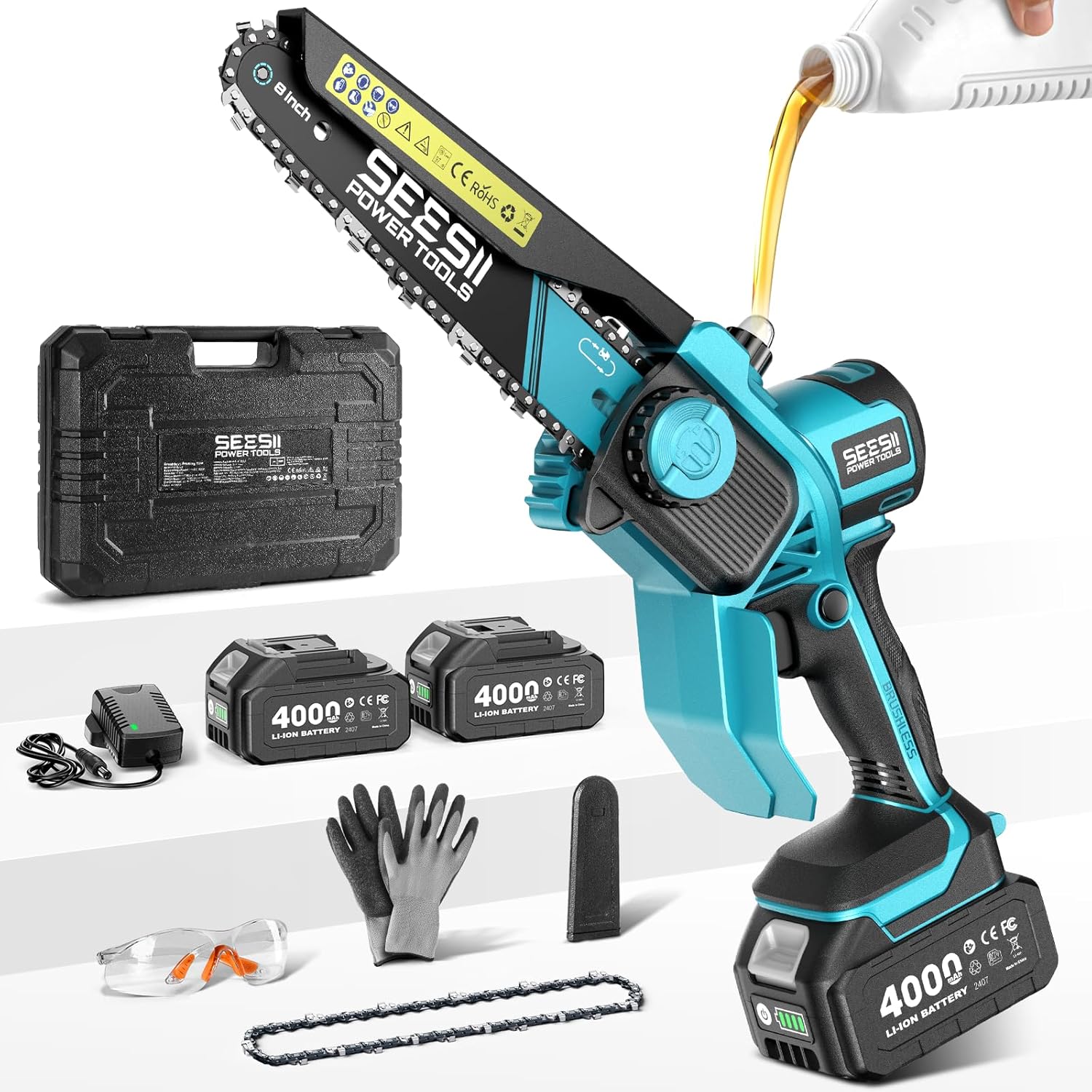
The SEESII M8 Boost is a handheld cordless mini chainsaw built for yard work and quick cutting tasks. It uses a 1000-watt brushless motor and an 8-inch guide bar to handle larger branches than typical 6-inch models, and the kit ships with two 4000mAh batteries so you can swap packs for extended sessions. Practical features include tool-free chain tensioning for fast adjustments, an automatic oiler with a translucent reservoir for easy level checks, and a compact ergonomic body that reduces vibration during use. In real-world gardening and storm cleanup the saw is convenient for pruning, limbing, and cutting small logs without the noise, fumes, or maintenance of a gas saw. Limitations for carving: the short bar and consumer-oriented chain make fine, controlled detail work and deep cuts harder than a dedicated carving saw or full-size model, and the unit is optimized for general yard chores rather than precision sculpting. For buyers who want easy starting, low upkeep, and reliable portable power, this is a capable tool; those needing specialized carving performance should consider a chainsaw designed for detailed work.
Best for: Practical homeowners who prioritize easy start-up, low maintenance, and reliable cordless power for pruning, limb removal, and general yard cleanup rather than specialist carving work.
Less Ideal for: Woodcarvers or sculptors who need a longer bar, specialized carving chains, or a tool engineered for fine, controlled cuts should look at dedicated carving or professional chainsaws.
- Brushless 1000W motor for higher efficiency and longer battery life
- Two 4000mAh batteries included for extended continuous cutting
- Tool-free chain tensioning speeds chain changes and adjustments
- Automatic chain lubrication with translucent reservoir for easy monitoring
- 8-inch bar provides greater cutting capacity than smaller mini models
- Short 8-inch bar and consumer chain limit precision and deep cuts needed for detailed carving
- Designed for yard work rather than professional or heavy-duty timber cutting
Verdict: If you want a low-maintenance cordless saw that reliably handles pruning and medium branch cutting with strong battery life, the SEESII M8 Boost is a solid choice.
Choosing the Right Chainsaw for Carving: Key Factors to Consider
Bar Length and Control
Bar length directly affects how finely you can cut and how much of the saw you can maneuver around curves and tight detail. Shorter bars are generally preferred for carving because they reduce rotational inertia and let you make tighter radii without catching or overcutting. However, bar length must match the size of the piece you plan to carve. For larger chainsaw sculptures a slightly longer bar helps remove bulk quickly, but you will trade some control.
Adjustable chain tensioning and compatibility with shorter carving chains are part of bar control. Look for saws that accept low-kickback, narrow-profile chains and bars in the 6 to 14 inch range if your focus is fine detail. The right bar and chain pairing will make precise slicing cuts and chip-out work more predictable.
Vibration Dampening
Vibration affects how steady your hands stay during delicate cuts and how long you can work without numbness. Carving requires consistent contact and subtle wrist movements, so systems that isolate the handles from the engine or employ internal counterbalancers can make a big difference. Lower vibration also reduces fatigue over multi-hour carving sessions, improving control on repeat passes.
Consider how handle designs and anti-vibration mounts route vibrations away from both hands. While lighter saws usually vibrate less, some heavier units have engineered dampening that outperforms a bare light frame. Try to evaluate reported vibration levels and the quality of handle cushioning when choosing a carving saw.
Throttle Responsiveness and Idle Control
Predictable throttle response is crucial for carving because you often need to feather power for chip cuts, plunge cuts, and delicate shaping. A responsive throttle and smooth idle reduce the chance of sudden surges that can ruin fine details or cause kickback. Carburetion setup, electronic fuel management, or precise carb adjustment capability all influence how smoothly the saw responds to small throttle inputs.
Also pay attention to whether the saw offers an easy and steady idle speed so you can pause without the chain creeping. That control makes detail work safer and more precise, especially when switching between carving strokes and repositioning the piece.
Weight, Balance, and Ergonomics
Carving often means holding the saw in non-standard positions and making controlled slices rather than long ripping cuts. A well-balanced saw with a low center of gravity helps you maintain steady contact with the workpiece and reduces wrist strain. Weight is a double-edged sword: heavier saws can be steadier but tire you faster, while very light saws are easy to move but may feel twitchy on detail cuts.
Handle shape, reach between front and rear handles, and foregrip comfort all influence control. Check how the saw feels in both hands and whether it supports the typical carving positions you use, such as sitting on a stump, working on a bench, or reaching into awkward angles on larger sculptures.
Chain and Bar Compatibility
Different carving tasks demand specific chain types and pitch sizes. Narrow-profile and low-kickback chains cut cleaner and are easier to control for detail work. Compatibility with common carving chain pitches matters for sharpening and availability of replacement parts. Some saws accommodate an easy swap to very short specialist bars or chisel chains used in sculptural carving.
Also consider how the saw handles chain tensioning and whether you can access the bar nuts and tensioner with gloved hands. Quick and accurate tensioning makes frequent sharpening and chain swaps less of a hassle during long projects.
Maintenance Accessibility and Serviceability
Routine maintenance is part of keeping a carving saw predictable. Easy access to the air filter, spark plug, and chain sprocket makes cleaning and minor adjustments quicker between sessions. Simpler tools for tensioning and bar removal save time. For carvers who sharpen chains themselves, a saw whose sprocket and chain can be serviced without specialized tools will be more convenient.
Durable construction of wear parts such as the chain sprocket, clutch, and chain brake affects long-term reliability. Assess how easy it is to perform common tasks like cleaning sawdust from the casing or replacing the bar when planning for recurring workshop use.
Why a Carving-Specific Setup Matters
Carving uses the chainsaw in a precision role rather than bulk removal, so the setup should prioritize control over brute force. A lower engine displacement but more refined throttle feel often outperforms raw horsepower for detail cuts. Smaller bars and carving chains produce cleaner shavings and reduce the tendency to grab wood fibers during tight curves.
A carving-focused setup also reduces the risk of damaging the piece while allowing you to execute fine techniques like beveling, rounding, and finishing passes with confidence.
- Shorter bars for tight radii
- Narrow-profile chains for cleaner cuts
- Ergonomic handles for sustained control
Common Carving Techniques and How the Saw Affects Them
Different carving strokes demand different tool responses. Plunge cuts require reliable chain braking and steady throttle control so you can start a hole without stalling or surging. Slicing and rounding benefit from a steady, low-vibration platform so your hand follows planned lines rather than compensating for shake.
When you make relief cuts or undercuts, the saw's balance and access to tight spots determine whether you can execute the move safely. Understand how your intended techniques match saw ergonomics before committing to a tool.
- Plunge cutting needs chain brake reliability
- Slicing needs low vibration and steady throttle
- Undercutting needs compact bar reach
Workshop Setup and Workpiece Handling
How you mount or stabilize the workpiece affects what saw characteristics matter most. If you carve on a bench or clamp small pieces, a very short bar and light balanced saw will let you work comfortably. For larger standing pieces or outdoor sculptures, you may prefer a saw that can remove bulk quickly while still allowing carving details once the roughing is done.
Consider safety in the workspace. Good footing, secure clamps or saddles, and an organized sequence for switching chains or bars will speed work and reduce mistakes when changing carving modes.
- Clamp small pieces for precise detail work
- Use saddles or stands for larger sculptures
- Keep sharpening and spare chains accessible
Safety Practices Specific to Carving
Carving places the saw and your hands close to complex shapes and sometimes requires awkward body positions. Always use proper personal protective equipment: face and eye protection, cut-resistant gloves, hearing protection, and sturdy boots. Plan cuts so the saw will not bind and avoid positions where a catching bar could drive the saw toward your body.
Practice controlled throttle use and test how the saw responds on scrap wood before working on the final piece. Regularly inspect safety systems like the chain brake and ensure maintenance is current so the saw behaves predictably when you need to stop the chain quickly.
- Wear face, eye, and hearing protection
- Test throttle response on scrap before each session
- Inspect chain brake and tension before starting
Sharpening and Chain Care for Fine Detail
Sharp chains are essential for clean carving cuts. Frequent touch-ups keep cutting predictable and reduce the need for heavy pressure that can cause mistakes. Carry a concise sharpening kit appropriate to the chain pitch you use and learn how to set the correct cutting angle for carving chains.
Proper lubrication and regular cleaning of the bar groove and sprocket also extend chain life and promote consistent cutting. Make chain maintenance part of your workflow to avoid mid-project surprises.
- Carry a matching file and gauge for on-the-spot sharpening
- Keep the bar groove and sprocket clean and lubricated
- Rotate or replace chains before they become overly worn
How We Chose the Best Chainsaw for Carving
We prioritized features that directly affect carving accuracy and user comfort. Our editorial filters focused on low vibration engineering, fine throttle responsiveness, compact bar compatibility, chain selection for detail cuts, and manageable weight for one-handed or careful two-handed carving. We evaluated handling characteristics such as balance and center of gravity, because these determine how steady you can hold the saw when making controlled cuts and scroll work. We also considered durability and maintenance accessibility, including how easy it is to sharpen or replace short carving chains, access to the chain tensioner, and routine serviceability. Safety features like a responsive chain brake and reduced kickback design were required for inclusion. We excluded full-sized forestry rigs and specialty industrial saws that are impractical for hand carving or detailed sculpture work. The final list reflects tools that meet the needs of carvers across experience levels, from hobbyists working on small sculptures to professionals doing larger chainsaw art.
FAQ
What bar length is best for beginner chainsaw carvers?
Beginners usually do best with a shorter bar in the 8 to 12 inch range because it offers greater control and reduced swing weight. This size still lets you rough out small sculptures and practice carving techniques without the inertia of a long bar.
How important is anti-vibration technology for carving?
Anti-vibration systems are often very important because they reduce hand fatigue and improve line holding for detailed cuts. For long sessions or fine work, vibration dampening helps you maintain steady strokes and reduces the chance of mistakes due to numb hands.
Can I use a regular chainsaw for carving if I change the chain?
Often you can adapt a general-purpose saw by fitting a narrow-profile carving chain and shorter bar, provided the saw supports those sizes. Check compatibility and whether the saw's balance and throttle control suit carving before relying on it for detailed work.
How frequently should I sharpen carving chains?
Sharpening frequency depends on wood species and workload, but carvers commonly touch up chains after every few hours of use or whenever cutting becomes less crisp. Regular light sharpening preserves tooth geometry better than infrequent heavy reshaping.
Are there fuel or power preferences for carving saws?
Both small two-stroke engines and battery saws are used for carving. Small displacement engines give steady torque for bulk removal, while modern battery saws can offer quieter operation, lower vibration, and instant throttle response. The best choice depends on how you balance run time, noise, and control needs.
Final Verdict
Choose a carving chainsaw by prioritizing control over raw power. Focus on short bar compatibility, low vibration, and predictable throttle response to make precise cuts and reduce fatigue. Balance and ergonomics determine how comfortably you can hold the saw in different carving positions, while maintenance accessibility keeps the tool reliable during long projects. Weigh the tradeoffs between a slightly heavier, steadier saw and a very light, nimble model based on the size of pieces you work on and how long you carve per session. Prioritize safety features and serviceability so your carving tool remains consistent and dependable over time.
