

Note: This article contains affiliate links. If you click on these links and make a purchase, I may earn a small commission at no extra cost to you. This helps support my research and content. Read my full affiliate disclosure here.
When you head off-grid, the right chainsaw becomes as essential as your recovery kit and water filter. A chainsaw for overlanding should be compact enough to ride on a roof rack or fit inside a cargo box, but durable and serviceable enough to handle deadfall, limbing, and small-matter fuelwood. This guide shortlists seven top-performing options tailored to vehicle-based camping and extended trail travel. We focused on portability, ease of field maintenance, cutting efficiency, and safe handling in remote conditions. Below you will find concise product write-ups followed by practical guidance on picking the best saw for your rig and trip plan.
Top Picks at a Glance
| Best Overall The best all-around choice for most situations | Husqvarna 120 Mark III Gas Chainsaw, 16-Inch Bar |  |
| Best Quality Built to a higher standard if you want something more solid | Husqvarna Power Axe 350i Cordless Chainsaw, 18-Inch with Battery and Charger |  |
| Best Value The sweet spot between price and what you get | SEESII 12-inch Cordless Chainsaw with Two 4.0Ah Batteries |  |
| Best Budget The cheapest option that still gets the job done reliably | DAOLONG 52-inch Folding Pocket Chainsaw with Carry Bag |  |
| Highest Rated A top-rated pick with lots of positive feedback | EGO POWER+ CS1611 16" Cordless Chainsaw with 56V 2.5Ah Battery and Charger |  |
| Most Popular A crowd favorite that many people choose with confidence | Seesii M6 Lite 6" Cordless Mini Chainsaw with Two Batteries |  |
| Best Seller A high-volume bestseller chosen again and again | SEESII 12-Inch Cordless Brushless Chainsaw |  |
Husqvarna 120 Mark III Gas Chainsaw, 16-Inch Bar

| Power Source | Gas Powered |
|---|---|
| Horsepower | 1.88 hp |
| Chain Length | 16 inches |
The Husqvarna 120 Mark III is a compact gas chainsaw built for routine yard work: limb pruning, light felling and cutting firewood. It pairs a 38-cc X-Torq two-stroke engine with a 16-inch bar and an automatic oiler so you can keep cutting without frequent lubrication fiddling. Features aimed at ease of use include an air purge to simplify starting, a combined choke/stop control to reduce flooding, a simple chain tensioner for quick adjustments, and LowVib dampening to lower operator fatigue. Safety is addressed with an inertia-activated chain brake. The Air Injection centrifugal system helps keep the air filter cleaner for longer, which is useful if you run the saw regularly in dusty conditions. Expect a capable, user-friendly tool for homeowners who want dependable gas power in the sub-$300 range, but professional users needing long daily runtimes or larger cutting capacity should consider heavier commercial models.
Best for: Homeowners and weekend landscapers who want a reliable, easy-to-use gas chainsaw for pruning, small felling and firewood without the complexity of professional equipment.
Less Ideal for: Commercial loggers or users who need a high-hour production saw or larger cutting capacity for big timber should choose a heavier-duty model instead.
- Easy starting with air purge and combined choke/stop control
- LowVib technology reduces vibration and operator fatigue
- Air Injection centrifugal system extends time between air filter cleanings
- Simple chain tensioning and automatic oiler for low-maintenance use
- 16-inch bar and 38-cc engine are best for light to medium tasks, not heavy professional felling
Verdict: A user-friendly, gas-powered 16-inch chainsaw that balances easy starting, low vibration, and low maintenance for homeowners seeking dependable cutting power under $300.
Husqvarna Power Axe 350i Cordless Chainsaw, 18-Inch with Battery and Charger

| Power Source | Battery Powered |
|---|---|
| Horsepower | 1.9 hp |
| Chain Length | 18 inches |
| Included Components | Chainsaw, Battery, Charger, Owner's Manual |
The Husqvarna Power Axe 350i is an 18-inch cordless chainsaw kit designed for homeowners and landscapers who need near-professional cutting power without gas. It uses a brushless motor and a 40V BLi30 battery to deliver strong, sustained cuts and includes boost mode for a temporary 25 percent power increase when tackling larger limbs. The X-Cut chain promises longer lasting sharpness and the tool-less chain tensioning system makes on-the-fly adjustments quick and simple. In practice this saw is well suited to pruning, limb removal, and cutting firewood around the yard while producing less vibration and noise than many gas models. The kit ships with a charger so you can start work right away, but run time will depend on battery charge and the intensity of use; heavy continuous cutting may require spare battery packs for all-day jobs. At roughly 7.7 pounds it is easier to maneuver than comparable gas saws, though users who need industrial continuous use should plan for battery rotation or a different power source.
Best for: Buyers who prioritize cutting performance in a cordless saw and want a robust, easy-to-use tool for pruning, limb removal, and cutting firewood around the property.
Less Ideal for: Professionals who need uninterrupted all-day chainsaw use without swapping batteries should consider corded or gas alternatives.
- Brushless motor with boost mode for higher power on demand
- Includes BLi30 40V battery and charger so it is ready to use out of the box
- X-Cut chain for longer-lasting sharpness and consistent cutting performance
- Tool-less chain tensioning and chain brake indicator light for fast adjustments and safer operation
- Battery run time will limit continuous heavy-duty work without spare batteries
- Heavier than some compact pruners at the 18-inch bar length for extended overhead work
Verdict: If you want near-gas cutting power in a cleaner, quieter cordless package, the Power Axe 350i delivers strong performance and convenient features in a ready-to-use kit.
SEESII 12-inch Cordless Chainsaw with Two 4.0Ah Batteries

| Power Source | Battery Powered |
|---|---|
| Horsepower | 1200 watts |
| Chain Speed | 34.8FT/S |
| Chain Length | 12 inches |
| Included Components | 2 × 4.0Ah batteries, charger, spare chain, gloves, goggles, blade cover, oil bottle, screwdriver |
The SEESII 12-inch cordless chainsaw is built for routine homeowner tasks like pruning, storm cleanup, and cutting small logs for firewood. Its 1200W brushless motor and up to ~39 ft/s chain speed deliver efficient cutting while brushless design reduces internal wear. The kit includes two 4.0Ah batteries that together offer roughly 50+ minutes of runtime and enough cuts through 4×4 wood to finish common jobs without constant recharging. Practical features that matter day-to-day include a 150 ml automatic oiler to keep the bar and chain lubricated, tool-assisted chain tensioning for easy maintenance, and dual safety protection with a chain brake and start lock. The saw is lighter and more maneuverable than gas models, and its cordless electric operation removes fuel mixing and exhaust. Limits to know: the 12-inch bar caps maximum log diameter, so it is not intended for heavy commercial felling, and real-world runtime will vary with cut type and user technique. For homeowners who value straightforward performance and lower upkeep, this is a capable cordless option.
Best for: Homeowners and garden keepers who want a low-maintenance, cordless saw for pruning, cutting firewood, and general yard cleanup and who prioritize practical runtime and easy upkeep.
Less Ideal for: Professionals or landowners who need to fell large trees or perform heavy continuous cutting should choose a larger bar or gas/pro-level model.
- Brushless 1200W motor for efficient cutting with less internal wear
- Two 4.0Ah batteries included to extend uninterrupted runtime for typical homeowner jobs
- 150 ml automatic oiling reduces manual lubrication and extends chain life
- Tool-assisted chain tensioning and included screwdriver make routine maintenance simple
- Built-in chain brake and safety lock add protection during operation
- 12-inch bar limits the maximum log diameter and heavy-duty felling capability
- Actual runtime and number of cuts depend on wood density and cutting technique
Verdict: A practical, low-upkeep cordless chainsaw that gives homeowners the runtime and convenience to handle pruning, storm cleanup, and small firewood jobs without gas or complex maintenance.
DAOLONG 52-inch Folding Pocket Chainsaw with Carry Bag

| Chain length | 52 inch |
|---|---|
| Number of teeth | 47 |
| Material | Rust-resistant steel |
| Included components | Bag |
| Power source | Pneumatic |
This DAOLONG pocket chainsaw is a simple, no-frills cutting tool for outdoor use. The 52-inch chain with 47 sharp teeth is single-sided to favor efficient pull-stroke cutting, which makes trimming branches and prepping small firewood less strenuous on the trail. The chain is described as rust-resistant and self-cleaning, so it keeps cutting effectively during extended use and stands up better to wet conditions than untreated steel. It folds compactly and stores in the included bag, so you can tuck it into a backpack, glove box, or emergency kit without much bulk. Typical use is manual: wrap the chain around a limb, hold each handle, and pull in alternating strokes until the cut is through. The saw is lightweight and portable, but it is intended for small- to medium-diameter wood and relies entirely on user effort, so it is not a replacement for a powered saw when you need fast cuts or work on large logs. For anyone wanting a reliable, packable cutting tool for campsite tasks and trail maintenance, this is a practical option.
Best for: Campers, hikers, and outdoor owners who prioritize a dependable, packable hand saw for occasional firewood prep, shelter building, and trail clearing.
Less Ideal for: Users who regularly cut large logs or need rapid, high-volume cutting should choose a powered chainsaw or larger manual saw instead.
- 47-tooth single-sided chain designed for efficient pull-stroke cutting
- Rust-resistant steel chain with self-cleaning teeth reduces sawdust buildup
- Folds compactly and includes a storage bag for easy transport and storage
- Lightweight and easy to deploy in camping, hiking, or emergency situations
- Manual operation requires sustained user effort and is slow on larger-diameter wood
- Not suitable as a replacement for powered saws for heavy-duty or frequent cutting
Verdict: A lightweight, reliably built pocket chainsaw that packs small and delivers effective manual cutting for campsite and trail tasks.
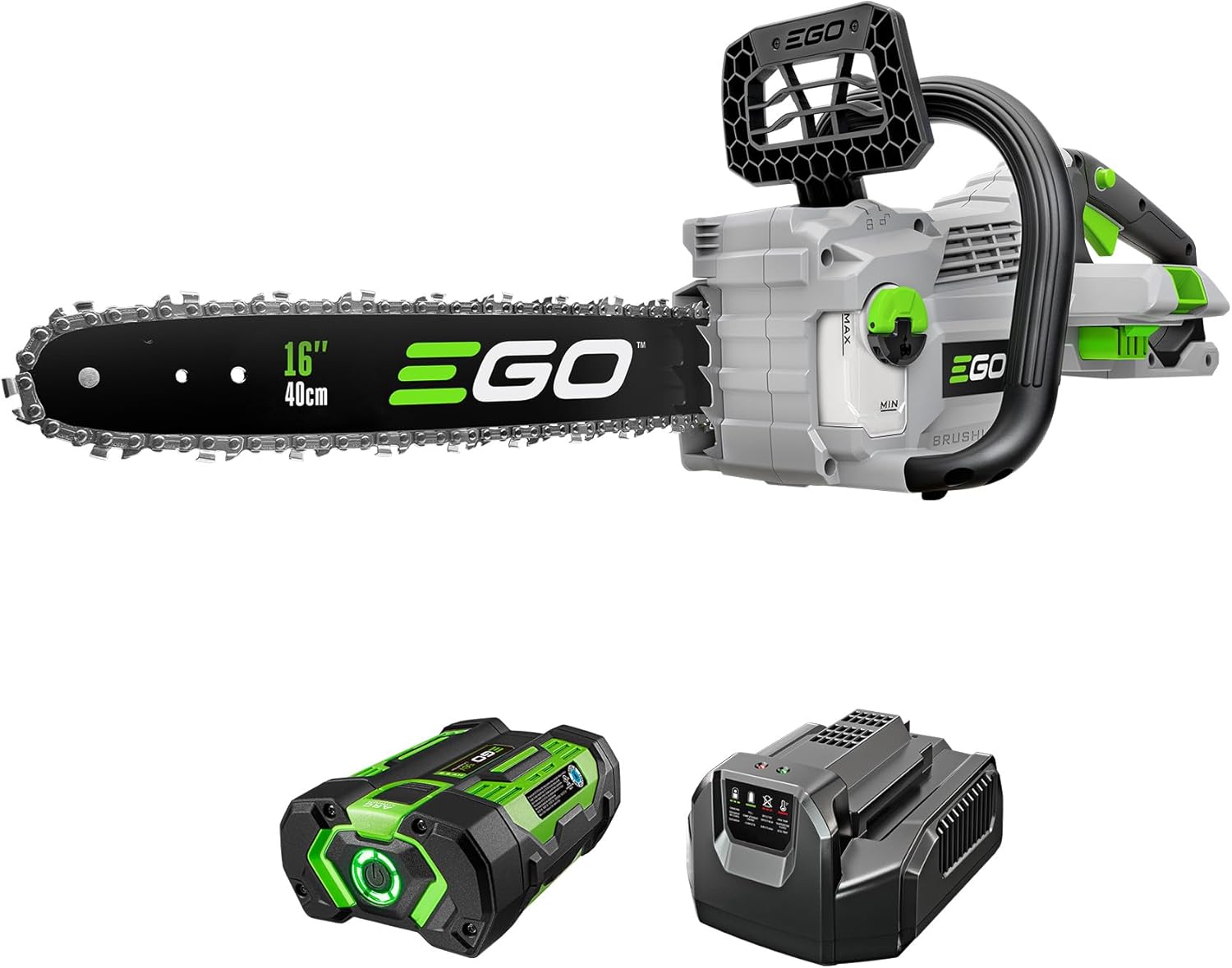
EGO POWER+ CS1611 16" Cordless Chainsaw with 56V 2.5Ah Battery and Charger
| Power Source | Battery Powered |
|---|---|
| Horsepower | 2.3 |
| Chain Length | 16 inches |
| Included Components | 2.5Ah Battery and Standard Charger |
| Chain Speed | 20 m/s |
The EGO POWER+ CS1611 is a battery-powered 16-inch chainsaw built to give prosumer-level cutting performance without gas. It uses a high-efficiency brushless motor rated as a 40CC equivalent and runs on the included 56V 2.5Ah ARC Lithium battery, which the manufacturer says delivers up to about 130 cuts through a 4×4 on a single charge. Notable features include a 20 m/s chain speed for efficient cuts, a tool-free chain-tensioning dial for quick on-the-job adjustments, automatic oiling with a spill-free reservoir, metal bucking spikes for secure cutting, and an IPX4 weather resistance rating. In real use this means quieter, low-maintenance operation compared with gas saws, fast setup between cuts, and enough runtime for routine property work like limb removal, small tree felling, and firewood prep. Limitations are battery runtime for very heavy or continuous commercial use and the saw’s 16-inch bar, which restricts maximum cut diameter compared with larger pro gas models.
Best for: Buyers wanting a low-maintenance, gas-free alternative that still delivers near-gas power for regular property maintenance, pruning, and medium-duty cutting tasks.
Less Ideal for: Users who need long uninterrupted runtime for commercial logging or must cut very large-diameter timber should consider larger gas or higher-capacity battery systems.
- Brushless motor with 40CC gas-equivalent power for strong cutting performance
- Includes 56V 2.5Ah battery and charger so it is ready to use out of the box
- Tool-free chain tensioning lets you adjust the chain quickly on site
- Automatic oiling with a spill-free reservoir keeps the chain lubricated during work
- IPX4 weather resistance and metal bucking spikes add durability and control in outdoor conditions
- 16-inch bar limits maximum cut diameter compared with larger pro chainsaws
- Runtime depends on battery capacity and may be insufficient for long, continuous heavy-duty jobs
Verdict: A ready-to-use cordless chainsaw that gives near-gas power and easy on-the-job adjustments, ideal for homeowners and pros doing regular medium-duty cutting.
Seesii M6 Lite 6" Cordless Mini Chainsaw with Two Batteries

| Power Source | Battery Powered |
|---|---|
| Horsepower | 900 watts |
| Chain Speed | 29ft/s |
| Chain Length | 6 inches |
The Seesii M6 Lite is a lightweight cordless mini chainsaw built for pruning, branch trimming, and small timber cuts around the yard. It pairs a 900 W motor with a 6-inch chain and claims chain speeds near 29–30 ft/s, which helps it slice through small logs and thick branches quickly. The kit includes two 21V 2000 mAh batteries, so you can swap batteries for extended work sessions without long downtime. Safety features include a double lock to prevent accidental starts, a chain guard to reduce flying debris, and a low-recoil ergonomic body that makes one-handed use comfortable for many users. Practical benefits are quick setup out of the box, included spare chain and basic tools, and a relatively quiet operation that is less intrusive than gas saws. Limitations are the short bar length, which restricts reach and large-log capability, and the unit uses a smaller chain pitch that is suited to light to medium yard tasks rather than heavy felling. For buyers focused on occasional pruning and portability, its balance of power and low weight is convenient, but it is not a replacement for larger professional saws when cutting large-diameter wood.
Best for: Buyers who want a compact, easy-to-use electric saw for routine yard pruning and small wood projects and who prioritize portability and convenience over industrial power.
Less Ideal for: People who need a chainsaw for heavy felling, professional logging, or cutting large firewood rounds should choose a larger bar length and higher-power model instead.
- Lightweight ergonomic design for easier one-handed pruning
- Includes two batteries and charger for extended run time
- Powerful 900 W motor and high chain speed for fast cuts on small branches
- Arrives ready to use with spare chain and basic tools included
- 6-inch bar limits reach and is unsuitable for large-diameter logs
- No automatic oiling system noted, so chain lubrication may require manual attention
Verdict: Choose the Seesii M6 Lite if you want a portable, one-handed electric chainsaw that makes quick work of pruning and small yard jobs with the convenience of two included batteries.
SEESII 12-Inch Cordless Brushless Chainsaw

| Power Source | Battery Powered |
|---|---|
| Horsepower | 1200 watts |
| Chain Length | 12 inches |
| Included Components | chainsaw |
The SEESII 12-inch cordless chainsaw is designed for homeowners and pros who need portable, high-power cutting without a generator. It pairs a 1200W brushless motor with two 4.0Ah batteries to deliver sustained cutting power for pruning, cutting storm debris, and working on small to medium logs. The tool-free chain tension system and automatic lubrication reduce downtime and routine maintenance, and the 60 mL oil tank helps keep the chain running smoothly during longer sessions. Because it is cordless and relatively lightweight for its class, it is easy to move around the yard or use at remote sites where cords are impractical. Important limits to note are the 12-inch bar, which constrains maximum log diameter compared with full-size saws, and battery reliance for very long jobs where alternating charged packs or a backup power source is needed. For straightforward woodcutting tasks this model balances cutting performance, convenience, and low maintenance.
Best for: Buyers who prioritize efficient, portable wood cutting for yard cleanup, pruning, and medium DIY projects and want a low-maintenance cordless saw they can move around the property easily.
Less Ideal for: Contractors or users who regularly need to fell large trees or process large-diameter logs should choose a full-size gas or professional electric chainsaw instead.
- 1200W brushless motor provides strong, efficient cutting power for hardwood and storm debris
- Two 4.0Ah batteries extend runtime for longer jobs and include a built-in charge indicator
- Automatic oiling with a 60 mL tank reduces frequent stops for lubrication
- Tool-free chain tensioning simplifies on-the-job adjustments
- Cordless, relatively lightweight design improves portability and use at remote sites
- 12-inch bar limits the maximum log diameter compared with larger professional chainsaws
- Runtime depends on battery swapping for extended heavy-duty cutting sessions
Verdict: A powerful, low-maintenance cordless 12-inch saw that maximizes portable cutting performance for homeowners and weekend woodworkers.
Choosing the Right Chainsaw for Overlanding: Key Factors to Consider
Portability and Stowage
How easily a chainsaw fits on your vehicle or inside packed gear determines whether you will actually bring it. Look for compact dimensions, a wrap or scabbard for the bar, and mounting-friendly shapes that tuck into a rooftop box or side case. Weight matters for both fuel economy and how you handle the saw when dismounting to clear an obstruction.
Consider the balance between bar length and transport size. A shorter bar stores more easily and weighs less, but limits the size of logs you can process. If you plan multi-day trips, factor how often you will be lifting and carrying the saw on uneven terrain.
Field Serviceability and Tools
When you are remote, simple repairability is critical. Prefer designs with easily accessible spark plugs or battery modules, user-replaceable chains, and tool storage or compatibility with a compact multi-tool. Quick chain tensioning systems and simple carburetor adjustments (for gas models) or removable battery packs (for electric models) reduce downtime.
Bring a small kit with spare links, a file or sharpening tool, a compact wrench, and any specialty bits the saw requires. Evaluate whether common service parts are generic or proprietary; generic chains and bars will be easier to replace on longer trips.
Fuel System, Battery Life, and Recharging Options
Fuel access and charging are major constraints while overlanding. Gas saws with simple carburetors and easy-start systems allow quick refueling from jerry cans, but they require carrying spare fuel and basic fuel-line maintenance supplies. Battery-electric saws eliminate fuel leaks and fumes and often start instantly, but they depend on battery capacity and your vehicle or portable power setup to recharge them.
Estimate how many cuts or hours you need per trip and compare that to tested runtime or expected fuel consumption. For electric setups, plan charging: can you top up from a dual-battery house system, a portable solar generator, or your vehicle's alternator? Consider carrying at least one spare battery or some lightweight fuel containers.
Cutting Performance for Trail Tasks
Chainsaw power should match typical overlanding needs: cutting logs for firewood, clearing leaning trees from a track, and limbing downed branches. Look at motor or engine power relative to bar length and chain type. A well-matched saw will slice through common hardwoods without bogging down and will return you to travel quickly.
Also consider chain speed and kickback characteristics. A saw that cuts efficiently with a modest bar length will reduce the number of passes needed and lower user fatigue. For frequent firewood processing, choose higher torque at low speeds; for quick branch clearing, higher chain speed may be preferable.
Durability Against Dust, Moisture, and Vibration
Trail conditions expose tools to dust, sand, rain, and sustained vibration. Seals, robust air filtration, and corrosion-resistant finishes extend service life. Components that are tightly fitted reduce the chance of dirt ingress that can jam chains or clog carburetors and filters.
Also assess the construction of mounting points and handles. Reinforced polymer or metal-reinforced housings resist cracking from drops or repeated loading. Vibration damping in handles helps reduce fatigue and protects fasteners from loosening during long drives on rough roads.
Safety Features and Ergonomics
Controls that are intuitive in cold, wet, or gloved hands make sawing safer. Chain brakes, responsive throttle controls, and comfortable grip ergonomics reduce the risk of mishandling when you are working quickly on roadside obstructions. Look for saws with clear choke and stop controls and guards that minimize accidental contact.
Ergonomic balance matters when you swing a saw repeatedly. Better balance lowers strain on your wrists and back and helps maintain a predictable cutting arc when processing awkward pieces of wood on uneven ground.
Choosing Between Gas and Battery Systems
Gas and battery chainsaws each bring tradeoffs for overlanding. Gas units offer extended operating range as long as you carry fuel and are often better for sustained heavy cutting. They can be refueled from jerry cans and tend to tolerate wide temperature ranges without runtime anxiety.
Battery saws are quieter, cleaner, and simpler to start and maintain at camp. Their usefulness depends on your ability to recharge batteries from a house battery, solar generator, or alternator. Battery technology improves rapidly, so newer packs can approach the runtime of small gas engines for light to moderate tasks.
- Choose gas when long, repeated heavy cutting is expected and you can carry spare fuel.
- Choose battery when noise, fumes, and quick starts are higher priorities and you have reliable recharge options.
Bar Length and Cutting Goals
Bar length determines what you can safely cut in a single pass. For overlanding, a compact bar in the 10 to 14 inch range often covers most campsite and trail-clearance needs while keeping the saw manageable for transport and handling. Longer bars increase reach but add bulk and weight.
Think about the largest log diameter you expect to encounter. If you frequently process large firewood logs, a longer bar or a plan for making multiple passes with a shorter bar is necessary.
- Short bars are lighter and easier to carry and store.
- Longer bars let you cut bigger logs but require stronger motors and add weight.
Safe Field Practices and Carrying Tips
Stowing and handling a chainsaw safely prevents accidents and damage. Always secure the bar with a scabbard and fasten the unit to a stable rack or in a padded box to stop movement while driving. Keep fuel or batteries sealed, and store a small spill kit for liquids.
When cutting, clear the work area of trip hazards and crouch or brace yourself so you are not off-balance. Use gloves, eye protection, and hearing protection. Rest the saw between longer cuts to avoid overheating and monitor chain tightness and lubrication.
- Use a scabbard for the bar and chain during transport.
- Pack a basic first-aid and tool kit tailored to saw maintenance.
Maintenance Routines You Can Do in the Field
Regular checks keep a saw running reliably away from a shop. Learn how to inspect and tension the chain, clean or replace the air filter, and sharpen the chain with a round file. For gas saws, carry a spare spark plug and a small bottle of fuel stabilizer if your trips are long.
Electric saws require watching battery contacts and keeping them clean and dry. Bring a small bottle brush, a soft rag, and a compact file or a chain sharpener to restore cutting efficiency. Simple, repeatable maintenance extends runtime and reduces the chance of a failure that leaves you stranded.
- Check chain tension and lubrication before each use.
- Carry spare wearable parts like a replacement chain or bar nuts.
Packing a Lightweight Saw Toolkit
A minimal toolkit keeps you mobile while enabling essential repairs. Include a multipurpose wrench that fits the bar nuts, a compact flat file or round-chain file with a guide, a small spark plug socket or screwdriver, and a length of replacement chain links or a full spare chain if weight allows.
Also pack a small container of bar oil and a few zip ties or hose clamps for emergency fixes. Organize the kit in a weatherproof pouch so tools remain usable after driving over dusty roads.
- Prioritize tools that cover the most common failures: chain dulling, loose fasteners, and a fouled spark plug.
- Keep oils and small parts in sealed containers to prevent contamination.
How We Chose the Best Chainsaw for Overlanding
We prioritized features that matter when a chainsaw must perform far from workshops or parts supply. Key evaluation criteria were portability and packability, field serviceability and tool access, fuel system simplicity or battery runtime and recharge options, cutting efficiency for common overlanding tasks, and safety features that reduce user fatigue during repeated limbing or clearing. We also considered durability of critical components like bars and chains and resistance to dust and moisture. Excluded items included full-size professional commercial saws that are impractical to transport on an overland rig and purely hobby yard saws that lack durability for wet or dirty trail conditions. We filtered candidates for realistic weight and stowage dimensions for rooftop cargo or interior storage, and we favored units with straightforward maintenance procedures that can be completed with a basic tool kit in the field. Final selections reflect gear that balances compact transport with dependable cutting performance and straightforward upkeep.
FAQ
What bar length is best for overlanding use?
For most overlanding tasks a bar between 10 and 14 inches hits the sweet spot. It balances the ability to process common campfire logs and clear trail obstructions while remaining compact and easier to carry.
Can I use a battery chainsaw without a generator?
You can if your vehicle has a reliable house battery system or you plan short, occasional use that fits the battery runtime. For longer or repeated cutting sessions you will need a way to recharge such as a portable power station or alternator charging.
Is carrying fuel for a gas saw a safety concern on trips?
Carrying fuel requires proper containers and secure stowage to prevent leaks and vapor buildup. Use approved jerry cans, keep fuel sealed, and separate it from living spaces. Small amounts for emergency use are common among overlanders when handled responsibly.
How often should I sharpen the chain on the trail?
Sharpen the chain when you notice it producing fine sawdust instead of clean chips or when cutting requires extra force. For regular campsite and trail clearing you may touch up the chain daily or after a few hours of cutting depending on wood type and amount.
What spare parts are wise to carry?
Carry a spare chain or a few replacement links, a spare spark plug for gas saws, a small bottle of bar oil, and basic fasteners that match your saw. These parts cover the most likely roadside repairs and keep you cutting until you can access a full workshop.
Final Verdict
Selecting a chainsaw for overlanding is about balancing transportability, the kinds of cutting you expect to do, and how you will maintain or refuel the saw on the trail. Prioritize units that are easy to service in the field, have manageable bar lengths for the tasks you face, and match your vehicle power or fuel plan. Accept tradeoffs: heavier gas models give longer range for heavy cutting but add weight and require fuel storage, while battery models offer cleaner, easier starts and quieter operation if you can recharge. Focus on portability, field serviceability, and safety features to make confident choices for extended vehicle-based travel.
