

Note: This article contains affiliate links. If you click on these links and make a purchase, I may earn a small commission at no extra cost to you. This helps support my research and content. Read my full affiliate disclosure here.
Working in the canopy changes how a chainsaw feels and performs. When you are suspended from a harness, every ounce, the balance point, and the ease of one-handed control matter for safety and efficiency. This guide compares seven carefully shortlisted chainsaws for tree climbing and focuses on the attributes climbers care about most. We evaluated these options across handling, safety features, and upkeep demands to highlight choices that reduce fatigue, make controlled cuts, and fit common arborist and enthusiast climbing setups. Read on to understand which specs and features matter for climbing work and why they influence real-world performance.
Top Picks at a Glance
| Best Overall The best all-around choice for most situations | V-MODEST 12" Top-Handle Gas Chainsaw, 25cc |  |
| Best Quality Built to a higher standard if you want something more solid | Husqvarna T435 12 in. Top-Handle Gas Chainsaw |  |
| Best Value The sweet spot between price and what you get | PROYAMA 26CC Top-Handle Gas Chainsaw, 12-Inch |  |
| Best Budget The cheapest option that still gets the job done reliably | kunghei 12" Top-Handle Gas Chainsaw, 25.4cc 2-Stroke |  |
| Highest Rated A top-rated pick with lots of positive feedback | NEO-TEC 25cc 12" Top-Handle Small Gas Chainsaw |  |
| Most Popular A crowd favorite that many people choose with confidence | VEVOR 25.4cc Top-Handle Gas Chainsaw, 12-Inch Bar |  |
| Best Seller A high-volume bestseller chosen again and again | NEO-TEC NCS2500 12" Top-Handle Gas Chainsaw (25.4cc) |  |
V-MODEST 12" Top-Handle Gas Chainsaw, 25cc

| Power Source | Gas Powered |
|---|---|
| Horsepower | 1.51 hp |
| Chain Speed | 26.7ft/s |
| Chain Length | 12 inches |
This V-MODEST 12-inch top-handle chainsaw is a compact gas-powered saw built for tree work where control and low weight matter. Its 25cc two-stroke engine produces about 1.5 hp and spins the chain quickly for clean cuts on branches, limbs, and small logs. The top-handle layout, 5.5 lb dry weight, anti-vibration system, and lanyard ring make it easy to handle when climbing or working in tight, elevated positions. Practical features include an easy-start system, adjustable oil pump, tool-free-ish chain tensioning, a dual-post chain brake, and a fine-mesh cover to help keep debris out of the air intake. The saw ships with a basic kit—bar, chain, fuel-mixing bottle, gloves, and tools—so you can get started without sourcing extras. Expect typical small-gas-saw maintenance: correct 25:1 fuel mixing, periodic air-filter and chain care, and attention to vibration and noise levels inherent to two-stroke engines. This is a solid choice for climbers and experienced homeowners who need a nimble, powerful saw for pruning rather than heavy felling of large trunks.
Best for: Climbers and arborist-minded homeowners who prioritize a lightweight, maneuverable saw for pruning and elevated work and who are comfortable with two-stroke engine maintenance.
Less Ideal for: People who need a saw for frequent heavy felling, large-diameter logs, or who want a low-maintenance electric alternative.
- Very lightweight top-handle design (5.5 lb) for easier control while climbing and working overhead
- 25cc two-stroke engine with about 1.5 hp offers strong power-to-weight for pruning and limb work
- Easy-start system and adjustable oil pump improve usability and chain lubrication control
- Safety and control features including dual-post chain brake, anti-vibration system, and lanyard ring
- Comes with essential accessories: bar, chain, fuel-mixing bottle, gloves, and basic tool kit
- Requires manual 25:1 gas/oil mixing and regular two-stroke maintenance
- Not intended for heavy felling or continuous cutting of large-diameter logs
Verdict: A nimble, top-handle gas saw that gives climbers the power and low weight needed for precise pruning and elevated tree work.
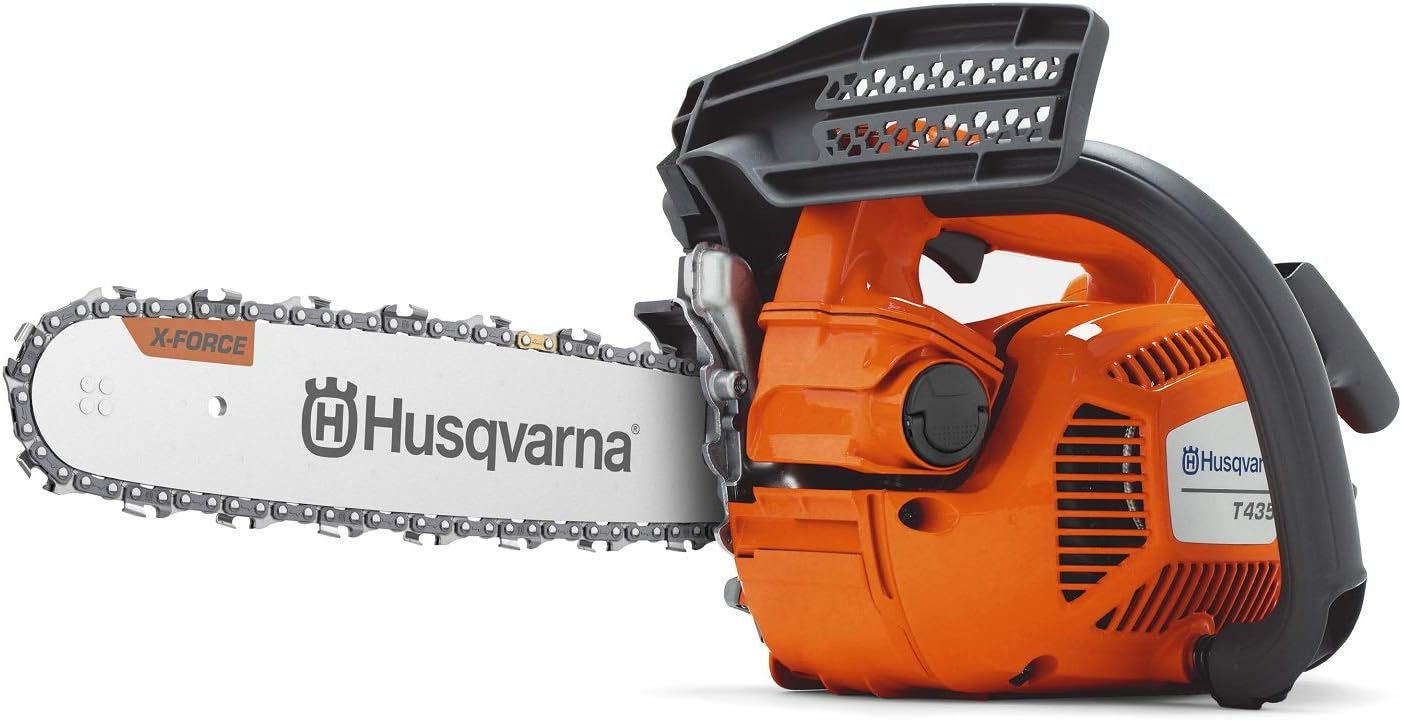
Husqvarna T435 12 in. Top-Handle Gas Chainsaw
| Power Source | Gas Powered |
|---|---|
| Horsepower | 2.01 hp |
| Chain Length | 14 inches |
The Husqvarna T435 is a top-handle gas chainsaw designed for tree care professionals who need a light, maneuverable tool for pruning, limbing, and work in the canopy. It delivers 2.01 horsepower from a 35.2 cc X-Torq engine that maintains torque at low RPMs, making controlled cuts easier when working overhead. The unit is unusually light for its power, improving balance and reducing operator fatigue during long shifts. Practical user-focused features include Smart Start for easier pulls, LowVib anti-vibration isolation, an inertia-activated chain brake for safety, adjustable oil pump for different weather or cutting conditions, and simple maintenance with a quick-release air filter and side-mounted chain tensioning. The top-handle layout and heavy-duty rope attachment point make it straightforward to hoist and position in trees. Limitations are the inherent requirements of a gas saw: routine fuel and oil maintenance and higher noise and emissions than battery alternatives, plus a learning curve for safe top-handle operation in tight canopy situations.
Best for: Aimed at professional arborists or serious tree-care contractors who prioritize maneuverability, quick responsiveness, and minimal operator fatigue when working aloft.
Less Ideal for: Homeowners who want a low-maintenance, quiet saw or casual users uncomfortable with top-handle operation should consider simpler rear-handle or battery options.
- Excellent power-to-weight ratio for overhead and canopy work
- X-Torq engine for good low-RPM torque and improved fuel efficiency
- Smart Start and LowVib reduce startup effort and operator fatigue
- Adjustable oil pump and easy-access maintenance features speed field servicing
- Top-handle design with rope attachment simplifies hoisting into trees
- Requires regular gasoline maintenance and produces more noise and emissions than battery saws
- Top-handle layout is less forgiving for inexperienced users and demands careful handling
Verdict: Buy this if you need a lightweight, professional-grade top-handle saw that balances strong low-end power with excellent maneuverability for canopy and pruning work.
PROYAMA 26CC Top-Handle Gas Chainsaw, 12-Inch

| Power Source | Gas Powered |
|---|---|
| Horsepower | 1.1 hp |
| Chain Length | 12 inches |
The PROYAMA 26CC top-handle chainsaw is a purpose-built small gas saw for pruning, tree climbing, and general yard maintenance. It pairs a 1.1 hp 26cc engine with a 12-inch bar and ships with two spare chains, so you can keep working through dulling without immediate downtime. The top-handle, wrap-around grip and relatively light build make the saw easy to maneuver in the canopy and to operate one-handed when positioned safely in a harness. Useful features for regular use include a spring-assisted pull start, quick-release air filter for easier cleaning, and an adjustable oil pump to control chain lubrication. The saw is intended for light to moderate cutting tasks such as limb removal, pruning, and small firewood; it is not aimed at heavy felling or prolonged industrial use. Buyers should expect routine small-engine maintenance and to use correct climbing safety gear for one-handed operation. For climbers who want a compact, serviceable gas option, this model balances portability and practical features without the weight of full-size saws.
Best for: Arborists, experienced climbers, and homeowners who need a lightweight, portable gas saw for pruning and canopy work and who prioritize maneuverability and easy servicing.
Less Ideal for: Users who need a saw for heavy felling, large-diameter cutting, or extended high-volume timber work should choose a full-size chainsaw instead.
- Top-handle, wrap-around grip designed for improved control when climbing and pruning
- 26cc engine with 1.1 hp delivers enough power for pruning, limb removal, and small firewood
- Comes with a 12-inch bar and two spare chains to reduce downtime
- Quick-release air filter and adjustable oil pump simplify routine maintenance and lubrication control
- Small 12-inch bar and 26cc engine are not suited for heavy felling or large-diameter logs
- Gas engine requires regular maintenance and fuel mixing typical of two-stroke saws
Verdict: A compact, climb-friendly gas chainsaw that gives climbers and pruners a balance of portability, serviceable features, and enough cutting power for light to moderate tree work.
kunghei 12" Top-Handle Gas Chainsaw, 25.4cc 2-Stroke

| Power Source | Gas Powered |
|---|---|
| Horsepower | 1.22 hp |
| Included Components | Manual, chainsaw, guide plate cover, protective baffle, assembly accessories |
| Model Number | 00400 |
This compact top-handle gas chainsaw is built around a 25.4cc two-stroke engine that delivers about 1.22 hp and can spin the chain up to 9,000 rpm for fast cuts. Its short guide bar (about 12 inches) and top-handle layout make the saw easier to maneuver in tight spots and when working from a harness or ladder, which suits pruning and limb work on trees. Notable features include a quick-start pull cord, a high-temperature-quenched chain for sharper cutting, and a tool-accessible chain tension adjustment that reduces downtime. The aluminum alloy housing with reinforced nylon is intended to balance durability with lower weight. Expect practical benefits like good control for directional cuts, quick starts in the field, and simpler on-the-job chain adjustments. Important limitations are the small displacement and lower horsepower compared with larger pro saws, which means slower progress on thick trunks and more frequent refueling and maintenance typical of budget gas models. Also, safety and vibration isolation are basic compared with higher-end climbing-specific saws.
Best for: A buyer who wants a low-cost, maneuverable gas saw for climbing, pruning, and light tree work and prioritizes portability and easy field service over high-end power.
Less Ideal for: Professional arborists or users who need a high-power saw for frequent felling of large trunks should consider more robust, purpose-built models.
- Top-handle, short-bar design improves maneuverability for pruning and working from a harness
- Quick-start pull cord for faster field starts
- Tool-accessible chain tension adjustment simplifies on-the-job maintenance
- Aluminum alloy and reinforced nylon construction aims to keep it durable while remaining relatively light
- Modest engine size and power that limit performance on large-diameter trunks
- Basic vibration and safety features compared with professional climbing saws
Verdict: A compact, budget-friendly top-handle gas chainsaw that gives climbing gardeners a portable, easy-to-start tool for pruning and light tree work.
NEO-TEC 25cc 12" Top-Handle Small Gas Chainsaw

| Power Source | Gas Powered |
|---|---|
| Horsepower | 1.2 hp |
| Chain Length | 12 inches |
The NEO-TEC 25cc top-handle chainsaw is a compact gas-powered saw built for pruning, limbing, and light felling where portability and quick starts matter. It pairs a 1.2 hp 2-stroke engine with a 12-inch bar to deliver high-revving performance up to 12,000 RPM, while a spring-assisted ignition and quick-start system make it easy to get running in the field. The wrap-around ergonomic handle and low vibration design support comfortable single-handed operation for tree climbing and tight cuts, and a metal lanyard ring improves safety when working at height. The carburetor tuning and claimed fuel-efficiency mean longer run times between refills compared with less refined small saws. Important limitations are its small bar length and top-handle layout, which restrict it to lighter-duty work and users comfortable operating a saw with one hand; heavier cutting or prolonged felling of large trees will require a full-size rear-handle saw. Routine 2-stroke maintenance and correct fuel mix are necessary to keep the engine reliable over time.
Best for: Buyers who prioritize a reliable, easy-to-start small gas saw for pruning, limbing, and climbing tasks and who value portability and consistent field performance.
Less Ideal for: Do not choose this if you need a saw for heavy felling, prolonged multi-day lumber work, or prefer a two-handed rear-handle saw for maximum control.
- Compact, lightweight top-handle design for easy single-handed use and climbing
- Spring-assisted ignition provides fast, consistent one-pull starts in the field
- 1.2 hp 2-stroke engine with high RPM delivers strong cutting power for a small saw
- Ergonomic wrap-around handle and reduced vibration for more comfortable extended use
- Precision carburetor and tuned combustion for improved fuel efficiency
- 12-inch bar limits capacity for large-diameter felling and deep cuts
- Top-handle configuration is less stable for two-handed heavy cutting and better suited to experienced climbers
Verdict: Choose this compact top-handle chainsaw when you need a dependable, easy-starting gas saw for pruning, limbing, and climbing jobs.
VEVOR 25.4cc Top-Handle Gas Chainsaw, 12-Inch Bar

| Power Source | Gas Powered |
|---|---|
| Horsepower | 1.2 hp |
| Chain Length | 12 inches |
| Model Number | CN-25 |
The VEVOR 25.4cc top-handle gas chainsaw is a compact, handheld saw built for pruning, light felling and general property maintenance. It uses a 2-cycle 25.4cc engine rated at about 1.2 hp and drives a 12-inch bar and high-strength steel chain that handles branches and small logs up to roughly 9.8 inches in diameter. Practical features include an easy-start system, a tool-free chain tension knob, a protective guard to reduce sawdust spray and onboard tanks for fuel and chain oil to limit downtime. At roughly 9 to 10 pounds the saw is relatively nimble for one-handed trimming and working in trees when combined with proper climbing gear. Important limitations are its modest power and short bar, which make it unsuitable for heavy felling or cutting large logs, and the usual maintenance needs of a 2-cycle gas engine such as mixing fuel and regular spark plug and carburetor care. For users who need a portable, serviceable saw for routine yard and tree work, it delivers sensible capability for its class.
Best for: Buyers who want a portable, serviceable gas saw for regular pruning, tree trimming and light felling and who value straightforward features and ease of use over maximum cutting power.
Less Ideal for: Not a good fit for landowners who need a saw for heavy timber work, milling logs, or frequent long-duration cutting where a larger bar and higher horsepower are required.
- Compact and lightweight for easier handling during pruning and above-ground work
- 12-inch steel bar and chain suited to trimming, limb work and small log cutting
- Tool-free chain tensioning for quick adjustments in the field
- Easy-start system and included maintenance kit simplify setup and upkeep
- 12-inch bar and 1.2 hp output limit use to light-duty cutting and small trees
- Requires routine 2-stroke engine maintenance and fuel mixing
Verdict: A lightweight, easy-to-use top-handle gas chainsaw that reliably handles pruning and light felling for homeowners and tree care hobbyists.
NEO-TEC NCS2500 12" Top-Handle Gas Chainsaw (25.4cc)

| Power Source | Gas Powered |
|---|---|
| Horsepower | 1.2 hp |
| Chain Length | 12 inches |
The NEO-TEC NCS2500 is a lightweight top-handle gas chainsaw built for tasks like tree climbing, pruning, limbing, and small-tree felling. Its 25.4cc two-stroke engine produces about 1.2 horsepower and is paired with a 12-inch bar and 3/8LP chain, giving it enough cutting power for limbs and medium branches while staying easy to maneuver aloft. The ergonomic wrap-around handle and metal lanyard ring are practical for single-handed operation and attaching safety gear when climbing. A spring-assisted quick-start system helps get the saw running with fewer pulls, and the manufacturer highlights a precision carburetor for better fuel efficiency. Expect the usual maintenance of a gas saw: fuel mixing, routine chain sharpening, and occasional carburetor adjustments. Also note that a top-handle design prioritizes portability over extended-duty comfort, and vibration and noise are higher than on electric models. For cautious users, its compact size and climbing-focused features make it a capable tool when used with proper safety equipment and climbing technique.
Best for: A cautious climber or arborist who prioritizes a small, portable saw for pruning and limb work and values easy starting and secure attachment points when working aloft.
Less Ideal for: Users who need a saw for long continuous felling or ground-based heavy cutting should choose a larger rear-handle or higher-displacement model instead.
- Compact 12" bar and light overall weight make it easy to maneuver while climbing
- Top-handle and metal lanyard ring designed for single-handed operation and attachment of climbing gear
- Spring-assisted quick-start system reduces pull effort and speeds setup
- Precision carburetor and tuned combustion aimed at improved fuel efficiency
- Top-handle layout is less comfortable for long ground work and offers less leverage than rear-handle saws
- As a small gas saw it requires regular fuel mixing and routine engine maintenance
Verdict: If you want a lightweight, climb-ready gas saw that starts easily and attaches securely for pruning and limb work, this NEO-TEC 12" top-handle is a solid choice.
Choosing the Right Chainsaw for Tree Climbing: Key Factors to Consider
Weight and Balance
Weight and balance directly influence how long you can safely hold and maneuver a saw while suspended. A lighter saw reduces arm and shoulder strain, but an underweight tool can feel twitchy if balance is poor. Balance point matters more than raw mass because a well-balanced saw lets you maintain control with short, precise cuts and lowers the chance of sudden rotation during the cut.
Consider how the saw behaves when held at the rear handle only or when supported with the back of the blade against a limb. For climbers, a slightly rear-heavy balance can help stabilize the bar during pull cuts, while too much front bias increases wrist load. Think about how you will move the saw between positions; a well-balanced unit requires less corrective motion and is safer when handling lines and carabiners.
Safety Features
Safety systems are critical when a miscut could quickly escalate while you are off the ground. Look for reliable chain brakes that engage instantly on kickback or sudden hand movement. A low-kickback chain and bumper nose design reduce the occurrence of violent upward motions that are especially dangerous aloft. Additional guards around the bar tip and thoughtful throttle interlocks help prevent accidental throttle engagement when you are repositioning.
Also evaluate how the saw behaves during binding or pinching. Chain quick-release and easy access to the chain when partially buried in a cut can shorten risky moments spent aloft. Consider whether the saw allows for safe one-handed operation in short bursts without losing engagement of safety systems.
Bar Length and Cutting Reach
Bar length determines what cuts you can make without changing position or lowering a limb. For most climbing pruning and limb removal tasks, a moderate bar length offers a balance between reach and maneuverability. Longer bars reach farther but add weight and increase leverage that can pull a climber off balance. Shorter bars are easier to control in tight canopy spaces.
Match bar length to the typical branch diameters and reach in your trees. Also consider whether the saw accepts low-profile bars designed for reduced bite and better control in confined cuts. Removable bar and chain combinations that are simple to swap on the ground give flexibility without committing to excessive bar length on the climb.
Starting Reliability
A saw that starts reliably reduces time spent troubleshooting while aloft or during a climb cycle. Consistent starting systems, easy choke operation, and predictable throttle response are important because a stalled saw in a difficult position creates additional risk. Cold-weather starting behavior can be a concern depending on your climate and season of work.
Also consider fuel or battery management. For gas models, easy refueling protocols and predictable fuel consumption help plan work sessions. For battery models, quick battery swaps and clear remaining charge indicators prevent mid-climb surprises and allow you to coordinate ground support when needed.
Serviceability and Routine Maintenance
Climbers benefit from saws that are straightforward to service because many maintenance tasks happen between climbs or during short breaks on the ground. Easy chain tensioning, accessible sprockets, and clear instructions for chain sharpening keep downtime low. Tools that require complex disassembly for basic adjustments increase the chance of neglected maintenance, which can degrade cutting performance and safety.
Consider how component wear is monitored and replaced, such as chain and bar longevity, air filter access, and spark plug or battery service. If a saw can be partially serviced on site with simple tools, it minimizes the need to lower heavy components and reduces the risk of leaving the work incomplete.
Choosing Between Gas and Battery Options
Gas and battery chainsaws each have tradeoffs that affect climbing use. Gas models often deliver stronger sustained power for heavy cuts and do not require mid-day battery swaps, but they bring additional weight and vibration. Battery saws are typically quieter, cleaner, and easier to maintain on the ground, and some modern batteries supply enough power for many pruning tasks while being lighter overall.
Think about the typical length of your jobs, availability of ground support, and environmental constraints. If you regularly work long shifts or need maximum cutting throughput, gas models may be appropriate despite the extra mass. If you prioritize reduced vibration, lower maintenance, and the ability to make quiet checks in suburban areas, battery models can be a better match.
- Gas: higher continuous power, more vibration and maintenance
- Battery: lower vibration, cleaner operation, limited run time per battery
- Consider spare batteries or fuel plan based on job duration
Ergonomics and Handle Setup
Handle shape, spacing, and vibration isolation influence how steady the saw feels when you are clipping in and repositioning. Look for rear and top handles that allow secure one-handed support when needed and include rubberized grips to reduce slippage. Anti-vibration mounts and dampening reduce numbness and fatigue over a long day of cuts.
The position of controls matters. Throttle locks, choke levers, and stops should be reachable without changing your grip drastically. Controls that require awkward hand positions increase the time your hands are off ropes or carabiners, so favor layouts designed for quick, intuitive use.
- Rubberized comfortable grips reduce slippage
- Anti-vibration features lessen arm fatigue
- Accessible control placement improves safety aloft
Chain Selection and Cutting Technique
Chain type and pitch affect cutting speed, smoothness, and kickback profile. For canopy work, choose chains that cut efficiently on limb wood while offering reduced kickback risk. Low-kickback chains with properly matched pitch to the bar will deliver cleaner, safer cuts when you are working at awkward angles.
Technique matters as much as chain choice. Use controlled, deliberate cuts, avoid aggressive plunging with the bar tip, and favor pull cuts that keep the saw body aligned with your center of mass. Keep chains sharp and properly tensioned to reduce binding and vibration that can destabilize a climber.
- Match chain pitch to bar specifications
- Keep chains sharp and tensioned for smooth cuts
- Favor cutting techniques that minimize tip contact
Rigging and Safe Saw Handling Practices
Integrate saw handling into your standard rigging routine. Use tethers or dedicated saw holsters to secure the saw when not in use, and practice transferring the saw safely between harness and limb positions. Always plan cuts so the saw can be lowered or retrieved without awkward reaches.
Communicate clear hand signals or verbal cues with your ground person when lowering or receiving a saw. Establish a safe method for releasing bar tension and securing the chain before stowing. Routine rehearsals on the ground reduce the chance of mistakes when canopy height and fatigue add pressure.
- Use a tether or holster when descending or moving
- Plan cuts with retrieval in mind
- Practice transfers on the ground before working aloft
When to Replace Parts Versus Trade Up
Assess whether worn components still meet safety and performance needs. Replacing chains, bars, or mounting parts can restore a saw to good working order without the weight or learning curve of a different model. However, persistent vibration, frequent binding, or control deterioration can signal that a different saw design would better suit climbing work.
Regularly inspect mounting hardware, anti-vibration mounts, and throttle linkages. If multiple components show wear simultaneously, the cumulative effect may justify upgrading to a saw designed specifically for lighter, canopy-focused tasks.
- Routine part replacement extends service life
- Multiple worn systems may indicate the need for a different saw
- Track maintenance dates and replacement intervals
How We Chose the Best Chainsaw for Tree Climbing
We prioritized criteria that directly affect safety and handling when a saw is used aloft. Weight and balance were key because they determine how quickly a climber tires and how easily the saw can be controlled with one hand or while repositioning. Cutting reach and bar length mattered for common pruning and limb removal tasks without overextending from the rope. Safety systems were examined for automatic chain braking, kickback protection, and nose guard designs that reduce accident risk during awkward cuts. We also assessed starting reliability and choke systems since a jammed or hard-to-start saw in a tree creates a hazardous retrieval scenario. Serviceability was a factor: easy chain tensioning, sprocket access, and routine maintenance steps reduce time spent working aloft or needing ground assistance. Vibration and handle ergonomics were included because lower vibration and comfortable grips reduce arm fatigue and improve control. Excluded from consideration were saws designed only for heavy-felled timber work where weight and size make them impractical for climbing. We filtered out specialized industrial units that require professional rigging beyond typical arborist setups. The final shortlist balances manageable mass, safety features tailored to overhead use, and practical maintainability for climbing environments.
FAQ
What bar length is best for most tree climbing tasks?
A moderate bar length is usually best for climbing because it offers a balance between reach and control. Bars that are too long add leverage and weight, while very short bars limit what you can cut without repositioning. Choose length based on typical branch size and how often you need extra reach.
Can battery chainsaws handle repeated canopy cuts?
Battery saws can handle many pruning and small limb removal tasks, but runtime depends on battery capacity and cut intensity. For extended sessions, plan spare batteries or expect to alternate between shorter cutting periods and repositioning. Heavy, continuous cutting may still favor gas options.
How important is anti-vibration for climbing saws?
Anti-vibration features are important because they reduce hand and arm fatigue, improving control and safety during prolonged use. Less vibration also decreases the chance of losing your grip when making precise cuts aloft.
Should I use a one-handed cutting technique while aloft?
One-handed use should be limited to brief, controlled motions when needed. Most safe cutting is done with both hands on the saw when possible. Train for secure one-handed control for specific tasks, but rely on stable positions and quick, deliberate cuts rather than extended one-handed operation.
How often should I check chain tension when working aloft?
Check tension before each climb and during extended work breaks on the ground. Chains can loosen as they warm and wear, and checking frequently reduces the risk of derailment or binding while you are suspended.
Final Verdict
Selecting a chainsaw for tree climbing requires prioritizing manageable weight, predictable balance, and robust safety systems over raw cutting power. Focus on tools that are serviceable, start reliably, and have ergonomics suited to one-handed positioning and quick transfers. Expect tradeoffs: lighter, battery models may reduce fatigue but limit runtime, while gas options deliver more sustained power at the cost of added mass. Decide which tradeoffs match your typical jobs, then prioritize those scoring criteria to narrow options. By putting balance, safety, and serviceability at the top of your list, you can select a saw that helps you work efficiently and reduces unnecessary risk while aloft.
