

Note: This article contains affiliate links. If you click on these links and make a purchase, I may earn a small commission at no extra cost to you. This helps support my research and content. Read my full affiliate disclosure here.
Picking the right Chinese LED grow light matters for healthy indoor plants, higher yields, and lower running costs. You want a fixture that delivers the right spectrum and intensity for your crop without overheating a small grow space or driving electricity bills through the roof. This guide covers seven shortlisted Chinese LED grow lights that stood out for real garden use. We evaluated spectral balance, energy efficiency, thermal management, build durability, and ease of setup so you can choose a fixture that fits your space and plants. Read on for practical guidance to match a light to your indoor gardening goals.
Top Picks at a Glance
| Best Overall The best all-around choice for most situations | MARS HYDRO TS1000 150W Full Spectrum LED Grow Light |  |
| Best Quality Built to a higher standard if you want something more solid | Spider Farmer SF1000 100W Full Spectrum LED Grow Light |  |
| Best Value The sweet spot between price and what you get | KINGPLUS KP1000 100W LED Grow Light for 2×2–2×3 ft Tents |  |
| Best Budget The cheapest option that still gets the job done reliably | mfxmf A19 Full-Spectrum LED Grow Light Bulb, 9W (2-Pack) |  |
| Highest Rated A top-rated pick with lots of positive feedback | VIPARSPECTRA P700 70W Dimmable Full Spectrum LED Grow Light |  |
| Most Popular A crowd favorite that many people choose with confidence | GooingTop HY-021 6000K Full-Spectrum Clip Grow Light |  |
| Best Seller A high-volume bestseller chosen again and again | Barrina 4ft T8 Full Spectrum LED Grow Light, 6-Pack |  |
MARS HYDRO TS1000 150W Full Spectrum LED Grow Light

| Wattage | 150 watts |
|---|---|
| Light Source Type | Light Emitting Diode |
| Power Source | Corded Electric |
| Light Source Special Features | Dimmable, Daisy Chain |
| Number of Light Sources | 342 |
The MARS HYDRO TS1000 is a compact 150W LED grow light built for small indoor grows and tent setups. It delivers a full-spectrum output aimed at all growth stages and uses a dense array of 342 LEDs arranged to give stronger, more even light in the center and usable coverage up to about 3×3 feet for vegetative growth and 2.5×2.5 feet in bloom. The driver offers 0–100% dimming and the fixture supports daisy-chaining multiple units, which makes it easy to scale a canopy without extra wiring. Its aluminum body and patented white reflector boost light utilization while the fanless design keeps operation silent. Practical benefits include low energy draw compared with equivalent HID systems and simple inside-mount installation for tents or racks. Limitations are its modest total wattage and coverage, which mean multiple units are needed for larger rooms, and true smart controls are optional add-ons rather than built in. Also the RJ12 connector for daisy-chaining may be required separately.
Best for: Growers who want a reliable, energy-efficient light for a single tent or small personal garden and value quiet, even lighting and easy scaling with additional fixtures.
Less Ideal for: People planning to light large rooms or commercial canopies with a single fixture should look at higher-wattage models or multiple-unit kits instead.
- Full-spectrum LED array suitable for seed-to-flower growth stages
- Dimmable 0–100% driver for easy light intensity control
- Fanless aluminum design runs quietly and dissipates heat efficiently
- Daisy-chain support lets you connect multiple units for larger coverage
- 150W output limits single-unit coverage to small tents or compact setups
- RJ12 connector for chaining is not included and must be sourced separately
Verdict: A quiet, energy-efficient 150W full-spectrum LED that fits small grow tents and scales well if you add more units.
Spider Farmer SF1000 100W Full Spectrum LED Grow Light

| Light Source Type | LED |
|---|---|
| Light Output Maximum | 10000 lumens |
| Light Source Wattage | 100 watts |
| Light Source Special Features | Dimmable |
| Specification Met | IP67 |
The Spider Farmer SF1000 is a compact 100W full spectrum LED grow light intended for 2×2 to 3×3 grow spaces and small tents. It uses a high diode count and upgraded LED chips to deliver broad-spectrum output that supports seedlings through flowering, with a dimmer knob to reduce intensity for early stages and ramp up for bloom. The fanless design and thick aluminum heatsink keep operation quiet while providing passive cooling, and the fixture meets IP67 for durable performance. Typical use is ceiling or tent mounting above individual plants or a small canopy where uniform coverage and deeper canopy penetration matter. Notable features include daisy-chain compatibility for linking multiple units under unified dimming, a 0–100% dimmable control, and a driver claimed to offer efficient power delivery. Practical benefits are even light distribution in a small footprint, predictable veg-to-flower capability, and near-silent operation. Limitations are inherent to its class: it is sized for small areas so you will need multiple units for larger tents, and the product description emphasizes specs from manufacturer tests rather than independent third-party PPFD maps.
Best for: Growers who want a quiet, compact full spectrum light for a small tent or single-plant setup and value adjustable intensity for each growth stage.
Less Ideal for: People running larger multi-plant rooms or commercial operations who need higher total output and broader single-fixture coverage.
- Full spectrum output suitable for all growth stages with added red and IR for flowering
- Dimmable 0–100% control lets you tailor light intensity to seedlings, veg, and bloom
- Fanless design with sturdy aluminum heatsink for quiet, low-maintenance operation
- Compact footprint ideal for 2×2 to 3×3 tents and small indoor setups
- Daisy-chain capable so multiple fixtures can be linked and dimmed together
- Coverage and power are intended for small grows so larger areas require multiple units
- Manufacturer gives efficiency and coverage figures without independent third-party PPFD charts
Verdict: A quiet, dimmable 100W full spectrum fixture that is a practical, balanced choice for hobbyists running 2×2 to 3×3 tents.
KINGPLUS KP1000 100W LED Grow Light for 2×2–2×3 ft Tents

| Light Source Type | LED |
|---|---|
| Power Source | Corded Electric |
| Color Temperature | 5000 Kelvin |
| Light Source Special Features | Built-in Fans, Full Spectrum, Not Dimmable, VEG & BLOOM Modes |
| Included Components | Adjustable Hanger Rope, Metal Hanging Kit, Power Cord |
The KINGPLUS KP1000 is a small, full‑spectrum LED panel meant for hobby growers using 2×2 or 2×3 ft tents or for supplemental overhead light in larger spaces. It provides blue, red, and white wavelengths suitable from seedling through flowering and includes on‑body VEG and BLOOM switches so you can dial output for different growth stages. Built‑in fans help keep airflow through the slim metal panel and reduce heat buildup, which is helpful when mounting in tight tents. The unit is lightweight, comes with hanging hardware and an adjustable rope, and is simple to install ceiling‑style above a canopy. Limitations are that the spec sheet lists a 1000W value in places that conflicts with the recommended 100W input classification, and its small size means light penetration is modest so very dense or tall canopies will need additional fixtures or side lighting. It also is not dimmable, so output control is via mode switching and hanging height instead of a continuous dimmer.
Best for: Growers who want a compact, easy‑to‑install full‑spectrum fixture for a single small tent or as supplemental light and who prioritize simple stage switching over advanced controls.
Less Ideal for: Commercial growers or those running large, dense canopies who need deeper light penetration, precise dimming, or integrated digital controls.
- Full spectrum (blue, red, white) supports all growth stages
- On‑body VEG and BLOOM switches for stage-specific output
- Built‑in fans and slim metal housing reduce heat in small tents
- Includes hanging kit and adjustable rope for easy installation
- Limited canopy penetration for very dense or tall plants
- Not dimmable so fine output control requires height adjustment or extra units
Verdict: A compact, budget‑minded full‑spectrum LED ideal for hobbyists who need a straightforward grow light for small tents or supplemental lighting.
mfxmf A19 Full-Spectrum LED Grow Light Bulb, 9W (2-Pack)

| Wattage | 9 watts |
|---|---|
| Bulb Base | E26 |
| Incandescent Equivalent Wattage | 100 watts |
| Light Color | Red/Blue |
| White Brightness | 1600 lumens |
These mfxmf A19 grow bulbs are straightforward plug-and-play LEDs that aim to replace a 100W incandescent while using only 9W each. Screw them into any standard E26 socket and position 2–4 feet above seedlings, herbs, or potted vegetables to provide a mix of red (630 nm) and blue (460 nm) wavelengths plus broad spectrum output for general growth. Notable features include 1600 lumens white-brightness equivalent, a claimed 20,000-hour life, and a plastic and aluminum cooling structure to manage heat during long runs. Because they are standard bulb shape and voltage compatible with household fixtures, they work well in small grow tents, windowsill setups, and kitchen herb stations without extra hardware. Limitations are typical for A19 bulbs: light is directional and less intense than purpose-built panel fixtures for dense canopies, and the plastic construction is not as rugged as commercial units. These are a practical, low-energy option when you need simple supplemental lighting or a budget first step into indoor growing.
Best for: Buyers who want an inexpensive, easy-to-install way to add supplemental or starter grow lighting for herbs, seedlings, and small indoor plants without changing fixtures.
Less Ideal for: Users planning a larger canopy, multi-tier grow tent, or high-light crops who need higher intensity, uniform coverage should choose purpose-built grow panels instead.
- Full-spectrum output with dedicated red and blue wavelengths suitable for all growth stages
- E26 A19 form factor installs in standard household sockets with no extra fixtures
- Low power draw at 9W while advertising a 100W incandescent equivalent for energy savings
- Claimed 20,000-hour lifetime and cooling elements to support longer continuous use
- Less concentrated light output than dedicated LED panels, so multiple bulbs needed for larger or dense plantings
- Plastic construction is less durable than metal-bodied professional grow lights
Verdict: A low-cost, easy-to-use full-spectrum bulb solution for beginners and anyone needing simple supplemental indoor lighting.
VIPARSPECTRA P700 70W Dimmable Full Spectrum LED Grow Light

| Light Output Maximum | 11000 lumens |
|---|---|
| Light Source Wattage | 70 watts |
| Mounting Type | Hanging Mount |
| Light Source Special Features | Dimmable |
| Number of Light Sources | 216 |
The VIPARSPECTRA P700 is a 70W full spectrum LED grow light built for seed starting and vegetative stages. It uses 216 diodes and a tuned mix of red and white LEDs to deliver high PAR output (advertised 11,000 lumens) across a small footprint roughly suited to a 2×2 ft veg area. The light is fanless and relies on large aluminum heat sinks to keep running temperatures low while the included 4-level dimmer lets you dial intensity for seedlings, clones, or mature veg. Setup is simple with hanging mount hardware included and the unit draws about 0.65 A at 120V so it runs far cooler and uses far less power than a comparable 150W HPS/MH system. For compact tents, shelves, or single-cabinet grows it offers a good balance of light output, spectrum, and efficiency. Limitations are its small coverage area and modest absolute wattage compared with larger fixtures, so gardeners with bigger canopies will want a higher-output model or multiple units.
Best for: Growers who want an efficient, low-heat fixture to run a single tent, shelf, or cabinet and who prioritize electricity savings and adjustable output for seedlings and veg.
Less Ideal for: Commercial growers or hobbyists running multi-plant canopies or larger tents who need wider coverage and higher total light output.
- Full spectrum diode layout optimized for seedlings and vegetative growth
- Low power draw (70W) with high reported lumen/PAR output for energy efficiency
- Fanless design with aluminum heat sinks for quiet, low-heat operation
- Integrated 4-level dimmer for easy intensity adjustment
- Coverage geared to a small 2×2 ft veg area so not ideal for larger grows
- Absolute wattage and diode count are modest compared with larger commercial fixtures
Verdict: A compact, energy-efficient full spectrum LED that delivers strong veg-stage light and adjustable intensity for small tents and cabinets.
GooingTop HY-021 6000K Full-Spectrum Clip Grow Light
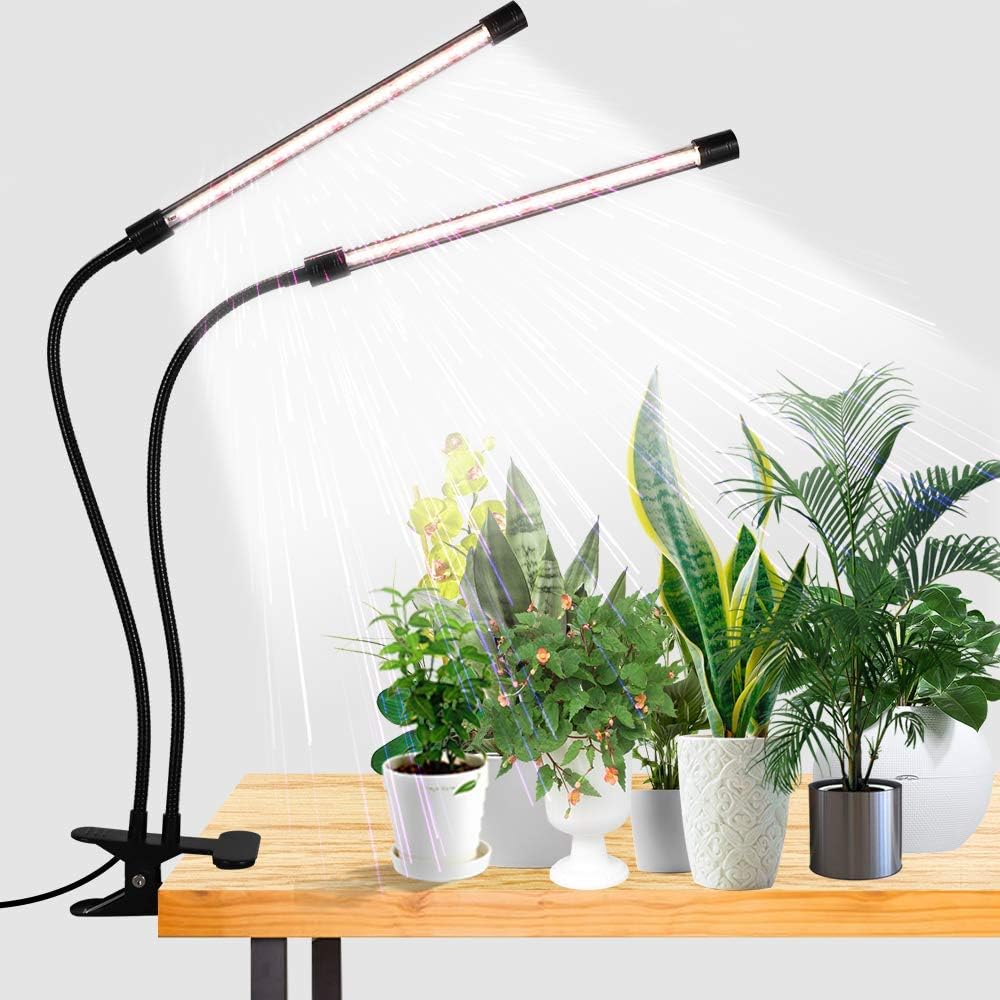
| Power Source | Corded Electric |
|---|---|
| Color Temperature | 6000 Kelvin |
| Light Output Maximum | 2500 lumens |
| Light Source Special Features | Dimmable |
| Number of Light Sources | 84 |
This GooingTop HY-021 is a compact clip-on grow light built for small houseplants, seedlings and shelf gardens. It uses 84 LEDs (white plus deep red) to deliver a 6000K full-spectrum output intended to mimic midday sun, with a high color-rendering output that also makes it pleasant as a reading lamp. Two flexible gooseneck heads and a strong clamp let you aim light precisely over pots and seed trays, while the attached remote provides 50%/100% dim levels and repeating timers at 4, 8 or 12 hours for hands-off scheduling. Practical benefits include low power draw (listed as roughly 10 W LED draw), a claimed 1 to 2 square meter coverage for seedlings, and an included timer that simplifies day/night cycles. Limitations are its design for small setups rather than large grow racks and the clip mounting limits placement compared with freestanding fixtures. The unit also relies on the corded remote instead of a smartphone app and the lifespan claim is typical of LEDs but not independently verifiable from the listing.
Best for: Buyers who want a simple, low-power, plug-and-play grow light to boost seedlings and a few houseplants on a desk or shelf and who value an easy-to-use timer and adjustable brightness.
Less Ideal for: Growers planning multi-shelf installations, larger vegetable grows, or who need networked or app-based control should consider larger bar lights or fixtures designed for commercial racks.
- Full-spectrum 6000K output with added 660 nm red LEDs to support vegetative growth and flowering
- Attached remote with dimming (50%/100%) and repeat timer settings (4/8/12 hours) for easy scheduling
- Flexible dual goosenecks and strong clamp enable precise positioning over small pots and seed trays
- High reported color rendering for comfortable viewing and accurate plant color assessment
- Low electrical draw around 10 W while covering small growing areas
- Clip-mount design and stated 1–2 m² coverage make it better suited to individual plants or small trays rather than large multi-shelf setups
- No smart app or wireless control option; remote is cord-attached which limits placement flexibility
Verdict: A compact, easy-to-use clip grow light that delivers full-spectrum light and convenient timer/dim controls for small indoor plant setups.
Barrina 4ft T8 Full Spectrum LED Grow Light, 6-Pack

| Wattage | 42 watts |
|---|---|
| Brightness | 2100 lumen |
| Color Temperature | 5000 Kelvin |
| Number of Light Sources | 6 |
| Mounting Type | Ceiling Mount |
The Barrina 4ft T8 full‑spectrum LED set is a plug‑and‑play solution for indoor seedling and vegetative stages. Each 42W fixture delivers about 2100 lumens at 5000K, and the included V‑shaped reflector plus aluminum shell improve light throw and heat dissipation for steady performance. Installation is straightforward with mounting clips, tape and connecting cables and you can link multiple fixtures in series to cover a long seedling bench or a small grow tent. Practical benefits for tomato seedlings include even white-spectrum light that encourages compact, balanced early growth and the ability to run an array without complex wiring. Limits to consider are that these are ceiling/indoor fixtures only and not water resistant, and the units use a fixed push‑button on/off control rather than dimming or spectrum adjustment, so you will need a separate timer or controller for precise photoperiods and intensity tuning.
Best for: Growers who prioritize steady, high‑output lighting arrays for fast, uniform seedling growth and want a straightforward, scalable installation for benches or small grow tents.
Less Ideal for: Home gardeners wanting adjustable spectrum or integrated dimming control, or setups where fixtures may be exposed to moisture or occasional splashing.
- Full spectrum 5000K output suited to seedling and vegetative growth
- Linkable design lets you daisy‑chain multiple fixtures to cover benches or tents
- V‑shaped reflector and aluminum body improve light distribution and heat dissipation
- No built‑in dimming or spectrum control so intensity and photoperiod need external timers or controllers
- Not water resistant, so it must be kept away from humidity and overhead watering
Verdict: A reliable, linkable full‑spectrum T8 array that delivers consistent light intensity for vigorous tomato seedlings when you need scalable, performance‑focused coverage.
Choosing the Right Chinese LED Grow Light: Key Factors to Consider
Spectrum and Plant Stage Coverage
Different stages of growth need different parts of the light spectrum. Seedlings and vegetative plants respond well to blue-rich light for compact growth, while flowering and fruiting stages benefit from red and far-red wavelengths. A fixture that offers a balanced full spectrum or selectable spectrum modes reduces the need to swap lights between stages.
For mixed planting or continuous cropping, look for even spectral distribution across the canopy so no plants are starved for the wavelengths they need. Pay attention to whether the manufacturer lists peak wavelengths and whether they provide a spectrum graph rather than just buzzwords.
Photon Output at Canopy Height
Photosynthetic Photon Flux (PPF) and Photosynthetic Photon Flux Density (PPFD) are the practical measures for how much usable light reaches plants. Higher PPF is useful for denser canopies and flowering crops, while lower but even PPFD can be fine for seedlings or low-light houseplants.
Consider the size of your grow area and the recommended hanging height. A fixture that reports PPF and gives PPFD charts at common hanging distances lets you match light output to your plant load and avoid light stress or wasted energy.
Energy Efficiency and Operating Cost
Look at PPF per watt (PPF/W) to estimate ongoing electricity cost for a given light level. More efficient fixtures deliver the same usable light with less electricity, which matters for continuous indoor use. Efficiency also affects how much heat the unit produces for a given light output.
Factor in the expected daily photoperiod for your crop. Long photoperiods amplify the importance of efficiency. Also check driver efficiency and whether the fixture supports dimming to lower consumption during less demanding growth phases.
Thermal Management and Heat Impact
LEDs generate heat at the driver and LED junctions, and poor cooling shortens component life and can raise canopy temperatures. Fixtures with robust passive heatsinks, well-placed fans, or good airflow design keep junction temperatures lower and maintain light output over time.
Consider how the heat will interact with your grow space. In small tents or enclosed cabinets, a bit of extra heat can be a problem. Conversely, in cool rooms, modest heat output may be beneficial. Choose a design whose cooling approach suits your ventilation setup.
Build Quality and Electrical Safety
Durable housings, secure mounting points, and quality electrical connectors reduce the chance of failure during a grow cycle. Corrosion-resistant finishes and strain-relieved cables are practical details that extend life in humid or hydroponic environments.
Prioritize fixtures with clear driver specifications, proper insulation, and grounded plugs or wiring. A reliable warranty and accessible customer support are bonuses for addressing defects or failures without long downtime.
Control, Dimming, and Installation Flexibility
Integrated dimming, spectrum switching, or external controller compatibility makes it easier to tune light levels as plants develop. Simple, repeatable settings mean you can maintain consistent daily schedules and ramp light intensity without guesswork.
Check mounting hardware, hanging points, and whether the fixture can be daisy-chained or spaced easily. Compact fixtures are easier to fit into small setups, while modular bars offer greater coverage for wider benches.
Matching Light Output to Grow Space
Measure your grow footprint before choosing a fixture. For a single shelf or small tent, a single high-efficiency panel can be enough. For wider benches you will likely need multiple bars or larger panels to achieve even PPFD across the canopy.
Use manufacturer PPFD charts when available, or aim for target PPFD ranges appropriate to your plants. Seedlings and clones usually thrive at lower PPFD, while heavy bloomers need significantly higher densities. Spacing lights too close can create hotspots; too far and plants stretch.
- Place higher-output fixtures higher and use a longer photoperiod rather than forcing intensity.
- For multi-tier setups choose low-profile fixtures with good lateral spread to prevent shading between racks.
Dimming and Spectrum Strategies by Crop
If a fixture includes dimming or spectrum modes, program gentler blue-rich light for early growth and increase red components as plants transition toward flowering. Gradual spectral shifts reduce transplant shock when changing photoperiods.
For leafy greens, maintain stronger blue ratios for compact, high-quality leaves. For flowering crops, add more red and maintain adequate overall PPFD to support bud formation.
- Use dimming to conserve energy overnight or during low-demand phases.
- Record settings that worked for each crop to repeat results in future cycles.
Mounting, Orientation, and Safety Tips
Mount fixtures securely and keep power connections off the ground and away from moisture. Use rated hanging hardware and avoid improvising with weak anchors. Ensure there is enough clearance for heat to dissipate if the unit relies on passive cooling.
Orient fixtures to maximize even light spread; in narrow setups mount long bars lengthwise to reduce shadowing. Label power cables and keep driver units accessible for service or replacement.
- Leave a small gap between fixtures to allow air circulation.
- Use insulated clips or strain reliefs where cables pass through metal frames.
Common Installation Mistakes to Avoid
A frequent error is assuming higher wattage equals better results. What matters is usable photon delivery at canopy level, not raw wattage. Overdriving plants with too-intense light at close range can cause bleaching and stress.
Another mistake is ignoring thermal ventilation in tight spaces. Even efficient LEDs need airflow to maintain driver life. Finally, do not mix incompatible control systems; if you plan to network fixtures, confirm controller protocols and connectors first.
- Do not hang fixtures directly against fabric covers or reflective film without airflow.
- Test a new setup with a few plants before scaling to a full crop.
Maintenance and Longevity
Keep heatsinks and fans free of dust and check cable integrity periodically. Accumulated dust raises junction temperatures and lowers output. Replace fans or drivers at signs of reduced performance rather than waiting for complete failure.
Regularly inspect mounting hardware and connectors for corrosion in humid environments. Good maintenance extends usable life and preserves consistent spectral output across runs.
- Save original installation guides and wiring diagrams for troubleshooting.
- Record cumulative run hours to anticipate end-of-life cycles for drivers.
How We Chose the Best Chinese LED Grow Light
We selected fixtures that fit realistic indoor-growing needs rather than exotic lab setups. Selection began with models designed for hobby and small-scale cultivation, focusing on reliable electrical components and complete spectral coverage suitable for common stages from seedlings to flower. We excluded experimental prototypes, single-use grow strips, and fixtures lacking clear electrical or thermal specs. Editorial filters emphasized measurable performance dimensions gardeners can verify before buying. Key evaluation criteria were light spectrum and photon output at canopy level, energy consumption and efficiency, thermal design and cooling, durability of the housing and connectors, and ease of installation and control. Safety markings, IP ratings where applicable, and straightforward user controls were also considered. We favored products with documented driver quality and reasonable serviceability so gardeners have fewer surprises during setup and season-long use.
FAQ
How close should a Chinese LED grow light be to seedlings?
Seedlings usually do well with lower intensity and benefit from greater distance to avoid stretching or light stress. Start with the manufacturer's recommended seedling height or about 12 to 24 inches depending on panel output, then lower gradually while watching leaf response.
Can I use a single-spectrum red-blue LED for all growth stages?
Single-spectrum red-blue fixtures can support all stages but may produce stretchier vegetative growth or less robust foliage. Full-spectrum or tunable fixtures give more natural growth patterns and better overall plant structure for mixed-stage cultivation.
Do I need active cooling for a small indoor tent?
Not always. Some efficient panels rely on passive cooling and work well in small tents with modest ventilation. If your tent is tightly sealed or you run long photoperiods, active ventilation or fixtures with fans will help keep temperatures under control.
How do I compare energy efficiency between fixtures?
Compare PPF per watt values if available, and consider driver efficiency and dimming capability. Higher PPF/W means more usable light for each watt consumed, which reduces operating cost over time.
Are waterproof ratings important for indoor grow lights?
Waterproof or IP ratings are helpful if you operate in very humid conditions or over hydroponic systems where splashes are likely. For typical indoor setups with good drip control, IP-rated fixtures are a nice extra but not always essential.
Final Verdict
Choose a fixture that matches the size of your canopy and the light demands of your plants. Prioritize clear spectrum data, PPF/PPFD information, efficient drivers, and a thermal design suited to your ventilation. Expect tradeoffs between compact convenience and wider coverage; pick the form factor that minimizes shading and simplifies installation. By focusing on spectrum control, usable photon output, and dependable thermal management you can select a Chinese LED grow light that performs reliably through multiple cycles and fits your indoor gardening goals.
