

Note: This article contains affiliate links. If you click on these links and make a purchase, I may earn a small commission at no extra cost to you. This helps support my research and content. Read my full affiliate disclosure here.
When you spend time treating beds, container plantings, or a small orchard, a comfortable garden sprayer can make routine spraying less tiring and more accurate. The right sprayer cuts wrist and shoulder strain, helps you maintain steady pressure, and delivers repeatable spray patterns so applications are effective and waste is minimized. This guide shortlists six top-rated options suited to comfort-focused gardeners and evaluates them across the practical criteria that matter in the yard and greenhouse. Below you will find why each sprayer made the list and what to look for when matching a sprayer to your typical tasks and body mechanics.
Top Picks at a Glance
| Best Overall The best all-around choice for most situations | PetraTools HD2000-S 2-Gallon Battery-Powered Garden Sprayer |  |
| Best Quality Built to a higher standard if you want something more solid | PetraTools HD4000 Battery-Powered 4‑Gallon Backpack Sprayer |  |
| Best Value The sweet spot between price and what you get | PetraTools HD101 1‑Gallon Garden Pump Sprayer with 52‑in Hose and 2 Nozzles |  |
| Best Budget The cheapest option that still gets the job done reliably | CHAPIN 1002 48-Ounce Hand Pump Sprayer |  |
| Highest Rated A top-rated pick with lots of positive feedback | SOLO 418 One-Hand 2-Liter Pressure Sprayer |  |
| Most Popular A crowd favorite that many people choose with confidence | CHAPIN 20004 1-Gallon Pump Sprayer |  |
PetraTools HD2000-S 2-Gallon Battery-Powered Garden Sprayer
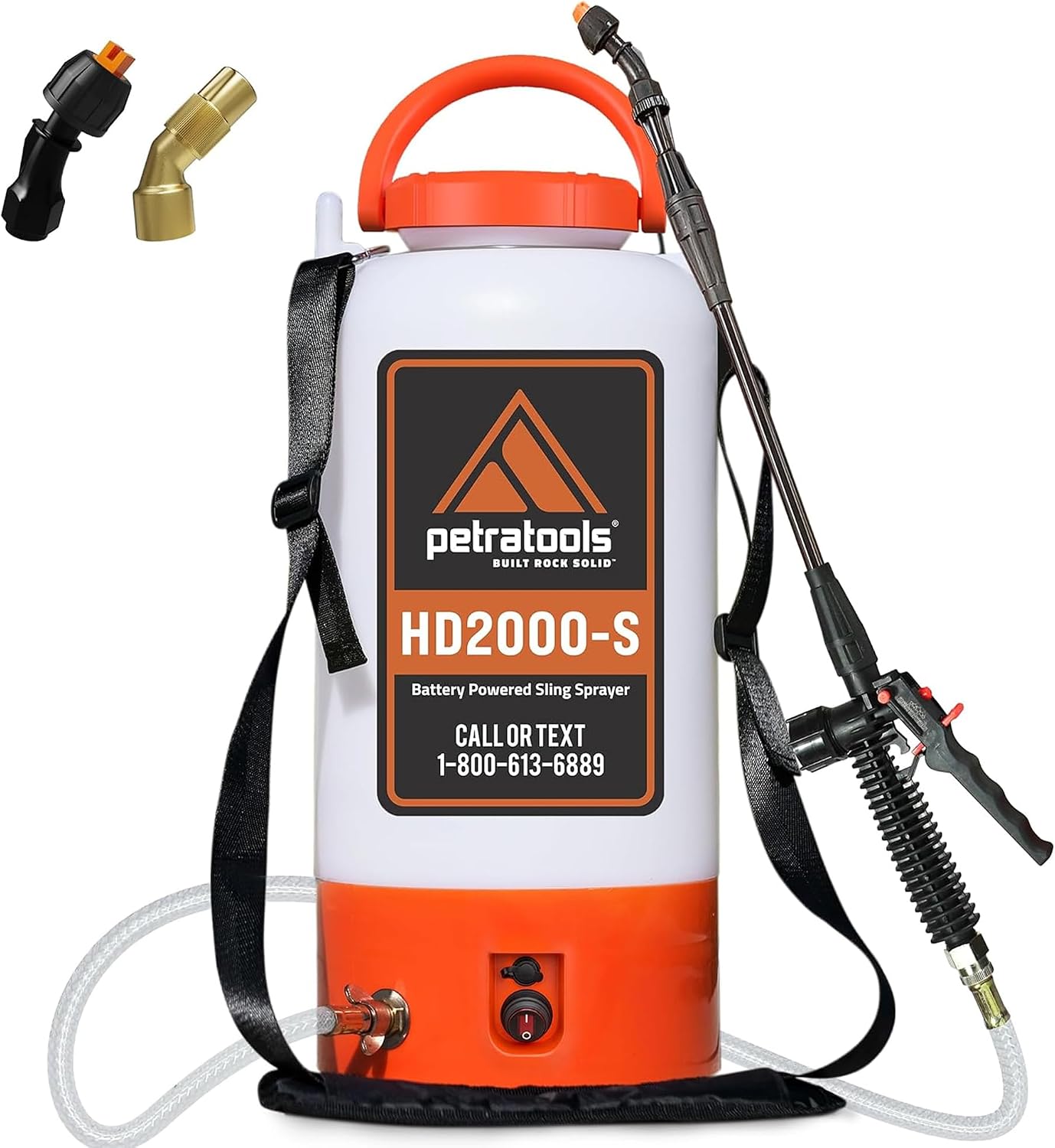
| Tank Volume | 2 gallons |
|---|---|
| Power Source | Battery Powered |
| Hose Length | 48 inches |
| Maximum Pressure | 80 psi |
The PetraTools HD2000-S is a battery-powered 2-gallon garden sprayer built to replace manual pumping for routine lawn and garden tasks. It includes a 12V rechargeable battery and charger that the manufacturer says provides up to two hours of runtime, letting you spray continuously for fences, beds, and around ornamental plantings without repeated effort. The sprayer comes with a 4 foot hose, an extendable wand and two interchangeable nozzles (brass adjustable and fan tip) so you can switch between mist and stream patterns for targeted spot treatment or broader coverage. The shoulder strap and ergonomic handle make it easier to carry when full, and metal hose fittings and an HDPE tank reduce the chance of leaks and chemical-wear issues. Limitations to note are the modest 2-gallon capacity, which means more refills on larger properties, and the specified maximum pressure of 80 psi which is adequate for typical garden chemicals but not for high-pressure commercial tasks.
Best for: Gardeners who want to eliminate hand pumping and finish routine fertilizing, weed control, and pest treatments more efficiently while minimizing physical effort.
Less Ideal for: People managing very large properties or commercial landscaping jobs that need longer runtime, larger capacity, or higher spray pressure.
- Battery-powered operation provides up to two hours of continuous spraying so no manual pumping is required
- Includes rechargeable 12V battery and charger for out-of-box use
- Two nozzles (adjustable brass and fan tip) offer mist and stream patterns for versatile application
- Metal hose fittings and HDPE tank construction reduce leak risk and chemical wear
- 2-gallon tank requires frequent refills on larger lawns
- Maximum 80 psi limits use to typical garden applications rather than heavy-duty commercial spraying
Verdict: If you want a cordless sprayer that removes manual pumping and gives adjustable spray patterns for small to medium yards, this 2-gallon PetraTools unit is a practical, ready-to-use choice.
PetraTools HD4000 Battery-Powered 4‑Gallon Backpack Sprayer

| Tank Volume | 4 gallons |
|---|---|
| Power Source | Battery Powered |
| Maximum Pressure | 90 psi |
| Hose Length | 48 inches |
The PetraTools HD4000 is a battery-powered backpack sprayer designed to replace hand-pumping for medium to large yards and professional-style jobs. It holds 4 gallons and runs on a 12V8AH battery that the manufacturer says delivers long runtime and can pump roughly 200+ gallons per charge, so you can cover large areas without frequent recharging. The unit includes six interchangeable nozzles and an adjustable pressure range up to 90 PSI, which makes it useful for misting, targeted spot treatment, and stronger stream applications for weed or pest control. Practical touches include a translucent tank with gallon markings, a wide-mouth lid for easy filling and cleaning, a screen filter to reduce clogs, and double-padded straps plus a back pad to reduce fatigue during extended use. Important limitations are its filled weight (backpack sprayers get heavy when full) and that optimal performance depends on following proper mixing and nozzle selection; heavier chemicals may require slower application. The HD4000 is a solid choice when you want cordless convenience and adjustable output for varied garden tasks.
Best for: Buyers who want a cordless, no-pump sprayer that balances runtime, adjustable output, and comfort for regular lawn, garden, or small professional jobs.
Less Ideal for: People who need an ultralight solution for very small gardens or who cannot manage carrying a filled 4‑gallon pack should consider smaller sling or handheld sprayers.
- Battery-powered pump eliminates manual pumping for continuous spray
- Adjustable 40–90 PSI pressure and six nozzles let you match spray pattern to the task
- Long-run 12V8AH battery suited for covering larger lawns without frequent recharging
- Translucent tank with gallon markers and wide mouth make filling and monitoring simple
- Padded straps and back pad improve comfort during extended use
- Backpack will be heavy when the 4‑gallon tank is full
- Performance depends on correct nozzle and pressure choice for different chemicals
Verdict: Choose the HD4000 if you want cordless, long‑runtime spraying with adjustable pressure and multiple nozzles for versatile lawn and garden applications.
PetraTools HD101 1‑Gallon Garden Pump Sprayer with 52‑in Hose and 2 Nozzles

| Tank Volume | 1 gallons |
|---|---|
| Hose Length | 52 inches |
| Material Type | Plastic |
| Maximum Pressure | 30 psi |
The PetraTools HD101 is a straightforward, reliability‑oriented 1‑gallon pump sprayer for common garden jobs like weed control, fertilizing, and applying mulch glue. You pressurize the translucent tank by hand and use the 52‑inch hose plus the 14–16‑inch wand to reach borders and under shrubs without moving the tank frequently. It ships with an adjustable nozzle and a fan tip so you can switch between a targeted jet and wider coverage, and built‑in filters help reduce nozzle clogs when using outdoor liquids. The large ergonomic handle, funnel‑style opening, and pressure release valve make filling, carrying, and safe depressurizing easier during routine use. Expect consistent performance for typical liquids if you avoid acidic or highly viscous mixtures and clean the filters after each use. The sprayer is plastic and hand‑powered, so it is best for small jobs and occasional use rather than continuous commercial work or very large areas where a battery or backpack unit would save time.
Best for: Buyers who prioritize a dependable, no‑frills sprayer for routine home gardening and small lawn tasks and who want simple, low‑maintenance gear that performs consistently.
Less Ideal for: People who need high‑capacity or continuous heavy‑duty spraying for large properties or professional landscaping should consider backpack or battery models instead.
- Compact 1‑gallon tank suited to small lawns and garden beds
- Long 52‑inch hose and wand improve reach without moving the tank
- Adjustable nozzle plus fan tip cover both pinpoint and wide applications
- Built‑in filters reduce nozzle clogging with outdoor solutions
- Safety pressure release valve and ergonomic handle simplify filling and transport
- Plastic construction and manual pump limit durability and throughput for heavy professional use
- Not rated for acidic or very thick/creamy solutions
Verdict: A dependable, easy‑to‑use 1‑gallon pump sprayer that delivers reliable, clog‑resistant performance for routine home garden and lawn tasks.
CHAPIN 1002 48-Ounce Hand Pump Sprayer

| Tank Volume | 1420 ml |
|---|---|
| Material Type | Plastic, Polypropylene (PP) |
| Power Source | manual |
| Maximum Pressure | 60 psi |
The CHAPIN 1002 is a straightforward handheld pump sprayer for spot treatments, feeding plants, and light cleaning around the yard. You fill the wide-mouth 48-ounce translucent tank, pressurize with the manual pump, and use the adjustable cone nozzle to switch between a fine mist and a focused stream. It includes an in-tank anti-clog filter and a built-in wand holder for tidier storage. The ergonomic handle and thumb-controlled shutoff make repeated applications easier and reduce hand fatigue during short sessions. Because it is manual, it does not require batteries or power and is easy to maintain and clean thanks to the wide opening. Limitations are inherent to its class: capacity and pressure are modest so it is best for beds, container plants, and small patches of weeds rather than treating large lawns or commercial workloads, and the plastic construction may wear faster under heavy professional use.
Best for: Home gardeners and budget-minded buyers who need a reliable, no-frills sprayer for spot treatments, potted plants, and small beds.
Less Ideal for: People managing large lawns, commercial properties, or frequent high-volume spraying should choose a larger or motorized sprayer instead.
- Compact, easy to fill wide-mouth 48-ounce translucent tank for quick fluid checks
- Adjustable nozzle that switches between mist and stream for versatile tasks
- In-tank anti-clog filter helps maintain a consistent spray
- Ergonomic handle and thumb-controlled shutoff reduce hand fatigue during use
- Manual pump limits pressure and runtime compared with motorized sprayers
- Plastic construction may not be as durable for heavy commercial use
Verdict: A cost-conscious, easy-to-use handheld sprayer that handles routine spot-spraying and plant care without the complexity of powered alternatives.
SOLO 418 One-Hand 2-Liter Pressure Sprayer

| Tank Volume | 2 liters |
|---|---|
| Material Type | High Density Polyethylene (HDPE) |
| Power Source | Manual |
| Maximum Pressure | 40 psi |
The SOLO 418 is a compact 2-liter one-hand pressure sprayer built for routine gardening, spot weed control, and light cleaning tasks. You pump the handle to pressurize the HDPE tank (about 2 liters), then hold the ergonomic grip and use the lock-on trigger for continuous spraying to reduce hand fatigue. Notable features include Viton gaskets and O-rings for chemical resistance, a multi-angle adjustable nozzle for flat or cone spray patterns, an in-tank filter and a drift/drip guard for more controlled application. In practice it is easy to carry between beds or around a car and provides consistent spray at the manufacturer pressure range up to about 40 psi when pumped properly. Limitations are the small tank capacity, which requires frequent refills for large areas, and the manual pumping effort needed to maintain pressure for extended use. The sprayer is straightforward to clean and works with common herbicides, fertilizers, and cleaners, making it a dependable tool for regular home garden upkeep where reliability and chemical compatibility matter.
Best for: Buyers who want a compact, dependable handheld sprayer for routine garden maintenance and occasional cleaning tasks and who prioritize durability and chemical compatibility over large capacity.
Less Ideal for: Not a good fit for users who need to cover large lawns or commercial areas without frequent refills or who prefer battery-powered continuous spraying for extended sessions.
- Chemical-resistant Viton seals and O-rings for durability with harsher solutions
- Lock-on trigger for continuous spraying and reduced hand fatigue
- Adjustable multi-angle nozzle for versatile spray patterns and under-leaf access
- Lightweight 2-liter HDPE tank that is easy to carry and maneuver around beds
- Small 2-liter capacity means frequent refills for larger gardens
- Requires manual pumping to build and maintain pressure during use
Verdict: A durable, chemically compatible one-hand sprayer that delivers reliable, comfortable spraying for small- to medium-scale garden and cleaning jobs.
CHAPIN 20004 1-Gallon Pump Sprayer

| Tank Volume | 1 gallons |
|---|---|
| Hose Length | 34 inches |
| Material Type | Polyethylene (PE) |
| Maximum Pressure | 60 psi |
The CHAPIN 20004 is a straightforward 1-gallon pump sprayer for spot treatments around the yard. You pressurize the translucent polyethylene tank by hand with the ergonomic pump handle, then apply product through an adjustable cone nozzle or the included poly extension wand and 34-inch hose for better reach into flower beds or under shrubs. The funnel-style top and clear tank make filling and monitoring fluid level quick and less messy, and the modular design allows cleaning and seal replacement to reduce leaks over time. It delivers up to 60 psi, which is adequate for fertilizers, pesticides, and general spot-spraying tasks but not for high-pressure commercial work. Because it is manual and lightweight, it is easy to carry for short jobs but requires periodic pumping for sustained spraying. For homeowners wanting a reliable, no-frills sprayer for occasional use, it balances utility with simple maintenance; power users needing longer run time or larger capacity should consider a motorized or larger-capacity model.
Best for: Gardeners who need a dependable, compact sprayer for occasional spot treatments and prefer simple, proven designs supported by broad customer use.
Less Ideal for: Large properties, commercial landscapers, or anyone who wants long continuous spray time without manual pumping should choose a powered or higher-capacity sprayer instead.
- Translucent funnel-top tank for easy, low-mess filling and fluid-level checks
- Ergonomic pump handle reduces fatigue during short jobs
- Adjustable cone nozzle plus 34-inch hose and extension wand for flexible reach and targeted or broad spray
- Modular design that lets you clean and replace seals to help prevent and fix leaks
- Manual operation requires repeated pumping for extended use
- 1-gallon capacity limits continuous coverage for larger lawns
Verdict: A reliable, easy-to-use 1-gallon manual sprayer that is ideal for homeowners doing spot treatments and small garden tasks.
Choosing the Right Comfortable Garden Sprayer: Key Factors to Consider
Pump Effort and Mechanism
The force required to pressurize a sprayer directly affects hand and forearm fatigue during routine tasks. A low-effort pump mechanism with smooth travel and positive feedback reduces the number of pumps required and shortens the time you spend applying pressure. Consider whether the pump is a vertical piston, bellows, or lever design. Vertical piston pumps often produce higher pressure with fewer strokes but may need stronger grip; bellows pumps require more frequent compression but can be gentler on the wrist.
Also note pump placement. Pumps built into a long wand can force you into awkward wrist angles, while body-mounted pumps that sit near the tank let you use larger muscle groups. Look for textured, contoured handles that match your grip and for mechanisms that allow a few firm pumps to reach working pressure rather than continuous high-repetition pumping.
Trigger Comfort and Control
The trigger is the interface you use for long stretches, so its shape, travel, and required finger force matter. Triggers with ergonomic finger molded shapes and wide contact areas reduce pressure points and distribute force across multiple fingers. A trigger lock or a variable flow control can prevent constant squeezing and let you maintain a steady stream without tiring your hand.
Check whether the trigger is reachable from the typical hand position and whether any safety or lock features are easy to engage and release. For gardeners with weaker grip strength or joint issues, look for triggers that operate smoothly with minimal effort and that have adjustable stops to control flow without continuous squeezing.
Nozzle Variety and Spray Pattern Control
Spray nozzles determine how much product lands where you want it. Adjustable nozzles that offer narrow streams, wide cones, and fine mist settings let you move between targeted spot treatments and broad foliar applications without changing tools. Good nozzle control reduces the need to overapply or make multiple passes, which lowers fatigue and chemical use.
Durable nozzle materials and easy-to-clean tips matter for consistent patterns. Consider models that accept common nozzle inserts or simple replacements, and that allow quick switching between pinhole, fan, and cone settings. Being able to dial in droplet size and pattern will also help when working in breezy conditions where drift control becomes important.
Capacity and Weight Distribution
A tank large enough for the job reduces refill trips but increases carry weight. The balance between capacity and ergonomics is a major comfort decision. Smaller tanks suit container gardens and quick spot treatments, while larger tanks are better for larger beds or repeated coverage tasks. More important than raw capacity is how the weight is distributed when full.
Backpack or shoulder strap systems that keep weight close to your center of gravity feel less tiring than awkward hand-carried jugs. Wide, padded straps and a low center of gravity help prevent back and shoulder strain. If using a handheld sprayer, look for handles positioned at the tank's centerline and consider foam or rubber grips to minimize slippage and pressure points.
Seal Quality and Leak Resistance
Poor seals cause drips and leaks that lead to awkward cleanup and repeated lifting. Durable gaskets and quality threads keep pressure stable and prevent product loss. Look for solvent-resistant seals if you plan to apply a variety of garden chemicals, and for designs that isolate pump parts from the chemical reservoir to reduce corrosion.
A reliable pressure relief or safety valve is also a comfort feature. It prevents accidental overpressurization that can make pumping feel harder or cause sudden pressure drops, which forces you to rework the area. Good seals and valves reduce the time spent troubleshooting and keep your work rhythm consistent.
Maintenance and Repairability
Comfort over time depends on how easy the sprayer is to maintain. Sprayers that allow quick access to nozzles, filters, and seals make routine cleaning fast and keep performance consistent. Replaceable components such as pump diaphragms, O-rings, and nozzle tips extend usable life and prevent progressive ergonomic decline from worn parts.
Consider whether spare parts are standard sizes or proprietary. Tools-free disassembly and clear service points mean less time bent over a workbench and more time in the garden. Ease of flushing and cleaning internal passages also reduces exposure to chemical residues and keeps moving parts functioning smoothly.
Handheld Versus Backpack Comfort Tradeoffs
Handheld sprayers are compact and easy to store, making them good for quick spot treatments and container gardens. They can be lighter when empty, but when filled they concentrate weight in one hand which can increase wrist strain during extended sessions.
Backpack sprayers spread load across the hips and shoulders and are often the better choice for larger beds and repetitive work. They keep the sprayer stable and let you use both hands for wand control, which reduces wrist fatigue but requires padded straps and good weight distribution to stay comfortable.
- Handheld: best for short tasks and small areas; watch for unbalanced weight as volume increases.
- Backpack: superior for long sessions; prioritize strap comfort and tank shape to reduce sway.
Right Capacity for Your Garden Size
Match tank volume to the area you typically treat. A smaller tank reduces carry weight and is easier to maneuver around delicate plants, while a larger tank reduces refill frequency but adds load.
Estimate how many beds or pots you usually cover in a session and factor in the additional weight of mixed chemicals or fertilizers. If you often move between distant beds, a mid-size tank with an easy refill process can be the most practical balance.
- Small plots and container gardens: choose lower capacity for maneuverability.
- Medium to large beds: consider mid-size tanks or backpack styles for fewer refills.
Wand Length, Reach, and Nozzle Positioning
Wand length affects how comfortably you can reach under foliage, into hanging baskets, or across raised beds. A longer wand reduces the need to stoop but can be heavier and harder to steady. Look for a wand with a comfortable balance point and an option to add extension sections if needed.
Nozzle placement and swivel connections help maintain a natural wrist position while spraying. A rotating nozzle or angled head can reduce awkward wrist rotation and allow you to spray at different angles without repositioning your body.
- Short wand: more control in close quarters, lighter to hold.
- Long wand or extension: reach without bending, but check for balance and trigger access.
Materials, Chemical Compatibility, and Longevity
Tank and seal materials determine how long a sprayer stays serviceable. High-density polyethylene tanks resist many garden chemicals and withstand UV exposure, while metal components can add durability but may corrode unless properly protected.
If you plan to use concentrated herbicides or solvents occasionally, verify chemical compatibility and choose models with resistant seals. Longevity affects comfort indirectly because a worn or leaking sprayer becomes harder to use and may require more pumping or awkward handling.
- Plastic tanks: lightweight and resistant to most garden chemicals.
- Metal components: durable but check for coatings or corrosion-resistant finishes.
Safe Handling and Storage Practices
Proper handling and storage reduce the risk of accidental leaks, exposure, and unexpected strain. Always empty and rinse tanks after use to prevent residue buildup that can clog nozzles and stiffen seals. Store sprayers in a cool, shaded place to protect plastic and seals from UV degradation.
Use padded hooks or shelves for backpack models to avoid deforming straps, and keep spare seals and O-rings in a small kit so routine repairs do not interrupt work. Following simple maintenance routines keeps the sprayer functioning comfortably session after session.
- Rinse and drain after each use to prevent clogs and residue hardening.
- Store out of direct sunlight and keep replacement parts accessible.
How We Chose the Best Comfortable Garden Sprayer
We focused on features that directly affect how the sprayer feels and performs during real garden work. Our selection filters prioritized ergonomic design and usability metrics, excluding models intended solely for heavy industrial, agricultural tractor-mount, or commercial pesticide rigs. We evaluated pump effort and handle ergonomics to judge how much hand and wrist strain a sprayer imposes during average use. We reviewed spray control features such as adjustable nozzles, pressure regulation, and trigger comfort because those determine coverage consistency and reduce the need for repeated passes. Build materials and seal quality were examined to estimate leak resistance and maintenance needs that affect long-term comfort. Capacity and weight distribution informed how balanced a filled sprayer feels when carried or worn. Finally, we checked maintenance accessibility and accessory compatibility so the sprayer stays comfortable to use over multiple seasons. Products that lacked basic sealing or had ergonomically awkward pump designs were excluded.
FAQ
How do I reduce hand fatigue when using a sprayer for long periods?
Use a sprayer with a low-effort pump and an ergonomic handle. Switching to a backpack design spreads weight across larger muscle groups. Also alternate hands or take short breaks to avoid repetitive strain.
Can I use the same sprayer for fertilizers and pesticides?
Often you can, but it depends on chemical compatibility. Rinse the tank thoroughly between uses and check seals and nozzle materials for resistance to the specific products you plan to apply.
What nozzle type is best for foliar feeding versus spot treatment?
Fine mist or cone nozzles work well for foliar feeding to provide even coverage, while narrow stream or adjustable nozzles are better for targeted spot treatments. Adjustable nozzles allow quick switching between tasks.
How much tank capacity should I choose for a medium-sized vegetable garden?
A mid-size tank that balances fewer refills with manageable carry weight is usually best. If you expect long sessions or multiple beds, prioritize comfortable straps and weight distribution over very large capacity.
Are repair parts commonly available for garden sprayers?
Many sprayers use standard O-rings, seals, and nozzle inserts that are easy to source. Models with common-sized replacement parts are easier to service and keep comfortable to use over time.
Is a pressure relief valve necessary for comfort?
A pressure relief valve prevents overpressurization and sudden pressure loss, which makes pumping feel safer and more consistent. It is a helpful feature for maintaining smooth operation and reducing surprise strain.
Final Verdict
Prioritize ergonomics, pump effort, and weight distribution when choosing a Comfortable Garden Sprayer. Decide on the tank capacity that fits how much area you treat in a session and match the trigger and nozzle features to the tasks you perform most often. Tradeoffs are unavoidable: larger tanks reduce refills but increase carry weight, and longer wands increase reach but may be harder to steady. Focus on the features that reduce repetitive strain and make routine maintenance simple to keep the sprayer comfortable season after season.
