

Note: This article contains affiliate links. If you click on these links and make a purchase, I may earn a small commission at no extra cost to you. This helps support my research and content. Read my full affiliate disclosure here.
If you manage commercial landscapes, parking lots, or multiple properties, a commercial cordless leaf blower can speed cleanup and reduce operator fatigue. The right blower combines strong airflow with long battery life and robust construction so crews finish jobs faster and with fewer interruptions. This guide covers five shortlisted commercial cordless blowers that suit heavy daily use. We evaluate each on runtime, airflow, build durability, and serviceability so you can match a tool to your workflow. Read on for the factors that matter and practical notes to help you pick the best option for your operations.
Top Picks at a Glance
| Best Overall The best all-around choice for most situations | Vitaler Cordless Brushless Leaf Blower with 2 Batteries (YS-C002) |  |
| Best Quality Built to a higher standard if you want something more solid | Greenworks 80V Cordless Axial Leaf Blower with 4.0Ah Battery and Charger |  |
| Best Value The sweet spot between price and what you get | WOLFBOX MegaThrust MT700 60V Cordless Leaf Blower | 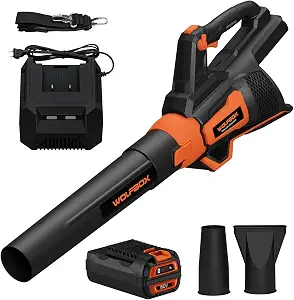 |
| Highest Rated A top-rated pick with lots of positive feedback | EWZ Cordless Leaf Blower C201 — 750 CFM, 250 MPH, 10.0Ah Battery |  |
| Most Popular A crowd favorite that many people choose with confidence | EGO POWER+ LB7654 765 CFM Cordless Handheld Leaf Blower with 5.0Ah Battery and Charger |  |
Vitaler Cordless Brushless Leaf Blower with 2 Batteries (YS-C002)

| Power Source | Battery Powered |
|---|---|
| Form Factor | Handheld |
| Additional Features | Brushless motor, Adjustable Speed |
| Air Flow Capacity | 850 cfm |
The Vitaler YS-C002 is a high‑power cordless blower built for fast yard cleanups and occasional heavier tasks like light snow or wet leaves. In use it offers three speed settings—Low, Medium, and Turbo—so you can dial airflow from gentle clearing to a full 850 CFM/250 MPH blast for stubborn debris. The kit includes two 21V 6.0Ah batteries and a rapid charger, which together provide long low-speed runtime and short bursts of maximum power when you need it. Practical touches include a 180° rotating handle for different grip angles and snap-on wide and flat nozzles for broad sweeping or concentrated blowing in corners and car crevices. The brushless motor should run cooler and last longer than brushed alternatives. Expect the blower to be bulkier than lightweight consumer models and the batteries to add noticeable weight during extended use. Noise and battery cost are other considerations if you plan heavy daily commercial use. For balanced, all‑around yard work this package gives strong power and useful accessories in a single kit.
Best for: Buyers who want a robust, versatile cordless blower for regular residential or light commercial jobs and value long low-speed runtime plus strong burst power for occasional heavy tasks.
Less Ideal for: Professionals who need long continuous high‑power runtime for full‑day commercial use or operators prioritizing the lightest possible handheld unit should consider backpack models or higher‑capacity battery systems.
- High airflow: up to 850 CFM and 250 MPH for moving wet leaves and packed debris
- Brushless motor for improved efficiency, cooler operation, and longer motor life
- Two 21V 6.0Ah batteries plus fast charger extend usable runtime and allow quick battery swaps
- 180° rotating handle and two nozzle types provide ergonomic flexibility and task-specific airflow
- Three speed settings let you balance runtime and power for different jobs
- Relatively heavy for a handheld unit when both batteries are installed which can tire users during long sessions
- Battery runtime at Turbo is short (minutes), so sustained high-power commercial jobs require frequent swaps or extras
Verdict: A powerful, versatile cordless blower kit that balances strong burst performance and user‑friendly features for routine yard and light commercial cleanup.
Greenworks 80V Cordless Axial Leaf Blower with 4.0Ah Battery and Charger

| Power Source | Battery Powered |
|---|---|
| Voltage | 80 volts |
| Air Flow Capacity | 770 cfm |
| Noise Level | 74 db |
| Speed | 180 miles_per_hour |
This Greenworks 80V axial leaf blower is built to replace gas models for large yards by pairing high airflow with cordless convenience. It produces up to 770 CFM and 180 MPH, which is strong enough for wet leaves, compacted piles, gravel driveways, and light snow, and a turbo mode finishes stubborn jobs quickly. The included 4.0Ah battery claims up to 80 minutes at moderate power and a 4A charger restores the pack quickly, so you can clear an acre without switching tools. Practical features like variable speed, cruise control, a tapered nozzle for focused air, and an anti-vibration handle make it easier to control and reduce arm fatigue during long sessions. The brushless motor lowers maintenance and improves longevity while operating at about 74 dB, noticeably quieter than typical gas blowers. Expect reduced runtime when using turbo and somewhat less power than high-displacement commercial gas units, but for homeowners with large properties who want gas-like performance without fumes and maintenance, this is a strong all-around cordless choice.
Best for: Homeowners with large yards who want near-gas power without fumes or gas maintenance and value a quieter, lightweight cordless tool for regular seasonal cleanup.
Less Ideal for: Commercial landscapers who need continuous all-day runtime or users who require the absolute maximum power of high-displacement gas blowers.
- High airflow (770 CFM) and 180 MPH speed suitable for heavy leaves and light snow
- Includes 4.0Ah battery and 4A charger for long runtimes and relatively fast recharge
- Brushless motor reduces maintenance and improves lifespan
- Variable speed plus cruise control and tapered nozzle for precise, comfortable operation
- Turbo mode significantly shortens battery runtime compared with moderate use
Verdict: Delivers gas-like clearing power for large yards with the convenience and low maintenance of an 80V cordless system.
WOLFBOX MegaThrust MT700 60V Cordless Leaf Blower
| Power Source | Battery Powered |
|---|---|
| Voltage | 60 volts |
| Form Factor | Handheld |
| Air Flow Capacity | 700 cfm |
| Additional Features | Adjustable Speed, Turbo, Thumb-Trigger Control |
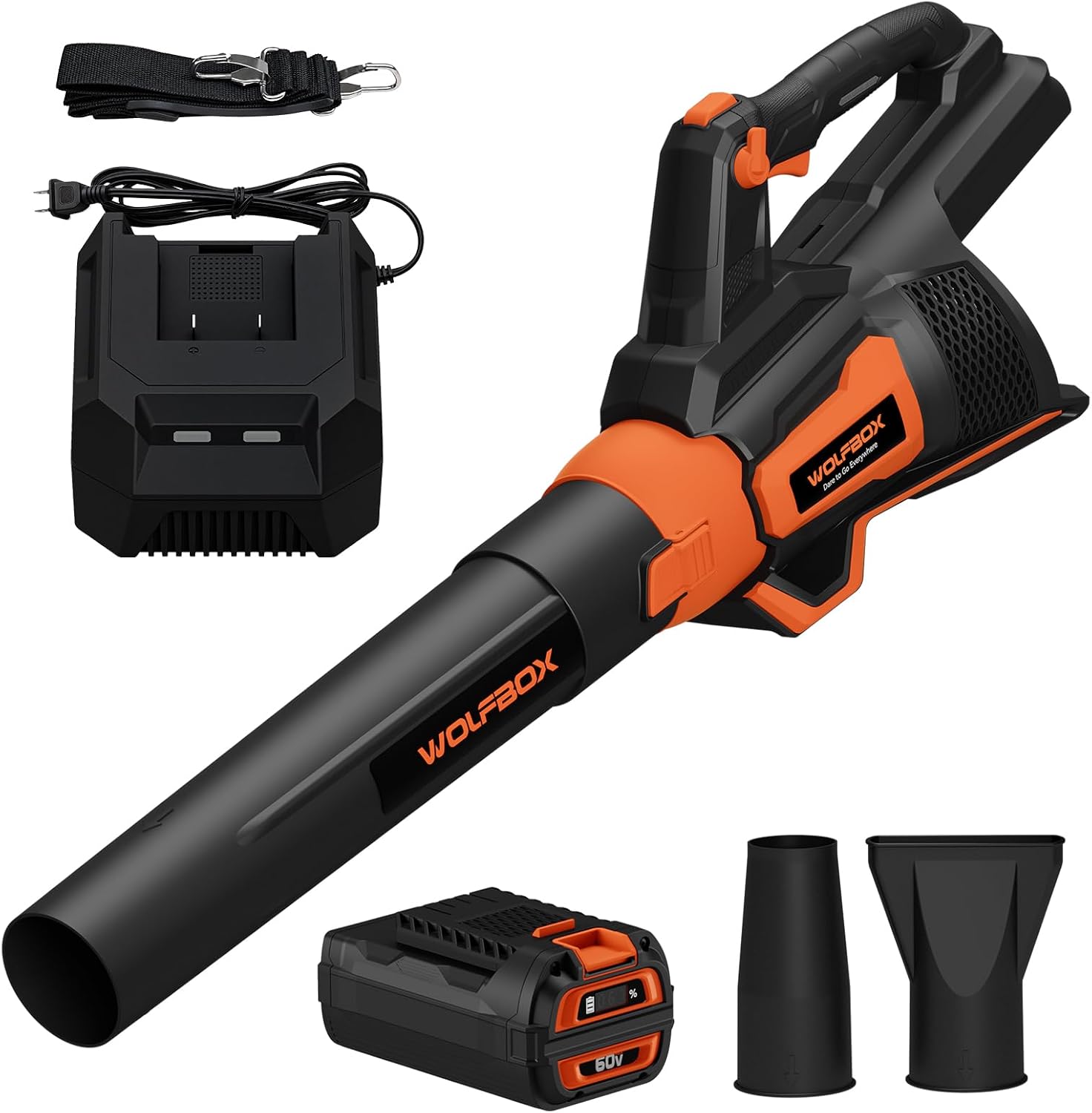
The WOLFBOX MegaThrust MT700 is a commercial-style cordless blower aimed at heavy-duty yard work. It produces up to 700 CFM and 160 MPH and uses a stepless thumb trigger plus MAX and TURBO buttons so you can dial in gentle sweeping or short bursts of extreme power for wet leaves and packed piles. The kit ships with a 60V battery, fast charger, shoulder strap, and two nozzles so it is ready to run out of the box. Practical benefits include long runtimes—up to 240 minutes at low speed and about 70 minutes at full power—plus a 2-hour recharge time and an LED battery indicator for predictable session planning. Ergonomics show attention to balance with a shoulder strap to ease fatigue during prolonged use. Trade-offs are the unit weight at about 9.5 pounds, which is heavier than lightweight consumer blowers, and TURBO drains the battery quickly so it is best used in short bursts. For large properties and commercial cleanup this blower brings gas-level performance without combustion maintenance, but its heft and power draw are factors to manage during long shifts.
Best for: Buyers who need near-commercial power for large properties or professional cleanup and prioritize runtime, controllable output, and a ready-to-use cordless kit.
Less Ideal for: Casual homeowners with small yards or users who need the lightest possible handheld blower for quick tasks.
- High maximum airflow (700 CFM) and 160 MPH wind speed for commercial-scale debris clearing
- Stepless thumb-trigger plus MAX and TURBO controls for precise power management
- Includes 60V battery, fast charger, shoulder strap and two nozzles so it is ready to use
- Long low-speed runtime (up to 240 minutes) and quick 2-hour recharge for extended tasks
- Relatively heavy at about 9.5 pounds, which can increase fatigue over long periods
- Turbo mode provides only short continuous runtime compared with lower speeds
Verdict: If you need gas-class blowing power and long runtimes for large yards or commercial cleanups without the maintenance of a gas unit, the MT700 delivers that capability in a cordless package.
EWZ Cordless Leaf Blower C201 — 750 CFM, 250 MPH, 10.0Ah Battery

| Power Source | Battery Powered |
|---|---|
| Voltage | 21 volts |
| Air Flow Capacity | 750 cfm |
| Speed | 250 meters_per_second |
| Included Components | Battery, Charger, Concentrator Nozzle, Extension Nozzle |
The EWZ C201 cordless leaf blower is built for heavy-duty home and light commercial cleanup by pairing a 20,000 RPM brushless motor with a 10.0Ah battery that can deliver up to 150 minutes on the lowest setting or shorter runtime in Turbo. It produces up to 750 CFM and 250 MPH airflow across three speeds plus a Turbo mode, so you can dial power down for patios and garages or crank it up for wet leaves and dense piles. The dual-tube design makes it easy to switch between a short nozzle for precision work and an extension tube for larger areas, and the adjustable shoulder strap and rubberized handle help reduce fatigue during long jobs. Practical features include a battery charge indicator and a stable base for set-downs. Limitations are typical of cordless models: Turbo drains the battery quickly and overall performance will depend on battery charge and age, and the blower is a handheld form factor rather than a backpack style preferred for full-day commercial work.
Best for: Buyers who prioritize dependable, battery-powered cleanup for medium to large properties and need a blower that balances strong performance with long battery life for repeated everyday jobs.
Less Ideal for: Contractors who need a backpack blower for all-day commercial use or teams that require instant extended runtime through hot-swappable battery systems.
- High airflow and speed: up to 750 CFM and 250 MPH for clearing heavy debris
- Long-run 10.0Ah battery rated up to 150 minutes on low speed
- Brushless motor for improved efficiency and longer motor life
- Adjustable speed settings, Turbo mode, and dual-tube design for versatile tasks
- Turbo mode significantly reduces runtime compared with low-speed operation
- Handheld form may be tiring for full-day commercial crews compared with backpack blowers
Verdict: Choose the EWZ C201 if you want a reliable cordless blower that pairs high airflow with a long-run 10.0Ah battery for demanding yard cleanup tasks.
EGO POWER+ LB7654 765 CFM Cordless Handheld Leaf Blower with 5.0Ah Battery and Charger

| Power Source | Battery Powered |
|---|---|
| Voltage | 56 volts |
| Air Flow Capacity | 765 cfm |
| Noise Level | 64 db |
| Included Components | Blower, 5.0Ah battery, 320W charger, tapered and spread nozzles |
The EGO POWER+ LB7654 is a performance-focused cordless handheld blower built to replace small gas units for routine yard cleanup. It uses a brushless motor and turbine fan design to produce up to 765 CFM and airspeeds to 200 MPH, with a variable-speed dial for precise control and a turbo mode for heavy debris. It ships with a 56V 5.0Ah ARC lithium battery and a 320W charger, which EGO rates for long runtimes so you can clear driveways, lawns, and patios in one session without swapping packs. Notable practical benefits are the included tapered and spread nozzles for concentrated or wide airflow, relatively quiet operation compared with gas blowers, and brushless efficiency that reduces vibration. Important limitations are the handheld format, which concentrates weight in one hand during extended use, and that highest turbo output will drain the battery faster than midrange speeds. The blower is well suited to homeowners who want near-gas power without fumes and who value adjustable control for different cleanup tasks.
Best for: Buyers who prioritize power and runtime in a cordless handheld blower and want a gas-level performance replacement for routine yard cleanup.
Less Ideal for: Users who need a lightweight blower for very short tasks or who prefer backpack blowers for large properties and long continuous use.
- High maximum airflow (765 CFM) and up to 200 MPH airspeed for moving heavy, wet debris
- Variable speed dial plus turbo mode for matching power to the task
- Includes 56V 5.0Ah battery and 320W charger for long single-charge runtime
- Brushless motor for lower vibration, improved efficiency, and longer motor life
- Comes with tapered and spread nozzles to focus or widen airflow for different jobs
- Handheld design can feel tiring during long sessions compared with backpack models
- Turbo mode significantly reduces battery runtime compared with midrange settings
Verdict: Choose the LB7654 when you want near-gas blowing power and long cordless runtime in a single handheld unit.
Choosing the Right Commercial Cordless Leaf Blower: Key Factors to Consider
Battery Runtime and Recharge Strategy
Battery runtime determines how much work a crew can complete between charges. For commercial use you should expect multiple hours of useful runtime under load or plan for quick-swap battery systems so work does not stop. Consider how runtime drops under heavy debris or wet leaves and whether the platform supports higher-capacity packs.
Recharge strategy matters just as much as runtime. Fast chargers or multiple batteries per blower let a small team keep machines running through a long shift. Also check whether the battery platform is shared across other commercial tools you already own to reduce the number of spare packs needed.
Sustained Airflow and Airspeed
Peak CFM or MPH numbers are useful, but sustained airflow under real load is more important for commercial cleaning. A blower that starts strong but loses power quickly will slow crews down. Look for published or tested figures showing airflow at load, and consider how nozzle design and variable-speed controls affect usable performance.
Airflow also determines what types of tasks the blower handles efficiently. Higher sustained CFM is better for wet leaves and heavy debris, while concentrated airspeed is helpful for moving compact piles or cleaning out drains and curbs.
Build Quality and Serviceability
Commercial equipment endures daily transport, quick turnarounds, and occasional rough handling. Sturdy housings, reinforced mounts, and sealed switches reduce failure risk. Equally important is serviceability: accessible filters, replaceable batteries, and available spare parts let shops keep machines in service with minimal downtime.
Consider whether components like impellers, housings, and switches are repairable in the field or require full unit replacement. Machines that allow routine maintenance without special tools extend working life and lower total operating disruption.
Weight, Balance, and Worker Ergonomics
Weight matters for multi-hour use. A lighter handheld blower reduces fatigue, but balance and handle ergonomics can matter more than raw pounds. A well-balanced unit with comfortable grip, vibration-dampening, and an intuitive control layout lets technicians work longer with fewer breaks.
Also think about accessory fit. Shoulder straps, padded handles, and reduced vibration levels all contribute to lower strain during repeated use. If crews switch between tasks, a blower that is easy to maneuver in tight beds and around obstacles will save time and reduce awkward movements.
Noise Output and Vibration
Noise restrictions and client comfort often shape what you can run during certain hours. Lower-noise blowers may allow earlier starts and fewer complaints, but quieter units must still deliver the airflow needed for the job. Check measured decibel levels and note any differences across speed settings.
Vibration affects operator comfort and can lead to fatigue or repetitive strain. Models with effective vibration dampening and ergonomic controls reduce these risks. If you operate near noise-sensitive sites, prioritize quieter, smoother-running units.
Matching Blower Type to Jobsite Needs
Commercial cordless blowers come in handheld and backpack-adaptable forms. Handheld units are lighter and faster to deploy for smaller tasks, while backpack or heavy-duty handheld designs typically pair with larger batteries for extended runtime. Consider the scale of daily tasks when selecting form factor.
For mixed jobs where crews alternate between sidewalks, lawns, and parking lots, favor a flexible platform that accepts multiple battery sizes or attaches to a backpack power module. That lets your team scale runtime without carrying multiple distinct tool types.
- Handheld for quick pickups and tight spaces
- Backpack-compatible for long continuous runtime
- Interchangeable batteries increase flexibility
Nozzle Options and Job Efficiency
Nozzle shape affects how the air is focused and how quickly debris moves. Wide, flared nozzles move larger volumes for open areas, while tapered nozzles concentrate airspeed for stubborn spots and crevices. Swappable nozzles or adjustable tips expand a blower's usefulness across tasks.
Consider nozzle length and reach when you need to blow leaves out of gutters, behind planters, or from parking lot cracks. A slightly longer tube can reduce bending and reach awkward spots more efficiently.
- Wide nozzles for open-area clearing
- Tapered nozzles for concentrated airspeed
- Extendable tubes reduce bending and improve reach
Battery Platform Compatibility and Fleet Management
If you manage a fleet of tools, battery compatibility reduces spare inventory and charging infrastructure. Standardized battery platforms let you rotate packs between blowers, trimmers, and other cordless equipment, streamlining logistics and reducing downtime.
Also check manufacturer support for commercial battery replacements and whether batteries have protective cases or fuel gauges. Fleet-friendly features save hours in the long run.
- Shared batteries simplify charging and spares
- Fuel gauges and indicators prevent mid-job surprises
- Plan for storage and charging capacity for multiple packs
Maintenance Practices to Extend Service Life
Routine maintenance keeps commercial blowers running and reduces unexpected failures. Regularly inspect and clean air inlets, replace worn nozzles, check battery contacts for corrosion, and store batteries in cool, dry conditions. Train crews on simple checks they can do before each shift.
Document maintenance intervals and keep a small stock of commonly replaced parts such as filters and nozzles. That reduces downtime and spreads repair scheduling across busy seasons.
- Clean air inlets and inspect impellers regularly
- Store batteries per manufacturer temperature guidelines
- Keep a basic parts kit for quick field repairs
Operational Tips for Maximizing Productivity
Use the lowest effective speed for a task to extend battery life and lower noise. Reserve high-speed bursts for stubborn wet debris, pile consolidation, or curb cleaning. Train crews to move methodically so work is finished with fewer passes.
Sequence jobs to minimize travel and switching between machines. For example, finish high-volume open-area clearing before moving to tight beds and edges where concentrated airspeed is more helpful.
- Use variable speed to balance power and runtime
- Plan work order to reduce tool switching
- Employ quick battery swaps to maintain continuous operation
How We Chose the Best Commercial Cordless Leaf Blower
We focused on tools designed for frequent, professional use rather than casual homeowner models. Each candidate had to meet minimum commercial benchmarks for motor power and sustained airflow, and demonstrate compatibility with commercial battery platforms or high-capacity battery packs. We prioritized blowers with proven runtime under load, consistent reported airspeed/CFM, and serviceable construction for routine maintenance. Editorial filters excluded consumer-grade handheld units with low-duty-cycle brush motors and any models lacking replaceable batteries or commercial service parts. Our evaluation emphasized measurable dimensions that affect jobsite productivity: battery runtime and recharge options, sustained airflow and airspeed under load, unit weight and ergonomics for long shifts, and ease of maintenance including accessible filters and replaceable components. Noise output and vibration levels were also considered where data existed because they affect crew comfort and compliance with site rules. The list reflects devices that balance performance and durability for landscapers, groundskeepers, and property maintenance teams. We did not include non-cordless electric blowers, backpack-only designs that use non-replaceable battery systems, or units without clear commercial service support.
FAQ
How long will a commercial cordless leaf blower run on a single battery?
Runtime depends on battery capacity and the power setting used. On high speed expect significantly shorter runtime than on low or medium settings. Planning for spare batteries or a quick-swap workflow is common for commercial crews.
Are cordless blowers powerful enough for wet leaves and heavy debris?
Many commercial cordless units deliver enough sustained airflow for damp leaves and heavier debris, but performance varies. Look for models with high sustained CFM and concentrated airspeed when heavy or wet material is common.
What maintenance does a commercial cordless blower need?
Regular maintenance includes cleaning air inlets, checking and replacing worn nozzles or tubes, inspecting battery contacts, and keeping batteries stored properly. These steps prevent performance loss and extend service life.
Can I use the same batteries across other commercial tools?
Often yes, if the tools share the same battery platform. Using a common platform simplifies logistics and reduces the number of spare packs required. Confirm compatibility and that battery capacity meets each tool's needs.
How loud are commercial cordless blowers compared with gas models?
Cordless blowers are typically quieter than gas-powered blowers, especially at comparable airflow on mid settings. That said, higher speed settings still produce significant noise, so check measured decibel levels if noise restrictions apply.
Final Verdict
For commercial landscape work, prioritize battery runtime, sustained airflow, and serviceability when choosing a cordless leaf blower. Those three dimensions determine how much ground a crew can cover between charges and how easily machines can be kept in service. Balance weight and ergonomics against raw power to reduce operator fatigue. Decide whether a handheld form or a backpack-capable setup fits your workload, then match battery strategy to shift lengths. With a clear plan for batteries, maintenance, and nozzle selection, you can choose a commercial cordless blower that keeps crews productive and minimizes downtime.
