

Note: This article contains affiliate links. If you click on these links and make a purchase, I may earn a small commission at no extra cost to you. This helps support my research and content. Read my full affiliate disclosure here.
If you manage large lawns, sports fields, or commercial landscapes, a reliable commercial push fertilizer spreader makes coverage faster and application more uniform. The right spreader reduces overlap, minimizes waste, and stands up to frequent use on varied turf conditions. This guide covers seven top shortlisted commercial push fertilizer spreaders suited to heavy-duty, large-area work. We evaluated each option for capacity, durability, and distribution consistency plus how easy it is to calibrate and tow across different surfaces. Below are our top picks and the evaluation criteria that matter for pro and groundskeeping use.
Top Picks at a Glance
| Best Overall The best all-around choice for most situations | Agri-Fab 130 lb. Commercial Push Spreader (Model 45-0548) |  |
| Best Quality Built to a higher standard if you want something more solid | LESCO High Wheel Fertilizer Spreader with Manual Deflector (Model 101186) |  |
| Best Value The sweet spot between price and what you get | Agri-Fab 45-0614 130 lb. Push Broadcast Spreader |  |
| Best Budget The cheapest option that still gets the job done reliably | VEVOR 60 lb Push Broadcast Spreader with Pneumatic Wheels |  |
| Highest Rated A top-rated pick with lots of positive feedback | John Deere 130 lb Push Broadcast Spreader |  |
| Most Popular A crowd favorite that many people choose with confidence | EarthWay 2150 Commercial 50 lb Broadcast Fertilizer Spreader |  |
| Best Seller A high-volume bestseller chosen again and again | CHAPIN SaltPro 100 lb Contractor Salt Spreader (stainless parts) |  |
Agri-Fab 130 lb. Commercial Push Spreader (Model 45-0548)

| Weight Capacity Maximum | 130 pounds |
|---|---|
| Tire Type | Pneumatic |
| Number of Wheels | 2 |
| Material Type | Polypropylene (PP) |
| Frame Material | Alloy Steel |
The Agri-Fab 130 lb. Commercial Push Spreader is a rugged, manual spreader built for winter ice control and large-area granular applications. It is typically pushed across driveways, sidewalks, and small commercial lots to broadcast rock salt or ice melt; the large hopper holds up to 130 pounds so you refill less often for bigger jobs. Notable features include 13" x 5" turf-tread pneumatic tires for smoother rolling on snow or uneven ground, an enclosed gearbox and stainless steel axle and impeller shaft for corrosion resistance, and a grate, hopper cover, and deflector to improve flow and narrow the spread pattern. Practical benefits are straightforward operation via a direct steel rod flow control and a generous coverage per fill that can reach roughly 25,000 sq ft depending on material and speed. Limitations are that it is manual push-only rather than tow-behind or motorized, and its polypropylene hopper and plastic handle may feel basic compared with fully metal commercial models.
Best for: Contractors, property managers, or homeowners who need a dependable, handed push spreader for seasonal ice control and medium-to-large granular spreading tasks and value durability and low maintenance.
Less Ideal for: Users who require motorized, tow-behind, or high-capacity industrial spreaders for very large commercial properties should consider heavier duty or powered models.
- Large 130 lb capacity reduces refills for commercial-sized jobs
- Pneumatic 13" x 5" turf tires roll well over snow and uneven surfaces
- Enclosed gearbox and stainless steel axle/impeller resist corrosion from salt
- Includes grate, hopper cover, and deflector for better material flow and controlled spreading
- Manual push operation can be tiring on very large sites compared with tow-behind spreaders
- Hopper and handle are molded plastic which may be less durable than all-metal alternatives
Verdict: Choose this spreader if you want a durable, high-capacity push unit that handles salt and ice melt reliably for medium commercial jobs.
LESCO High Wheel Fertilizer Spreader with Manual Deflector (Model 101186)
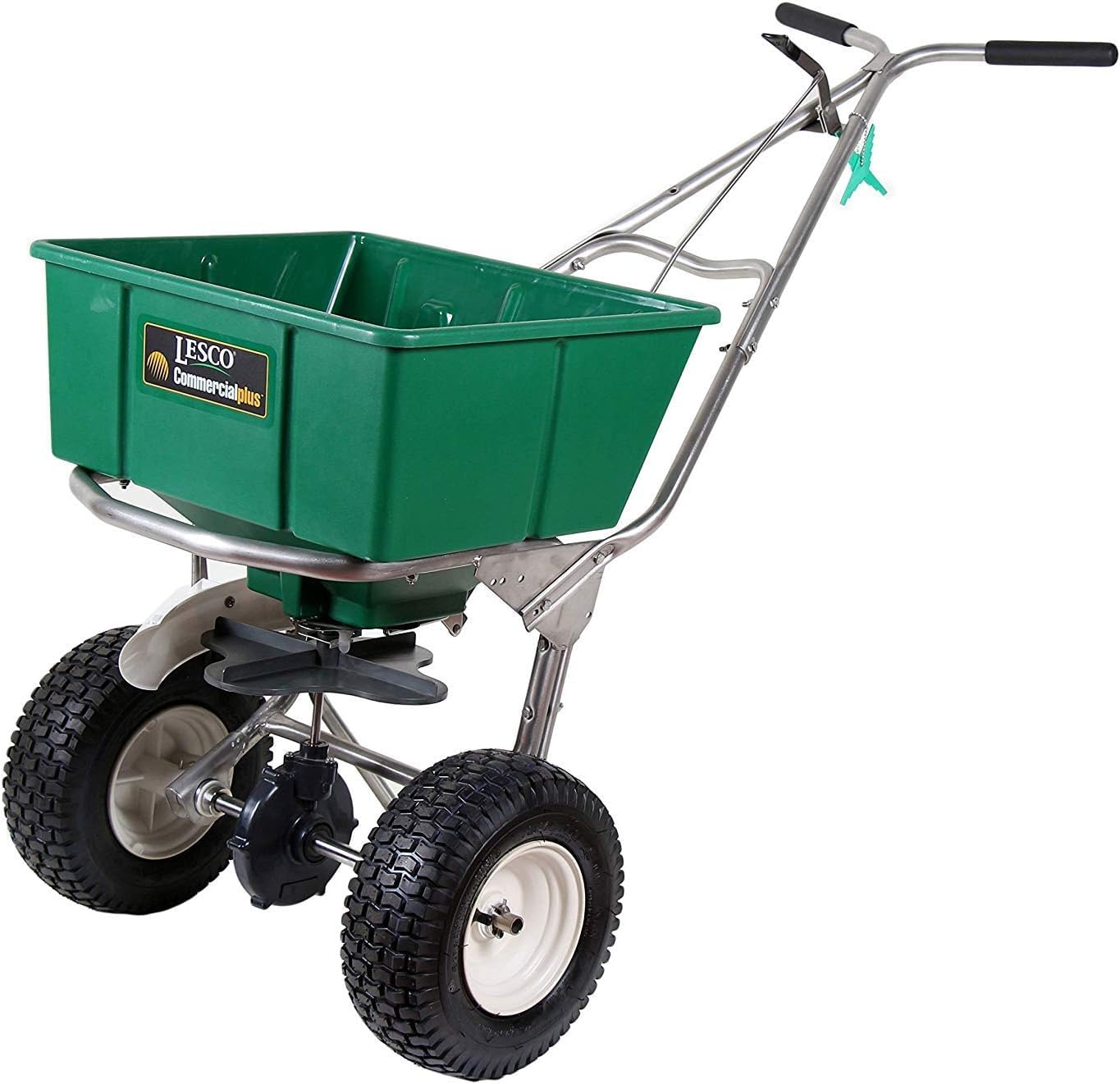
| Coverage | 80 lb. hopper |
|---|---|
| Item Form | Spreader |
| Specific Uses For Product | Lawn Care |
| Target Species | lawn grasses |
The LESCO High Wheel Fertilizer Spreader (model 101186) is built for demanding, commercial-style lawn work where consistent coverage and durability matter. It is used to broadcast granular fertilizer, grass seed, salt, or ice melt across turf and paved surfaces; the 80 pound hopper lets you cover substantial areas between refills. Notable features for performance users include an enclosed gearbox with a 5:1 gear ratio for reliable drive, an oscillating agitator to keep material flowing, a manual deflector for controlled distribution, and oversized pneumatic tires that improve stability and reduce rutting on uneven ground. The all stainless steel frame, axle, and impeller shaft are practical for long-term outdoor exposure and frequent use. Expect some assembly and a need to calibrate settings for different materials to get precise application rates. This unit does not include a hopper cover, so wet conditions or dusty materials may require extra care or aftermarket protection.
Best for: Designed for landscape pros and performance-minded property managers who need a durable, commercial-capable spreader for frequent fertilizer, seed, or salt applications.
Less Ideal for: Casual homeowners with very small lawns or occasional use should consider smaller, lower-capacity spreaders that are lighter and easier to store.
- Large 80 lb hopper reduces refill frequency on medium to large jobs
- Enclosed gearbox with 5:1 ratio delivers dependable drive under heavy loads
- Stainless steel frame, axle, and impeller shaft resist corrosion for long service life
- Oversized pneumatic tires improve stability and minimize turf rutting
- Oscillating agitator and manual deflector enable consistent product flow and controlled spread pattern
- No hopper cover included which can allow wetting or spillage in poor weather
- Requires assembly and careful calibration to achieve accurate application rates
Verdict: A rugged, high-capacity spreader built for professional use that delivers reliable, consistent application across large lawns and turf areas.
Agri-Fab 45-0614 130 lb. Push Broadcast Spreader

| Hopper capacity | 130 lbs. |
|---|---|
| Coverage | About 1/2 acre (25,000 sq. ft.) |
| Spread width | 10-12 ft. |
| Wheels | 13" x 4" pneumatic tires |
The Agri-Fab 45-0614 is a robust push broadcast spreader built for routine lawn-care tasks across larger properties. Its 130 lb. hopper holds enough material to cover about half an acre, and the 10 to 12 foot spread width moves product quickly so you make fewer passes. The spreader uses a simple direct rod flow control lever for on-the-go rate adjustment and rides on 13 x 4 inch pneumatic tires that smooth rolling over typical turf. Practical details like a large hopper and wide spread pattern mean less refilling and faster application for fertilizer or seed, and the unit is engineered for season-to-season durability rather than light use. Expect basic assembly and manual push operation rather than motorized convenience, and accuracy at very low application rates can be less precise than a drop-style spreader. This is a work-focused tool that favors capacity and throughput for commercial or high-output residential use over fine-grain metering for small ornamental beds.
Best for: Best for buyers who need a durable, high-capacity spreader to cover large lawns or commercial turf quickly and who prioritize throughput and fewer refills over fingertip precision.
Less Ideal for: Not a good fit for gardeners who need very precise application on small ornamental beds or those who prefer motorized or tow-behind powered spreaders.
- Large 130 lb. hopper reduces refills for mid-to-large properties
- 10–12 ft. spread width covers wide swaths quickly
- Direct rod flow control allows real-time adjustment while walking
- Pneumatic 13 x 4 in. tires provide smoother rolling over uneven turf
- Built for multi-season durability rather than disposable construction
- Manual push design requires operator effort on very large sites
- Not intended for precise low-rate applications where spot accuracy matters
Verdict: Choose this Agri-Fab if you want a tough, high-capacity push spreader that speeds fertilizer and seed application across large lawns.
VEVOR 60 lb Push Broadcast Spreader with Pneumatic Wheels

| Load capacity | 60LB |
|---|---|
| Wheels | 8-inch pneumatic |
| Frame | Powder-coated steel |
This VEVOR push broadcast spreader is built for straightforward, frequent lawn jobs where speed and coverage matter. It holds up to 60 pounds of seed or fertilizer in a plastic hopper mounted on a powder-coated steel frame and rolls on 8-inch pneumatic tires for easier movement across grass, gravel, and uneven ground. The unit offers multiple adjustable settings and a disc-style pellet controller to fine-tune spread width and flow, which helps achieve even coverage and reduces missed strips. Assembly is tool-free and quick, and the large hopper cuts down on how often you need to refill during a typical yard run. Practical buyers will appreciate the rugged frame and all-terrain wheels for year-round tasks from seeding to fertilizing. Limitations to note are that the spreader is a push model without motorized assistance, so it requires physical effort on larger properties, and the plastic hopper, while durable, is not as impact-resistant as metal for heavy-duty farm use.
Best for: Homeowners who want a reliable, no-frills spreader to speed up regular seeding and fertilizing on small to medium lawns while keeping setup and maintenance simple.
Less Ideal for: People who need a motorized or tow-behind spreader for large acreage or commercial operations should look at heavier duty or powered models.
- Large 60 lb hopper reduces refill frequency for medium-sized lawns
- Adjustable spread settings and disc pellet controller for precise coverage
- 8-inch pneumatic wheels ease movement over uneven terrain
- Powder-coated steel frame offers corrosion resistance for outdoor use
- Manual push design can be tiring on larger properties
- Plastic hopper is less impact-resistant than an all-steel construction
Verdict: Choose this spreader if you want a durable, large-capacity push unit that delivers controlled, even coverage for routine lawn seeding and fertilizing.
John Deere 130 lb Push Broadcast Spreader

| Capacity | 130 lbs. |
|---|---|
| Approximate coverage | Up to 25,000 sq ft |
| Spread width | 10 – 12 ft |
| Wheels | 13" x 4" pneumatic tires |
This John Deere push broadcast spreader is built for larger lawns and frequent use. The 130 lb rust-proof poly hopper lets you cover roughly half an acre between refills, while the broadcast plate delivers a 10 to 12 ft spread that speeds application and reduces passes. Control is simple: a direct rod gate and adjustable flow stop let you dial output for seed, fertilizer, weed control products, or ice melt so you get more even coverage and less waste. Durability is focused on practical longevity rather than lightweight portability — heat-treated steel gears are enclosed to resist corrosive materials and large turf-tread pneumatic tires make it easy to push across uneven turf. Assembly is required and the unit is substantial to maneuver compared with compact hand spreaders, but that heft contributes to stability and capacity. For performance-focused gardeners with mid-size to large lawns, it reduces refill frequency and produces consistent spreading; casual users with very small yards may find it larger than necessary.
Best for: Gardeners and property owners who prioritize efficient, consistent coverage across mid-size to large lawns and want a durable spreader that reduces refill interruptions.
Less Ideal for: People with very small yards, limited storage space, or who need a lightweight, highly portable seed spreader.
- Large 130 lb poly hopper reduces refills for up to 25,000 sq ft of coverage
- Wide 10–12 ft broadcast spread speeds application and improves uniformity
- Direct rod control and adjustable flow stop for precise output with different materials
- Enclosed heat-treated steel gears and turf-tread pneumatic tires improve durability and maneuverability
- Substantial size and weight make it less convenient for very small yards or frequent transport
- Some assembly required before first use
Verdict: Choose this spreader if you need high-capacity, consistent broadcast coverage for mid-size to large lawns without frequent refilling.
EarthWay 2150 Commercial 50 lb Broadcast Fertilizer Spreader

| Brand | EarthWay |
|---|---|
| Model Number | 2150 |
| Hopper Capacity | 50 lb |
| Tire Type | 13 inch pneumatic |
| Gearbox | Fully enclosed |
The EarthWay 2150 is a professional-grade broadcast spreader designed to deliver an even application of fertilizer, seed, or ice melt across turf. It is typically used as a push spreader for lawns where accuracy and durability matter. Notable features include EarthWay’s patented 3-hole drop shut off system and side-spread control for an approximately 50/50 spread pattern, a clog-free removable grate, an enclosed gearbox that resists moisture, and large 13 inch pneumatic tires that roll smoothly over uneven turf. The rustproof poly hopper is impact resistant and easy to wash down, and stainless-steel linkage replaces sticky cables for reliable operation. In practice this means fewer missed spots, less product waste, and consistent results across multiple passes. The unit is engineered for longevity with powder-coated steel and a sealed gearbox, but its commercial construction makes it heavier and bulkier than lightweight consumer models and requires storage space. Assembly and calibration take a bit more time up front, but the payoff is precise, repeatable spreading season after season.
Best for: Buyers who prioritize application accuracy and long-term durability for frequent or professional lawn care and who are willing to trade portability for performance.
Less Ideal for: Casual or infrequent users with very small yards who prefer a lightweight, compact spreader that is easier to store and transport.
- Patented 3-hole drop system plus side-spread control for a consistent, even spread pattern
- Fully enclosed gearbox allows use in moist or damp conditions and reduces maintenance
- Large 13 inch pneumatic tires provide smooth movement over rough or uneven lawns
- Rustproof poly hopper with removable grate is clog resistant and easy to clean
- Commercial-grade weight and size make it less convenient to move and store than lightweight spreaders
- Requires initial assembly and calibration to achieve optimal accuracy
Verdict: Choose the EarthWay 2150 when you need a durable, precision spreader that delivers consistent, professional results across uneven lawns.
CHAPIN SaltPro 100 lb Contractor Salt Spreader (stainless parts)
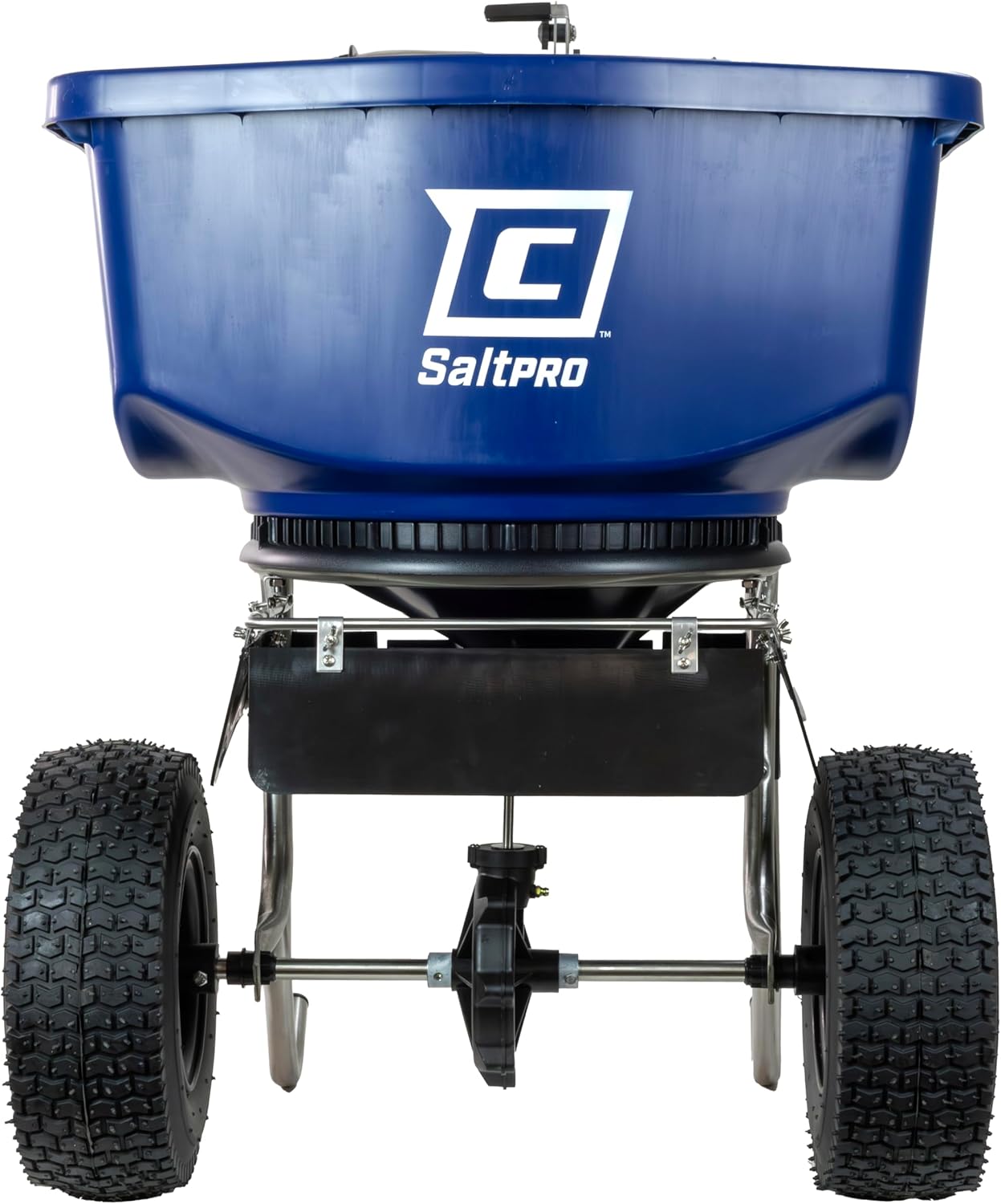
| Capacity | 100 lb hopper |
|---|---|
| Tire size | 12" pneumatic |
| Auger | Spiked auger |
| Hardware | Stainless steel |
The CHAPIN SaltPro 100 lb Contractor Spreader is a walk-behind broadcast spreader built for larger winter jobs where you need steady, reliable material delivery. It uses a 100 lb weather-resistant poly hopper and a spiked auger to break up clumps so pelletized or small ice-melt flows consistently through an adjustable gate and solid linkage. Side and rear baffles focus the pattern to reduce overspray and a T-handle sized for gloved use plus 12-inch pneumatic tires make it easier to push across uneven driveways and sidewalks. Stainless-steel hardware, enclosed gears with a grease fitting, and a rain cover add durability for frequent use. It is intended for salt and compatible ice melts rather than sand or lime blends, so it is best where melting agents are the chosen material. The unit is fairly large and built for regular commercial or heavy residential use, so it may be more than needed for small properties but will save time on larger areas and repeat jobs.
Best for: Buyers who need a dependable, heavy-use spreader for treating large driveways, commercial sidewalks, or multi-property winter maintenance and who prioritize reliability and low downtime.
Less Ideal for: Homeowners with only small yards or infrequent use who would prefer a lighter, simpler residential spreader or a handheld option.
- Large 100 lb poly hopper reduces refill frequency for big jobs
- Spiked auger and adjustable gate keep material flowing and let you control spread rate
- Stainless-steel hardware and enclosed, greased gears improve durability for frequent use
- 12" pneumatic tires and T-handle make it easier to maneuver over uneven ground
- Not recommended for sand, sand mixes, lime, or pelletized lime so material options are limited
- Relatively large and heavy which may be overkill for small lawns
Verdict: Choose this spreader when you need a durable, low-maintenance unit that handles large winter jobs reliably with stainless components.
Choosing the Right Commercial Push Fertilizer Spreader: Key Factors to Consider
Hopper Capacity and Refill Frequency
Hopper capacity determines how much fertilizer you can carry between refills. Larger hoppers reduce the number of stops on big jobs and keep crews moving, but they also add weight that affects pushing effort and traction.
Consider the typical area you treat in a single shift. If you cover multiple acres or large athletic fields, prioritize a higher-capacity hopper to minimize downtime. For confined or tightly landscaped sites, a slightly smaller hopper can make maneuvering around beds and obstacles easier while still delivering reasonable run times.
Construction Materials and Corrosion Resistance
Commercial spreaders see heavy use and exposure to corrosive fertilizers and wet conditions, so material choice matters. Steel frames can be very strong but require good coatings or stainless components to resist rust. Polymer hoppers resist corrosion but must be thick enough to avoid cracking under load.
Look for UV-stabilized plastics, powder-coated steel, or stainless fasteners in areas that contact fertilizer. Robust welds, reinforced mounting points, and sealed bearings extend service life and reduce the frequency of repairs in a commercial schedule.
Distribution Pattern and Adjustment Range
An even, controllable spread pattern is critical to avoid stripes, burn, or under-treated patches. Commercial turf work often needs both wide coverage for open turf and narrow, offset patterns for edges and planting beds.
Check how finely the flow rate can be adjusted and whether the spreader offers deflectors or pattern guides. The ability to dial in application rate and pattern helps you match product granule size and formulation to achieve uniform results across different turf types.
Calibration and Metering Accuracy
Accurate calibration ensures the fertilizer is applied at the intended rate per area, which affects plant health and compliance with application guidelines. Metering mechanisms that are easy to set and verify reduce operator error on the job.
Prefer spreaders with clear calibration charts or adjustable dials that correspond to bag recommendations. Quick checks and repeatable settings save time during shift changes and help maintain consistent application across multiple operators.
Maneuverability and Operator Effort
Push spreaders must be easy to steer and control, especially when fully loaded. Wheel size, tread type, and axle design influence rolling resistance and how the unit tracks over uneven ground.
Larger pneumatic tires help over rough turf and reduce compaction, while smooth hard wheels roll easily on firm surfaces. Consider handle ergonomics and whether the spreader tracks straight when loaded to reduce operator fatigue during long shifts.
Maintenance Accessibility and Replacement Parts
Commercial gear demands routine maintenance. Ease of accessing bearings, drive components, and the metering gate speeds service and reduces downtime. Readily available replacement parts and standardized fittings lower the total cost of ownership.
Look for simple linkage designs, replaceable wear plates near the hopper outlet, and sealed bearings that can be swapped without specialized tools. A machine that is easy to service on-site keeps crews productive and extends the working life of the spreader.
Why Commercial Push Spreaders Suit Professional Landscapes
Commercial push spreaders combine capacity and control for businesses that need reliable manual application without towing or motorized drive systems. They let crews make precise passes across turf, stopping easily at property edges or around obstacles while maintaining a consistent application rate.
These units are particularly useful where access or maneuvering prevents the use of ride-on or tow-behind machines, or where budget and storage constraints favor a push-style tool that still performs to commercial standards.
- Good for athletic fields, school grounds, and medium-sized commercial properties
- Allow controlled, low-speed application for sensitive turf or close-to-edge work
- Fit in smaller storage spaces compared with larger motorized equipment
Matching Spreader Calibration to Fertilizer Granule Size
Fertilizer granules vary in size, shape, and flow characteristics, and that affects how they exit the metering gate and disperse. A coarse granular product may require a different opening and spreader setting than a fine one to keep the distribution even.
Start with the manufacturer calibration chart if available, then make a small test pass and measure the applied rate. Adjust the metering incrementally until you achieve the target coverage, and note settings for each product you use frequently to save time on future jobs.
- Perform a simple catch test on a known area to confirm application rate
- Record settings for common fertilizer formulations used by your crew
Routine Care to Maximize Service Life
Rinse residual fertilizer from hopper and discharge areas after each use to prevent corrosion and clogging. Avoid high-pressure washing on bearings and sealed components that can force water into lubrication points.
Inspect tires, axles, and linkage daily during busy seasons and replace worn parts immediately. Small preventive actions keep commercial spreaders working through peak workloads and reduce emergency repairs that disrupt schedules.
- Flush hopper with water and let fully dry before storage
- Lubricate moving parts on a regular schedule
- Keep an inventory of wear parts like bearings, gaskets, and metering plates
Adapting Push Spreaders for Different Turf Conditions
Ground firmness, slope, and vegetation density change how a push spreader performs. On soft or wet turf, larger tires and careful loading reduce risk of rutting and compaction. On slopes, control your walking speed and avoid overfilling to maintain safe handling.
For tight landscapes with planting beds and hard edges, use deflectors or offset passes to prevent overspreading into beds. Practice setting up your path to minimize overlap and maintain a consistent walking pace for uniform application.
- Choose tire and tread types appropriate to the typical ground conditions
- Use deflectors and pattern adjustments for edging and near plantings
- Reduce hopper load on steep sections to keep handling predictable
Transport and Storage Considerations
Commercial push spreaders should be easy to stow and move between jobs. Consider whether the unit breaks down for transport or has locking handles and wheel chocks for secure transit. Compact storage size matters if you share equipment in a crew vehicle or store in a small utility room.
If the spreader will be transported frequently in trucks or trailers, ensure mounting points and tie-down locations are robust and that tires are suitable for loading and unloading without damage.
- Verify folding or detachable handles if transport space is tight
- Check for secure tie-down points and protective covers for long hauls
- Store indoors or under cover to reduce UV and weather exposure
How We Chose the Best Commercial Push Fertilizer Spreader
We focused on the attributes that matter for repeated, large-area fertilizer application. Primary filters included hopper capacity and construction durability to ensure a spreader can hold enough material for long runs and resist corrosion and wear in outdoor environments. We prioritized even distribution and adjustable spread patterns so users can match coverage rates and minimize streaking. Ease of calibration and meter control was another key filter because accurate application rates matter for turf health and regulatory compliance. Mobility and ground clearance were evaluated for safe, stable operation across turf, gravel, and slight slopes. Finally, maintenance needs and parts availability were considered to ensure long service life and simple field repairs. We excluded consumer-grade handheld and tow-behind lawn spreaders that lack the capacity or frame strength for professional workloads. We also excluded units designed only for seed or ice melt where spread pattern and calibration differ from fertilizer needs. The resulting list focuses on commercial push spreaders that meet performance and durability standards suited to property managers, grounds crews, and athletic field maintenance.
FAQ
How often should I calibrate a commercial push fertilizer spreader?
Calibrate whenever you change fertilizer formulations, and verify settings at the start of each season. Small changes in granule size or humidity can alter flow rates, so a quick catch-test before a large job is wise.
Can I use the same spreader for seed and fertilizer?
Often you can, but seed and fertilizer behave differently. Clean the hopper and metering components thoroughly between uses and test application patterns to avoid uneven seeding or contamination of materials.
What maintenance keeps a push spreader working reliably?
Rinse residual product from contact areas, lubricate linkages, inspect bearings and tires, and replace worn metering parts. Regular checks during heavy seasons prevent small issues from causing downtime.
Is a larger hopper always better for commercial work?
Not always. Larger hoppers reduce refill frequency on big jobs but increase pushing effort and may reduce maneuverability in tight areas. Match hopper size to the job scale and crew strength.
How do I prevent corrosion when using fertilizer frequently?
Rinse exposed metal and hopper outlets after use, dry the unit before storage, and choose spreaders with corrosion-resistant materials or coatings. Replacing quickly corroded fasteners with stainless parts can also help.
What tire type is best for heavy-duty turf spreading?
Pneumatic tires with wider treads reduce compaction and roll better over uneven turf, while hard plastic or semi-pneumatic wheels may be fine for firm surfaces. Select tire type based on typical ground conditions and load.
Final Verdict
For commercial fertilizer application, prioritize spreaders that balance hopper capacity with durable construction and reliable distribution. Accurate calibration and easy-to-service metering reduce waste and keep turf healthy, while appropriate tire choice and handle ergonomics reduce operator fatigue. Consider the tradeoff between larger hoppers for fewer refills and increased pushing effort in tight or steep sites. Focusing on these practical factors will help you choose a spreader that stands up to heavy use and delivers consistent, uniform coverage.
