

Note: This article contains affiliate links. If you click on these links and make a purchase, I may earn a small commission at no extra cost to you. This helps support my research and content. Read my full affiliate disclosure here.
If you manage a warm-season lawn, choosing the right Zoysia weed and feed fertilizer changes how quickly bare spots fill in and how much time you spend removing broadleaf weeds. The right formula gives steady nitrogen for dense tillering while suppressing common lawn weeds without burning tender summer grass. This guide shortlists seven top products suited to Zoysia lawn care and explains the practical tradeoffs you should weigh in the yard. We evaluated options based on nutrient release profile, weed-control spectrum, and application safety so you can pick a fertilizer that matches your maintenance rhythm and local conditions. Read on to see why these picks made the cut and which characteristics matter most for Zoysia turf.
Top Picks at a Glance
| Best Overall The best all-around choice for most situations | Scotts Turf Builder Triple Action 3-in-1 Lawn Fertilizer and Weed Control, 33.94 lb |  |
| Best Quality Built to a higher standard if you want something more solid | The Andersons Barricade 18-0-4 Granular Fertilizer with Pre-Emergent Weed Control, 40 lb (10,000 sq ft) |  |
| Best Value The sweet spot between price and what you get | GreenView Weed & Feed Lawn Fertilizer, 39 lb (Covers 15,000 sq ft) |  |
| Best Budget The cheapest option that still gets the job done reliably | GreenView Weed & Feed Lawn Fertilizer, 13 lb Bag |  |
| Highest Rated A top-rated pick with lots of positive feedback | The Andersons Premium Weed and Feed 24-0-16 (18 lb) |  |
| Most Popular A crowd favorite that many people choose with confidence | Scotts Turf Builder Weed & Feed (42.87 lb) |  |
| Best Seller A high-volume bestseller chosen again and again | Scotts Turf Builder Weed & Feed 3, Granular Lawn Fertilizer and Weed Killer, 14.29 lb |  |
Scotts Turf Builder Triple Action 3-in-1 Lawn Fertilizer and Weed Control, 33.94 lb

| Item Form | Granule |
|---|---|
| Coverage | All-purpose |
| Active Ingredients | Pendimethalin, 2,4-D, Dicamba |
| Unit Count | 543.04 Ounce |
Scotts Turf Builder Triple Action combines weed control, crabgrass prevention, and fertilizer into one granular product aimed at simplifying spring lawn care. You apply it with a broadcast spreader to a wet lawn when broadleaf weeds like dandelions are actively growing, let the granules settle for 24 hours, then water to activate the pre-emergent layer that blocks crabgrass germination. The formula contains pendimethalin plus 2,4-D and dicamba to target a broad list of lawn weeds while providing nutrients to strengthen turf. Its main benefits are convenience and broad coverage — one 33.94 lb bag treats about 12,000 sq ft — and it works on most common turf species. Important limitations to note are safety and timing: active ingredients require care around children and pets until dusts settle, it will not kill established crabgrass, and correct application timing and watering are essential for prevention to work. For best results use a calibrated spreader and follow label directions for temperature and grass type compatibility.
Best for: Buyers who prioritize measurable lawn performance and want a single product to reduce steps in spring lawn care, particularly homeowners managing medium to large cool- or warm-season lawns.
Less Ideal for: Those who need a solution for existing crabgrass patches, have very small decorative turf areas, or prefer organic-only products should consider alternative targeted treatments.
- Three functions in one bag: fertilizer, broadleaf weed killer, and crabgrass pre-emergent
- Large coverage per bag suitable for medium to large lawns (up to 12,000 sq ft)
- Granular form works with standard broadcast spreaders for even application
- Contains multiple active ingredients for control of a wide range of listed weeds
- Instructions and recommended use timing are provided to optimize performance
- Does not control existing crabgrass since pre-emergent only prevents germination
- Contains herbicides that require keeping people and pets off treated area until granules settle
- Effectiveness depends on correct timing, watering, and spreader calibration
Verdict: Choose this if you want a performance-focused, all-in-one granular treatment that feeds turf while preventing crabgrass and controlling common broadleaf weeds.
The Andersons Barricade 18-0-4 Granular Fertilizer with Pre-Emergent Weed Control, 40 lb (10,000 sq ft)

| Item Form | Granule |
|---|---|
| Coverage | 10,000 sq ft |
| Active Ingredients | Prodiamine |
This product combines a high-nitrogen-free fertilizer formula with a pre-emergent herbicide to prevent common grassy and broadleaf weeds across large lawns. It is applied as a granule over the turf in early spring or fall and activated by watering so the dispersible granule technology helps the active ingredient move into the soil quickly. Practical benefits include single-product convenience for both feeding and weed prevention, broad coverage that lists common targets such as crabgrass and poa annua, and a delivery format suited to standard broadcast or drop spreaders. The limitations are that it will not eliminate weeds already present and must be used only in the specified application windows; safety directions warn to keep pets and children away during and immediately after application. For someone managing a medium to large lawn who prefers a preventive approach, this product reduces the need to buy separate fertilizer and pre-emergent treatments but requires proper timing and handling to be effective and safe.
Best for: Buyers who want an all-in-one preventive solution for a thicker, weed-free lawn and who plan applications on a seasonal schedule and follow label safety guidance.
Less Ideal for: Homeowners needing to remove existing weed infestations or those seeking immediate post-emergent control should choose a different product or add a separate treatment.
- Combines fertilizer and pre-emergent weed control in one product for convenience
- Covers up to 10,000 square feet per bag suitable for medium to large lawns
- Dispersible granule technology helps active ingredient reach soil quickly after watering
- Targets a wide range of grassy and broadleaf weeds including crabgrass and poa annua
- Does not control weeds that are already established
- Must be applied only in early spring or fall to be effective
Verdict: A convenient, large-coverage granular product that prevents common lawn weeds while feeding turf when used as directed in spring or fall.
GreenView Weed & Feed Lawn Fertilizer, 39 lb (Covers 15,000 sq ft)

| NPK | 27-0-4 |
|---|---|
| Form | Granule |
| Coverage | 15000 sq ft |
| Active Ingredient | Nitrogen |
| Unit Count | 624 Ounce |
GreenView Weed & Feed is a single-application granular product that combines a slow-release nitrogen fertilizer with a broadleaf herbicide to feed turf and control common lawn weeds. It is typically applied to established lawns when weeds are actively growing, using the recommended rate and watering in afterward; the bag covers up to 15,000 square feet at the stated application rate. Notable features include MESA controlled-release nitrogen for up to eight weeks of steady feeding and labeled control of over 250 weeds such as dandelion and clover. Practical benefits are faster, uniform green-up without a surge of growth, improved root development for heat and drought tolerance, and convenience from a combined weed-control plus fertilizer approach. Important limitations are that it is intended only for established turf and specific grass species, requires careful timing (do not mow two days before or after application) and is not suitable for some grasses like dichondra or certain St. Augustine varieties in Florida, so checking the label for species compatibility is essential.
Best for: A cautious buyer who values proven results and wants a convenient, evidence-backed product to maintain and improve established warm- or cool-season lawns while reducing application frequency.
Less Ideal for: Do not choose this if you are overseeding, establishing a new lawn, or managing grass types listed as incompatible such as certain Floratam St. Augustine selections or non-turf groundcovers.
- Combines fertilizer and herbicide so you treat weeds while feeding in one application
- MESA controlled-release nitrogen provides up to 8 weeks of steady feeding
- Labeled to control over 250 common broadleaf lawn weeds
- Large 39 lb bag covers up to 15,000 sq ft at the recommended rate
- Formulation is for established turf only and can harm non-listed species
- Requires precise timing and watering instructions to work effectively
Verdict: Choose this if you want a single, proven weed-and-feed product that delivers steady feeding and broadleaf weed control across common established turf.
GreenView Weed & Feed Lawn Fertilizer, 13 lb Bag

| NPK | 27-0-4 |
|---|---|
| Form | Granule |
| Coverage | 5000 square_feet |
| Active ingredient | Nitrogen |
GreenView Weed & Feed is a combined granular fertilizer and selective herbicide designed to feed established turf while controlling broadleaf weeds. You apply it to a dry, established lawn when weeds are actively growing, then water to activate the product and avoid mowing for two days. It uses a controlled-release nitrogen formulation to deliver steady feeding for up to eight weeks, which helps green-up without pushing surge growth and supports deeper roots for better drought tolerance. The herbicide component targets more than 250 common lawn weeds such as dandelion, clover, and plantain, so one application handles both nutrition and weed pressure across many cool- and warm-season grasses. Practical benefits include long feeding duration, wide weed control, and coverage suitable for medium to large yards. Important limitations are that it is for established turf only, it can damage certain grasses like St. Augustine (in Florida), dichondra, and carpetgrass, and timing matters because weeds must be actively growing for best control.
Best for: Homeowners who want a single, budget-friendly product to both feed and reduce broadleaf weeds on established lawns and prefer less frequent applications over the season.
Less Ideal for: Gardeners establishing new turf, owners of sensitive or excluded grass types, or those seeking an organic or granular fertilizer without herbicide.
- Controlled-release nitrogen feeds lawns for up to eight weeks, reducing the need for frequent applications
- Provides selective control of over 250 broadleaf weeds alongside fertilization
- Covers approximately 5,000 square feet from a single 13 lb bag, suitable for medium to large yards
- Zero phosphate formulation to reduce risk of waterway runoff
- Not safe for certain turf types such as St. Augustine in Florida, dichondra, and carpetgrass
- Requires correct timing and watering after application for effective weed control
- Intended only for established lawns and can harm seedlings or sensitive grasses
Verdict: A cost-effective all-in-one weed-and-feed that delivers eight weeks of controlled-release nitrogen while knocking back a wide range of common broadleaf weeds.
The Andersons Premium Weed and Feed 24-0-16 (18 lb)

| Item Form | Granule |
|---|---|
| Coverage | 5,000 sq ft |
| Unit Count | 288 Ounce |
| Active Ingredients | Herbicide, Iron, Nitrogen, Sulfur |
The Andersons Premium Weed and Feed 24-0-16 is a granular lawn product designed to kill broadleaf weeds while feeding turf with a mix of quick- and slow-release nitrogen plus iron for deeper greening. You apply it with a rotary or drop spreader to a dry lawn, following the label spreader settings and the two-step application schedule for best control. It targets over 250 broadleaf weeds and lists compatibility with St. Augustine and other common warm- and cool-season grasses, making it useful for seasonal lawn program maintenance. Practical benefits include combined weed control and extended feeding in one pass and improved lawn color from added iron. Important limitations are geographic restrictions and the need to follow the two-application procedure and post-application watering to activate herbicide; it is also not suitable for dichondra or carpet grass. For performance-focused users, correct spreader calibration and adherence to timing will determine results more than the product alone.
Best for: Homeowners who prioritize visible lawn performance and want a combined weed-control plus feeding product for regular seasonal maintenance of St. Augustine and similar grasses.
Less Ideal for: People managing sensitive or restricted lawns such as dichondra or carpet grass or those located in states where this product is not approved.
- Combines herbicide and fertilizer so you kill weeds while feeding grass in one application
- Includes both quick- and slow-release nitrogen for immediate green-up and longer-lasting feeding
- Contains iron for deeper, faster greening of turf
- Covers up to 5,000 sq ft per bag, suitable for medium-sized yards
- Not approved for sale or use in some states which limits availability
- Requires specific spreader settings and a two-step application schedule for full effectiveness
Verdict: Choose this product if you want a single granular treatment that controls broadleaf weeds and delivers both quick and extended feeding for a noticeably greener St. Augustine lawn.
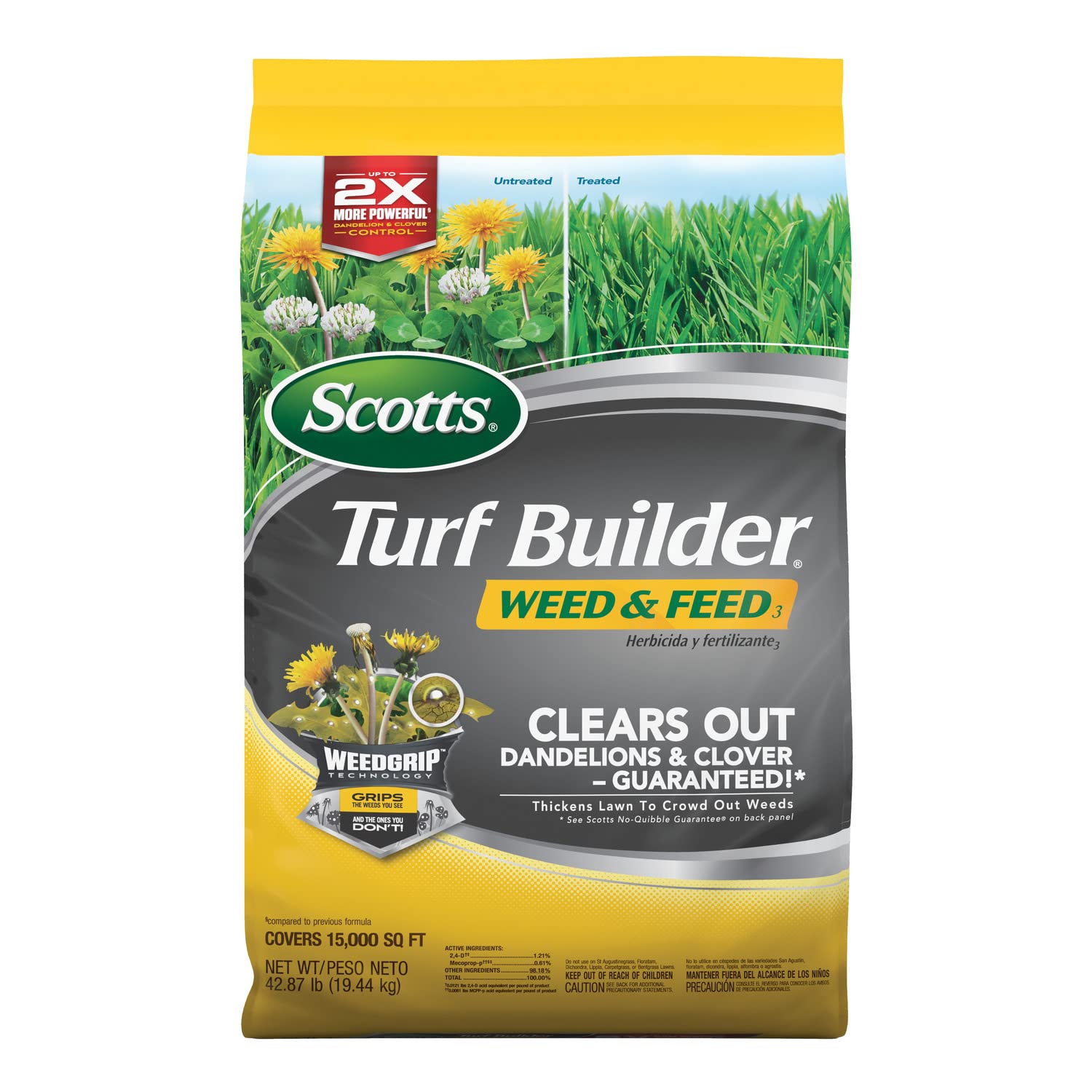
Scotts Turf Builder Weed & Feed (42.87 lb)
| Item Form | Granule |
|---|---|
| Coverage | 15000 square_feet |
| Active Ingredients | 24-D Mecoprop-p |
Scotts Turf Builder Weed & Feed is a granular lawn treatment that kills broadleaf weeds while feeding grass to encourage thicker turf. It is applied with a spreader when weeds are actively growing and temperatures are between 60°F and 90°F; the label recommends applying to a wet lawn so granules stick to weed leaves and waiting 24 hours before watering. The formula uses WeedGrip technology and lists active ingredients including 2,4-D and Mecoprop-p, and the 42.87 lb bag covers about 15,000 square feet. In practice this product is straightforward to broadcast across medium to large lawns and gives visible reduction of common weeds like dandelions and clover while supplying nutrients to help crowd out future weeds. Important limitations are application timing and grass restrictions: do not use on St. Augustinegrass, bentgrass, carpetgrass, dichondra, or lippia, and do not apply if rain is expected within 24 hours. Also keep people and pets off treated turf until dust settles. For homeowners who follow label directions, it is an efficient one-step option for late spring weed control and feeding.
Best for: Homeowners who want a single product to both reduce common broadleaf weeds and feed a cool- or warm-season lawn and who prefer a proven brand with clear label instructions and wide user adoption.
Less Ideal for: People with lawns made of excluded grass types or those needing immediate spot treatment for individual weeds should consider alternatives designed for those specific situations.
- Combines selective broadleaf weed control and fertilizer in one application
- Large bag covers up to 15,000 sq. ft., suitable for medium to large lawns
- WeedGrip technology helps granules adhere to weed leaves for better control
- Granular form is compatible with common broadcast or drop spreaders
- Not safe for several grass types including St. Augustine and bentgrass
- Requires specific temperature and moisture conditions for best results
Verdict: A convenient, proven one-step weed-and-feed for homeowners who want broadleaf weed control plus lawn feeding across large yards.
Scotts Turf Builder Weed & Feed 3, Granular Lawn Fertilizer and Weed Killer, 14.29 lb

| Item Form | Granule |
|---|---|
| Coverage | 5000 square_feet |
| Active Ingredients | 2,4-D 1.220%, Mecoprop 0.081% |
Scotts Turf Builder Weed & Feed3 is a granular lawn product that combines a fertilizer with broadleaf weed control for routine lawn maintenance. It is applied with a broadcast or drop spreader to a wet lawn when daytime temperatures are between 60 and 90°F, and it uses WeedGrip technology to help granules stick to weed leaves for better uptake. In practice it kills common weeds such as dandelion and clover while delivering nutrients to thicken grass, so treated areas often green up and look fuller over a few weeks. The package covers about 5,000 sq. ft. and manufacturer instructions recommend avoiding certain grass types and keeping people and pets off the lawn until dust settles. Important limitations are that it is not safe for some turf species and must not be watered for 24 hours after application; timing and correct spreader settings affect results. For homeowners wanting a combined feed-and-weed treatment for standard lawns, it simplifies two tasks into one application, but it requires following the label closely for safe and effective use.
Best for: Homeowners seeking a straightforward, combined fertilizer and weed-control treatment to maintain and thicken common cool- and warm-season turf in a typical yard.
Less Ideal for: Specialist turf managers, owners of sensitive turf varieties (listed on the label), or those who need spot treatment only rather than whole-lawn applications.
- Combines fertilizer and broadleaf weed control in one granular product
- WeedGrip formulation helps granules adhere to weed leaves for improved herbicide contact
- Covers approximately 5,000 sq. ft. per 14.29 lb bag, suitable for many small to medium lawns
- Clear application guidance for use with common spreaders and specific temperature/wetting windows
- Contains active herbicide ingredients not appropriate for all turf types and must be avoided on listed grasses
- Requires strict timing and no watering for 24 hours after application to be effective and safe
Verdict: A practical one-step weed-and-feed for typical lawns that feeds turf while targeting common broadleaf weeds across a 5,000 sq. ft. area.
Choosing the Right Zoysia Weed and Feed Fertilizer: Key Factors to Consider
Nitrogen Source and Release Rate
Zoysia responds best to steady, moderate nitrogen that promotes tillering without forcing weak, succulent growth that attracts disease. Slow-release nitrogen sources such as polymer-coated urea or natural organics provide a more even supply over weeks, reducing the risk of leaf scorch in hot weather. Fast-release nitrogen can produce a quick green-up but increases mowing frequency and burn risk on warm, dry days.
When choosing a fertilizer, check the guaranteed analysis and the percentage of slow-release nitrogen. A higher proportion of slow-release nitrogen helps maintain color and density between feedings and is easier to time around heat spells and irrigation schedules.
Weed-Control Active Ingredients
Not all weed-control chemistries are labeled or safe for use on Zoysia. Broadleaf herbicides and select post-emergent actives control common invaders like clover, dandelion, and plantain. Effective weed-and-feed formulas specify the active ingredients and the types of weeds they target. Some actives control certain grassy weeds while others only affect broadleaf species.
Consider which weeds are dominant in your lawn and whether pre-emergent or post-emergent control is needed. Also check timing restrictions, since many weed actives should not be applied during peak heat or drought and some require repeat applications for persistent weeds.
Turf Safety and Timing
Zoysia is tolerant of heat and drought but can be sensitive to excessive nitrogen or herbicide stress. Turf safety depends on following label rates, applying at the recommended growth stage, and avoiding applications during extreme heat or prolonged dry spells. Some formulations advise watering in after application; others require a dry period for herbicide uptake.
Plan applications for spring green-up or late spring to early summer depending on local climate. Avoid late-season high-nitrogen applications that encourage growth before dormancy. Read label warnings about reseeding or overseeding and restrictions around ornamentals and vegetable gardens.
Application Method and Spreader Calibration
Uniform coverage is critical for both feeding and weed control. Granular blends vary in particle size and flow characteristics, which affects how they drop through broadcast or rotary spreaders. Uneven application leads to patchy color and inconsistent weed control. Look for products that list spreader settings or provide guidance for common spreader models.
Also consider package size relative to your lawn to avoid multiple storage cycles that can expose product to moisture. Smaller lawns may prefer a fine granule for easier metering, while larger lawns benefit from bulk packaging and clear spreader instructions to speed application.
Environmental Considerations and Runoff Risk
Fertilizer and herbicide runoff can impact nearby planting beds, water features, and municipal waterways. Choose formulations with lower soluble nitrogen spikes and follow buffer-zone recommendations near storm drains and bodies of water. Slow-release nitrogen reduces the immediate concentration of soluble nutrients available for runoff after a heavy rain.
Proper timing relative to rainfall forecasts and following label watering instructions minimizes off-target movement. Consider using products with clear stewardship guidance and avoid application before heavy rain events.
Longevity and Maintenance Rhythm
Think about how often you want to treat your lawn. Some weed-and-feed products are formulated to provide coverage for several weeks, reducing the number of applications, while others are intended as part of a frequent maintenance schedule. Longevity affects the season-long plan for mowing, irrigation, and any follow-up spot treatments.
If you prefer a low-input routine, prioritize longer-lasting slow-release formulas and plan spot treatments for stubborn weeds. If you like frequent, targeted care, a shorter-duration product with easier spot-treatment compatibility may fit your maintenance style better.
When to Apply on Zoysia Lawns
Timing affects both efficacy and turf safety. Apply early in the active growing season after the grass has fully greened up but before extreme summer heat sets in. In many climates that means late spring to early summer when soil temperatures and turf growth support active uptake of nutrients and herbicides.
Avoid applications during drought stress or heat waves. If rain is forecast within 24 hours, consult the product label for rainfastness. Some formulations need an initial dry period for herbicide uptake; others require light irrigation after spreading to move nutrients into the root zone.
- Apply when Zoysia is actively growing and not dormant.
- Check soil temperature recommendations on the label when available.
- Avoid treating during or immediately before heat stress or drought.
Managing Spot Treatments After a Weed-and-Feed
Even with a broad-spectrum weed-and-feed, persistent weeds may require follow-up spot treatments. Wait the labeled interval after the initial application before applying additional herbicides to avoid turf damage and chemical interactions.
Use selective post-emergent herbicides that are labeled safe for Zoysia for spot control. Physical removal combined with targeted herbicide use often reduces the need for repeated whole-lawn treatments.
- Confirm wait times on labels before applying more herbicide.
- Combine manual removal with targeted herbicide applications for best results.
Watering Practices Around Application
Water management around the time of application influences nutrient uptake and herbicide performance. For slow-release nitrogen, heavy immediate irrigation is usually unnecessary and can reduce longevity. For some herbicide actives a short dry period improves uptake, while others perform better with a light irrigation after application.
Adjust irrigation schedules based on the product instructions and current weather. Overwatering soon after application can promote runoff and reduce efficacy, while insufficient moisture later in the season can stress treated turf.
- Follow label guidance for watering before and after application.
- Avoid heavy irrigation that could wash product off the lawn into gutters or beds.
Mowing and Cultural Practices To Complement Treatment
Set mower height to the recommended level for Zoysia to promote deeper roots and shade out weeds. Avoid mowing immediately before or after application unless the label permits it, since fresh clippings can redistribute granules unevenly.
Aeration and appropriate dethatching on a schedule compatible with treatment timing help fertilizer reach the root zone. Combining good cultural practices with a weed-and-feed program reduces reliance on chemical controls over time.
- Raise mower height slightly after fertilization if rapid growth occurs.
- Coordinate aeration and dethatching with feeding schedule to avoid stressing turf.
Interpreting Guaranteed Analysis on Labels
The guaranteed analysis lists percentages of nitrogen, phosphorus, and potassium along with the share of slow-release nitrogen. Understand the N-P-K numbers and identify the fraction that is slow-release to predict feeding longevity. A product with a higher slow-release percentage will feed longer and reduce the chance of burn.
Also look for secondary nutrients such as iron or sulfur that can affect color and stress tolerance. The label should show active herbicide ingredients and any use restrictions for warm-season grasses like Zoysia.
- Prioritize the slow-release nitrogen percentage for steady feeding.
- Check label for secondary nutrients and herbicide active ingredients.
How We Chose the Best Zoysia Weed and Feed Fertilizer
We focused on attributes that directly affect Zoysia lawns in real-world conditions. Primary evaluation criteria included nitrogen source and release rate, which determine steady green-up and lower burn risk; the breadth and labeled control of weed-active ingredients, which matter for the kinds of broadleaf and grassy weeds that compete with Zoysia; and formulation compatibility with Zoysia growth habits, including recommended timing and rebound effects after application. We also weighed ease of application for homeowners, including granule size and spreader calibration guidance, and the product safety profile for surrounding plants and water runoff. Products were excluded if labeling did not specify use on Zoysia or if the weed-control claim lacked clear active ingredients appropriate for common cool- or warm-season lawn weeds. We avoided products with ambiguous nutrient analysis or without clear instructions for summer application. Final selections balanced predictable slow-release feeding with reliable weed suppression and homeowner-friendly application instructions. These same dimensions are reflected in the scoring criteria so readers can compare like for like.
FAQ
Can I use a general-purpose weed-and-feed on Zoysia?
Often general-purpose products are labeled for multiple turf types but you must confirm the label specifically lists Zoysia. Some herbicide actives included in broad formulations are not safe on all warm-season grasses. Always follow label directions for application rate and timing.
How long after applying should I water my lawn?
It depends on the product. Some formulas recommend light watering to move granules into the root zone, while others require a dry period for herbicide uptake. Check the label; when in doubt, a light irrigation 24 hours after application is commonly appropriate for many slow-release fertilizers.
Will a weed-and-feed damage Zoysia in hot weather?
Weed-and-feed products can stress Zoysia if applied during heat waves or drought. Slow-release nitrogen reduces burn risk compared with fast-release formulations, but avoiding application during extreme heat and following label rates is the best way to protect turf.
How often should I apply a weed-and-feed to maintain Zoysia?
Frequency depends on the nitrogen release profile and the product's labeled interval. Some homeowners apply a long-lasting slow-release product every 8 to 12 weeks during the growing season, while others use shorter-interval programs combined with spot treatments. Follow label recommendations and local extension guidance.
Can I overseed or repair Zoysia after using a weed-and-feed?
Most weed-and-feed products advise a waiting period before seeding or overseeding to avoid herbicide injury to new seedlings. The label will specify how long to wait; typically a few weeks to several months depending on the active ingredient.
Is a separate pre-emergent still needed if I use a weed-and-feed?
Some weed-and-feed formulations include pre-emergent herbicides, but many do not. If crabgrass or other annual grassy weeds are a concern, check the label for pre-emergent actives or plan a dedicated pre-emergent application at the recommended timing for your region.
Final Verdict
Pick a weed-and-feed that matches your Zoysia maintenance rhythm and local growing conditions. Prioritize a high percentage of slow-release nitrogen if you want steady color and lower burn risk, and match herbicide actives to the weeds you actually have in the lawn. Follow label timing, spreader settings, and watering guidance to protect turf and minimize runoff. Balancing feeding frequency against persistence of problem weeds helps you plan a season-long program. If you prefer low input, choose longer-lasting formulas and spot-treat stubborn weeds. If you like frequent, precise control, a shorter-duration product combined with targeted post-emergent treatments can deliver better outcomes.
