

Note: This article contains affiliate links. If you click on these links and make a purchase, I may earn a small commission at no extra cost to you. This helps support my research and content. Read my full affiliate disclosure here.
Hellebores thrive in soil that is loose, humus-rich, and consistently damp without staying waterlogged. Choosing the right compost for hellebores matters because these shade-adapted perennials respond best to steady nutrient release and good crumb structure rather than frequent high-nitrogen feeds. This guide shortlists the top composts suited for hellebores, focusing on mixes that improve drainage, build organic matter, and hold moisture in a woodland or shaded border setting. We evaluated options for texture, nutrient profile, and how each compost behaves in real garden conditions. Read on to get practical guidance that helps you pick a compost that supports healthy foliage, reliable flowering, and long-term soil improvement.
Top Picks at a Glance
| Best Overall The best all-around choice for most situations | Charlie's Compost Concentrated Organic Plant Fertilizer (10 lb) |  |
| Best Quality Built to a higher standard if you want something more solid | Espoma Organic Land and Sea Gourmet Compost with Lobster & Crab Meal, 1 cu ft |  |
| Best Value The sweet spot between price and what you get | Brut Organic Worm Castings, 5 lb |  |
| Best Budget The cheapest option that still gets the job done reliably | Seedlingers Worm Magic Worm Castings, 1 lb |  |
| Highest Rated A top-rated pick with lots of positive feedback | Earth Science Premium Earthworm Castings, 3 lb |  |
| Most Popular A crowd favorite that many people choose with confidence | Wiggle Worm Pure Worm Castings Organic Fertilizer, 15 lb |  |
Charlie's Compost Concentrated Organic Plant Fertilizer (10 lb)

| Net weight | 10 pounds |
|---|---|
| Manufacturer | Charlie's Compost |
| Ingredients | Vegetarian chicken manure, biochar, organic grasses, crop residue |
| Certification | OMRI listed organic |
Charlie’s Compost is a concentrated, OMRI-listed organic compost intended to boost soil biology and nutrient content for vegetables, ornamentals and container plants. You apply it by working small amounts into garden soil or mixing with potting media to add organic matter, microorganisms and slow-release nutrients rather than relying on synthetic fertilizers. Notable features include a vegetarian, antibiotic-free chicken manure base, added biochar and crop-residue organics, and organic certification that makes it suitable for organic vegetable production. In practice a little goes a long way, so it is useful for improving tired beds, prepping new vegetable rows, or topdressing containers; the concentrated nature reduces the volume you need to handle compared with loose compost. Limitations are that this is a bagged, concentrated product so it will not replace large volumes of finished compost for major soil building and may require additional application or mixing for even distribution in large beds.
Best for: Gardeners who prioritize organic, low-risk inputs and want a ready-to-use concentrated amendment to improve vegetable beds or containers without synthetic chemicals.
Less Ideal for: Those needing large quantities of finished compost to rebuild soil structure across many beds or landscapers who prefer bulk, loose compost for large-scale projects.
- OMRI-listed organic formulation safe for certified organic vegetable production
- Concentrated formula delivers nutrients and microbes with smaller application volumes
- Contains biochar and diverse organic inputs to improve soil structure and biology
- Suitable for both in-ground beds and containers when mixed appropriately
- Not a bulk finished compost so larger soil-building projects will still need more volume
- Bagged form requires mixing or spreading to avoid uneven application
Verdict: Choose this concentrated, OMRI-listed compost when you want an organic, low-volume soil amendment to boost biology and nutrients in veggie beds and containers.
Espoma Organic Land and Sea Gourmet Compost with Lobster & Crab Meal, 1 cu ft

| Item Form | Granules |
|---|---|
| Specific Uses For Product | Soil Conditioning, Plant Growth, Seed Development, Root Development |
| Included Components | Lobster and crab meal |
| Ingredients | Aged forest products, sphagnum peat moss, humus, limestone, lobster meal & crab meal |
Espoma Organic Land and Sea is a premium, ready-to-use compost intended for amending garden beds, planters, and transplant holes. The mix combines aged forest products, sphagnum peat moss, humus, limestone for pH adjustment, and lobster and crab meal to deliver organic nutrients and slow-release nitrogen. It also includes a mycorrhizae blend to help root establishment and nutrient uptake. In practice this product is mixed into native soil when planting or used to refresh container mixes, and it noticeably improves moisture retention and soil texture while adding a food source for vegetables, flowers, trees, and shrubs. Because it is a finished compost you do not need to wait for further decomposition before planting. Limitations are typical of peat-containing mixes: it is somewhat bulky to handle and not a concentrated fertilizer for rapid greening, so heavy feeders may still need supplemental feedings during the season. Overall it is a convenient, performance-focused soil amendment for gardeners who want an organic, biologically active boost at planting time.
Best for: Gardeners who prioritize reliable, organic soil improvement at planting time and want a biologically active amendment that supports root development and steady plant performance.
Less Ideal for: Buyers seeking an instant, high-nitrogen fertilizer or those who strictly avoid peat-based products should consider alternatives.
- Finished, ready-to-use compost suitable for immediate planting
- Contains lobster and crab meal for slow-release organic nutrients
- Includes endo and ecto mycorrhizae to support root growth and nutrient uptake
- Improves soil texture and moisture retention for containers and beds
- Contains peat moss which some gardeners avoid for sustainability reasons
- Not formulated as a high-concentration fertilizer for rapid greening
Verdict: A ready-to-use organic compost that boosts soil biology and root performance at planting for gardeners focused on steady, long-term results.
Brut Organic Worm Castings, 5 lb

| Item Form | Granules |
|---|---|
| Specific Uses For Product | Gardening,Organic |
| Target Species | All plants |
| Mixing Ratio | 1:5 |
Brut Organic Worm Castings function as a concentrated, natural soil amendment you mix into potting mixes or top-dress garden beds and raised beds. Typical use is mixing at the recommended 1:5 ratio for new indoor plants, sprinkling a cup around established houseplants, or working into outdoor planting holes and beds according to the brand directions. The product is OMRI/CDFA listed and produced in controlled conditions, which supports consistent nutrient content and beneficial microbial life that help roots establish, improve soil structure, and increase moisture retention without burning plants. Practical benefits for raised garden beds include improved aeration, slow-release nutrients, and a boost in microbial activity that supports long-term fertility. Limitations are that it is not a complete NPK fertilizer for immediate heavy feeding needs and larger beds require significant quantities to hit the suggested per-square-foot rates, so frequent applications or bulk purchases may be needed for big projects.
Best for: Gardeners who prioritize dependable, organic soil improvement for raised beds and container gardens and prefer predictable, low-risk amendments that support long-term soil health.
Less Ideal for: Those needing immediate, high-NPK feeding for heavy-feeding crops or gardeners who want to amend very large beds without buying supplemental bulk material.
- Certified organic and produced indoors for consistent purity
- Rich in beneficial microbes that improve soil structure and plant vigor
- Easy-to-use granular form suitable for mixing or top-dressing
- Not a standalone high-NPK fertilizer for rapid nutrient correction
- Five-pound bag may be small for large raised beds and repeated seasonal use
Verdict: Use this OMRI/CDFA-listed worm castings product to reliably build long-term fertility and microbial health in raised beds and containers.
Seedlingers Worm Magic Worm Castings, 1 lb

| Item Form | Granules |
|---|---|
| Specific Uses For Product | Plant Growth, Root Development, Seed Development, Soil Conditioning |
| Coverage | 100 Square Feet |
| Target Species | Indoor and Outdoor Flowers |
| Unit Count | 16 Ounce |
Seedlingers Worm Magic is a small, ready-to-use bag of granular worm castings intended as a soil amendment and top dressing for potted plants, flower beds, and vegetable gardens. You can mix it into potting soil or add a half- to one-inch layer on garden beds to improve moisture retention, aeration, and microbial activity—attributes hellebores appreciate in humus-rich, well-draining compost. The product is odor-free, chemical-free, and contains a mix of beneficial microbes listed on the label, so it supports root development and nutrient availability without additional mixing steps. The 1 pound shaker format and 100 sq ft coverage claim make it convenient for spot applications, container-grown hellebores, or to refresh small beds. Limitations are the small unit size for larger gardens and that precise nutrient analysis is not provided, so it is best used as an amendment mixed into richer compost rather than the sole potting medium for heavy feeding plants.
Best for: Gardeners on a budget looking to boost soil biology and structure in containers or small beds will appreciate an affordable, easy-to-apply amendment to refresh compost for hellebores and other perennials.
Less Ideal for: Gardeners managing large borders or seeking a single complete potting mix should consider bulk compost or formulated potting blends instead.
- All-natural, chemical-free worm castings that improve soil texture and moisture retention
- Contains a blend of beneficial bacteria and fungi to support root health and nutrient availability
- Odor-free, non-toxic granular form that can be used as a top dressing or mixed into potting soil
- Convenient 1 pound shaker format for spot treatments and container use
- Small 1 lb unit is not economical for large beds or whole-garden applications
- No guaranteed N-P-K analysis provided, so nutrient contribution is imprecise for feeding plans
Verdict: A compact, low-cost way to add biological activity and improved soil texture to containers and small hellebore beds.
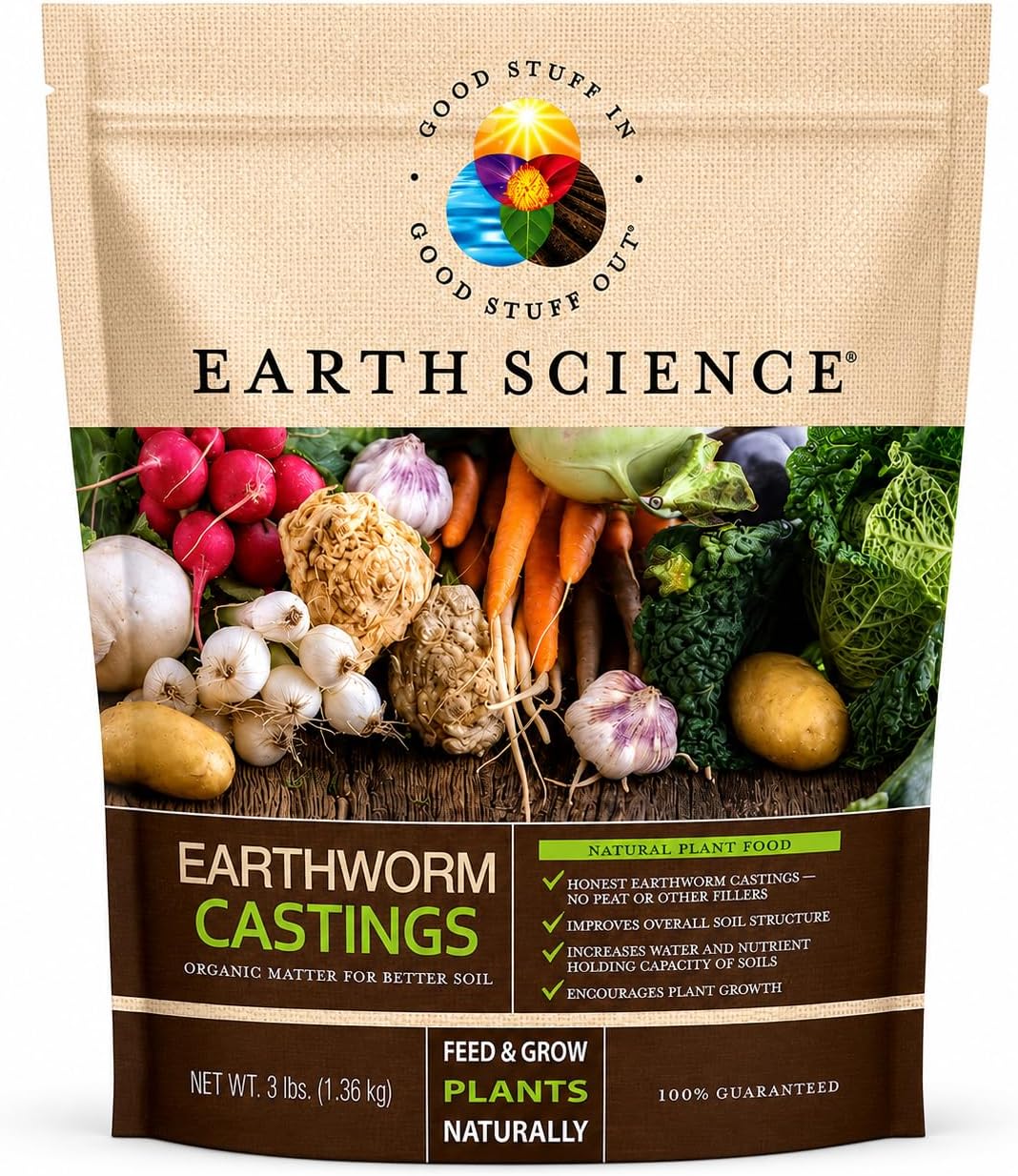
Earth Science Premium Earthworm Castings, 3 lb
| Item Form | Granules |
|---|---|
| Specific Uses For Product | Organic,Plant Food,Plant Growth |
| Coverage | Medium |
| Target Species | gardens, flower beds, fruits, trees, shrubs |
| Mixing Ratio | 1:4 |
Earth Science Premium Earthworm Castings are a pure vermicompost product intended to enrich garden and potting soils. Gardeners typically use it as a top dressing, mixed into potting mixes at about 1:4 castings to soil, or incorporated into garden beds at 1/4 to 1/2 inch and watered in; it can also be brewed as compost tea. The castings add organic matter that helps soil retain moisture, supports beneficial microbes, and can reduce compaction by improving aggregation. Practical benefits include a straightforward application for vegetables, flower beds, trees, and shrubs and the flexibility to use in pots, compost piles, or on lawns. The product is free of fillers and presented as a slow-release, natural fertilizer rather than a quick synthetic boost, so expect gradual improvements over weeks to months rather than immediate greening. Because this is a small, concentrated pouch, frequent reapplication during the growing season is recommended for larger beds or heavy-feeding crops.
Best for: Gardeners who prioritize dependable, natural soil improvement for organic vegetable beds and potted edibles and prefer steady, biology-driven results over quick chemical fixes.
Less Ideal for: Growers who need rapid, high-N fertilizer responses for a single fast-growing crop or who require large-volume amendments for extensive beds without frequent reapplication.
- 100% vermicompost with no peat or fillers
- Versatile uses: top dressing, potting mix amendment, compost tea, and compost layering
- Improves soil structure and water retention while feeding beneficial microbes
- Slow-acting nutrient release not suited for immediate greening or fast corrective feeding
Verdict: Use this pure earthworm castings product when you want a reliable, natural soil conditioner that builds long-term fertility for an organic vegetable garden.
Wiggle Worm Pure Worm Castings Organic Fertilizer, 15 lb

| Item Form | Pure earthworm castings |
|---|---|
| Specific Uses For Product | Soil Conditioning |
| Unit Count | 240 Ounce |
| OMRI Listed | Yes |
Wiggle Worm Pure Worm Castings is a straightforward organic soil amendment that supplies water-soluble nutrients and a boost of beneficial microbes to garden beds, containers, and lawns. It is used by mixing a portion into potting mixes, adding a thin top dressing to established plants, working into planting holes for transplants, or brewing into a quick casting tea for fast uptake. Notable features include its pure castings formulation with screening to remove debris and worm eggs and an OMRI listing that makes it suitable for organic gardens. Practical benefits are improved soil aeration and water retention, enhanced root development, and slow-release nutrition that reduces the need for frequent feeding. The product is non-burning and odorless, so it is safe for use around seedlings and mature plants. Limitations are that a single 15 lb bag covers a modest area so larger lawns or multiple raised beds will require multiple bags, and because it is an amendment rather than a complete fertilizer you may still need to supplement specific nutrients depending on soil test results.
Best for: Gardeners seeking an all-purpose organic soil builder to improve soil health and root development across flower beds, vegetables, and containers who prefer low-risk, easy-to-use amendments.
Less Ideal for: People who need large-scale bulk fertilizer for extensive lawns or those looking for a single product to meet precise N-P-K requirements without soil testing.
- 100% pure worm castings that add beneficial microbes and plant-ready nutrients
- OMRI listed for organic use and safe around seedlings due to non-burning formula
- Versatile application methods: top dressing, soil mix-in, planting hole amendment, or tea
- Improves soil aeration and water retention to support stronger root growth
- 15 lb bag provides only modest coverage for larger gardens or lawns
- Not a complete fertilizer so specific nutrient gaps may still require testing and supplementation
Verdict: A safe, OMRI-listed organic soil amendment that reliably improves soil structure and root health for gardeners who want an easy, low-risk way to boost plant vigor.
Choosing the Right Compost for Hellebores: Key Factors to Consider
Texture and Drainage
Hellebores prefer a crumbly, well-structured soil that drains freely while retaining enough moisture for steady growth. Compost that is too fine or compacted can lead to poor aeration around the crown and roots, increasing the risk of crown rot in cool, damp microclimates.
Look for compost with visible fibrous material and a loamy feel. Coarser particles like well-rotted leaf litter, wood fines, or shredded bark improve porosity and help maintain the open structure hellebores need. Texture also determines how the compost mixes with native soil and whether it shifts drainage toward wetter or drier conditions.
Moisture Retention Balance
In shaded, sheltered spots hellebores need consistent moisture without standing water. Compost should hold water in the particle matrix so the plant has a reserve during dry spells, but it must also shed excess in heavy rains to avoid waterlogged roots.
Materials such as well-rotted leaf mold and humified green waste provide good moisture buffering. Peat-like water-holding components can be helpful in sandy soils but avoid mixes that remain soggy. Consider local climate and bed position when weighing moisture retention needs.
Nutrient Release Profile
Hellebores are not heavy feeders that need constant high nitrogen. They do best with compost that supplies a steady, moderate release of nutrients and builds long-term fertility through humus rather than forcing quick leafy growth.
Well-matured compost and leaf mold provide slow-release nitrogen, phosphorus, and trace elements. Avoid fresh, incompletely broken-down materials that may tie up nitrogen as they continue to decompose. A predictable, gentle nutrient profile supports balanced foliage, resilient crowns, and reliable flowering.
Organic Matter Quality
High-quality organic matter improves soil structure, biological activity, and root health-key for long-lived perennials like hellebores. Compost rich in stable humus increases cation exchange capacity and helps retain nutrients between seasons.
Prefer compost made from diverse, well-rotted inputs rather than single-source waste streams. Good organic matter encourages earthworms and root proliferation, creating the crumbly soil that helps hellebores establish and resist stress.
Contamination and Salt Levels
Contaminants such as persistent weed seeds, herbicide residues, or high soluble salts can harm sensitive perennials. Hellebores planted from crowns or divisions can be particularly vulnerable to contaminated compost introducing weeds or chemical stress.
Choose compost tested for low salt content and minimal viable weed seed counts. Avoid compost derived from manure that has not been fully cured or from sources known to contain persistent herbicide residues. Clean feedstock and thorough maturation reduce these risks.
pH and Trace Elements
Hellebores tolerate a range of soil pH but generally prefer neutral to slightly alkaline conditions in many garden soils. Compost can influence pH over time and supply trace elements that affect flowering and leaf color.
Select compost with a stable, near-neutral pH or one that will not acidify soil significantly. Compost rich in limestone-derived materials or balanced in mineral content helps avoid slow drift toward acidic conditions. If your garden soil is already very acidic or alkaline, factor that into the compost choice and test soil periodically.
When to Apply Compost in the Hellebore Bed
Apply compost in early spring after the worst winter wet has passed and before new growth accelerates, or in autumn to topdress and boost humus ahead of the dormant season. Spring topdressing helps feed developing foliage without smothering new shoots.
For established clumps, a thin 2 to 3 cm layer worked lightly into the surface preserves the litter layer that many hellebores enjoy. For new plantings, blend a moderate amount of compost into the planting hole to improve structure and immediate rooting conditions.
- Topdress rather than deep-digging near crowns to avoid disturbing shallow roots.
- In heavy clay, mix compost with grit or horticultural sand to maintain drainage.
- Refresh mulch or leaf litter after applying compost to stabilize moisture.
How to Use Compost for Planting and Dividing
When planting hellebores or dividing established clumps, incorporate compost sparingly into the backfill. Use a mix that improves texture and provides a gentle nutrient reserve without creating a distinct nutrient pocket that encourages roots to circle.
For divisions, pack compost into the root zone to help new roots find humus and moisture. Avoid burying the crown too deep; compost should sit around the roots and at the original crown level to maintain healthy growth.
- Mix one part compost with two parts native soil for planting holes, adjusting based on existing soil quality.
- Keep the crown level with surrounding soil to prevent rot.
Building Long-Term Soil Health with Compost
Regular additions of compost improve soil biology and structure over multiple seasons, which benefits hellebores more than one-off high-feeding applications. Aim to topdress annually or every other year to maintain humus levels and encourage a stable litter layer.
Combine compost with leaf mulch under trees or shrubs to recreate woodland floor conditions. Over time this approach reduces the need for additional fertilizer and supports natural nutrient cycling.
- Layer compost thinly each year rather than adding a thick layer once.
- Encourage earthworm activity by avoiding excessive soil disturbance.
Compost for Containers and Patio Grown Hellebores
Containers dry out faster and need a compost-rich potting mix that balances moisture retention with drainage. Use well-matured compost blended with coarse components like grit and horticultural char to keep the rootball airy.
In pots, monitor moisture and repot with fresh mix every two to three years to renew humus and prevent nutrient depletion. Choose composts with low salt concentrations to protect container roots from osmotic stress.
- Add a chunky drainage layer or coarse grit to the base of pots to improve percolation.
- Top-dress containers in spring with a small amount of compost instead of heavy feeding.
Sourcing and Verifying Compost Quality
Buy or source compost from suppliers who provide clear feedstock information and maturation details. Look for descriptions such as 'well-rotted leaf mold' or 'mature green waste compost' rather than vague 'garden compost' claims.
If using homemade compost, ensure thorough curing and absence of persistent weed seeds. A finished compost should be crumbly, dark, and earthy-smelling, not sharp or sour, which indicates incomplete decomposition.
- Ask suppliers about screening, salt testing, and weed seed counts if possible.
- Avoid compost with a strong ammonia smell or visible undecomposed material.
How We Chose the Best Compost for Hellebores
We focused on factors that directly affect hellebore performance in shaded beds and woodland borders. Primary evaluation criteria included compost texture and drainage to ensure good root aeration; nutrient release profile, emphasizing steady, slow-release fertility rather than quick spikes; organic matter content and humus quality for long-term soil structure improvement; moisture retention balanced with porosity to prevent both drought stress and waterlogging; and contamination risk, screening for minimal weed seeds and low salt content. We excluded products aimed primarily at high-nitrogen turf or rapid vegetable growth, mixes with heavy synthetic additives, and any composts marketed chiefly for container splash rather than in-ground soil building. Our selection favored composts gardeners can incorporate into planting holes, topdress under established clumps, or mix into beds to improve humus levels and drainage. Practical handling and availability in common bag sizes were noted but not used as disqualifiers unless the product compromised core soil needs for hellebores.
FAQ
Can I use leaf mold as the sole compost for hellebores?
Often leaf mold is an excellent base because it provides crumbly structure and steady moisture retention. However, depending on your garden soil, combining leaf mold with a more mineral-rich compost can improve drainage and nutrient balance.
How much compost should I mix into the planting hole for a new hellebore?
Usually blend no more than one part compost to two parts native soil for the backfill. This improves texture without creating a loose nutrient pocket that can shift drainage or encourage roots to remain confined to the amended zone.
Is garden compost from general use suitable for hellebores?
It depends on the compost's maturity and feedstock. Well-matured garden compost with low salt and few weed seeds is suitable. Avoid fresh or hot composts that continue to decompose and may tie up nitrogen or damage roots.
Should I topdress hellebores with compost every year?
Usually a light annual topdressing or a thicker application every two to three years is sufficient. Regular thin additions maintain humus without burying crowns or creating excessive nutrient pulses.
Can compost make hellebores flower more?
Compost that improves soil structure and supplies steady, moderate nutrients can support healthier plants and more reliable flowering. Excessive high-nitrogen inputs, however, may favor foliage over blooms.
Final Verdict
Choosing the right compost for hellebores means balancing drainage, steady moisture retention, and a slow-release nutrient profile. Prioritize well-matured, humus-rich mixes with good texture and low contamination risk to support long-term crown health and consistent flowering. Focus on building soil structure with thin, regular topdressings and careful incorporation at planting. That approach reduces the need for heavy feeding and keeps hellebores thriving in shady, woodland-style beds.
