

Note: This article contains affiliate links. If you click on these links and make a purchase, I may earn a small commission at no extra cost to you. This helps support my research and content. Read my full affiliate disclosure here.
Picking the right compost for plants matters because the material you add to beds or containers directly affects root development, water retention, and nutrient cycling. Good compost improves structure in heavy clay, helps sandy mixes hold moisture, and supplies slow-release nutrients for steady growth. This guide covers six top compost options suitable for plant use across gardens and containers, shortlisted for gardeners who want reliable, ready-to-use soil amendments. We evaluated each pick on nutrient profile, texture and drainage, and ease of use to help you match compost characteristics to your growing situation.
Top Picks at a Glance
| Best Overall The best all-around choice for most situations | Blue Ribbon Organics OMRI-Certified Organic Compost (Bag) |  |
| Best Quality Built to a higher standard if you want something more solid | Espoma Organic Mushroom Compost Blend, 0.75 cu ft |  |
| Best Value The sweet spot between price and what you get | True Organic Worm Castings, 64 oz |  |
| Best Budget The cheapest option that still gets the job done reliably | Life Cycle Organics 100% Organic Worm Castings, 20 oz |  |
| Highest Rated A top-rated pick with lots of positive feedback | Earth Science Premium Earthworm Castings, 3 lb |  |
| Most Popular A crowd favorite that many people choose with confidence | Brut Organic Worm Castings, 5 lb |  |
Blue Ribbon Organics OMRI-Certified Organic Compost (Bag)

| Brand | Blue Ribbon Organics |
|---|---|
| Included Components | Compost |
| Item Type Name | Organic Compost |
| Volume | 7.48 gallons |
Blue Ribbon Organics OMRI-Certified Compost is a bagged, fully processed organic compost designed to be worked into beds, used as a topdressing on lawns, or applied as a mulch around trees and shrubs. It is made from recycled food and yard residuals, monitored for maturity and contaminants, and certified for organic use so you can add it directly to vegetable, flower, and landscape plantings. Typical applications include incorporating 3–4 inches into new beds, adding a light 1/4–1 inch replenishment to established beds, or topdressing lawns at 1/4–1/2 inch in fall. The product claims improved aeration, increased water retention, pH buffering, and a boost of key nutrients such as nitrogen, phosphorus, and potassium. Because it is a natural material, moisture variation can affect bag weight and handling, and a single bag covers a modest area, so larger projects will require multiple bags or bulk compost. For gardeners focused on measurable soil improvement and organic certification, this compost delivers an easy, safe way to rebuild soil health without synthetic inputs.
Best for: Gardeners who prioritize measurable soil improvement and organic certification and want a ready-made compost to reliably boost planting beds, lawns, and established landscapes.
Less Ideal for: Large-scale landscapers or gardeners needing to amend many beds quickly should consider bulk compost options rather than repeated bag purchases.
- OMRI certified and meets US Composting Council standards so it is suitable for organic vegetable and flower gardens
- Processed and tested for maturity, pathogens, and weed seed to reduce risk of introducing problems
- Versatile use: can be tilled into new beds, used as a topdressing for lawns, or applied as mulch around trees and shrubs
- Contains a balanced mix of organic nutrients and improves soil aeration and water retention
- Bag size/volume is modest so several bags are needed for large beds or multiple trees
- Moisture variation in a natural product can make individual bag weights inconsistent
Verdict: Choose this bagged OMRI-certified compost when you want a tested, organic-ready product that reliably improves soil structure and supports performance-oriented gardening.
Espoma Organic Mushroom Compost Blend, 0.75 cu ft

| Item Form | Solid |
|---|---|
| Specific Uses For Product | Plant Growth, Soil Conditioning |
| Application Method | Mix or rototill into soil |
| Target Species | flowers, vegetables, trees, shrubs |
| Liquid Volume | 0.75 cubic feet |
Espoma Organic Mushroom Compost Blend is a ready-to-use soil conditioner formulated from mushroom compost and aged forest products. It is typically mixed or rototilled into existing soil at planting or during lawn renovation to improve structure and organic content. Notable features include its organic composition, a recommended mixing ratio (60:40), and guidance to incorporate to a depth of 4 to 6 inches. For St. Augustine grass, this product will help increase soil organic matter, improve water retention and drainage in compacted clay or sandy soils, and feed the rootzone over time. Because it comes in a compact 0.75 cubic foot bag, it is easy to apply to small to medium areas but requires many bags to cover larger lawns. The compost is solid and intended as a conditioner rather than a quick-release fertilizer, so expect gradual improvement in soil health rather than immediate greening. Use during renovation or topdressing mixed into the top few inches for best results.
Best for: Homeowners renovating or topdressing St. Augustine lawns who prioritize improving soil health and long-term turf performance through organic amendments.
Less Ideal for: People looking for an immediate, high-nitrogen turf fertilizer or those needing large-volume bulk compost for extensive acreage.
- Organic blend of mushroom compost and aged forest products improves long-term soil structure
- Instructions and mixing ratio (60:40) provided for consistent incorporation
- Suitable for a range of plants including turf, vegetables, trees and shrubs
- Small 0.75 cubic foot bag means multiple bags are needed for whole-yard applications
Verdict: Use this organic mushroom compost blend when you want a soil-first approach to improve St. Augustine turf quality over time.
True Organic Worm Castings, 64 oz

| Unit Count | 64 Ounce |
|---|---|
| Item Form | Granules |
| Specific Uses For Product | Agriculture, Gardening, Root Development, Seed Development |
| Application Method | Mix into soil, use for seeding and transplants |
True Organic Worm Castings are a straightforward organic soil amendment that boost microbial activity and improve soil structure for vegetables, flowers, and transplants. Sold as granular castings, they are typically mixed into potting blends, garden beds, or used at seeding and transplant time to enhance aeration and water retention while feeding roots with a mild, slow-release nitrogen source. Notable features include a high concentration of biological matter and a stated 1% total nitrogen with 0.95% slow-release nitrogen, which supports steady nutrient availability without the burn risk of synthetic fertilizers. Practical benefits are healthier root systems, improved moisture retention in sandy soils, and easier transplant success. Limitations are that castings are low in NPK compared with concentrated fertilizers so larger quantities or complementary feeding may be needed for heavy-feeding crops, and results build over time rather than producing an immediate, dramatic growth spike. For gardeners aiming to build soil life and long-term fertility, these provide an easy, low-risk option.
Best for: Gardeners focused on building long-term soil health who prefer low-risk, organic amendments for vegetables, flowers, and transplant work.
Less Ideal for: Growers who need a fast, high-release fertilizer for immediate heavy-feeding crops or those who prioritize single-application high NPK boost.
- Supports soil microbial activity to improve nutrient cycling and plant health
- Improves soil structure, aeration, and water retention when mixed into media
- Provides gentle slow-release nitrogen that reduces burn risk for seedlings and transplants
- Versatile application for mixing into soil, seeding, and transplanting
- Low nutrient concentration compared with synthetic or blended fertilizers so may require supplemental feeding for heavy feeders
- Benefits accumulate over time rather than delivering immediate, high-release nutrient boosts
Verdict: Choose these worm castings when you want an easy, organic way to build soil life and provide steady, low-risk nutrition for healthier plants.
Life Cycle Organics 100% Organic Worm Castings, 20 oz

| Unit Count | 20 Ounce |
|---|---|
| OMRI listed | Yes |
| pH | Neutral (7) |
| Style Name | Traditional |
Life Cycle Organics worm castings are a ready-to-use organic soil amendment sold in a resealable 20 oz pouch for potting, seed starting, and top-dressing established plants. Use by mixing about 20 oz into 1 to 2 gallons of potting mix for seed starts or by sprinkling a thin layer around the base of potted plants, garden vegetables, herbs, flowers, and shrubs. The product is OMRI listed and claims a neutral pH, making it safe for repeated applications without risk of burning plants. Practical benefits include improved root development, more vigorous growth, and a natural source of micronutrients such as nitrogen, phosphorus, and potassium. The small pouch is convenient for container gardeners and those trying worm castings for the first time, and the resealable bag helps keep material fresh between uses. Limitations are the modest 20 oz quantity, which is fine for pots and small beds but will require frequent repurchasing or larger sizes for bigger gardens and heavier feeding schedules.
Best for: Gardeners on a tight budget who want to try an organic soil booster for containers, seed starting, or small garden patches and prefer a ready-to-use, easy-to-store pouch.
Less Ideal for: Large-scale gardeners, market growers, or anyone who needs a bulk amendment for multiple raised beds or large lawns should choose gallon-sized or bulk options instead.
- Certified OMRI listed and suitable for organic growing
- Resealable pouch that is easy to store and measure
- Neutral pH and non-toxic so it can be applied repeatedly without burning plants
- Versatile use for seed starting, potting mixes, top-dressing, and indoor or outdoor plants
- Small 20 oz size is not economical for large beds or heavy feeders
Verdict: A convenient, OMRI-listed 20 oz pouch that makes trying organic worm castings affordable and simple for container gardeners and small plots.
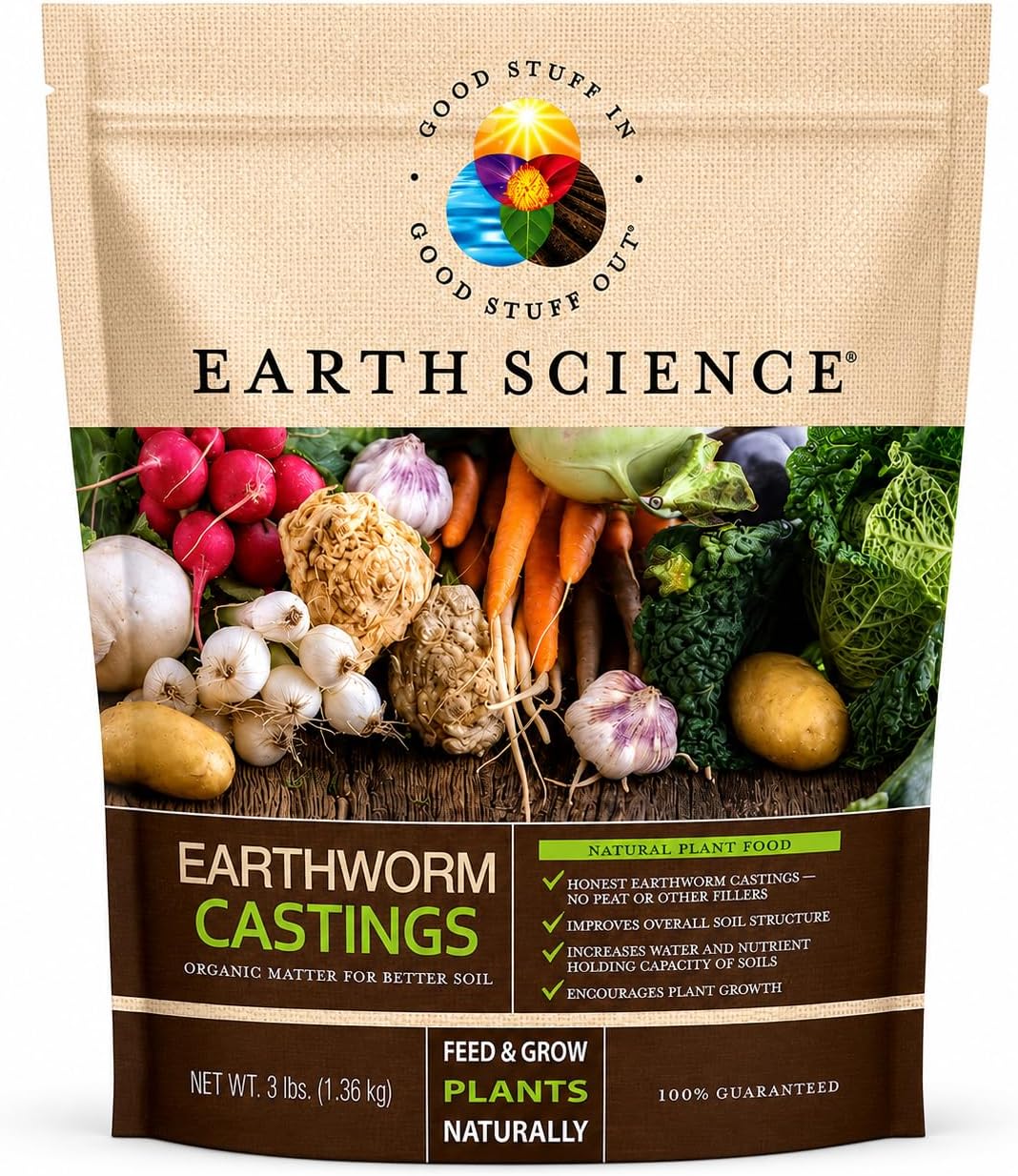
Earth Science Premium Earthworm Castings, 3 lb
| Item Form | Granules |
|---|---|
| Specific Uses For Product | Organic,Plant Food,Plant Growth |
| Coverage | Medium |
| Target Species | gardens, flower beds, fruits, trees, shrubs |
| Mixing Ratio | 1:4 |
Earth Science Premium Earthworm Castings are a pure vermicompost product intended to enrich garden and potting soils. Gardeners typically use it as a top dressing, mixed into potting mixes at about 1:4 castings to soil, or incorporated into garden beds at 1/4 to 1/2 inch and watered in; it can also be brewed as compost tea. The castings add organic matter that helps soil retain moisture, supports beneficial microbes, and can reduce compaction by improving aggregation. Practical benefits include a straightforward application for vegetables, flower beds, trees, and shrubs and the flexibility to use in pots, compost piles, or on lawns. The product is free of fillers and presented as a slow-release, natural fertilizer rather than a quick synthetic boost, so expect gradual improvements over weeks to months rather than immediate greening. Because this is a small, concentrated pouch, frequent reapplication during the growing season is recommended for larger beds or heavy-feeding crops.
Best for: Gardeners who prioritize dependable, natural soil improvement for organic vegetable beds and potted edibles and prefer steady, biology-driven results over quick chemical fixes.
Less Ideal for: Growers who need rapid, high-N fertilizer responses for a single fast-growing crop or who require large-volume amendments for extensive beds without frequent reapplication.
- 100% vermicompost with no peat or fillers
- Versatile uses: top dressing, potting mix amendment, compost tea, and compost layering
- Improves soil structure and water retention while feeding beneficial microbes
- Slow-acting nutrient release not suited for immediate greening or fast corrective feeding
Verdict: Use this pure earthworm castings product when you want a reliable, natural soil conditioner that builds long-term fertility for an organic vegetable garden.
Brut Organic Worm Castings, 5 lb

| Item Form | Granules |
|---|---|
| Specific Uses For Product | Gardening,Organic |
| Target Species | All plants |
| Mixing Ratio | 1:5 |
Brut Organic Worm Castings function as a concentrated, natural soil amendment you mix into potting mixes or top-dress garden beds and raised beds. Typical use is mixing at the recommended 1:5 ratio for new indoor plants, sprinkling a cup around established houseplants, or working into outdoor planting holes and beds according to the brand directions. The product is OMRI/CDFA listed and produced in controlled conditions, which supports consistent nutrient content and beneficial microbial life that help roots establish, improve soil structure, and increase moisture retention without burning plants. Practical benefits for raised garden beds include improved aeration, slow-release nutrients, and a boost in microbial activity that supports long-term fertility. Limitations are that it is not a complete NPK fertilizer for immediate heavy feeding needs and larger beds require significant quantities to hit the suggested per-square-foot rates, so frequent applications or bulk purchases may be needed for big projects.
Best for: Gardeners who prioritize dependable, organic soil improvement for raised beds and container gardens and prefer predictable, low-risk amendments that support long-term soil health.
Less Ideal for: Those needing immediate, high-NPK feeding for heavy-feeding crops or gardeners who want to amend very large beds without buying supplemental bulk material.
- Certified organic and produced indoors for consistent purity
- Rich in beneficial microbes that improve soil structure and plant vigor
- Easy-to-use granular form suitable for mixing or top-dressing
- Not a standalone high-NPK fertilizer for rapid nutrient correction
- Five-pound bag may be small for large raised beds and repeated seasonal use
Verdict: Use this OMRI/CDFA-listed worm castings product to reliably build long-term fertility and microbial health in raised beds and containers.
Choosing the Right Compost for Plants: Key Factors to Consider
Nutrient Balance
Plants need a mix of macronutrients and trace elements, not just organic matter. A compost with a balanced nitrogen, phosphorus, and potassium profile supports leaf growth, root development, and flowering at different life stages. High initial nitrogen can favor leafy growth but may suppress blooms if not balanced. Look for composts that list analysis or typical N-P-K ranges and mention additional trace minerals when possible.
Nutrient balance matters because compost is a slow-release source. It will interact with existing soil mineral content and any fertilizers you apply. For containers and young plants, a compost with moderate nutrient density avoids overfeeding seedlings while still supplying steady nutrition.
Texture and Drainage
How compost feels determines how it changes soil structure. Fine, dusty compost improves nutrient contact with roots but can compact in heavy soils and restrict air flow. Coarse, fibrous compost improves drainage and reduces compaction but may not hold moisture well in dry climates or small pots. The ideal choice depends on the use: beds often benefit from coarser, well-structured compost to open clay, while containers need a finer, well-draining mix that still retains water.
Consider mixing compost with native soil or a potting mix to achieve the right balance of water retention and aeration. For seedlings and young transplants, prioritize lighter textures that allow fast root penetration and consistent moisture.
Maturity and Stability
Compost maturity is critical to avoid harming plants. Immature compost can continue decomposing in the soil, tying up nitrogen and generating heat that damages roots. Mature compost has a stable organic fraction, a crumbly texture, and an earthy smell. Producers often test for maturity indicators such as cress germination or carbon-to-nitrogen ratios. Using mature compost reduces the risk of nitrogen drawdown and makes nutrient release more predictable.
If maturity is unclear, apply compost as a top dressing or blend it with finished soil rather than using it as a sole growing medium. For container-grown plants, always use compost known to be fully decomposed to protect sensitive root systems.
Contamination Risk
Contaminants include persistent weed seeds, pathogens, heavy metals, and excess salts. Compost produced at high enough temperatures for sustained periods will usually kill weed seeds and pathogens, but not all sources are equally reliable. Urban or industrial-origin composts should be checked for heavy metal testing. High salt levels can be a problem for salt-sensitive plants and seedlings, especially in containers where salts concentrate.
Gardeners should look for product labeling that mentions screening, testing, or certified feedstock sources. When in doubt, conduct a small trial on noncritical plants or use the compost as an amendment mixed into existing soil rather than as a sole medium.
Versatility for Beds and Containers
A compost that works well across multiple garden contexts is often the most practical choice. Some composts are formulated for soil conditioning in beds and will be coarser and higher in lignin, making them excellent for structural improvement but less suitable for potting mixes. Others are milled and screened for container use, offering a finer particle size and more predictable moisture behavior.
Match compost selection to intended uses. If you manage both beds and containers, prefer a versatile, screened compost and keep a coarse option on hand for heavy soil rehabilitation. Versatility reduces the need for multiple specialized products while ensuring each planting situation gets the right physical and nutritional support.
Application Rate and Compatibility
How much compost to add and how it blends with existing soil affects results. Light topdressing, incorporation to a few inches, or full replacement in containers are all valid approaches but require different compost properties. Highly concentrated applications make nutrient and salt levels more critical, while light incorporation reduces those risks.
Consider compatibility with fertilizers, lime, or other amendments you plan to use. Compost can buffer pH changes and supply slow-release nutrients that interact with supplemental feeding. Read guidance on recommended application rates for beds versus containers and adjust based on the plant type and life stage.
Using Compost in Vegetable Beds
Compost applied to vegetable beds improves soil tilth and supplies nutrients across the growing season. For annual vegetables, incorporate a layer of well-matured compost into the top 4 to 6 inches of soil before planting to boost fertility and microbial life. Work compost in during cool, moist conditions to avoid excessive drying or compaction.
Pay attention to texture when preparing beds for seedlings. Finer, screened compost blends more uniformly with seedbed soil, while coarser compost is better for rebuilding degraded or compacted plots. Adjust the application rate based on soil tests and the previous crop's nutrient removal.
- Incorporate compost in spring or autumn for best integration
- Use finer compost for direct seeding and transplant beds
- Mix with bulk amendments if soil is extremely sandy or clay-heavy
Compost for Container Gardening
Containers demand compost that provides water retention without becoming waterlogged. Screened, crumbly compost works best when blended into potting mixes at lower ratios than for beds. A common approach is to mix one part compost with two parts potting mix or soilless media to keep drainage predictable.
Avoid very coarse compost in small pots, where it can create air pockets and uneven moisture. For large planters, a higher proportion of compost is acceptable, but monitor for salt buildup and flush containers periodically.
- Blend compost with potting mix to balance moisture and aeration
- Use mature compost to protect delicate root systems
- Flush containers occasionally to prevent salt accumulation
Compost and Soil pH
Most finished composts have a near-neutral pH and act as a buffer rather than a major pH driver. However, the feedstock can influence acidity or alkalinity slightly. If you grow acid-loving plants or pH-sensitive crops, test both your soil and compost before wide application.
When pH adjustments are needed, factor compost into the calculation. Compost can reduce the immediate need for lime in slightly acidic soils and mellow high-pH extremes over time through improved microbial activity.
- Test compost pH if growing pH-sensitive plants
- Consider compost as part of a broader pH management strategy
- Retest soil after a season of regular compost applications
Storing and Handling Compost
Store compost in a dry, covered area to maintain stability and prevent nutrient leaching. Keep bags or piles off bare soil on pallets to reduce contamination and waterlogging. Exposure to prolonged rain can wash soluble nutrients away and encourage anaerobic conditions.
When applying, use a spreader or shovel for even distribution in beds and a trowel or scoop for containers. Wear gloves and avoid inhaling dust from very dry compost. If you notice strong ammonia or sour odors, the material may be immature or anaerobic and should be cured further before use.
- Store covered and off the ground to preserve quality
- Avoid using compost with foul odors until it stabilizes
- Use gloves and a mask when handling dusty or dry material
Testing Compost and Tracking Results
If you rely on compost long term, test it periodically for nutrient content, salt levels, and contaminants. Simple soil-like tests give useful N-P-K ranges and electrical conductivity readings that indicate salt concentration. Tracking crop response over seasons also helps calibrate application rates.
Keep notes on application timing, rates, and observed plant responses such as leaf color, vigor, and yield. That empirical record is often the best guide for refining how much compost to apply and when to supplement with targeted fertilizers.
- Conduct occasional lab or home tests for nutrients and salts
- Record application details and plant responses for future adjustments
- Adjust compost rates based on observed plant health and soil tests
How We Chose the Best Compost for Plants
We selected composts based on criteria that matter in actual garden practice for plants. Nutrient content was assessed by expected levels of nitrogen, phosphorus, and potassium and the presence of trace minerals that support foliage, flowering, and root growth. Physical texture and drainage were considered because overly fine or poorly decomposed compost can compact and suffocate roots while very coarse material may not hold enough moisture for seedlings. Stability and maturity were judged to avoid products that will tie up nitrogen or burn young roots. Odor and contamination risk were checked to reduce the chance of introducing persistent weed seeds, pathogens, or excessive salts. Ease of use and versatility were evaluated for application across beds, raised boxes, and containers. We excluded unprocessed green waste and untested homemade mixes that lack maturity data or lab analysis. Products that rely heavily on fillers without clear organic matter content were also filtered out. Our approach prioritized composts that are well balanced for plant nutrition, physically appropriate for common garden soils and pots, and documented as mature and low-risk for gardeners to apply directly.
FAQ
Can I use compost for all types of plants?
Often, yes. Mature compost is broadly useful for ornamentals, edibles, and shrubs. Some sensitive seedlings or acid-loving plants may need lower rates or pH-specific amendments, so adjust application and test when necessary.
How much compost should I add to garden beds?
A common recommendation is to work a 1 to 3 inch layer of finished compost into the top few inches of soil annually. The exact rate depends on existing soil quality and crop demands; heavier improvement may require larger applications spread over seasons.
Is bagged compost different from loose or bulk compost?
Bagged compost is typically screened and drier for easier handling, while bulk compost may be coarser and fresher. Both can be effective if mature, but bagged products are often more consistent in texture for container use.
How can I tell if compost is mature and safe to use?
Mature compost has an earthy smell, crumbly texture, and no visible heat or steam. Seed germination or C:N ratio tests provide objective checks. If compost smells strongly of ammonia or looks slimy, allow further curing before using.
Will compost change my soil pH?
Usually compost buffers soil pH rather than causing large shifts. Many finished composts are near neutral, but feedstock and initial soil conditions can cause minor changes. Test soil pH if you manage pH-sensitive crops.
Can too much compost harm my plants?
Yes. Excessive application can raise salt levels, create nutrient imbalances, or cause oxygen-poor conditions in the root zone. Follow recommended rates and blend with existing soil, especially for containers and young plants.
Final Verdict
Choose compost based on how you will use it: pick finer, screened, mature compost for containers and seedbeds, and coarser, structural compost for rebuilding heavy or compacted garden beds. Prioritize maturity, balanced nutrient content, and appropriate texture to avoid common problems like nitrogen drawdown or poor drainage. By matching compost properties to the planting context and monitoring results over a season, you can confidently improve soil health and plant performance.
