

Note: This article contains affiliate links. If you click on these links and make a purchase, I may earn a small commission at no extra cost to you. This helps support my research and content. Read my full affiliate disclosure here.
A continuous compost bin changes how you manage kitchen scraps and yard trimmings by letting you add material regularly without restarting a pile. For gardeners who want ongoing output rather than occasional batches, the right continuous system reduces interruptions and keeps decomposition active. This guide covers the top shortlisted continuous compost bins suited to backyard and small-scale garden settings. We evaluate each option on airflow, capacity, durability, and ease of harvest so you can pick a system that fits how you garden. Below are compact profiles and an editorial buying guide that explain the tradeoffs between faster breakdown, ease of use, and long-term maintenance.
Top Picks at a Glance
| Best Overall The best all-around choice for most situations | Algreen Soil Saver Classic 94‑Gallon Compost Bin |  |
| Best Quality Built to a higher standard if you want something more solid | Maygrove 53 Gallon Dual-Chamber Rotating Compost Tumbler |  |
| Best Value The sweet spot between price and what you get | Goplus 80-Gallon Outdoor Compost Bin with Top Lid and Bottom Exit Door |  |
| Best Budget The cheapest option that still gets the job done reliably | JupiterForce 80 Gallon Garden Compost Bin (Polypropylene) |  |
| Highest Rated A top-rated pick with lots of positive feedback | Cozurra 45‑Gallon Dual‑Chamber Compost Tumbler |  |
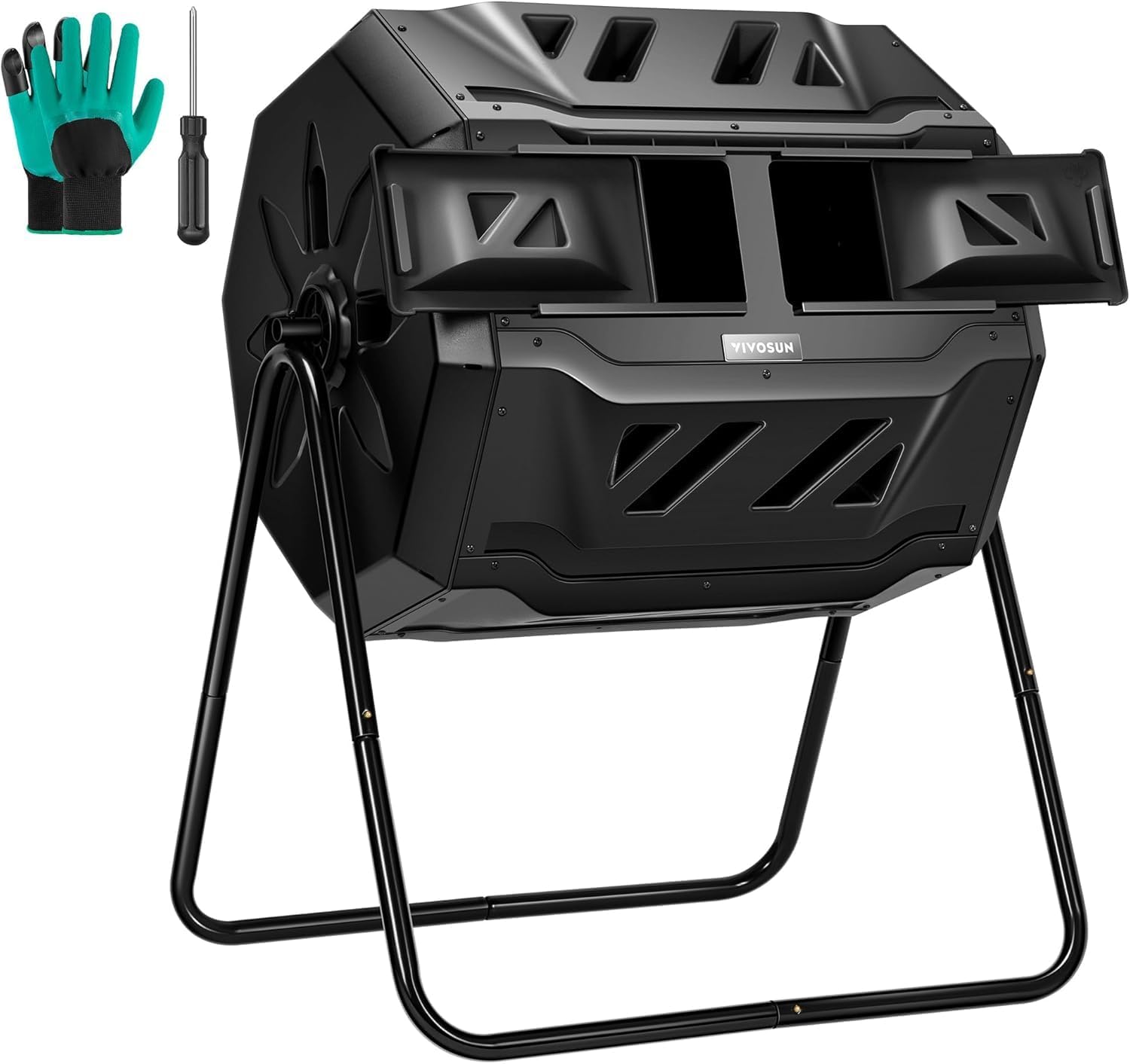
| Most Popular A crowd favorite that many people choose with confidence | VIVOSUN Outdoor Tumbling Composter, Dual-Chamber 43 Gallon |  |
Algreen Soil Saver Classic 94‑Gallon Compost Bin

| Capacity | 94 gallons |
|---|---|
| Material Type | Plastic |
The Algreen Soil Saver Classic is a large, stationary outdoor composter built to accelerate backyard decomposition and hold a full season’s worth of scraps and yard waste. You load material through a wide top lid and finished compost is retrieved through two sliding doors at the bottom, which lets you pull out ready humus without disturbing new inputs. The solid, octagonal walls are molded from 100% recycled plastic and retain heat to help microbes break down material faster, while slim ventilation slots and bottom aeration openings provide airflow. A locking lid reduces problems with wildlife and odors. Practical benefits include a roomy 94‑gallon capacity for heavy users, simple top loading, and low-maintenance construction that will not rust. Limitations are that it is a stationary bin so turning is limited to manual mixing through the top, and its plastic walls mean it can warm well in cold weather but will not insulate like insulated or tumbling designs that speed processing further for very fast results.
Best for: Gardeners who prioritize steady, high‑volume compost production and want a low‑maintenance, pest‑resistant backyard bin that holds a large amount of material.
Less Ideal for: People needing a compact or portable solution, or those who want a fast‑acting tumbling composter that minimizes manual turning and boosts heat quickly.
- Large 94‑gallon capacity handles substantial household and yard waste
- Dual sliding bottom doors let you extract finished compost without disturbing new material
- Made from 100% recycled plastic with heat‑retaining walls to support decomposition
- Locking lid and solid walls reduce pest access and limit odors
- Stationary design limits mechanical turning so you must mix manually for faster decomposition
- No built‑in insulation or tumbling action to accelerate composting in cold climates
Verdict: Choose the Soil Saver Classic if you need a roomy, durable stationary bin that reliably converts large volumes of kitchen and yard waste into usable compost.
Maygrove 53 Gallon Dual-Chamber Rotating Compost Tumbler

| Capacity | 53.01 gallons |
|---|---|
| Material Type | Polypropylene (PP) |
This Maygrove dual-chamber compost tumbler is built for continuous performance-oriented composting. The 360 degree rotating drum with internal mixing bars makes turning simple — a few spins mix fresh scraps and finished material without poking into the pile. Two separate chambers let you add new waste to one side while the other cures, enabling near-constant output for gardeners who want a steady supply of compost. Adjustable air vents and a gear-assist ergonomic handle help control airflow, moisture, and rotation effort, which speeds decomposition and reduces odors. The extra-wide sliding doors make loading and harvesting easier and the dual-direction brake locks the drum when you need it stable. Construction combines UV-resistant polypropylene and a reinforced steel frame to resist cracking and sagging in outdoor conditions. Expect straightforward snap-together assembly with minimal screws. Limitations are typical for tumblers: capacity is finite so very large households may need multiple units, and plastic drums can retain heat less than insulated models in cold climates.
Best for: Gardeners who prioritize steady, fast compost production and want a low-effort continuous system that yields usable compost on a regular schedule.
Less Ideal for: People with very large composting needs who prefer pile-based systems or those in consistently cold climates looking for highly insulated bins.
- Dual-chamber design supports continuous composting by allowing one side to finish while the other is filled
- 360° rotating drum with internal mixing bars simplifies turning and promotes even decomposition
- Adjustable air vents and gear-assist handle let you control airflow and reduce odor while making rotation easier
- Sturdy steel frame and reinforced legs prevent sagging and improve outdoor durability
- Extra-wide sliding doors speed loading and harvesting of compost
- 53 gallon capacity may be small for very large households or high-volume yard waste
- Polypropylene drum offers less insulation than insulated metal models for winter composting
Verdict: For gardeners who want continuous, low-effort composting, this dual-chamber rotating tumbler reliably turns kitchen and yard waste into usable compost on a regular cadence.
Goplus 80-Gallon Outdoor Compost Bin with Top Lid and Bottom Exit Door

| Capacity | 80 gallons |
|---|---|
| Material Type | Polypropylene (PP) |
This Goplus compost bin is a straightforward, no-frills outdoor composter built for gardeners who want to turn kitchen scraps and yard waste into usable soil without fuss. The 80-gallon capacity means you can add more material and go longer between emptying, while the top flip lid makes loading easy and the bottom exit door lets you pull finished compost without digging through the whole pile. Made from thick polypropylene rated BPA-free and UV-inhibited, the unit resists weathering and helps retain heat and moisture for steady decomposition. Twelve vents on each side improve air flow so aerobic breakdown is faster than in sealed containers, and the open-bottom grounding design lets leachate drain and worms access the pile naturally. Assembly requires no tools and is quick. Limitations are that the rigid rectangular panels are less insulated than heavy wooden or double-walled options, so in very cold climates decomposition will slow, and the plastic panels may warp over many seasons if exposed to extreme sun. For uncomplicated backyard composting where capacity and ease matter most, this model is a practical choice.
Best for: Gardeners who want a high-capacity, low-maintenance composter to process regular kitchen scraps and yard trimmings with minimal setup and handling.
Less Ideal for: Those who need a heavily insulated or insulated tumbling system for rapid winter composting or who prefer an attractive, built-in garden fixture.
- Large 80-gallon capacity reduces how often you need to empty or rotate material
- Top flip lid and bottom exit door make loading and harvesting finished compost simple
- 12 side vents promote airflow for faster aerobic decomposition
- BPA-free polypropylene construction is weather-resistant and helps retain heat and moisture
- Tool-free assembly lets you set it up in minutes
- Single-wall plastic panels offer less insulation than wood or double-walled designs, slowing composting in cold weather
- Plastic may eventually degrade or warp with prolonged high-UV exposure
Verdict: Choose this bin if you want a large, easy-to-use outdoor composter that lets you load from the top and harvest finished compost from the bottom with minimal assembly.
JupiterForce 80 Gallon Garden Compost Bin (Polypropylene)

| Capacity | 80 gallons |
|---|---|
| Material Type | Polypropylene (PP) |
| Compost Completion Time | 4 to 5 weeks |
This JupiterForce compost bin is a basic, budget-friendly outdoor composter designed to turn kitchen scraps and yard waste into usable soil over several weeks. It assembles without tools and sits directly on the ground so you load materials through the top lid, rely on molded ventilation panels for airflow, and retrieve finished compost via a sliding bottom door. The molded polypropylene construction makes the unit lightweight and weather resistant while the included gloves are a helpful touch for handling material. Because it lacks a base, the bin depends on contact with soil and moisture for decomposition and will be easiest to use on bare ground rather than a hard patio. The relatively large 80 gallon capacity means less frequent emptying for small to medium gardens, but the plastic construction is basic compared with heavier-duty metal or insulated tumblers, so it will not retain heat as well in cold climates. For gardeners who want an inexpensive, simple way to compost and collect finished material, this does the job with minimal fuss.
Best for: Gardeners on a tight budget who need an easy, low-maintenance way to compost kitchen scraps and yard waste and who will place the bin on soil or garden beds.
Less Ideal for: People who need a compost system for a paved patio, require rapid high-heat composting year-round, or prefer heavy-duty insulated tumblers for faster results.
- Generous 80 gallon capacity reduces how often you need to empty it
- Tool-free assembly makes setup quick and straightforward
- Top lid plus sliding bottom door simplifies loading and removing finished compost
- Molded ventilation on each side improves airflow to speed decomposition
- Lightweight, weather-resistant polypropylene construction resists rot and rust
- No integrated base so it must sit on soil to compost efficiently
- Plastic construction offers limited insulation so composting slows in cold weather
Verdict: A simple, inexpensive 80‑gallon polypropylene composter that lets budget-minded gardeners turn yard and kitchen waste into usable compost with minimal setup.
Cozurra 45‑Gallon Dual‑Chamber Compost Tumbler

| Capacity | 45 gallons |
|---|---|
| Material Type | Polypropylene (PP) |
This Cozurra compost tumbler is a dual‑chamber, 45‑gallon spinner built to make backyard composting straightforward. You use one chamber for fresh scraps while the other side breaks down, so you can produce compost continuously without waiting to empty a single bin. Rotation is easy thanks to the 360° tumbling system and interior mixing ribs that break up clumps and improve aeration; adjustable vents further help control moisture and odors. The unit snaps together for tool‑free assembly and sits on a reinforced steel frame for stability when turning. Constructed from BPA‑free polypropylene, it resists weathering and is sized to handle kitchen waste, grass clippings, and leaves for an average household. Limitations to note are that plastic construction can feel less heavy‑duty than metal alternatives and the two smaller 22.5‑gallon chambers may require frequent turning in very large gardens to keep decomposition active. The tumbler works best when you follow recommended turning and moisture guidelines to speed composting and avoid smells.
Best for: A gardener who wants an easy, low‑effort system to convert kitchen and yard waste into usable compost on a regular schedule and values continuous output over maximum single‑load capacity.
Less Ideal for: Large properties or commercial users who need very high single‑batch capacity or a metal industrial tumbler should consider heavier duty alternatives.
- Dual 22.5‑gallon chambers allow continuous composting without downtime
- 360° tumbling with internal mixing ribs makes turning simple and improves breakdown
- Adjustable vents and airflow control reduce odors and help regulate moisture
- Snap‑together assembly and ergonomic openings simplify setup and loading
- Weather‑resistant BPA‑free polypropylene on a reinforced steel frame for year‑round outdoor use
- Plastic body is less robust than heavy gauge metal and may be more prone to UV wear over many years
- Total capacity split across two chambers means each chamber fills faster than a single large drum
Verdict: Choose this dual‑chamber Cozurra tumbler if you want a simple, weather‑resistant spinner that makes continuous home composting easy and low maintenance.
VIVOSUN Outdoor Tumbling Composter, Dual-Chamber 43 Gallon
| Material Type | galvanized steel |
|---|---|
| Capacity | 43 gallons |
This VIVOSUN tumbling composter is a practical backyard unit built around two rotating chambers so you can add fresh waste to one side while the other finishes breaking down. The 360 degree tumbling design with deep internal fins makes turning the pile simple and helps break up clumps without digging. Ventilation slots around the drum promote airflow for aerobic decomposition, and the metal frame with a PP plastic barrel is designed to resist corrosion and outdoor weathering. It comes with waterproof garden gloves and small digging claws to make loading and aerating easier. At 43 gallons it is sized for a family garden or vegetable patch but is compact enough for a patio or small yard. Limitations to note are that it requires occasional manual turning to maintain activity and that the plastic drum means it will warm less in cold climates than insulated models, so composting speed will vary by season. Assembly and placement on a level spot are also important for smooth rotation.
Best for: Gardeners who want a hands-on, efficient system to produce regular batches of compost without digging a pile and who prioritize continuous output and easy turning.
Less Ideal for: People who need a completely hands-off hot composter or who compost only very large volumes; those in very cold climates seeking year-round rapid breakdown should consider insulated or electric options.
- Dual chambers let you load new material while another batch finishes, ensuring continuous compost production
- 360 degree tumbling with deep fins makes mixing and aeration easy without manual digging
- Galvanized steel frame and PP plastic barrel designed for outdoor durability and corrosion resistance
- Ventilation slots support aerobic breakdown for faster, less smelly composting
- Plastic drum offers less insulation than insulated or fully metal units, slowing composting in cold weather
- Requires manual turning and regular management to maintain heat and moisture for fast results
Verdict: If you want steady, manageable batches of compost with easy tumbling and continuous use, this dual-chamber VIVOSUN tumbler delivers practical, durable performance.
Choosing the Right Continuous Compost Bin: Key Factors to Consider
Airflow and Venting Design
Proper airflow is the most important factor in continuous composting. Continuous bins depend on steady oxygen circulation to avoid anaerobic pockets that slow decomposition and create odors. Look for designs with vents, open cores, or passive chimneys that promote upward flow while preventing vermin entry.
Airflow design matters because it affects how often you need to turn or mix material. A well-vented bin can maintain active microbial activity with minimal manual aeration, which is vital for gardeners who add scraps daily. Poor venting forces heavier reliance on turning or bulking agents, undermining the convenience that continuous systems promise.
Usable Capacity and Modularity
Capacity determines how long you can continuously add material before the bin needs harvesting. Usable capacity is more important than nominal volume because it reflects the portion of the bin that actually supports active decomposition. Modular systems or multi-chamber designs let you expand capacity or isolate finished compost while still adding fresh material.
Consider your household and garden waste stream. A small family producing lots of kitchen scraps needs larger usable capacity or stacked modules. Conversely, a balcony gardener may prioritize a compact footprint. Also think about seasonal peaks in yard waste and whether the system scales or lets you pause additions.
Access Points and Ease of Harvest
Harvesting finished compost without disturbing new inputs is a core selling point of continuous bins. Look for low doors, slide-out trays, or twist-off sections that let you remove finished material from the bottom or side. The easier the access, the less manual sifting or reworking you will need to do.
Access design also impacts where you can place the bin. Systems that require clearance around a back panel or heavy lifting for removal are less practical in tight or paved spaces. Evaluate how access works in real use: will you be able to rake compost out, scoop it, or slide it onto a tarp?
Durability and Weather Resistance
Continuous bins are exposed to weather and repeated load cycles. Materials that resist UV breakdown, rust, rot, or warping last longer and protect compost quality. Metal parts should be corrosion-resistant; plastics should be UV-stabilized; wooden components need weather treatment or rot-resistant species.
Durability also influences pest resistance. Gaps, degradable seals, or rusted hinges invite rodents and insects. A sturdy build reduces maintenance time and the likelihood you will need to replace components in a few seasons.
Maintenance Needs and Winter Performance
Every continuous bin requires some upkeep, but the level varies. Consider how often you will need to open the unit for turning, how easy it is to add bulking agents, and whether internal features trap moisture. In cold climates, bins that retain heat or allow insulation perform better through winter; in wet climates, drainage and overflow protection matter more.
Also review whether parts are replaceable and how much seasonal adjustment is needed. Systems that let you manage moisture and airflow without disassembly save time and keep composting steady year-round.
Compatibility With Feedstock Types
Different bins handle mixed kitchen scraps, woodier yard trimmings, and high-moisture materials differently. Continuous systems that permit easy addition of dry bulking materials or have internal baffles to prevent clogging will cope better with varied feedstocks.
Assess how the design prevents compaction and handles stringy or fibrous materials. A bin that clogs when you add grass clippings or long stems will require more manual intervention and may not sustain continuous feeding as intended.
How Continuous Composting Works
Continuous composting separates active inputs from finished output so you can keep adding scraps without restarting the whole pile. Most systems either use a vertical core that draws air upward or a multi-chamber setup that moves material through stages as it decomposes. The goal is steady microbial activity and a predictable harvest cycle.
In practice, continuous systems reduce labor because you do not need to build new batches from scratch. They emphasize steady feeding, periodic removal of finished material, and managing moisture and particle size rather than frequent full turns.
- Common designs include vertical core, tumbling continuous hybrids, and stacked modular chambers.
- Successful continuous composting balances air, moisture, and carbon-to-nitrogen ratio over time.
Placement and Site Considerations
Choose a level, well-drained spot with some shade to avoid overheating in full sun. Access for harvesting finished compost should guide placement; leave room for a wheelbarrow or tarp at the removal side. Avoid low depressions where runoff could pool around the base.
If pests are a concern, place the bin on compacted soil or a paved surface and consider a small perimeter of hardware cloth to deter burrowing. For balconies or patios, confirm weight limits and pick a compact unit with secure lid closures.
- Leave clearance for doors or panels used during harvest.
- Consider sunlight and wind exposure based on your climate to help regulate internal temperature.
Managing Feedstock for Continuous Systems
Feedstock management keeps continuous bins functioning. Chop bulky materials, alternate wet kitchen scraps with dry carbon sources, and avoid adding large, intact woody branches that slow breakdown. Regularly add small amounts of brown material to maintain airflow and carbon balance.
If clumping or compaction appears, add bulky agents such as straw or shredded cardboard and use a garden fork or aerator tool through vents if the design allows.
- Aim for a mix of greens and browns rather than long runs of one type.
- Avoid meat, dairy, and oils which attract pests and prolong pathogen concerns.
Seasonal Tips and Troubleshooting
In winter, insulate the bin with straw bales or move it to a more sheltered spot to retain heat. Reduce additions of wet, high-nitrogen material in cold months and focus on drier browns to keep structure. In hot, dry seasons, check moisture more often and add water to preserve microbial activity.
Common issues include foul odors from anaerobic pockets, which signal poor aeration or excessive moisture, and slow decomposition from overloading with woodier materials. Address odors by increasing ventilation, adding dry carbon, and turning or mixing if accessible.
- Monitor temperature and moisture by hand; a well-working continuous bin should be warm but not saturated.
- Resolve compaction early to prevent long-term breakdown delays.
Tools and Accessories That Help
Certain tools make continuous composting easier. A compost thermometer helps monitor internal heat. A small garden fork or aerator that fits existing vents allows spot aeration without full disassembly. A dedicated scoop or shovel sized to the harvest opening speeds removal of finished material.
Accessories like breathable covers, drain trays for excess leachate, and lightweight insulation wraps can improve year-round performance. Pick items that match the bin's access points and that are easy to store near the compost area.
- Choose tools sized to the bin's openings to avoid awkward scraping or forced entry.
- Consider a tarp or bin base to catch finished compost during harvest for cleaner transfer.
How We Chose the Best Continuous Compost Bin
We focused on real-world gardener needs for continuous composting and applied concrete filters to narrow the field. Primary evaluation criteria were airflow and ventilation design, because sustained aeration keeps material hot enough to decompose steadily; usable capacity and modularity, to match output to household and yard waste volumes; durability of materials and resistance to weather, pests, and rot; ease of harvest and access for removing finished compost without disturbing fresh inputs; and assembly, maintenance, and winter performance. We also considered how easily a bin handles mixed kitchen and yard materials and whether access points let gardeners remove finished compost without turning the whole pile. We excluded single-batch tumblers and open windrows, focusing only on units designed for continuous feeding. Products that relied on proprietary consumables or required tools for daily use were deprioritized. The final list highlights systems that balance steady throughput, manageable maintenance, and straightforward harvest mechanics. These same criteria were used to structure the scorecard and inform the short advice sections below.
FAQ
How often should I add kitchen scraps to a continuous compost bin?
Often daily or several times a week depending on household output. Add small amounts regularly and balance with dry carbon so the bin does not get too wet or compacted.
Can continuous bins reach hot composting temperatures?
They can, but reaching and sustaining high temperatures depends on feedstock mix, capacity, and airflow. Well-vented, properly loaded bins with adequate nitrogen can achieve hot decomposition for pathogen and seed reduction.
What maintenance does a continuous compost bin need during winter?
Reduce wet additions, add drier browns, and consider insulating the bin. Maintain occasional aeration and monitor moisture because cold slows microbial activity and excess water can freeze and compact material.
Will a continuous system handle grass clippings and leaves together?
Usually yes if you manage moisture and structure. Grass clippings are high in moisture and nitrogen, so mix with dry leaves or cardboard to prevent matting and compaction that block airflow.
How do I prevent pests from getting into a continuous compost bin?
Keep meat and dairy out, maintain a good carbon balance, and ensure tight-fitting lids and pest-resistant vents. Placing the unit on compacted ground and addressing gaps or damaged seals reduces access points for rodents.
How long before I can harvest finished compost from a continuous bin?
Harvest time varies widely, often from a few months to a year depending on climate, feedstock, and bin design. Continuous systems aim to produce a steady trickle of finished material rather than a single large batch.
Final Verdict
For gardeners who want steady, ongoing compost production, prioritize airflow, usable capacity, and easy access for harvest. Expect tradeoffs between compact footprint and continuous throughput; larger or modular units reduce how often you must harvest, while smaller systems are easier to place. Consider how your typical feedstock mix and climate affect maintenance needs, and choose a design that lets you manage moisture and aeration without frequent heavy lifting. Focus on a system that matches the volume you generate and offers harvest access that fits your space. With the right balance of ventilation, durability, and maintenance convenience, a continuous compost bin can turn daily scraps into a reliable source of finished compost for your garden.
