

Note: This article contains affiliate links. If you click on these links and make a purchase, I may earn a small commission at no extra cost to you. This helps support my research and content. Read my full affiliate disclosure here.
If you have crabgrass or grassy weeds spreading through lawn edges, garden paths, or flower beds, the right crab weed and grass killer can save time and reduce ongoing hand-pulling. You want an option that kills the unwanted grasses reliably without damaging nearby ornamentals or the rest of your turf. This guide covers seven shortlisted crab weed and grass killers selected for common yard situations, including spot treatments, broadcast applications, and uses around beds and walkways. We explain the practical tradeoffs in effectiveness, speed of action, and safety so you can pick the approach that fits your yard and schedule.
Top Picks at a Glance
| Best Overall The best all-around choice for most situations | Ortho WeedClear Lawn Weed Killer Ready-to-Spray, 32 fl. oz. |  |
| Best Quality Built to a higher standard if you want something more solid | BASF Drive XLR8 Crabgrass Killer Concentrate, 64 oz |  |
| Best Value The sweet spot between price and what you get | Spruce Weed & Grass Killer Kit with Power Wand and 64 oz Refill |  |
| Best Budget The cheapest option that still gets the job done reliably | Spectracide Weed Stop for Lawns Plus Crabgrass Killer Concentrate, 32 oz |  |
| Highest Rated A top-rated pick with lots of positive feedback | Quali-Pro Prodiamine Pre-Emergent Herbicide, 5 lb Granules |  |
| Most Popular A crowd favorite that many people choose with confidence | Spectracide Weed & Grass Killer with AccuShot Power Sprayer, 1.33 gal |  |
| Best Seller A high-volume bestseller chosen again and again | Roundup Weed & Grass Killer4 with Pump 'N Go 2 Sprayer, 1.33 gal |  |
Ortho WeedClear Lawn Weed Killer Ready-to-Spray, 32 fl. oz.

| Item Form | Spray |
|---|---|
| Coverage | 5000 square_feet |
| Liquid Volume | 32 fluid ounces |
| Active Ingredients | 2,4-D, Quinclorac, Dicamba (dimethylamine salts) |
Ortho WeedClear Ready-to-Spray is a hose-end weed killer designed for homeowners who want a fast, simple way to clear common lawn weeds including crabgrass, dandelion, clover and creeping charlie. You attach the bottle to a garden hose, switch it on and spray until the lawn surface is wet, which makes application quick and easy without mixing. The formula is rainproof within an hour and claims visible results in hours after a single application, so it is useful for spot treatments or whole-lawn passes in spring or fall when weeds are actively growing. Notable features are broad weed coverage across more than 200 listed species and compatibility with many northern lawn grasses when used as directed. Important limitations are the list of grasses and plants you must avoid and the temperature guidance for bermudagrass, so you need to check label restrictions before treating. As with all chemical weed controls, wear protective clothing during use and keep people and pets off the treated area until sprays dry.
Best for: Homeowners who want a straightforward, fast method to control crabgrass and common broadleaf weeds across a typical lawn without mixing concentrates.
Less Ideal for: People growing sensitive or excluded turf types, owners of mixed beds and ornamentals, or anyone who needs a year-long residual prevention solution.
- Ready-to-use hose-end applicator makes coverage quick and easy without mixing
- Fast-acting formula that is rainproof within 1 hour and shows results in hours
- Covers up to 5,000 sq. ft. from a 32 fl. oz. bottle for single-application treatments
- Formulated to kill both broadleaf weeds and grassy weeds down to the root on listed lawn grasses
- Not safe for several warm-season and specialty grasses and cannot be used on gardens or ornamentals
- Temperature restrictions for use on bermudagrass limit application windows
Verdict: A fast, easy hose‑end solution for homeowners who need reliable crabgrass and broadleaf weed control across common lawn grasses.
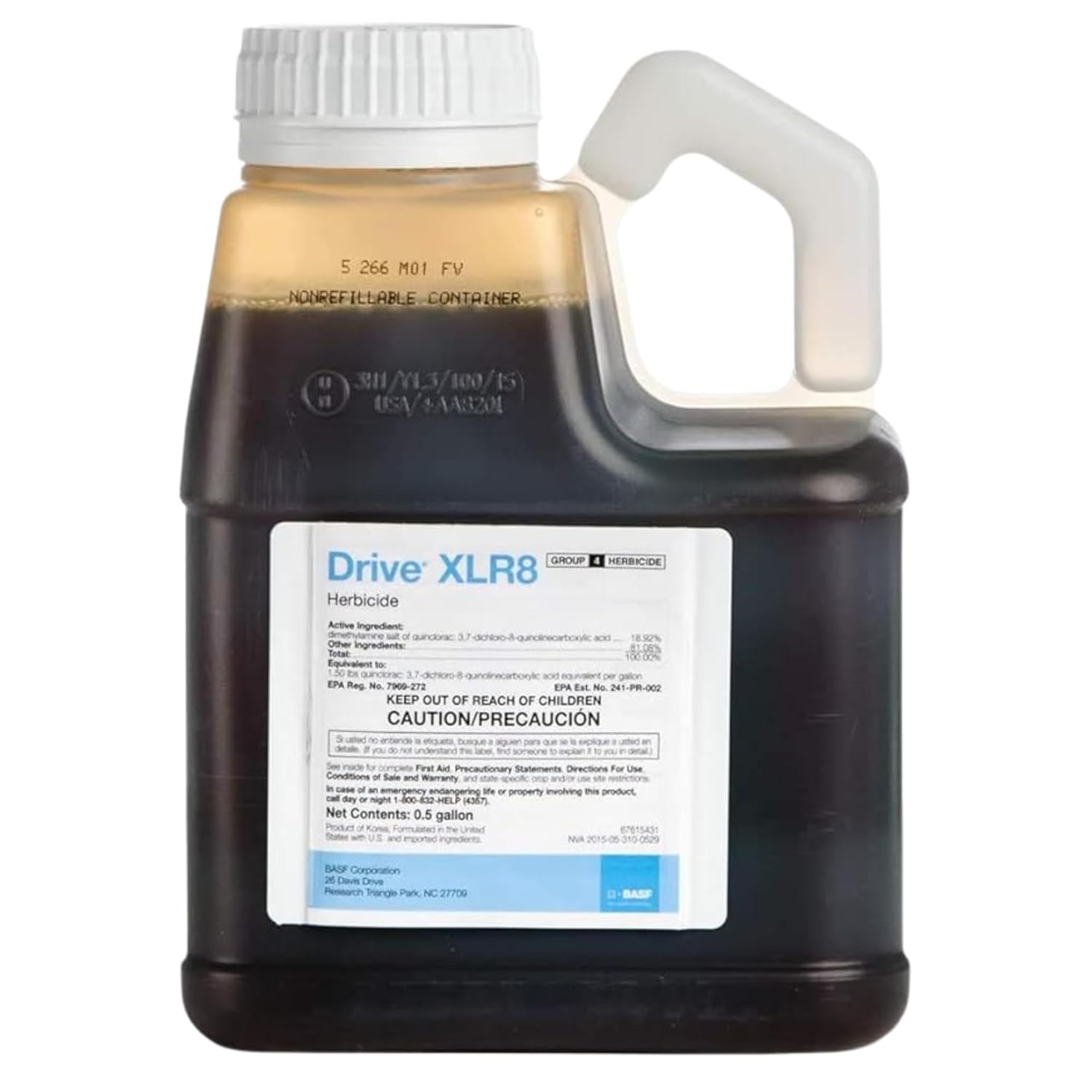
BASF Drive XLR8 Crabgrass Killer Concentrate, 64 oz
| Unit Count | 64 Ounce |
|---|---|
| Item Form | Liquid |
| Coverage | Full |
| Active Ingredients | Quinclorac 18.92% |
Drive XLR8 is a performance-focused post-emergent herbicide designed to knock back crabgrass and a wide spectrum of grassy and some broadleaf weeds in lawns and turf. It is used by mixing the concentrate with water and a methylated seed oil surfactant, then applying uniform spray coverage; the provided directions estimate a 1,000 sq ft coverage per gallon mix based on the label recipe. The product lists quinclorac at 18.92 percent and promises up to 30 days of residual control and quick plant uptake from its water-based formulation, which helps reduce repeat applications. Practical benefits include broad applicability across warm- and cool-season turf and tank-mix flexibility with certain pre- and post-emergent herbicides to address mixed weed populations. Important limitations are the need to follow safety precautions and PPE, spot-application restrictions in some jurisdictions, and the requirement to avoid mowing two days before and after treatment, which may complicate scheduling on high-use lawns.
Best for: Gardeners and turf managers who prioritize fast, reliable control of crabgrass and mixed grass weeds and want a concentrated product they can mix and integrate with other treatments.
Less Ideal for: Casual homeowners who prefer ready-to-use products or who cannot follow label PPE and local application restrictions should consider simpler, lower-risk options.
- High active ingredient (Quinclorac 18.92%) effective against crabgrass and several grassy weeds
- Water-based concentrate designed for quicker uptake and visible results
- Provides up to 30 days of residual control to reduce frequency of reapplication
- Tank-mix compatible with certain other turf herbicides for flexible integrated control
- Requires careful mixing and use of surfactant and protective equipment
- Some state or local restrictions limit use to spot treatments only
- Mowing restrictions around application reduce scheduling flexibility
Verdict: Choose Drive XLR8 when you need a concentrated, fast-acting post-emergent solution that delivers strong crabgrass and grassy weed control with up to 30 days of residual protection.
Spruce Weed & Grass Killer Kit with Power Wand and 64 oz Refill

| Unit Count | 64 Fluid Ounces |
|---|---|
| Coverage | 1 bottle treats up to 400 weeds |
| Item Form | Multiple |
| Included Batteries | 2 AA batteries included |
This kit pairs a 64 oz ready-to-use herbicide with a rechargeable-style power wand (runs on included AA batteries) for spot treating weeds and grass in driveways, beds, and cracks. The formula is water-based with essential oils and a surfactant so you do not need to mix or measure; one bottle claims coverage for up to about 400 weeds. The wand makes it easy to aim at individual plants and the EZ-AIM option improves precision for edges and cracks. You should see leaf darkening within an hour and full death of small weeds within a day when applied per directions. The product is marketed as safe around people, pets, and bees when used as directed and becomes rainproof within about 10 minutes. Important limitations are that it is non-selective so avoid spraying desirable plants or lawns, and best results require calm, dry conditions above about 60°F. Some users may need to prime the wand a short time before it sprays consistently.
Best for: Buyers who want a practical, low-fuss spot-treatment solution for crabgrass and broadleaf weeds that saves time and reduces mixing and measuring. Ideal for homeowners who prioritize precision control around driveways, pavers, and garden beds.
Less Ideal for: Gardeners who need a selective lawn-safe treatment for widespread turf weed control or those who prefer granular or systemic professional herbicides for large-area applications.
- Ready-to-use no-mix formula simplifies spot treatments
- Battery-powered wand and EZ-AIM nozzle improve targeting for cracks and edges
- Visible results often within 1 hour and dead weeds by 24 hours
- Large 64 oz refill treats a high number of weeds per bottle
- Formulated to be rainproof about 10 minutes after application
- Non-selective formula requires careful application to avoid desirable plants
- Performance depends on weather and temperature conditions for best efficacy
Verdict: A convenient, ready-to-use spot-treatment kit that delivers fast visible results and precise targeting for homeowners who want an easy, low-mess way to eliminate crabgrass and common weeds.
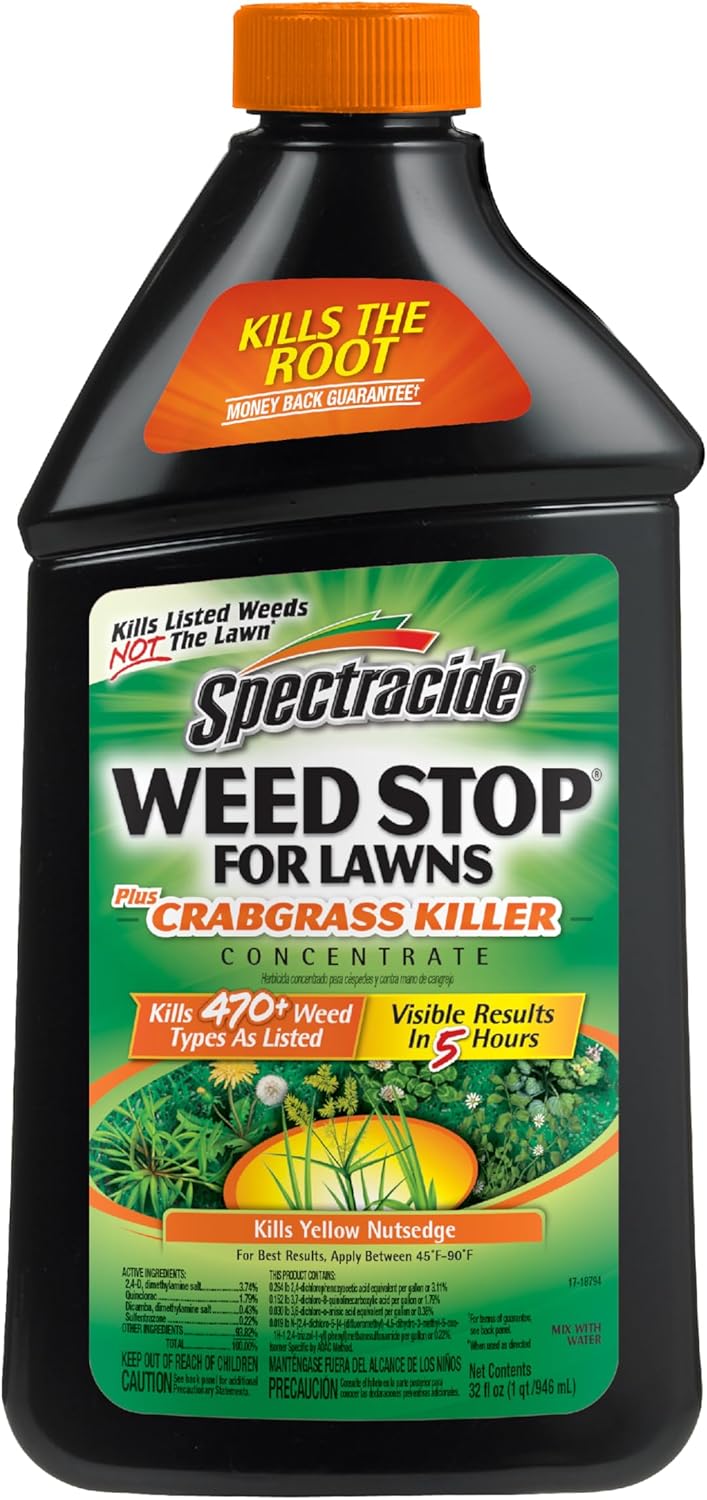
Spectracide Weed Stop for Lawns Plus Crabgrass Killer Concentrate, 32 oz
| Unit Count | 32 Ounce |
|---|---|
| Liquid Volume | 32 fluid ounces |
| Coverage | 5000 square_feet |
| Item Form | Liquid |
Spectracide Weed Stop Plus Crabgrass Killer is a ready-to-mix liquid concentrate designed for spot or full-lawn treatments to control broadleaf and grassy weeds, including crabgrass. You dilute and spray until wet over the target area; the formula kills by contact down to the root with visible results in about five hours and becomes rainfast in roughly three hours. Notable features include a long advertised list of controlled weeds, coverage up to 5,000 square feet from one 32 fl oz bottle, and guidance for use across common lawn grasses with temperature limits to prevent injury. In practice it is straightforward to apply with a pump or hose sprayer and works quickly on exposed weeds, making it useful for restoring a tidy lawn before peak season. Limitations are the weather restrictions and specific cautions for Bermudagrass and very hot days, plus the need to keep people and pets off the lawn until treated areas dry and to wait several weeks before reseeding. For routine crabgrass and broadleaf control on established lawns this concentrate is an efficient, fast-acting option.
Best for: A budget-minded homeowner who wants a single, fast-acting concentrate to treat crabgrass and a wide range of common lawn weeds across an average-sized yard.
Less Ideal for: People planning to reseed immediately or those with recently seeded lawns and gardeners who need a product rated safe for use in very hot climates or on sensitive grass types without restrictions.
- Controls over 470 listed broadleaf and grassy weeds including crabgrass
- Visible results in about 5 hours and rainfast in approximately 3 hours
- 32 fl oz concentrate treats up to 5,000 square feet, offering good coverage from one bottle
- Kills weeds down to the root for more lasting control when applied correctly
- Cannot be applied in high daytime temperatures and may temporarily discolor Bermudagrass
- Requires dilution and a sprayer which adds a small setup step before use
Verdict: An economical, fast-acting concentrate that treats up to 5,000 sq ft and quickly knocks down crabgrass and many common lawn weeds.
Quali-Pro Prodiamine Pre-Emergent Herbicide, 5 lb Granules

| Item Form | Granule |
|---|---|
| Coverage | Pre-emergent grass and broadleaf weed control, season long crabgrass control |
| Active Ingredients | Herbicide (Prodiamine 65%) |
Quali-Pro Prodiamine is a granular pre-emergent herbicide formulated to prevent germination of crabgrass and a range of annual grassy and broadleaf weeds for the season. Applied to turf and landscape areas in spring or fall, the granules create a residual barrier in the soil that stops seedlings like annual bluegrass, foxtail, and chickweed before they establish. The product lists prodiamine 65% as the active ingredient and is presented as tank-mix compatible with fertilizers and iron solutions for convenience during routine turf treatments. In practice it is straightforward to broadcast over lawns, golf course turf, and landscaped beds and provides reliable long-duration control when used according to label timing. Limitations include that it is a preventive product so it will not remove existing weeds and proper timing and even coverage are essential for consistent results. Users must follow label directions for application rates and site restrictions to avoid non-target damage.
Best for: Buyers who prioritize consistent, preventive weed control for lawns and managed turf and want a dependable product to include in regular maintenance routines.
Less Ideal for: Gardeners seeking a quick cure for existing weeds or those who need a post-emergent solution for broadleaf or perennial weed removal.
- Contains prodiamine 65% for season-long pre-emergent control of crabgrass and many annual weeds
- Granular form is easy to apply with a broadcast spreader and mixes with fertilizers
- Label lists use on turf, landscape, nursery and golf course sites for versatile application
- Pre-emergent only so it will not kill established weeds
- Requires correct timing and even application to be effective
Verdict: A reliable preventive granular herbicide that protects turf from crabgrass and many annual weeds for the full season when applied correctly.
Spectracide Weed & Grass Killer with AccuShot Power Sprayer, 1.33 gal

| Unit Count | 170 Fluid Ounces |
|---|---|
| Item Form | Spray |
| Coverage | 1 gallon |
| Active Ingredients | Diquat Dibromide 0.12%, Fluazifop-p-butyl 0.06%, Dicamba DMA salt 0.04% |
This Spectracide kit pairs a 1.33 gallon non-selective herbicide with a battery-powered AccuShot sprayer to make spot and area weed control fast and controlled. The formula is absorbed through leaves and moves to the root, so it will kill crabgrass, broadleaf weeds and most grasses it touches; the product is rainproof in 15 minutes and can show visible browning within about three hours. The AccuShot wand provides a continuous power spray and an extendable nozzle for better reach and accuracy, which reduces pumping and hand fatigue during larger jobs. Practical benefits include the ability to treat walkways, patios, fence lines and beds where you need to remove unwanted vegetation and the convenience of replanting in treated soil after a short wait. Important limitations are that the herbicide is non-selective and will damage desirable plants if contacted, the sprayer requires four AA batteries and occasional priming, and precautions are necessary around water and pets due to toxicity to aquatic life.
Best for: Buyers who want a proven, fast-acting solution for clearing crabgrass and mixed weeds from hardscapes and beds and who prefer a ready-to-use system with a powered wand for easier application.
Less Ideal for: Gardeners who need selective weed control inside lawns or who work very close to ornamental plants and water features should look for targeted or selective herbicides instead.
- Non-selective formula that kills weeds and grasses down to the root for longer-lasting control
- AccuShot battery-powered sprayer with extendable wand for continuous spray and improved accuracy
- Rainproof in 15 minutes and shows visible results in about three hours
- Large 1.33 gallon volume covers multiple areas without frequent refills
- Non-selective action can harm desirable plants if accidentally sprayed
- Sprayer depends on four AA batteries and may need priming or maintenance
- Product is toxic to aquatic life and requires careful application near water
Verdict: A convenient, fast-acting non-selective herbicide with a powered wand that makes quick work of crabgrass and mixed weeds on patios and beds.
Roundup Weed & Grass Killer4 with Pump 'N Go 2 Sprayer, 1.33 gal

| Unit Count | 170 Fluid Ounces |
|---|---|
| Item Form | Spray |
| Coverage | 300 Square_Feet |
| Active Ingredients | Triclopyr, Fluazifop-P-Butyl, Diquat Dibromide |
This 1.33 gallon Roundup kit pairs a formulated Weed & Grass Killer4 concentrate with a Pump 'N Go 2 sprayer so you can apply without mixing or separate equipment. It targets tough weeds and grasses such as dandelion, crabgrass, clover, and poison ivy and promises visible browning in hours and rainproofing in as fast as 30 minutes. The extendable wand adds reach and accuracy for edging beds, spraying around foundations, patios, and walkways while allowing up to about 10 minutes of continuous spray per fill. Practical benefits include no-measure application, the convenience of an integrated sprayer, and the ability to plant again within the stated window after treatment. Important limitations are that it is a chemical herbicide requiring careful PPE and exclusion of people and pets until spray dries, and it will damage desirable plants if oversprayed; follow label directions for safe use. The product also provides control for roughly one month but is not a long-term weed-prevention system on its own.
Best for: Buyers who want a convenient, no-mixing chemical solution to remove crabgrass and common broadleaf weeds quickly and with an integrated sprayer for easier application.
Less Ideal for: People seeking organic or non-chemical weed control or those who need a long-term pre-emergent solution for persistent weed prevention.
- Ready-to-use system with built-in Pump 'N Go sprayer so no mixing is required
- Kills a broad range of common weeds and grasses down to the root
- Extendable wand improves accuracy and reach for edging and hard-to-reach spots
- Produces visible results within hours and becomes rainproof quickly
- Contains strong active ingredients that require protective clothing and keeping people and pets away until dry
- Can harm desirable plants and should be applied carefully to avoid drift or overspray
Verdict: If you want a fast, ready-to-use chemical treatment for crabgrass and common broadleaf weeds with an integrated sprayer, this Roundup kit delivers convenient, visible control.
Choosing the Right Crab Weed and Grass Killer: Key Factors to Consider
Mode of Action and Target Species
Different products kill grasses through contact burn-down, systemic uptake, or by blocking growth pathways. Contact herbicides brown and desiccate shoots quickly but may not kill roots, so they are best for visible annual crabgrass patches that can be followed up with repeat treatments. Systemic products are absorbed and translocated into roots, offering longer-term control for perennial grassy weeds.
Knowing exactly which grasses you are targeting matters because some formulations are labeled specifically for crabgrass, while others are broad-spectrum on grassy weeds. Match the mode of action to whether you need fast top-kill or root-level control for repeat offenders.
Selectivity and Risk to Desirable Plants
Selectivity defines whether a product will harm surrounding turf or ornamentals. Some grass killers are nonselective and will damage any green plant they contact, so they are suitable only for spot applications on bare soil, driveways, or gravel. Others are formulated to target grassy species while leaving broadleaf plants alone, which is useful along bed edges or when treating grassy weeds in mixed plantings.
Check label language for buffer distances, drift warnings, and whether the product can be used next to specific lawn grass types or near shrubs. Even labeled selective products can injure sensitive species if applied too heavily or in hot, dry conditions.
Application Method and Precision
How you apply determines how much collateral damage you risk and how efficient treatments are. Ready-to-use spray bottles and trigger applicators are convenient for spot-killing patches, while hose-end sprayers and hand-pump sprayers work for larger areas. Granular formulations can be useful for broadcast treatments on bare ground but lack the precision of a spray for isolating patches near plantings.
Consider whether you need a fine spray to minimize drift, a wand for targeted stems, or a granular product that will not splash. Ease of measuring and mixing also matters because small yard jobs are best served by products with simple dilution instructions and clear nozzle settings.
Timing and Environmental Conditions
Herbicide performance varies with plant growth stage, temperature, and soil moisture. Many grass killers are most effective on actively growing crabgrass and grassy weeds, often in warm weather when the plants are drawing water and nutrients. Applying during drought, extreme heat, or dormancy reduces uptake and slows results.
Avoid treatment before heavy rain or irrigation that could wash product away, and be mindful of windy conditions that increase drift risk. Some products require waiting several days before mowing or watering to allow uptake, so plan applications around routine landscape maintenance.
Residual Activity and Replanting Intervals
Residual control can suppress new flushes of crabgrass for weeks, which reduces repeat treatments but may limit when you can safely plant seeds or transplants. Short-residual contact products allow quicker replanting but may need follow-up applications. Longer-residual products reduce re-emergence but require checking the label for safe planting intervals for lawns, flowers, or vegetables.
If you plan to reseed a lawn or add transplants in treated areas, choose a product with a compatible waiting period or plan treatment timing well ahead of planting dates.
Safety, Storage, and Local Regulations
Herbicide safety extends beyond immediate application. Look for clear personal protective equipment recommendations, mixing guidance, and storage instructions. Proper containment and disposal of leftover concentrate and rinse water protect soil and water resources.
Local regulations or neighborhood restrictions may limit the use of certain active ingredients, so check municipal guidelines. Choose products with straightforward label directions and conservative application windows if you want to minimize risk to pollinators and non-target species.
When to Use Spot Treatments Versus Broadcast Applications
Spot treatments are the most efficient approach when crabgrass appears in isolated patches, cracks, or near ornamental beds. They reduce chemical use and minimize the chance of harming nearby desirable plants. Use a targeted sprayer or a sponge applicator for narrow areas.
Broadcast applications make sense for widespread infestations or when preparing bare ground before reseeding. Granular or broadcast liquid applications cover more ground but require careful timing and calibration to avoid overapplication.
- Spot treatment: minimal drift, less product, best for edges and cracks
- Broadcast: covers large areas, better for heavy infestations, requires calibration
- Hand removal: useful for small isolated plants and when chemical use is undesired
Safe Use Around Flower Beds and Vegetable Gardens
If you treat near flowers or vegetables, use products labeled for use adjacent to ornamentals and follow buffer specifications. Apply on calm days and use a shielded wand to prevent drift onto desirable foliage.
For vegetable gardens, avoid treatments in planting beds unless the label specifically allows it. Instead, apply to pathways and cracks, and use physical barriers or mulch to control grasses near seedlings.
- Maintain label-recommended buffer zones
- Avoid treating on windy days
- Rinse equipment away from garden soils to prevent contamination
Integrated Strategies to Reduce Future Crabgrass Pressure
Combining cultural practices with chemical control reduces long-term crabgrass pressure. In lawns, regular mowing at appropriate heights, timely fertilization, and overseeding thin spots make conditions less favorable for crabgrass to colonize.
Mulching beds, fixing irrigation to avoid overwatering, and sealing pavement cracks with sand or polymeric fillers reduce the bare soil and moisture that crabgrass favors. Use herbicidal treatments as part of a broader management plan rather than the sole tactic.
- Overseed thin turf areas in fall to outcompete crabgrass
- Mulch beds to block seed germination
- Repair and seal cracks where seed collects
Application Timing Through the Season
Early-season timing is critical for crabgrass control. Preemergent strategies or early postemergent applications when crabgrass seedlings are small offer better results. For postemergent products, treat when crabgrass is actively growing and not stressed by heat or drought.
Late-season spot treatments can reduce seed production and minimize next year's pressure, but expect slower results as plants begin to senesce. Plan treatments to align with your lawn care calendar and local growing conditions.
- Treat small, actively growing plants for best uptake
- Avoid applications during drought or immediately before heavy rain
- Use late-season control to reduce seed set
Transport and Disposal of Leftover Product
Store concentrates in their original containers with labels intact and keep them locked away from children and pets. Transport products upright and secured to prevent spills.
Dispose of rinse water and leftover product according to local regulations. Many municipalities have hazardous waste programs for pesticide disposal. Never pour concentrates into storm drains or onto bare soil.
- Keep original labels for reference
- Do not reuse containers for other liquids
- Follow local hazardous waste guidelines for disposal
How We Chose the Best Crab Weed and Grass Killer
We evaluated products that are appropriate for targeted crabgrass and grassy-weed control in yards, beds, and hardscape cracks. Our selection filters prioritized materials with clear application instructions, labeled uses for crabgrass or grassy weeds, and evidence of consistent control in typical home landscapes. We excluded items only intended for agricultural or commercial turf use, as well as generic herbicide concentrates that lack precise rates for small-scale spot work. Key evaluation criteria included speed of visible control, selectivity between grassy weeds and desirable plants, ease and precision of application for spot or edge work, and residual activity to limit re-emergence. We also considered safety information and reentry/planting intervals that affect how you can use the product around ornamentals and vegetable beds. Packaging formats and dilution clarity were reviewed to assess practicality for homeowners who will mix or apply small volumes.
FAQ
Can I use crab weed and grass killer around my ornamental plants?
It depends on the product. Some formulations are selective for grassy weeds and safe near many ornamentals when applied according to the label. Others are nonselective and will damage any green plant they contact. Always read label restrictions and observe recommended buffer distances.
How long after applying a grass killer can I reseed or plant?
Replanting intervals vary by active ingredient and formulation. Short-contact products often allow quick replanting, while residual chemistries may require waiting several weeks. Check the product label for specified waiting periods before seeding or transplanting.
Will a single treatment eliminate crabgrass for the season?
A single treatment can remove visible plants, but recurrence is common if conditions remain favorable for crabgrass or if seed in the soil is abundant. Combining treatment with cultural practices and monitoring for new flushes gives better season-long control.
Are granular and liquid products equally effective?
Both can be effective when used correctly. Liquids usually offer greater application precision for spot treatments, while granules are convenient for broadcast coverage. Effectiveness depends more on timing, rate, and how well the product is applied than the physical form alone.
What precautions reduce drift when spraying near desirable plants?
Spray on calm days with low wind, use a coarse nozzle setting, lower spray pressure, and employ a shield or shielded wand for narrow applications. Maintaining distance and using targeted applicators reduces the chance of drift onto nearby plants.
Can I combine chemical control with hand pulling?
Yes. Hand pulling removes immediate biomass and seed heads, while targeted herbicide applications reduce regrowth and root persistence. Combining methods is especially useful for small infestations or sensitive planting areas.
Final Verdict
Focus on matching the product's mode of action and application precision to the scale and location of the infestation. Prioritize products that allow targeted application if you have nearby ornamentals, and select longer-residual options only when you do not plan to reseed or transplant soon. Combine chemical control with cultural practices like overseeding, mulching, and crack sealing for the most reliable, long-term reduction of crabgrass pressure.
