

Note: This article contains affiliate links. If you click on these links and make a purchase, I may earn a small commission at no extra cost to you. This helps support my research and content. Read my full affiliate disclosure here.
If crab grass is taking over bare patches and thin edges of your turf, choosing the right weed killer makes a practical difference in recovery and maintenance. This guide looks at the best weed killer options for crab grass in typical lawn and turf situations. We shortlisted seven products that work in different application windows and lawn types, then evaluated them for ease of use, turf safety, and lasting control. The picks below are focused on dependable crabgrass control and gardener-friendly application. Read on to see the evaluation criteria used and practical notes that will help you pick the right approach for your lawn.
Top Picks at a Glance
| Best Overall The best all-around choice for most situations | Ortho GroundClear Weed & Grass Killer with Comfort Wand, 1 gal |  |
| Best Quality Built to a higher standard if you want something more solid | Syngenta Tenacity Turf Herbicide, 8 fl oz |  |
| Best Value The sweet spot between price and what you get | Spectracide Weed Stop for Lawns Plus Crabgrass Killer Concentrate, 32 oz |  |
| Best Budget The cheapest option that still gets the job done reliably | Spectracide Weed Stop for Lawns Plus Crabgrass Killer, Ready-to-Use, 32 oz |  |
| Highest Rated A top-rated pick with lots of positive feedback | Monterey Crab-E-Rad Plus Weed Control, 16 oz |  |
| Most Popular A crowd favorite that many people choose with confidence | Ortho WeedClear Lawn Weed Killer Ready-to-Spray, 32 fl. oz. |  |
| Best Seller A high-volume bestseller chosen again and again | Roundup Weed & Grass Killer4 with Pump 'N Go 2 Sprayer, 1.33 gal. |  |
Ortho GroundClear Weed & Grass Killer with Comfort Wand, 1 gal

| Item Form | Spray |
|---|---|
| Coverage | 5120 square feet |
| Liquid Volume | 128 fluid ounces |
| Active Ingredients | Ammonium Nonanoate |
Ortho GroundClear is a one-gallon, ready-to-use weed and grass killer designed for spot and area treatment of unwanted vegetation in landscapes, walkways, driveways, and around trees. The included Comfort Wand makes it easy to target individual weeds like crabgrass, dandelions, and chickweed without splashing nearby plants. The ammonium nonanoate formula works on contact with visible browning in about 15 minutes and becomes rainproof approximately two hours after drying, so results are fast and you do not have to wait long on a dry day. It is OMRI Listed which may appeal to gardeners seeking products compatible with organic production. Practical limits are that perennial or well-established weeds often need repeat applications and the spray must not contact desirable plants or lawns. Users also need to follow safety guidance to avoid skin or eye contact and keep children and pets away until treated areas are dry.
Best for: Gardeners who want a convenient, fast-acting spot treatment for crabgrass and common landscape weeds and who prioritize precise application and quick results.
Less Ideal for: Homeowners seeking a selective lawn herbicide or a long-term systemic solution for deep-rooted perennials should consider lawn-specific or systemic alternatives.
- Ready-to-use spray with included Comfort Wand for precise spot treatment
- Fast visible results in as little as 15 minutes
- Becomes rainproof about 2 hours after drying so treatments withstand light rain
- OMRI Listed for use in organic production contexts
- Not selective to grass so it will damage turf and desirable plants if contacted
- Perennial or established weeds may require multiple applications
Verdict: A convenient, OMRI Listed ready-to-use spray that gives fast, targeted control of crabgrass and common landscape weeds with an included comfort wand.
Syngenta Tenacity Turf Herbicide, 8 fl oz
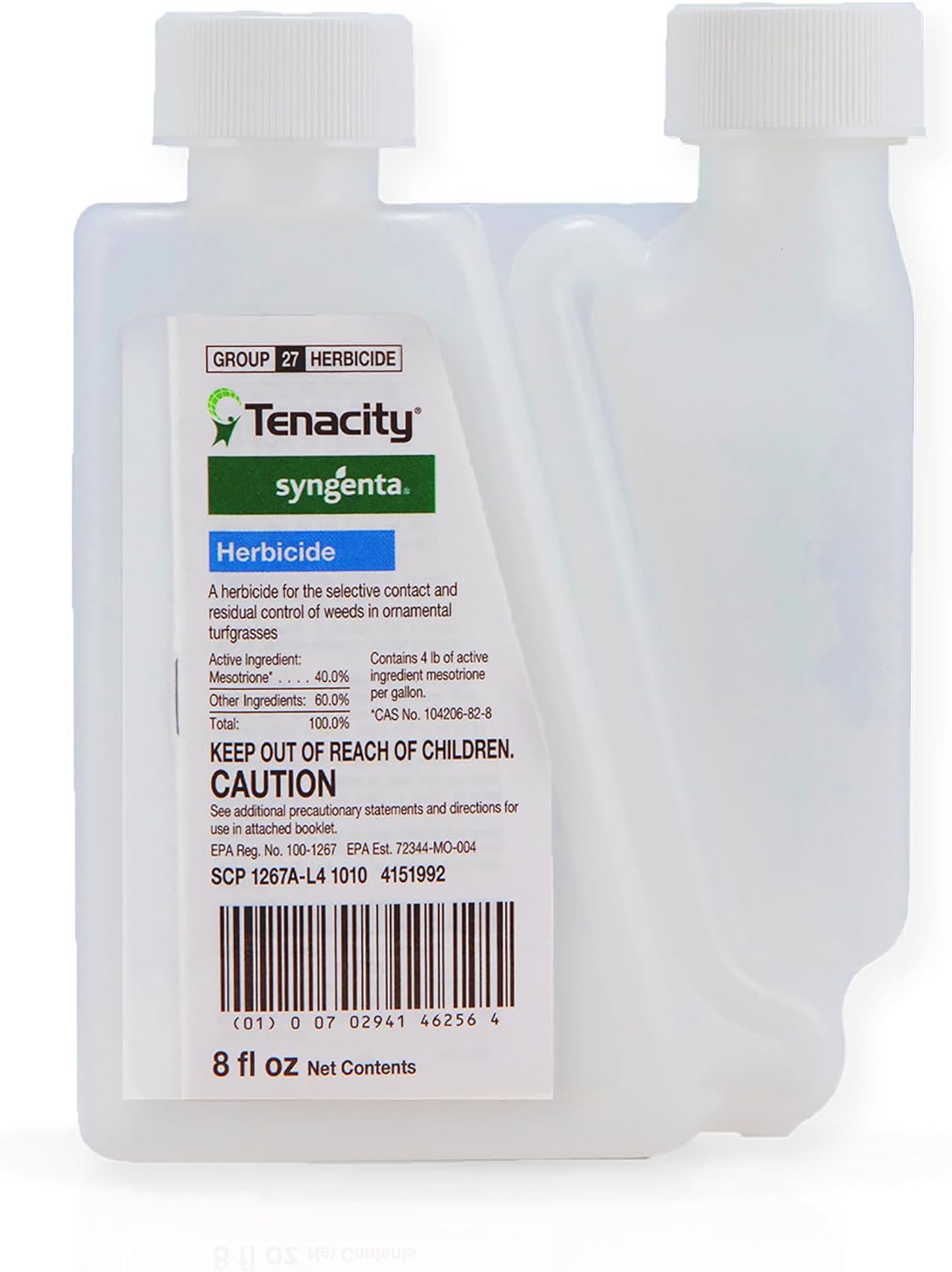
| Unit Count | 8 Fluid Ounces |
|---|---|
| Item Form | Liquid |
| Coverage | 2000 ft^2 per 1sp of product |
| Active Ingredients | Mesotrione |
Tenacity is a concentrated liquid herbicide formulated to provide both pre-emergent and post-emergent control of common lawn weeds, including crabgrass. Applied with water through a sprayer, it is absorbed systemically during weed emergence and also gives contact activity, which helps control established seedlings and certain broadleaf weeds. The product lists mesotrione as the active ingredient and claims coverage suitable for treating large areas when mixed according to label rates. Practical benefits include residual control that reduces follow-up applications and broad-spectrum activity against grassy and broadleaf weeds common in lawns. Important limitations are that it is turf-selective, so it must be used only on labeled grass species to avoid damage to ornamentals or non-target plants, and correct timing and thorough mixing are required for best results. Users should follow label directions for application rates, safety, and turf compatibility to get reliable crabgrass control.
Best for: Homeowners and turf managers who prioritize effective, performance-oriented control of crabgrass and other common lawn weeds and who are comfortable following label application instructions.
Less Ideal for: People with mixed beds of ornamentals or sensitive plants near the treatment area or those who prefer non-chemical weed management strategies.
- Provides both pre-emergent and post-emergent activity for emerging and young weeds
- Contains mesotrione, a systemic active ingredient effective on a range of grassy and broadleaf weeds
- Residual control can reduce the need for frequent reapplications
- Concentrated liquid formula that can cover large turf areas when mixed per label
- Selective to labeled turfgrasses and can injure non-target plants if misapplied
- Requires precise timing, correct mixing and application equipment for best performance
Verdict: A performance-oriented turf herbicide that delivers both pre- and post-emergent control of crabgrass when used exactly as directed.
Spectracide Weed Stop for Lawns Plus Crabgrass Killer Concentrate, 32 oz
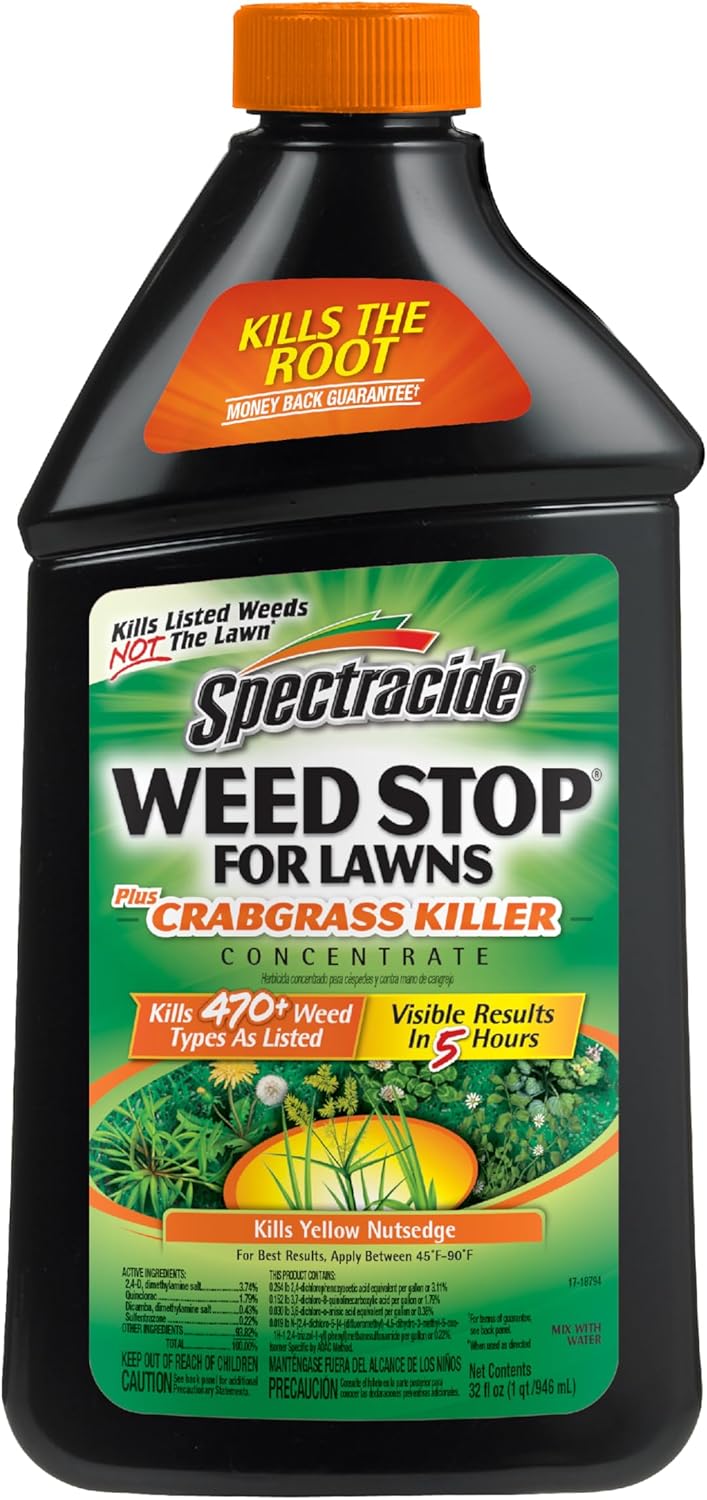
| Liquid Volume | 32 fluid ounces |
|---|---|
| Coverage | 5000 square_feet |
| Item Form | Liquid |
Spectracide Weed Stop Plus Crabgrass Killer is a ready-to-dilute concentrate designed to control crabgrass and a long list of broadleaf and grassy weeds across an average lawn. You mix the concentrate with water and spray until weeds are wet; the formula kills by contact down to the root with visible browning in about five hours and becomes rainproof in roughly three hours. The product is intended for routine lawn maintenance and spot or whole-lawn treatments and covers up to 5,000 square feet from a 32 ounce bottle. Practical features include clear temperature guidelines for safe application, explicit instructions for reseeding and pet re-entry once dry, and a label listing specific weeds controlled. Limitations to keep in mind are temperature constraints that restrict use above about 90 degrees to avoid lawn injury and specific cautions for Bermudagrass where temporary yellowing can occur. Follow label directions carefully for dilution rates and timing to get reliable, fast results without harming desirable turf.
Best for: Homeowners who want a fast-acting, broad-spectrum weed control for crabgrass and common lawn weeds and who plan treatments carefully around temperature and reseeding schedules.
Less Ideal for: People seeking an all-season, temperature-agnostic solution or those who need a product explicitly formulated for newly seeded lawns or delicate turf types without risk of discoloration.
- Kills crabgrass and over 470 listed broadleaf and grassy weeds, including dandelion and clover
- Visible results in about five hours and rainproof after roughly three hours
- 32 fl oz concentrate treats up to 5,000 sq ft, suitable for whole-lawns or spot treatments
- Clear application guidance and safety directions for reseeding and pet re-entry
- Should not be applied when daytime temperatures exceed 90°F to avoid lawn damage
- May cause temporary yellowing on Bermudagrass if used improperly
Verdict: Choose this concentrate if you need a fast, reliable treatment that kills crabgrass and a wide range of common lawn weeds while covering a typical yard from a single bottle.
Spectracide Weed Stop for Lawns Plus Crabgrass Killer, Ready-to-Use, 32 oz

| Unit Count | 32 Fluid Ounces |
|---|---|
| Item Form | Spray |
| Coverage | up to 5,000 square feet |
| Liquid Volume | 32 fluid ounces |
Spectracide Weed Stop for Lawns Plus Crabgrass Killer is a ready-to-use spray designed to knock down broadleaf and grassy weeds, including crabgrass, with visible results in about five hours. It is typically used by walking the lawn and spraying problem areas with the trigger sprayer—no mixing or extra equipment is required—which makes it convenient for quick spot treatments or treating larger patches up to the stated coverage. The formula kills by contact and is marketed to reach the root, so you can expect dying foliage within hours and reduced regrowth afterward. Notable features include an easy applicator, a claimed list of 470+ target weeds, and guidance on temperature limits to protect sensitive turf types. Practical benefits are fast action, simple use, and broad weed control without needing a separate spreader or tank sprayer. Important limitations: it is a contact killer so thorough coverage matters, it can harm certain grasses like bermudagrass at higher temperatures, and performance depends on following label directions and weather windows for safe application.
Best for: Homeowners who want a low-effort, low-cost solution to remove crabgrass and common lawn weeds quickly without mixing chemicals or renting equipment.
Less Ideal for: People managing sensitive turf types year-round or those needing a systemic, soil-active preemergent solution should consider professional treatments or alternate products.
- Ready-to-use spray so no mixing or extra equipment required
- Claims fast visible results in about five hours after application
- Targets a wide range of weeds including crabgrass and other grassy and broadleaf species
- Coverage stated up to 5,000 square feet for treating larger lawns
- Contact action requires thorough coverage so missed spots may regrow
- Application restrictions for bermudagrass and high temperatures limit use windows
Verdict: An affordable, ready-to-use spray that delivers fast, wide-spectrum knockdown of crabgrass and common lawn weeds with minimal setup.
Monterey Crab-E-Rad Plus Weed Control, 16 oz

| Item Form | Granule |
|---|---|
| Coverage | 5000 square feet |
| Unit Count | 16 Ounce |
Monterey Crab-E-Rad Plus is a granular selective herbicide designed to control crabgrass and a wide range of broadleaf weeds in residential and ornamental turf. You apply it across the lawn when weeds are actively growing, using the included measuring spoon to dose a 16 ounce pack that covers up to 5,000 square feet. The granule form makes it straightforward to broadcast by hand or with a spreader for spot or area treatment. Notable features include labeled safety guidance for personal protection and a fast rainproofing time so treatments are not washed away if rain arrives within hours. In practice it gives visible weed decline in a few weeks and allows repeat spot treatments as needed. Limitations are that it is intended for turf use only so it is not suitable for garden beds or non-turf planting, and users must follow safety precautions to avoid skin or eye contact when handling the product.
Best for: Homeowners who prioritize reliable, no-nonsense crabgrass control for established lawns and want a product that holds up if weather turns shortly after application.
Less Ideal for: Gardeners who need weed control in flower beds, vegetable gardens, or non-turf areas should choose a product labeled for those uses instead.
- Controls crabgrass plus many common broadleaf weeds in turf
- Granule form distributes evenly for spot or full-lawn applications
- Covers up to 5,000 sq ft from a single 16 oz bottle
- Becomes rainproof within hours to resist wash-off
- Formulated only for lawns and ornamental turf, not for garden beds or non-turf plants
- Requires protective clothing and care during handling due to potential skin or eye contact
Verdict: A dependable granular treatment for homeowners who need fast, rainproof crabgrass and broadleaf weed control across a lawn.
Ortho WeedClear Lawn Weed Killer Ready-to-Spray, 32 fl. oz.

| Item Form | Spray |
|---|---|
| Coverage | 5000 square_feet |
| Liquid Volume | 32 fluid ounces |
| Active Ingredients | 2,4-D; Quinclorac; Dicamba |
Ortho WeedClear Ready-to-Spray is a hose-end applicator designed for DIY lawn weed control, targeting broadleaf weeds and grassy weeds such as crabgrass. You attach it to a garden hose, switch it on, and spray evenly until the lawn surface is wet; one 32 fl. oz. bottle treats up to 5,000 sq. ft. The formula lists active ingredients (2,4-D, quinclorac and dicamba salts) that work down to the root and promise visible results in hours with rainproofing after about one hour. It is marketed for use on common northern lawn grasses including fescues, Kentucky bluegrass, ryegrass and zoysiagrass, and includes specific application windows and temperature limits for best results. Important limitations: it is not safe for several warm-season and specialty turfs and should not be used near gardens or ornamentals, and treated areas must stay clear of people and pets until dry. Also follow label directions carefully because of the herbicides involved and temperature restrictions for some grasses.
Best for: Homeowners who want a straightforward, science-backed solution to remove crabgrass and common broadleaf weeds on compatible northern lawns and who prioritize proven performance and clear usage guidance.
Less Ideal for: People with warm-season or specialty turf (for example St. Augustine or centipedegrass), those who need a product safe for gardens or ornamentals, or users unwilling to follow herbicide safety precautions.
- Ready-to-use hose-end design makes application quick and simple for homeowners.
- Covers up to 5,000 sq. ft. per 32 fl. oz. bottle, suitable for medium lawns.
- Active ingredients effective against crabgrass and many broadleaf weeds, with results visible in hours.
- Rainproof within about one hour so treatment is less likely to wash off if light rain follows.
- Not safe for several turf types and ornamental plants, restricting where it can be used.
- Contains strong herbicides that require careful handling, protective clothing, and adherence to label directions.
Verdict: If you need a fast, easy hose-end treatment that reliably kills crabgrass and many broadleaf weeds on compatible northern lawns, this ready-to-spray formula is a practical choice.
Roundup Weed & Grass Killer4 with Pump 'N Go 2 Sprayer, 1.33 gal.

| Unit Count | 170 Fluid Ounces |
|---|---|
| Item Form | Spray |
| Coverage | 300 Square_Feet |
| Active Ingredients | Triclopyr, Fluazifop-P-Butyl, Diquat Dibromide |
This Roundup kit combines a pre-mixed 1.33 gallon herbicide with a Pump 'N Go 2 sprayer for targeted spot treatment of weeds and crabgrass. The product is formulated to kill common broadleaf weeds and grasses to the root and is described as producing visible results in hours and becoming rainproof in about 30 minutes. The attachable sprayer and extendable wand make it easier to apply without bending and give up to 10 minutes of continuous spray so you can treat edges, driveways, and flower bed margins more accurately. It also notes you can replant in 1 to 30 days depending on instructions. Important limitations are the safety precautions and chemical active ingredients, which require keeping people and pets off treated areas until dry and using protective clothing; this is not a non-chemical option. Coverage is listed around 300 to 400 square feet per container, so very large lawns will need multiple units. For gardeners concerned about speed and convenience, it delivers powerful, easy-to-apply control, but it demands careful handling and adherence to label directions.
Best for: A buyer who wants a fast, straightforward chemical solution for spot treatment of crabgrass and tough broadleaf weeds and values an integrated sprayer for accurate application.
Less Ideal for: People seeking organic or non-chemical weed control or those managing very large turf areas where concentrated broadcast products would be more economical.
- Pre-mixed formula with integrated Pump 'N Go sprayer for quick, no-mixing application
- Extendable wand and up to 10 minutes continuous spray improve accuracy and reduce bending
- Produces visible results in hours and becomes rainproof in about 30 minutes
- Specifically lists common tough weeds and grasses including crabgrass and dandelion
- Contains multiple active herbicidal ingredients that require protective measures and area restriction until dry
- Coverage per container is limited to roughly 300–400 sq ft, so not ideal for large lawns
Verdict: Choose this product if you want a ready-to-use, fast-acting chemical treatment with an integrated sprayer that makes removing crabgrass and tough weeds quick and accurate.
Choosing the Right Weed Killer for Crab Grass: Key Factors to Consider
Active Ingredient and Mode of Action
Knowing the active ingredient matters because different chemistries target grasses versus broadleaf weeds. Pre-emergent actives prevent crabgrass seedlings from establishing, while post-emergent chemistries kill actively growing plants. Choose a mode of action that matches whether you are trying to prevent new crabgrass in spring or eliminate existing plants in summer.
Understanding mode of action also helps avoid resistance issues if you treat repeatedly over multiple seasons. Some active ingredients require repeat application windows or combine with cultural controls for best results.
Timing and Application Window
Crabgrass responds to treatment timing more than many broadleaf weeds. Pre-emergent products should be applied before soil temperatures consistently hit the germination range, while post-emergent treatments work best on young, actively growing crabgrass and lose effectiveness as plants mature.
Consider your local climate and soil temperature trends when scheduling application. Also check label guidance for rainfast periods and reapplication intervals so treatments are not washed away or applied too frequently.
Turfgrass Type and Safety
Not all lawns tolerate the same chemistries equally. Some herbicides are labeled safe for cool-season grasses but can damage warm-season turf, and vice versa. Match the product to your lawn species and follow any temperature or growth-stage restrictions on the label.
Safety also extends to desirable plants near treated zones. Look for products with narrow turfgrass labeling if you have ornamental beds or mixed grass areas to reduce the chance of non-target injury.
Residual Activity and Long-Term Control
Residual control determines how long a product prevents new crabgrass from germinating after application. Longer residuals reduce the need for repeat treatments but can delay seeding or overseeding because the soil remains suppressive to grass seedlings.
Balance the desire for extended control with your renovation plans. If you intend to overseed or repair bare spots, choose a product with a shorter residual or follow label windows for safe seeding after treatment.
Application Method and Equipment Needs
Ease of application impacts how accurately you can target crabgrass and how likely you are to follow label directions. Broadcast treatments work for whole lawns, while spot treatments reduce chemical use in small infestations. Some formulations require a sprayer, others come as granules or ready-to-use mixes.
Consider the equipment you already own and whether you prefer liquid precision or the convenience of granular spreaders. Calibration and mixing instructions matter for safety and effectiveness, so pick products with clear, garden-friendly directions.
Post-Treatment Lawn Care and Seeding Restrictions
Many herbicides include specific wait times before you can overseed or plant new turf. These restrictions affect how quickly a lawn can recover after treatment and whether you can repair treated spots the same season.
Plan treatments around renovation goals. If you need to seed soon, select products with short replant intervals or schedule crabgrass control outside of seeding windows. Also account for watering and mowing guidance after treatment to support both weed control and turf recovery.
Pre-emergent Vs Post-emergent Approaches
Pre-emergent herbicides create a barrier that prevents crabgrass seed from germinating and are most effective when applied before the soil warms to the germination threshold. These are a proactive choice for lawns with a history of crabgrass and can significantly reduce seedling pressure in spring.
Post-emergent products kill actively growing crabgrass and are best for tackling visible patches. They work well when plants are young; effectiveness drops as plants mature and set seed. Combining cultural controls with post-emergent treatments speeds recovery and reduces recurrence.
- Use pre-emergents in early spring based on soil temperature cues.
- Use post-emergents for spot control of green, actively growing plants.
- Follow label timing to avoid harming desirable turf or interfering with seeding.
Spot Treatment Strategies
For small infestations, spot treatments limit chemical use and preserve more of the lawn's biological activity. Apply a targeted post-emergent at the base of crabgrass clumps, and avoid overspray to adjacent desirable grass.
Mechanical removal by pulling or digging is an option for isolated patches, especially where soil is moist. After removing plants, treat the bare spot according to seeding guidance if you plan to replant.
- Hand-pull when soil is soft to remove roots and crowns.
- Use a spray shield or targeted wand to protect nearby turf when applying herbicide.
- Rake and seed bare spots only when label permits reseeding after treatment.
Integrating Cultural Controls
Cultural practices greatly reduce crabgrass pressure over time. Thick, healthy turf shades soil and reduces the light and space crabgrass needs to germinate. Adjust mowing height, fertilize appropriately, and repair thin areas to create competitive turf.
Proper irrigation timing helps too. Frequent shallow watering favors crabgrass, while deeper, less frequent watering supports deep-rooted desirable grasses and discourages annual grassy weeds.
- Raise mowing height slightly during peak crabgrass season to shade out seedlings.
- Aerate and overseed thin areas during appropriate seasons to increase turf density.
- Adopt irrigation schedules that promote deeper root growth in desirable grasses.
Handling Spotty Lawns and Overseeding
If your lawn has bare spots that encourage crabgrass, plan weed control around repair work. Some herbicides prevent seeding for weeks or months, so schedule treatments either after overseeding has established or choose products labeled safe for seeding sooner.
When overseeding after treatment is allowed, prep the soil by loosening the surface and using seed mixes appropriate for your turf type. Keep treated areas moist for seed establishment while following any watering restrictions from the herbicide label.
- Test small areas first if you are unsure how your turf will respond to a product.
- Follow seeding windows and soil prep recommendations to improve establishment success.
Safety and Environmental Considerations
Follow label instructions for buffer zones near sidewalks, gardens, and water features to reduce runoff and non-target exposure. Use personal protective equipment recommended by the label when mixing and applying any herbicide.
Consider mechanical and cultural tactics first for small infestations. Limiting chemical use reduces the risk to pollinators and beneficial organisms and fits into an integrated approach to weed management.
- Avoid treating when rain is expected within the rainfast window stated on the label.
- Store chemicals securely and dispose of unused product according to local regulations.
How We Chose the Best Weed Killer for Crab Grass
We prioritized products and formulations that are effective specifically against crab grass while posing minimal risk to established turf. Selection criteria focused on application timing, active ingredient behavior, and lawn safety across common turfgrass types. We looked for options that offer clear directions for spot treatment and broadcast application, and that provide guidance for repeat treatments or follow-up seeding. Editorial filters excluded general-purpose herbicides that lack specific crabgrass labeling or that are intended only for non-turf areas. We also excluded products with unclear usage windows or those that require specialized commercial licensing. Key dimensions that actually mattered were ease of application, labeled turf compatibility, residual control period, and instructions for overseeding or reseeding after treatment. These criteria align with the scorecard metrics used in our reviews and reflect practical concerns gardeners face when removing crab grass.
FAQ
When is the best time to apply a pre-emergent for crabgrass?
Apply pre-emergent before soil temperatures consistently reach crabgrass germination range, which often aligns with early spring warming. Timing depends on local climate, so monitor soil temperature or local phenological cues.
Can I spot-treat crabgrass without harming nearby lawn grass?
Yes. Using a targeted post-emergent and applying carefully at the base of crabgrass clumps reduces risk to surrounding turf. Use a spray shield or a wand with a narrow nozzle and avoid overspray.
How long after treating can I overseed bare patches?
Wait times vary by product. Some herbicides allow seeding within a few weeks, while others recommend waiting several months. Check the product label for the exact reseeding interval before planning overseeding.
Will treating crabgrass prevent it from returning next season?
Treatment reduces current-season populations but does not eliminate seed in the soil. Combining timely pre-emergent applications, cultural practices, and spot treatments reduces the seedbank and lowers recurrence risk over multiple seasons.
Are granular products better than liquids for crabgrass control?
Both forms can be effective. Granular pre-emergents are convenient for broadcast applications, while liquid post-emergents provide more precision for spot control. Choose the form that matches your equipment and the infestation size.
Final Verdict
Choose a crabgrass control approach that matches your immediate need and long-term lawn goals. If prevention is the priority, schedule pre-emergent treatments based on soil temperatures and accept seeding restrictions. For active infestations, use targeted post-emergents on young plants and follow up with cultural fixes to reduce future pressure. Balance residual control with reseeding plans and always match product labeling to your turf type. Prioritizing timing, turf safety, and application precision will yield the most reliable results for crabgrass management.
