

Note: This article contains affiliate links. If you click on these links and make a purchase, I may earn a small commission at no extra cost to you. This helps support my research and content. Read my full affiliate disclosure here.
If you want a lawn that resists crabgrass outbreaks rather than fighting them every summer, the right crabgrass fertilizer makes a big difference. Choosing the proper formula affects not just turf color but seed suppression, root strength, and how long protection lasts through the heat. This guide shortlists the six best options for crabgrass control and explains the practical tradeoffs gardeners encounter, from application timing to effects on different turf types. We evaluate how easy each product is to apply and how long its residual control lasts, plus turf recovery and safety considerations. Read on for clear, gardener-focused guidance before you pick a product.
Top Picks at a Glance
| Best Overall The best all-around choice for most situations | Scotts Halts Crabgrass & Grassy Weed Preventer, 20.12 lb |  |
| Best Quality Built to a higher standard if you want something more solid | The Andersons Barricade Professional-Grade Granular Pre-Emergent Weed Control (40 lb) |  |
| Best Value The sweet spot between price and what you get | Scotts Turf Builder Triple Action Lawn Fertilizer and Weed Control, 11.31 lb |  |
| Best Budget The cheapest option that still gets the job done reliably | Preen Lawn Crabgrass Control, 15 lb Bag (Covers 5,000 sq. ft.) |  |
| Highest Rated A top-rated pick with lots of positive feedback | Lesco/Lawn Synergy 0-0-7 Stonewall Pre-Emergent Granules, 50 lb |  |
| Most Popular A crowd favorite that many people choose with confidence | Scotts Turf Builder Halts Crabgrass Preventer with Lawn Food (covers 5,000 sq. ft.) |  |
Scotts Halts Crabgrass & Grassy Weed Preventer, 20.12 lb

| Item Form | Granule |
|---|---|
| Coverage | 10,000 sq. ft. |
| Unit Count | 321.92 Ounce |
Scotts Halts is a granular pre-emergent formulated to prevent germination of crabgrass and other grassy weeds when applied in early spring or fall. You apply it to a dry, established lawn with a broadcast or drop spreader, then water it in as directed; once activated the product forms a chemical barrier in the soil that blocks weed seedlings without killing existing mature weeds. The bag treats up to 10,000 square feet and the label notes it works through normal rain, snow, or freezing temperatures, which reduces timing worries. Important features include clear spreader settings and label guidance about waiting before overseeding or aerifying so that the barrier is not disturbed. Limitations: it does not control existing, mature weeds and must not be used on newly seeded or certain turf types like Bentgrass or Dichondra. Because it lasts seasonally and cannot be applied more than twice a year, planning application timing is necessary for best results.
Best for: A homeowner who prefers a cautious, preventive approach to lawn care and wants a straightforward product to reduce spring crabgrass pressure across a typical yard.
Less Ideal for: Anyone needing a quick cure for established weeds or those planning to overseed or renovate turf within four to five months should consider other solutions.
- Pre-emergent action prevents crabgrass and multiple grassy weeds before they sprout.
- Covers up to 10,000 sq. ft. per bag, suitable for typical residential lawns.
- Granular form is easy to apply with common spreaders and includes recommended spreader settings.
- Performance is not affected by rain, snow, or freezing soon after application, reducing scheduling stress.
- Does not kill existing or mature weeds so it must be combined with other control methods for current infestations.
- Requires waiting period before seeding, sprigging, aerifying, or mowing practices that disturb the soil.
- Not safe for use on certain turf types such as Dichondra and Creeping Bentgrass.
Verdict: Choose Scotts Halts when you want a reliable, easy-to-apply pre-emergent to prevent crabgrass and grassy weeds across a standard residential lawn.
The Andersons Barricade Professional-Grade Granular Pre-Emergent Weed Control (40 lb)

| Item Form | Granule |
|---|---|
| Coverage | 12880 square_feet |
| Active Ingredients | Herbicide (prodiamine 0.48%) |
| Unit Count | 640 Ounce |
The Andersons Barricade is a granular pre-emergent designed to stop common weeds before they emerge rather than kill existing plants. It contains 0.48% prodiamine and uses a dispersible granule formulation that dissolves quickly with watering so the active ingredient moves into the soil where seeds germinate. Typical use is a broadcast application across established turf and ornamental beds in early spring or fall following label rates to cover up to the listed square footage. Notable features include small particle granules for broader coverage and a professional-strength active ingredient used to prevent crabgrass, poa annua, goosegrass and many broadleaf weeds. The practical benefits are long-lasting prevention when timed correctly and efficient coverage for larger yards thanks to the 40 lb bag. Limitations to plan for are that it will not remove existing weeds, it requires precise application timing and watering to activate, and safety precautions are necessary because the product is harmful if ingested or contacts skin.
Best for: Buyers who prioritize proven, professional-strength prevention for medium to large lawns and want a product backed by many user reviews and established performance.
Less Ideal for: Gardeners who need to eliminate established weeds, have very small yards where large-volume packaging is impractical, or prefer non-chemical weed control methods.
- Dispersible granule formula that dissolves quickly with water to move the active ingredient into the soil
- Professional-grade active ingredient prodiamine effective against common grassy and broadleaf weeds
- Small particle size for broader coverage per square inch
- Large 40 lb bag intended to cover a wide area without frequent repurchasing
- Does not control or kill existing weeds, only prevents new ones
- Requires correct timing and follow-up watering to be effective
- Contains herbicide active ingredients that require careful handling and adherence to safety directions
Verdict: Choose Barricade when you need a reliable, professional-strength pre-emergent to prevent common lawn weeds across a large area.
Scotts Turf Builder Triple Action Lawn Fertilizer and Weed Control, 11.31 lb

| Item Form | Granule |
|---|---|
| Coverage | 4000 square_feet |
| Active Ingredients | Pendimethalin, Dicamba |
Scotts Turf Builder Triple Action combines fertilizer, broadleaf weed control, and a crabgrass pre-emergent into a single granular bag aimed at spring lawn care. You apply it with a broadcast spreader to a wet lawn, let granules sit for 24 hours, then water to move the active ingredients into the soil. Notable features are its 3-in-1 formulation and a coverage claim of 4,000 square feet from the 11.31 lb. bag, plus compatibility with common turf types such as Kentucky bluegrass, fescue, and bermudagrass. In practice it simplifies chores by replacing separate fertilizer and pre-emergent steps and helps prevent crabgrass for several months while also targeting common broadleaf weeds like dandelion and clover. Important limitations are that it will not kill existing crabgrass and it contains herbicides that require careful timing and following safety directions for people and pets. For a homeowner who wants a single spring treatment to strengthen turf and reduce weed pressure, this is a practical, time-saving option.
Best for: Homeowners who want a single spring treatment to both strengthen their lawn and reduce weed pressure without managing multiple products, and who follow label timing and safety instructions.
Less Ideal for: People needing a quick cure for established crabgrass or those who prefer separate targeted treatments for fertilizer and herbicide control.
- 3-in-1 formula feeds grass, kills listed broadleaf weeds, and prevents crabgrass
- Covers up to 4,000 square feet from a single 11.31 lb. bag
- Granular form works with broadcast spreaders for even application
- Suitable for a wide range of common turf types
- Does not control existing crabgrass since the product is a pre-emergent
- Contains herbicides that require strict timing, wet grass at application, and re-entry precautions
Verdict: Use this single-bag 3-in-1 granular treatment if you want an easy spring application that feeds your lawn while preventing crabgrass and treating common broadleaf weeds.
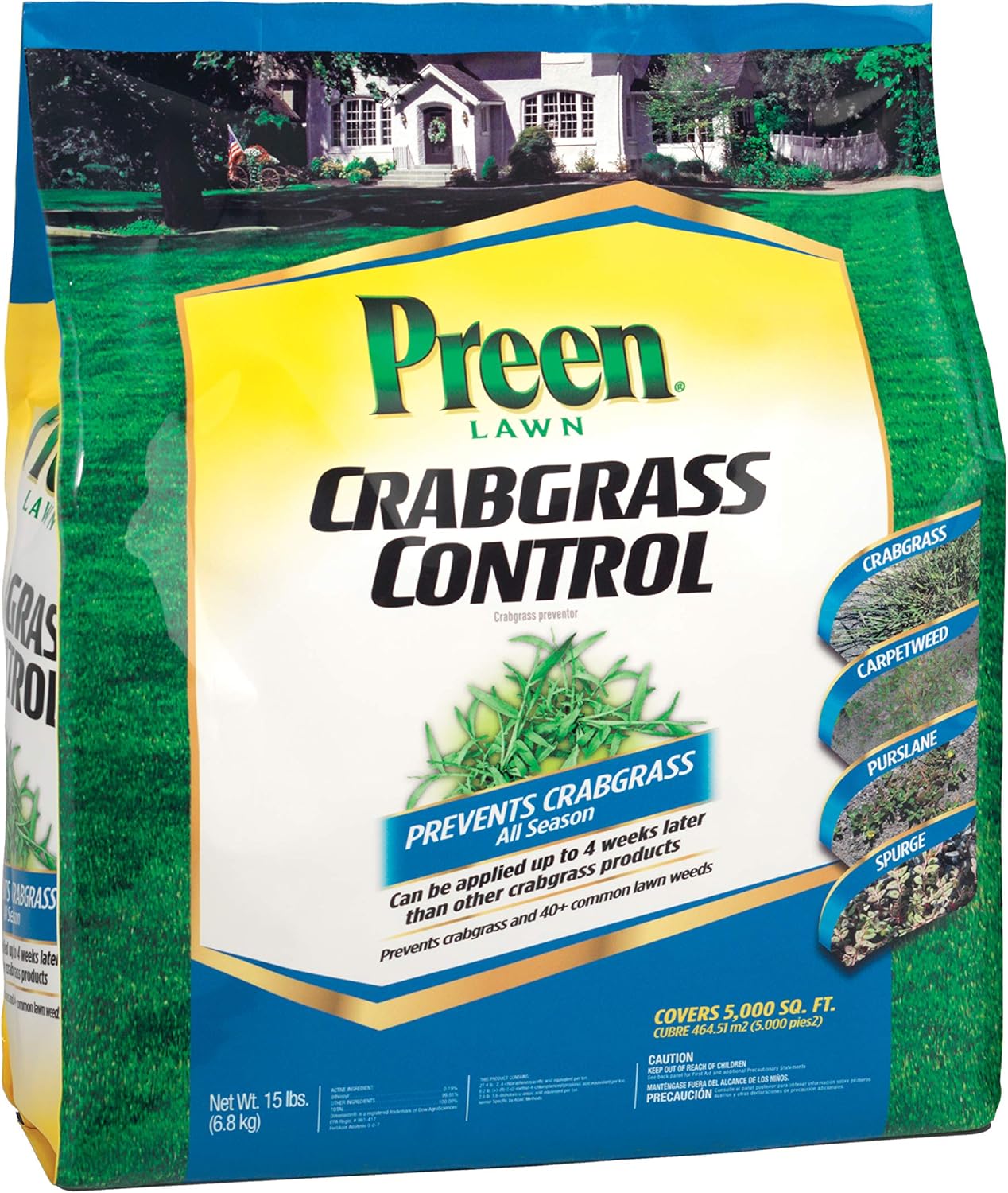
Preen Lawn Crabgrass Control, 15 lb Bag (Covers 5,000 sq. ft.)
| Item Form | Granule |
|---|---|
| Coverage | Covers 5,000 sq. ft. |
| Active Ingredients | Dithiopyr |
Preen Lawn Crabgrass Control is a granular weed preventer formulated to stop crabgrass and other common grassy and broadleaf weeds for up to four months when applied before seed germination, and it also suppresses seedling crabgrass up to four weeks after emergence. It is typically broadcast with a spreader across established lawns in spring or fall and can be used on many cool- and warm-season grasses. Notable features include season-long preemergent protection, labeled post-emergent activity on young crabgrass, and a 5,000 sq. ft. coverage per 15 lb bag, which makes it suitable for medium-sized yards. Practical benefits are reduced hand-weeding, fewer weed flushes through the season, and compatibility with common turf types. Important limitations are that it should not be used before reseeding or overseeding (follow the 12-week restriction after fall application) and eyewear and hygiene precautions are recommended during application because it can irritate eyes. It is a practical, no-nonsense option for routine crabgrass management when used as directed.
Best for: Buyers who want an affordable, single-bag solution to prevent crabgrass across a medium-sized lawn and prefer a straightforward granular product that works on both cool- and warm-season grasses.
Less Ideal for: Owners planning to reseed or overseed within a few months or those who prefer organic, non-chemical weed control methods should consider alternatives.
- Provides up to four months of preemergent control against crabgrass and many other weeds
- Offers limited post-emergent control of seedling crabgrass for up to four weeks after emergence
- Covers 5,000 square feet per 15 lb bag, suitable for medium lawns
- Works on a wide range of cool- and warm-season turfgrasses
- Cannot be used for 12 weeks before reseeding or overseeding after a fall application
- Contains chemicals that require protective eyewear and washing after handling
Verdict: A budget-friendly granular product that delivers season-long crabgrass prevention and short-term post-emergent control for medium lawns.
Lesco/Lawn Synergy 0-0-7 Stonewall Pre-Emergent Granules, 50 lb

| Item Form | Granule |
|---|---|
| Coverage | 12,500 sq. Ft. |
| Active Ingredients | Prodiamine |
| Included Components | BAG |
This granular pre-emergent combines 0-0-7 fertilizer with a prodiamine-based herbicide to prevent annual weeds in turf and landscape beds. It is typically broadcast over established lawns in early spring and again in fall for warm season timing, applied at about 4 to 5 lb per 1,000 sq. ft., and provides up to roughly four months of weed control when used as directed. The product includes potassium and iron for turf health while the Stonewall active ingredient delivers consistent pre-emergent performance. Because it is a large 50 lb bag that covers up to 12,500 sq. ft., it is convenient for homeowners with medium to large yards and reduces the need for frequent reapplication. Important practical limits are that it must be applied according to label directions to avoid crop injury, it cannot be used on sod farms or through irrigation systems, and it prevents desirable seed germination while active so do not overseed treated areas until label-allowed intervals have passed.
Best for: Homeowners with medium to large lawns who want a single product that prevents common annual weeds while supporting turf health and reduces return trips for reapplication.
Less Ideal for: People planning to overseed or establish new lawns soon or commercial growers who need application through irrigation or use on sod farms should choose a different product.
- Contains prodiamine (Stonewall) for reliable pre-emergent weed control
- Includes potassium and added iron to support turf color and vigor
- Large 50 lb bag covers up to 12,500 sq. ft., suitable for medium to large lawns
- Granular form spreads easily with standard broadcast or drop spreaders
- Will inhibit germination of seeded lawns so not suitable when overseeding
- Label restrictions prohibit use on sod farms and through irrigation systems
Verdict: A practical, large-coverage prodiamine pre-emergent that prevents weeds and supports turf health for homeowners with established lawns.
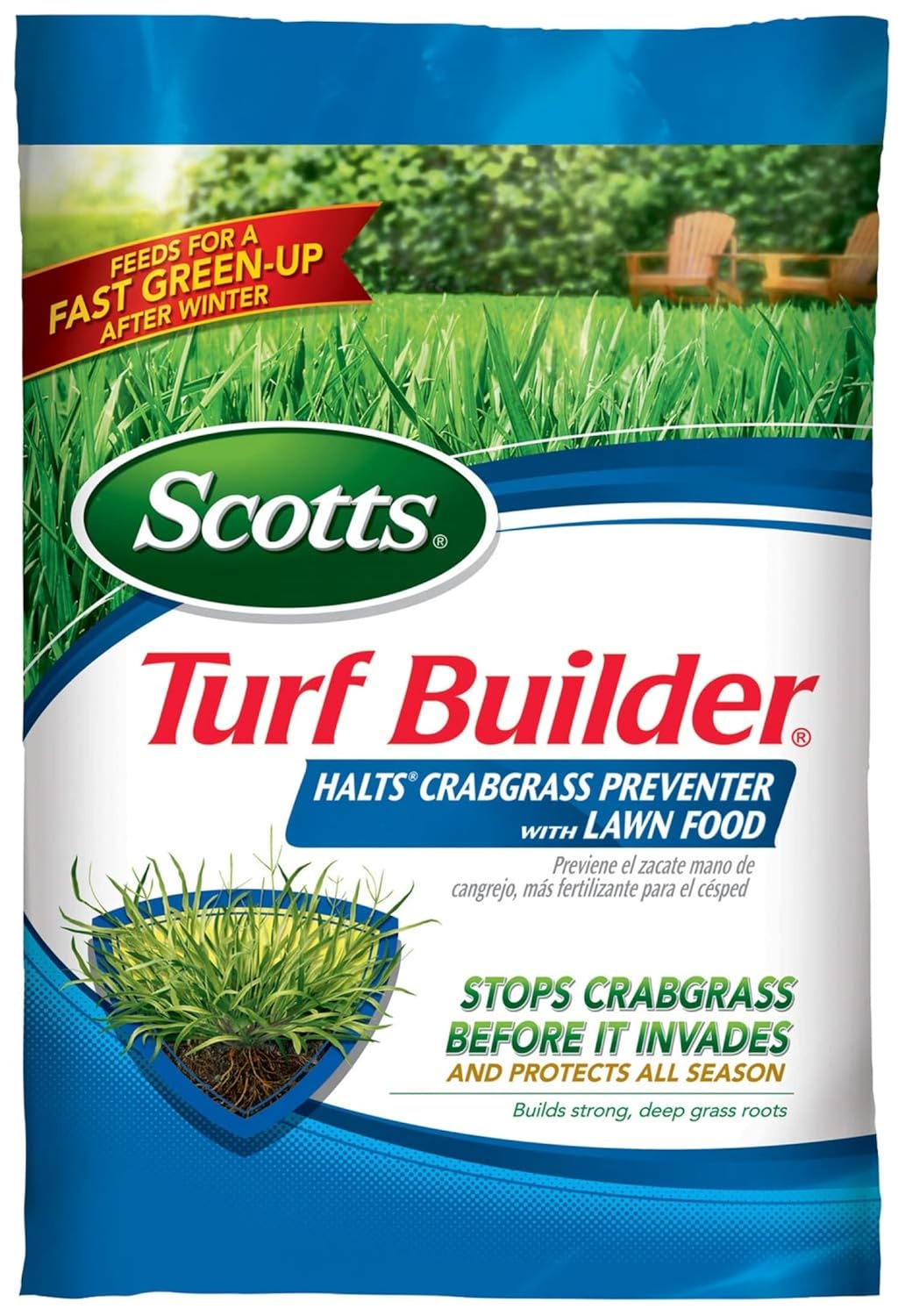
Scotts Turf Builder Halts Crabgrass Preventer with Lawn Food (covers 5,000 sq. ft.)
| Item Form | Granule |
|---|---|
| Coverage | 5000 square feet |
| Unit Count | 213.6 Ounce |
| Fertilizer analysis | 30-0-4 |
Scotts Turf Builder Halts combines a pre-emergent crabgrass preventer with a granular lawn fertilizer to protect and feed an established lawn through the spring. You apply it once in early spring to a dry lawn before regular hot weather, using a broadcast or drop spreader and then water the lawn lightly within 2 to 3 days so the active ingredient forms a barrier in the soil. The product covers 5,000 sq. ft. per bag and is formulated to prevent several grassy and broadleaf weeds while the 30-0-4 fertilizer helps grass green up quickly and build deeper roots. Practical benefits include season-long prevention of new crabgrass and simultaneous feeding, which reduces extra steps in spring lawn care. Limitations are that it will not kill mature crabgrass or existing weeds and it is not suitable for certain turf types like dichondra or bentgrass. Also, correct spreader settings and post-application watering are important for reliable performance, so casual or inexperienced applicators should follow directions closely.
Best for: Homeowners who prioritize reliable, season-long prevention and want a simple spring treatment that both blocks new crabgrass and feeds the lawn.
Less Ideal for: People needing a post-emergent weed killer for existing crabgrass or those managing dichondra or bentgrass turf should choose a different product.
- Pre-emergent formula prevents crabgrass and several other grassy weeds when applied correctly
- Includes fertilizer (30-0-4) for fast green-up and stronger root development
- Single-application coverage for 5,000 sq. ft. reduces repeat treatments in spring
- Granular form works with common broadcast and drop spreaders for even application
- Does not control established or mature crabgrass or existing weeds
- Not safe for use on dichondra and bentgrass lawns
Verdict: Choose this product if you want a dependable one-time early-spring treatment that prevents new crabgrass while feeding and strengthening your lawn.
Choosing the Right Crabgrass Fertilizer: Key Factors to Consider
Type of Control Needed
Deciding between preemergent and postemergent action changes when you apply product and what you can expect it to do. Preemergent formulations create a chemical barrier that prevents crabgrass seed from germinating, which is most effective when applied before soil temperatures reach the germination threshold. Postemergent options are used after crabgrass has emerged and rely on selective herbicide activity to brown out existing plants.
Some products combine both feeding and preemergent control, which can be convenient but also demands careful timing to avoid interfering with desirable turf establishment. Knowing whether you need preventative coverage, active elimination, or a combination will guide your choice and seasonal schedule.
Timing and Seasonal Window
Crabgrass germinates when soil consistently reaches a certain temperature in spring. Effective use therefore depends on local climate and monitoring soil heat rather than following calendar dates alone. Applying too early shortens protection, and applying too late reduces efficacy against seedlings that have already emerged.
Products differ in the length of protection they provide. Those with longer residual windows can cover the entire germination period with a single application, while shorter-duration options might require follow-up treatments or be paired with cultural practices like timely overseeding.
Nutrient Balance and Turf Health
A fertilizer intended to suppress crabgrass should also feed the turf without encouraging uneven growth that favors weeds. Look for balanced nutrient profiles that strengthen root systems and support dense canopy development. High nitrogen bursts can green the lawn quickly but may stimulate shallow growth that is vulnerable to heat and weeds.
Slow-release nitrogen and appropriate levels of phosphorus and potassium help build sustained vigor. Strong, competitive turf shades the soil surface and reduces the niche where crabgrass seedlings establish, so feeding behavior matters as much as herbicidal activity.
Application Equipment and Coverage
How you apply a product affects coverage uniformity and safety. Granular formulations typically require a broadcast spreader; liquid concentrates need a sprayer. Spreader calibration, overlapping passes, and correct walking speed determine even distribution. Uneven coverage produces patchy protection and can leave gaps where crabgrass can emerge.
Consider whether you have the right equipment and are comfortable calibrating it. Some gardeners prefer ready-to-use hose-end or ready-mixed sprays for small areas, while larger lawns benefit from calibrated rotary or drop spreaders for consistent granular application.
Safety for Pets, Plants, and Waterways
Many crabgrass-control products include active ingredients that require attention to reentry intervals, pet restrictions, and runoff risks. Readability of label warnings and clear instructions for irrigation timing and mowing after application are important for minimizing non-target impact.
Avoid products with application windows that conflict with seeding or vulnerable ornamentals. Where runoff to storm drains or water features is a concern, select formulations and application methods that reduce movement, and follow label guidance on buffer zones and rainfall timing.
Compatibility with Lawn Renovation
If you plan to overseed or renovate the lawn, compatibility between crabgrass control and seeding timelines matters. Preemergent barriers can prevent desirable grass seed from sprouting, so check how long the herbicidal activity persists and whether there are safe seeding windows after treatment.
For renovation projects, you may prefer products with shorter residual activity or choose to schedule seeding during the safe interval specified on the label. Understanding these interactions prevents wasted seed and allows you to design a treatment calendar that supports both weed control and turf establishment.
When To Apply For Best Results
Timing is the single most important practical decision for crabgrass control. Rather than relying on a specific date, monitor soil temperature at a 1 to 2-inch depth. Many regions see crabgrass germination trigger when soil warms to about a consistent mid-50s Fahrenheit range across several days.
Apply preemergent products a little before that window opens. If you miss the ideal preemergent window and crabgrass is already visible, switch to a postemergent approach and focus on spot treatments to reduce collateral impact on the lawn. For combination products, follow label guidance for both prevention and treatment timing to avoid undercutting either function.
- Use a soil thermometer for precision
- Avoid heavy irrigation immediately after dry-applied preemergents unless label requires incorporation
- Spot treat visible patches with targeted postemergents
Spreader Setup and Application Tips
Proper spreader calibration is crucial for even coverage. Test the spreader on a driveway to measure output at a set setting and walking speed before applying to turf. Follow label spreader settings as a starting point, then adjust for your device and walking pace.
For granular products, overlap swaths slightly but avoid double-feeding the same area. For liquids, use spray nozzles recommended by the manufacturer and keep a consistent spray pattern. Always record the date and product used so you can plan follow-up treatments or seeding accordingly.
- Calibrate on a measured strip to verify coverage
- Use a consistent walking speed and pattern
- Note environmental conditions like wind and recent rainfall
Combining Cultural Practices With Chemical Control
Chemical control is most effective when paired with good lawn care. Mow at the recommended height for your turf species to shade soil and reduce weed germination. Regular irrigation scheduling that encourages deep rooting rather than frequent shallow watering strengthens turf resilience.
Core aeration and overseeding thin areas in the fall so there are fewer bare spots for crabgrass to exploit. Addressing soil compaction and fertility through routine maintenance reduces long-term dependence on herbicides and promotes a competitive turf canopy.
- Mow slightly higher in summer to shade soil
- Water deeply and infrequently to build roots
- Aerate and overseed during cool-season windows
Environmental Considerations and Runoff Prevention
Preventing chemical movement off-site protects waterways and beneficial plants. Avoid applying before heavy rain is forecast and follow label instructions for buffer zones near streams or ponds. Use low-drift spray tips and avoid overapplication that increases runoff risk.
Consider using slower-release nutrient formulations and targeted spot treatments to lower overall chemical load. For properties with slopes, treat the top of the slope first and work downhill using careful irrigation practices to limit movement.
- Check weather forecasts and avoid imminent heavy rain
- Maintain buffer zones around water features
- Prefer spot treatment where infestations are isolated
Seeding After Crabgrass Control
If overseeding is planned, read label guidance for safe waiting periods after preemergent use. Some products permit seeding after a specified interval, while others require extended waits that can complicate renovation timing. Pick a product whose residual fits your renovation calendar or plan renovation for a season when herbicidal activity has subsided.
When reseeding is necessary soon after control, mechanical solutions like core aeration and topdressing can improve seed-to-soil contact and help new grass establish in areas where chemical options limit seeding windows.
- Coordinate seeding windows with product residual information
- Use core aeration to improve seedbed contact
- Choose seeding timing aligned with grass species requirements
How We Chose the Best Crabgrass Fertilizer
We selected entries that perform the two practical tasks gardeners expect from a crabgrass fertilizer: encourage dense turf growth and suppress crabgrass establishment. Our editorial filters prioritized formulations with documented preemergent or combined pre/postemergent action, consistent turf feeding profiles, and application formats suited to home and small-property use. We favored products with clear label directions and predictable seasonal windows so backyard users can time treatments without specialist equipment. Evaluation criteria included application ease and spreader compatibility, length of residual crabgrass control, nutrient balance and turf recovery, and safety for common lawn grasses and surrounding plants. We excluded agricultural- or sod-farm-only formulations, experimental mixes without clear labeling, and products requiring specialized licensing or equipment. Where label instructions conflicted with common home practices, we prioritized options that balance efficacy with practical safety and minimal maintenance.
FAQ
Can I apply crabgrass control and seed the lawn at the same time?
It often depends on the product. Preemergent barriers typically prevent seed germination, so seeding is usually delayed until the safe interval specified on the label. Some shorter-residual products or targeted postemergent approaches may allow seeding sooner.
How long after applying should I water or mow?
Follow label directions because some granular products need light irrigation to activate while others advise waiting. Mowing frequency usually resumes once turf shows normal recovery, but avoid heavy mowing immediately after postemergent treatments to reduce stress.
Will a crabgrass fertilizer harm my garden beds or ornamentals?
Runoff and drift can impact nearby plants. Maintain buffer zones, avoid spraying on windy days, and follow instructions on restrictions near ornamentals. Using targeted applications reduces the chance of non-target damage.
How often do I need to reapply for season-long control?
Application frequency depends on the product's residual duration and local germination period. Some formulations provide sufficient coverage with a single spring application, while others may require follow-ups or supplemental postemergent spot treatments.
Is a liquid or granular formulation better for home lawns?
Both have pros and cons. Granular products are convenient for broadcast application and slow release. Liquids allow for more precise spot treatment and quicker uptake. Choose based on lawn size, equipment, and personal comfort with application methods.
Can I use crabgrass control on all turfgrass types?
Compatibility varies by turf species and product. Some active ingredients are labeled for cool-season lawns, others for warm-season grasses. Always check label compatibility to avoid stressing or damaging desirable turf.
Final Verdict
Prioritize timing, application method, and residual length when choosing a crabgrass fertilizer. Decide first whether you need preventative protection, active postemergent control, or a combined approach, then match that need to a formulation that works with your equipment and renovation plans. Keep safety for pets, ornamentals, and waterways in mind, and pair chemical control with good cultural practices like proper mowing, irrigation, and overseeding to reduce future infestations.
