

Note: This article contains affiliate links. If you click on these links and make a purchase, I may earn a small commission at no extra cost to you. This helps support my research and content. Read my full affiliate disclosure here.
If you grow crotons you know their leaf color and vigor hinge on steady, balanced feeding. Choosing the right Croton Fertilizer affects color intensity, leaf size, and how often you need to tend plants. This guide covers seven shortlisted options that suit common croton situations from container houseplants to patio specimens. We evaluated these fertilizers for nutrient balance, application style, and how they behave in regular garden and container environments. Read on to see which feeding approach fits your schedule and plant goals before the product list.
Top Picks at a Glance
| Best Overall The best all-around choice for most situations | Miracle-Gro Indoor Plant Food for Tropicals, 8 fl. oz. (2-Pack) |  |
| Best Quality Built to a higher standard if you want something more solid | Exotica Tropicals Professional Nursery Croton Fertilizer, 4 lb Slow-Release Granules |  |
| Best Value The sweet spot between price and what you get | Osmocote Smart‑Release Plant Food Plus Outdoor & Indoor, 2 lb |  |
| Best Budget The cheapest option that still gets the job done reliably | Miracle-Gro Water Soluble All Purpose Plant Food, 1.5 lb |  |
| Highest Rated A top-rated pick with lots of positive feedback | Osmocote Smart-Release Plant Food Plus Outdoor & Indoor, 1 lb |  |
| Most Popular A crowd favorite that many people choose with confidence | Miracle-Gro Indoor Plant Food for All Plants, Liquid, 8 fl. oz. (2-Pack) |  |
| Best Seller A high-volume bestseller chosen again and again | TPS NUTRIENTS Indoor Plant Food Liquid Fertilizer, 8 fl oz |  |
Miracle-Gro Indoor Plant Food for Tropicals, 8 fl. oz. (2-Pack)

| Item Form | Liquid |
|---|---|
| Application Method | Directly to soil or mixed with water |
| Target Species | Tropical Plants |
| Mixing Ratio | 4 pumps:1 quart of water |
| Unit Count | 16 Fluid Ounces (per bottle) |
This liquid formula is designed to feed tropical indoor plants and is useful for houseplants that benefit from regular, low‑volume nutrition. It can be applied directly to potting soil using the built‑in pump or diluted at a ratio of 4 pumps per quart of water for routine watering, with reapplication every two weeks. The potassium‑focused formulation aims to promote lush green foliage, which matters for many broadleaf tropicals. Practical benefits include an easy pump dispenser for small pots, two bottles in the bundle for longer supply, and clear mixing guidance so dosing is straightforward. Limitations to consider: the product is formulated for general tropical houseplants rather than a specialist crop, and coverage is described as low so frequent dosing or multiple bottles may be needed for larger collections. If you prefer granular slow‑release nutrition or a fertilizer tailored to a very specific species, this liquid feed may not match those needs.
Best for: Indoor plant owners who want a simple, pump‑dispensed liquid fertilizer to maintain lush foliage on common tropical houseplants and who value straightforward dosing and social proof from other buyers.
Less Ideal for: Collectors seeking a slow‑release granular fertilizer, a formula customized for specialist epiphytes, or growers who want concentrated coverage for large collections.
- Designed specifically for tropical indoor plants with a potassium‑focused formula to support foliage
- Built‑in pump and clear 4 pumps per quart mixing ratio for easy, repeatable dosing
- Comes as a two‑bottle bundle so you have spare supply for ongoing feeding
- Liquid form delivers nutrients immediately when applied to soil
- Not species‑specific so it is a general tropical formula rather than tailored to unusual plants
- Labeled coverage is low, meaning frequent applications or additional product may be required for many plants
Verdict: A convenient, pump‑dispensed liquid fertilizer that makes biweekly feeding of common tropical houseplants quick and reliable.
Exotica Tropicals Professional Nursery Croton Fertilizer, 4 lb Slow-Release Granules

| Item Form | Granules |
|---|---|
| Coverage | 5 to 6 months |
| Target Species | Croton Codiaeum variegatum |
| Mixing Ratio | 18:5:12 |
This fertilizer is designed specifically for crotons and other ornamental tropicals, combining a high 18-5-12 NPK with micronutrients and slow-release pellets to feed plants for roughly 5 to 6 months. Typical use is a measured surface application around the root zone at planting or during the growing season; the product also contains a small instant-release fraction to give an early green-up while the slow-release component sustains growth. Notable features include professional nursery-grade formulation, added magnesium, iron and trace elements, and a long coverage window that reduces reapplication frequency. In practice it simplifies feeding for owners who want consistent foliage color and vigorous growth without monthly fertilizing. Important limitations are that the 18% nitrogen is relatively high, so application rates must be followed to avoid leaf burn or excessive leggy growth, and the granular form requires even distribution and occasional watering to activate the release. For crotons grown for showy foliage this delivers focused nutrition with minimal fuss, but careful dosing is required on small or young plants.
Best for: Gardeners who prioritize strong, consistent foliage performance and want a professional nursery formulation that minimizes how often they have to fertilize crotons.
Less Ideal for: People who prefer liquid feeds, need precise low-dose fertilizing for seedlings or very small pots, or who want an all-purpose household fertilizer for many plant types.
- Professional nursery-grade 18-5-12 NPK formulated for croton growth
- Slow-release pellets provide 5 to 6 months of steady feeding, reducing reapplication
- Includes micronutrients such as magnesium, iron, manganese and zinc for healthier foliage
- Contains a small instant-release portion for an early green-up after application
- High nitrogen content requires careful dosing to avoid burn or overly vigorous, leggy growth
- Granular form needs even application and watering to activate release
Verdict: Choose this if you want a professional-grade, long-lasting granular fertilizer that delivers targeted nutrition for showy croton foliage with minimal reapplication.
Osmocote Smart‑Release Plant Food Plus Outdoor & Indoor, 2 lb

| Item Form | Granules |
|---|---|
| Application Method | Sprinkle |
| Target Species | All plants |
| Mixing Ratio | 1 capful (3 tablespoons) per 2 gallons soil or per 4 sq. ft. |
| Unit Count | 32 Ounce |
Osmocote Smart‑Release Plant Food Plus is a granular, resin‑coated fertilizer designed to feed flowers and other plants steadily for up to six months with 11 essential nutrients. You apply it by sprinkling the recommended amount into the top inch or two of potting mix or garden soil, watering it in, and reapplying every six months; indoor plants use about half the outdoor rate. The resin coating times nutrient release to moisture and temperature, which reduces the need for frequent feedings and lowers the risk of fertilizer burn when used as directed. It works across containers, raised beds, and in‑ground flower beds and covers up to roughly 75 square feet per 2 lb container. Limitations are that a single 2 lb container is only enough for small gardens or several pots, and the slow‑release formula is not suitable when an immediate corrective boost is needed for acute nutrient deficiencies. For gardeners focused on steady, maintenance feeding for flowering plants this is an easy, low‑effort option.
Best for: Gardeners who want reliable, low‑maintenance feeding for flowers and mixed plantings and prefer a consistent supply of nutrients over months rather than frequent liquid feedings.
Less Ideal for: Growers who need fast corrective feeding for visible nutrient deficiencies or those managing very large beds who want bulk fertilizer options to reduce trips to reapply.
- Feeds continuously up to six months with a single application
- Resin coating times nutrient release to plant needs based on moisture and temperature
- Formulated with 11 essential nutrients suitable for a wide range of flowering plants
- No-burn pledge when used as directed reduces risk of overfeeding
- 2 lb container only covers about 75 sq. ft., so frequent repurchase is needed for larger gardens
- Slow‑release formulation does not provide a rapid corrective nutrient boost
Verdict: Choose this product if you want a hands-off, long‑lasting fertilizer that keeps flowering plants fed for months with a single application.
Miracle-Gro Water Soluble All Purpose Plant Food, 1.5 lb

| Item Form | Powder |
|---|---|
| Application Method | Watering Can |
| Target Species | For all flowers, vegetables, trees, shrubs and houseplants |
| Mixing Ratio | 24-8-16 |
Miracle-Gro Water Soluble All Purpose Plant Food is a powdered, water-soluble fertilizer formulated to deliver fast nutrition to a broad mix of plants. You mix the powder into a watering can or a garden feeder and apply every 1 to 2 weeks depending on whether plants are indoors or out. The 24-8-16 NPK ratio supplies a strong nitrogen boost for leafy growth along with phosphorus and potassium to support flowering and fruit set. For pepper growers this means it can help produce vigorous plants and encourage fruit development when used at the recommended strengths. Notable features include clear mixing guidance for both indoor and outdoor use and compatibility with container and in-ground plantings. Practical benefits are quick uptake by roots and flexible application options. Important limitations are the high nitrogen proportion, which can favor foliage over fruit if overused, and the need to follow dilution instructions to avoid nutrient burn. This product is best used as a regular boost within a balanced feeding plan rather than the only fertility source for long-term soil health.
Best for: Home gardeners looking for an affordable, easy-to-use boost to support vigorous pepper plant growth and quick results in both containers and garden beds.
Less Ideal for: Growers who want a low-nitrogen or slow-release fertility plan for long-term soil building should consider specialized or organic alternatives.
- Water-soluble powder that feeds plants quickly through the roots
- Clear mixing instructions for indoor and outdoor applications
- Broadly labeled for use on flowers, vegetables, trees, shrubs and houseplants
- Feeds approximately 600 sq. ft. from the 1.5 lb container
- High nitrogen ratio may encourage foliage more than fruit if used too frequently
Verdict: A budget-friendly, fast-acting soluble fertilizer that gives bell pepper plants a regular nitrogen-rich boost to promote vigorous growth and quicker results.
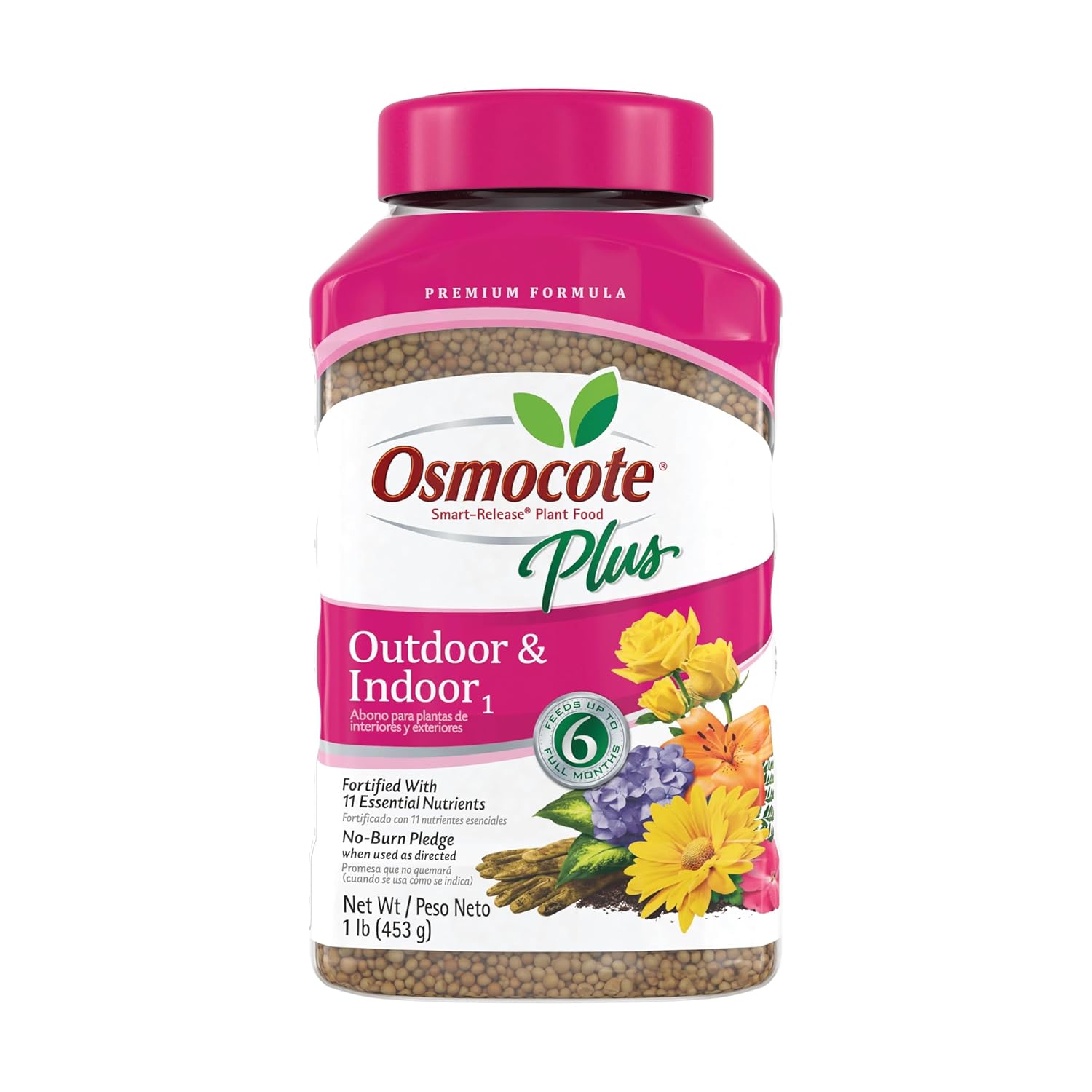
Osmocote Smart-Release Plant Food Plus Outdoor & Indoor, 1 lb
| Item Form | Granules |
|---|---|
| Specific Uses For Product | Plant Food |
| Application Method | sprinkle around the base and work into the soil |
| Unit Count | 16 Ounce |
Osmocote Smart-Release Plant Food Plus is a resin-coated granular fertilizer designed to deliver steady nutrition to a wide range of plants for up to six months from a single application. You apply it by sprinkling the recommended scoop into the top inch or so of potting mix for containers or around plants in garden beds, then watering to activate the coating. The product contains 11 essential nutrients and is formulated to release based on soil temperature, which helps reduce overfeeding and supports consistent bloom and foliage performance in hanging baskets. Its no-burn pledge makes it easy to use at the recommended rates for mixed annuals, trailing plants, and container veggies. Limitations are that coverage is modest from a 1 lb. container so frequent use on many large baskets will require buying more, and release timing still depends on temperature so plants in cool, shaded spots may receive nutrients more slowly than those in warm sun.
Best for: Gardeners who prioritize steady, low-maintenance feeding for hanging baskets and containers and want consistent bloom and foliage without frequent fertilizing.
Less Ideal for: Those who need immediate, short-term nutrient boosts or precise liquid feeding schedules for plants that demand fast correction.
- Resin-coated granules provide controlled release of nutrients for up to six months
- Formulated with 11 essential nutrients suitable for a wide variety of plants
- No-burn pledge when used as directed reduces risk of damaging roots in containers
- Simple sprinkle-and-water application works well for hanging baskets and pots
- 1 lb container covers a limited area so multiple baskets will need additional product
- Release rate depends on temperature so nutrient delivery can be slower in cool conditions
Verdict: An easy, low-maintenance slow-release fertilizer that keeps hanging baskets fed for months with minimal effort.
Miracle-Gro Indoor Plant Food for All Plants, Liquid, 8 fl. oz. (2-Pack)

| Item Form | Liquid |
|---|---|
| Application Method | Apply directly to soil or mix with water |
| Target Species | Houseplants |
| Liquid Volume | 8 fluid ounces |
| Mixing Ratio | 4 pumps per 1 quart of water |
Miracle-Gro Indoor Plant Food is a ready-to-use liquid fertilizer for indoor potted plants that you apply either directly to soil or diluted in water. It is typically used every two weeks by mixing the recommended number of pumps into a quart of water or by applying a few pumps for larger pots, making it easy to add to a regular watering routine. The product feeds quickly because nutrients are water-soluble and the pump dispenser gives repeatable doses without measuring spoons. Practical benefits include broad compatibility with most houseplants and a compact bottle size that is convenient for small indoor gardens. Limitations are that the label lists only N, P, K without a full nutrient breakdown, so growers wanting precise NPK ratios or micronutrient profiles may prefer a more detailed formula. Also the 8 fl. oz. bottles are best for hobbyists or small collections rather than large indoor plantings because frequent repurchasing will be necessary for heavy users.
Best for: Buyers who want a simple, low-effort fertilizer to add to a regular watering routine and who prioritize straightforward dosing and broad houseplant compatibility.
Less Ideal for: Specialist growers who need exact NPK ratios, detailed micronutrient information, or bulk quantities for many plants should consider a different product.
- Liquid formula feeds instantly when mixed with water or applied to soil
- Pump dispenser provides simple, repeatable dosing without measuring
- Designed for use with a wide range of indoor plants including herbs, flowers and vegetables
- Full NPK ratio and micronutrient details are not shown on the product summary
- Small 8 fl. oz. bottle size may require frequent replacement for larger collections
Verdict: A convenient, pump-dosed liquid fertilizer that makes fortnightly feeding simple for casual indoor plant owners.
TPS NUTRIENTS Indoor Plant Food Liquid Fertilizer, 8 fl oz

| Item Form | Liquid |
|---|---|
| Specific Uses For Product | Plant Food |
| Application Method | Watering can |
| Mixing Ratio | 2:1 (oz/gallon) or 1:64 (tbsp/gallon) |
TPS NUTRIENTS Indoor Plant Food is a concentrated liquid fertilizer made for regular use with houseplants. You mix the measured dose into water and apply it with your usual watering can; the label gives an easy mixing ratio for household use. Its kelp-enriched formula is pitched at improving leaf color, encouraging steady new growth, and supporting root health, so expect glossier foliage and more frequent leaf production when plants are fed consistently. The 8 fl oz bottle is portable and fits on a plant shelf or utility area, and the liquid form dissolves readily for even application. It is intended for medium coverage and labeled as gentle for weekly feeding, which simplifies care for busy owners. Important limitations are that this is a small bottle meant for regular top-up feedings rather than long-term bulk use, and it assumes you will follow dilution directions to avoid overfeeding. Keep it away from children and pets and avoid skin or eye contact when handling.
Best for: Plant owners who want a simple, low-effort weekly fertilizer to keep indoor foliage vibrant and encourage steady new leaf growth. Good for people who prefer an easy liquid mix applied during regular watering routines.
Less Ideal for: Gardeners needing a bulk or multi-season fertilizer for outdoor beds or large collections should consider larger-capacity or specialized products instead.
- Liquid concentrate mixes easily for even application with a watering can
- Kelp-enriched formula aimed at improving foliage color and encouraging new growth
- Gentle enough for weekly feedings according to product guidance
- Clear mixing instructions for home use
- Small 8 fl oz volume limits how many plants you can feed before repurchasing
- Not formulated or labeled for outdoor or large-scale garden use
Verdict: A convenient kelp-enriched liquid concentrate that makes weekly feeding easy for anyone who wants healthier, more vibrant indoor foliage.
Choosing the Right Croton Fertilizer: Key Factors to Consider
Nutrient Balance and NPK Ratio
Crotons need a nutrient mix that supports leafy growth and bright pigmentation rather than heavy flowering. A fertilizer with a moderate to high nitrogen component encourages leaf size and new growth, while phosphorus and potassium in balanced amounts support root health and overall vigor. Check the guaranteed analysis so you understand the relative amounts of N, P, and K and how they align with your growth goals.
Too much nitrogen alone can produce lush, green growth but may dull the variegation or color intensity. Conversely, inadequate nitrogen will slow growth and reduce leaf size. Aim for a balanced approach that supports both color and steady development.
Micronutrients and Trace Elements
Micronutrients like iron, magnesium, manganese, and boron influence leaf color, pattern sharpness, and chlorophyll production. Iron and magnesium are especially important when leaves look washed out or show interveinal chlorosis. A formula with chelated micronutrients can help prevent deficiencies in container-grown crotons where soil reserves are limited.
Since many crotons are kept in pots, micronutrient depletion happens faster than in-ground plants. Regular low-dose feeding with a product that lists trace elements reduces the chance of subtle nutrient disorders that compromise foliage show.
Application Method and Frequency
Fertilizers come as water-soluble concentrates, slow-release granules, spikes, or liquid ready-to-use sprays. Each method changes how often you need to feed and how nutrients move through potting mix. Water-soluble feeds let you correct deficiencies quickly but often require more frequent applications. Slow-release granules reduce maintenance but may deliver nutrients less evenly in small containers.
Think about how often you water, whether you repot frequently, and how precise you need dosing to be. For busy gardeners, a longer-release option reduces tasks. For active growers chasing peak color, more frequent, diluted liquid feeds allow finer control.
Salt Index and Root Safety
High-salt fertilizers can build up in potting mix and cause leaf-tip burn, poor water uptake, and root stress. This is especially true in containers with limited leaching. Look for products formulated for potted ornamentals or instructions that emphasize regular flushing and reduced concentration for container plants.
Managing salt buildup also involves monitoring EC or watching for stressed leaves. Choosing a fertilizer with a lower salt index or planning periodic flushing will help maintain healthy roots and prevent foliage damage.
Compatibility with Potting Mix and Water Quality
Crotons in store-bought potting mixes, peat-based blends, or recycled soils respond differently to the same fertilizer. Some mixes hold nutrients tightly while others allow quick leaching. Hard water can interact with nutrients and reduce availability, particularly for iron and manganese, so chelated forms or acidifying feeds may be preferable in alkaline water areas.
Consider your water chemistry and potting medium when selecting a fertilizer. If you use tap water with high pH, choose products or supplemental amendments that keep micronutrients available to the plant.
Plant Size and Container Scale
The size of the croton and its container determine nutrient demand and how quickly substrate nutrients are exhausted. Large specimen plants in big pots need more total nutrients but can tolerate slower-release formats. Small houseplant crotons in 4 to 6 inch pots require lighter doses and are more at risk of salt buildup.
Match dose size and release rate to container volume. Overfeeding small pots is a common cause of leaf burn, while underfeeding larger specimens produces dull color and weak new growth.
Feeding Schedules for Different Growing Situations
Adjust fertilizing frequency to your croton's environment. Active spring and summer growth often benefits from more frequent feeding, while reduced winter feeding helps avoid pushing tender growth when light levels are low. In bright indoor conditions or warm outdoor climates, a regular diluted liquid feed every two to four weeks is common.
For slow-release granules, plan a single application at potting or at the start of the season and monitor plant response. Always reduce concentration or frequency for younger plants and small pots.
- Active growth: diluted liquid feed every 2 to 4 weeks
- Winter: cut back feeding to once every 6 to 8 weeks or stop
- Large pots: consider slower-release options to reduce chores
Correcting Common Nutrient Problems
Yellowing between veins often indicates magnesium or iron deficiency. A fast-acting foliar feed or chelated micronutrient solution can correct symptoms more quickly than soil-only applications. For general thinning or pale leaves, a balanced nitrogen boost will restore vigor.
If leaves show brown edges or tip burn, check for salt buildup before increasing feed. Flush the potting mix with plain water, reduce fertilizer concentration, and consider switching to a lower-salt product.
- Interveinal yellowing: check iron and magnesium
- Tip burn: suspect salt buildup or overfertilization
- Slow growth: assess light first, then nutrient supply
Best Practices for Container Application
When feeding potted crotons, measure doses carefully and apply with consistent water volume to avoid concentration spikes. Apply fertilizer when the soil is evenly moist to reduce root shock. Avoid applying dry granular feeds directly against the stem or in a concentrated ring that can cause localized burn.
Periodically flush containers with extra water to leach accumulated salts, especially if you use a high-frequency liquid feed. Repot every 12 to 24 months into fresh mix if root crowding or nutrient depletion becomes evident.
- Measure and dilute concentrates to recommended strength or weaker for small pots
- Apply to evenly moist soil, not to dry roots
- Flush pots occasionally to prevent salt accumulation
When to Use Foliar Feeding
Foliar feeding delivers nutrients directly to leaves and can give a quick correction for micronutrient shortages. It works best for iron or magnesium issues and when root uptake is slowed by cold or compacted mix. Use fine sprays and avoid foliar application in intense sun to prevent leaf scorch.
Foliar feeds are a supplement, not a replacement for balanced soil fertility. Use them sparingly and follow label guidance on concentration to avoid leaf damage.
- Ideal for quick correction of micronutrient deficiencies
- Apply during cooler parts of the day to minimize scorch
- Do not rely on foliar feeding as the sole nutrient source
Adjusting Fertilizer Choice by Season
Increase feeding slightly in spring as growth resumes and decrease through fall as growth slows. In warmer climates where crotons grow year-round, maintain a lighter steady feed rather than large seasonal swings. Seasonal adjustment helps prevent soft, over-elongated growth during low-light months.
Consider switching to a lower nitrogen blend late in the season to encourage sturdier growth and reduce the risk of winter injury in temperate climates.
- Spring: gradually increase feed to support new growth
- Summer: maintain steady feeding for color and vigor
- Fall/winter: reduce or pause feeding depending on growth
How We Chose the Best Croton Fertilizer
We focused on practical, garden-ready criteria that matter for crotons. First, nutrient profile was essential: crotons respond well to an NPK balance that supports both foliage growth and pigmentation, so we prioritized products with clear guaranteed analysis and micronutrient content. Second, application method and ease of use were weighed, since many growers prefer a consistent routine that fits container watering or occasional soil drench. Third, nutrient release behavior was considered, including whether a formula feeds steadily or requires frequent reapplication. Fourth, salt management and suitability for frequent feeding were part of the filter to reduce the risk of leaf tip burn in containers. We also checked compatibility with common watering and potting mixes and whether a product provided helpful dosing guidance for indoor and outdoor crotons. Exclusions included fertilizers designed only for flowering bulbs, lawn feeds, or highly specialized laboratory formulations. Our goal was to surface well-documented, gardener-appropriate fertilizers that balance color enhancement, growth support, and practical application in real garden and container settings.
FAQ
How often should I fertilize indoor crotons?
It depends on the product and growing conditions. A common approach is a diluted liquid feed every two to four weeks during active growth and reduced feeding in winter. Slow-release formulas may require feeding only once per season.
Can I use a general houseplant fertilizer on crotons?
Often a general houseplant fertilizer is acceptable if it provides a balanced NPK and includes micronutrients. Watch for formulas with very high nitrogen that could mute leaf color and adjust concentration for small pots.
What signs show my croton is underfed?
Look for slow new growth, small or dull leaves, and faded or washed-out coloration. These signs often indicate inadequate nutrients, but also check light and watering before increasing fertilizer.
Will too much fertilizer affect leaf color?
Yes. Excessive feeding, especially high-salt or high-nitrogen products, can cause leaf-tip burn and overly lush green growth that reduces variegation or color intensity. If you see burn, flush the soil and reduce concentration.
Is foliar feeding safe for crotons?
Foliar feeding is a safe short-term method to correct micronutrient deficiencies when used at the correct dilution and applied during cooler light conditions. It should complement, not replace, soil-based feeding.
How do I avoid fertilizer salt buildup in pots?
Use lower-concentration feeds, flush pots periodically with extra water, and repot into fresh mix when salts accumulate. Choosing a fertilizer formulated for container plants also helps limit salt issues.
Final Verdict
Pick a fertilizer that matches your croton's container size, water chemistry, and how hands-on you want to be. Prioritize a nutrient balance and micronutrient package that supports vivid foliage, and choose an application method that fits your routine. Manage salt buildup with periodic flushing and dose conservatively in small pots. Ultimately, the right feeding approach balances steady nutrition with careful observation of leaf color and growth. Follow the criteria above to select a formula that keeps crotons healthy and colorful without adding unnecessary maintenance.
