

Note: This article contains affiliate links. If you click on these links and make a purchase, I may earn a small commission at no extra cost to you. This helps support my research and content. Read my full affiliate disclosure here.
Deer flies can make warm months miserable for people, pets, and livestock. The right deer fly trap reduces biting pressure across pastures, paddocks, and patios by intercepting or attracting flies before they reach animals or outdoor gatherings. This guide covers seven shortlisted top options chosen for real outdoor use, emphasizing how well they capture flies, how they hold up to weather, and how easy they are to deploy and maintain. Read on to understand the tradeoffs between coverage area, setup needs, and seasonal care so you can pick the trap that fits your property and routine.
Top Picks at a Glance
| Best Overall The best all-around choice for most situations | Bug Ball Deer Fly Ball Replacement Kit, Pack of 3 |  |
| Best Quality Built to a higher standard if you want something more solid | Bug Ball Deer Fly Ball Deluxe Complete Kit (3-pack) |  |
| Best Value The sweet spot between price and what you get | RESCUE! POP! Large Reusable Outdoor Fly Trap, 3-Pack |  |
| Best Budget The cheapest option that still gets the job done reliably | BugBane Reusable Outdoor Hanging Fly Trap with 2 Non-Toxic Bait Refills |  |
| Highest Rated A top-rated pick with lots of positive feedback | RESCUE! Outdoor Disposable Hanging Fly Trap (12 count) |  |
| Most Popular A crowd favorite that many people choose with confidence | RESCUE! Outdoor Disposable Hanging Fly Trap, 2 Pack |  |
| Best Seller A high-volume bestseller chosen again and again | TERRO Fly Magnet Outdoor Reusable Fly Trap with Bait |  |
Bug Ball Deer Fly Ball Replacement Kit, Pack of 3

| Unit Count | 3 |
|---|---|
| Target Species | Fly |
| Power Source | manual |
| Material Type | Polyvinyl Chloride (PVC) |
The Bug Ball Deer Fly Ball Replacement Kit supplies three inflatable PVC ball traps intended to reduce deer flies, horse flies, black flies and similar biting insects around yards, barns and patios. Each ball has a molded hanging loop and an inflation port so you inflate, brush or spray on a sticky coating and suspend the ball about 4 to 5 feet off the ground where it will attract and hold flies. The set is lightweight, weather resistant and simple to deploy in groups of two to three per acre for broader coverage. Its main advantage is low maintenance: no electricity or bait required, and the sticky coating is odorless and safe for use near people and animals when used as directed. Expect to reapply sticky coating every 2 to 3 weeks and replace heavily loaded or damaged balls seasonally. This kit does not include the sticky coating or a mounting pole, so budget for those extras if you need a ready-to-deploy system.
Best for: Buyers who want a straightforward, low-tech way to cut biting fly populations around a yard, barn, or outdoor living space and prefer a reusable, non-electric trap system.
Less Ideal for: People seeking an all-in-one plug-and-play solution or those who need immediate, pesticide-based knockdown should consider alternative control methods.
- Includes three inflatable PVC traps so you can cover multiple spots or an area up to about an acre with two to three balls
- Molded hanging loop and inflation port make setup quick using standard pump and rope
- Weather resistant PVC construction suitable for outdoor use
- Works without electricity or chemical pesticides when paired with the recommended sticky coating
- Sticky coating is not included, so an additional purchase is required for effective trapping
- Effectiveness depends on correct placement and periodic reapplication of adhesive
- Does not include mounting hardware such as shepherd hooks or poles
Verdict: A simple, reusable three-pack of hanging PVC ball traps that provides an effective low-tech way to reduce deer flies and other biting flies when used with a sticky coating.
Bug Ball Deer Fly Ball Deluxe Complete Kit (3-pack)

| Unit Count | 3 Count |
|---|---|
| Target Species | Fly |
| Power Source | manual |
| Material Type | Polyvinyl Chloride (PVC) |
The Bug Ball Deer Fly Ball Deluxe Complete Kit provides a simple, low-tech way to reduce deer flies, horse flies and other biting flies across yards, stalls and orchards. Each kit includes three heavy-duty PVC inflatable balls with molded hanging loops, rope kits for suspension and a bottle of Catch Em' spray-on sticky coating so the traps are ready to deploy. In practice you inflate a ball, brush or spray the sticky coating over its surface, and hang it about 4 to 5 feet off the ground in sunny spots near shade. The balls are weather resistant and meant to be used in multiples—the maker recommends two to three per acre for effective coverage. Benefits are straightforward: passive, pesticide-free control that works continuously without power, and easy repositioning as fly pressure changes. Limitations are that performance depends on correct placement and regular reapplication of the sticky coating every 2 to 3 weeks, and you will need several traps for larger properties. The kit is best when pest pressure is moderate to high and you want a durable, reusable trap rather than chemical sprays or electric devices.
Best for: Buyers who prioritize measurable fly reduction using a durable, low-maintenance trap system and who are prepared to deploy multiple units and maintain sticky coating on a schedule.
Less Ideal for: People seeking a one-time or instant knockdown solution, or those who prefer electronic or pesticide-based control methods.
- Complete kit with traps, rope kits, and included Catch Em' sticky coating for immediate use.
- Heavy-duty weather-resistant PVC construction suitable for outdoor hanging.
- Passive, pesticide-free operation that works continuously without electricity.
- Designed hanging loop and inflation port make setup and repositioning straightforward.
- Effectiveness depends on correct placement and periodic reapplication of sticky coating every 2 to 3 weeks.
- Needs multiple balls to cover larger areas, so a single kit may be insufficient for big properties.
Verdict: Choose this kit if you want a durable, ready-to-use, pesticide-free trapping system that reduces biting flies across outdoor spaces when deployed and maintained correctly.
RESCUE! POP! Large Reusable Outdoor Fly Trap, 3-Pack

| Unit Count | 3 Count |
|---|---|
| Target Species | Fly |
| Power Source | Manual |
| Material Type | Plastic |
The RESCUE! POP! Large Reusable Fly Trap is built for heavy-duty outdoor fly control and comes as a three-pack for coverage around patios, barns, or yards. Use is straightforward: add the included bait pouch and water to the fill line, hang the trap well away from living areas, and let the attractant lure flies into the reservoir where they drown. Its high stated capacity and reusable design mean fewer replacements over a season — simply empty, rinse, and refill with a new attractant packet. The trap is manual and plastic, so it needs no power and is lightweight to hang and reposition. Practical benefits include continuous, low-effort control for large infestations and reduced reliance on sprays. Important limitations are the strong odor once activated that confines use to outdoor, well-ventilated locations and the need to periodically empty and refill the trap. For people who want a robust, hands-off solution for big outdoor fly problems, this trap focuses on performance more than aesthetics.
Best for: Buyers needing a high-capacity, low-effort outdoor solution for persistent fly problems who prioritize continuous performance over appearance.
Less Ideal for: People who need indoor-safe, odor-free control or who do not want the periodic task of emptying and refilling traps.
- High capacity suitable for large outdoor infestations
- Reusable design lets you rinse and refill to cut waste and ongoing cost
- Simple manual operation with food-based attractant requires no power
- Comes as a three-pack to cover multiple hang points or larger areas
- Strong odor when active requires placement well away from living spaces
- Made of basic plastic that may show wear over repeated seasonal use
Verdict: Choose this trap if you want a high-capacity, reusable outdoor fly solution that delivers continuous, hands-off performance for large infestations.
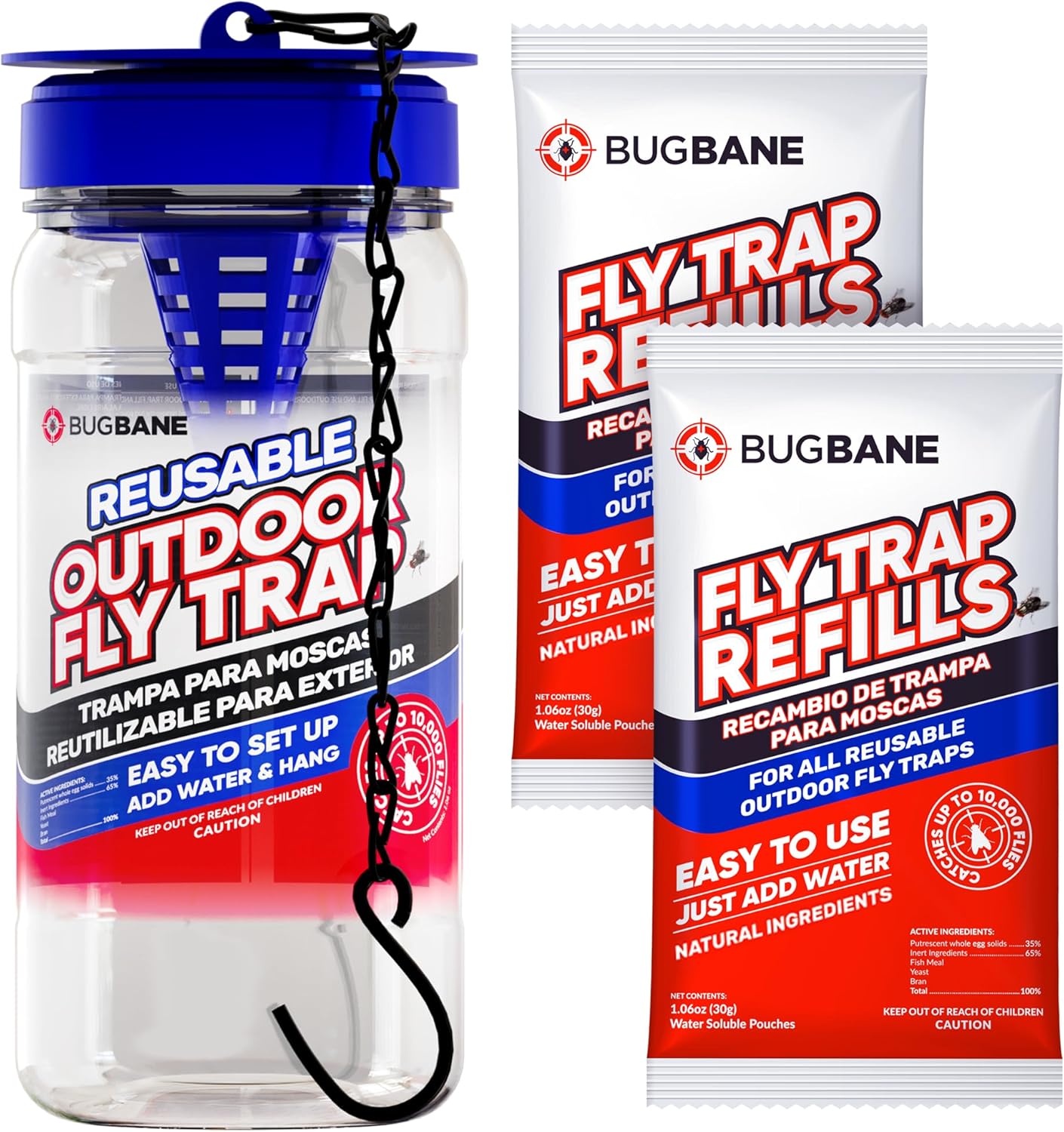
BugBane Reusable Outdoor Hanging Fly Trap with 2 Non-Toxic Bait Refills
| Brand Name | BugBane |
|---|---|
| Unit Count | 1 Count |
| Target Species | Fly |
| Power Source | manual |
| Material Type | Plastic, Stainless Steel |
This BugBane hanging fly trap is built for routine outdoor fly control around patios, barns, and ranch spaces. You add one of the included bait packets and water to activate a bait that attracts common filth flies from about 30 feet, then hang the durable plastic trap with the supplied chain. The unit combines a scent lure with a blue visual attractant, so it draws flies without relying on strong, persistent odors, and the bait is made from food-based ingredients that are safe if pets accidentally sample them. The trap is reusable: when full you empty and dispose of the contents, then refill with bait and water again. Practical touches include simple setup, guidance for placement (keep it about 20 feet from living areas and in low wind), and compact construction that is easy to move. Limitations are that you must empty and clean the trap when it fills and that effectiveness depends on placement and bait replacement every few months, so it requires periodic attention rather than being a set-and-forget device.
Best for: Gardeners and property owners who want an affordable, reusable solution to reduce outdoor flies and are willing to maintain the trap periodically for best results.
Less Ideal for: People seeking a maintenance-free or instant elimination method or those who need indoor fly control should consider other options tailored to those use cases.
- Reusable durable plastic body with included hanging chain for repeated outdoor use
- Non-toxic, food-based bait that is safe around children and pets
- Dual attractant: dissolvable scent bait plus a blue visual lure to increase catch range
- Simple setup and maintenance: add bait and water then hang about 20 feet from living areas
- Requires regular emptying, cleaning, and periodic bait replacement to remain effective
- Performance varies with placement and weather conditions such as wind and temperature
Verdict: A cost-conscious, reusable outdoor fly trap that uses non-toxic bait and a visual lure to reliably reduce common filth flies when sited and maintained properly.
RESCUE! Outdoor Disposable Hanging Fly Trap (12 count)

| Unit Count | 12 Count |
|---|---|
| Target Species | Fly |
| Power Source | manual |
| Material Type | Plastic |
The RESCUE! Outdoor Disposable Hanging Fly Trap is a straightforward, no-frills solution for reducing flies around patios, trash areas, barns, and other outdoor spots. Setup is quick: cut the top, add the included attractant and water to the fill line, insert the hanger and hang the trap away from living spaces. The bait produces a strong scent that draws common nuisance flies into the plastic bag where they cannot escape, and when the trap is full you wrap and discard it for a mess-free replacement. Because the traps are disposable and pre-baited, there is minimal maintenance and no need to handle sticky surfaces or refill liquids. The main compromises are the single-use design and the odor, which means you must place traps well away from seating areas and replace them periodically in heavy-fly seasons. For someone prioritizing reliable, low-effort fly control, these traps deliver predictable performance without complicated upkeep.
Best for: Buyers who want dependable, low-maintenance outdoor fly control and prefer simple, ready-to-hang solutions that require minimal upkeep.
Less Ideal for: People seeking a reusable or odorless solution or those who need fly control directly adjacent to patios and seating areas.
- Ready-to-use disposable design requires only water and hanging for quick setup
- Effective water-activated attractant formulated for common nuisance flies
- Mess-free disposal eliminates contact with trapped flies
- Made in the USA and EPA registered, indicating regulatory compliance and consistent manufacturing
- Single-use design creates recurring replacement needs
- Attractant has a strong odor and must be positioned away from living areas
Verdict: A dependable, no-touch disposable trap that delivers reliable outdoor fly reduction with minimal setup and maintenance.
RESCUE! Outdoor Disposable Hanging Fly Trap, 2 Pack

| Target Species | Fly |
|---|---|
| Number of Pieces | 2 |
| Material Type | Plastic |
| Recommended Uses For Product | Patios and Outdoor Gatherings,Backyards and Gardens |
The RESCUE! Outdoor Disposable Hanging Fly Trap is a ready-to-use disposable bait trap designed for patios, yards, and outdoor problem areas. Setup is straightforward: cut the top, add water to the fill line, attach the included hanger, and suspend the trap away from living areas. The internal attractant activates with water and emits a strong scent that draws common nuisance flies into the trap where they cannot escape, then the whole unit is thrown away when full. Practical benefits include very low maintenance, no need to handle bait or dead insects, and EPA registration plus U.S. manufacturing. It is most useful for concentrating flies away from patios, trash bins, barns, or kennels. Limitations are the single-use design which creates recurring replacement needs and the deliberately strong odor that requires placing traps well away from seating areas. The trap also targets typical fly species only, so it will not address other pests.
Best for: Buyers who want a low-effort, proven way to reduce flies around outdoor gatherings or work areas and prefer a product with a long track record and regulatory registration.
Less Ideal for: People seeking a reusable or scent-free solution or those who need a multi-pest control device should consider alternative traps or integrated pest approaches.
- Very easy setup: cut, add water, hang and forget until disposal
- Disposable design avoids handling dead insects or messy bait
- EPA registered and made in the USA
- Strong attractant effectively pulls flies away from targeted areas
- Single-use traps require repeated repurchasing and replacement
- Attractant has a strong odor that must be sited away from people
Verdict: Choose this if you want a no-fuss disposable trap that reliably pulls flies away from outdoor spaces with minimal upkeep.
TERRO Fly Magnet Outdoor Reusable Fly Trap with Bait

| Target Species | Fly |
|---|---|
| Included Components | Trap with bait |
| Material Type | Plastic |
| Power Source | power_source_type |
The TERRO Fly Magnet is a simple, reusable outdoor fly trap designed to reduce populations of house flies, barn flies, and bottle flies around patios, yards, and outbuildings. Use is straightforward: empty the included bait packet into the trap, add warm water to the fill line, swirl to mix, then hang or set the quart‑sized trap at ground level in a warm, bright, calm spot. The diamond‑pattern lid and bait are formulated to lure flies in and make escape unlikely. Because the bait contains no chemical insecticides the trap is suitable for use near outdoor living areas where people and pets gather. It can be emptied and re‑baited for ongoing control, so one unit provides season‑long service if maintained. Limitations are that bait can take a few hours to activate and placement matters for best results, and it captures flies rather than repelling them from a large radius, so expect localized control rather than elimination of flies across a whole property.
Best for: Buyers who want a low‑toxicity, easy‑to‑use way to reduce nuisance flies around outdoor living spaces and value products with a strong track record.
Less Ideal for: People who need instant wide‑area repellency or who prefer a deterrent that prevents flies from approaching rather than trapping them in one spot.
- Reusable design allows emptying and re‑baiting for ongoing seasonal use
- Included non‑poisonous bait formulated to attract multiple common fly species
- Easy setup and placement: fill with water, mix, then hang or set at ground level
- Works by trapping flies locally rather than repelling them from a wide area
Verdict: Choose this trap if you want a low‑chemical, reusable solution that reliably captures nuisance flies around patios and outdoor gathering areas.
Choosing the Right Deer Fly Trap: Key Factors to Consider
Attraction Method and Effectiveness
How a trap lures deer flies determines overall performance. Visual attractants mimic host cues or rely on contrast and motion, while baited or chemical lures use odor or CO2 analogs. Effectiveness varies with local fly species, population density, and ambient conditions. A trap that works well in one yard may be less effective in a pasture where flies use different host cues.
Consider whether the trap depends on periodic replacement lures or continuous power for fans and bait release. Low-maintenance visual traps often require less ongoing input but may be slower to reduce large populations, whereas actively baited systems can deliver faster reductions but need refill and monitoring.
Coverage Area and Placement Flexibility
The area a single trap can protect influences how many units you need and where to place them. Coverage depends on attraction radius, trap size, and how flies move across the landscape. A trap with a broad effective radius reduces the number of units required for open pastures; in contrast, high-activity hotspots near water, shade, or animal congregation points may need traps placed closer together.
Placement flexibility is important. Portable traps that hang from trees, stakes, or posts allow you to move them seasonally to match shifting fly pressure. Fixed or heavy units work well near long-term problem spots such as loafing areas or entryways.
Durability and Weather Resistance
Outdoor durability determines how long a trap remains effective and safe. UV-stabilized plastics, rust-resistant metals, and sealed electronics last longer when exposed to sun, rain, and temperature swings. Poorly protected components can fail mid-season or degrade attractants quickly, increasing maintenance needs.
Check how the trap handles storms and wind. Lightweight units may need additional anchoring, and containers that collect trapped insects should resist cracking and retain function after freezing or heavy rain. Weather-resistant designs reduce seasonal replacement and labor.
Ease of Setup and Ongoing Maintenance
Practical setup and maintenance determine whether a trap will be used correctly all season. Simple assembly and clear placement instructions help you position units where they intercept deer flies. Consider how often you must empty collection chambers, replace lures, or recharge batteries.
Traps that require tools or professional installation increase upfront effort. Those with easy-access collection trays, washable surfaces, and long-lived lures save time. Also evaluate whether maintenance can be done safely without exposing people or animals to attractants or trapped insects.
Safety and Non-target Effects
A good deer fly trap reduces target insects while minimizing harm to beneficial species and pets. Traps that use broad-spectrum attractants or open sticky surfaces may capture pollinators or small birds if placed in flowering areas or flight paths. Consider designs that selectively attract biting flies or incorporate guards to limit non-target access.
Safety also covers how attractants and disposed catches are handled. Avoid traps that require handling of toxic baits. Ensure placement keeps traps away from curious pets and children, and choose units with secure collection vessels to prevent spills or contact with trapped insects.
Seasonal Durability and Storage Needs
How a trap fares across seasons affects long-term cost and convenience. Some traps are intended for single-season use and must be replaced each year, while others are designed to be emptied, cleaned, and stored for repeated use. The materials and construction determine whether freezing, damp storage, or sun exposure will shorten the useful life.
Consider storage volume and whether parts disassemble for compact storage. Traps that clean easily and resist odor buildup make offseason storage simpler and reduce the risk of attracting pests year-round.
Where Deer Flies Are Most Active
Deer flies concentrate where hosts congregate and where females find water or shaded resting spots. Look for high-activity zones near livestock watering points, shady hedgerows, wetland edges, and driveways or walkways shaded by trees. Activity often peaks during warm, sunny periods when flies search for blood meals, and pressure can rise rapidly after heavy rain when breeding sites become abundant.
- Prioritize placement near animal loafing and watering areas.
- Avoid placing traps directly over flowering plants to reduce pollinator capture.
- Move traps seasonally as shade patterns and animal movement change.
Best Placement Strategies
Position traps at or slightly above the height of the target animal's midline for greatest interception. For people and pets, place traps near entry points to outdoor gathering areas but not adjacent to dining or play spaces. In pastures, space traps to cover known congregation points rather than evenly across the field. If using more than one trap, stagger them to create overlapping attraction zones without clustering all units in one spot.
- Hang traps from branches or posts for easier repositioning.
- Anchor lightweight units to prevent tipping in wind.
- Place traps downwind of activity when using odor-based lures.
Maintenance Tips to Keep Traps Working
Empty and clean collection chambers regularly to maintain attraction and prevent odor buildup that repels target flies. Rinse washable parts with water and mild detergent; avoid harsh solvents that degrade plastics. Replace disposable lures on the manufacturer-recommended interval or when capture rates drop noticeably. For battery- or solar-powered units, check power components before peak season and keep solar panels free of debris.
- Schedule a weekly visual check during peak activity.
- Wear gloves when emptying traps and dispose of contents away from animal areas.
- Store spare lures and replacement parts in a dry, cool spot.
Combining Traps with Habitat Management
Traps are most effective when paired with basic habitat management. Reducing localized breeding habitat such as small standing water pools, clogged gutters, or dense wet vegetation can lower fly emergence. Improving air movement in paddocks and around patios with pruning or strategic fencing can reduce landing frequency and make traps relatively more effective. Traps should be one element in an integrated approach focused on reducing host-attractant cues and limiting breeding sites, rather than a sole reliance for large-scale infestations.
- Address small water collection points near animal areas.
- Thin dense shade where practical to reduce fly resting sites.
- Use traps to protect high-value zones while implementing broader habitat fixes.
How We Chose the Best Deer Fly Trap
We selected the seven Deer Fly Traps using criteria that reflect real-world use around homes, farms, and recreation areas. Capture efficiency was a primary filter: we favored traps with proven attraction mechanisms and trap designs that reliably reduce fly numbers in field reports or user experience accounts. Coverage and placement flexibility were required; traps that protect larger areas or can be moved to target activity hotspots scored higher. Durability and weather resistance were essential, since traps left outdoors must withstand sun, rain, and wind without rapid degradation. Ease of setup and routine maintenance mattered because complicated assemblies or frequent servicing reduce real-world effectiveness. Safety and non-target impact were considered to avoid solutions that create hazards for pets, beneficial insects, or wildlife. Finally, we excluded devices that rely solely on chemical sprays or require restricted attractants, and we filtered out fragile or single-season designs. The resulting shortlist emphasizes traps that balance strong capture performance, robust construction, and low-friction upkeep for seasonal deer fly control.
FAQ
How many traps do I need for a pasture or yard?
It depends on the size of the area and fly pressure. A single trap can lower local activity at a loafing site or patio. Open pastures usually need multiple traps placed at key congregation points to achieve broader coverage. Start with traps at watering and resting areas and add units if activity remains high.
Will traps harm bees and other beneficial insects?
Some trap types can capture non-target insects, especially if placed near flowering plants. Use traps with selective visual cues or position units away from pollinator-rich areas to reduce bycatch. Regular monitoring and relocating traps if non-target capture occurs helps protect beneficials.
How often should I empty and service a deer fly trap?
During peak season, check traps at least weekly and empty collection chambers as needed. Some heavy-use sites may require more frequent cleaning. Replace disposable lures or refresh attractants according to the product schedule or when capture drops.
Can traps work without chemical baits?
Yes. Many traps use visual contrast, heat, or simple physical interception to catch deer flies and can be effective in reducing local populations. Baited systems may speed results but add maintenance and safety considerations.
Are traps safe to use around pets and livestock?
Most traps are safe when placed out of the animals' immediate reach and secured against tipping. Avoid traps with open sticky surfaces near animal feeding or bedding areas, and keep attractants and collection containers inaccessible to curious animals.
Final Verdict
Choose a Deer Fly Trap based on where you need protection, how much maintenance you want, and whether you must limit non-target capture. Prioritize a trap with proven capture efficiency for your setting, durable construction for outdoor seasons, and straightforward servicing so you will maintain it during peak months. Combine traps with habitat fixes and strategic placement to reduce overall fly pressure and get the best seasonal protection for animals and outdoor living spaces.
