

Note: This article contains affiliate links. If you click on these links and make a purchase, I may earn a small commission at no extra cost to you. This helps support my research and content. Read my full affiliate disclosure here.
A properly chosen double bit felling axe makes big work in the woods safer and faster. Whether you are clearing land, cutting firewood, or felling standing timber, the right axe affects how clean each cut goes, how long the edge holds up, and how comfortably you can work through a long shift. This guide covers the top shortlisted Double Bit Felling Axes suited to heavy felling tasks and evaluates them on the real-world traits that matter to woodcutters and land stewards. We focus on cutting geometry, balance and handling, durability, and ease of maintenance to help you pick the best option for repeated felling work. Read on to compare the key tradeoffs and pick the tool that matches your workload and skill level.
Top Picks at a Glance
| Best Overall The best all-around choice for most situations | 1844 Helko Werk Odyssey Double Bit Felling Axe |  |
| Best Quality Built to a higher standard if you want something more solid | Hults Bruk Double Bit Axe — 3.75 lb Head, 30" Hickory Handle |  |
| Best Value The sweet spot between price and what you get | ESTWING Double Bit Axe, 38 oz Splitting Axe |  |
| Best Budget The cheapest option that still gets the job done reliably | Truper 3.5 lb Double Bit Michigan Axe with Hickory Handle, 35-Inch |  |
| Highest Rated A top-rated pick with lots of positive feedback | Truper 3.5 lb Double-Bit Michigan Axe with 34 in. Fiberglass Handle |  |
| Most Popular A crowd favorite that many people choose with confidence | Estwing 38 oz Double Bit Axe (Forged Steel, Shock Reduction Grip) |  |
1844 Helko Werk Odyssey Double Bit Felling Axe

| Head Type | Felling |
|---|---|
| Blade Edge | double |
| Handle Material | Hickory Wood |
| Blade Material | Carbon Steel, Steel |
The Helko Werk Odyssey is a classic double-bit felling axe designed for cutting large timber and heavy-duty forestry work. Its hand-forged C50 high carbon steel head is drop-forged and polished to reduce friction and resist rust, while the double-bit layout lets you set up one edge for aggressive chopping and the other for a finer, honed profile. The sustainably sourced Grade A American hickory handle is finished with boiled linseed oil and sanded smooth for a secure, comfortable grip during extended use. Practical extras include two full-grain leather sheaths and a small bottle of Axe Guard oil for head maintenance. The head weight and 30-inch handle provide leverage and power for felling, but the tool is physically heavy and best handled by someone comfortable with larger axes. Maintenance requires regular sharpening and care to protect the finished head and wooden handle. For buyers who want a durable, traditional felling axe with the versatility of two differently profiled edges, this model delivers professional-level performance; casual users may find its size and weight more than they need.
Best for: Buyers looking for a robust, traditional felling axe for serious timber work who value versatility between a rough and a fine edge and prefer a hand-forged tool built to professional standards.
Less Ideal for: Casual gardeners, campers, or users wanting a lightweight, easy-to-carry hatchet for small jobs should consider smaller single-bit axes or hatchets instead.
- Hand-forged C50 high carbon steel head offers strong edge holding and durability
- Double-bit design lets you set one edge for heavy work and the other for a fine edge
- Grade A American hickory handle finished with boiled linseed oil for a comfortable grip
- Includes leather sheaths and Axe Guard oil to protect the blade and assist maintenance
- Heavier and larger than single-bit axes, making it less suitable for light or precision tasks
- Requires routine sharpening and oiling to maintain the polished finish and edge
Verdict: A premium, hand-forged double-bit felling axe that gives professional-level cutting power and the flexibility to keep one blade for heavy work and the other finely honed.
Hults Bruk Double Bit Axe — 3.75 lb Head, 30" Hickory Handle

| Head Weight | 3.8 pounds |
|---|---|
| Handle Material | Hickory Wood |
| Blade Material | Forged Steel |
| Head Type | Double Bit |
The Hults Bruk double bit axe is a performance-focused felling tool that pairs a 3.75 lb hand-forged Swedish steel head with a straight American hickory handle. It is typically used for cutting and felling medium to large trees and is also popular among competitive throwers. The head is forged and tempered to hold a keen edge and the convex blade geometry gives clean, controlled cuts through grain. The sanded, linseed-oiled hickory handle offers a solid, traditional grip and transfers power efficiently to the head. A premium leather sheath is included for safe transport and storage. Notable benefits are the high-quality steel and craftsmanship that support repeatable, precise chopping and long-term edge retention. Important limitations are the weight and length, which make it less maneuverable in tight spaces and heavier to swing over long sessions, and the double-bit design requires care to keep both faces maintained and sharp. This axe is built for users who prioritize cutting performance and traditional construction over ultralight convenience.
Best for: Experienced woodcutters and performance-focused users who want a traditional, high-quality felling axe for efficient, precise chopping and long edge life.
Less Ideal for: Casual gardeners, light-duty users, or anyone who needs a lightweight, highly maneuverable axe for quick tasks or tight spaces.
- Hand-forged Swedish steel head engineered for edge retention and durability
- Convex blade edge designed for clean, controlled cuts through timber
- Straight American hickory handle finished with linseed oil for reliable grip and shock absorption
- Includes premium leather sheath for safe transport and storage
- Heavier 3.75 lb head and 30" handle reduce maneuverability in tight or prolonged work
- Double-bit configuration requires maintaining two cutting faces rather than one
Verdict: Choose this axe if you want a traditional, hand-forged double-bit felling axe built for cutting performance and long-lasting edge retention.
ESTWING Double Bit Axe, 38 oz Splitting Axe

| Weight | 38 oz |
|---|---|
| Head type | Double bit |
| Grip | Patented shock reduction molded grip |
| Sheath | Ballistic nylon |
| Made in | USA |
The Estwing 38 oz double bit axe is a traditional, heavy-duty tool built for chopping logs, taking down small trees, and splitting firewood. Its forged steel head provides strength and edge retention across both bits so you can set up one face for cutting and the other for splitting or reserve a second edge as a backup. The molded shock-reduction grip reduces impact vibration and improves hold during prolonged use, which makes repeated swings easier on the hands. It arrives with a ballistic nylon sheath to protect the edges in storage and transport. Because the head is forged as a single piece, durability is excellent and the tool feels balanced for controlled felling and splitting tasks. The main limitations are that a double-bit head requires upkeep on both edges and the weight and design are optimized for two-handed outdoor use rather than precision or light garden work. For users who need a dependable, long-lasting axe for regular firewood processing and timber work, this is a practical choice.
Best for: Buyers who need a reliable, long-lasting axe for regular felling and firewood processing and who prioritize durability and comfortable repetitive use.
Less Ideal for: Casual gardeners or anyone seeking a lightweight one-handed tool for pruning or delicate yard tasks should look elsewhere.
- Forged steel one-piece head for high durability and strength
- Double-bit design lets you keep one edge sharp for cutting and the other for splitting or backup
- Molded shock-reduction grip cuts impact vibration for more comfortable extended use
- Comes with a ballistic nylon sheath to protect the edges during storage and transport
- Requires maintenance on two cutting edges which doubles sharpening time
- Heavier, two-handed design is not suited for light garden trimming or precision jobs
Verdict: A durable, well-balanced double-bit axe built for regular felling and firewood work with a comfort-focused grip.
Truper 3.5 lb Double Bit Michigan Axe with Hickory Handle, 35-Inch
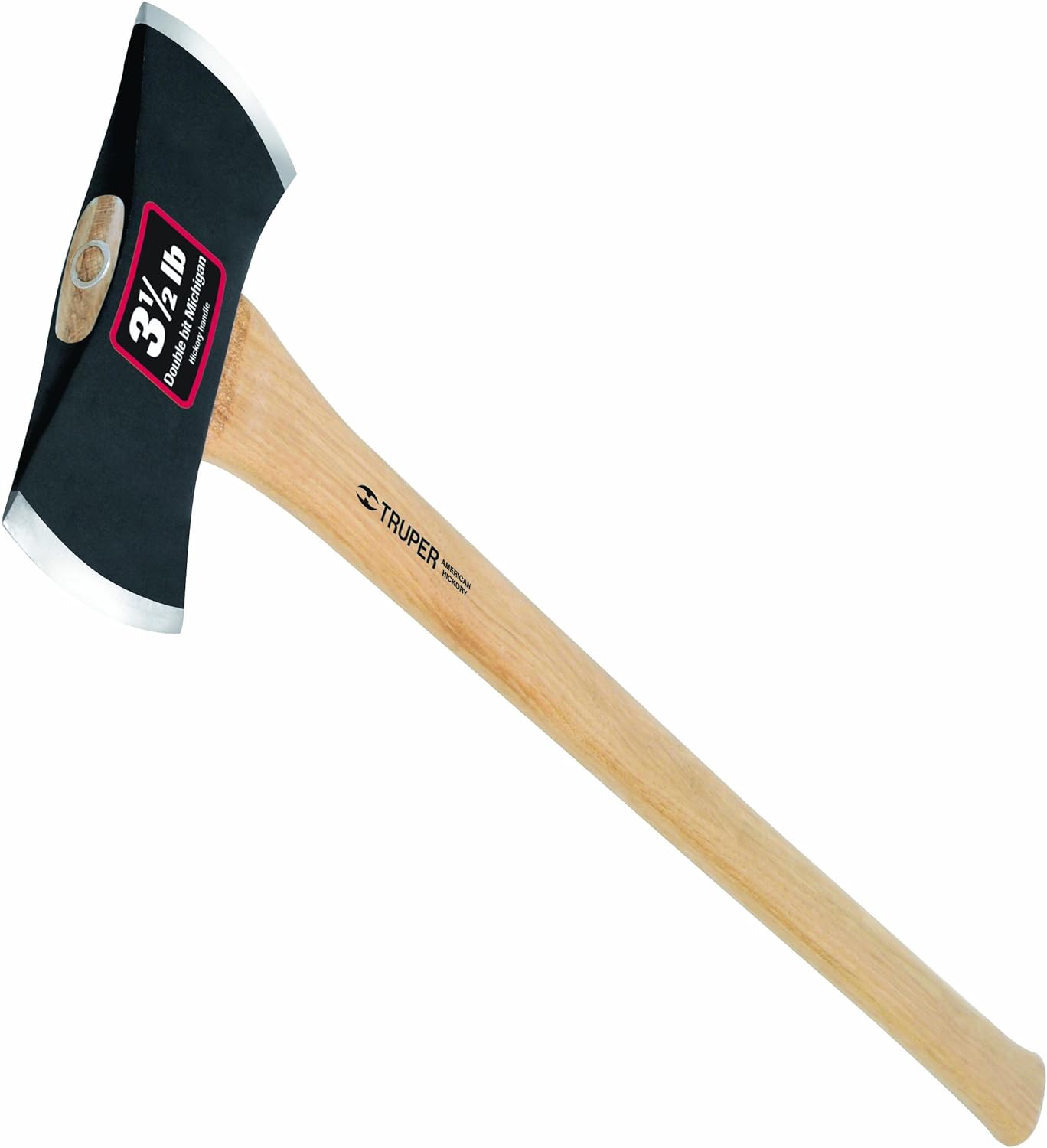
| Head Weight | 2.2 pounds |
|---|---|
| Blade Material | Alloy Steel |
| Handle Material | Hickory, Steel, Wood |
| Unit Count | 1 count |
This Truper double-bit Michigan axe is built for felling and heavy-duty yard work. The dual cutting edges let you keep one blade sharp for chopping and use the other for splitting or rougher tasks, extending time between sharpenings. The heat-treated alloy-steel head and steel wedge assembly provide solid impact performance while the 35-inch hickory handle gives reach and good leverage for driving cuts on medium to large trees. Typical use is directional felling, limbing, and splitting small rounds on a property or homestead. Practical benefits include a traditional balance favored for controlled swings and a replaceable hickory handle that absorbs shock better than metal shafts. Limitations are the tool's weight and length, which make it less suited to tight urban lots or prolonged overhead work, and the need for routine maintenance such as blade lubrication and sharpening to prevent rust and maintain cutting performance.
Best for: Buyers who need a no-frills felling axe for property-scale tree work and prefer a traditional, serviceable tool they can maintain themselves.
Less Ideal for: Urban gardeners with limited space, frequent overhead pruning needs, or those who prefer very lightweight or multi-tool solutions.
- Double-bit head provides two working edges for chopping and splitting without switching tools
- Heat-treated alloy-steel head for durable cutting performance
- Long hickory handle offers good leverage and shock absorption
- Traditional construction that is easy to maintain and repair
- Long 35-inch handle and overall weight reduce maneuverability in tight spaces
Verdict: A rugged, traditional double-bit felling axe that delivers reliable chopping power and easy maintenance for property-scale tree work.
Truper 3.5 lb Double-Bit Michigan Axe with 34 in. Fiberglass Handle
| Head Weight | 3.5 pounds |
|---|---|
| Handle Material | Fiberglass |
| Blade Material | High Carbon Steel |
| Head Type | Double Bit |
This Truper double-bit Michigan axe pairs a 3.5 lb high carbon steel head with a 34 inch fiberglass handle to deliver a reliable chopping tool for felling and general heavy-duty work. The double-bit head gives two usable cutting edges so you can dedicate one face to felling and keep the other sharp for finishing or limbing. The high carbon steel blades hold an edge well and can be resharpened, while the fiberglass handle reduces vibration and is less prone to cracking than wood. In practice this axe performs best with full swings for cutting into trunks and for splitting medium sections where control and durability matter. Important limitations are the fixed head weight and handle length, which cannot be customized, and the axe is heavier and less maneuverable than a small hatchet for close work. You should also plan to maintain the steel regularly to prevent rust and preserve edge geometry.
Best for: Buyers who prioritize a dependable, long-lasting felling tool for regular chopping and limbing will appreciate this axe’s durable materials and two-edge design.
Less Ideal for: Not a good fit for gardeners or homeowners needing a lightweight hatchet for small, precise tasks or for users who prefer replaceable handle options.
- Double-bit head provides two cutting edges for dedicated tasks and longer service between resharpening
- High carbon steel head holds edge and can be resharpened for long-term use
- Fiberglass handle resists cracking and reduces vibration compared with traditional wood handles
- Fixed 34 inch length and 3.5 lb head limit maneuverability for tight work and cannot be adjusted
- Requires routine blade maintenance to prevent rust and maintain cutting performance
Verdict: Choose this axe if you want a sturdy, maintenance-friendly double-bit felling tool built for dependable, repeated use.
Estwing 38 oz Double Bit Axe (Forged Steel, Shock Reduction Grip)

| Head Type | Double Bit |
|---|---|
| Handle Material | Metal |
| Blade Material | Alloy Steel |
| Included Components | Double Bit Axe |
This Estwing 38 oz double-bit axe is a straightforward, heavy-duty tool for cutting, felling small trees, and splitting firewood. The one-piece forged steel construction means the head and handle are a single solid unit, which increases durability and reduces failure points compared with taped or glued handles. It has two cutting edges so you can keep one sharp for chopping and the other for rougher work, and the included ballistic nylon sheath protects the blades in transport. Estwing’s molded Shock Reduction Grip noticeably reduces vibration and gives a non-slip hold during repeated swings, making longer sessions less fatiguing. Because the handle is metal, it sacrifices the shock-absorbing flex of a wooden haft but gains impact resistance and longevity. This axe is compact enough to carry for outdoor work yet heavy enough for effective chopping; the trade-off is that its metal handle transfers more force to the forearms than some wooden-handled alternatives. For buyers who value a durable, low-maintenance, American-made tool that will withstand frequent use, this is a reliable double-bit option.
Best for: A practical buyer who prioritizes proven durability and low maintenance for regular chopping or felling tasks and wants a tool that holds up to heavy outdoor use with minimal fuss.
Less Ideal for: Those seeking the lightest possible carry weight or a traditional wooden-handle feel should consider wooden-shaft axes or lighter backpacking tools instead.
- One-piece forged steel construction for high durability and reduced failure risk
- Double-bit head lets you reserve one edge for fine work and use the other for heavy-duty chopping
- Molded Shock Reduction Grip reduces vibration and improves handling during extended use
- Includes heavy-duty ballistic nylon sheath for safe transport and blade protection
- Metal handle lacks the natural flex and cushioning of a wooden haft, which can increase felt shock to the arms
Verdict: Buy this if you want a rugged, American-made double-bit axe that delivers long-term durability and a comfortable shock-reducing grip.
Choosing the Right Double Bit Felling Axe: Key Factors to Consider
Cutting Geometry and Bevel Angle
Bevel angle and bit profile dictate how an axe slices into timber. A more acute bevel gives faster, cleaner cuts in sound wood but can dull or chip faster when it strikes knots or dirt. A slightly more obtuse bevel sacrifices some cutting speed for longer edge life and better resistance to impact damage. For double-bit felling axes, many users prefer a mirrored pair of mid-range bevels so both edges are useful in the field. One edge is often kept slightly finer for clean cuts while the other is left steeper for rough work and striking through tougher grain.
Understanding the steel hardness and how it pairs with the bevel angle helps predict maintenance intervals. If you expect to encounter a lot of gritty or knotty wood, prioritize a tougher edge geometry even if it costs some initial bite.
Overall Balance and Swing Dynamics
Balance affects how accurately the head travels through the arc and how much control you retain over repeated swings. A properly balanced double-bit axe will feel centered in the swing, letting momentum do work without forcing the wrist or shoulder to overcompensate. Handle length, head mass, and the distance between the eye and poll all influence swing dynamics.
For felling, a slightly heavier head paired with a comfortable handle length helps deliver penetrating strikes with fewer swings. However, too much weight increases fatigue and risk of mis-hits. Consider who will use the axe most often and how long typical work sessions last when judging balance.
Head Material and Heat Treatment
The composition of the axe head and how it is heat-treated determine toughness, brittleness, and how well the edge holds. Higher carbon steels that are properly quenched and tempered provide good edge retention but can be more brittle if over-hardened. Forged heads with visible grain structure and consistent tempering tend to perform predictably under impact.
For field use in felling, prioritize heads designed with impact toughness in mind so the bit resists chipping when encountering knots. Also look for clear information about recommended sharpening angles and any manufacturer guidance on re-tempering after heavy reprofiling.
Handle Material and Attachment Method
Handles transmit the shock of each strike to the user and must be robust enough to survive heavy felling work. Traditional hickory handles absorb vibration well and are easy to replace, while modern composite or fiberglass handles can increase durability and resist moisture but may transmit more shock. The method the head is attached to the handle matters too. A well-set eye with a secure wedge or modern mechanical retention reduces the chance of the head loosening under repeated strikes.
Consider whether you want a handle material you can field-replace or a low-maintenance composite. Also check how the head is mounted and whether the design allows simple, safe replacement if the handle fails.
Ease of Sharpening and Field Maintenance
Fellers often need to touch up an edge away from a workshop. An axe whose bevels accept common files and stones will be easier to maintain on the trail. Bit profile should allow a straightforward sharpening angle without complex jigging. Some double-bit users deliberately keep asymmetrical edges so one can be used for heavy work and the other for finishing; that strategy depends on being able to resharpen each side reliably.
Also consider whether the head design permits easy removal from the handle for thorough maintenance or re-profiling, and whether spare parts like wedges or replacement handles are generally available.
Safety, Poll Design, and Edge Protection
Safety features for felling axes include poll shape and how the poll is finished, the presence of bit guards for transport, and whether the head geometry reduces the likelihood of the axe bouncing or glancing off the cut. A smooth poll aids controlled strikes and can be used for sliding strikes or light hammering, but a blunt poll should not create unpredictable rebound.
Consider how you will transport and store the axe. Bit covers or sheaths prevent accidental cuts and protect the edge. Also think about how the double bits are profiled relative to each other so that one edge does not unintentionally contact the user during handling.
How Double Bit Felling Axes Are Used in the Field
Double bit felling axes are purpose-built for cutting across the grain of standing timber. With two cutting edges, many users adopt a workflow where one edge handles the clean cuts and the other edge takes rougher impact or knotty sections. This keeps a sharp edge available longer during extended work sessions.
In practice, these axes are favored for tasks that require repeated, high-energy strikes like felling medium to large trees and removing large limbs. They are less suitable for fine shaping or splitting where single-bit designs or specialized tools perform better.
- Two edges allow alternating use to extend time between sharpening
- Heavier head mass improves penetration on felling strokes
- Best used with clear swing space and proper felling techniques
Protecting the Edge and Transporting an Axe
A good edge cover is essential when carrying a double bit felling axe to prevent both accidental injury and unnecessary dulling. Leather or heavy-duty polymer sheaths that fully enclose each bit work well. When loading the axe into a vehicle or onto a pack, separate the head from other tools and secure the handle to prevent movement.
During transport, avoid banging the bits against metal or stone surfaces. If you must stash the axe for longer-term storage, lightly oil the head to inhibit rust and store it dry and off the ground to preserve the handle.
- Use a dual-bit sheath covering both edges
- Carry with the poll pointing away from the body
- Store in a dry place and oil the head for longer storage
Sharpening Techniques for Double Bits
Maintaining two usable edges requires a practical sharpening routine. Start by filing both edges to the intended bevel to remove nicks and restore a consistent profile. Use a round or half-round file to follow the curve of the bit and finish with stones to refine the burr. Keep one edge slightly sharper for finishing cuts and the other slightly steeper for rough work if you plan to alternate them.
When reprofiling, do so in a controlled area and check the balance after heavy material removal. Restoring a lot of steel to one side can affect swing feel, so try to remove similar amounts from both bits when possible.
- File nicks away before honing with stones
- Consider alternating edges so one remains serviceable
- Check balance after major reprofiling
Safety Practices During Felling
Felling requires clear planning: examine tree lean, escape routes, and surroundings before swinging. Keep bystanders well away and never cut above shoulder height. Use controlled, full-body swings that engage legs and hips rather than relying solely on arm strength to reduce the risk of loss of control.
Wear appropriate personal protective equipment such as eye protection, heavy gloves, and work boots. Regularly inspect the axe for a secure head fit and sharp, consistent edges; a loose head or a severely nicked bit increases the chance of dangerous mishits.
- Plan escape routes and clear the work area
- Use full-body mechanics for safer, repeatable swings
- Inspect head fit and edge condition before each session
When to Choose a Double Bit Over Other Felling Tools
Choose a double bit felling axe if you need two ready edges for extended cutting sessions and prefer the rhythmic efficiency of traditional swinging techniques. They are a good middle ground between single-bit felling axes and larger saws for moderate-to-large trees when mobility and tool simplicity matter.
If your work frequently involves splitting, fine shaping, or heavy limbing close to the ground, you might prefer specialized tools. Double-bit axes shine when you need a durable, dual-edged cutter that can be alternated to stretch maintenance intervals.
- Prefer double bits for extended felling tasks
- Single-bit axes or saws may outperform in niche tasks
- Consider portability and the expected tree sizes
How We Chose the Best Double Bit Felling Axe
We shortlisted Double Bit Felling Axes that are built for repeat felling, then filtered options using concrete, field-oriented criteria. Primary evaluation centers on cutting geometry and edge retention because those determine how cleanly an axe severs wood and how often it needs resharpening. Balance and swing feel were tested conceptually by assessing head-to-handle proportions and listed weight distribution to predict user fatigue during prolonged use. Durability criteria covered head steel and heat treatment characteristics plus handle material and attachment method to forecast service life under heavy use. Maintenance and serviceability looked at how easy it is to resharpen the bevels in the field and how readily handles can be replaced if damaged. Safety and user control assessed poll design, bit protection options, and deceleration characteristics in chopping scenarios. We excluded lightweight hatchets, single-bit felling axes intended for limbing, and tools primarily marketed for splitting to keep the list focused on true double-bit felling geometry and heavy cutting performance.
FAQ
How often do I need to sharpen a double bit felling axe?
Sharpening frequency depends on wood species and how often you strike knots or dirt. For regular felling work expect light touch-ups daily or every few hours, with more thorough filing after several days of heavy use.
Can I replace the handle myself if it breaks?
Often yes. Traditional wooden handles can be replaced in the field or workshop with basic tools and a replacement handle sized to the eye. Composite handles are usually more difficult to replace and may require specific parts or professional service.
Should I keep both edges the same sharpness?
Many fellers intentionally keep one edge sharper for finishing cuts and the other steeper for rough work. That strategy preserves a serviceable edge longer and reduces the need for constant re-sharpening during a job.
Is a heavier head always better for felling?
Not necessarily. Heavier heads deliver more momentum and can reduce the number of strikes, but they also increase fatigue and require better technique. Match head weight to your strength and the typical job length.
How should I store a double bit axe to prevent rust and damage?
Store the axe in a dry place away from ground moisture. Lightly oil the head to slow rust, cover the bits with a sheath, and hang or rest the handle to avoid warping. Regular inspections catch issues early.
Final Verdict
For felling work, prioritize cutting geometry, edge retention, and balance when choosing a double bit felling axe. Decide whether you value slightly faster cutting or greater impact resistance and pick a head and bevel scheme that matches the wood you commonly encounter. Also weigh handle material and ease of maintenance because those determine how long the tool remains serviceable in the field. With those tradeoffs in mind, choose an axe that fits your swing, allows predictable strikes, and offers straightforward upkeep so you can fell trees efficiently and safely.
