

Note: This article contains affiliate links. If you click on these links and make a purchase, I may earn a small commission at no extra cost to you. This helps support my research and content. Read my full affiliate disclosure here.
Choosing the right eco friendly lawn fertilizer matters because it affects turf health, soil biology, water quality, and nearby wildlife. The wrong product can burn grass, overload soils with salts, or wash into storm drains. The right product supports steady growth, improves soil structure, and reduces risk to kids, pets, and pollinators. This guide covers the top shortlisted eco friendly lawn fertilizers suited to common yard sizes and maintenance goals. We evaluated options across practical garden criteria so you can pick a formulation that fits your lawn care rhythm and environmental priorities. Read on for the factors we weighed and what to expect from each type.
Top Picks at a Glance
| Best Overall The best all-around choice for most situations | Espoma Turf-Tone All Season Organic Lawn Food with Bio-Tone, 28 lb |  |
| Best Quality Built to a higher standard if you want something more solid | Scotts Natural Lawn Food, 29.1 lb (covers 4,000 sq. ft.) |  |
| Best Budget The cheapest option that still gets the job done reliably | Milorganite Slow-Release Organic Fertilizer, 5 lb |  |
| Highest Rated A top-rated pick with lots of positive feedback | Espoma Turf-Tone Lawn Starter Organic 4-6-3 Fertilizer, 30 lb |  |
| Most Popular A crowd favorite that many people choose with confidence | Milorganite 6-4-0 Slow-Release Fertilizer, 32 lb (with Feeding Tips Brochure) |  |
Espoma Turf-Tone All Season Organic Lawn Food with Bio-Tone, 28 lb

| Item Form | Granules |
|---|---|
| Application Method | Spread evenly on a dry, mowed lawn |
| Target Species | Lawn Grass |
| Unit Count | 448 Ounce |
Espoma Turf-Tone is a 28 lb granular, slow-release lawn fertilizer designed for routine feeding of lawns including Kentucky bluegrass. It supplies a low-rate nitrogen formula that releases slowly to encourage steady greening and reduced frequency of applications. The product is intended to be applied with a drop or broadcast spreader to a dry, mowed lawn and claims coverage up to about 5,000 sq ft. Notable features are its organic ingredients and Bio-Tone microbial formula, which aim to support soil biology while minimizing risk of burn or leaching compared with high-salt synthetic feeds. Practical benefits for bluegrass include gentler, longer-lasting color improvement and less chance of creating quick flushes of top growth that demand more mowing. Important limitations are that its nutrient numbers are modest (9-0-1) so it is not a quick corrective for severe nitrogen deficiency and may require multiple seasonal applications to build vigor; large or very depleted lawns may need supplemental treatments or higher-analysis products for rapid recovery.
Best for: Homeowners who prioritize reliable, low-risk feeding and steady seasonal improvement for cool-season lawns like Kentucky bluegrass and who prefer organic products over synthetic quick fixes.
Less Ideal for: Gardeners needing a fast green-up or immediate corrective treatment for very nutrient-deficient or large commercial lawns should consider higher-analysis or targeted products instead.
- Slow-release nitrogen that promotes steady greening without rapid top growth
- Organic and natural ingredient base that reduces burn risk and supports soil health
- Formulated with Bio-Tone microbes to help root and soil biology
- Easy to apply with a broadcast or drop spreader and suitable for all-season use
- Lower analysis (9-0-1) so it is not ideal for rapid correction of severe nutrient deficiencies
- Coverage claim depends on even spread; may require multiple bags for large or thin lawns
Verdict: Choose this organic, slow-release Turf-Tone when you want dependable, low-risk seasonal feeding that supports Kentucky bluegrass and soil biology.
Scotts Natural Lawn Food, 29.1 lb (covers 4,000 sq. ft.)

| Item Form | Powder |
|---|---|
| Application Method | spreader |
| Coverage | 4,000 square feet |
| Specific Uses For Product | Lawn |
| Target Species | grass |
Scotts Natural Lawn Food is a granular lawn fertilizer designed to thicken and green turf with a mostly natural formulation and OMRI listing. It is applied with a spreader and is intended for use any season on any grass type; Scotts recommends up to four applications per year and feeding every 6 to 8 weeks during the growing season. In real-world use it delivers noticeable greening within one to three weeks and is safe to walk on immediately after application, which makes it convenient for yards with kids and pets. The bag covers 4,000 square feet and has no strong odor, so application is straightforward and unobtrusive. Limitations to consider are that it is intended as lawn food rather than a weed or pest solution and you should avoid applying before heavy rain and sweep product off hard surfaces to prevent runoff. For best distribution use a compatible Scotts drop or rotary spreader to get even coverage across the lawn.
Best for: Homeowners who prioritize pet and child safety and want a straightforward, season-round lawn food that promotes greener, thicker grass with minimal fuss.
Less Ideal for: People needing an all-in-one weed or insect control product or those with very large lawns who want less frequent, higher-coverage bags.
- OMRI listed formulation suitable for natural lawn care practices
- Safe to walk on immediately after application and labeled for use around kids and pets when used as directed
- Covers up to 4,000 sq. ft. from a single 29.1 lb bag
- No strong odor and easy to apply with standard spreaders
- Not formulated to control weeds or pests so additional products may be required
- Requires proper spreader use and care to avoid uneven application or runoff
Verdict: Choose this if you want a pet-friendly, OMRI-listed lawn food that reliably greens and thickens turf with simple spreader application.
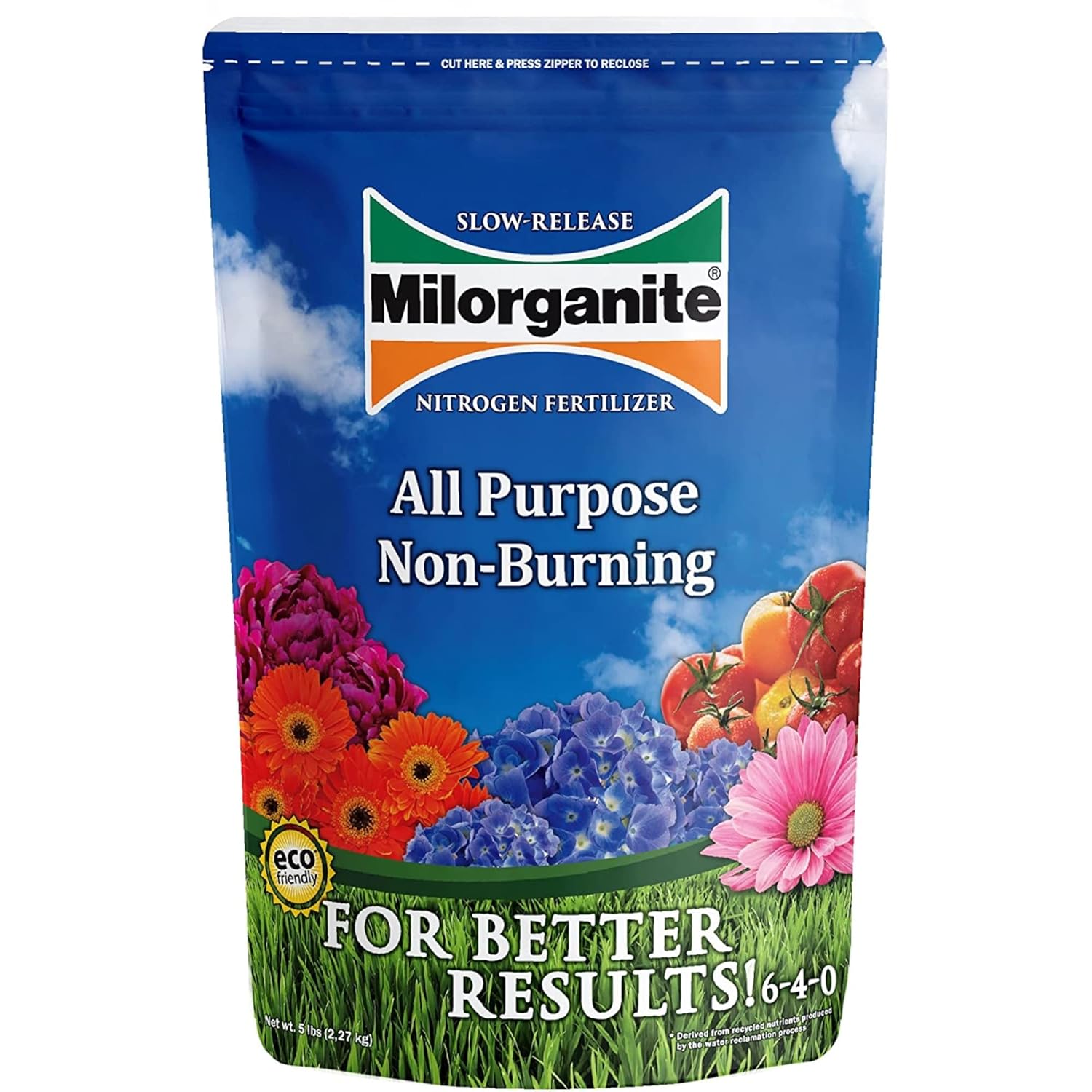
Milorganite Slow-Release Organic Fertilizer, 5 lb
| Item Form | Granules |
|---|---|
| Specific Uses For Product | Lawns, Flowers and Gardens |
| Coverage | 390 Square Feet |
| Ingredients | Nitrogen |
Milorganite is a granular, slow-release organic fertilizer formulated to feed lawns and garden plants for about 8 to 10 weeks per application. It is typically broadcast by hand or with a spreader and does not require immediate watering in, making it easy to fit into routine maintenance. Notable features include a low-salt formula that greatly reduces the risk of burning turf, organically complex iron that greens grass without staining hard surfaces, and about 85% organic matter that helps improve soil structure over time. The product covers roughly 390 square feet from a 5 pound bag and is positioned as safe for use on lawns, shrubs, flowers, trees, and edible gardens. Limitations are that nutrient release is gradual, so it is not a quick fix for severe nitrogen deficiency, and the bag has an earthy odor at first that some pets may find attractive until it dissipates or is watered in. For someone managing Empire Zoysia, use on the recommended schedule and expect steady, low-risk green-up rather than instant color change.
Best for: Gardeners who prioritize steady, low-risk nutrient delivery and soil health and who prefer a hands-off feeding schedule for fine-textured lawns like Empire Zoysia.
Less Ideal for: Homeowners wanting rapid color correction or fast-acting synthetic nitrogen boosts should choose a quick-release fertilizer instead.
- Slow-release nitrogen feeds lawns for 8–10 weeks reducing application frequency
- Low salt formulation minimizes risk of burning sensitive turf like Zoysia
- Provides organically complex iron that greens grass without staining concrete
- High organic matter improves soil structure and water retention over time
- Slow-release action means it will not correct severe yellowing immediately
- Initial earthy odor that may attract some pets until it is watered in or dissipates
Verdict: Choose Milorganite for Empire Zoysia when you want a safe, slow-release organic feed that greens turf steadily without burning or staining.
Espoma Turf-Tone Lawn Starter Organic 4-6-3 Fertilizer, 30 lb

| Item Form | Granules |
|---|---|
| Application Method | Apply with a drop or broadcast spreader. |
| Target Species | Lawn Grass |
| Mixing Ratio | 4:6:3 |
Espoma Turf-Tone Lawn Starter is an organic granular starter fertilizer designed for establishing new turf, overseeding, or laying sod. It is applied with a drop or broadcast spreader and supplies a 4-6-3 ratio that emphasizes phosphorus for root development while providing long-lasting nitrogen and Espoma's Bio-tone formula to support early growth. Practical benefits include organic nutrient sources such as feather meal and poultry manure, predictable coverage for moderate-sized yards, and simple application instructions tailored to new turf situations. For reliability-minded buyers this product reduces the risk of starter burn that can come from high-soluble synthetic starters and supports steady root establishment. Limitations are that it is a starter formula intended for new or recently seeded turf rather than routine maintenance feeding, and application timing and rates matter to avoid wasting product. Expect good early root development on warm-season grasses when used as directed, but plan a separate maintenance program for long-term fertility needs.
Best for: Homeowners installing new turf, overseeding thin areas, or laying sod who prioritize dependable, gentler organic nutrition that supports early root development.
Less Ideal for: People looking for an all-season maintenance fertilizer or quick greening treatments for established lawns should choose a regular maintenance formula instead.
- Organic ingredients (feather meal and poultry manure) that feed soil biology
- Starter-specific 4-6-3 analysis to promote root establishment and early growth
- Applied with standard drop or broadcast spreaders for even coverage
- Formulated to reduce risk of seedling burn compared with high-salt synthetic starters
- Designed for new lawns and overseeding rather than ongoing maintenance feeding
Verdict: A reliable organic starter fertilizer that helps new or overseeded lawns establish strong roots without the harshness of high-salt synthetic starters.
Milorganite 6-4-0 Slow-Release Fertilizer, 32 lb (with Feeding Tips Brochure)

| Item Form | Pelletized |
|---|---|
| Application Method | Broadcast, Rotary or Manual |
| Coverage | 2,500 Square Feet |
| Specific Uses For Product | Lawns, Flowers and Gardens, Education |
Milorganite 6-4-0 is an organic, pelletized slow-release fertilizer intended for routine lawn and garden feeding. It is typically broadcast with a rotary or manual spreader and provides nitrogen slowly over 8 to 10 weeks, which reduces the need for frequent applications and lowers burn risk. The product contains organically complex iron for greening without the strong staining associated with iron salts and is low in soluble salts, so it performs well in warm or drier conditions. The 32 lb bag covers roughly 2,500 square feet and comes with a printed feeding and spreader tips brochure to simplify seasonal timing and application rates. Because it is made from heat-dried microbes, it also adds organic matter to improve soil structure in heavy clay or sandy soils. Limitations are that nutrient release is gradual so it is not suited to quick color fixes or rapid turf recovery, and users seeking tightly controlled N-P-K ratios or fast-acting synthetic performance may prefer a different product.
Best for: Buyers who want a low-maintenance, environmentally minded fertilizer that steadily feeds established lawns and mixed garden beds with minimal risk of burn and fewer repeat applications.
Less Ideal for: If you need rapid turf recovery, immediate color correction, or precise synthetic nutrient control for athletic fields or newly sodded lawns, choose a fast-release or specialty fertilizer instead.
- Slow-release nitrogen feeds lawns and plants for 8–10 weeks, reducing application frequency
- Low-salt formulation minimizes fertilizer burn and streaking in hot or dry conditions
- Organically complex iron promotes deep greening without heavy staining of concrete
- Pelletized form works with broadcast, rotary, or manual spreaders for easy application
- Adds organic matter that can improve drainage and soil structure in clay or sandy soils
- Not fast-acting, so it will not deliver an immediate green-up after application
- Contains biosolids which some buyers may prefer to avoid for personal or local reasons
Verdict: Pick this if you want a reliable, low-salt slow-release fertilizer that feeds lawns and gardens for weeks with minimal maintenance.
Choosing the Right Eco Friendly Lawn Fertilizer: Key Factors to Consider
Nutrient Balance and Ratio
A fertilizer's nutrient label matters because the right nitrogen, phosphorus, and potassium ratio supports turf without encouraging disease or excess topgrowth. Lawns typically need higher nitrogen relative to phosphorus and potassium, but soil test results should guide exact ratios.
Excess nitrogen leads to rapid, succulent growth that demands more mowing and can increase disease pressure. Too much phosphorus can accumulate in soil and contribute to algae blooms if it runs off into waterways. Choosing a balanced eco friendly formula that supplies measured nutrients helps maintain steady growth and reduces the chance of nutrient buildup.
Release Profile and Timing
Slow-release and controlled-release formulas deliver nutrition gradually, reducing the chance of burn and minimizing nutrient loss from heavy rainfall. Organic materials and coated granules are common slow-release mechanisms in eco friendly fertilizers.
Timing matters with seasons and lawn species. Applying at the wrong time can waste nutrients or stress plants. An eco friendly product with an appropriate release profile for your climate and mowing schedule makes it easier to fertilize less often while maintaining color and density.
Soil Biology and Organic Amendments
Products that include compost, humic acids, microbial inoculants, or other organic amendments support soil structure and microbial communities. Healthy soil biology improves nutrient cycling and water infiltration, so turf needs less frequent feeding over time.
While organics act more slowly than soluble synthetic fertilizers, they build long-term resilience. For gardeners focused on sustainability, choosing a formula that actively supports soil life is a practical investment in future lawn health.
Environmental Risk and Runoff
An eco friendly label is only useful if the product actually reduces runoff and leaching risk. Granule size, solubility, and the presence of quick-release salts influence how much nutrient moves off-site after rain. Products that minimize soluble nitrogen and include slow-release carriers lower the likelihood of harming nearby streams and ponds.
Consider your yard slope, proximity to water, and local rainfall patterns. In high-risk situations, choose materials with the lowest leaching potential and follow recommended application rates and buffer zone guidance.
Pet and Pollinator Safety
Gardeners often share their yards with children, pets, and pollinators. Many eco friendly fertilizers avoid harmful pesticides and include ingredients less likely to cause acute toxicity. However, even natural amendments can be risky if misapplied.
Look for clear safety information, minimal use of synthetic additives, and guidance on re-entry intervals after application. Products that support flowering lawn plants or avoid broad-spectrum biocides help pollinators while maintaining turf function.
Application Method and Practicality
Ease of applying a fertilizer determines whether it will be used correctly. Granular products should work with common spreaders and have particle sizes that promote even distribution. Liquid or soluble alternatives require different equipment and may fit users comfortable with hose-end or pump sprayers.
Consider storage, dust, and cleanup. A product that is straightforward to measure, store, and apply reduces user error and improves real-world results in a home lawn setting.
Organic Versus Low-Synthetic Blends
Organic-only fertilizers supply nutrients more slowly, often through composted materials, feather meal, or bone meal. They improve soil organic matter and microbial activity but take longer to change turf color and density. Low-synthetic blends combine a modest amount of fast-acting nutrients with organic carriers to provide quicker visual improvement while retaining some long-term soil benefits.
Match the choice to your goals. If you want steady, incremental improvement and stronger soil life, organics are a good fit. If you need faster green-up but still want reduced environmental impact, a low-synthetic blend can be a compromise.
- Organics build soil over seasons but need patience
- Blends give faster results with partial soil benefits
- Consider mowing and irrigation habits when choosing
Reading the Guaranteed Analysis
The guaranteed analysis shows the percentage of nitrogen, phosphorus, and potassium. For eco conscious choices, also scan for terms like 'slow-release nitrogen' or 'derived from' statements that clarify ingredient sources. If secondary nutrients or micronutrients appear, those can help correct specific deficiencies detected by a soil test.
Use the label to calculate application rates by the square footage of your lawn and avoid over-application. Following label directions reduces environmental risk and extends the effectiveness of each application.
- Look for slow-release nitrogen sources
- Convert application rates to your lawn size
- Check for added soil-building amendments
Application Windows and Seasonal Strategy
Seasonal timing depends on grass species and regional climate. Cool-season grasses benefit from feeding in early fall and again in spring, while warm-season grasses often respond best to late spring through summer programs. Eco friendly products with slow-release characteristics offer broader application windows and lower risk if rain moves in after application.
Use soil temperature cues and avoid fertilizing before heavy rain events. Pair fertilizer timing with aeration and overseeding for the most efficient lawn renovation.
- Plan applications around grass growth cycles
- Avoid applying immediately before forecasted heavy rain
- Coordinate feeding with core aeration for best uptake
Storage, Handling, and Safety
Store fertilizers in a cool, dry, and secure location away from pets and children. Keep organic and synthetic products in their original packaging with labels intact. Moisture can cause clumping in granular products and reduce effectiveness.
Use protective gloves and avoid inhaling dust when spreading. Rinse spreader equipment after use to prevent cross-contamination, and follow any safety instructions for re-entry times or watering-in recommendations.
- Keep products dry to prevent clumping
- Use gloves and a dust mask if dusty
- Clean equipment after each use
Adapting Fertilizer Use for Small Yards and Urban Lots
Small yards and urban lots often have higher exposure to neighbors, pets, and stormwater systems. Apply smaller, measured amounts and favor slow-release organics or low-synthetic blends to reduce the chance of runoff. Container-grown lawn plugs or turf on roofs need even more conservative feeding.
Consider spot-feeding high-traffic or thin areas rather than blanket applications. This targeted approach reduces material use and limits environmental exposure.
- Spot-feed thin areas instead of blanket applications
- Favor slow-release products in confined spaces
- Adjust application rates for small square footage
How We Chose the Best Eco Friendly Lawn Fertilizer
We focused on products that reduce environmental harm while still supplying the nutrients turf needs. Selection began with formulations that use slow-release organics, reduced synthetic nitrogen, or biological amendments to minimize leaching and runoff. We favored items with clear nutrient analysis statements and transparent ingredient lists so gardeners know what they are applying. Ease of application and flexibility for common spreader types mattered because even an eco formulation can be misapplied. We also considered product suitability across lawn types and regional climates, looking for options that support soil biology and minimize burn risk. Excluded from the list were products that rely primarily on undisclosed proprietary blends or that lack basic nutrient labeling. We also excluded specialty mixes intended only for golf greens or commercial sports turf because they do not match typical homeowner maintenance. Key dimensions that determined inclusion were nutrient balance and release profile, soil and microbial benefits, runoff and leaching risk, application practicality, and suitability for pets and pollinators. These criteria guided our scoring and ensured each pick fits real garden use.
FAQ
How often should I apply an eco friendly lawn fertilizer?
It depends on the product's release profile and your grass type. Slow-release organics often need fewer applications per year, while blends with some soluble nitrogen may be applied two to four times. Follow label directions and base frequency on turf response and soil test results.
Will an eco friendly fertilizer green up my lawn as fast as conventional products?
Often it will be slower to show dramatic color change, especially with organic-only formulas. Low-synthetic blends can provide faster green-up while still reducing environmental impact. Expect steadier improvements rather than instant results.
Are eco friendly fertilizers safe for pets and kids?
Many are designed to be lower risk, but safety varies by formulation. Avoid allowing pets on the lawn until any recommended watering-in or re-entry interval has passed and follow label safety instructions. Organic does not always mean non-toxic, so check guidance on the product label.
Can I mix eco friendly lawn fertilizers with herbicides or pesticides?
Compatibility depends on the specific products. Some herbicides and pesticides advise against tank-mixing with fertilizers or recommend sequencing applications. Read both product labels and, when in doubt, apply them separately according to instructions.
Do eco friendly options reduce nutrient runoff completely?
They reduce the risk but do not eliminate runoff entirely. Slow-release and organic components lower soluble nutrient levels, which helps, but application technique, timing, and site conditions also play major roles in runoff risk.
Should I still do a soil test when using eco friendly fertilizers?
Yes. A soil test reveals existing nutrient levels and pH, which guides the choice and rate of any fertilizer. Eco friendly products work best when matched to soil needs rather than applied indiscriminately.
Final Verdict
Prioritize products that match your lawn species, soil test results, and site conditions. Focus on nutrient balance, a predictable slow-release profile, and formulations that build soil biology while minimizing soluble nitrogen. Balance the desire for quick green-up against long-term soil health and environmental risk. Choose the eco friendly fertilizer that fits your seasonal timing and application habits, and apply conservatively using label guidance. That approach will give you a healthier lawn, fewer environmental concerns, and a more resilient turf over time.
