

Note: This article contains affiliate links. If you click on these links and make a purchase, I may earn a small commission at no extra cost to you. This helps support my research and content. Read my full affiliate disclosure here.
If you are tired of pulling weeds by hand or using messy chemical sprays, an electric weed killer can change how you manage unwanted plants around the yard and hardscapes. These devices deliver targeted heat or electrical discharge to kill weeds at the stem and root interface so you spend less time on repeat spot treatments. This guide covers five shortlisted electric weed killers chosen for real garden use. We focus on effectiveness, operator safety, ease of use, and suitability for different garden sizes. Read on to see the criteria we used and practical tips for choosing the right electric option for patios, gravel paths, driveways, and beds.
Top Picks at a Glance
| Best Overall The best all-around choice for most situations | Seesii 20V Cordless Stand-Up Electric Weed Puller with 3-Claw Steel Head |  |
| Best Quality Built to a higher standard if you want something more solid | DIAINSKY DS618G 21V Cordless Electric Weed Puller |  |
| Best Value The sweet spot between price and what you get | TaskStar 21V Electric Weed Puller with Dual 2000mAh Batteries and 3-Claw Steel Root Remover |  |
| Best Budget The cheapest option that still gets the job done reliably | karelwui 1500W 3-in-1 Electric Weed Burner with Adjustable Temperature Nozzles |  |
| Highest Rated A top-rated pick with lots of positive feedback | Abrispl Electric Stand-Up Weed Puller with 3-Claw Steel Head and 3.0Ah Batteries |  |
Seesii 20V Cordless Stand-Up Electric Weed Puller with 3-Claw Steel Head
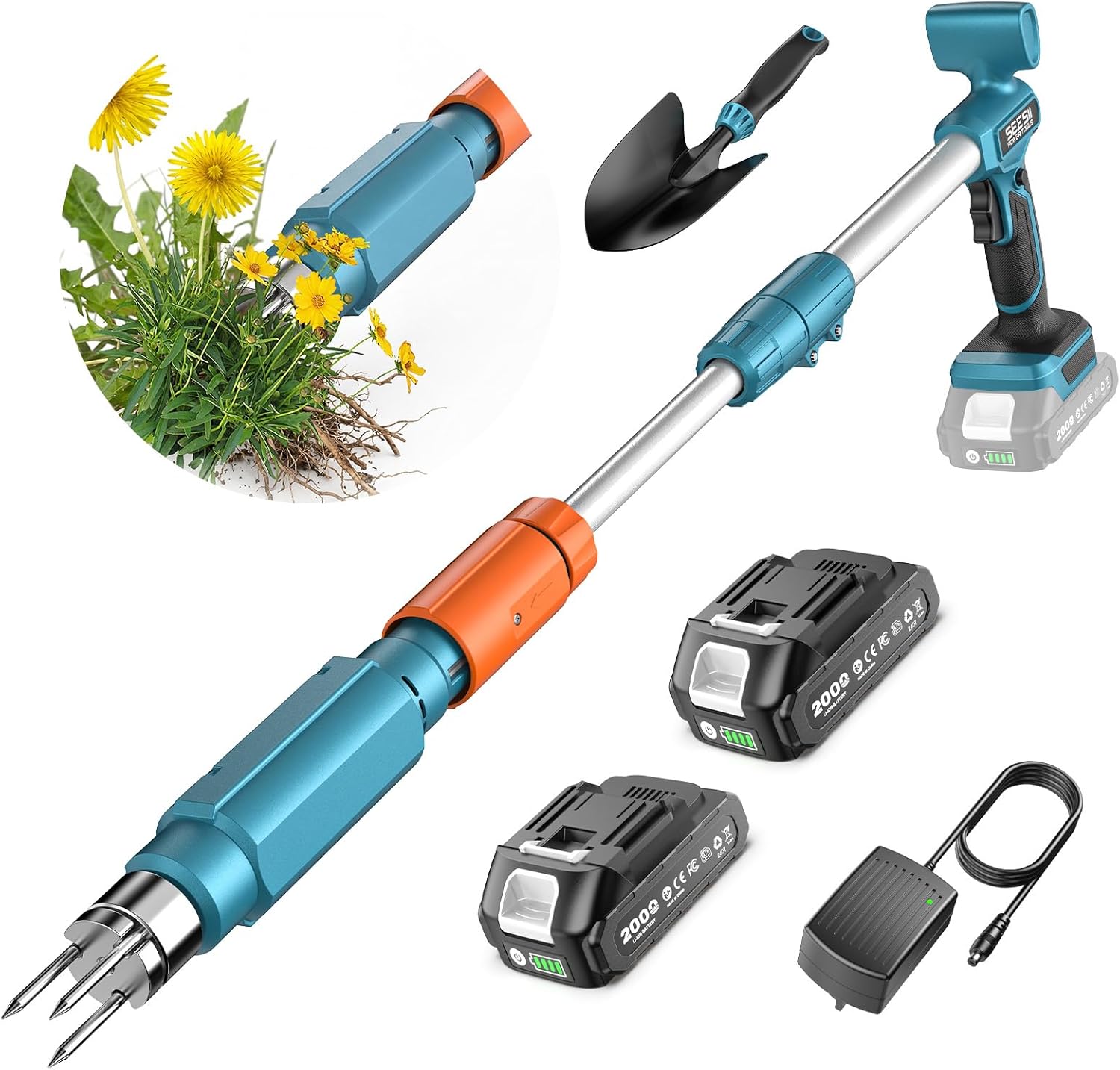
| Motor power | 350W |
|---|---|
| Voltage | 20V |
| Root depth | Up to 2.4 inches |
| Included batteries | 2 × 2000mAh Li‑ion |
| Head material | Stainless steel 3-claw |
The Seesii electric weed puller is a battery-powered, stand-up tool that pulls dandelions, crabgrass, thistles and similar weeds by the root. It uses a 20V/350W motor driving a stainless-steel three-claw head to grip and extract roots up to about 2.4 inches deep, and the telescoping handle eliminates bending so you can work standing. It comes with two 2000mAh batteries so you can swap cells for continuous use and a simple ejection mechanism pushes weeds free without touching them. Safety is addressed with a dual-switch requirement for startup, and the unit breaks down tool-free for storage. Practical limits are that it performs best in soft or moist soil and will need more user force or retries on very hard clay; battery run time and a long initial 9-hour charge may slow long sessions without the spare battery. For general lawn maintenance and easing repetitive bending, it speeds up weeding compared with hand tools and keeps cleanup tidy.
Best for: A practical homeowner or caregiver who wants a back-friendly, quicker alternative to hand weeding for lawns and garden beds and values straightforward, tool-free use and safety features.
Less Ideal for: Not the best choice for users who need to remove very deep-rooted plants or who regularly work large areas of very compacted clay where powered tines cannot penetrate effectively.
- Stand-up telescoping handle reduces bending and makes long sessions easier
- Three-claw stainless steel head designed to grab and remove roots to about 2.4 inches deep
- Dual-switch safety and easy-release ejection keep operation safer and cleaner
- Includes two rechargeable 2000mAh batteries so you can swap for continuous use
- Tool-free assembly and compact breakdown for simple storage and transport
- Best performance on soft or moist soil and can struggle or require extra force in compacted clay
- Initial battery charge time is long and actual runtime per battery is limited
Verdict: A convenient, stand-up cordless weeder that speeds up routine lawn weeding and saves your back by pulling common turf weeds by the root.
DIAINSKY DS618G 21V Cordless Electric Weed Puller

| Manufacturer | DIAINSKY |
|---|---|
| Item model number | DS618G |
| Batteries | 1 Lithium Ion (included) |
| Battery Cell Type | Lithium Ion |
The DIAINSKY DS618G is a cordless stand-up weed puller that uses a 21V lithium-ion battery and a three-claw steel head to extract weeds by the root while you remain standing. It is typically used for lawns, garden beds, and courtyards where repeated bending and kneeling are undesirable. The T-shaped ergonomic handle and detachable three-piece shaft make it comfortable to use and easy to store or transport. The tool’s easy-eject mechanism lets you release pulled weeds without touching them and the two-step safety lock plus head cover reduce accidental activation and injury during storage. The steel claw head digs deep to remove root systems, which speeds cleanup compared with manual pullers and reduces regrowth. Limitations to consider are that battery runtime and torque are not specified in detail so it may need recharging for large areas, and the motorized mechanism is best for individual weeds rather than continuous commercial-scale clearing.
Best for: Gardeners who prioritize fast, back-friendly weeding and want a powered tool to remove roots without bending over, especially for lawns and small to medium yards.
Less Ideal for: Landscapers or users who need to clear very large areas continuously or who require detailed runtime and torque specs for heavy-duty commercial use.
- Cordless 21V lithium-ion battery allows upright, untethered use
- Three-claw steel head designed to dig and remove entire root systems
- Easy-eject mechanism removes weeds without hand contact for faster clean up
- T-shaped ergonomic handle and detachable shaft improve comfort and storage
- Two-step safety lock and head cover reduce accidental activation and injury
- Battery capacity and continuous runtime are not detailed which may limit large-area work
- Best suited for individual weeds rather than heavy-duty commercial clearing
Verdict: Choose this cordless electric weed puller if you want a faster, stand-up solution that extracts roots and cuts down on bending during routine lawn and garden weeding.
TaskStar 21V Electric Weed Puller with Dual 2000mAh Batteries and 3-Claw Steel Root Remover

| Battery voltage | 21V |
|---|---|
| Battery capacity | 2 × 2000mAh |
| Power source | Rechargeable lithium ion batteries |
| Claw material | Steel |
The TaskStar 21V electric weed puller is designed to speed up routine weed removal by extracting roots from standing position with a three-claw steel head. It is typically used by placing the claw over a weed, activating the motor with a safety-enabled switch, then ejecting the plant—TaskStar says the cycle takes about four seconds. Notable features include two 2000mAh batteries that together extend runtime for long sessions, a simple eject mechanism that reduces handling of pulled plants, and a compact shovel and charger included for immediate use. Practical benefits are reduced bending and kneeling, faster clearing of large patches (the maker estimates roughly 500 pulls per charge), and a safer two-step activation to avoid accidental starts. Important limitations are its reliance on battery power for continuous use and the tool’s effectiveness can vary with very large, deep-rooted weeds or in heavy clay soils where manual follow-up may be required. Its weight and upright form make it better for open lawn areas than tight garden beds.
Best for: Buyers who prioritize practical time savings and reduced physical strain when maintaining lawns and larger garden areas and want a plug-and-play electric solution to replace repetitive hand-pulling.
Less Ideal for: Gardeners who mainly manage small, crowded flower beds, potted plants, or need a tool for consistently removing extremely deep-rooted species should consider other manual or heavy-duty options.
- Stand-up operation reduces bending and strain during extended weeding sessions
- Motor-driven 3-claw steel head designed to pull roots rather than just tops
- Two included 2000mAh batteries extend runtime for larger jobs and come with a charger
- Simple eject mechanism allows mostly hands-free disposal of pulled weeds
- Safety dual-switch design helps prevent accidental activation
- May struggle with very large, deep-rooted weeds or compacted clay without manual follow-up
- Battery-powered operation limits continuous use compared with corded alternatives
Verdict: If you want a practical, hands-free way to clear common lawn weeds quickly while avoiding bending, this electric puller delivers efficient root removal and long runtime.
karelwui 1500W 3-in-1 Electric Weed Burner with Adjustable Temperature Nozzles

| Power | 1500W |
|---|---|
| Temperature range | 80 to 650°C |
| Cord length | 1.8 m |
| Material | Aluminum, ABS plastic |
This corded 1500W electric weed burner delivers concentrated heat for spot weed control and surface tasks like melting ice or light roofing work. It heats up quickly and the temperature is adjustable from low settings up to the stated maximum, which gives control for delicate areas or stubborn growth. The unit ships with replacement nozzles and a detachable handle that improves reach and storage. Construction mixes aluminum and ABS plastic so the tool feels lightweight yet reasonably durable for occasional yard use. Because it runs on mains power via a roughly 1.8 m cord, it is best for small to medium patches near an outlet or when used with an outdoor extension lead. Practical limits are its short cord and reliance on electricity which restricts continuous use away from power, and the plastic parts mean heavy daily commercial use may wear them faster. For homeowners wanting an inexpensive, flame-free way to scorch weeds and clear small icy patches, this is a simple, straightforward option.
Best for: Budget-minded homeowners who need an inexpensive, electric alternative to gas torches for occasional spot weeding, ice-melting, and small outdoor maintenance tasks.
Less Ideal for: People who need long runtime far from power sources or those who require a heavy-duty tool for frequent commercial landscaping should consider petrol or battery-powered professional units instead.
- High 1500W power with adjustable temperature up to 650°C for targeted weed control
- Comes with replacement nozzles to extend usable life
- Lightweight design with detachable handle for easier storage and maneuvering
- Simple push-button ignition makes it easy to start without external lighters
- Short built-in power cord limits use unless you add an outdoor extension
- Plastic components may show wear with heavy or commercial use
Verdict: A low-cost, easy-to-use corded electric weed burner that gives adjustable high-heat spot control for homeowners who need an affordable alternative to gas torches.
Abrispl Electric Stand-Up Weed Puller with 3-Claw Steel Head and 3.0Ah Batteries

| Power Source | Battery Powered |
|---|---|
| Operation Mode | Electric |
| Material Type | Plastic |
| Unit Count | 1 Count |
| Number of Batteries Included | 2 x 3.0Ah (listed in description) |
This electric stand-up weed puller is designed to speed up root-level weed removal without bending or kneeling. It uses a motor-driven 3-claw steel head to dig into soil and pull weeds out by the root, and a one-touch ejection lets you release plants into a bin or the ground without handling them. The package includes two 3.0Ah lithium batteries and a charger so you can keep working while one battery charges, and a charge-level display helps manage runtime. Adjustable shaft length makes it comfortable for different users, and the plastic body keeps the unit lightweight for maneuvering across lawns and garden beds. Limitations include a primarily plastic construction that may not be as rugged as all-metal units in heavy professional use, and effectiveness will depend on soil conditions since very compacted or rocky ground reduces rooting grip. This tool suits routine backyard weed control and users who value less bending and quicker operation than hand-pulling provides.
Best for: Buyers who prioritize a reliable, lower-effort solution for routine yard and garden weeding and want a tool that reduces bending and finishes jobs faster than manual pulling.
Less Ideal for: Professional landscapers or users who need a heavy-duty all-metal tool for constant commercial use or frequent work in very rocky or compacted soils.
- Root-level removal with a durable 3-claw steel head for pulling weeds by the root
- Two 3.0Ah lithium batteries with charger and charge-level indicator for extended runtime and monitoring
- One-touch ejection speeds disposal and reduces hand contact with weeds
- Adjustable shaft lets users work upright to reduce bending and strain
- Plastic-bodied construction may be less durable under heavy commercial or very rough use
- Performance can be reduced in compacted, rocky, or clay-heavy soils where claws cannot get purchase
Verdict: Choose this Abrispl electric stand-up weed puller if you want a dependable, battery-powered tool that removes weeds by the root while saving your back and cutting weeding time.
Choosing the Right Electric Weed Killer: Key Factors to Consider
Kill Method and How It Affects Results
Electric weed killers use either directed heat or electrical discharge to destroy weed tissue. Heat systems char the stem and can denature root tissue with repeated application, while electrical systems disrupt plant cells and root connections more quickly. Understanding the method matters because it affects how many passes you need and whether perennial roots are likely to resprout.
Consider how the method interacts with surrounding plants. Heat can scorch nearby desirable foliage if used carelessly, and electrical systems can conduct through moist soil in unpredictable ways. Choose a method that matches the type of weeds you face and the margin for error around ornamentals.
Area Coverage and Power Source
Electric models vary between corded units and battery-powered systems. Corded units offer continuous power for large paved areas but require access to a safe outdoor outlet and manageable cable routing. Battery models trade continuous runtime for portability, which is useful for beds, fences, and remote corners without outlets.
Estimate the area you will treat and match that to typical run-time or cable length. For large driveways and long pathways, look for higher power output or longer battery life so you are not stopping frequently to recharge or reposition an extension.
Safety Features and User Controls
Because these tools deliver heat or electricity, built-in safety is essential. Look for positive safety interlocks, clear on-off controls, insulated handles, and guards that prevent accidental contact. Some devices include dual-action triggers requiring two-hand activation to reduce accidental use by children or pets.
Also consider visible indicators, such as LEDs or temperature readouts, that tell you the unit is active. Ease of shutting the device off quickly is important when unexpected conditions arise, like a child or pet entering the work area.
Precision and Ease of Targeting
Good targeting keeps damage confined to weeds and protects nearby plants, mulch, and hardscape. Long nozzles, narrow tips, or focused electrodes help direct the effect at the base of the weed without a broad heat plume. Mobility of the head and comfortable reach are also important for treating cracks between pavers or weeds under low plant canopies.
Ergonomics matters for longer sessions. A unit that is heavy or awkward to hold will make precise work harder, increasing the risk of accidental contact with desired plants. Look for comfortable grips and balance that let you steady the tip for accurate strikes.
Durability and Weather Resistance
Equipment stored outdoors or used on damp surfaces must resist moisture and corrosion. Materials and seals determine how long units perform reliably in wet conditions or after exposure to morning dew. Rust-prone fasteners and exposed electronics shorten useful life.
Check for design features that shed water from switches, replaceable wear parts on tips or guards, and simple maintenance access. A weather-resistant finish and removable cleaning components extend service life and reduce the likelihood of performance loss during busy seasons.
When Electric Weed Killers Make Sense
Electric weed killers are best for gardeners who need targeted control on paved surfaces, gravel paths, patios, and between stepping stones where herbicide use is undesirable. They are also useful near vegetable beds or play areas where minimizing chemical residues is a priority. In these contexts, an electric option reducesrepeat hand-pulling and prevents weed seed buildup from plants left to flower.
Electric tools are less effective for dense turf infestation or deep-rooted perennial patches over large lawn areas. In those cases, mechanical removal or established cultural controls are more practical.
- Best for spot treatment on hardscape cracks and edges
- Useful around children, pets, and food-growing areas where low-chemical approaches are preferred
- Less suited to treating large turf expanses or deep-rooted perennial mats
Preparing the Area and Safe Operation Practices
Before using an electric weed killer, clear loose debris and inspect the surface. Remove toys, hoses, or other trip hazards and keep children and pets well away. Wear eye protection, long sleeves, and gloves to shield against splatter, sparks, or scorched plant material.
Operate the device at recommended distances and in short bursts rather than prolonged contact to avoid unnecessary damage. Allow treated weeds time to wither rather than immediately disturbing roots. If treating near desirable plants, lightly wet the soil around the target to reduce heat transfer but avoid overwatering that could create electrical conduction risks in systems that rely on discharge.
- Clear the work area of debris before starting
- Use personal protective equipment and keep bystanders away
- Treat in short, controlled passes for precision and safety
Maintaining Your Electric Weed Killer
Regular maintenance preserves performance and safety. After each use, allow the unit to cool, then clean tips or electrodes with a brush to remove charred plant residue. Inspect seals and insulation for cracking, replace worn tips if the manufacturer provides replacements, and store the device dry and out of direct weather when not in use.
If the unit is battery powered, follow the battery care guidelines: store partially charged in cool, dry conditions and avoid complete discharge during storage. For corded models, inspect the cable for cuts or fraying and keep connectors dry and covered.
- Clean tips after cooling to prevent buildup
- Inspect seals and cables before each season
- Store in a dry location and follow battery care instructions
Using Electric Weed Killers Around Different Surfaces
Hardscapes like concrete and pavers are ideal because weeds are concentrated in cracks and treatment is precise. On gravel or mulch, take extra care because heat can scorch organic mulch and small stones can shift, exposing roots. In beds with desirable plants nearby, use narrow nozzles and work from the edge toward the target to reduce accidental scorch.
Avoid using high-temperature settings on plastic edging or low-grade paving that can deform. When treating slopes, ensure you can stand safely and maintain steady control of the unit; unstable footing increases the risk of accidental contact.
- Concrete and paver joints are ideal targets
- Use narrow nozzles near mulch and ornamentals
- Avoid high heat on plastic edging and work from stable footing
How We Chose the Best Electric Weed Killer
We shortlisted electric weed killers by focusing on attributes that matter in everyday garden use. Primary evaluation criteria included kill effectiveness at the root collar, operator safety features that reduce the chance of accidental contact, power delivery and run-time for plugging into typical outdoor outlets or batteries, and build quality related to weather exposure. We also assessed versatility for different surfaces such as paving gaps, gravel, and mulched beds, and the ease of aiming or treating individual weeds without damaging nearby plants. We excluded items that rely primarily on chemical herbicides or that require complex commercial hookups. Products that lack clear safety interlocks or that had inadequate power delivery for typical yard tasks were not considered. The final selection prioritizes devices that balance thorough weed control with safe, repeatable operation and reasonable durability for outdoor storage.
FAQ
Are electric weed killers safe to use around pets and children?
They can be safer than broadcast chemical herbicides because treatment is targeted, but operator controls and supervision are still necessary. Keep pets and children away during use, and ensure the device has safety interlocks and insulated handles to reduce accidental contact.
Will an electric weed killer kill weed roots permanently?
Effectiveness at root killing depends on the plant species and number of treatments. Annual weeds usually die after one or two strikes, while deep-rooted perennials may need repeated applications or follow-up removal to prevent resprouting.
Can electric weed killers be used in wet conditions?
Most manufacturers advise against using these devices in heavy rain or standing water for safety reasons. Light moisture on surfaces is common, but avoid operation when the ground is saturated or during thunderstorms.
How often will I need to treat the same area?
Frequency depends on weed species, seedbank, and site conditions. Expect to revisit newly infested cracks every few weeks early in the season, then less often once weeds are under control. Persistent perennial patches may need scheduled follow-up treatments.
Do electric weed killers damage nearby plants or soil life?
Targeted strikes minimize collateral damage, but heat and electrical discharge can harm nearby roots or soil organisms if applied broadly. Use precise targeting and shorter bursts to protect desirable plants and soil structure.
Final Verdict
Choose an electric weed killer that matches the size and surfaces of the area you need to treat, and prioritize safety features that suit household use. Balance power and run-time against portability needs, and expect to make repeat treatments on tough perennials. With proper technique, maintenance, and sensible safety precautions, an electric option can reduce manual weeding and keep paths and patios tidy without relying on broad chemical applications.
