

Note: This article contains affiliate links. If you click on these links and make a purchase, I may earn a small commission at no extra cost to you. This helps support my research and content. Read my full affiliate disclosure here.
If deer are browsing your flower beds, vegetable patch, or ornamental shrubs, an electronic deer repellent can cut damage without constant reapplication. These devices use motion sensing, lights, sounds, or timed sprays to interrupt deer behavior so plants get a chance to recover. This guide looks at seven shortlisted options that perform well in home gardens and small yards. We evaluated coverage area, activation reliability, power and maintenance needs, and weather resistance to help you pick a unit that fits your layout and routine. Read on for practical notes on setup, expected upkeep, and situational pros and cons before the product list.
Top Picks at a Glance
| Best Overall The best all-around choice for most situations | G-Jyuncyou Solar Ultrasonic Animal Repeller (2-Pack) |  |
| Best Quality Built to a higher standard if you want something more solid | ASPECTEK Yard Sentinel Ultrasonic Animal Repeller with Strobe Light |  |
| Best Value The sweet spot between price and what you get | Lycxbfjia Solar Ultrasonic Animal Repellent 4-Pack |  |
| Best Budget The cheapest option that still gets the job done reliably | Grrwz Solar Ultrasonic Motion-Activated Animal Repellent |  |
| Highest Rated A top-rated pick with lots of positive feedback | PEXPEL 4-Pack Solar Ultrasonic Animal Repellent with Motion Sensor and Strobe Light |  |
| Most Popular A crowd favorite that many people choose with confidence | Broox RB-101 Solar Ultrasonic Animal Repellent |  |
| Best Seller A high-volume bestseller chosen again and again | CKCOEO Solar Ultrasonic Outdoor Animal Repellent, 2-Pack |  |
G-Jyuncyou Solar Ultrasonic Animal Repeller (2-Pack)
| Power Source | Solar Powered |
|---|---|
| IP Rating | IP65 |
| Frequency Range | 18–45 kHz |
| Charging | Solar and USB charging option |
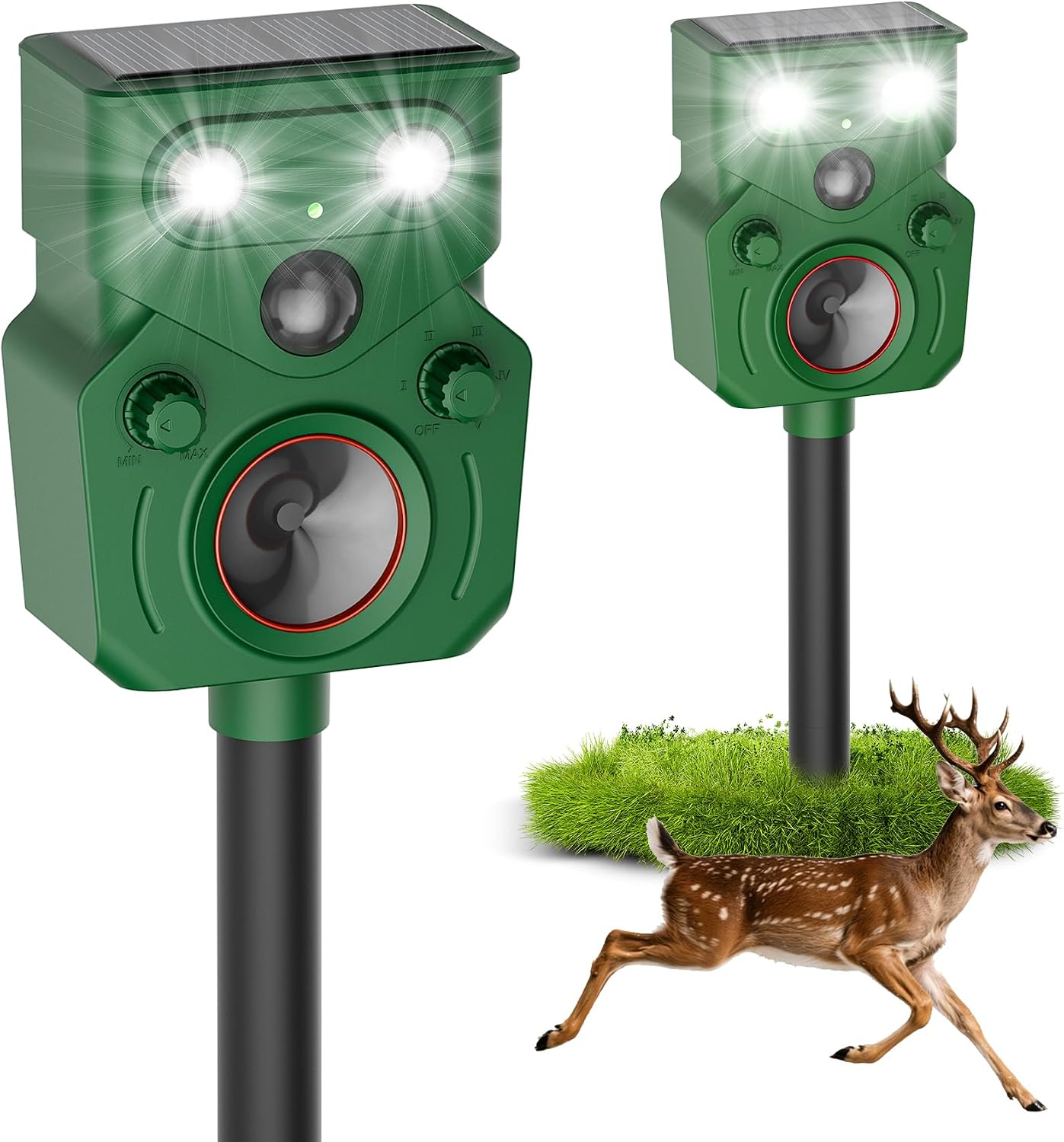
This two-pack of G-Jyuncyou solar ultrasonic repellers combines PIR motion detection, adjustable ultrasonic frequency and strobe lighting to protect yards, orchards, and gardens from deer, raccoons, coyotes and similar animals. Install by staking into the ground or hanging; the PIR sensor triggers ultrasonic pulses (18–45 kHz depending on mode) and flashing LEDs when animals enter the detection zone. There are five modes including sweep, high-frequency, full cycle and strobe-only, plus separate knobs for sensitivity and frequency so you can tune coverage for different animals and distances. Solar panels recharge during the day and a USB port lets you top up the internal battery when sunlight is limited. The unit is IP65 rated, built from ABS plastic, and intended for continuous outdoor use. Important limitations are that ultrasonic effectiveness varies by species and environment and requires correct placement and angle; sound does not physically harm animals and results are not instant in every situation. The device is best used as part of a layered approach to deer control rather than a guaranteed single solution.
Best for: Buyers who prioritize a low-maintenance, weatherproof deterrent they can rely on for continuous outdoor protection and who want the ability to fine-tune detection and frequency settings.
Less Ideal for: Those seeking an immediate, guaranteed elimination of large herd deer or users who prefer physical exclusion methods only should consider alternative or additional solutions.
- Adjustable frequency and sensitivity knobs let you target different animals and tune detection range.
- Dual charging via solar panel plus USB ensures power even in cloudy weather or winter.
- IP65 waterproof rating and ABS construction for outdoor durability.
- Multiple working modes including strobe-only and full-cycle provide flexible deterrent patterns.
- Ultrasonic effectiveness depends on species, landscape and placement so results can vary.
- No detailed coverage radius provided, so planning exact placement requires trial and error.
Verdict: A weatherproof, adjustable solar-powered repeller that provides reliable, low-maintenance deterrence when used as part of a broader deer-control strategy.
ASPECTEK Yard Sentinel Ultrasonic Animal Repeller with Strobe Light

| Coverage | up to 5500 square feet |
|---|---|
| Operating modes | Day, Night, 24-Hour |
| Power | AC cord or 4 C-cell batteries |
| Weather resistance | IPX4 |
The ASPECTEK Yard Sentinel pairs adjustable ultrasonic output with an optional high-intensity strobe and audible predator alarm to deter deer, raccoons, squirrels, rabbits and birds around yards and patios. You mount it on a fence, wall, or tree and choose Day, Night, or 24-hour modes so the PIR motion sensor triggers the strobe and sound only when needed or runs continuously for full-time coverage. A frequency dial lets you focus the output toward larger or smaller species, and a volume control switches between silent ultrasonic-only operation and audible alarm. Power options include an included long AC cord for permanent placement or four C-cell batteries for remote spots. The unit is IPX4 weather resistant and shaped to shed water for outdoor use. Important limitations are that ultrasonic effectiveness depends on line-of-sight and species sensitivity, audible alarms may bother neighbors, and battery operation can become costly for continuous use in large areas.
Best for: Buyers who prioritize measurable, adjustable deterrence and want a configurable device they can tune for specific pests and coverage patterns in outdoor spaces.
Less Ideal for: People who need a silent, barrier-based solution or who cannot tolerate intermittent loud alarms near neighbors or shared properties.
- Adjustable frequency dial to target different animal sizes
- Motion-activated strobe and optional audible alarm for immediate deterrence
- Dual power: long AC cord for permanent use or battery option for remote placement
- IPX4-rated housing and angled design help resist rain and splashes
- Ultrasonic waves require clear pathing and may be less effective through vegetation or obstacles
- Audible predator alarm can be disruptive in close residential settings
Verdict: Choose the Yard Sentinel if you want a tunable, multi-sensory outdoor repeller that you can configure for targeted, performance-focused pest control.
Lycxbfjia Solar Ultrasonic Animal Repellent 4-Pack

| Sensor range | up to 30 ft |
|---|---|
| Detection angle | 110° PIR |
| Ultrasonic frequency | 13.5–45.5 kHz |
| Weather resistance | IP65 |
| Batteries included | 1 12V battery (included) |
This 4-pack of solar ultrasonic repellers combines a motion-triggered PIR sensor with variable ultrasonic output and a white flashing light to discourage deer, rabbits, raccoons, skunks, squirrels and feral cats from approaching gardens and lawns. Each unit wakes when the 110° sensor detects movement up to about 30 feet, delivering changing 13.5–45.5 kHz sound plus a strobe to create an unpredictable stimulus that tends to startle wildlife without chemicals or traps. The IP65 weather-resistant housing and solar power make setup simple and wire-free; positioning the sensor toward animal travel paths and keeping the panel in sun improves performance. Because the devices are sold in a four-pack users can cover multiple approach points around vegetable beds, orchards, fence lines, and trash areas. Limitations include dependence on sunlight for charging and the typical reduced effectiveness if animals become acclimated to the same placement, so occasional repositioning is recommended for sustained results.
Best for: Gardeners who want a hands-off, chemical-free way to protect multiple planting areas and prefer low-maintenance, solar-powered solutions they can reposition as needed.
Less Ideal for: People with heavily shaded yards or those needing a single high-powered deterrent for a very large property should consider alternatives better suited to low-light or larger coverage needs.
- Motion-activated 110° PIR sensor detects activity up to ~30 feet for targeted activation
- Combination of variable ultrasonic frequencies (13.5–45.5 kHz) and flashing white light increases chance of deterring multiple species
- Solar-powered with included 12V battery for wire-free installation and low maintenance
- IP65 weather-resistant housing suitable for outdoor placement in changing conditions
- Sold as a four-pack to cover multiple entry points and trouble spots around a yard
- Performance depends on adequate sunlight to keep batteries charged
- Animals can become habituated if units remain in the same position for long periods
Verdict: Buy this four-pack if you want a low-maintenance, solar-powered motion deterrent to protect several garden trouble spots from deer and similar pests.
Grrwz Solar Ultrasonic Motion-Activated Animal Repellent

| Detection range | Up to 30 feet |
|---|---|
| Detection angle | 150° |
| Weather rating | IP65 |
| Power source | Solar with internal battery |
This compact unit combines a PIR motion sensor, ultrasonic speaker, and flashing strobe to deliver hands-off animal control for gardens and yards. Install it on a stake or hang it on a fence and the sensor will detect movement up to about 30 feet across a 150 degree arc, triggering a burst of high-frequency sound plus a bright strobe to startle animals. The integrated solar panel charges the internal battery so the device runs day and night without wiring; LED indicators show charging and active status. The ABS housing and IP65 rating mean it tolerates rain and snow for year-round use. In practice it is best for perimeter protection of planting beds, bird feeders, and trash areas where a nonlethal, maintenance-free deterrent is desired. Expect brief activations rather than continuous output to conserve power, and note that ultrasonic effects can vary by species and terrain so placement and angle matter. For homeowners wanting a low-effort, chemical-free solution this unit delivers convenience and weatherproof reliability, though it may need trial-and-error positioning for maximum effectiveness.
Best for: Buyers who want a low-maintenance, humane way to protect gardens, feeders, and small yards from common wildlife without chemicals or wiring and who are willing to experiment with placement for best results.
Less Ideal for: People who need guaranteed elimination of pests, continuous loud deterrence, or solutions for very large properties where single units cannot cover all approach paths.
- Solar-powered with built-in battery enables continuous day and night operation without wiring
- Motion-triggered ultrasonic sound plus strobe light offers dual-action deterrence up to about 30 feet
- IP65 weatherproof ABS housing stands up to rain, snow, and outdoor conditions
- Wide 150° detection zone covers large approach angles for perimeter protection
- Ultrasonic effectiveness varies by species and environmental layout, so results are not guaranteed
- Requires direct sun to charge optimally and may need relocation in shaded areas
Verdict: A weatherproof, solar-powered motion repeller that provides convenient, chemical-free perimeter protection for gardens and small yards.
PEXPEL 4-Pack Solar Ultrasonic Animal Repellent with Motion Sensor and Strobe Light

| Power Source | solar_powered |
|---|---|
| Number of Pieces | 4 |
| IP Rating | IP65 |
This four-pack of PEXPEL solar ultrasonic repellers is built for hands-off, long-term yard protection. Each unit uses a PIR motion sensor to trigger ultrasonic pulses (18–45 kHz) plus a strobe light, and the left and right knobs let you change detection sensitivity and choose from five operating modes to match different pests. It charges from sunlight and also accepts USB fast charging, and a full charge is claimed to run roughly 25–30 days, which makes it convenient for seasonal use without daily maintenance. The IP65 rating and included ground stakes or mounting options mean you can place them in beds, along fences, or near known animal paths and expect weatherproof performance. Expect effective deterrence for medium and small mammals in open, sunny areas; like most ultrasonic devices they work best as part of a layered strategy and performance can vary by species and landscape. If you need a low-effort, weather-resistant solution to reduce cat visits and other garden pests, this set offers flexible controls and multi-unit coverage.
Best for: Gardeners who prioritize a reliable, low-maintenance deterrent and want adjustable settings and weatherproof hardware to reduce visits from neighborhood cats and other small to medium mammals.
Less Ideal for: People seeking an immediate, guaranteed removal of persistent animals or solutions for indoor pests should consider other methods.
- Solar plus USB charging with claimed 25–30 days runtime per full charge reduces maintenance
- Adjustable sensitivity and five operating modes let you tailor detection for different animals
- IP65 waterproof construction and included mounting stakes allow outdoor, year-round placement
- Sold as a four-pack to provide broader coverage across a yard or multiple sites
- Ultrasonic effectiveness varies by species and obstruction and may not stop all animals
- Performance depends on placement in sunny locations for reliable solar charging
Verdict: A weatherproof, low-maintenance four-pack with adjustable sensitivity and solar plus USB charging that suits gardeners who want dependable, set-and-forget outdoor cat and small-mammal deterrence.
Broox RB-101 Solar Ultrasonic Animal Repellent

| Target Species | Cat, Dog, Rabbit, Raccoon, Skunk, Squirrel |
|---|---|
| Infrared sensor angle | 110 degrees |
| Detection range | 20-25 feet |
| Power supply | Solar plus 3 Ni-MH rechargeable batteries with USB charging |
The Broox RB-101 is a weatherproof, solar-powered ultrasonic animal repellent intended to keep gardens and yards clear of cats, squirrels, raccoons, deer and similar animals. It mounts in the ground or on a wall, uses an infrared motion sensor to trigger ultrasonic tones and a flashing LED, and offers five frequency modes and a sensitivity knob so you can match output to different species and detection distances. Practical benefits include solar charging with USB backup so it can run with minimal maintenance, a 110 degree sensor sweep and roughly 20–25 foot detection range for decent coverage of small to medium areas, and clearly labeled mode settings that make it easy to adjust. Limitations are that effectiveness depends on animals being sensitive to ultrasonic frequencies and on correct placement and orientation, and some users may not hear the device because the sound is above human hearing range. The unit is a straightforward, low-effort option for reducing nuisance wildlife where a humane, nonchemical approach is preferred.
Best for: Someone who wants a low-maintenance, humane way to discourage common garden pests and prefers configurable settings to tailor coverage to specific animals and areas.
Less Ideal for: People needing guaranteed removal of burrowing or hearing-insensitive animals or those who require a solution for very large acreage beyond the stated detection range.
- Solar panel with USB backup reduces need for frequent battery changes
- Adjustable frequency and sensitivity knobs let you target different species and distances
- Motion-activated ultrasonic sound plus flashing LED adds both audio and visual deterrence
- IP65 weatherproof construction suitable for outdoor exposure
- Relies on animals being able to hear ultrasonic frequencies so it will not affect all species
- Effectiveness depends on correct placement and periodic repositioning if animals habituate
Verdict: A simple, weatherproof solar ultrasonic repeller with adjustable frequency and motion detection that offers a low-effort, humane way to reduce common garden pests.
CKCOEO Solar Ultrasonic Outdoor Animal Repellent, 2-Pack

| Unit Count | 2 Count |
|---|---|
| Detection Angle | 150° |
| Detection Range | 25-30 ft |
| Waterproof Rating | IP65 |
This 2-pack of solar ultrasonic repellents uses a PIR motion sensor to trigger high-frequency sound pulses and a flashing strobe light to discourage animals from entering gardens and lawns. Install one where animals enter a bed or pathway about 9 to 10 inches above ground or hang it on a fence; when motion is detected within roughly 25 to 30 feet and 150 degrees, the unit emits ultrasonic bursts and a strobe for about 15 seconds before returning to standby. Practical benefits include solar charging for continuous day-to-night operation, IP65 waterproof ABS housing for outdoor durability, and simple tool-free setup that most users complete in minutes. For performance-minded buyers the sensor coverage and dual-action stimulus give a stronger active deterrent than passive methods like barriers. Limitations to expect are a required initial charge period in direct sun, a recommended adjustment period of a few weeks before animals consistently avoid the area, and the possibility that very determined or habituated animals may eventually become less responsive without repositioning or adding units to cover entry points.
Best for: Buyers who prioritize active, low-maintenance pest control and want a performance-focused, weatherproof solution to reduce cat and small wildlife activity in garden beds and yards without chemicals.
Less Ideal for: People who need immediate results overnight or who lack reliable sun exposure for charging should consider hardwired or battery-backed options instead.
- Solar-powered with built-in charging for continuous day-to-night operation
- Dual-action deterrent combining ultrasonic pulses and flashing strobe light
- Wide PIR detection angle up to 150 degrees and 25–30 foot range
- IP65 waterproof ABS construction suitable for outdoor exposure
- Tool-free installation with stake or hanging options for flexible placement
- Requires direct sun for initial charging and consistent solar performance
- May take 2–4 weeks to reach full effectiveness as animals learn to avoid it
- Ultrasonic stimulus may be less effective on habituated or determined animals
Verdict: A performance-focused, weatherproof solar repellent that delivers active ultrasonic plus strobe deterrence for long-term reduction of cats and small wildlife in outdoor gardens.
Choosing the Right Electronic Deer Repellent: Key Factors to Consider
Coverage Area and Sensor Range
Coverage determines how many devices you need and where to place them. A device with a wide detection arc and long range can protect a larger border or bed from a single mounting point, while a unit with a narrow beam works best when aimed at specific access points such as a garden gate or a gap in a hedge.
Also consider how detection distance and beam angle interact with landscape features. Slopes, shrubs, and fencing will all change effective range, so plan for some overlap between units to avoid blind spots where deer can slip through undetected.
Activation Consistency
Reliable activation is critical. Devices that trigger on any movement may give false activations from wind-blown vegetation, causing wasted deterrence events and faster battery drain. Conversely, sensors tuned only to fast motion can miss slow-feeding deer.
Look for adjustable sensitivity or dual-sensor designs that reduce false triggers but still respond to grazing deer. Aim for a unit that you can tune to your garden's typical activity so it responds when deer arrive and stays quiet otherwise.
Deterrent Method and Adjustability
Electronic repellents use different modalities such as flashing lights, ultrasonic or audible alarms, and timed water sprays. Each method has tradeoffs: visual bursts are effective in small yards and around human activity, ultrasonic devices vary in effectiveness depending on vegetation density, and spray systems physically remove deer from an area but require a water source or refillable cartridges.
Adjustability matters because you may need to change intensity by season or to reduce disturbance to neighbors and pets. A unit with selectable modes or adjustable cycles gives more control and longevity of usefulness.
Power Source and Maintenance
How a unit is powered affects placement and ongoing effort. Mains-powered devices offer continuous operation but limit placement to where you have power. Battery units are flexible but require periodic replacement or charging. Integrated solar charging reduces maintenance but depends on site sunlight and usually provides less power during winter.
Also consider routine tasks like cleaning sensors and replacing consumables. Devices with easy-access housings and common battery types or readily available refill cartridges lower the friction of regular upkeep.
Weatherproofing and Build Durability
Outdoor repellents face sun, rain, freezing temperatures, and occasional impacts from tools or wildlife. IP-rated housings and UV-resistant plastics extend working life and protect electronic components. Metal parts should be corrosion-resistant if they will contact soil or irrigation water.
Durability also affects warranty expectations and whether you need seasonal storage. A more robust unit may cost more up front but save time and replacement hassle in the long run.
Placement Flexibility and Mounting Options
How and where you can mount the device affects coverage and ease of use. Stakes allow quick repositioning in beds and lawns, wall mounts secure units to sheds and fences, and pole mounts provide height for longer sensor range. Some devices include multiple mounting choices to adapt to different garden architectures.
Consider whether the unit can be aimed or tilted, and whether cabling or hoses are long enough for intended placement. The easier it is to reposition the unit, the more effectively you can respond to changing deer paths and garden growth.
How Electronic Repellents Actually Deter Deer
Electronic devices interrupt deer behavior through unexpected stimuli that trigger a startle response. Brief flashes of light, sudden noises, or instant water sprays make deer pause, reassess the risk, and usually move elsewhere rather than continuing to feed.
The deterrent effect is strongest when stimuli are unpredictable and varied. Repeating the same cue at the same intensity can lead to habituation over time, so look for units that offer multiple modes or randomized timing to keep deer uncertain.
- Visual stimuli work well around patios and paths where lights can be aimed on approach.
- Audible and ultrasonic cues can be less effective in dense vegetation but useful across open lawns.
- Spray-based systems provide a physical reprimand that deer associate with the site.
Site Planning and Device Placement Tips
Map likely deer routes and concentrate protection where damage is most frequent: garden borders, preferred shrubs, or vegetable plots. Place units so their detection cone covers those access points rather than centering them in the middle of a bed.
Place units a little higher than deer head height for clearer line-of-sight, and angle sensors to scan across paths rather than straight at the expected approach. This reduces detection dead zones caused by low plants or small landscape undulations.
- Overlap coverage slightly between devices to avoid blind spots.
- Avoid aiming sensors at wind-prone ornamental grasses to reduce false triggers.
- Test placement for a few nights and adjust sensitivity or angle based on observed activity.
Combining Repellents with Physical and Cultural Controls
Electronic repellents work best as part of a layered strategy. Complementing devices with physical barriers like temporary netting, deer-resistant plants, and timed lighting reduces pressure on any single measure and delays habituation.
Cultural controls such as removing fallen fruit, securing compost, and avoiding late-season plantings of highly palatable species reduce attractants and improve the overall effectiveness of repellents.
- Use electronics near vulnerable plants while relying on shrubs or fencing for perimeter defense.
- Rotate deterrent methods seasonally to maintain effectiveness.
- Keep attractants minimized to lower deer visitation frequency.
Seasonal Considerations and Runtime Scheduling
Deer behavior changes with season. When plants are scarce in winter, animals range farther and become persistent. In spring and summer, concentrated feeding in lush beds may require more targeted coverage. Adjust activation schedules and sensitivity to match these patterns.
If a device uses timed cycles, run it during high-activity windows such as dawn and dusk to conserve power while maximizing deterrence. For continuous pressure situations, prioritize power sources and weatherproofing.
- Increase sensitivity and coverage in late fall and winter when deer forage more widely.
- Use solar-charged units in sunny, low-maintenance sites but supplement during overcast months.
- Monitor and adjust settings monthly as plantings and deer patterns evolve.
Noise, Neighbors, and Pet Safety
Audible alarms and sudden sprays can disturb nearby occupants and pets. If you live close to neighbors or have outdoor pets, choose modes and timing that reduce nuisance while still deterring deer. Lower-volume visual cues or short randomized intervals may strike a better balance.
Consider legal and community norms about outdoor noise and visible water sprays. Test a unit at low settings before leaving it to operate overnight to confirm it will not create ongoing disturbances.
- Select devices with adjustable volume or silent visual modes for close quarters.
- Warn household members when testing new deterrent modes to avoid startling pets.
- Position spray systems so runoff does not reach patios or adjacent properties.
How We Chose the Best Electronic Deer Repellent
We focused on attributes that actually affect how electronic deer repellents behave in real outdoor settings. Key evaluation criteria included coverage area and sensor range to match device placement to typical garden footprints; activation consistency to ensure the unit triggers for walking and feeding deer rather than only fast movement; deterrent method and adjustability so users can choose light, sound, or spray intensity depending on nearby people, pets, and desired nuisance level; power and runtime options including mains, battery, and solar charging for seasonal use and low maintenance; and weatherproofing and durability for year-round exposure. We excluded units designed strictly for large-acreage commercial use or ephemeral novelty gadgets with no documented outdoor survivability. Units that rely on consumables were judged also on refill availability and cost of operation. The final shortlist favored devices that balance reliable detection, practical coverage patterns, and reasonable upkeep for typical residential gardens.
FAQ
How far will an electronic deer repellent typically detect motion?
Detection distance varies widely but many household units cover between 15 and 50 feet depending on sensor type and mounting height. Vegetation, slope, and mounting angle strongly affect effective range, so real-world detection is often less than the ideal specification.
Can deer get used to electronic repellents?
Deer can habituate to consistent, predictable stimuli over time. Devices that offer multiple deterrent modes, randomized activation, or periodic repositioning are less likely to be ignored. Combining electronic deterrents with other barriers also slows habituation.
Are ultrasonic deterrents safe for pets and people?
Ultrasonic devices are generally inaudible to humans but can affect some pets, particularly small mammals. Most units let you switch modes or lower intensity so you can avoid disturbance. If you have sensitive pets, test the device at a distance and observe behavior before leaving it active full-time.
Do spray-based units need a water hookup?
Some spray systems attach to a garden hose while others use refillable cartridges. Hose-connected units provide continuous supply but need a nearby spigot. Cartridge-based systems are portable but require periodic replacing or refilling, which affects maintenance frequency.
How do I reduce false activations from wind or wildlife?
Lower sensor sensitivity, change the mounting height or angle, and avoid pointing the sensor at shifting plants. Some units include dual-sensor processing to distinguish between slow vegetation movement and mammal-sized motion, which reduces false triggers.
What maintenance do electronic deer repellents require?
Regular tasks include cleaning lenses and sensors, checking seals and mounts for weather damage, replacing batteries or refill cartridges, and winter storage if the unit is not rated for freezing temperatures. A quick monthly check keeps systems reliable through the season.
Final Verdict
Prioritize coverage and reliable detection when choosing an electronic deer repellent. Match sensor range and mounting options to the layout of your garden so units protect access points rather than wasting events on open space. Consider power needs and weatherproofing for continuous seasonal use, and select adjustable deterrent modes to limit nuisance to neighbors and pets. Layer electronic repellents with physical and cultural controls to reduce habituation and maximize long-term protection. With the right placement and upkeep, an electronic unit can greatly reduce browsing on high-value plantings and give you more time to enjoy your yard.
