

Note: This article contains affiliate links. If you click on these links and make a purchase, I may earn a small commission at no extra cost to you. This helps support my research and content. Read my full affiliate disclosure here.
Brown spots in a lawn can come from many causes, but correcting nutrient imbalances and supporting quick, steady recovery is a reliable first step. Choosing a fertilizer intended for patch repair matters because some formulas focus on fast green-up while others deliver slow, deep feeding that strengthens roots. This guide presents six shortlisted fertilizers that suit common brown-spot scenarios, from thin, nutrient-poor patches to sun- or drought-stressed areas. We evaluated picks based on the specific needs of damaged turf, including nutrient ratios, safety for established grass, and how easy each product is to apply. Read on to understand the decision factors and pick the approach that matches your lawn's symptoms and maintenance routine.
Top Picks at a Glance
| Best Overall The best all-around choice for most situations | Scotts Turf Builder Healthy Plus Lawn Food with Fungicide, 13.7 lb |  |
| Best Quality Built to a higher standard if you want something more solid | The Andersons Professional PGF Complete 16-4-8 Granular Lawn Fertilizer (covers 5,000 sq ft) |  |
| Best Value The sweet spot between price and what you get | Scotts Green Max Lawn Food (16.67 lb) |  |
| Best Budget The cheapest option that still gets the job done reliably | Prevegenics 16-4-8 Liquid Lawn Fertilizer (8 fl. oz.) |  |
| Highest Rated A top-rated pick with lots of positive feedback | ferti-lome Lawn Food Plus Iron, Granules, 24-0-4 (20 lb) – Covers up to 5,000 sq ft |  |
| Best Seller A high-volume bestseller chosen again and again | Scotts Turf Builder WinterGuard Fall Lawn Food, 10 lb. |  |
Scotts Turf Builder Healthy Plus Lawn Food with Fungicide, 13.7 lb

| Item Form | Granules |
|---|---|
| Application Method | spreader |
| Coverage | 4M |
| Active Ingredient | Azoxystrobin (0.362%) |
Scotts Turf Builder Healthy Plus combines a balanced fertilizer with a low-rate systemic fungicide designed to prevent and control many common lawn diseases while promoting greener, stronger turf. It is applied with a broadcast or drop spreader and watered in for best results; one 13.7 lb. bag covers about 4,000 sq ft. In practice this product works as a preventative tool—apply it before disease shows or when conditions favor disease—and it begins acting quickly to strengthen roots and leaf tissue. Notable features include a broad-spectrum active ingredient (azoxystrobin) that targets 27 turf diseases and a fast-dissolving granule formula compatible with standard spreaders. Benefits for homeowners include reduced risk of brown patch and powdery mildew and improved drought and heat resilience because the fertilizer portion feeds the lawn. Important limitations are that it is intended primarily for prevention rather than curing advanced infections and it requires following label timing, spreader calibration, and watering instructions to be effective and safe.
Best for: Homeowners who want a single seasonal treatment to both feed their lawn and reduce the chance of brown spots and fungal outbreaks, and who follow spreader settings and watering guidance.
Less Ideal for: People looking for a spot-treatment cure for large, active disease outbreaks or those who prefer liquid, fast-curing fungicide applications.
- Two-in-one formula combines fertilizer with a systemic fungicide for disease prevention and feeding
- Covers approximately 4,000 sq ft per 13.7 lb. bag, suitable for typical suburban lawns
- Active ingredient (azoxystrobin) provides broad-spectrum control of many turf diseases
- Granular form works with common spreaders and dissolves quickly when watered in
- Designed mainly for preventative use and less effective at curing severe, established infections
Verdict: Choose this product if you want a convenient, preventive lawn food that reduces the risk of brown spots while feeding turf across a typical 4,000 sq ft lawn.
The Andersons Professional PGF Complete 16-4-8 Granular Lawn Fertilizer (covers 5,000 sq ft)

| Item Form | Granules |
|---|---|
| Specific Uses For Product | Soil Conditioning |
| Target Species | lawn grasses |
| Unit Count | 288 Ounce |
| Mixing Ratio | 4-1-2 ratio |
This granular fertilizer is built to boost turf performance with a 16-4-8 N-P-K ratio that delivers both immediate and extended nitrogen release for up to eight weeks. It is typically applied with a broadcast spreader at the recommended rate on dry foliage, then lightly watered to activate the Humic DG technology that helps nutrients move into the root zone. Notable features include super-fine particles for even coverage, added iron and micronutrients for richer color, and a mix of quick and slow-release nitrogen for steady growth without frequent reapplication. Practical benefits for a performance-focused buyer are visibly greener turf, reduced application frequency, and improved soil conditioning from humic acids. Important limitations are that it is a granular product so precise spreader calibration and steady walking are required for uniform results, and it is not labeled for sale in California which restricts availability in that state.
Best for: Gardeners focused on high-performance, visibly greener lawns who want a single application product that delivers both immediate and extended feeding and supports soil health.
Less Ideal for: Small container gardeners or people who prefer liquid or organic-only fertilizer programs should consider other formats or formulations.
- Balanced 16-4-8 N-P-K with both quick- and slow-release nitrogen for immediate color and sustained feeding
- Super-fine particles designed for even distribution across the lawn
- Includes iron and multiple micronutrients to improve turf color and overall plant nutrition
- Humic DG additive to help move nutrients into the soil and support soil conditioning
- Requires correct spreader settings and consistent walking speed to avoid streaking
- Not available for sale in California
Verdict: Choose this fertilizer when you want a performance-focused granular formula that delivers quick color boost plus up to eight weeks of sustained feeding for greener grass.
Scotts Green Max Lawn Food (16.67 lb)

| Item Form | Granules |
|---|---|
| Coverage | 5000 square feet |
| Specific Uses For Product | Lawn |
| Target Species | lawn grass |
Scotts Green Max Lawn Food is a granular, all-purpose lawn fertilizer formulated to deliver fast greening with a 2-in-1 feed plus 5% iron supplement. It is applied with a broadcast or drop spreader to any grass type and is recommended for routine spring, summer, or fall applications. Notable features include a guaranteed nonstaining formula when used as directed and settings provided for Scotts spreaders to help get an even application across the advertised 5,000 sq ft coverage. The iron content speeds visible greening in as little as three days and the granules are ready to water in for faster uptake. For a risk-averse homeowner growing fescue in spring, the product is straightforward to use and safe to re-enter the lawn immediately after application. Limitations are that proper spreader settings and sweeping up excess product are important to avoid runoff and that it is a general lawn food rather than a specialized product for nutrient-deficient soils, so a soil test is still useful for targeted corrections.
Best for: Homeowners who want a low-risk, easy-to-apply lawn food that produces quick green results on fescue lawns in spring and prefer established brand guidance for application.
Less Ideal for: Gardeners seeking a product to correct a specific nutrient imbalance or those who prefer liquid or organic-only fertilizing approaches.
- Includes 5% iron for faster, deeper greening visible in about three days
- Premeasured granular form covers up to 5,000 sq ft from one bag
- Manufacturer provides spreader settings to simplify even application
- Formulated not to stain concrete or driveways when used as directed
- Not a tailored corrective fertilizer for specific soil deficiencies
- Requires correct spreader settings and cleanup to prevent runoff
Verdict: A simple, fast-acting granular lawn food with added iron that reliably greens fescue lawns when applied with a spreader.
Prevegenics 16-4-8 Liquid Lawn Fertilizer (8 fl. oz.)

| Item Form | Liquid |
|---|---|
| Application Method | Mix with water and apply to lawn |
| Coverage | 10000 |
| Target Species | Lawn Grass |
| Mixing Ratio | 3-5 fl. oz. per gallon of water |
This 8 fl. oz. bottle of Prevegenics 16-4-8 is a concentrated liquid lawn food designed to be mixed with water and applied across turf to encourage green-up and stronger roots. You dilute 3 to 5 fl. oz. per gallon of water, which makes the small bottle cover a surprisingly large area when used at recommended rates and gives flexibility for spot treating brown areas or feeding an entire small lawn. The formula includes nitrogen, phosphorus and potassium in a balanced 16-4-8 ratio plus iron, L-amino acids and fulvic acid to support color and nutrient uptake. Practical benefits include easy mixing, quicker foliar uptake than granules, and suitability for regular maintenance applications every 30 to 45 days. Important limitations are the small bottle size—expect multiple purchases for larger lawns—and the product is a maintenance fertilizer rather than a targeted disease or weed treatment, so brown spots from pests or fungal diseases may need separate diagnosis and treatment.
Best for: Homeowners who prioritize an affordable, easy-to-apply maintenance fertilizer and want a concentrated product they can use for spot treating brown patches or feeding small lawns.
Less Ideal for: Owners of large properties or those needing a product to treat fungal diseases, pests, or severe nutrient deficiencies should choose a larger-volume fertilizer or a specialized treatment.
- Concentrated liquid mixes with water for flexible spot or broadcast applications
- Balanced 16-4-8 N-P-K plus iron and fulvic acid to support green-up and nutrient uptake
- Mixing ratio provided for controlled application and coverage guidance
- Suitable for all grass types and regular maintenance feeding schedule
- Small 8 fl. oz. bottle may not be cost-effective for large lawns
- Not a fungicide or pest control so it will not fix brown spots caused by disease or insects
Verdict: A concentrated, easy-to-mix liquid fertilizer that offers quick green-up and root support for spot treatment and small lawns.
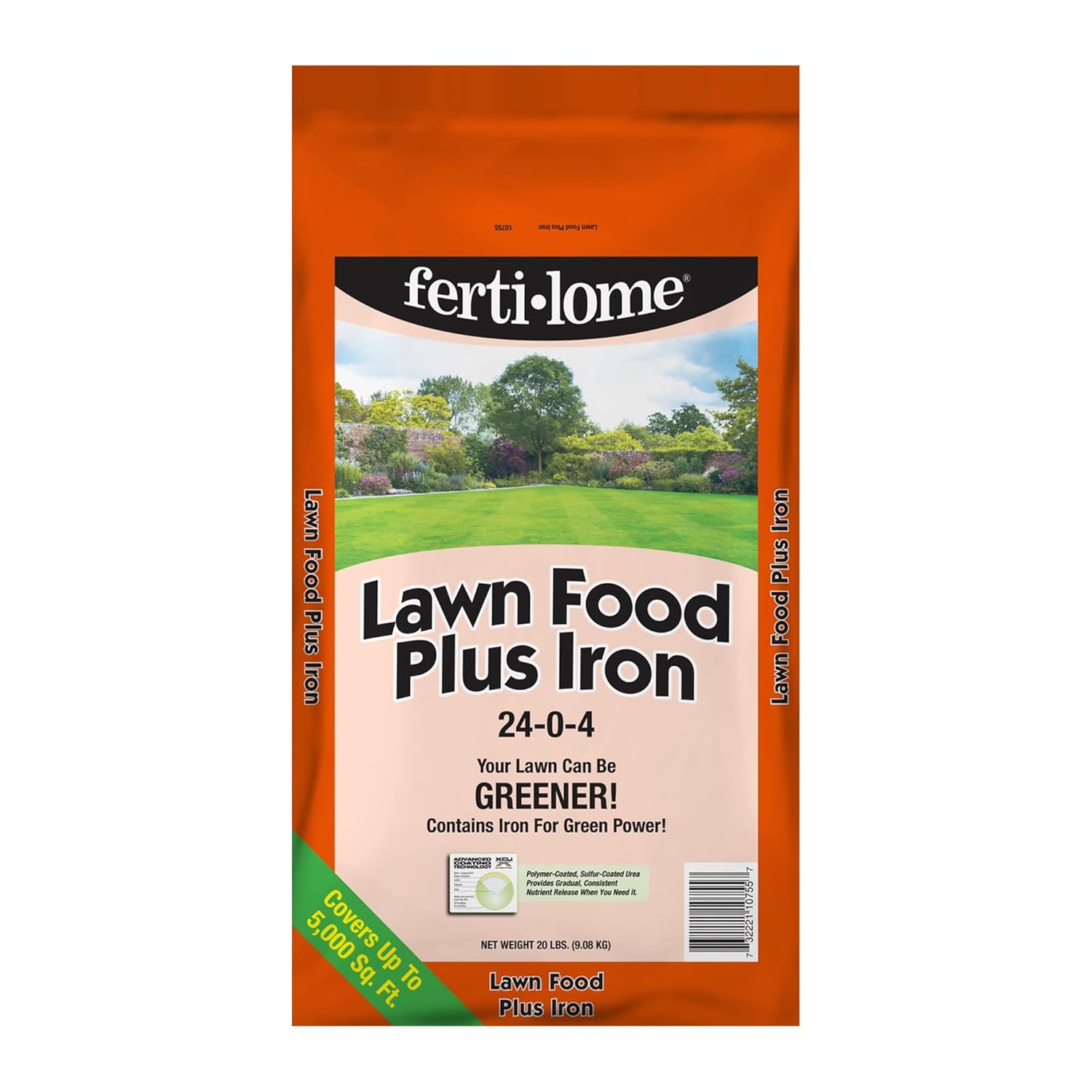
ferti-lome Lawn Food Plus Iron, Granules, 24-0-4 (20 lb) – Covers up to 5,000 sq ft
| Item Form | Granules |
|---|---|
| Application Method | broadcast spreader |
| Coverage | Full |
| Mixing Ratio | 24-0-4 |
| Target Species | lawns |
This granular lawn food combines quick-release nitrogen with polymer-coated slow-release nitrogen plus chelated iron to produce both immediate greening and longer-term, steady growth. It is applied with a broadcast spreader at the recommended rate and watered in, so typical use is a spring or early-summer feeding to revive stressed turf and address pale or brown patches. The added micronutrients (zinc, copper, manganese and boron) support overall plant health and can help improve recovery from localized damage. Because it covers up to 5,000 square feet per bag, it suits routine maintenance on medium to large yards and reduces the need for frequent spot treatments. Limitations to note are that it is a general-purpose lawn food rather than a targeted brown-spot fungicide, so very localized disease problems may require additional diagnosis and treatment, and broadcast application means care is needed to avoid overlap or runoff near sensitive plantings.
Best for: Homeowners who prioritize dependable, low-maintenance lawn feeding to restore color and promote steady recovery across medium to large turf areas.
Less Ideal for: Gardeners seeking a targeted treatment for confirmed fungal brown spots or those with very small lawns who prefer spot treatments or liquid feeds.
- Combines fast-release and slow-release nitrogen for immediate green-up and sustained feeding
- Chelated iron delivers quick improvement in leaf color
- Includes multiple micronutrients to support turf recovery and vigor
- Covers up to 5,000 sq ft per bag, reducing reapplication frequency
- Not a fungicide and will not directly cure fungal brown-spot diseases
- Requires a broadcast spreader and watering in for best results
Verdict: A reliable, easy-to-apply granular lawn food that delivers fast green-up and sustained feeding to restore color and density across larger yards.
Scotts Turf Builder WinterGuard Fall Lawn Food, 10 lb.

| Item Form | Granules |
|---|---|
| Specific Uses For Product | Lawn Fertilizer |
| Application Method | spread |
| Coverage | 4000 |
| Target Species | lawn grasses |
Scotts Turf Builder WinterGuard is a granular fall lawn food designed to build strong, deep roots and help turf recover from summer heat, drought, and regular wear. It is applied with a broadcast or drop spreader over a lawn in autumn and can be used on any grass type. The bag covers about 4,000 sq. ft., and the package directions include recommended spreader settings and note that watering-in is optional for fast results. In practice this product provides a straightforward, DIY-friendly way to add nutrients before winter; the granules are easy to spread and work with standard spreaders. Notable features are its all-grass compatibility and clear application guidance. Limitations are that it is a single-season bag sized for small to medium yards and it does not include weed or insect control functions found in some other Scotts formulas, so you may need additional products if those issues are a concern. For homeowners wanting a simple autumn boost to root strength, this is an effective, no-frills option.
Best for: Homeowners who want a simple, reliable fall fertilizer to strengthen roots and help lawns recover from summer stress without complicated application steps.
Less Ideal for: People managing large lawns who need wide-coverage bulk fertilizer or those who want combined weed or insect control in the same product.
- Formulated specifically for fall to build deep, winter-ready roots
- Works on all grass types so it fits mixed lawns
- Clear application instructions and spreader settings for easy DIY use
- Covers 4,000 sq. ft. from a single 10 lb. bag for small to medium yards
- No built-in weed or insect control so additional products may be needed
- Single 10 lb. bag may be small for larger properties
Verdict: Choose this bag if you want an easy-to-apply fall fertilizer that strengthens roots and helps your lawn recover before winter.
Choosing the Right Fertilizer for Brown Spots on Lawn: Key Factors to Consider
Nutrient Ratio and Micronutrients
The proper balance of nitrogen, phosphorus, and potassium determines whether a fertilizer will correct the common causes of brown spots or simply green the blades briefly. Nitrogen promotes leaf color and growth, phosphorus supports root repair in damaged areas, and potassium helps stress tolerance. Micronutrients such as iron and manganese can correct localized chlorosis that looks like brown or yellow patches. Choosing a formula with the right ratio for your lawn's condition will affect both how quickly color returns and whether the repair is sustained.
Applying a high-nitrogen-only product may produce a quick green-up but can leave roots shallow and the lawn vulnerable to recurring spots. For patch repair, a balanced feed or a starter formula with some phosphorus is often more effective at reestablishing plant vigor than nitrogen-only sprays.
Formulation Type and Practicality
Granular products are easy to spread for larger damaged areas and provide steady nutrient release, while liquid fertilizers act fast and are convenient for small spot treatments. Controlled-release granules reduce the risk of burning and deliver nutrients over weeks, which helps roots recover without forcing sudden top growth. Soluble powders and concentrates are useful when you need immediate color or are combining fertilization with watering or reseeding.
Consider how the formulation fits your tools and schedule. If you plan repeated spot applications, liquids or hose-end mixes may be faster. For a one-time repair that coincides with routine feeding, a granular controlled-release product can be lower maintenance.
Application Safety and Burn Risk
Applying too much fertilizer or using the wrong concentration can scorch grass and turn small brown spots into larger problems. Products with high salt indexes or fast-release urea are the riskiest on stressed turf. Look for formulations labeled safe for spot treatment or designed for high-stress situations. Instructions about watering in after application are important because proper irrigation helps dissolve granules and move nutrients into the root zone while limiting surface concentration.
Spot treating near sidewalks, plantings, and sensitive grass varieties requires extra care with spreader calibration or hand-application methods to avoid uneven dosage. Safety also means choosing formulations that will not harm pets or children if the lawn is used soon after treatment; check re-entry guidance on product labels.
Compatibility with Overseeding and Repair
If brown spots are being repaired with seed or sod, fertilizer choice affects germination and establishment. Starter fertilizers or formulations with a balanced N-P-K and added phosphorus can support young roots and improve seedling vigor. Some quick-release high-nitrogen feeds can discourage seedling root development or burn new shoots if applied too strongly.
Plan timing so the fertilizer supports whichever repair method you use. When overseeding, choose a product recommended for new seed or follow label rates that are safe for young grass; when laying sod, prioritize root-building nutrients and moderate nitrogen to encourage root anchorage rather than immediate shoot growth.
Timing and Lawn Stress Factors
Seasonal timing matters because grass responds differently in spring, summer, and fall. Warm-season lawns and cool-season lawns have distinct growth windows, and applying the wrong feed at the wrong time can worsen brown spots. Heat and drought stress amplify burn risks, so during hot, dry periods choose slow-release options or postpone feeding until cooler weather or after irrigating.
Assess environmental stressors such as shade, compaction, or pests before relying on fertilizer alone. Brown spots caused by disease, pests, or pet urine will not be solved by nutrients alone; correct timing and complementary cultural fixes increase the odds that fertilizer will restore patchy turf.
Coverage Method and Cost Per Area
How you plan to apply the fertilizer influences both results and overall cost. Broadcast spreaders are efficient for treating whole lawns, while handheld spreaders, shaker bottles, or watering-can mixes are better for precise spot applications. Coverage efficiency affects how many applications you need and whether product waste will be an issue when treating scattered brown spots.
Estimate the treated area before purchasing and choose a product size and application method that minimizes waste. Some concentrated liquids or soluble powders can be diluted to cover larger areas, but mixing accuracy is important to avoid under- or over-application.
Diagnosing Brown Spots Before Fertilizing
Not every brown patch responds to fertilizer. Begin by checking for signs of pests, disease, pet urine, or mechanical damage. Pull back turf to inspect roots and soil moisture, and note whether patches are circular, irregular, or follow a pattern that suggests an animal or irrigation issue.
If the problem seems nutritional, a soil test is the most reliable way to identify deficiencies or pH extremes. Low phosphorus or iron deficiency often shows localized symptoms that fertilizers can correct, while issues like poor drainage require cultural fixes before fertilizing.
- Look for bite marks, thinning, or fungal fruiting bodies to rule out pests and disease
- Check soil moisture and compaction around affected spots
- Consider a simple soil test to check pH and available nutrients
Spot Treatment Techniques
For small, isolated patches, apply a measured dose directly to the area rather than treating the whole lawn. Use a hand spreader or a small scoop to control the amount and avoid overlap onto healthy grass. After application, water lightly to move nutrients into the root zone unless the product label advises otherwise.
For larger or numerous patches, treat broader zones to avoid a mottled appearance as grass recovers at different rates. Follow label directions for rate and frequency, and avoid reapplying too quickly if you see temporary green-up followed by stress.
- Measure affected area and calculate product needed to avoid over-application
- Water in after application per label to reduce burn risk
- Stagger treatments to allow roots time to respond between applications
Combining Fertilizer with Cultural Repairs
Fertilizer works best alongside practices that address the underlying cause. Aerating compacted lawn, adjusting irrigation patterns, and dethatching can improve root access to nutrients and water. When pet spots are frequent, neutralizing agents and more frequent, light watering after fertilizing can help distribution without harming nearby turf.
If you are overseeding, loosen soil, rake lightly, and apply a starter feed designed for seedlings. Pairing the right fertilizer with proper seedbed preparation greatly increases the chances that brown areas will fill in and remain healthy.
- Aerate compacted areas before applying deeper-feeding products
- Correct irrigation coverage to avoid dry spots or pooling
- Coordinate fertilization timing with seeding or sod installation
When Fertilizer Is Not the Solution
Some brown spots are caused primarily by fungi, insect damage, or chemical injury, and adding fertilizer can mask symptoms without fixing the problem. If you see rapidly expanding patches or signs of disease cycles, address the specific stressor first. Fungicide or pest control and cultural changes may be necessary before nutrients will have a lasting effect.
Also consider soil pH problems. If pH is too high or too low, many nutrients become unavailable and fertilizer alone will not correct the deficiency. A soil test and pH adjustment plan are often the right first steps for stubborn brown areas.
- Investigate disease or insect activity before applying more fertilizer
- Test soil pH if patches persist despite feeding
- Avoid over-fertilizing in hopes of masking non-nutritional issues
Maintenance Feeding to Prevent Recurrence
After brown spots recover, a maintenance schedule helps prevent future patches. For many lawns, moderate, seasonally timed feedings with a balanced or slow-release fertilizer support root strength and stress tolerance. Avoid frequent high-nitrogen quick feeds unless rapid color is needed for a special occasion.
Maintain good mowing, watering, and soil health practices to reduce the need for corrective spot treatments. Regular observation makes it easier to address small problems before they develop into extensive brown areas.
- Use slow-release products to sustain nutrients between applications
- Adjust feeding schedule to match grass species and seasonal growth
- Monitor lawn health and act early on small discolored areas
How We Chose the Best Fertilizer for Brown Spots on Lawn
We focused on attributes that directly affect recovery of brown turf patches and the long-term health of a lawn. Key evaluation criteria included nutrient balance, specifically the presence and ratio of nitrogen, phosphorus, and potassium and whether micronutrients address common deficiencies. Application method and user safety were assessed to ensure gardeners can apply the fertilizer to patches without burning nearby healthy grass. Speed of visible recovery was considered alongside the risk of causing excessive top growth that leaves roots weak. We also reviewed formulation type for suitability in patch repair, comparing granular, controlled-release, and liquid starter feeds for their practicality in spot treatments. Coverage efficiency and mixability were evaluated to determine how well a product treats irregular patches and integrates with typical garden tools or spreaders. Exclusions included products that are solely herbicides, fungicides, or soil amendments without plant-ready nutrients. We prioritized options that balance fast visible improvement with root-strengthening nutrition and straightforward, safe application practices.
FAQ
How soon will a fertilizer fix a brown spot?
Visible green-up can appear within a week with liquid or fast-release fertilizers, but full recovery that includes root rebuilding often takes several weeks. The timeline depends on the cause of the spot, the formulation used, and environmental conditions.
Can I apply fertilizer directly to pet urine spots?
Fertilizing pet urine spots can help only after salts are diluted and the area is rebalanced. Rinse the area with water before applying fertilizer and choose a formulation with low burn risk. Replacing heavily damaged turf with new seed or sod may be needed in severe cases.
Will too much fertilizer make brown spots worse?
Yes, over-application or using high-salt, quick-release products can scorch stressed turf and enlarge brown areas. Always measure treated area and follow label rates, and water in as recommended to reduce surface concentration.
Should I test my soil before buying a fertilizer?
A soil test is a useful diagnostic step because it identifies nutrient deficiencies and pH issues that influence product choice. Testing helps you choose a formula that supplies the lacking nutrients rather than applying unnecessary or unhelpful feeds.
Is there a best time of year to treat brown spots?
Timing depends on grass type. Treat during active growth periods so plants can use the nutrients to rebuild roots and shoots. Avoid heavy feeding during peak summer heat on cool-season grasses, and time applications to align with spring or fall growth windows when possible.
Final Verdict
When addressing brown spots, prioritize diagnosing the cause, then choose a fertilizer that supplies the specific nutrients needed while minimizing burn risk. Balance fast-acting options for quick improvement with controlled-release or starter-type feeds that support root repair. Consider application method, timing, and complementary cultural repairs so the patch recovers fully and is less likely to return. Focus on steady recovery over instant color and follow label directions carefully. With the right approach you can restore patchy turf and build a stronger, more resilient lawn that resists future brown spots.
