

Note: This article contains affiliate links. If you click on these links and make a purchase, I may earn a small commission at no extra cost to you. This helps support my research and content. Read my full affiliate disclosure here.
If you grow boxwood hedges, topiary, or specimen Buxus in beds and containers, the right fertilizer makes a visible difference in leaf color, density, and winter hardiness. You want steady, even growth without excessive shoot surge that wrecks shape, and you need a formula that reduces salt buildup in tight root zones. This guide shortlists five top fertilizers for Buxus and explains how each one performs across the needs most gardeners care about: nutrient balance, release pattern, and ease of application. Read on to understand which formula matches your planting situation and maintenance rhythm.
Top Picks at a Glance
| Best Quality Built to a higher standard if you want something more solid | Osmocote Smart‑Release Plant Food Plus Outdoor & Indoor, 2 lb |  |
| Best Value The sweet spot between price and what you get | TOPBUXUS Turbo Grow Boxwood Fertilizer (Granules) |  |
| Highest Rated A top-rated pick with lots of positive feedback | EB Stone Tree & Shrub Food, Organic Granules, 4 lb |  |
| Most Popular A crowd favorite that many people choose with confidence | Jobe's Slow Release Tree and Shrub Fertilizer Spikes, 15 Count |  |
| Best Seller A high-volume bestseller chosen again and again | Jobe's Organics Granular All Purpose Fertilizer, 4 lb |  |
Osmocote Smart‑Release Plant Food Plus Outdoor & Indoor, 2 lb

| Item Form | Granules |
|---|---|
| Application Method | Sprinkle |
| Target Species | All plants |
| Mixing Ratio | 1 capful (3 tablespoons) per 2 gallons soil or per 4 sq. ft. |
| Unit Count | 32 Ounce |
Osmocote Smart‑Release Plant Food Plus is a granular, resin‑coated fertilizer designed to feed flowers and other plants steadily for up to six months with 11 essential nutrients. You apply it by sprinkling the recommended amount into the top inch or two of potting mix or garden soil, watering it in, and reapplying every six months; indoor plants use about half the outdoor rate. The resin coating times nutrient release to moisture and temperature, which reduces the need for frequent feedings and lowers the risk of fertilizer burn when used as directed. It works across containers, raised beds, and in‑ground flower beds and covers up to roughly 75 square feet per 2 lb container. Limitations are that a single 2 lb container is only enough for small gardens or several pots, and the slow‑release formula is not suitable when an immediate corrective boost is needed for acute nutrient deficiencies. For gardeners focused on steady, maintenance feeding for flowering plants this is an easy, low‑effort option.
Best for: Gardeners who want reliable, low‑maintenance feeding for flowers and mixed plantings and prefer a consistent supply of nutrients over months rather than frequent liquid feedings.
Less Ideal for: Growers who need fast corrective feeding for visible nutrient deficiencies or those managing very large beds who want bulk fertilizer options to reduce trips to reapply.
- Feeds continuously up to six months with a single application
- Resin coating times nutrient release to plant needs based on moisture and temperature
- Formulated with 11 essential nutrients suitable for a wide range of flowering plants
- No-burn pledge when used as directed reduces risk of overfeeding
- 2 lb container only covers about 75 sq. ft., so frequent repurchase is needed for larger gardens
- Slow‑release formulation does not provide a rapid corrective nutrient boost
Verdict: Choose this product if you want a hands-off, long‑lasting fertilizer that keeps flowering plants fed for months with a single application.
TOPBUXUS Turbo Grow Boxwood Fertilizer (Granules)

| Item Form | Granules |
|---|---|
| Specific Uses For Product | Root Development |
| Application Method | Sprinkle |
| Coverage | 100 square feet |
| Mixing Ratio | 13-3-13 |
TOPBUXUS Turbo Grow is a granular fertilizer made for boxwood that delivers a quick nutrient boost when sprinkled into the soil around plants. It is typically applied three times during the boxwood growing season to support the species' natural growth spurts and to correct leaf yellowing. The formula (NPK 13-3-13 with added magnesium, sulfur, and calcium) supplies higher nitrogen for leafy growth while supporting root uptake through root-directed application rather than foliage spraying. Because it is fast acting rather than slow release, you should see color and vigor improvements sooner, which is useful for corrective feeding or timed growth pushes. Practical benefits include straightforward application by hand, clear coverage guidance, and a mix ratio provided for dosing. Limitations are that it is a corrective, not maintenance, product for those who prefer very slow, low‑maintenance feeding, and it must be applied to soil not foliage which requires careful placement to avoid waste or burn if overapplied.
Best for: Gardeners who want a practical, results‑focused fertilizer to correct yellowing and stimulate seasonal growth in boxwood and who prefer scheduled, hands‑on feeding.
Less Ideal for: People seeking a hands‑off, once‑a‑year slow‑release solution or those who prefer foliar feeds for rapid spot treatment.
- Formulated specifically for boxwood for targeted nutrition
- Fast‑acting granules that deliver visible results sooner than slow‑release feeds
- Includes magnesium, sulfur, and calcium to address yellowing and nutrient balance
- Simple sprinkle application with clear coverage guidance (100 sq ft per listed amount)
- Not a slow‑release maintenance fertilizer so requires multiple seasonal applications
- Must be applied to the soil under plants rather than broadcast on foliage which takes more careful placement
Verdict: Use TOPBUXUS Turbo Grow when you want a fast, targeted soil application to revive boxwood color and spur seasonal growth.
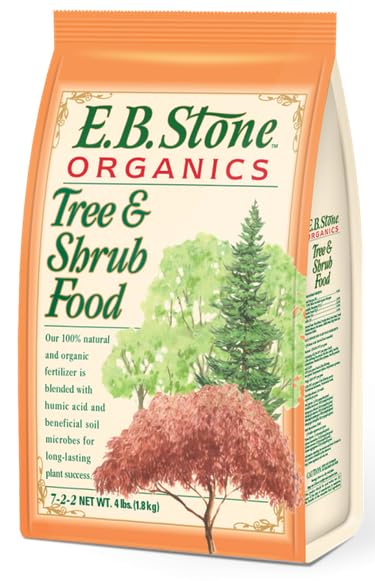
EB Stone Tree & Shrub Food, Organic Granules, 4 lb
| Item Form | Granules |
|---|---|
| Specific Uses For Product | Landscape,Organic |
| Coverage | Medium |
| Target Species | trees and shrubs |
| Mixing Ratio | 7-2-2 |
This organic granular tree and shrub food supplies nitrogen, phosphate, and potash in a 7-2-2 mixing ratio and is designed for routine feeding of woody landscape plants. Applied around the root zone and watered in, the granules release nutrients to support leafy growth, flowering, and overall vigor; the included humic acid and mycorrhizae aim to improve soil biology and nutrient uptake. It works well for maintenance feeding of boxwood (Buxus) where steady, moderate nitrogen is desired to keep foliage dense and green without forcing excessive leggy growth. The product is easy to handle and has medium coverage suitable for several small shrubs or a few larger specimens per 4 pound bag. Limitations are the small package size for larger landscapes and that the N-P-K is weighted toward nitrogen, so you may need supplemental phosphorus if soil tests show a deficiency. This is a straightforward, organic-friendly option for gardeners who want dependable, biologically minded feeding for established shrubs.
Best for: Gardeners who prioritize reliable, organic maintenance feeding for established shrubs and want a product that boosts foliage density and soil biology without complex application.
Less Ideal for: Those managing large landscapes who need bulk fertilizer or gardeners seeking a high-phosphorus formula for correcting soil deficiencies.
- Organic granular formula with humic acid and mycorrhizae to support soil biology
- Nitrogen-rich 7-2-2 ratio promotes dense green foliage useful for evergreen shrubs
- Granules are simple to apply around root zones and can be incorporated into routine maintenance
- Medium coverage suitable for feeding multiple small shrubs from a single bag
- Small 4 lb package may require frequent repurchasing for larger gardens
- Low phosphorus content may not correct existing P deficiencies
Verdict: A dependable organic granular fertilizer that reliably promotes dense green growth and soil health for boxwood and other shrubs.
Jobe's Slow Release Tree and Shrub Fertilizer Spikes, 15 Count

| NPK | 16-4-4 |
|---|---|
| Application method | Insert spikes into soil |
| Coverage | 15 fertilizer spikes |
| Target species | Tree and Shrub |
Jobe's Tree and Shrub Fertilizer Spikes are premeasured slow-release sticks designed to deliver nutrients directly to the root zone with minimal effort. You insert the spikes around the drip line in early spring and again in late fall; the 16-4-4 NPK blend derived from feather and bone meal supplies steady nitrogen and modest phosphorus and potassium over the growing season. For a Japanese maple this means easier maintenance and reduced risk of surface burn or overfertilizing compared with granulars or liquid feeds. The spikes cut down on mess and runoff and are simple to place with the included plastic caps and a hammer. Limitations are that the fixed NPK ratio may not match specific soil test recommendations and the spikes only treat the area where they are placed, so larger trees or uneven root spread may need more spikes or supplemental feeding. Also they require two timed applications per year rather than continuous top-dressing.
Best for: Buyers who want a low-effort, no-mess way to keep small ornamental trees like Japanese maples fed twice a year and prefer targeted root feeding over frequent applications.
Less Ideal for: Gardeners who follow detailed soil test recommendations, need adjustable nutrient ratios, or manage very large trees with wide root zones should consider granular or liquid options instead.
- Direct root-zone delivery reduces surface waste and runoff
- Slow-release 16-4-4 formula provides season-long nutrient supply
- Premeasured spikes are easy to place and minimize mess
- Safe for use around lawns, children, and pets when used as directed
- Fixed NPK ratio may not match soil-specific needs
- Coverage is localized so large or irregular root systems may need extra spikes
Verdict: A simple, low-maintenance way to feed Japanese maples by delivering slow-release nutrients directly to the root zone with two seasonal applications.
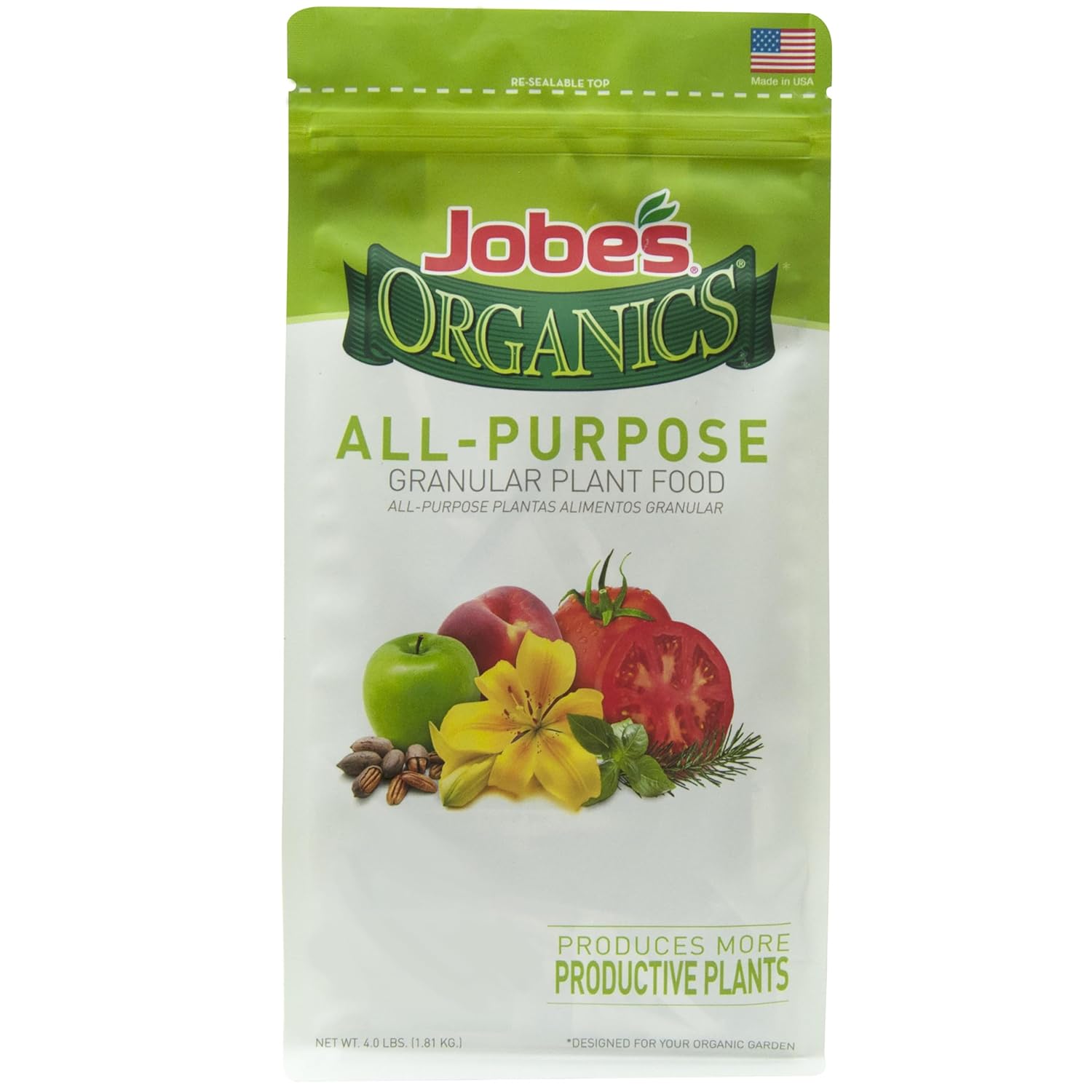
Jobe's Organics Granular All Purpose Fertilizer, 4 lb
| Item Form | Granules |
|---|---|
| Specific Uses For Product | Gardening |
| Coverage | Resealable |
| Mixing Ratio | 4-4-4 |
Jobe's Organics Granular All Purpose Fertilizer is a slow-release, OMRI-listed granular fertilizer designed for routine feeding of garden plants including young trees. You apply measured amounts around the root zone, water it in, and repeat every 2 to 3 weeks during the growing season. The 4-4-4 NPK balance with added calcium, magnesium, and sulfur supplies steady, mild nourishment without the burn risk of high-strength synthetic feeds, and the organic feedstocks encourage soil microbial activity that helps young root systems access nutrients. The resealable bag and granular form make it easy to portion and store, and directions are straightforward for gardeners who prefer repeat, low-effort applications. Limitations are that it is a light-strength general feed, so very nutrient-deficient soils or trees with established nutrient needs may require supplemental feeding or a specialized tree formula for faster correction. Also, granular organics act more slowly than soluble fertilizers, so expect gradual improvement rather than immediate greening.
Best for: Gardeners who prioritize safe, repeatable organic feeding and want a low-risk, easy-to-use fertilizer to support establishing root systems in young trees and mixed garden beds.
Less Ideal for: Users seeking fast, dramatic nutrient correction or a tree-specific high-nitrogen formulation for rapid canopy growth should consider more targeted or soluble products.
- USDA OMRI-listed organic formula suitable for organic gardening
- Balanced 4-4-4 NPK plus calcium, magnesium, and sulfur for steady, mild feeding
- Granular slow-release form reduces burn risk and supports soil microbes
- Resealable bag and simple application instructions make dosing and storage easy
- Lower NPK strength means slower visible results compared with soluble or high-N fertilizers
- Not targeted specifically to young trees so may need supplemental fertilization for deficient soils
Verdict: A gentle OMRI-listed granular fertilizer that is a practical, low-risk choice for regularly feeding young trees and maintaining soil health.
Choosing the Right Fertilizer for Buxus: Key Factors to Consider
Nutrient Balance and NPK Ratio
Buxus responds best to a balanced nutrient profile that supports steady foliage production rather than rapid, leggy growth. A moderate nitrogen level maintains leaf color and density, while available phosphorus and potassium support root health and winter resilience. Too much nitrogen can force soft shoots that are susceptible to cold or disease, and too little will lead to pale, sparse foliage. When evaluating labels, look for products that specify both immediate-available nutrients and any slow-release nitrogen source. Consider micronutrients as well; iron and manganese are often important for avoiding chlorosis in compact soils.
Release Pattern and Timing
How a fertilizer releases its nutrients affects pruning schedules and seasonal form. Slow-release or controlled-release formulations provide steady feeding over weeks to months, reducing the risk of sudden flushes that alter hedge shape and require extra trimming. Water-soluble feeds give quick green-up for recovery after stress but are better used sparingly. Match release pattern to your maintenance: minimal intervention gardeners benefit from longer-release granules, while those who correct color problems mid-season may prefer soluble options for targeted treatments. Also check label guidance for feeding frequency near dormancy and active growth periods.
Salt Index and Root Safety
Boxwood roots sit in tight, often compact root environments, so fertilizers with a high salt index or heavy chloride content can cause root burn and leaf scorch. Lower-salt formulations and those designed for woody ornamentals reduce that risk. For container-grown Buxus, salts can accumulate faster because of limited soil volume and more frequent watering cycles. Look for products that advertise low chloride, slow nutrient release, or are formulated for shrubs and evergreens to protect root tissue and maintain leaf integrity.
Application Method and Practicality
The physical form of the fertilizer affects how easy it is to use across hedges, individual specimens, and containers. Granules are simple for broadcast feeding around a hedge root zone and for incorporation into surface mulches. Water-soluble powders let you target individual plants quickly but require measuring and mixing. Spikes or tablets are tidy for containers and individual specimens but may be less practical for long runs of hedging. Consider how much time you have for routine feeding and whether you need a product that is easy to measure and apply precisely.
Compatibility with Soil and Mulch
Soil texture and mulching practice influence how nutrients move to roots. In heavy clay, nutrients stay near the surface and require surface-applied granules to be watered in properly. In free-draining sandy soils, more frequent, lower-dose applications can prevent leaching losses. Organic mulches slow release and improve cation exchange capacity, which interacts with fertilizer choices. If you use compost or slow-release organic fertilizers regularly, you may need to reduce supplemental rates to avoid overfeeding. Check compatibility notes and adjust application timing based on soil moisture and mulch depth.
Suitability for Containers and Small Spaces
Container-grown boxwood has a much smaller root volume than in-ground plants, so nutrient concentration and watering schedules must be managed carefully. Slow-release pellets designed for pots or measured soluble feeds help avoid hot spots and salt buildup. Containers often need more frequent but lower-dose feedings because of faster nutrient depletion and leaching from regular watering. Also think about ease of feeding in restricted spaces and whether a product allows for surface application without disturbing roots or existing topdressing.
Feeding Schedule for Different Growth Stages
Establish a seasonal feeding rhythm that matches boxwood growth patterns. Apply a light, balanced feed in early spring as new shoots begin to form, then follow with slow-release maintenance through the growing season. Avoid high-nitrogen boosts late in the season to reduce risk of soft growth entering cold months.
For newly planted Buxus, apply a gentler, low-rate starter feed to support root establishment rather than forcing quick top growth. Established hedges benefit from a single measured application of slow-release fertilizer in spring and a lighter touch mid-summer if foliage looks pale.
- Spring: slow-release granules after soil warms
- Early summer: targeted soluble feed only if needed
- Late summer to fall: avoid high nitrogen applications
Feeding Boxwood in Containers Vs In-Ground
Containers need more attention because nutrients leach faster and salts build up more quickly. Use products labeled safe for containers or reduce granular rates and flush pots occasionally with water to prevent accumulation. Spikes and measured tablets work well in pots but are inefficient for long hedges.
In-ground Buxus in fertile beds can often be maintained with annual slow-release feeding and an organic mulch layer. Test soil periodically to adjust feeding frequency and consider localized topdressings for hedgerows rather than wholesale broadcast applications near ornamentals.
- Containers: lower dose, more frequent feeding, occasional flushing
- In-ground: single spring application often sufficient with organic matter
Addressing Chlorosis and Pale Foliage
Pale or yellowing leaves can indicate iron or manganese deficiency, tight soil pH, or overwatering rather than general nutrient shortage. A chelated iron supplement or a specially balanced foliar feed can correct minor chlorosis quickly, but persistent issues warrant a soil pH test and drainage review.
When treating chlorosis, apply corrective feeds cautiously and follow label directions. Rapid correction with high-nitrogen products can mask the underlying issue while causing unwanted succulent growth that alters formal shapes.
- Try a chelated iron product for quick leaf color improvement
- Test soil pH if chlorosis persists
Integrating Fertilizer with Pruning and Pest Management
Timing fertilizer applications around pruning cycles helps maintain form. Feed after major pruning is complete so new shoots emerge in a controlled way, not immediately before a heavy prune. Avoid heavy feeding during active pest outbreaks; vigorous new growth can attract some pests or stress plants coping with infestation.
When combining fertilizer with pesticide or fungicide treatments, space applications to prevent chemical interactions. Always follow label guidance on tank mixes and application intervals to protect plant health.
- Feed after major pruning, not immediately before
- Avoid heavy fertilizing during active pest pressure
Organic Vs Synthetic Options for Boxwood
Organic fertilizers release nutrients more slowly and improve soil structure over time. They are gentler on root systems and reduce salt buildup risk, making them attractive for Buxus grown in containers or compact soils. Expect slower visual responses compared with synthetic soluble feeds.
Synthetic slow-release formulas give more predictable nutrient timing and are available in low-salt blends tailored for woody shrubs. Choose based on how quickly you need a visual response and whether improving long-term soil health is a priority.
- Organic: improves soil life, slower visual change
- Synthetic slow-release: predictable timing, often lower immediate salt
How We Chose the Best Fertilizer for Buxus
We shortlisted fertilizers that are well suited to the growth habit and sensitivity of Buxus by applying a strict set of editorial filters. We prioritized nutrient balance, looking for formulas with an appropriate nitrogen to phosphorus to potassium ratio that encourages leaf retention and color without forcing excessive soft growth. Release pattern was essential; we favored slow-release or controlled-release options and granular mixes that minimize flushes of growth that disrupt pruning schedules. Salt index and chloride content were evaluated because boxwood roots are sensitive to salt buildup in compact soils and containers. Ease of application and measurement mattered for routine maintenance on hedges, standards, and pots. Finally, we considered formulation versatility for different planting situations, including granular, water-soluble, and measured spike or tablet options. We excluded any product types that are high-chloride, labeled primarily for annuals or rapid flush growth, or unsuitable for woody evergreen shrubs. We also filtered out fertilizers that require specialized equipment to apply. The criteria that determined inclusion and ranking are reflected in the scoring metrics used throughout the guide.
FAQ
How often should I fertilize established boxwood hedges?
Most established Buxus do well with one measured application of slow-release fertilizer in spring and a light top-up only if foliage shows paleness later in the season. Frequency depends on soil fertility and planting density.
Can I use general shrub fertilizer on Buxus?
Often yes, provided the formula is low in chloride and offers a moderate nitrogen level appropriate for evergreen shrubs. Avoid products designed for fast-flowering annuals that push rapid leafy flushes.
What is the safest feed for potted boxwood?
Low-dose slow-release granules formulated for containers or measured soluble feeds at lower concentration are safest. Also flush pots periodically to prevent salt buildup from repeated feedings.
Will a high-nitrogen fertilizer help if my boxwood looks thin?
High nitrogen can prompt rapid but soft growth that may temporarily fill gaps, but it can reduce winter hardiness and increase pruning needs. Investigate underlying causes like soil compaction, pests, or disease before relying on high-nitrogen treatments.
How do I treat leaf yellowing on boxwood?
Leaf yellowing can stem from nutrient deficiency, poor drainage, or incorrect pH. Try a chelated iron application for quick improvement and test soil pH if the problem persists. Address drainage or watering practices if roots are waterlogged.
Final Verdict
Choose a fertilizer that matches how you manage your Buxus: slow-release, low-salt options work best for steady, low-maintenance hedges, while targeted soluble feeds are useful for correcting color issues. Prioritize nutrient balance, safe application for containers, and a release pattern that fits your pruning schedule. With the right feeding approach you can keep boxwood dense, green, and structurally sound without encouraging weak, seasonal surges.
