

Note: This article contains affiliate links. If you click on these links and make a purchase, I may earn a small commission at no extra cost to you. This helps support my research and content. Read my full affiliate disclosure here.
Daphne shrubs are prized for their compact form and fragrant flowers, but they can be picky about soil and feeding. Choosing the right fertilizer for daphne matters because these shrubs need a steady, balanced nutrient supply without salt buildup or dramatic pH shifts. In this guide we shortlisted six top fertilizer options that suit common daphne situations, from established garden beds to containers. We evaluated products for nutrient balance, salt content, and how they interact with typical soil pH and drainage. The following picks focus on steady feeding and bloom support; use the evaluation criteria below to match a product to your planting situation.
Top Picks at a Glance
| Best Overall The best all-around choice for most situations | Espoma Organic Holly-Tone 4-3-4 Evergreen & Acid-Loving Plant Food, 4 lb. Bag (Pack of 2) |  |
| Best Quality Built to a higher standard if you want something more solid | SouthernGRO Azalea, Camellia & Gardenia Fertilizer 04-08-08, 4 lb |  |
| Best Value The sweet spot between price and what you get | Cz Garden 4-8-8 Azalea, Camellia, Gardenia & Evergreen Fertilizer (4 lb) |  |
| Best Budget The cheapest option that still gets the job done reliably | Down To Earth Acid Mix Organic Fertilizer 4-3-6, 1 lb |  |
| Most Popular A crowd favorite that many people choose with confidence | Jobe's Organics Azalea, Camellia & Rhododendron Fertilizer Spikes, 10 Count |  |
| Best Seller A high-volume bestseller chosen again and again | Miracle-Gro Water Soluble Azalea, Camellia & Rhododendron Plant Food, 5 lb |  |
Espoma Organic Holly-Tone 4-3-4 Evergreen & Acid-Loving Plant Food, 4 lb. Bag (Pack of 2)

| Item Form | Powder |
|---|---|
| Specific Uses For Product | Organic,Plant Food |
| Application Method | Sprinkle over the root zone and water in |
| Coverage | Medium |
| Target Species | Acid-loving Plants |
Espoma Holly-Tone is a ready-to-use organic fertilizer made for acid-loving plants such as blueberries and raspberries. Supplied as a powder/granular form with an N-P-K of 4-3-4 and added sulfur, it is intended to be sprinkled around the root zone and watered in, providing a slow-release nutrient reservoir that supports blooms and fruiting over the growing season. Its organic ingredients and Bio-tone inoculant are designed to feed plants while improving soil biology, which suits gardeners who prefer low-chemical approaches. Practical benefits include simple application with no mixing, suitability for spring and fall feedings, and certification for organic gardening. Limitations are that it delivers modest nutrient levels per application, so heavy-feeding situations may need more frequent use or supplementary fertilizer, and the medium coverage means larger plantings require multiple bags. For cautious gardeners wanting predictable, organic nutrition for blueberries and raspberries, Holly-Tone offers a reliable, low-risk option that integrates easily into standard care routines.
Best for: Gardeners who prioritize organic, low-risk feeding for acid-loving fruit shrubs and want a simple, no-mix fertilizer to maintain soil health and steady fruiting.
Less Ideal for: Growers managing large commercial patches or plants that need high immediate nutrient boosts should consider higher-analysis or concentrated products instead.
- Organic formula with Bio-tone to support soil biology and gradual nutrient release
- Formulated specifically for acid-loving plants like blueberries and raspberries
- Ready-to-use granular powder that requires no mixing and is simple to apply
- Contains sulfur to help maintain acidic soil conditions favored by target plants
- Low N-P-K ratio means heavier feeders may need additional applications or supplements
- Medium coverage requires multiple bags for larger patches or rows
Verdict: A dependable organic, ready-to-use fertilizer that makes feeding blueberries and raspberries simple while supporting soil biology.
SouthernGRO Azalea, Camellia & Gardenia Fertilizer 04-08-08, 4 lb

| Item Form | Granules |
|---|---|
| Specific Uses For Product | Lawn |
| Application Method | Apply to the plants' root systems |
| Target Species | Azaleas, Camellias, Gardenias |
| Mixing Ratio | 04-08-08 |
This granular SouthernGRO formula is designed specifically for acid-loving shrubs such as azaleas, camellias, and gardenias and is applied directly to the root zone. With a 04-08-08 N-P-K ratio it emphasizes phosphorus and potassium to support blooms and root development while providing modest nitrogen for foliage. The 4 lb bag is easy to handle for backyard beds and the granules let you scatter or spot-apply around individual shrubs. Practical benefits include a targeted nutrient balance for flowering shrubs and simple application instructions that suit seasonal feedings. Important limitations are that it is not intended for container use and the bag size is best for small to medium plantings rather than large landscapes. Also the product lists a medium coverage rather than a precise application rate by shrub size, so careful measuring is needed to avoid overapplication. Overall this is a straightforward, shrub-focused fertilizer for gardeners who want a purpose-made feed to boost blooms and root strength.
Best for: Gardeners who maintain small to medium beds of azaleas, camellias, or gardenias and prefer a ready-made, shrub-specific fertilizer to simplify seasonal feeding.
Less Ideal for: Those tending large landscapes, commercial plantings, or container-grown acid-loving shrubs should consider larger bulk products or formulas labeled for container use.
- 04-08-08 N-P-K ratio tailored to promote blooms and strong root development in acid-loving shrubs
- Granular form allows easy broadcast or spot application to the root zone
- 4 lb bag is convenient and manageable for small to medium shrub beds
- Formulated specifically for azaleas, camellias, and gardenias which simplifies product choice
- Not intended for container use which limits versatility
- No detailed per-shrub application rates listed on the product details may require extra measuring care
Verdict: A small, easy-to-use granular fertilizer formulated to boost blooms and root strength in azaleas, camellias, and gardenias.
Cz Garden 4-8-8 Azalea, Camellia, Gardenia & Evergreen Fertilizer (4 lb)

| NPK | 4-8-8 |
|---|---|
| Intended plants | Azalea, Camellia, Gardenia & Evergreens |
| Net weight | 4 lb |
| Packaging | Resealable pouch |
| Country of origin | USA |
This Cz Garden 4-8-8 formula is a straightforward granular fertilizer aimed at acid-loving shrubs such as azaleas, camellias, gardenias and other evergreens. It is packaged in a heavy-duty resealable 4 lb pouch that makes measuring and storing small amounts convenient for repeat feedings. The 4-8-8 NPK balance emphasizes phosphorus and potassium compared with nitrogen, which supports flowering and root development rather than rapid leafy growth—useful for encouraging blooms without overstimulating foliage. Typical use is surface application around the drip line or lightly worked into topsoil in spring and again during the flowering season, following label rates. Being manufactured in the USA and marketed for ornamental shrubs, it should integrate easily into existing soil amendment plans for acidic soil lovers. Limitations are that the label does not list guaranteed micronutrient levels on the product page and the NPK ratio is moderate so heavy feeders or plants with acute nutrient deficiencies may need supplemental products or soil testing first.
Best for: Buyers who want a simple, shrub-focused fertilizer to promote blooms and root health for acid-loving ornamental shrubs and who prefer easy-to-store packaging for small-scale or container gardening.
Less Ideal for: Large-scale landscapers or gardeners caring for heavy-feeding plants who need high-rate feeds or detailed micronutrient formulations should consider more intensive fertilizer programs.
- NPK ratio (4-8-8) supports flowering and root strength rather than excessive leafy growth
- Resealable heavy-duty pouch makes portioning and storage easy for small gardens
- Formulated specifically for acid-loving shrubs and evergreens
- Manufactured in the USA
- Product details do not specify exact micronutrient guarantees or trace element amounts
- Moderate nutrient levels may require additional amendments for severely deficient soils
Verdict: A practical, shrub-focused 4-8-8 fertilizer in an easy resealable pouch that helps promote flowering and root health for acid-loving ornamental shrubs.
Down To Earth Acid Mix Organic Fertilizer 4-3-6, 1 lb
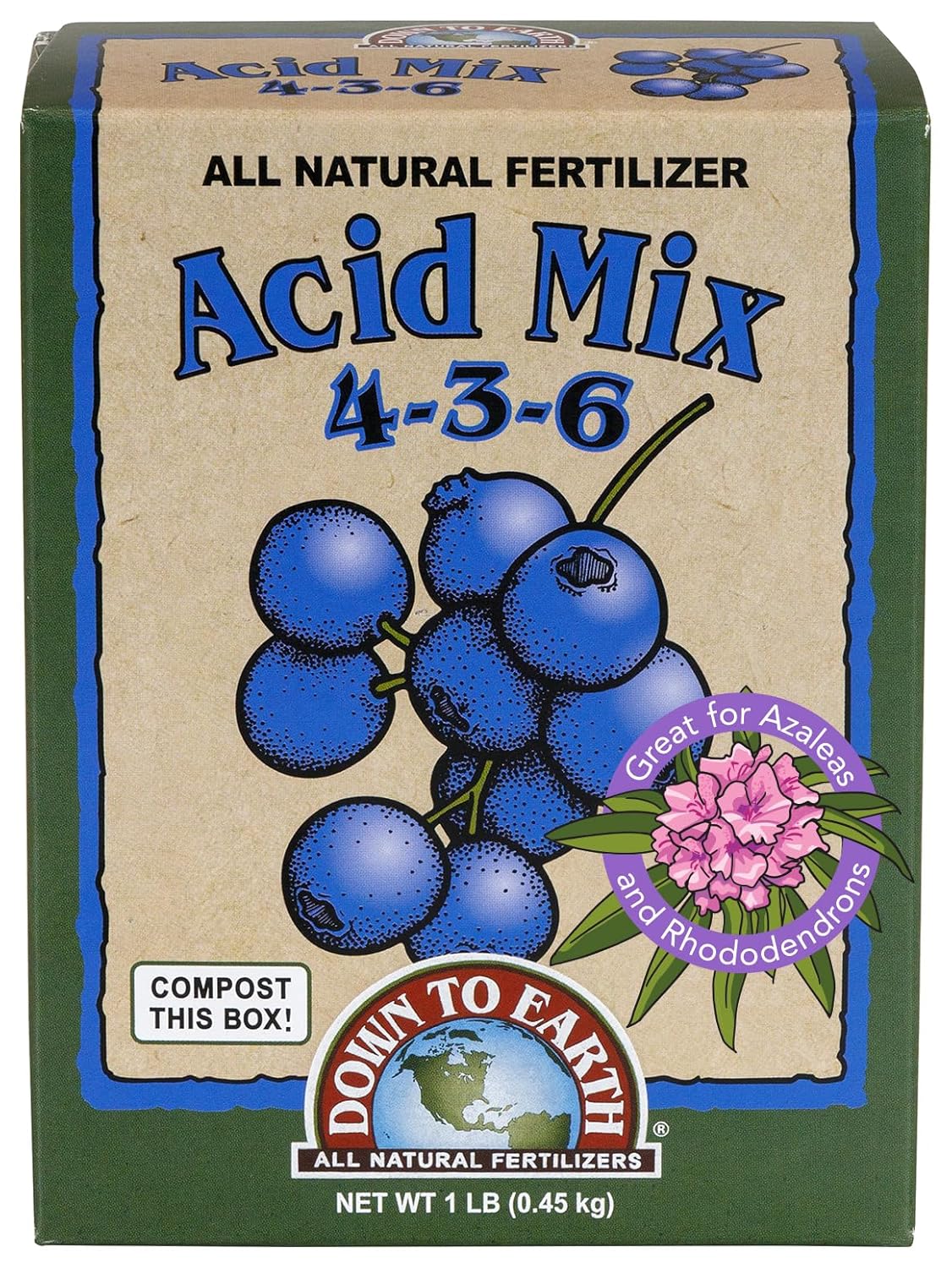
| Item Form | Granules |
|---|---|
| Specific Uses For Product | Acid-loving plants |
| Target Species | rhododendrons, azaleas, hydrangeas, evergreen trees and shrubs, blueberries, raspberries |
| Mixing Ratio | 4:3:6 |
Down To Earth Acid Mix is an organic granular fertilizer designed to feed acid-loving plants such as blueberries, azaleas, rhododendrons and other shrubs. You can broadcast it on the soil surface or mix it into planting holes, then water it in; the manufacturer recommends applications in early spring, at bloom and again in fall to support vegetative growth, flowering and root development. The 4-3-6 formula delivers a higher potassium ratio to help fruiting and overall plant vigor, while slow-release materials like feather meal, fish bone meal and kelp provide longer-lasting nutrition so you do not need to feed frequently. It is shelf stable and OMRI-listed ingredients support organic gardening practices. Limitations to note are the small 1 lb unit size, which means frequent repurchase for larger beds, and that this product is a fertilizer rather than a soil pH fixer so you will still need sulfur or lime to significantly change soil acidity. For gardeners feeding a few blueberry plants or refreshening planting holes, it is an effective, low-fuss organic option.
Best for: Gardeners with a few blueberry plants or small acid-loving beds who want an easy-to-use organic fertilizer and prefer low-maintenance, sustained feeding.
Less Ideal for: Large-scale blueberry plantings or growers who need to change soil pH significantly without using separate amendments.
- Formulated specifically for acid-loving plants including blueberries and azaleas
- Slow-release organic ingredients provide sustained feeding and reduce application frequency
- Can be applied on the soil surface or mixed into planting holes for flexible use
- OMRI-friendly ingredient sources support organic gardening practices
- Small 1 lb package limits coverage for larger beds or multiple bushes
Verdict: A compact, slow-release organic fertilizer tailored for small blueberry plantings and other acid-loving plants to provide steady, low-maintenance nutrition.
Jobe's Organics Azalea, Camellia & Rhododendron Fertilizer Spikes, 10 Count

| Item Form | Sticks |
|---|---|
| Application Method | Spikes |
| Specific Uses For Product | Plant Growth, Root Development, Soil Conditioning |
| Target Species | Azalea, Camellia, Rhododendron |
| Mixing Ratio | 9-8-7 |
These Jobe's Organics spikes are designed to feed acid-loving shrubs like azaleas, camellias, rhododendrons and other similar plants by inserting premeasured sticks into the root zone. Each spike contains a 9-8-7 NPK mix that releases nutrients slowly, which reduces surface runoff and the need for frequent granular or liquid feeding. They are simple to use: push the spikes into the soil around shrubs every 4 to 6 weeks during the growing season, and the waterproof resealable pouch keeps unused spikes dry. Practical benefits include mess-free application, reduced risk of overfertilizing because each spike is portioned, and targeted root delivery that supports bloom production. Limitations are that spikes cover a medium area so larger or densely planted shrubs may need several spikes per plant, and they are specific to acid-loving species so they are not a one-stop fertilizer for mixed beds. Also the spike format is less flexible than a granular or soluble feed if you prefer custom dosing or foliar feeding.
Best for: Ideal for gardeners who want a low-effort, no-mess way to maintain flowering acid-loving shrubs and prefer straightforward, premeasured applications.
Less Ideal for: Not a good fit for gardeners needing a single fertilizer for mixed plantings or those who want precise custom dosing or foliar/soil drench applications.
- Premeasured spikes reduce mess and make dosing straightforward
- Slow-release 9-8-7 NPK delivers nutrients at the roots to support blooms
- Waterproof resealable pouch preserves unused spikes
- Formulated specifically for acid-loving shrubs to match nutrient needs
- Medium coverage per spike means multiple spikes needed for large shrubs
Verdict: A simple, low-mess slow-release spike feed that makes keeping holly and other acid-loving shrubs blooming easy for budget-minded gardeners.
Miracle-Gro Water Soluble Azalea, Camellia & Rhododendron Plant Food, 5 lb

| Item Form | Powder |
|---|---|
| Application Method | watering can or Miracle-Gro Garden Feeder |
| Target Species | Azaleas, Camellias, Rhododendrons, Gardenias, Hibiscus, Hollies, Hydrangeas, Orchids |
| Mixing Ratio | 1:144 (indoor), 1:18 (outdoor) |
| Coverage | Medium |
This water-soluble Miracle-Gro formula is designed specifically for acid-loving shrubs and flowering plants and is straightforward to use: mix into a watering can or fill a Miracle-Gro Garden Feeder and apply every 7 to 14 days while plants are actively growing. It lists a broad target range that includes azaleas, camellias, rhododendrons, gardenias, hydrangeas and even orchids and hibiscus, so you can use one product across much of an acid-loving border or collection. The powder form dissolves for quick uptake and the package provides mixing ratios for indoor and outdoor use, making dose control easy. Practical benefits are fast nutrient delivery and convenience for regular feeding of shrubs and container plantings. Limits to note are that this is a soluble feed meant for routine use rather than long-term slow release so it requires repeat applications, and it assumes you will follow the specified dilution to avoid overfeeding.
Best for: Gardeners who want a reliable, easy-to-apply feed for acid-loving shrubs and mixed container plantings and who are willing to commit to regular watering-can or feeder applications.
Less Ideal for: Those seeking a one-time, slow-release fertilizer or a product they can apply infrequently over months instead of every few weeks.
- Formulated specifically for acid-loving plants like azaleas and rhododendrons
- Water-soluble powder gives fast nutrient availability when mixed and applied
- Clear mixing instructions for indoor and outdoor use simplify dosing
- Works with a watering can or compatible Miracle-Gro Garden Feeder for convenience
- Requires repeated applications every 7–14 days during active growth
- Not a slow-release soil amendment for long-term feeding
Verdict: A straightforward, water-soluble fertilizer that delivers fast, targeted nutrition for acid-loving plants when used regularly.
Choosing the Right Fertilizer for Daphne: Key Factors to Consider
Nutrient Ratio and Bloom Support
Daphne prefers a moderate nutrient supply that supports flowering without excessive vegetative growth. Look for formulas with a balanced N-P-K ratio or a slightly higher middle number to encourage bloom set. Too much nitrogen can push rapid leafy growth at the expense of flowers and can make the plant more susceptible to stress.
Fertilizer labels may list multiple micro-nutrients as well. Trace elements like magnesium, iron, and manganese help when soils are marginal, but they should complement a sensible primary nutrient balance rather than replace it.
Salt Content and Root Sensitivity
Daphne roots are sensitive to soluble salts and can suffer burn or reduced water uptake if salt levels rise. Fertilizers with a low salt index, slow-release granules, or water-soluble mixes designed for ornamentals reduce that risk. Avoid repeated heavy applications and products with high chloride or sodium content.
For container daphnes, rinsing media periodically and using measured doses is especially important because salts concentrate in small volumes of potting mix. In-ground plantings benefit from thorough watering after application to move salts away from roots.
Release Type and Feeding Schedule
Slow-release fertilizers provide steady nutrients and are often safer for daphne than frequent high-strength soluble feeds. They reduce the chance of nutrient spikes and feed across weeks to months, which matches daphne's steady growth habit. Water-soluble feeds can be useful for quick corrections but should be used at reduced strength and frequency.
Consider seasonal needs when planning release type. A balanced slow-release applied in spring supports the growing season while a light top-dressing or targeted soluble feed can help with a weak bloom year. Read label timing to avoid late-season nitrogen that can encourage tender growth before winter.
Soil pH Interaction
Daphne generally prefers slightly acidic to neutral soils. Some fertilizers can alter root-zone pH over time. Choosing a product with neutral pH impact or one that includes pH buffering helps keep nutrients available. If your soil is already very alkaline or very acidic, pick a fertilizer that corrects micronutrient availability rather than shifting pH dramatically.
Testing soil pH before making a long-term feeding plan is useful. For container daphnes, potting mixes vary widely so consider an amendment that stabilizes pH or select a fertilizer formulated for acid-loving ornamentals if test results show benefit.
Application Method and Convenience
How you apply fertilizer affects both safety and results. Granular slow-release products are easy to spread and low-risk for burn when used per label. Water-soluble feeds give precise control but require measuring and frequent applications. Liquid concentrates are convenient for foliar or root drench applications but must be diluted accurately.
Choose a format that fits your maintenance habits and the planting situation. Containers and small specimens often benefit from measured liquid or soluble feeds, while beds and borders are well suited to controlled-release granules that require less frequent attention.
Compatibility With Mulch and Soil Amendments
Mulch and organic amendments influence nutrient release and moisture retention around daphne roots. Thick organic mulches can break down and temporarily tie up nitrogen near the surface, so account for that when planning fertilizer rate and timing. Some fertilizers include slow-release nitrogen that offsets minor tie-up without risking overfeeding.
Also consider if you routinely apply lime, compost, or other amendments. Those inputs change nutrient availability and pH, so coordinate fertilizer choice and timing to avoid conflicting effects. For example, frequent heavy compost applications may reduce the need for high nitrogen fertilizers.
Feeding Schedule by Season
Plan feeding around daphne's active growth and bloom cycle. Apply a balanced, slow-release feed in early spring as growth resumes. Use only light maintenance feeding after bloom; avoid high-nitrogen applications late in the season that encourage tender shoots before dormancy.
For container plants, feed more frequently at reduced strength because potting mixes leach nutrients faster. A light spring top-dressing and two low-strength liquid feeds across the summer will usually keep a container daphne healthy.
- Spring: single balanced slow-release application
- Early summer: optional low-strength liquid feed if blooms were weak
- Late summer/fall: avoid nitrogen-heavy feeds
Adjusting Feeding to Soil Test Results
A soil test gives concrete guidance on pH and nutrient availability. If phosphorus or potassium is low, select a formulation that addresses those deficits rather than increasing nitrogen indiscriminately. Correcting specific deficiencies improves bloom and overall vigor.
If the test shows high soluble salts or excess available nitrogen, reduce or skip applications and focus on improving drainage and organic matter to rebalance the root environment.
- Use test results to prioritize corrective nutrients
- Avoid blanket high-nitrogen feeding when tests show excess
Container Care and Potting Mix Considerations
Container-grown daphnes need different feeding than in-ground shrubs because potting mix has limited nutrient reserve and salts accumulate faster. Choose fertilizers with clear label dilution rates and aim for gentler, more frequent feedings rather than heavy single doses.
Refresh or partially replace potting mix every couple of years to prevent compaction and salt buildup. When repotting, incorporate a balanced slow-release granule designed for ornamentals to provide steady nutrition as roots reestablish.
- Dilute soluble feeds to half strength for regular container maintenance
- Flush containers periodically to prevent salt accumulation
Organic Versus Synthetic Options
Organic fertilizers release nutrients more slowly as microbes break them down, which can match daphne's steady needs and build long-term soil health. They also tend to have lower soluble salt levels. However, organic sources may not correct an acute phosphorus or potassium shortfall quickly.
Synthetic slow-release products offer predictable nutrient release and consistent N-P-K ratios. For gardeners seeking immediate correction or precise dosing, a synthetic slow-release can be a practical choice. Either approach works if matched to soil conditions and application discipline.
- Organics improve soil biology and are gentler on roots
- Synthetic slow-release gives precise and predictable feeding
Avoiding Common Feeding Mistakes
Over-fertilizing is a frequent cause of daphne decline. Excessive nitrogen or repeated heavy applications can cause root stress, fewer blooms, and vulnerability to pests. Always follow label rates and err on the lower side for small or container specimens.
Applying fertilizer directly against the trunk or stem can burn roots. Broadcast granular products evenly around the dripline and use water-soluble feeds diluted and applied to the soil surface. After application, water in gently to move nutrients into the root zone without concentrating salts.
- Never place granules against stems or crowns
- Water in applications to reduce salt concentrations
How We Chose the Best Fertilizer for Daphne
Our shortlist focused on fertilizers that meet the particular habits and sensitivities of daphne shrubs. We prioritized nutrient balance that favors moderate nitrogen with adequate phosphorus and potassium to support bloom set while avoiding flushes of excessive leafy growth. Salt index and soluble salt build-up were evaluated because daphnes dislike high-salt conditions and are prone to root stress in compacted soils. We also considered formulation and release profile. Slow-release and low-salt soluble fertilizers reduce the risk of root burn and provide steady feeding across the growing season. Soil compatibility and pH effects were another filter; products that buffer pH or are neutral in effect scored higher than those likely to raise alkalinity. Application flexibility mattered for container-grown and in-ground daphnes, so ease of measurement and safe label rates were part of our selection. We excluded any products intended only for high-feeding vegetables or with very high nitrogen ratios that encourage soft growth. The final choices reflect nutrient composition, salt safety, release type, soil pH compatibility, and user-friendly application.
FAQ
How often should I fertilize my daphne?
Often a single balanced slow-release application in spring is sufficient for established in-ground plants. Container daphnes usually need lighter, more frequent feeds during the growing season. Frequency depends on fertilizer type and soil tests.
Can I use a general shrub fertilizer on daphne?
Usually yes if the shrub fertilizer has a moderate nitrogen level and a good phosphorus component for blooms. Check that the product is low-salt and appropriate for ornamental shrubs rather than high-nitrogen formulas intended for turf or vegetables.
Will foliar feeding help a daphne with few blooms?
Foliar sprays can supply micronutrients quickly and sometimes correct a short-term deficiency, but they do not replace root-applied phosphorus for bloom set. Use foliar feeding as a supplement after addressing soil nutrient balance.
How do I avoid salt buildup in container plants?
Use measured, reduced-strength liquid feeds and periodically flush pots with generous watering to leach accumulated salts. Repotting or replacing part of the potting mix every couple of years also helps control salt levels.
Should I change fertilizer if my soil is alkaline?
If soil pH is high, choose a fertilizer and amendments that improve micronutrient availability rather than dramatically shifting pH. Amending with acidifying materials may be necessary, but coordinate that with fertilizer choice to avoid conflicting effects.
Final Verdict
Prioritize a fertilizer that delivers steady, balanced nutrients with a low salt risk and a release profile suited to your planting situation. Match the N-P-K and micronutrient content to soil test results and favor slow-release or low-strength soluble options for most daphnes. Weigh tradeoffs between convenience and precision: slow-release granules reduce maintenance and salt spikes, while diluted soluble feeds allow quick correction. Focus on consistent, measured feeding and proper water management to keep daphne healthy and flowering reliably.
