

Note: This article contains affiliate links. If you click on these links and make a purchase, I may earn a small commission at no extra cost to you. This helps support my research and content. Read my full affiliate disclosure here.
If you have an established lawn, choosing the right fertilizer determines whether grass stays dense, disease-resistant, and green through the season. Mature turf needs a different feeding strategy than new seed or sod: the goal is to sustain root strength and leaf quality while minimizing rapid growth that invites pests or scalping. This guide examines seven top options that suit established lawns and explains the factors that matter, such as nutrient ratios, release type, and timing. We shortlisted products that match common lawn situations and tested evaluation criteria like nutrient balance and application ease. Read on to compare approaches and find a feeding plan that fits your lawn care rhythm.
Top Picks at a Glance
| Best Overall The best all-around choice for most situations | The Andersons PGF Balanced 10-10-10 Granular Fertilizer with Micronutrients and 2% Iron (18 lb, 5,000 sq ft) |  |
| Best Quality Built to a higher standard if you want something more solid | The Andersons Professional PGF Complete 16-4-8 Granular Lawn Fertilizer (covers 5,000 sq ft) |  |
| Best Value The sweet spot between price and what you get | Scotts Turf Builder Lawn Food, 37.5 lb. |  |
| Best Budget The cheapest option that still gets the job done reliably | Southern Ag All Purpose Granular Fertilizer 10-10-10 (5 lb) |  |
| Highest Rated A top-rated pick with lots of positive feedback | CountryMax Organic Lawn Fertilizer 36 lb (10-6-4) Slow Release |  |
| Most Popular A crowd favorite that many people choose with confidence | Scotts Turf Builder Lawn Food, 12.5 lb |  |
| Best Seller A high-volume bestseller chosen again and again | Scotts Turf Builder Weed & Feed5 Granular Lawn Fertilizer (33.95 lb) |  |
The Andersons PGF Balanced 10-10-10 Granular Fertilizer with Micronutrients and 2% Iron (18 lb, 5,000 sq ft)

| Item Form | Granules |
|---|---|
| Application Method | spreader |
| Coverage | 5000 square feet |
| Mixing Ratio | 10-10-10 |
| Target Species | Lawns and Gardens |
The Andersons PGF Balanced 10-10-10 is a fine-particle granular fertilizer designed for broad, even coverage across lawns and garden beds. It is typically applied with a broadcast spreader and then watered in to activate the quick-release nutrients. The unusually small particle size means a single 18 lb bag claims coverage up to 5,000 sq ft and helps reduce patchy feeding compared with coarse granules. The formula is balanced for nitrogen, phosphorus and potassium and includes micronutrients plus 2% iron for enhanced greening. It works well for spring and fall applications, for establishing new turf or boosting established lawns, and can be worked into soil for vegetable or flower beds. Users should sweep or blow product off paved surfaces to avoid iron staining and store any leftover in a dry area. Because the fertilizer is quick-release, expect faster visible response but shorter duration between applications than slow-release products.
Best for: Homeowners who prioritize consistent, dependable feeding and want a straightforward granular option that gives quick visible results across lawns and planting beds.
Less Ideal for: Gardeners seeking a long-duration, slow-release feeding program or those who need a no-iron product to avoid any risk of surface staining.
- Very fine particle size for more even coverage and less patchy feeding
- Balanced 10-10-10 formula with added micronutrients and 2% iron for deeper greening
- Suitable for lawns, gardens, trees and shrubs and can be applied at planting or during the season
- Covers up to 5,000 sq ft from a single 18 lb bag when applied as directed
- Quick-release nutrients mean results appear sooner but may require more frequent reapplication versus slow-release formulas
- Contains iron that can stain sidewalks and driveways if not cleaned off immediately
Verdict: Choose this fine-particle 10-10-10 if you want a reliable, fast-acting granular fertilizer that delivers even coverage and deeper greening for summer lawn care.
The Andersons Professional PGF Complete 16-4-8 Granular Lawn Fertilizer (covers 5,000 sq ft)

| Item Form | Granules |
|---|---|
| Specific Uses For Product | Soil Conditioning |
| Target Species | lawn grasses |
| Unit Count | 288 Ounce |
| Mixing Ratio | 4-1-2 ratio |
This granular fertilizer is built to boost turf performance with a 16-4-8 N-P-K ratio that delivers both immediate and extended nitrogen release for up to eight weeks. It is typically applied with a broadcast spreader at the recommended rate on dry foliage, then lightly watered to activate the Humic DG technology that helps nutrients move into the root zone. Notable features include super-fine particles for even coverage, added iron and micronutrients for richer color, and a mix of quick and slow-release nitrogen for steady growth without frequent reapplication. Practical benefits for a performance-focused buyer are visibly greener turf, reduced application frequency, and improved soil conditioning from humic acids. Important limitations are that it is a granular product so precise spreader calibration and steady walking are required for uniform results, and it is not labeled for sale in California which restricts availability in that state.
Best for: Gardeners focused on high-performance, visibly greener lawns who want a single application product that delivers both immediate and extended feeding and supports soil health.
Less Ideal for: Small container gardeners or people who prefer liquid or organic-only fertilizer programs should consider other formats or formulations.
- Balanced 16-4-8 N-P-K with both quick- and slow-release nitrogen for immediate color and sustained feeding
- Super-fine particles designed for even distribution across the lawn
- Includes iron and multiple micronutrients to improve turf color and overall plant nutrition
- Humic DG additive to help move nutrients into the soil and support soil conditioning
- Requires correct spreader settings and consistent walking speed to avoid streaking
- Not available for sale in California
Verdict: Choose this fertilizer when you want a performance-focused granular formula that delivers quick color boost plus up to eight weeks of sustained feeding for greener grass.
Scotts Turf Builder Lawn Food, 37.5 lb.

| Item Form | Granules |
|---|---|
| Specific Uses For Product | Lawn |
| Coverage | 15000 |
| Mixing Ratio | 32:0:4 |
Scotts Turf Builder Lawn Food is a granular, all-purpose lawn fertilizer formulated to thicken and green lawns while building deeper roots. It is used by broadcasting with a spreader or dropping with a drop spreader; Scotts gives specific spreader settings for easy, repeatable application. The bag covers a large area so it is convenient for whole-yard spring feeding routines. Practical benefits include improved root strength and better nutrient and water uptake compared with unfed turf, plus flexible timing since it can be applied to wet or dry grass and lightly watered in for faster greening. The product is pesticide-free and intended for any grass type, so it can fit into a seasonal program for warm-season grasses like Zoysia. Limitations are that it is a straight lawn food without weed control or insect ingredients, so you will need separate products for weeds or pests, and handling a 37.5 lb bag can be bulky for small yards or single-application needs.
Best for: Homeowners who want a straightforward, high-coverage spring fertilizer to strengthen and green their Zoysia lawn as part of a planned feeding routine.
Less Ideal for: Gardners who need one-step weed and feed or combined pest control solutions or those with very small lawns who prefer smaller package sizes.
- Covers up to 15,000 sq. ft. from one 37.5 lb. bag
- Formulated to build stronger roots and improve nutrient uptake
- Can be applied to wet or dry lawns and used with common spreaders
- Pesticide-free lawn food suitable for any grass type
- Does not include weed or insect control so additional products may be required
- Large bag size may be awkward for small properties or single applications
Verdict: A simple, high-coverage lawn food that reliably builds root strength and greens Zoysia when used as part of a seasonal feeding plan.
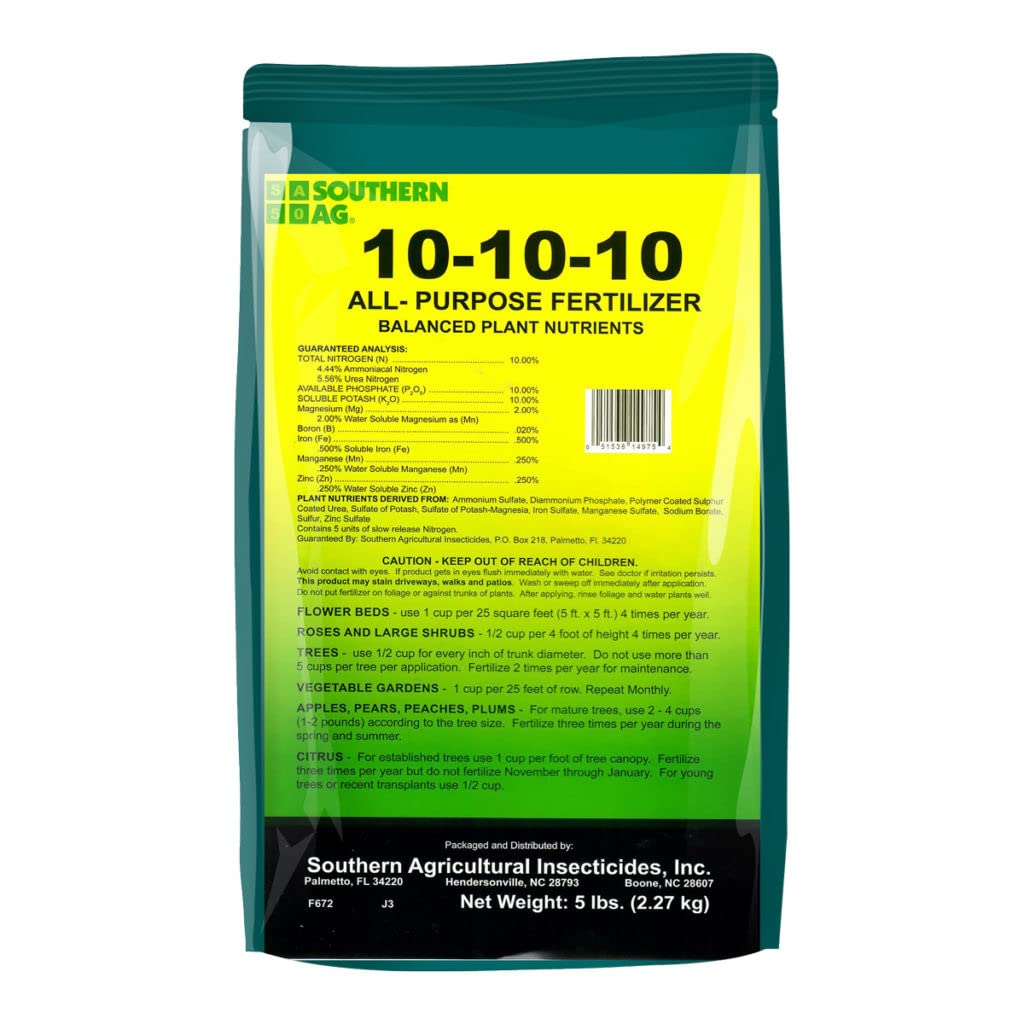
Southern Ag All Purpose Granular Fertilizer 10-10-10 (5 lb)
| Item Form | Granules |
|---|---|
| Specific Uses For Product | Citrus and Fruit Trees, Flowerbeds, Roses, and Large Shrubs, Vegetable Gardens |
| Application Method | Broadcast evenly over area and water in. |
| Mixing Ratio | 10:10:10 |
This 5 lb bag of Southern Ag 10-10-10 granular fertilizer is a straightforward, balanced all-purpose feed for vegetable beds, fruit trees, roses, and shrubs. You spread the granules uniformly over soil or beds and water them in; directions and recommended cup measurements are printed for common uses so dosing is easy. The formula supplies equal parts nitrogen, phosphorus, and potassium plus trace minerals like magnesium, iron, manganese, zinc, and boron, which supports steady vegetative growth and overall plant health. For asparagus specifically it can be used as a periodic maintenance feed during the growing season to support fern growth and energy storage in crowns. The product is simple to store and apply, and the small bag size is convenient for trialing on a single bed or patch. Limitations are that it is a general blend rather than a tailored asparagus formula, so heavy feeders or soils needing specific nutrient correction may require additional amendments, and granular broadcast feedings require careful placement to avoid contact with foliage or runoff risks described on the label.
Best for: Gardeners on a budget who want a simple, balanced fertilizer to maintain small asparagus patches and other mixed beds without buying specialty formulas.
Less Ideal for: Growers managing large asparagus plantings, or who need a targeted high-potassium or soil-specific amendment, should choose a crop-specific or soil-test-driven fertilizer.
- Balanced 10-10-10 N-P-K supports general growth and root development.
- Includes micronutrients (iron, manganese, zinc, boron) for broader plant nutrition.
- Clear application instructions and coverage rates for common garden uses.
- Small 5 lb size is convenient for testing on a single asparagus bed or small garden.
- Not formulated specifically for asparagus so may lack the higher potassium or phosphorus some heavy beds benefit from.
- Granular broadcast application can stain hard surfaces and requires watering after application to activate nutrients.
Verdict: A low-cost, easy-to-use balanced granular fertilizer that is a practical maintenance feed for small asparagus beds and mixed gardens.
CountryMax Organic Lawn Fertilizer 36 lb (10-6-4) Slow Release

| Net weight | 36 lb |
|---|---|
| N-P-K | 10-6-4 |
CountryMax Organic Lawn Fertilizer is a 10-6-4 slow-release formula designed for routine feeding of established lawns. It supplies balanced nutrients over time to encourage deeper root development, denser turf, and a greener appearance while reducing the risk of nitrogen stress or burn. Typical use is a seasonal application for residential or professional lawns where steady, long-lasting nutrition is preferred over quick-release treatments. Notable features include an organic-forward formulation and drought and stress support, which help lawns recover from heat, insects, or other common stresses. In practice this means fewer emergency feedings and more consistent color and turf strength across a growing season. The product is best used with even spreader application and regular watering patterns to maximize the slow-release benefits. Limitations are that results come gradually rather than immediately and it is not intended as a fast green-up solution after severe nutrient depletion or for rapid repair of large bare areas.
Best for: Buyers who prioritize consistent, low-risk feeding for an established lawn and want a dependable, season-long organic-leaning fertilizer rather than quick, immediate results.
Less Ideal for: People needing an instant green-up or rapid repair after heavy damage should choose a fast-release or specialty repair product instead.
- Slow-release 10-6-4 formula provides steady feeding and reduces risk of lawn burn
- Organic-focused ingredients support root development and turf resilience
- Designed to help lawns recover from drought and common stressors
- 36 lb bag supplies multiple applications for typical residential lawns
- Gradual effects mean it will not produce rapid green-up after severe nutrient loss
- May require complementary products or overseeding for fixing large bare spots
Verdict: A reliable slow-release organic fertilizer for homeowners who want steady, low-risk nutrition to maintain and strengthen established lawns.
Scotts Turf Builder Lawn Food, 12.5 lb

| Item Form | Powder |
|---|---|
| Specific Uses For Product | Lawn |
| Coverage | 5,000 sq. ft. |
| Mixing Ratio | 32:0:4 |
Scotts Turf Builder Lawn Food is a general-purpose granular fertilizer formulated for use on any grass type to thicken turf and improve root strength. You spread it with a broadcast or drop spreader (Scotts provides recommended settings) and can apply it to wet or dry lawns in spring, summer, or fall. The formula is pesticide-free and emphasizes building deeper roots so the lawn better absorbs water and nutrients, which helps turf resist stress over the season. One 12.5 lb bag covers about 5,000 sq. ft., making it a simple option for small to medium yards or spot treatments. Practical benefits include clear application guidance, compatibility with common spreaders, and the option to water in for faster greening. Limitations are that this single bag covers a modest area compared with larger homeowner bags and it does not include weed control or insect protection, so you may need additional products for comprehensive lawn care.
Best for: Buyers who want a reliable, easy-to-apply granular fertilizer to strengthen and green a small to medium lawn and prefer products with widespread user approval and clear instructions.
Less Ideal for: Homeowners needing one-step weed or pest control, or those with large properties who want a single bag to cover many thousands of square feet.
- Works on all common grass types so one product fits mixed lawns
- Builds stronger, deeper roots to improve water and nutrient uptake
- Clear spreader settings and can be applied to wet or dry turf for flexibility
- Pesticide-free formula suitable when you only want fertilization
- Covers only about 5,000 sq. ft. per bag, requiring multiple bags for larger yards
- Does not include weed or insect control so additional products may be needed
Verdict: A reliable, easy-to-use granular lawn food that builds stronger roots and is a solid choice for feeding small to medium lawns.
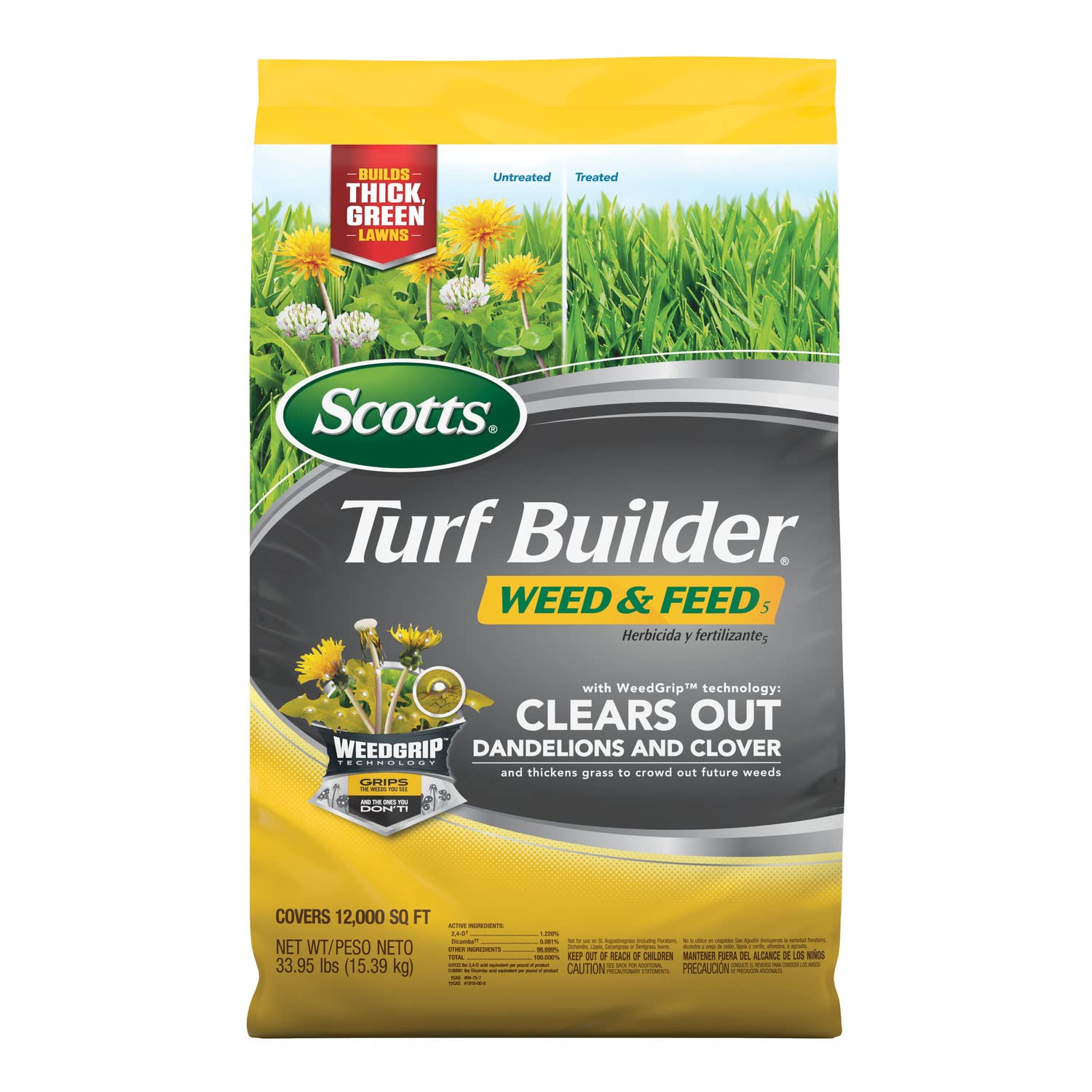
Scotts Turf Builder Weed & Feed5 Granular Lawn Fertilizer (33.95 lb)
| Item Form | Granule |
|---|---|
| Coverage | 12000 square feet |
| Active Ingredients | 2.4‑D and Dicamba |
| Unit Count | 1 Count |
Scotts Turf Builder Weed & Feed5 is a combined granular weed killer and lawn fertilizer intended for use when broadleaf weeds are actively growing and daytime temperatures are between 60°F and 90°F. You apply it to a wet lawn with a broadcast, drop, or hand spreader (Scotts publishes spreader settings) and then avoid watering for 24 hours to let granules stick to weed leaves. The formula uses WeedGrip technology and active ingredients 2,4‑D and dicamba to target common lawn weeds such as clover and dandelion while the fertilizer portion delivers nitrogen and potassium to thicken turf. A single 33.95 lb. bag is sized to cover about 12,000 square feet, making it convenient for medium to large yards. Important limits: do not use on St. Augustine, bentgrass, dichondra, carpetgrass, or lippia and do not apply if rain is expected within 24 hours; the product can also require keeping people and pets off treated turf until dust settles. For homeowners seeking a combined weed control plus feeding step, this simplifies late‑spring applications, but those with excluded grass types or who need precise spot treatments should consider alternatives.
Best for: Homeowners with warm‑season Bahia and other listed grass types who want a single late‑spring application to control broadleaf weeds while feeding the lawn and prefer products with established brand usage guidance.
Less Ideal for: Anyone growing St. Augustine, bentgrass, dichondra, carpetgrass, or lippia or gardeners who need spot treatments, organic options, or year‑round fertilization plans.
- Kills a wide range of listed broadleaf lawn weeds including clover and dandelion using WeedGrip technology
- Feeds lawn while treating weeds so it both reduces weeds and promotes thicker turf
- Large 33.95 lb. bag covers up to 12,000 sq ft, suitable for medium to large lawns
- Published application guidance and spreader settings make it straightforward to apply evenly
- Not safe for use on several turf types including St. Augustine and bentgrass
- Requires dry window after application and restriction on people and pets until dust settles
- Contains synthetic herbicides that require careful handling and label compliance
Verdict: A convenient, proven weed‑and‑feed option for Bahia and other compatible lawns that combines broadleaf weed control with feeding in one late‑spring application.
Choosing the Right Fertilizer for Established Lawn: Key Factors to Consider
Nutrient Ratio and Secondary Elements
The primary nutrients nitrogen, phosphorus, and potassium drive most turf responses. Established lawns typically need moderate to higher nitrogen for leaf color and density, modest phosphorus unless soil tests show a deficiency, and adequate potassium for stress tolerance.
Secondary elements like iron, magnesium, and sulfur can improve color and chlorophyll production without causing excessive top growth. Choosing a fertilizer with the right nutrient mix for your soil will prevent weak growth, reduce disease susceptibility, and avoid unnecessary nutrient lockups. A soil test is the best way to narrow the ideal ratio for a mature lawn.
Release Profile and Feeding Schedule
Slow-release formulations provide a steady supply of nutrients over weeks to months, which helps established turf maintain steady growth and lowers the risk of burning or rapid mowing demands. Quick-release products deliver an immediate green-up but often require more frequent mowing and carry a higher burn risk if applied incorrectly.
Match the release profile to your maintenance plan and climate. In warm seasons or high-rainfall areas, slow-release is often safer. For short-term recovery or targeted greening before an event, a controlled quick-release boost can be appropriate if used sparingly.
Application Method and Equipment Compatibility
Granular, liquid, and water-soluble fertilizers behave differently in a yard. Granular slow-release products are convenient with broadcast or drop spreaders, while liquids and soluble powders need a hose-end sprayer or fertilizer injector for even coverage.
Consider how easy the product is to measure, apply, and store. Uniform granules reduce streaking and uneven patches. If you rely on a spreader, check product spreader settings and coverage recommendations. Ease of cleanup and mixing also matters if you want to avoid extra maintenance time.
Seasonal Timing and Turf Response
Established lawns have seasonal nutrient needs. Cool-season grasses respond best to feeding in early fall and spring, while warm-season grasses take advantage of late spring and summer applications. Timing affects root growth, thatch accumulation, and disease pressure.
Plan applications around peak growth and avoid heavy nitrogen feeds before high heat or drought periods. A well-timed application can build root reserves and improve stress tolerance without forcing weak, rapid top growth.
Soil Health and Environmental Considerations
Fertilizer choices influence soil microbiology, runoff risk, and local waterways. High-salt or high-concentration products can damage soil structure or harm plants if overapplied. Look for recommendations that match your soil test and apply at rates that minimize runoff, especially before heavy rain.
Practices such as leaving clippings, using slow-release formulas, and following buffer zones near water reduce environmental impact. For established lawns, incremental feeding that builds soil organic matter and encourages root growth is often preferable to repeated heavy doses.
Cost Per Application Versus Longevity
A cheaper product per bag may cost more over a season if it requires frequent reapplication. Calculate the cost per application in relation to how long the fertilizer feeds the lawn and the coverage area per package.
Also consider labor costs. Products that save time through fewer applications or easier spreading can be better value for a homeowner who applies fertilizer themselves. Balance upfront expense with season-long performance to choose the most practical option.
When to Feed an Established Lawn
Established lawns have predictable windows when feeding does the most good. For cool-season grasses, early fall is prime because it supports root growth and carbohydrate storage ahead of winter. Spring feeding should be conservative to avoid excess thatch and disease.
Warm-season grasses benefit from spring and early summer applications when they are actively growing. Avoid heavy nitrogen applications during heat waves or drought stress. Adjust timing based on local climate and recent weather to reduce runoff and prevent lawn shock.
- Do a soil test before major seasonal feeding
- Avoid fertilizing before heavy rain to prevent runoff
- Split seasonal amounts into smaller applications for steady nutrition
How to Apply Fertilizer Evenly
Even distribution is essential to prevent patchy color and growth. Use a properly calibrated spreader and overlap passes at recommended widths. For liquid applications, maintain consistent walking speed and nozzle pressure.
Check spreader settings on a non-visible area first to verify output. For hand applications, measure carefully and rake lightly to incorporate granules into the turf surface for better soil contact.
- Calibrate your spreader with a small test area
- Apply at recommended rates; more is not better
- Water lightly after application when instructed to activate granules
Organic Versus Synthetic Approaches
Organic fertilizers release nutrients more slowly and can build soil organic matter, which benefits long-term soil health. They are less likely to cause burn but may take longer to show visible green-up on mature lawns.
Synthetic fertilizers offer predictable nutrient ratios and quicker responses. They can be useful for targeted corrections or when rapid color improvement is needed. Many gardeners combine both approaches to balance immediate results and soil-building benefits.
- Use organics for gradual improvement and soil structure
- Use synthetics for quick greening or precise nutrient correction
- Consider a split program to harness benefits of both types
Managing Thatch, Mowing, and Fertilizer
Thatch and mowing height influence how fertilizer reaches the soil. Heavy thatch can block granules and reduce effectiveness, while mowing too low stresses grass and increases fertilizer needs.
Keep mower blades sharp and maintain recommended mowing heights for your grass type. Dethatch or core aerate if thatch is excessive before applying major fertilizer treatments to improve soil contact and root uptake.
- Core aerate in seasons suited to your grass type
- Raise mowing height slightly after fertilizing to protect recovering turf
- Sharpen blades to avoid tearing and uneven turf response
Adjusting Feed Plans for Shade and Traffic
Lawns in shade or heavy-traffic areas often need tailored feeding. Shaded turf grows slower and benefits from less nitrogen but may need iron to maintain color. High-traffic zones require strong root systems, so choose formulas that support root vigor and recovery.
Manage traffic with rest periods and consider reinforcement with soil amendments or overseeding in high-wear patches. Feeding alone will not compensate for chronic compaction or shade issues; pair nutrition with cultural fixes.
- Reduce nitrogen rates in heavily shaded areas
- Focus on root-strengthening nutrients in high-traffic zones
- Combine feeding with aeration and overseeding where needed
How We Chose the Best Fertilizer for Established Lawn
We evaluated candidates using criteria that reflect how fertilizers actually perform on mature turf. Key evaluation points included nutrient formulation, specifically the ratio of nitrogen, phosphorus, and potassium and the presence of secondary elements that support root and leaf health. Release profile was another essential filter: slow-release versus quick-release formulas change mowing and watering needs and affect color and growth rate. Application practicality guided selection too, including spreader compatibility, granule uniformity, and whether liquid options mixed cleanly. Environmental impact and runoff risk were considered by checking formulation concentration and recommended application rates. Longevity and seasonal timing mattered because established lawns benefit from steady feeding rather than aggressive pushes. We excluded products primarily marketed for new lawns, seed-start fertilization, or specialized turf disease treatments. Organic-only options were considered but only if they met performance and release expectations for mature turf. The final list favors balanced formulations and easy application suited to real-world lawn care schedules.
FAQ
How often should I fertilize an established lawn?
Frequency depends on grass type and fertilizer release profile. Slow-release fertilizers typically need two to four applications per season, while quick-release products may be applied more often. Tailor timing to seasonal growth patterns and your soil test results.
Can I apply fertilizer after aerating?
Yes. Aeration improves soil contact and nutrient uptake, so applying fertilizer after core aeration helps nutrients reach roots. Use a product suited to your timing and water lightly if the fertilizer instructions recommend activation.
Will fertilizing reduce weeds in my lawn?
Healthy, well-fed turf can outcompete many weeds over time, but fertilizer is not a weed control treatment. If weeds are already established, combine proper feeding with targeted weed management for better long-term results.
Is it safe to use fertilizer around trees and flower beds?
Fertilizer can be used near landscape plants, but avoid direct contact with tree trunks and plant roots that are drought-stressed. Follow label buffer recommendations and try to prevent runoff into beds where it could harm sensitive plants.
How do I know if my lawn needs more potassium or iron?
Signs of potassium deficiency include weak root systems and poor stress tolerance, while iron deficiency shows as yellowing between leaf veins, especially on younger leaves. A soil test is the most reliable way to determine specific nutrient shortages.
Can I mix organic and synthetic fertilizers in one program?
Yes, many gardeners use a hybrid approach. Organics build soil health and provide slow nutrition, while synthetics offer quick correction. Space applications appropriately and follow label guidance to avoid overapplication.
Final Verdict
For established lawns, prioritize a balanced nutrient ratio and a release profile that matches your maintenance schedule. Slow-release options reduce risk and provide steady feeding, while targeted quick-release boosts can address short-term needs. Always base major feeding decisions on a soil test and adjust rates for shade, traffic, and seasonal growth.
