

Note: This article contains affiliate links. If you click on these links and make a purchase, I may earn a small commission at no extra cost to you. This helps support my research and content. Read my full affiliate disclosure here.
Picking the right 100 Watt LED grow light matters because it determines plant stretch, flowering success, and how hot your tent or shelf will run. For small indoor setups, patios, or single-shelf propagation, the right fixture balances usable light with low heat and low running cost. This guide covers our shortlisted top picks for 100 watt LED grow lights and explains the practical factors gardeners should weigh. We evaluated spectrum balance, usable PPFD across a typical canopy, heat management, build durability, and ease of mounting and use. Read on to see which fixture characteristics matter most for your space and growing goals.
Top Picks at a Glance
| Best Overall The best all-around choice for most situations | MARS HYDRO TS600 100W Dimmable LED Grow Light (2×2 Coverage) |  |
| Best Quality Built to a higher standard if you want something more solid | Sun System HelioGrow P1000 100W LED Grow Light |  |
| Best Value The sweet spot between price and what you get | KINGPLUS KP1000 100W LED Grow Light |  |
| Best Budget The cheapest option that still gets the job done reliably | Leo's Light 100W PAR38 LED Plant Grow Light Bulb (Full Spectrum) |  |
| Highest Rated A top-rated pick with lots of positive feedback | VIPARSPECTRA P1000 100W LED Grow Light (Dimmable, Daisy-Chain) |  |
| Most Popular A crowd favorite that many people choose with confidence | Spider Farmer SF1000 100W Full Spectrum LED Grow Light |  |
MARS HYDRO TS600 100W Dimmable LED Grow Light (2×2 Coverage)

| Wattage | 100 watts |
|---|---|
| Light Output Maximum | 10000 lumens |
| Light Source Special Features | Sunlike Full Spectrum |
| Number of Light Sources | 225 |
| Voltage | 110 volts |
The MARS HYDRO TS600 is a 100W full‑spectrum LED designed for small indoor grows, especially 2×2 tents and single‑plant setups. It uses a dense array of diodes and a patented 120° reflector to deliver even PPFD across the canopy and includes a newly added dimmable control so you can lower intensity for seedlings and raise it for flower. In practice the light runs cool and quiet because it is passively cooled in an aluminum housing and draws about 100W while claiming a PPF around 190 µmol/s and PPE near 2.0 µmol/J. That makes it significantly more efficient than equivalent HPS fixtures and useful for growers who want energy savings without losing usable light. The unit is lightweight and simple to hang or mount, and the sunlike spectrum with added IR supports all growth stages. Limitations: the TS600 is sized for small footprints so it will need multiples for larger tents, and its performance figures are manufacturer provided rather than independent lab reports, so serious commercial growers may prefer higher‑output fixtures with verified PPFD charts.
Best for: Buyers who want an energy‑efficient, easy‑to‑use LED for a 2×2 tent or small indoor setup and value adjustable light output across plant stages.
Less Ideal for: Large or commercial grows that need higher total PPF and independently verified performance should choose more powerful fixtures or lab‑tested models.
- Dimmable 0–100% control for tailoring intensity to growth stages.
- Full spectrum including IR that supports seedlings through flowering.
- Efficient 100W draw with advertised PPE ~2.0 µmol/J for lower energy consumption.
- Patented 120° reflector and dense diode layout for more even canopy coverage.
- Lightweight aluminum build that is easy to hang and stays cool in operation.
- Designed for 2×2 coverage so larger grow areas require multiple units.
- Key performance numbers come from the manufacturer and lack independent lab verification.
Verdict: A compact, dimmable 100W full‑spectrum LED that delivers even coverage and efficient light for 2×2 tents and small indoor gardens.
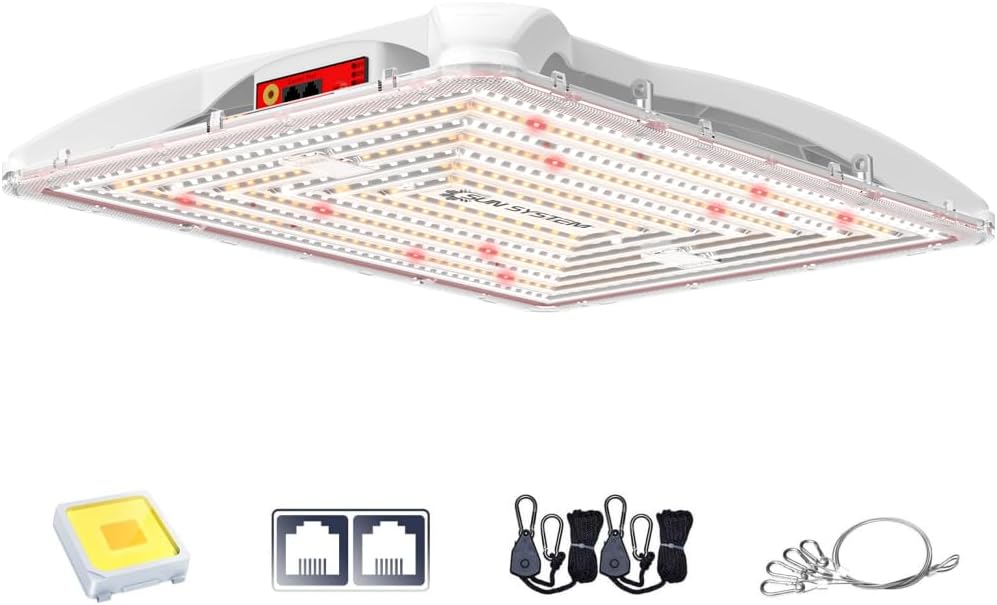
Sun System HelioGrow P1000 100W LED Grow Light
| Light Source Type | Light Emitting Diode |
|---|---|
| Light Source Wattage | 100 watts |
| Mounting Type | Adjustable Mount |
| Light Source Special Features | Dimmable, Memory Function |
| Power Source | Corded Electric |
The Sun System HelioGrow P1000 is a performance-focused 100W LED fixture intended for serious indoor gardeners and hydroponic growers. It uses a high-density diode array and full-spectrum output to deliver sun-like light across all growth stages, with manufacturer PPFD maps showing a 4'x4' vegetative coverage and 3'x3' flowering footprint. The integrated four-step dimmer and memory function let you tune intensity for seedlings through bloom and recover settings automatically after power interruptions. Practical features include corrosion-resistant lens protection for humid grow rooms, adjustable mounting hardware, quiet passive cooling, and the ability to daisy-chain up to 512 units or use standard RJ12 controllers for larger arrays. In use it provides even light distribution and convenient control without needing external drivers. The fixture is plastic-bodied rather than metal which keeps cost and weight down but may feel less industrial, and the product description lists a 2 year warranty rather than a longer commercial warranty, so growers scaling to heavy commercial use may want a different spec. For hobbyists and small commercial racks seeking efficient, tunable 100W performance this unit fits well.
Best for: Growers who prioritize light quality and controllable output for maximum plant performance, including hobbyists running serious indoor gardens and small commercial operators building scalable racks.
Less Ideal for: Casual plant owners who only need a small, inexpensive seedling light or large industrial operations seeking fully commercial metal-bodied fixtures with extended warranties.
- Full-spectrum, high-density LED layout for balanced growth across seedling to bloom
- Four-step integrated dimmer with memory restores preferred brightness after power loss
- Uniform PPFD coverage suitable for a 4'x4' veg or 3'x3' flower area
- Daisy-chainable to 512 units and RJ12 controller compatible for scalable setups
- Corrosion-resistant lens and passive cooling for reliable operation in humid environments
- Plastic housing rather than metal may be less robust for heavy commercial use
- Warranty is 2 years which may be shorter than some commercial-grade fixtures
Verdict: Choose the HelioGrow P1000 when you want an efficient, tunable 100W fixture that delivers uniform full‑spectrum light and scales easily for multi‑fixture grows.
KINGPLUS KP1000 100W LED Grow Light

| Light Source Type | LED |
|---|---|
| Power Source | Corded Electric |
| Color Temperature | 5000 Kelvin |
| Light Source Special Features | Built-in Fans, Full Spectrum, VEG & BLOOM Modes |
| Mounting Type | Ceiling Mount |
The KINGPLUS KP1000 is a compact full-spectrum LED grow light intended for small indoor setups and supplemental lighting. It is typically hung over a 2×2 or 2×3 ft grow tent and used through all plant stages with its VEG and BLOOM modes to adjust output as plants progress. Notable features include built-in cooling fans, a 5000K-dominant spectrum with targeted blue and red wavelengths, and an included hanging kit and adjustable rope for quick installation. In practice the light delivers even coverage for seedlings, vegetative growth, and light flowering in small footprints and can be raised for broader, lower-intensity coverage if used without a tent. Trade-offs are visible: the unit lists high nominal wattage values in the product text that can be confusing, and its penetration is limited compared with larger fixtures so dense, tall canopies may need additional or higher-output lights. For growers who need an efficient, easy-to-install 100W panel for a small tent, this provides a reliable, ready-to-use option with basic mode controls.
Best for: Growers who prioritize straightforward, practical gear for a small tent or a few plants and want an easy-to-install 100W panel that supports all growth stages with basic controls.
Less Ideal for: Users running dense or tall canopies, larger tents, or growers who need deep light penetration for heavy flowering should consider higher-output fixtures or supplemental side lighting.
- Full-spectrum output with specific blue (460 nm) and red (660 nm) wavelengths suitable for all growth stages
- Built-in fans provide active cooling to help maintain performance and airflow around the fixture
- Includes hanging hardware and adjustable rope for quick installation in tents
- Compact footprint designed to fit 2×2 and 2×3 ft grow tents
- Limited canopy penetration compared with larger, higher-output fixtures
- Product spec text contains inconsistent wattage numbers that can be confusing to buyers
Verdict: A compact, easy-to-install 100W full-spectrum LED that's a practical choice for growers running a 2×2 or 2×3 ft tent and wanting reliable all-stage lighting.
Leo's Light 100W PAR38 LED Plant Grow Light Bulb (Full Spectrum)

| Wattage | 100 watts |
|---|---|
| Bulb Base | E26 |
| Bulb Shape Size | PAR38 |
| Light Source Type | LED |
| Life Span | >50000hrs |
This Leo's Light 100W PAR38 LED grow bulb delivers a full-spectrum output aimed at supporting all stages of plant growth, with a heavy red component for flowering and blue for vegetative growth. It installs like a normal E26 bulb and can be hung in standard fixtures, making it simple to add to a small indoor setup or greenhouse. The aluminum body helps dissipate heat so the lamp can run for long periods and the manufacturer lists a long rated lifespan. Controls include a push-button and IR connectivity for basic remote operation. Practical advantages are the focused PAR38 beam for directed light, straightforward installation, and a high LED count that produces bright usable light for individual plants or small clusters. Limitations are that the bulb provides a directional beam rather than wide-area coverage so multiple bulbs are needed for larger benches, and the listing mixes claims about waterproofing and water resistance that would need verification before use in humid greenhouse zones. For growers on a budget this bulb is an easy-to-install boost of concentrated light for single fixtures.
Best for: Budget-minded growers who want a simple, screw-in full-spectrum bulb to add concentrated light to one or a few indoor plants or a small greenhouse area.
Less Ideal for: Growers who need uniform coverage for larger benches or multi-tier setups should consider full panels or multiple bulbs rather than a single PAR38 lamp.
- Full-spectrum LED mix with strong red and blue ratios suited for flowering and veg stages
- Standard E26 base for easy screw-in installation in common fixtures
- Aluminum shell for improved heat dissipation and longer rated lifespan
- High LED count and focused PAR38 beam produce bright, concentrated light for individual plants
- Directional PAR38 beam limits coverage area compared with panel-style fixtures
- Claims about waterproofing and water resistance are inconsistent and should be confirmed before use in humid environments
Verdict: A cost-effective, easy-to-install 100W full-spectrum PAR38 bulb that adds concentrated, plant-ready light to single fixtures or small indoor setups.
VIPARSPECTRA P1000 100W LED Grow Light (Dimmable, Daisy-Chain)

| Light Source Type | LED |
|---|---|
| Wattage | 100 watts |
| Color Temperature | 4000 Kelvin |
| Light Source Special Features | Daisy Chain, Dimmable |
| Number of Light Sources | 216 |
The VIPARSPECTRA P1000 is a compact 100W LED grow light intended for seed starting and small grow spaces. It delivers a tailored full spectrum including red, white, and far-red diodes and uses an updated diode layout and aluminum heat sinks for cooler, quieter operation. Typical use is hung above trays or a small tent where its manufacturer-stated coverage fits a roughly 2.5 x 2.5 foot veg area and a smaller flowering footprint at closer hang heights. The built-in dimmer knob lets you fine-tune intensity for delicate seedlings or stronger vegetative light without additional controllers, and the daisy-chain feature supports linking multiple units for expanding bench or vertical setups. Practical benefits include low energy draw compared with older HPS/MH fixtures, a fanless design that reduces noise and maintenance, and a straightforward plug-and-play setup with hangers included. Limitations are its modest single-unit coverage for larger beds and reliance on the supplied dimmer rather than a programmable controller for advanced light schedules and automation.
Best for: Growers who prioritize strong PAR output and energy efficiency for starting seeds and running compact veg cycles and who want a straightforward, tweakable fixture they can scale by adding more units.
Less Ideal for: Gardeners who need wide single-fixture coverage for large grow rooms or who require integrated programmable controls and advanced automation features.
- Full-spectrum diode mix (including 660nm and 730nm) suitable for seedling through bloom stages
- 100W power with low energy consumption compared with equivalent HPS/MH setups
- Dimmable knob for easy intensity control during seed starting and vegetative growth
- Daisy-chainable so multiple fixtures can be linked for larger or vertical setups
- Fanless aluminum heatsink design for quiet, low-maintenance operation
- Coverage is limited per unit so multiple lights are needed for larger trays or tents
- No built-in programmable timer or remote control for automated schedules
Verdict: A compact, energy-efficient 100W full-spectrum grow light that offers precise dimming and daisy-chaining for performance-focused seed starting and small veg setups.
Spider Farmer SF1000 100W Full Spectrum LED Grow Light

| Light Source Type | LED |
|---|---|
| Light Output Maximum | 10000 lumens |
| Light Source Wattage | 100 watts |
| Light Source Special Features | Dimmable |
| Specification Met | IP67 |
The Spider Farmer SF1000 is a compact 100W full spectrum LED grow light intended for 2×2 to 3×3 grow spaces and small tents. It uses a high diode count and upgraded LED chips to deliver broad-spectrum output that supports seedlings through flowering, with a dimmer knob to reduce intensity for early stages and ramp up for bloom. The fanless design and thick aluminum heatsink keep operation quiet while providing passive cooling, and the fixture meets IP67 for durable performance. Typical use is ceiling or tent mounting above individual plants or a small canopy where uniform coverage and deeper canopy penetration matter. Notable features include daisy-chain compatibility for linking multiple units under unified dimming, a 0–100% dimmable control, and a driver claimed to offer efficient power delivery. Practical benefits are even light distribution in a small footprint, predictable veg-to-flower capability, and near-silent operation. Limitations are inherent to its class: it is sized for small areas so you will need multiple units for larger tents, and the product description emphasizes specs from manufacturer tests rather than independent third-party PPFD maps.
Best for: Growers who want a quiet, compact full spectrum light for a small tent or single-plant setup and value adjustable intensity for each growth stage.
Less Ideal for: People running larger multi-plant rooms or commercial operations who need higher total output and broader single-fixture coverage.
- Full spectrum output suitable for all growth stages with added red and IR for flowering
- Dimmable 0–100% control lets you tailor light intensity to seedlings, veg, and bloom
- Fanless design with sturdy aluminum heatsink for quiet, low-maintenance operation
- Compact footprint ideal for 2×2 to 3×3 tents and small indoor setups
- Daisy-chain capable so multiple fixtures can be linked and dimmed together
- Coverage and power are intended for small grows so larger areas require multiple units
- Manufacturer gives efficiency and coverage figures without independent third-party PPFD charts
Verdict: A quiet, dimmable 100W full spectrum fixture that is a practical, balanced choice for hobbyists running 2×2 to 3×3 tents.
Choosing the Right 100 Watt LED Grow Light: Key Factors to Consider
Light Intensity and Canopy Coverage
Light intensity determines how well plants photosynthesize and how compact or stretched they grow. For a 100 watt LED in a small indoor area, consider the practical PPFD you will get at realistic hanging heights. High raw LED wattage does not guarantee even canopy coverage; beam angle, reflector design, and array layout change how light spreads.
Think about the footprint you need to cover. Seedlings and clones need much less PPFD than flowering plants. If you plan to flower dense plants under a single 100 watt fixture, expect hotspots near the center and lower readings at the edges unless the fixture has optics designed for a wider spread.
Spectrum and Plant Stage Suitability
The spectral composition affects plant morphology, flowering, and overall vigor. Full-spectrum or broad-spectrum white LEDs mimic sunlight more closely and make it easier to manage different growth stages without swapping lights. Red- and blue-heavy arrays can be optimized for specific stages but may force you to change fixtures or accept color-biased light for all stages.
Check whether the fixture lists usable PAR or spectral distribution rather than just color temperature. Adjustable spectrum controls are useful if you plan to run seedlings and flowering under the same lamp, while fixed-spectrum fixtures can still perform well if the spectrum is balanced for the plant stages you run most often.
Thermal Performance and Runtime
Heat is the limiting factor in many compact indoor grows. Good thermal design keeps LED junction temperatures lower, prolongs diode life, and prevents heat stress on plants in tents or small rooms. For a 100 watt LED, passive heat sinks, active fans, and the fixture's ability to disperse heat across a larger surface area all matter.
Consider how long you will run lights each day and whether the fixture sits near canopy or close to tent walls. Poor heat management can force you to raise the light further away, reducing usable intensity, or to add additional ventilation, which changes your setup complexity.
Electrical Efficiency and True Power Use
A fixture rated at 100 watts should show consistent input power near that figure under normal conditions. Efficiency affects both the amount of useful light produced per watt and operating cost. Look for fixtures that provide clear driver specifications and measured input power rather than marketing wattage.
Higher efficacy LEDs deliver more photons per watt and reduce waste heat. For indoor gardeners on limited circuits or with multiple fixtures, knowing true power draw helps plan electrical load and avoids nuisance breaker trips.
Physical Size, Mounting, and Fit
A 100 watt LED fixture can come in compact bars, panels, or square arrays. Physical dimensions and mounting options determine whether it fits your tent, shelf, or greenhouse bench. Consider whether the fixture includes hanging hardware, adjustable ratchets, or bracket mounts for flexible placement.
Also think about serviceability. Fixtures that allow easy access to drivers or have modular diodes are easier to repair or repurpose. Low-profile designs are preferable for cramped setups, while larger heat sinks can improve thermal performance but need more clearance.
Durability and Component Quality
Long-term reliability comes from quality diodes, a stable driver, corrosion-resistant housing, and robust connectors. For hobby growers, a fixture that lasts multiple seasons with consistent output reduces hassle and replacement frequency.
Pay attention to ingress protection if you expect humid conditions, and the quality of electrical fittings if the fixture will be moved frequently. Cheaper assemblies may save money upfront but commonly show faster lumen depreciation and driver failures under continuous schedules.
Matching Fixture Choice to Your Grow Space
A 100 watt LED suits small footprints such as a single tent, a propagation shelf, or a balcony box. First map your usable canopy area and target flowering stage. If you plan to run several small pots, position the light so that the highest-use plants sit near the center but allow for edge planting where intensity tapers off.
In taller setups where you can hang fixtures higher, a single 100 watt unit may cover more area but at lower PPFD. Conversely, in short cabinets you can hang the light closer for greater intensity but watch for heat buildup and light stress on delicate foliage.
- For seedlings, hang higher and reduce daily hours rather than cranking intensity.
- For flowering in a small cabinet, aim for even overlap rather than a single intense hotspot.
- Use reflectors or light-colored interiors to improve effective coverage without moving the fixture closer.
Mounting Options and Practical Installation Tips
Check mounting hardware and plan where to attach hangers before installing. Ratchet-style hangers make it easier to fine-tune height during growth cycles. If a fixture is light and compact, a shelf clamp or bracket can add stability.
Consider cable routing and driver placement. Keeping the driver outside humid zones extends its life. If the fixture uses a small fan, ensure airflow is not blocked by tent walls or shelving.
- Avoid hanging directly from flimsy poles; reinforce attachment points if needed.
- Leave a little slack in power cords to reduce stress at connectors.
- Place the driver where it can dissipate heat and is accessible for occasional checks.
Managing Heat in Small Indoor Setups
Even at 100 watts, LEDs produce heat where the diodes and driver concentrate it. Passive heat sinks are silent and low-maintenance but require space. Fixtures with small fans control temperature more aggressively but can add noise and have moving parts that may fail.
Measure canopy temperature in early runs and note the change when lights turn on. If temperatures rise too much, raise the fixture, increase ventilation, or reduce daily run hours until you find a stable schedule that plants tolerate without stress.
- Use a thermometer or IR gun to track canopy temperature changes.
- Combine ventilation and heat dispersion rather than relying on distance alone.
- Consider a small circulating fan to even out temperature pockets under the lamp.
Spectrum Choices for Mixed-Stage Growing
If you plan to use one fixture for all growth stages, prioritize a broad white spectrum or a full-spectrum LED that includes both blue and red energy. This simplifies scheduling and avoids swapping fixtures between vegetative and flowering cycles.
If you run dedicated cycles, a fixture with switchable red boost or adjustable channels lets you push flowering photosynthetic drive when needed and dial back for vegetative maintenance.
- White-broad spectrum is easiest for mixed-stage work and plant observation.
- Adjustable spectrum saves hands-on time for multi-stage growers.
- Check whether the spectrum is provided as PAR distribution rather than only kelvin numbers.
Routine Maintenance and Longevity
Schedule quick maintenance checks every few months. Wipe dust from heat sinks and lenses, inspect mounting hardware, and listen for changes in fan noise. Dust accumulation reduces light output and can raise operating temperatures.
Expect gradual lumen depreciation. Track plant response and light output over seasons; a small drop is normal, but sudden changes usually point to driver or diode issues. Keep replacement parts or a backup light if uninterrupted cycles are essential.
- Clean with a soft, dry cloth and avoid sprays on electrical parts.
- Log hours of operation to anticipate component wear.
- Inspect connectors and cabling for corrosion if growing in humid environments.
How We Chose the Best 100 Watt LED Grow Light
We focused on the practical fixtures and specs that matter for small indoor gardens that use a single 100 watt LED. Our selection criteria targeted real-world performance rather than marketing numbers, and we excluded lights that only listed watts without providing usable light distribution data or spectral information. Evaluation criteria included measured light output across the usable spectrum for plants, PPFD or equivalent distribution across a typical 2×2 or single-shelf canopy, thermal management under continuous run, electrical efficiency and real input power, and durability of components such as drivers, diodes, and heat sinks. We also considered fixture size, mounting options, and user controls that affect installation in tight spaces. We excluded units that lacked clear spectral specifications, omitted thermal ratings, or were designed only for decorative use. The final group represents fixtures that provide documented plant-useful light, manageable heat in compact grows, and straightforward installation for hobby and small-scale gardeners.
FAQ
How close should I hang a 100 watt LED to seedlings?
Usually keep seedlings farther than you would flowering plants because they need lower PPFD. Start with the fixture higher and watch for signs of stretching or bleaching. Adjust distance gradually over several days until growth is compact and leaves are a healthy green.
Can a 100 watt LED run a small flowering tent effectively?
It can, depending on canopy size and target yields. For very small tents or single plants, a well-designed 100 watt fixture with good spectrum and distribution can produce satisfactory flowering results. Expect tradeoffs in intensity compared with larger fixtures.
Will a 100 watt LED make my grow area too hot?
Not necessarily. Heat depends on thermal design, driver placement, and ventilation. Fixtures with passive heat sinks usually run cooler into the room, while those with compact drivers can concentrate heat. Monitor canopy temperature and add ventilation if needed.
Is spectrum listed as kelvin enough to judge a light?
Kelvin describes color appearance but not plant-useful spectral power. Look for spectral distribution charts or PAR numbers to understand how much usable light a fixture provides for photosynthesis across blue and red bands.
How long do 100 watt LED grow lights typically last?
High-quality diodes and drivers can last many years under normal schedules, while cheaper assemblies may show reduced output sooner. Lifespan depends on heat management and duty cycle, so good cooling and stable drivers extend service life.
Final Verdict
For small indoor gardens, prioritize fixtures that deliver usable PAR across your intended canopy while keeping heat manageable. Balance spectrum needs against whether you will run mixed stages under one fixture and check true input power to plan electrical load. Choose the solution that fits your space and workflow: pick a compact, well-ventilated unit with clear spectral information for reliable results. Focus on coverage, thermal management, and build quality to get consistent year-round performance.
