

Note: This article contains affiliate links. If you click on these links and make a purchase, I may earn a small commission at no extra cost to you. This helps support my research and content. Read my full affiliate disclosure here.
If you want fuller spring blossoms and sturdier stems, the right fertilizer for Forsythia bushes makes a measurable difference in how these spring-flowering shrubs perform. Forsythia responds well to balanced feeding that supports early-season growth without encouraging excessive late-season tender shoots. This guide shortlists seven top fertilizer options suited for Forsythia care across different garden situations. We evaluate each pick for nutrient profile, application method, and how it fits common maintenance routines so you can pick an approach that matches your soil, time, and landscape goals.
Top Picks at a Glance
| Best Overall The best all-around choice for most situations | Miracle-Gro Shake 'N Feed Flowering Trees & Shrubs Plant Food, 8 lb. |  |
| Best Quality Built to a higher standard if you want something more solid | Osmocote Smart‑Release Plant Food Plus Outdoor & Indoor, 2 lb |  |
| Best Value The sweet spot between price and what you get | Southern Ag All Purpose Granular Fertilizer 10-10-10 (5 lb) |  |
| Best Budget The cheapest option that still gets the job done reliably | Scotts Evergreen, Flowering Tree & Shrub Continuous Release Plant Food |  |
| Highest Rated A top-rated pick with lots of positive feedback | Jobe's Organics Tree & Shrub Fertilizer Spikes 16-4-4, 30 Count (2 Pack) |  |
| Most Popular A crowd favorite that many people choose with confidence | Miracle-Gro Tree & Shrub Plant Food Spikes, 12 Spikes |  |
| Best Seller A high-volume bestseller chosen again and again | Miracle-Gro Water Soluble All Purpose Plant Food, 3 lb |  |
Miracle-Gro Shake 'N Feed Flowering Trees & Shrubs Plant Food, 8 lb.

| Item Form | Granules |
|---|---|
| Application Method | shake evenly onto the soil |
| Target Species | flowering trees, shrubs and other acid-loving plants |
| Mixing Ratio | 18:6:12 |
| Unit Count | 128 Ounce |
Miracle-Gro Shake 'N Feed Flowering Trees & Shrubs is a granular, slow-release fertilizer designed to support flowering shrubs and acid-loving plants over an extended period. You apply it by shaking the granules evenly onto the soil under the branch spread or working it into potting mix for containers, then watering to activate the nutrients. The formula lists an 18-6-12 N-P-K ratio and includes organic-derived inputs such as kelp, feather meal, bone meal and earthworm castings to help feed soil microbes and support root development. Practically, that means less frequent feeding and improved foliage and bloom quality across a season—Miracle-Gro recommends reapplying every three months. It works for both in-ground and container plantings and covers a medium area per bag. Limitations are that it is a general-purpose shrub formula tuned for acid-loving species so it is not a precision fertilizer for nutrient-deficient soils and you still need to avoid contact with trunks and foliage when applying. For best results monitor soil pH and follow labeled application rates for newly planted versus established shrubs.
Best for: Gardeners who want a low-effort, season-long feed for flowering shrubs like forsythia and prefer a product that supports soil health without frequent reapplication.
Less Ideal for: Growers who need a precise corrective fertilizer for diagnosed nutrient deficiencies or who maintain shrubs that prefer neutral to alkaline soils.
- Continuous-release granules feed plants for up to three months reducing application frequency
- Contains organic inputs like kelp and earthworm castings to support soil microbes and root health
- Clear application method for both in-ground and container plants makes it easy to use
- Higher nitrogen ratio (18-6-12) promotes lush foliage and supports flowering season-long
- Not a targeted corrective fertilizer for specific mineral deficiencies
- Designed for acid-loving plants so less suitable for neutral or alkaline-preferring shrubs
Verdict: Use this to give forsythia and other acid-loving shrubs an easy, three-month continuous feeding that boosts foliage and blooms with minimal effort.
Osmocote Smart‑Release Plant Food Plus Outdoor & Indoor, 2 lb

| Item Form | Granules |
|---|---|
| Application Method | Sprinkle |
| Target Species | All plants |
| Mixing Ratio | 1 capful (3 tablespoons) per 2 gallons soil or per 4 sq. ft. |
| Unit Count | 32 Ounce |
Osmocote Smart‑Release Plant Food Plus is a granular, resin‑coated fertilizer designed to feed flowers and other plants steadily for up to six months with 11 essential nutrients. You apply it by sprinkling the recommended amount into the top inch or two of potting mix or garden soil, watering it in, and reapplying every six months; indoor plants use about half the outdoor rate. The resin coating times nutrient release to moisture and temperature, which reduces the need for frequent feedings and lowers the risk of fertilizer burn when used as directed. It works across containers, raised beds, and in‑ground flower beds and covers up to roughly 75 square feet per 2 lb container. Limitations are that a single 2 lb container is only enough for small gardens or several pots, and the slow‑release formula is not suitable when an immediate corrective boost is needed for acute nutrient deficiencies. For gardeners focused on steady, maintenance feeding for flowering plants this is an easy, low‑effort option.
Best for: Gardeners who want reliable, low‑maintenance feeding for flowers and mixed plantings and prefer a consistent supply of nutrients over months rather than frequent liquid feedings.
Less Ideal for: Growers who need fast corrective feeding for visible nutrient deficiencies or those managing very large beds who want bulk fertilizer options to reduce trips to reapply.
- Feeds continuously up to six months with a single application
- Resin coating times nutrient release to plant needs based on moisture and temperature
- Formulated with 11 essential nutrients suitable for a wide range of flowering plants
- No-burn pledge when used as directed reduces risk of overfeeding
- 2 lb container only covers about 75 sq. ft., so frequent repurchase is needed for larger gardens
- Slow‑release formulation does not provide a rapid corrective nutrient boost
Verdict: Choose this product if you want a hands-off, long‑lasting fertilizer that keeps flowering plants fed for months with a single application.
Southern Ag All Purpose Granular Fertilizer 10-10-10 (5 lb)
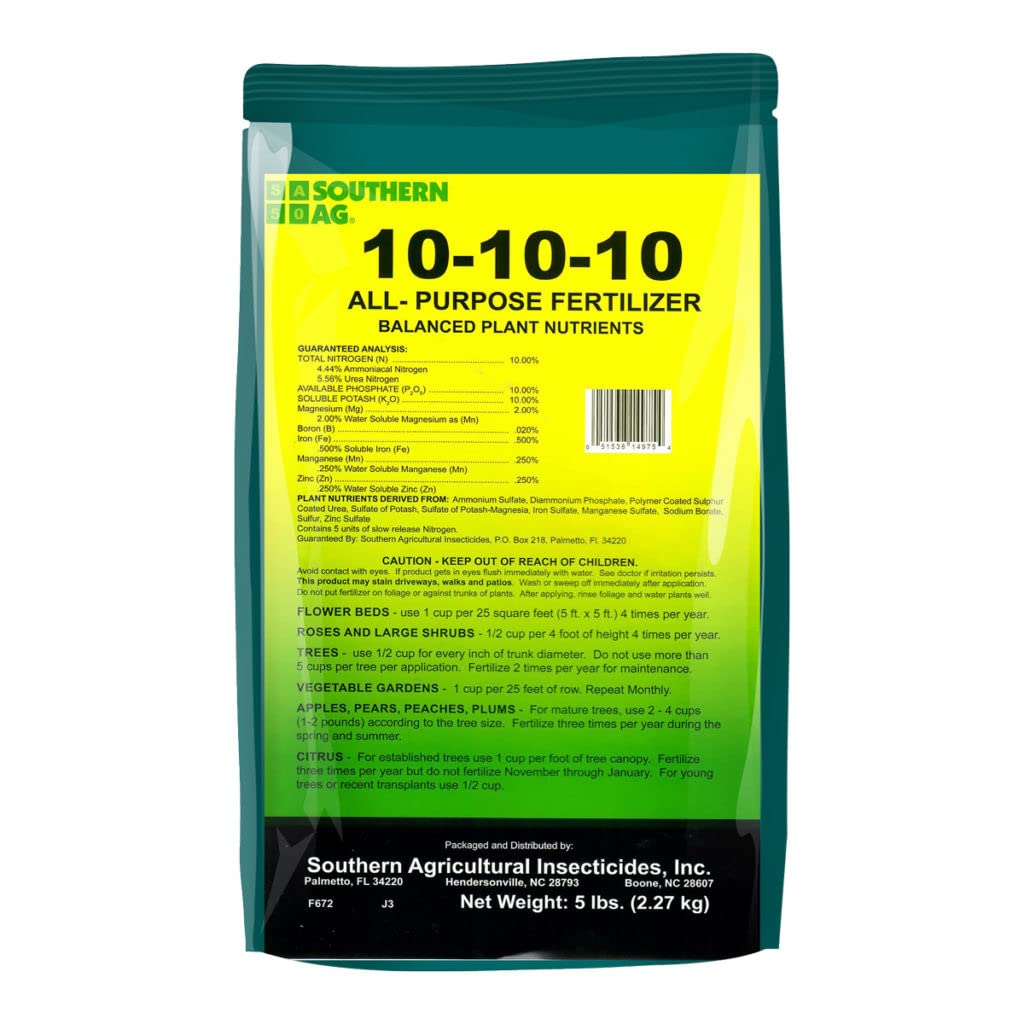
| Item Form | Granules |
|---|---|
| Specific Uses For Product | Citrus and Fruit Trees, Flowerbeds, Roses, and Large Shrubs, Vegetable Gardens |
| Application Method | Broadcast evenly over area and water in. |
| Mixing Ratio | 10:10:10 |
This 5 lb bag of Southern Ag 10-10-10 granular fertilizer is a straightforward, balanced all-purpose feed for vegetable beds, fruit trees, roses, and shrubs. You spread the granules uniformly over soil or beds and water them in; directions and recommended cup measurements are printed for common uses so dosing is easy. The formula supplies equal parts nitrogen, phosphorus, and potassium plus trace minerals like magnesium, iron, manganese, zinc, and boron, which supports steady vegetative growth and overall plant health. For asparagus specifically it can be used as a periodic maintenance feed during the growing season to support fern growth and energy storage in crowns. The product is simple to store and apply, and the small bag size is convenient for trialing on a single bed or patch. Limitations are that it is a general blend rather than a tailored asparagus formula, so heavy feeders or soils needing specific nutrient correction may require additional amendments, and granular broadcast feedings require careful placement to avoid contact with foliage or runoff risks described on the label.
Best for: Gardeners on a budget who want a simple, balanced fertilizer to maintain small asparagus patches and other mixed beds without buying specialty formulas.
Less Ideal for: Growers managing large asparagus plantings, or who need a targeted high-potassium or soil-specific amendment, should choose a crop-specific or soil-test-driven fertilizer.
- Balanced 10-10-10 N-P-K supports general growth and root development.
- Includes micronutrients (iron, manganese, zinc, boron) for broader plant nutrition.
- Clear application instructions and coverage rates for common garden uses.
- Small 5 lb size is convenient for testing on a single asparagus bed or small garden.
- Not formulated specifically for asparagus so may lack the higher potassium or phosphorus some heavy beds benefit from.
- Granular broadcast application can stain hard surfaces and requires watering after application to activate nutrients.
Verdict: A low-cost, easy-to-use balanced granular fertilizer that is a practical maintenance feed for small asparagus beds and mixed gardens.
Scotts Evergreen, Flowering Tree & Shrub Continuous Release Plant Food

| Item Form | Powder |
|---|---|
| Application Method | Apply directly to soil |
| Coverage | Medium |
| Target Species | Evergreens, dogwoods, hydrangeas, magnolias, azaleas, camellias, rhododendrons |
This Scotts continuous-release plant food is designed for established magnolias, hydrangeas, azaleas and other acid-loving trees and shrubs. You apply the powder directly to the soil under the canopy, rake it into the top 1 to 3 inches, then water to start the slow-release feeding that lasts about two months. The formulation emphasizes steady nutrient availability to encourage vigorous root growth and lush foliage without the quick spikes that can stress woody shrubs. It is straightforward to use and sized for repeated applications through the growing season every two months. Limitations are that it is a general shrub formula rather than a magnolia-specific mix and coverage is described as medium, so larger trees will require multiple bags or repeated applications to treat the whole drip line. Also it is a granular/powder form so you must measure and distribute it evenly rather than using a liquid drench for quick correction of deficiencies.
Best for: Home gardeners on a budget who want a low-effort, periodic fertilizer to maintain established magnolia trees and similar acid-loving shrubs during the growing season.
Less Ideal for: People seeking a quick corrective treatment for nutrient deficiencies or a fertilizer tailored with a magnolia-specific N‑P‑K balance for intensive bloom or fruiting goals.
- Continuous-release formula feeds for up to two months reducing application frequency
- Formulated for acid-loving trees and shrubs common to magnolia care
- Easy application: apply from bag, rake into topsoil and water in
- Promotes root growth and fuller foliage suitable for woody ornamentals
- Coverage rated as medium so larger magnolias may need additional product to treat full canopy
Verdict: A simple, budget-friendly slow-release shrub fertilizer that keeps magnolias fed with minimal effort every two months.
Jobe's Organics Tree & Shrub Fertilizer Spikes 16-4-4, 30 Count (2 Pack)

| Item Form | Sticks |
|---|---|
| Application Method | Insert spikes around each tree's dripline |
| Coverage | Medium |
| Target Species | Trees and shrubs |
| Mixing Ratio | 16:4:4 |
Jobe's Organics Tree & Shrub Fertilizer Spikes deliver a season-long supply of nutrients directly to root zones using ready-to-insert sticks. You place spikes around each tree's dripline in early spring and late fall and the time-release 16-4-4 formula supplies nitrogen, phosphorus, and potassium over time without mixing, runoff, or strong odors. The sticks are simple to use for homeowners who want low-effort maintenance and are especially helpful for fruit trees that benefit from steady nitrogen and balanced nutrients during the growing season. Practical advantages include mess-free application and reduced risk of overfertilizing since the product releases slowly. Limitations are that spikes give a general, medium coverage rather than precise dosing for individual tree ages or soil tests, and they are not a complete soil amendment if the soil lacks micronutrients or organic matter. For productive fruit trees, use these spikes as a routine, easy supplemental feed while still monitoring tree health and adjusting with soil tests or targeted treatments as needed.
Best for: Homeowners who want a low-effort, consistent feeding method for established fruit trees and shrubs and prefer an easy seasonal routine over frequent liquid or granular applications.
Less Ideal for: Gardeners who need customized fertilizer programs based on soil tests, young transplants requiring precise starter feeds, or those who want to correct micronutrient deficiencies with targeted products.
- Slow-release 16-4-4 formula feeds trees over the season without runoff
- Very easy application by inserting spikes around the tree dripline
- Mess-free, no mixing or strong odors
- Pack contains 30 spikes suitable for multiple trees or repeat treatments
- Medium coverage and fixed nutrient ratio limit precise dosing for specific tree needs
- Does not address soil structure or micronutrient deficiencies
Verdict: A simple, season-long slow-release spike that makes regular supplemental feeding of fruit trees quick and nearly foolproof.
Miracle-Gro Tree & Shrub Plant Food Spikes, 12 Spikes

| NPK | 15-5-10 |
|---|---|
| Coverage | 12 spikes per season |
| Target Species | trees, shrubs, evergreens and acid-loving plants |
| Application Method | Place spikes around the tree's drip line |
These Miracle-Gro Tree & Shrub Plant Food Spikes are pre-measured sticks that deliver slow-release nutrition directly to the root zone of trees and shrubs. They are typically used by watering the soil around the drip line, spacing spikes around the drip line at least 3 feet apart, and driving them into the ground so they sit below the soil surface. The 15-5-10 NPK mix supplies a higher proportion of nitrogen for foliage with phosphorus and potassium to support root and overall plant health, and the package contains 12 spikes intended for seasonal feedings. Practical benefits include simple, low-effort applications for established cherry trees where precise granular spreading is inconvenient, and the spikes help localize nutrients to the root zone rather than blanket-feeding the whole bed. Limitations are that they are designed for early spring and mid-fall use only, so they do not replace a tailored feeding schedule for trees needing summer supplements, and they require firm soil for insertion which can be difficult in very compacted or rocky sites. The product is best as an easy seasonal maintenance feed rather than an intensive corrective treatment.
Best for: Gardeners who want a low-effort, dependable seasonal feed for established flowering trees and shrubs and prefer an application that targets the root zone without granular spreading.
Less Ideal for: People needing aggressive summer corrections, quick nutrient fixes, or those working on newly planted trees that require a different feeding routine.
- Slow-release formula delivers nutrients directly to the root zone
- Pre-measured spikes make application simple and low-mess
- NPK 15-5-10 supports foliage color and overall tree vigor
- Includes 12 spikes, enough for multiple small trees or one larger drip line
- Intended for two seasonal applications only and not for summer feeding needs
- Can be hard to install in very rocky or compacted soils
Verdict: A simple, targeted seasonal feeding option that makes it easy to maintain vibrant foliage on established flowering trees with minimal effort.
Miracle-Gro Water Soluble All Purpose Plant Food, 3 lb

| Item Form | Powder |
|---|---|
| Application Method | Mix with water in a watering can |
| Fertilizer Analysis (N‑P‑K) | 24-8-16 |
| Unit Count | 48 Ounce |
| Coverage | Feeds approximately 1,200 sq. ft. |
Miracle‑Gro Water Soluble All Purpose Plant Food is a powdered NPK 24‑8‑16 formula that dissolves in water to give plants a quick nutrient boost. You mix measured scoops into a watering can and apply to the soil at the base of plants every 7–14 days for outdoor use or every 14 days for houseplants. Notable features include a high nitrogen content for leafy growth, compatibility with containers and in‑ground beds, and guidance for use with a Miracle‑Gro Garden Feeder for larger areas. In practical terms this is a fast‑acting feed that encourages bigger, greener foliage and works well in regular maintenance of perennials like hostas. Limitations are that it is a fast‑release fertilizer rather than a slow‑release option, so it requires regular reapplication and careful measuring to avoid overfeeding. Also, the 24‑8‑16 balance is geared toward vegetative growth, so it is not optimized if you want to prioritize flowering or bloom boosting.
Best for: Buyers who want a reliable, fast‑acting feed to maintain lush, leafy perennials and container plants and who value proven products with broad user endorsement.
Less Ideal for: Gardeners seeking a single, long‑lasting granular fertilizer or a bloom‑focused formula should consider alternative slow‑release or high‑phosphorus products.
- Water‑soluble powder mixes easily for quick uptake by roots
- High nitrogen formula promotes robust leafy growth ideal for shade plants
- Clear mixing and application instructions for both indoor and outdoor use
- Suitable for containers and in‑ground gardens and compatible with garden feeders
- Requires frequent applications so it is not a low‑maintenance, slow‑release option
- High nitrogen ratio is less suitable when the primary goal is more flowers than foliage
Verdict: A fast‑acting, water‑soluble fertilizer that reliably produces bigger, greener hosta leaves when used as directed.
Choosing the Right Fertilizer for Forsythia Bushes: Key Factors to Consider
Nutrient Ratio and Timing
Forsythia benefits from a fertilizer that supports early spring leaf and flower development without driving excessive late-season soft growth. Look for a balanced formula where nitrogen is moderate rather than extremely high, and phosphorus and potassium support bloom and root strength. Knowing the NPK numbers lets you match feeding to the plant's growth stage.
Timing matters. Apply a spring feeding as growth begins and avoid high-nitrogen applications late in the season. If you plan repeat applications, choose products with clear interval guidance to avoid overfertilizing.
Release Type and Longevity
Fertilizers come as quick-release, slow-release, or controlled-release formulations. Quick-release mixes and water-soluble feeds give fast results and are useful when a rapid green-up or bloom boost is needed. Slow- and controlled-release products reduce the risk of nutrient burn and require fewer applications, which suits low-maintenance beds.
Consider your watering schedule and whether the shrub is irrigated or rain-fed. Controlled-release granules perform well in predictable moisture regimes, while liquid or water-soluble options are better when you want immediate uptake.
Application Method and Practicality
Application formats include granular spread-and-water, spikes, water-soluble powders, and liquid concentrates. Granular products are easy to broadcast under the dripline and work with routine mulching. Spikes are tidy but may not distribute nutrients evenly in wider root zones. Water-soluble feeds require mixing but let you deliver nutrients directly through irrigation or hand-watering.
Choose an approach that fits how you maintain shrubs. If you prefer seasonal, low-effort care, a single spring application of a slow-release granule is often best. If you already fertilize other garden beds with liquid feeds, matching that routine simplifies care.
Soil Type and pH Compatibility
Soil texture and pH affect nutrient availability. Forsythia tolerates a range of soils but performs best in moderately fertile, well-drained loam. If your soil is very clayey or sandy, you may need different application rates or split feedings to avoid leaching or nutrient lock-up.
Soil pH influences phosphorus availability. If a soil test shows pH extremes, address pH first or choose a fertilizer formulation formulated to work across a broad pH range. Periodic soil testing helps dial in the right approach for long-term shrub vigor.
Safety and Plant Stress
Young transplants and recently pruned shrubs are more sensitive to concentrated fertilizers. Avoid high-salt or high-nitrogen products immediately after planting or heavy pruning, since they can stress roots and delay establishment.
Follow label directions for placement and dilution. Applying fertilizer on top of mulch or too close to stems can cause localized damage. Choosing a gentler, lower-rate formula during stressful periods reduces risk.
Environmental Impact and Runoff Risk
Fertilizer that releases nutrients quickly can increase runoff risk, particularly on slopes or where irrigation is heavy. Slow-release formulations and careful timing with rainfall reduce leaching. Consider how close Forsythia beds are to waterways and adapt the feeding schedule to minimize environmental impact.
Using organic-origin fertilizers or products with coated-release technology can lower immediate runoff potential. Matching application rates to shrub size and avoiding excess helps protect surrounding plants and soil life.
When to Feed Forsythia
Feed Forsythia in early spring as new growth appears and again, if needed, in early summer. Early-season nutrition supports flower bud formation and sturdy vegetative growth. Avoid high-nitrogen feeds in late summer or autumn to prevent tender new shoots that are vulnerable to winter injury.
If you use a slow-release product, a single spring application is often sufficient for the growing season. For quick-release or water-soluble feeds, follow label intervals and reduce frequency on older, well-established shrubs.
- Apply as buds swell but before full bloom for best flower response
- Skip heavy late-summer fertilizing to prevent late tender growth
- Adjust timing based on local climate and frost dates
How Much Fertilizer to Use
Dosage depends on the product concentration and shrub size. For granular products, follow the label rate per square foot under the shrub dripline rather than packing fertilizer against the stems. For water-soluble feeds, dilute according to the label and apply uniformly around the root zone.
Reduce rates for young or recently moved shrubs and increase gradually as the plant establishes. Overapplication will not improve flowering and can harm roots and nearby plants.
- Measure application area under the spread of branches, not trunk circumference
- Use lower initial rates on new transplants
- Avoid applying directly at the stem base
Using Organic Vs Synthetic Options
Organic fertilizers release nutrients more slowly and add organic matter to soil, which improves structure and microbial activity over time. They are kinder to soil life and lower immediate burn risk. However, organics may release nutrients more slowly in cool soils and may not provide the quick bloom boost some gardeners want.
Synthetic fertilizers can offer predictable nutrient ratios and faster uptake. They are useful when you need a rapid response, but they require careful dosing and timing to avoid salt buildup. Consider combining practices: use organic amendments in fall and a light synthetic or soluble feed in early spring if rapid greening is desired.
- Organics improve soil life and structure over time
- Synthetics provide fast, measurable nutrient delivery
- Hybrid approaches can balance immediate needs with long-term soil health
Applying Fertilizer Around Mulched Shrub Beds
If the shrub is mulched, either remove a thin ring of mulch before applying granular fertilizer or broadcast granules on top and water them in per label instructions. Mulch can slow nutrient movement into the soil, especially thick layers, so plan placement accordingly.
With liquid feeds, you can water through mulch after mixing the solution so nutrients reach the root zone. Keep fertilizer away from the trunk flare and focus on the root zone beneath the dripline for even nutrient uptake.
- Avoid piling granules against stems under mulch
- Thin mulch where you apply fertilizer if layers are thick
- Water after application to move nutrients into the root zone
Signs Your Forsythia Needs Feeding
Paler-than-normal leaves, sparse flowering, or slow spring growth can indicate a need for fertilizer. Before feeding aggressively, check for other causes like drought stress, root damage, or poor light conditions that can mimic nutrient deficiency.
A soil test is the most reliable way to confirm nutrient shortages. If testing is not feasible, a balanced early-season feed timed with active growth often corrects mild deficiencies in established shrubs.
- Look for reduced bloom numbers and smaller flowers
- Inspect leaves for discoloration indicative of nutrient lack
- Confirm watering and site conditions before increasing fertilizer
How We Chose the Best Fertilizer for Forsythia Bushes
We focused on the factors that directly affect Forsythia health and flowering rather than broad or vague claims. Our selection criteria prioritized nutrient ratios that favor robust spring blooms and woody shrub development, application formats gardeners commonly use on shrubs, and predictable release behavior to avoid late-season soft growth. We also filtered for products with clear instructions and measurable nutrient guarantees, because dosing matters for established shrubs and new transplants differently. Ease of application matters in real gardens, so we considered granules, spikes, water-soluble mixes, and slow-release formulas that fit common watering and maintenance habits. Exclusions: we excluded mixes designed exclusively for annuals, turf-only feeds, and products lacking an NPK guarantee or basic usage directions. The final list balanced quick-acting options for rapid response and longer-term formulas for less frequent feeding, while keeping shrub health and bloom timing as primary anchors.
FAQ
How often should I fertilize Forsythia bushes?
Usually a single application in early spring is enough for many established shrubs, especially with slow-release formulas. If you use quick-release or water-soluble feeds, follow label intervals and avoid late-season applications.
Can I use general-purpose shrub fertilizer on Forsythia?
Yes. General-purpose shrub fertilizers often provide a balanced NPK suitable for Forsythia, but check the ratio and timing guidance to avoid excessive late-season nitrogen that can encourage tender growth.
Is organic fertilizer effective for promoting blooms?
Organic fertilizers support long-term soil health and can improve flowering over time, but their slower nutrient release may not produce an immediate bloom increase. Combining organic soil-building in fall with a targeted spring feed can be effective.
Will too much fertilizer increase blooming?
Excessive fertilizer, particularly high-nitrogen types, usually promotes vegetative growth at the expense of flowers and can stress roots. Follow recommended rates and focus on balanced formulas to encourage blooms.
Should I fertilize newly planted Forsythia?
Newly planted shrubs need gentler feeding. Avoid high-rate fertilizers at planting time; use a light starter feed or wait until the shrub shows established growth to apply a regular feeding.
Can I use lawn fertilizer around Forsythia?
Lawn fertilizers may have higher nitrogen formulations and are designed for turf density, not shrub bloom. If using turf products, choose low-nitrogen mixes and apply cautiously following label instructions for landscape plants.
Final Verdict
Prioritize a fertilizer that matches your Forsythia's growth stage, site conditions, and your maintenance schedule. Balanced nutrient ratios and appropriate release patterns are more important than chasing high numbers. For most gardeners, a single well-timed spring application with a product suited to the soil and watering regime will encourage reliable flowering and healthy shrub structure. Weigh the tradeoffs between quick results and long-term soil health, and adjust rates for young or stressed plants. With attention to timing, placement, and product type, you can confidently pick a feeding strategy that keeps Forsythia bushes blooming and vigorous year after year.
