

Note: This article contains affiliate links. If you click on these links and make a purchase, I may earn a small commission at no extra cost to you. This helps support my research and content. Read my full affiliate disclosure here.
New sod needs a feeding approach that encourages quick root growth without stressing tender turf. Liquid fertilizer for new sod delivers soluble nutrients that are available immediately to young roots and can be applied precisely during the critical establishment window. Choosing the right formula and application method reduces transplant shock, supports uniform rooting across seams, and helps the grass anchor faster. This guide covers seven shortlisted liquid fertilizers chosen for sod establishment. We evaluate each on nutrient balance, application ease, and safety for young turf so you can pick an option that fits your watering routine and equipment. Read on for practical guidance before the product details below.
Top Picks at a Glance
| Best Overall The best all-around choice for most situations | Lawnifi New Lawn Starter Box — 3 Liquid Fertilizer Bottles (2 Grow, 1 Maintain) |  |
| Best Quality Built to a higher standard if you want something more solid | Covington ProLine 16-21-2 Liquid Lawn Starter Fertilizer (32 oz) |  |
| Best Value The sweet spot between price and what you get | Simple Lawn Solutions 3-18-18 Liquid Lawn Food (1 Gallon) |  |
| Best Budget The cheapest option that still gets the job done reliably | Scotts Turf Builder Liquid Starter Lawn Food, 32 fl. oz. |  |
| Highest Rated A top-rated pick with lots of positive feedback | EverLawn Lawn Starter 0-8-5 Liquid Fertilizer, 32 oz |  |
| Most Popular A crowd favorite that many people choose with confidence | Scotts Turf Builder Starter Food for New Grass Ready-Spray, 32 fl oz |  |
| Best Seller A high-volume bestseller chosen again and again | Simple Lawn Solutions Growth Booster Liquid Fertilizer (32 oz) with Humic Acid, Hose-End Sprayer |  |
Lawnifi New Lawn Starter Box — 3 Liquid Fertilizer Bottles (2 Grow, 1 Maintain)

| Item Form | Liquid |
|---|---|
| Application Method | Hose |
| Coverage | 5000 sq ft per bottle |
| Target Species | Lawn grasses |
| Liquid Volume | 32 fluid ounces |
This starter box supplies two "Grow" bottles and one "Maintain" bottle of hose-attach liquid fertilizer formulated for new lawns. Each 32 fl oz bottle sprays evenly over turf, and the manufacturer recommends a simple three-application schedule: one Grow at installation, a second Grow two weeks later, then Maintain four weeks after that. The liquid form and hose applicator make coverage quick across large areas and reduce manual mixing. Stated coverage is 5,000 sq ft per bottle, so a single kit treats substantial area without extra dilution steps. The product emphasizes root development, soil conditioning, and easy timing for beginners. Important limitations are that nutrient analysis details are not provided here and the program is focused only on early establishment rather than ongoing seasonal feeding, so users wanting long-term nutrient planning or specific N-P-K ratios will need additional products or guidance. Also the hose applicator means you need access to a water source and a pattern-conscious spray to avoid streaking.
Best for: Homeowners installing new sod or seed who want a straightforward, low-effort fertilizing routine to establish thick grass without complex mixing or scheduling.
Less Ideal for: Gardeners seeking specific nutrient ratios, ongoing seasonal fertilizer programs, or those without convenient hose access should consider alternative products or supplemental feeding plans.
- Hose-attach liquid makes application fast and provides even spray coverage over turf
- Kited schedule (2 Grow, 1 Maintain) simplifies feeding for newly seeded or sodded lawns
- Each bottle covers up to 5,000 sq ft so one kit treats a large area
- Formulation targets root development and soil conditioning to help establishment
- No detailed nutrient (N-P-K) breakdown provided in the listing for precise fertilization planning
- Designed for initial establishment period and not a complete year-round feeding program
- Requires a hose and outdoor water source and careful spraying technique to avoid uneven application
Verdict: If you need a simple, hose-ready three-application kit to get new sod or seed established quickly, this starter box delivers easy coverage and root-focused nourishment.
Covington ProLine 16-21-2 Liquid Lawn Starter Fertilizer (32 oz)

| Item Form | Liquid |
|---|---|
| Specific Uses For Product | Lawn Grass Care, New Lawns, Spring Growth |
| Mixing Ratio | 7:1 |
| Liquid Volume | 1 quarts |
This Covington ProLine liquid starter is designed to jumpstart root growth in seed, sod, and newly renovated lawns by supplying a 16-21-2 N-P-K blend in an easy-to-mix concentrate. You dilute it (mixing ratio 7:1) and apply with a hose-end or pump sprayer to cover turf evenly; the high phosphorus is intended to encourage stronger root establishment and faster early green-up. The liquid form makes it simple to apply precisely across bare or newly seeded areas and can be integrated as the first step in a seasonal lawn program. Practical benefits include quick uptake compared with granular starters and compatibility with common sprayers. Important limitations are that it is a starter product not formulated for ongoing high-nitrogen summer feeding and it requires careful handling and protective gear during mixing and application. Users will also need a sprayer and to follow the mixing directions to avoid overapplication.
Best for: Buyers installing seed, sod, or renovating a lawn who prioritize strong root establishment and faster early green-up and want a starter product that applies evenly with a sprayer.
Less Ideal for: Homeowners looking for an all-season feed or a single product to maintain mature lawns through summer should consider a high-nitrogen maintenance fertilizer instead.
- High phosphorus ratio (21%) formulated specifically to promote root development in new lawns
- Liquid concentrate mixes for even application with hose-end or pump sprayers
- Suitable for seed, sod, spring growth and turf renovation projects
- Quick uptake compared with granular starters for faster early green-up
- Not intended as a continuing high-nitrogen maintenance fertilizer for summer growth
- Requires careful handling and protective gear during mixing and application
Verdict: Choose this concentrated high-phosphorus starter if your priority is fast, reliable root development for new or newly renovated lawns.
Simple Lawn Solutions 3-18-18 Liquid Lawn Food (1 Gallon)

| Item Form | Liquid |
|---|---|
| Specific Uses For Product | Lawn |
| Application Method | Spray |
| Target Species | All grass types |
| Liquid Volume | 1 gallons |
This 3-18-18 liquid lawn food is designed as a high-phosphorus, high-potassium feed for establishing new turf and correcting P and K deficiencies. It comes as a ready-to-mix liquid with a 3:18:18 mixing ratio and an attached hose-end sprayer for simple application across lawns. In practice it is used on actively growing turf, especially when laying sod or seeding, to encourage root development and help the turf withstand stress. The concentrated liquid formula delivers nutrients quickly compared with granular options and can be applied with the included hose-end or with other sprayers for larger areas. Practical benefits include fast nutrient availability, suitability for both warm- and cool-season grasses, and coverage claims that fit typical yard sizes when using the hose-end. Important limitations are the low nitrogen content, so it will not drive rapid top growth or green-up by itself, and it should be used as part of a broader fertility program rather than as a sole seasonal feed. Also follow label directions and apply only to actively growing turf.
Best for: Homeowners installing new sod or repairing lawns who prioritize root development and want a straightforward liquid option to support establishment.
Less Ideal for: People seeking a fast green-up or rapid shoot growth response as a primary result or those who prefer a single-product seasonal feeding program.
- High phosphorus and potassium formulation targeted to improve root establishment and turf hardiness
- Liquid form provides faster nutrient availability than many granular fertilizers
- Includes a hose-end sprayer for straightforward, even application
- Suitable for all common warm- and cool-season grass types
- Low nitrogen content means limited immediate top-growth or greening effect
- Designed for use on actively growing turf only and not intended as a standalone seasonal fertilizer
Verdict: Choose this concentrated 3-18-18 liquid fertilizer when establishing new sod to prioritize root vigor and nutrient uptake during turf establishment.
Scotts Turf Builder Liquid Starter Lawn Food, 32 fl. oz.

| Item Form | Liquid |
|---|---|
| Specific Uses For Product | Lawn Grass Seedling Establishment |
| Target Species | Lawn Grass |
| Unit Count | 32 Fluid Ounces |
Scotts Turf Builder Liquid Starter Lawn Food is a hose‑end, ready‑to‑spray liquid fertilizer designed to help new sod and seed establish faster. Its 7-12-15 NPK formula emphasizes phosphorus for early root development, with nitrogen for greening and potassium for resilience. Use it after seedlings or new sod begin to show growth: connect the included reusable applicator to a garden hose, spray a 600 sq ft area per dosing instructions, and repeat weekly for three feedings. The translucent bottle makes application amounts visible and the hose‑end sprayer lets you feed and water at the same time, so a 10-minute session covers a modest lawn. For budget buyers this bottle supplies three treatments for a 600 sq ft area, which helps lower labor and time costs compared with more frequent manual applications. Limitations are that one 32 fl oz bottle only covers smaller areas and you must buy refills for continued use; also precise coverage depends on even spraying technique. It is straightforward for first-time installers but not a replacement for broader lawn programs once turf is established.
Best for: Homeowners installing new sod or overseeding small lawns who want a quick, easy feeding routine that speeds early root establishment while minimizing time spent.
Less Ideal for: People with large lawns or professional landscapers who need high‑coverage or bulk fertilizer solutions; those wanting an all‑season program rather than a short starter treatment should look elsewhere.
- Ready-to-spray hose‑end applicator for fast application and simultaneous watering
- Phosphorus‑rich 7-12-15 NPK supports early root growth and seedling establishment
- Translucent bottle lets you monitor remaining product and application volume
- Reusable applicator reduces disposable plastic when used with refills
- Small 32 fl oz volume only provides three treatments for a 600 sq ft area which limits coverage for larger lawns
- Requires even spraying technique for consistent coverage and results
Verdict: A simple, ready‑to‑spray starter formula that speeds root development and makes feeding new sod quick and hassle‑free.
EverLawn Lawn Starter 0-8-5 Liquid Fertilizer, 32 oz

| Item Form | Liquid |
|---|---|
| Target Species | Lawn Grass |
| Unit Count | 32 Fluid Ounces |
| Part Number | 0-8-5 |
EverLawn Lawn Starter 0-8-5 is a liquid starter fertilizer aimed at establishing new lawns and repairing thin spots. You use it when laying sod, overseeding, or patching bare areas; apply according to label directions and water in to deliver phosphorus to developing roots while keeping nitrogen low to avoid burning young grass. The 0-8-5 N-P-K profile emphasizes root and bloom support, and the liquid form lets you mix and distribute the product evenly for quick availability to seedlings and transplants. Practical benefits include gentle feeding for tender turf, faster root establishment compared with plain water, and suitability for cool-season seeding in fall and winter. Limitations are the focused nutrient profile—this product is a starter feed not a complete-season fertilizer—so you will need follow-up applications or a balanced maintenance program later in the season. Also, being a concentrated liquid, measuring accurately is important to avoid overapplication.
Best for: Buyers who prioritize predictable, establishment-focused feeding for new sod or overseeding and want a product formulated specifically to build roots and reduce risk to young turf.
Less Ideal for: Gardeners seeking an all-in-one, season-long lawn fertilizer or those who prefer granular slow-release products for low-maintenance feeding.
- High phosphorus ratio (0-8-5) targeted to promote strong root development for new sod and seed
- Liquid form dissolves and distributes quickly for fast uptake by young turf
- Low nitrogen reduces risk of burning tender grass and is appropriate for young lawns
- Compact 32 oz bottle is easy to store and handle during small to medium lawn projects
- Not a complete-season fertilizer so additional balanced feeds are required later
- Requires accurate measuring and proper watering-in to avoid uneven application
Verdict: Choose EverLawn 0-8-5 if you want a dependable starter feed that promotes strong root establishment for new sod and overseeding.
Scotts Turf Builder Starter Food for New Grass Ready-Spray, 32 fl oz

| Item Form | Liquid |
|---|---|
| Application Method | spray |
| Coverage | 600 |
| Target Species | Grass |
| Liquid Volume | 32 fluid ounces |
This hose‑end liquid starter fertilizer is designed to jump‑start new grass and make early watering and feeding simple. Attach the 32 fl. oz. bottle to an outdoor hose, spray evenly over newly seeded areas, sod or plugs, and repeat the manufacturer’s three-feed schedule one week apart. Notable features include a ready‑spray application method that combines watering and feeding in one step and coverage rated at about 600 sq. ft. for the three treatments. In practice the product saves time compared with handheld mixing and can help seedlings establish thicker, faster growth when used as directed. Limitations to expect are the fixed dilution and spray pattern of the hose connector, which can make very small or irregular areas harder to treat precisely, and the need to follow the three-application timing for full benefit. This is a straightforward option if you want an easy, low-skill way to feed new grass without measuring fertilizers or mixing concentrates.
Best for: Buyers who prioritize simple, low-effort establishment of new sod or seed and who prefer proven products with broad customer use for predictable results.
Less Ideal for: Gardeners who need precision application on small patches, variable dilution for sensitive seedlings, or granular feeding schedules should consider alternative formats.
- Ready-to-use hose-end design combines watering and feeding in a single step
- Formulated specifically for new grass, sod and plugs with a three-application schedule
- Covers about 600 sq. ft. across the recommended treatments, simplifying planning
- Fixed hose connector limits spray control for very small or oddly shaped patches
- Not adjustable concentration so you cannot weaken or strengthen the mix for special conditions
Verdict: If you want an easy, no-mixing way to feed and water newly laid sod or seed, this hose-end starter spray gets healthy grass established with minimal effort.
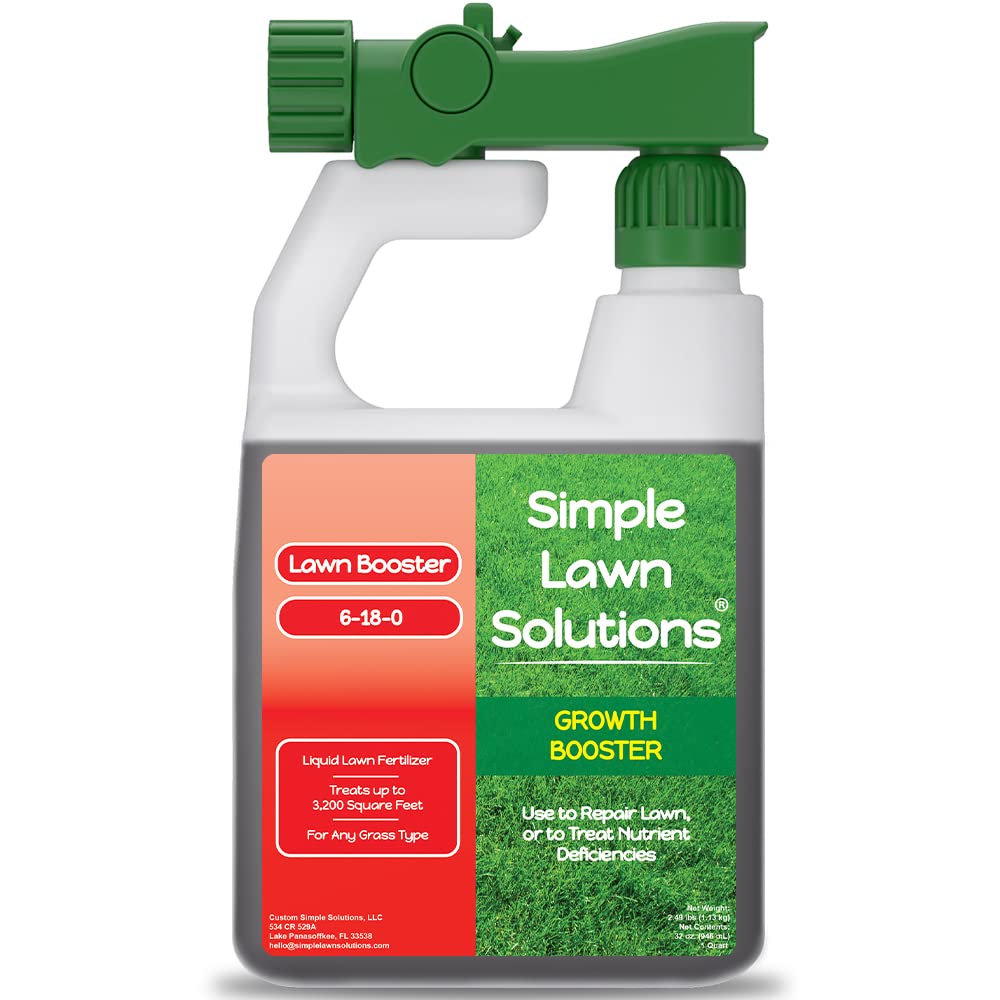
Simple Lawn Solutions Growth Booster Liquid Fertilizer (32 oz) with Humic Acid, Hose-End Sprayer
| Item Form | Liquid |
|---|---|
| Specific Uses For Product | Establishing lawn with sod or seed, Boosting vertical and lateral growth, Addressing phosphorus nutrient deficiencies |
| Application Method | Spray |
| Coverage | 3,200 square feet |
| Target Species | all grass types |
This ready-to-use growth booster is designed for establishing new lawns and encouraging faster vertical and lateral turf growth. It attaches to a hose-end sprayer and covers up to 3,200 square feet per bottle, so application is quick for medium-sized yards and for seeding or sodding jobs. The formula supplies nitrogen and a relatively high phosphorus percentage to promote seedling vigor and root development, while added humic acid helps improve nutrient availability in the soil. Practical benefits include easy hose connection, suitability for all common grass types, and a concentrate strength aimed at early-stage establishment. Limitations to note are that the product is focused on growth stimulation and phosphorus support rather than long-term balanced feeding, so it works best as a starter or boost rather than a standalone seasonal program. Users should follow the mixing directions carefully and pair this with a regular lawn food if longer-term fertility is needed.
Best for: Gardeners who want a simple, fast solution to establish new seed or sod and to accelerate early root and shoot growth without complex mixing or equipment.
Less Ideal for: Lawn owners seeking a full-season fertilizer program or those managing very large lawns where a concentrated bulk product and repeated coverage are needed.
- Ready-to-use hose-end sprayer for fast, even application over lawns
- High phosphorus content improves seedling vigor and root establishment
- Includes humic acid to enhance nutrient uptake and soil mineral availability
- Covers up to 3,200 square feet per bottle, suitable for medium yards
- Suitable for all common grass types and for both sod and seed
- Formulation is aimed at early growth and does not replace a complete seasonal fertilizer program
- Bottle volume may be small for larger properties requiring multiple applications
Verdict: A quick, hose-end starter booster that speeds root and seedling development for new lawns and repairs.
Choosing the Right Liquid Fertilizer for New Sod: Key Factors to Consider
Nutrient Ratio and Role in Establishment
The balance of nitrogen, phosphorus, and potassium dictates how young sod directs energy. Higher available nitrogen encourages top growth but can stress roots if overapplied. Phosphorus supports root formation, which is critical in the first few weeks as sod reestablishes contact with underlying soil. Potassium improves overall stress tolerance and helps new grass withstand heat and traffic during establishment.
Look for formulations that emphasize early root support without excessive soluble nitrogen. Gardeners should also check for micronutrients such as iron and manganese when soil tests indicate deficiencies since these trace elements can influence color and vigor in new turf.
Concentration and Dilution Options
Liquid fertilizers come in different concentrates. A highly concentrated product offers economy but requires accurate measuring and careful dilution to avoid burning new sod. A low-concentration or ready-to-use liquid is simpler to apply but may require more frequent applications to maintain nutrient availability.
Consider how comfortable you are with mixing concentrated solutions and whether you have measuring tools and clean water for dilution. Also factor in how quickly you plan to water in the product; lighter dilutions are more forgiving if irrigation timing varies.
Application Method and Equipment Compatibility
How you apply liquid fertilizer affects coverage and safety. Hose-end sprayers, backpack sprayers, and tank sprayers each deliver different flow rates and droplet sizes. Some concentrated liquids are compatible with hose-end or hand-pump sprayers, while others are formulated for injectors or professional equipment.
Choose products that match the gear you already have to avoid uneven distribution. For small lawns or patchy installations, a pump sprayer gives precise control. For larger areas, look for formulas that work with wider-coverage hose-end or broadcast sprayer attachments.
Timing Relative to Sod Installation and Watering
Timing determines how effectively nutrients reach new roots. Apply a starter feed shortly after laying sod once the turf is in contact with the soil and the bed has been watered. If applied too early or onto dry turf, concentrated liquids can cause burn. If applied too late, the sod may begin using reserves and root growth can lag.
Coordinate fertilizer application with irrigation. A light irrigation after application helps move nutrients into the soil contact zone. Avoid applying in midday heat; early morning or late afternoon minimizes stress and reduces evaporation of spray droplets.
Turf Safety and Label Guidance
Young sod is more vulnerable to chemical stress and burn than established turf. Labels that give specific rates for newly installed sod, recommend water volumes to dilute or rinse in, and provide clear reentry or mowing intervals are safer choices. Some liquids include explicit instructions for avoiding contact with plant crowns or seams, which reduces uneven establishment risks.
Always follow label instructions for maximum concentrations and do a small patch test on a less visible area when trying a new product. Safety information and first aid directions are also important in case of accidental skin or eye exposure.
Soil Contact and Microbial Considerations
A liquid fertilizer helps nutrients reach the soil surface and the thin root mat of sod faster than a granular starter, but soil biology still matters. Beneficial microbes and mycorrhizal associations aid root penetration into the soil. Some liquid formulations include additives to support microbial activity, while others are straight nutrient solutions.
If your soil is compacted or low in organic matter, consider pairing nutrient application with practices that improve contact and biology such as light raking, topdressing with compost, or aeration prior to sodding. Liquids applied alone will supply nutrients but do not replace good planting technique.
When to Apply Starter Liquid Vs Follow-Up Feeds
Apply a starter-strength liquid within the first week after sod installation to encourage root formation, provided the turf has been watered so the fertilizer will move into the soil. Follow-up applications can use slightly higher nitrogen formulations to encourage tillering once roots are established, but be conservative on rate and frequency until the sod shows consistent rooting through the seam areas.
- Starter applications: light, root-focused, often higher phosphorus relative to nitrogen.
- Follow-up feeds: lower phosphorus, moderate nitrogen to build green-up without stretch.
- Space liquid applications according to label and monitor turf response before repeating.
How to Mix and Calibrate Common Sprayers
Get accurate mixing by measuring concentrate and water precisely. For pump sprayers, mix the measured fertilizer in a separate bucket before filling the tank to ensure even dissolution. For hose-end applicators, follow dilution instructions closely and run water through the line briefly to flush the product evenly.
Calibrate application by marking a test area and timing how long it takes to cover that area with a stream. Use that timing to estimate coverage per tank or bottle and calculate the correct amount of fertilizer to achieve the label rate across your lawn.
- Always rinse sprayers after use to prevent clogged nozzles and degraded future mixes.
- Wear gloves and eye protection when mixing concentrated liquids.
Adjusting Rates for Soil Tests and Local Conditions
If you have a recent soil test, use it to tailor application rates. Strong phosphorus levels in soil mean you can reduce starter phosphorus to avoid runoff and waste. Sandy soils leach nutrients faster and may need more frequent, lighter liquid applications, while clay soils retain nutrients longer and require lower repeat rates.
Account for local weather and seasonality. Cooler soil temperatures slow nutrient uptake, so reduce rates in early spring. In hot, dry periods avoid concentrated applications that increase burn risk and prefer early morning watering to incorporate the feed.
- Sandy soils: lighter, more frequent liquid doses.
- Clay soils: lower frequency and more careful timing.
- Soil tests: adjust phosphorus and micronutrient inputs accordingly.
Integrating Liquid Fertilizer With Irrigation Plans
Liquid fertilizer and irrigation are closely linked for new sod. A light irrigation before application ensures turf and soil are receptive. After applying, follow with a gentle watering to move nutrients into the root zone and reduce foliar residue that could burn in sunlight.
Use irrigation events to schedule feeds so you do not overwater. For systems on timers, set a short run cycle immediately before or after spraying based on label guidance. Hand-watered installations can be targeted to seams and stressed patches to encourage uniform rooting.
- Irrigate lightly after application to wash nutrients into the soil.
- Avoid heavy irrigation that creates runoff; adjust spray volume to match soil infiltration.
How We Chose the Best Liquid Fertilizer for New Sod
We prioritized products and formulations that match the specific needs of newly installed sod rather than long-term maintenance feeds. Selection focused on nutrient ratios that favor root development, soluble delivery mechanisms, and label guidance for use on newly laid turf. We also considered application versatility for common lawn equipment and how forgiving a formula is when timing, water volume, or tank-mix conditions vary. Concrete evaluation criteria included nitrogen type and release profile for immediate but safe growth; the presence and balance of phosphorus and potassium to support root establishment and stress tolerance; concentration and dilution flexibility so gardeners can control strength for delicate sod; compatibility with common spreaders, hose-end sprayers, and sprayer nozzles; and label clarity and safety guidance to reduce risk of burning or uneven feeding. We excluded granular-only fertilizers and products intended solely for established lawns or specialty turf diseases. Formulas lacking clear application rates for new sod or those requiring specialized injector systems were also removed from consideration.
FAQ
Can I apply liquid fertilizer to sod immediately after installation?
Usually you should wait until the sod has been watered in and the soil is moist. Applying to dry turf or dry soil increases burn risk. Check product labels for specific guidance on timing for newly laid sod.
How often should I reapply liquid fertilizer during establishment?
Frequency depends on product concentration and formulation. Many starters are applied once at installation with a light follow-up after two to four weeks. If using low-strength liquids, gardeners often apply every two to three weeks while monitoring root progress.
Will a liquid starter replace the need for soil preparation?
No. Liquid fertilizer supplies nutrients but does not fix poor soil contact, compaction, or low organic matter. Proper soil preparation and ensuring good contact between sod and soil are still essential for successful establishment.
Is there a burn risk to new sod with liquid fertilizers?
Yes. New sod has a shallow root system and is sensitive to concentrated nutrients. Using recommended dilutions, applying when turf is moist, and irrigating lightly after application reduce burn risk.
Can I mix liquid fertilizer with other lawn care products?
Mixing depends on compatibility. Some liquids are safe to tank-mix with wetting agents or certain herbicides, while others are not. Always follow label compatibility charts and perform a small jar test before widespread mixing.
Final Verdict
Prioritize products and practices that support root development, precise application, and turf safety when establishing new sod. Focus on a starter-friendly nutrient profile, manageable dilution options, and equipment compatibility that matches your lawn size and skill with sprayers. Balance the need for early rooting with conservative rates to avoid burning tender grass. When you follow label directions, coordinate feeding with irrigation, and adjust for soil type, liquid fertilizers can speed establishment and lead to a stronger, more uniform lawn. Choose the approach that fits your watering schedule and the scale of the job to get the most reliable results.
