

Note: This article contains affiliate links. If you click on these links and make a purchase, I may earn a small commission at no extra cost to you. This helps support my research and content. Read my full affiliate disclosure here.
Potted herbs have different needs than garden beds. In containers the root zone is limited, soil nutrients wash out faster, and concentrated feeding can quickly change plant vigor. Choosing the right fertilizer for herbs in containers helps you maintain steady leaf growth, strong flavor, and predictable harvests without burning delicate foliage. This guide shortlists six top options suited to container herbs and evaluates them by how they feed, how easy they are to use, and how they affect flavor and leaf production. Read on to understand the tradeoffs and which feeding patterns fit your growing routine.
Top Picks at a Glance
| Best Overall The best all-around choice for most situations | Jack's Classic 20-20-20 All Purpose Water-Soluble Fertilizer (24 oz) | 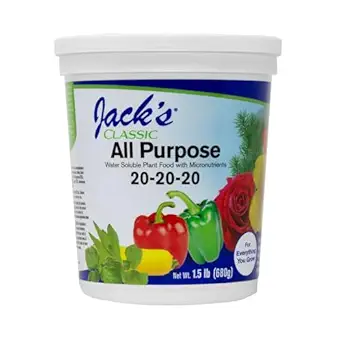 |
| Best Quality Built to a higher standard if you want something more solid | FoxFarm Big Bloom Liquid Plant Food, 16 fl oz |  |
| Best Value The sweet spot between price and what you get | Miracle-Gro Water Soluble All Purpose Plant Food, 3 lb |  |
| Best Budget The cheapest option that still gets the job done reliably | Miracle-Gro Pour & Feed Singles Ready-to-Use Plant Food |  |
| Highest Rated A top-rated pick with lots of positive feedback | Miracle-Gro Water Soluble All Purpose Plant Food, 1.5 lb |  |
| Most Popular A crowd favorite that many people choose with confidence | Miracle-Gro Indoor Plant Food for All Plants, Liquid, 8 fl. oz. (2-Pack) |  |
Jack's Classic 20-20-20 All Purpose Water-Soluble Fertilizer (24 oz)

| Item Form | Powder |
|---|---|
| Specific Uses For Product | Plant Growth |
| Coverage | All |
| Mixing Ratio | 0.22 |
Jack's Classic 20-20-20 is a professional‑grade, water‑soluble powder fertilizer intended for general feeding of indoor and outdoor plants. You dissolve the measured spoonfuls in water and apply as a root drench or foliar spray every 7 to 14 days, or use weaker mixes for seedlings and cuttings. The even 20-20-20 NPK formula promotes quick green‑up and leaf expansion, while included micronutrients support overall plant health. Because it is a powder concentrate, a small tub makes multiple gallons of feed, which is convenient for regular maintenance across beds, containers, and ornamentals. The product ships with a measuring spoon and clear directions, so it is easy to dose consistently. Limitations to note are that it is a generalist formula rather than crop‑specific booster, so plants with specialized needs may do better with targeted blends, and it requires careful handling and dilution to avoid overfeeding. Protective handling is recommended since the powder can irritate skin and eyes.
Best for: Gardeners who want a reliable, easy-to-use all‑around fertilizer for regular maintenance of outdoor beds, containers, and ornamentals and who value predictable, balanced nutrition.
Less Ideal for: Growers seeking a specialized bloom booster or a fertilizer tailored to a single crop should choose a targeted formula instead.
- Balanced 20-20-20 NPK supports fast green-up and leaf growth across many plant types
- Water‑soluble powder stretches farther than comparable liquid feeds so one tub makes multiple gallons
- Usable as both foliar spray and root feed for flexible application
- Includes measuring spoon and clear mixing directions for consistent dosing
- Added micronutrients reduce need for separate supplements
- General all-purpose formula is not optimized for bloom or fruit boosting
- Requires accurate measuring and dilution to avoid fertilizer burn
Verdict: A straightforward, professional‑grade balanced fertilizer that delivers reliable, easy-to-dose nutrition for maintaining healthy outdoor plants.
FoxFarm Big Bloom Liquid Plant Food, 16 fl oz

| Item Form | Liquid |
|---|---|
| Specific Uses For Product | Organic |
| Application Method | watering can, sprayer, or drip system |
| Liquid Volume | 16 fluid ounces |
| Mixing Ratio | 4 |
Big Bloom is a concentrated liquid bloom fertilizer aimed at boosting flowers and fruit by supplying readily available organic nutrients. It mixes into water (manufacturer recommends 4 tablespoons per gallon) and can be applied with a watering can, sprayer, hose-end siphon, or through drip systems, so you can feed potted plants, beds, or containers without changing your routine. Notable features are its OMRI listing for organic use and the inclusion of bat guano and earthworm castings, which provide phosphorus and organic matter to encourage blooms and seed set. Because it is liquid and fast-acting, you can expect visible perk-up within a short time after feeding, and it is suitable for regular use at watering times to extend flowering. Limitations to consider are the small 16 fl oz size for larger gardens and the presence of phosphorus, which may be restricted in some locales and requires careful application to avoid runoff.
Best for: Gardeners focused on maximizing blooms and fruit who want an organic, fast-acting feed they can add to routine watering for container and bed-grown flowering plants.
Less Ideal for: Large-scale landscapers or very large perennial beds who need bulk fertilizer solutions or want to avoid phosphorus-based products due to local regulations.
- OMRI-listed organic formula with natural inputs like bat guano and earthworm castings
- Liquid concentrate allows fast nutrient uptake and flexible application methods
- Works with watering cans, sprayers, hose-end siphons, and drip systems for easy integration
- Small 16 fl oz bottle may require frequent repurchasing for larger flower beds
- Contains phosphorus so local restrictions on phosphorus fertilizers may apply
Verdict: Choose Big Bloom when you want an OMRI-listed, easy-to-apply liquid fertilizer that delivers fast organic nutrients to boost flowering and fruiting.
Miracle-Gro Water Soluble All Purpose Plant Food, 3 lb

| Item Form | Powder |
|---|---|
| Application Method | Mix with water in a watering can |
| Fertilizer Analysis (N‑P‑K) | 24-8-16 |
| Unit Count | 48 Ounce |
| Coverage | Feeds approximately 1,200 sq. ft. |
Miracle‑Gro Water Soluble All Purpose Plant Food is a powdered NPK 24‑8‑16 formula that dissolves in water to give plants a quick nutrient boost. You mix measured scoops into a watering can and apply to the soil at the base of plants every 7–14 days for outdoor use or every 14 days for houseplants. Notable features include a high nitrogen content for leafy growth, compatibility with containers and in‑ground beds, and guidance for use with a Miracle‑Gro Garden Feeder for larger areas. In practical terms this is a fast‑acting feed that encourages bigger, greener foliage and works well in regular maintenance of perennials like hostas. Limitations are that it is a fast‑release fertilizer rather than a slow‑release option, so it requires regular reapplication and careful measuring to avoid overfeeding. Also, the 24‑8‑16 balance is geared toward vegetative growth, so it is not optimized if you want to prioritize flowering or bloom boosting.
Best for: Buyers who want a reliable, fast‑acting feed to maintain lush, leafy perennials and container plants and who value proven products with broad user endorsement.
Less Ideal for: Gardeners seeking a single, long‑lasting granular fertilizer or a bloom‑focused formula should consider alternative slow‑release or high‑phosphorus products.
- Water‑soluble powder mixes easily for quick uptake by roots
- High nitrogen formula promotes robust leafy growth ideal for shade plants
- Clear mixing and application instructions for both indoor and outdoor use
- Suitable for containers and in‑ground gardens and compatible with garden feeders
- Requires frequent applications so it is not a low‑maintenance, slow‑release option
- High nitrogen ratio is less suitable when the primary goal is more flowers than foliage
Verdict: A fast‑acting, water‑soluble fertilizer that reliably produces bigger, greener hosta leaves when used as directed.
Miracle-Gro Pour & Feed Singles Ready-to-Use Plant Food

| Item Form | Liquid |
|---|---|
| Application Method | Pour |
| Coverage | Medium |
| Unit Count | 2 Ounce |
| Specific Uses For Product | Plant Food |
Miracle-Gro Pour & Feed Singles are single-use, pre-measured liquid doses that you snap open and pour onto the soil of container plants, so there is no mixing, measuring, or long-term storage. Each 2-ounce single is formulated for potted plants and is intended to feed 12 to 18-inch containers every 10 to 14 days, making it convenient for quick top-ups on vegetables grown in pots. The cap-measure instructions and pour application simplify regular feeding, and the ready-to-use format reduces the chance of over- or under-dosing. Practically, these work well for growers who rotate several small vegetable containers or need an easy solution when juggling many plants. Limitations are that the singles are sized for medium pots only, so very small or very large containers may need adjusted amounts or additional applications, and the format creates more single-use packaging than bulk concentrates. For gardeners prioritizing simplicity and predictable dosing, the product streamlines weekly feeding for container vegetables, but those managing large numbers of pots may prefer a concentrated liquid or granular option for lower per-application cost and less waste.
Best for: Ideal for hobby gardeners growing a few container vegetables who want a no-fuss, predictable feeding routine and value convenience over lowest cost.
Less Ideal for: Not the best choice for producers managing many pots or those focused on minimizing packaging waste or per-application cost.
- Ready-to-use pre-measured singles eliminate mixing and measuring
- Simple pour application designed for container plants
- Labels recommend a clear 10 to 14 day feeding schedule for consistency
- Portable single doses are convenient for spot feeding or travel
- Singles are sized for 12–18 inch pots and may not match very small or very large containers
- Single-use packaging generates more waste than concentrated formulas
Verdict: An easy, no-mix feeding solution that makes consistent fertilizing of medium container vegetables fast and foolproof.
Miracle-Gro Water Soluble All Purpose Plant Food, 1.5 lb

| Item Form | Powder |
|---|---|
| Application Method | Watering Can |
| Target Species | For all flowers, vegetables, trees, shrubs and houseplants |
| Mixing Ratio | 24-8-16 |
Miracle-Gro Water Soluble All Purpose Plant Food is a powdered, water-soluble fertilizer formulated to deliver fast nutrition to a broad mix of plants. You mix the powder into a watering can or a garden feeder and apply every 1 to 2 weeks depending on whether plants are indoors or out. The 24-8-16 NPK ratio supplies a strong nitrogen boost for leafy growth along with phosphorus and potassium to support flowering and fruit set. For pepper growers this means it can help produce vigorous plants and encourage fruit development when used at the recommended strengths. Notable features include clear mixing guidance for both indoor and outdoor use and compatibility with container and in-ground plantings. Practical benefits are quick uptake by roots and flexible application options. Important limitations are the high nitrogen proportion, which can favor foliage over fruit if overused, and the need to follow dilution instructions to avoid nutrient burn. This product is best used as a regular boost within a balanced feeding plan rather than the only fertility source for long-term soil health.
Best for: Home gardeners looking for an affordable, easy-to-use boost to support vigorous pepper plant growth and quick results in both containers and garden beds.
Less Ideal for: Growers who want a low-nitrogen or slow-release fertility plan for long-term soil building should consider specialized or organic alternatives.
- Water-soluble powder that feeds plants quickly through the roots
- Clear mixing instructions for indoor and outdoor applications
- Broadly labeled for use on flowers, vegetables, trees, shrubs and houseplants
- Feeds approximately 600 sq. ft. from the 1.5 lb container
- High nitrogen ratio may encourage foliage more than fruit if used too frequently
Verdict: A budget-friendly, fast-acting soluble fertilizer that gives bell pepper plants a regular nitrogen-rich boost to promote vigorous growth and quicker results.
Miracle-Gro Indoor Plant Food for All Plants, Liquid, 8 fl. oz. (2-Pack)

| Item Form | Liquid |
|---|---|
| Application Method | Apply directly to soil or mix with water |
| Target Species | Houseplants |
| Liquid Volume | 8 fluid ounces |
| Mixing Ratio | 4 pumps per 1 quart of water |
Miracle-Gro Indoor Plant Food is a ready-to-use liquid fertilizer for indoor potted plants that you apply either directly to soil or diluted in water. It is typically used every two weeks by mixing the recommended number of pumps into a quart of water or by applying a few pumps for larger pots, making it easy to add to a regular watering routine. The product feeds quickly because nutrients are water-soluble and the pump dispenser gives repeatable doses without measuring spoons. Practical benefits include broad compatibility with most houseplants and a compact bottle size that is convenient for small indoor gardens. Limitations are that the label lists only N, P, K without a full nutrient breakdown, so growers wanting precise NPK ratios or micronutrient profiles may prefer a more detailed formula. Also the 8 fl. oz. bottles are best for hobbyists or small collections rather than large indoor plantings because frequent repurchasing will be necessary for heavy users.
Best for: Buyers who want a simple, low-effort fertilizer to add to a regular watering routine and who prioritize straightforward dosing and broad houseplant compatibility.
Less Ideal for: Specialist growers who need exact NPK ratios, detailed micronutrient information, or bulk quantities for many plants should consider a different product.
- Liquid formula feeds instantly when mixed with water or applied to soil
- Pump dispenser provides simple, repeatable dosing without measuring
- Designed for use with a wide range of indoor plants including herbs, flowers and vegetables
- Full NPK ratio and micronutrient details are not shown on the product summary
- Small 8 fl. oz. bottle size may require frequent replacement for larger collections
Verdict: A convenient, pump-dosed liquid fertilizer that makes fortnightly feeding simple for casual indoor plant owners.
Choosing the Right Fertilizer for Herbs in Containers: Key Factors to Consider
Nutrient Ratio and What Herbs Need
Herbs grown in containers generally benefit from formulas higher in nitrogen relative to phosphorus and potassium because foliage is the harvested product. A balanced but leaf-leaning ratio helps promote dense, flavorful leaves rather than excessive flowering or woody growth.
Look for a feed that lists its N-P-K ratio clearly and consider slightly higher nitrogen during active leaf growth, then switch to a balanced maintenance feed when herbs approach maturity. Overfeeding phosphorus can encourage root-bound stress in small pots, while excessive potassium may limit tender new leaf production.
Release Type and Feeding Frequency
Fertilizers come as water-soluble concentrates, slow-release granules, or liquid organics, and each interacts with container conditions differently. Water-soluble feeds give quick results and let you correct deficiencies fast, but they require frequent dosing and careful measurement for small pots.
Slow-release granules reduce maintenance by delivering nutrients over weeks or months, which is helpful if you water inconsistently. However, they can be less precise and may run out faster in heavily planted pots. Organic liquid feeds tend to improve soil biology but act more slowly and often need repeated applications to build nutrient levels.
Salt Index and Concentration
Containers are prone to salt buildup because soluble salts from fertilizers and tap water can accumulate as water evaporates. High-concentration formulas or frequent dosing increase the risk of leaf tip burn and root damage.
Choose lower concentration feeds or dilute liquid concentrates well for small pots. Flush containers occasionally with plain water to leach excess salts and monitor foliage for browning tips as an early sign of salt stress.
Compatibility With Culinary Use
If you harvest herbs for the kitchen, consider fertilizer sources and any residual taste or regulatory concerns. Organic or low-residue fertilizers are often preferred for edible herbs because they rely on mineralization and microbial activity rather than concentrated synthetic salts.
That said, many synthetic formulas are safe when used as directed and do not impart flavor if rinsed before use. Decide whether you prefer organic certification or are comfortable with conventional feeds based on how you plan to use the herbs.
Container Size and Root Volume
The volume of potting mix dictates how much nutrient reserve is available and how quickly chemicals concentrate. Small pots need gentler, more frequent feeds because there is less buffer against nutrient depletion and salt buildup.
Large containers can hold more slow-release granules and tolerate higher single doses, but they still require monitoring. Match feed strength and application frequency to the pot size and the number of plants sharing the container.
Ease of Measurement and Application
Practicality matters in home herb care. Feeds that are easy to measure and apply reduce mistakes like overconcentration. Powdered packets, measured liquid droppers, or premeasured stakes lower the chance of misfeeding small pots.
Consider how the product fits into your routine. If you water daily, a slow-release or weaker soluble feed is less likely to cause spikes. If you travel often, low-maintenance options become more attractive.
How Feeding Affects Flavor and Aroma
Nutrient levels shape not just growth but also the concentration of essential oils that give herbs their aroma. Moderate nitrogen encourages lush leaf production, but overly rapid growth can dilute flavor. Slight nutrient stress at the right time can concentrate flavors before harvest.
Timing feed cycles matters. For example, reduce heavy feeding a week or two before harvest to let plants channel resources into oil production rather than rapid biomass accumulation. Consistency in feeding and watering tends to produce the most predictable flavor profiles.
- Even feeding produces more consistent essential oil levels than erratic dosing
- Avoid last-minute heavy feeding before harvest to prevent diluted flavor
Feeding Schedules for Different Growing Seasons
Herbs slow down in cooler weather and need less frequent feeding. In spring and summer when growth is rapid, weekly or biweekly light feeds are often appropriate depending on feed type. Slow-release options can cover several weeks through active seasons.
Adjust frequency when moving herbs indoors for winter. Indoor light levels and reduced evapotranspiration usually mean you should cut back on feeding and watch for signs of nutrient deficiency rather than automatically following a summer schedule.
- Increase feed frequency in high light and warm temperatures
- Reduce or pause feeding during dormancy or low-light winter months
Mixing and Dilution Tips for Small Pots
Small containers magnify dosing errors, so always follow the low-end dilution instructions for concentrated fertilizers. Use a graduated measuring device for liquids and mix in a watering can to ensure even distribution. When trying a new feed, start at half the recommended strength and monitor plant response for a week.
For slow-release granules, scatter them lightly and avoid piling near stems where concentrated salts may build up. When combining organic and synthetic feeds, do so cautiously and observe plants closely, because interactions can change effective nutrient availability.
- Start new fertilizers at reduced strength in small pots
- Mix liquids thoroughly before applying to avoid hotspots
Troubleshooting Common Container Fertilizer Problems
Yellowing leaves, stunted growth, or brown leaf tips can indicate either deficiency or salt burn. Check for build-up on the soil surface and perform a flush if salts appear. If leaves are pale but new growth is sparse, a mild, balanced feed can correct deficiencies without shocking roots.
Root-bound pots often show nutrient stress even with regular feeding. Repotting into fresh mix or dividing plants can restore healthy uptake and make feeding more effective.
- Flush pots with water to remove excess salts
- Repot or divide if roots fill the container and feeding is less effective
Organic Vs Synthetic Feeds for Container Herbs
Organic feeds supply nutrients more slowly through microbial activity, which can be gentler for small-root systems and improve long-term soil health. They are less likely to cause sudden salt spikes but may require more frequent application to build nutrient levels.
Synthetic watersoluble feeds provide precise nutrient control and quick correction of deficiencies. They are useful if you want rapid response, but require careful dilution and more frequent application in containers to avoid buildup.
- Choose organics for soil health and low-residue preferences
- Choose synthetic solutions for quick corrections and precise nutrient ratios
How We Chose the Best Fertilizer for Herbs in Containers
We focused on attributes that directly affect success with potted herbs. Nutrient balance was a primary filter because container-grown herbs need a fertilizer ratio that encourages leafy growth without pushing excessive stem elongation. Release profile and longevity were evaluated to match different watering schedules and to avoid frequent reapplication that can disturb small pots. Application method was another key criterion, separating soluble feeds, slow-release granules, and blends that are easy to measure for small volumes of potting mix. We also examined salt levels and formulation concentration to reduce the risk of root burn in confined root balls. Organic inputs and compatibility with culinary herbs were considered for gardeners who want minimal synthetic residues or prefer compost-based fertility. Ease of use and packaging sizes were reviewed for practicality in container gardening. Excluded items included fertilizers designed solely for lawns, large-scale agriculture, or specialty crops with very different nutrient needs. We did not include products intended only for transplant starter mixes or seed treatments because those do not match ongoing feeding for established potted herbs. The result is a mix of feeding styles and concentrations that work well in small to medium containers under typical home growing conditions.
FAQ
How often should I fertilize potted herbs during the growing season?
It depends on the feed type. Water-soluble fertilizers are often applied every one to two weeks at a low dose. Slow-release granules can last from four to twelve weeks depending on formulation. Monitor growth and adjust frequency if you see signs of deficiency or excess.
Can I use houseplant fertilizer on culinary herbs in containers?
Often houseplant fertilizers will work because they are formulated for foliage, but check the nutrient ratio and salt concentration. Use reduced strength for small culinary pots and avoid formulas labeled for flowering or fruiting if you want leafy herbs.
Will organic fertilizers make my herbs taste different?
Organic fertilizers can influence soil biology, which in turn can affect nutrient uptake and subtle flavor notes. Most gardeners do not notice a direct off-flavor if products are used properly. Rinsing herbs before use and following recommended application rates reduces any risk of residual taste.
What are signs of fertilizer burn in container herbs?
Symptoms include brown or crispy leaf tips, sudden leaf drop, or stalled new growth. Soil may have a white crust on the surface from salts. If you suspect burn, flush the pot thoroughly with water and hold off on additional feeding until recovery.
Should I change feeding when herbs are moved indoors?
Yes. Indoor conditions typically mean lower light and slower growth, so reduce both the concentration and frequency of feeding. Watch for pests and lower evaporation rates that may change how nutrients are taken up.
Final Verdict
For container herbs prioritize a fertilizer that supports leafy growth, matches your watering routine, and minimizes salt risk in small root volumes. Decide between quick-acting watersoluble feeds for fast correction and slow-release or organic options for lower-maintenance, gentler feeding. Match concentration and frequency to pot size and seasonal growth rate. Focus on nutrient ratio, release profile, and ease of application when choosing a fertilizer for herbs in containers. With those priorities in mind you can keep potted herbs healthy, flavorful, and reliably productive.
