

Note: This article contains affiliate links. If you click on these links and make a purchase, I may earn a small commission at no extra cost to you. This helps support my research and content. Read my full affiliate disclosure here.
Summer heat changes how plants use nutrients and how quickly soil dries out. Choosing a fertilizer formulated for hot weather helps plants keep steady growth, maintain leaf turgor, and recover faster after heat spikes. This guide covers six top fertilizer options suited for hot summer conditions and explains the practical tradeoffs between feeding strength, salt risk, and long‑term soil health. We'll evaluate each choice on the needs that matter most to gardeners managing heat stress and water limits, then summarize what to prioritize for different garden situations.
Top Picks at a Glance
| Best Overall The best all-around choice for most situations | Scotts Turf Builder Southern Lawn Food, 14.06 lb |  |
| Best Quality Built to a higher standard if you want something more solid | FoxFarm Soil Liquid Trio Pack (Big Bloom, Grow Big, Tiger Bloom) |  |
| Best Value The sweet spot between price and what you get | Southern Ag All Purpose Granular Fertilizer 10-10-10 (5 lb) |  |
| Best Budget The cheapest option that still gets the job done reliably | Miracle-Gro Water Soluble All Purpose Plant Food, 1.5 lb |  |
| Highest Rated A top-rated pick with lots of positive feedback | Miracle-Gro Water Soluble All Purpose Plant Food, 12.5 lb |  |
| Best Seller A high-volume bestseller chosen again and again | Scotts Turf Builder Lawn Food, 37.5 lb. |  |
Scotts Turf Builder Southern Lawn Food, 14.06 lb

| Item Form | Granules |
|---|---|
| Application Method | spreader |
| Coverage | 5,000 sq. ft. |
| Mixing Ratio | 32-0-10 |
| Target Species | Southern lawns, Southern grass |
Scotts Turf Builder Southern Lawn Food is a granular fertilizer made specifically for southern warm-season grasses such as Zoysia, St. Augustine, Bermuda, Bahia, and Centipede. It is designed for broadcast or drop spreader application and uses slow-release nitrogen in every granule so you can apply one feeding and expect up to six weeks of greening. Typical use is in the growing season—apply after the first spring mow or in recommended fall windows and follow spreader settings listed on the bag; light watering after application speeds results but is not required. Practical benefits include even coverage from all-in-one particles, deeper root development to help through heat and drought, and a known feeding schedule for repeat applications. Important limitations are that it contains phosphorus so local restrictions may apply and it is not a weed-and-feed product, so broadleaf weeds will not be controlled by this bag. The product is most useful when paired with a proper spreader and timing that matches Zoysia's fall growth window.
Best for: Homeowners who prioritize a reliable, low-risk fertilizer tailored to Zoysia and other southern warm-season lawns and who prefer predictable, infrequent feedings with measured spreader guidance.
Less Ideal for: Gardeners who need a fertilizer that also controls weeds or who must avoid phosphorus due to local restrictions should consider alternative weed-and-feed or phosphorus-free products.
- Formulated for warm-season southern grasses including Zoysia
- Slow-release nitrogen in each granule for up to six weeks of feeding
- All-in-one particles promote even distribution and consistent greening
- Builds deeper roots to help maintain color through heat and drought
- Contains phosphorus which may be restricted by local regulations
- Does not include weed control so separate weed treatment may be needed
Verdict: A dependable, slow-release granular feed designed to strengthen roots and keep Zoysia green with a single application lasting about six weeks.
FoxFarm Soil Liquid Trio Pack (Big Bloom, Grow Big, Tiger Bloom)

| Brand | FoxFarm |
|---|---|
| Item Form | Liquid |
| Unit Count | 48 Fluid Ounces |
| Specific Uses For Product | Plant Food |
| Coverage | Organic |
The FoxFarm Soil Liquid Trio Pack combines Big Bloom, Grow Big, and Tiger Bloom into a simple program for indoor gardeners who want strong vegetative growth followed by bigger blooms and fruit. Typical use is stage-based: Grow Big during vegetative growth to push leafy development, Big Bloom as an all-purpose supplement across cycles, and Tiger Bloom once buds form to encourage multiple bud sites and fuller flowers. The liquids are concentrated and greenhouse-tested for consistency, so measured feedings integrate easily with regular watering schedules. Practical benefits include a complete, complementary nutrient progression and formulations designed to keep micronutrients available in storage. Important limitations are that these are general-purpose concentrates rather than precision NPK formulations for specialty crops, and users who want exact nutrient ratios or automated dosing systems will need extra equipment and testing. Safety precautions such as keeping away from children and pets and wearing protective clothing are required when handling concentrated liquids.
Best for: Indoor growers who prioritize measurable performance and want a simple, stage-based feeding plan to push vigorous growth and larger blooms without building their own nutrient lineup.
Less Ideal for: Growers seeking exact NPK control, automated dosing integration, or a fertilizer tailored to a single specialist crop should consider lab-formulated or hydroponic-specific options instead.
- Three complementary formulas cover vegetative growth, bloom support, and fruiting in one kit
- Concentrated liquid form mixes readily for regular indoor feedings
- Greenhouse-tested formulations deliver consistent performance across batches
- Suitable for a wide range of indoor plants including houseplants, herbs, and vegetables
- Not a precision nutrient program for specialty or hydroponic crops
- Concentrated liquids require careful measuring and handling to avoid overfeeding
Verdict: For indoor gardeners who want a proven, stage-based liquid feeding program to boost vegetative growth and maximize blooms, this trio delivers a ready-made performance pathway.
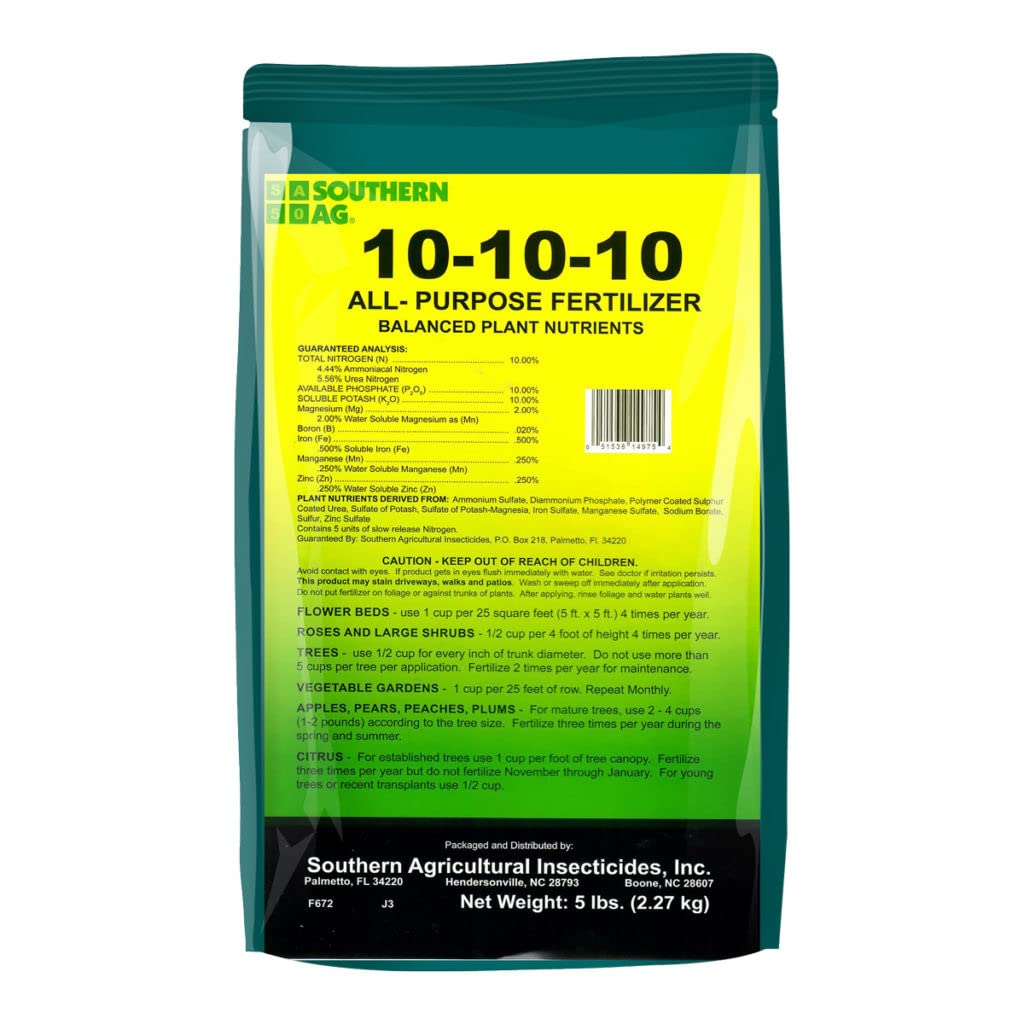
Southern Ag All Purpose Granular Fertilizer 10-10-10 (5 lb)
| Item Form | Granules |
|---|---|
| Specific Uses For Product | Citrus and Fruit Trees, Flowerbeds, Roses, and Large Shrubs, Vegetable Gardens |
| Application Method | Broadcast evenly over area and water in. |
| Mixing Ratio | 10:10:10 |
This 5 lb bag of Southern Ag 10-10-10 granular fertilizer is a straightforward, balanced all-purpose feed for vegetable beds, fruit trees, roses, and shrubs. You spread the granules uniformly over soil or beds and water them in; directions and recommended cup measurements are printed for common uses so dosing is easy. The formula supplies equal parts nitrogen, phosphorus, and potassium plus trace minerals like magnesium, iron, manganese, zinc, and boron, which supports steady vegetative growth and overall plant health. For asparagus specifically it can be used as a periodic maintenance feed during the growing season to support fern growth and energy storage in crowns. The product is simple to store and apply, and the small bag size is convenient for trialing on a single bed or patch. Limitations are that it is a general blend rather than a tailored asparagus formula, so heavy feeders or soils needing specific nutrient correction may require additional amendments, and granular broadcast feedings require careful placement to avoid contact with foliage or runoff risks described on the label.
Best for: Gardeners on a budget who want a simple, balanced fertilizer to maintain small asparagus patches and other mixed beds without buying specialty formulas.
Less Ideal for: Growers managing large asparagus plantings, or who need a targeted high-potassium or soil-specific amendment, should choose a crop-specific or soil-test-driven fertilizer.
- Balanced 10-10-10 N-P-K supports general growth and root development.
- Includes micronutrients (iron, manganese, zinc, boron) for broader plant nutrition.
- Clear application instructions and coverage rates for common garden uses.
- Small 5 lb size is convenient for testing on a single asparagus bed or small garden.
- Not formulated specifically for asparagus so may lack the higher potassium or phosphorus some heavy beds benefit from.
- Granular broadcast application can stain hard surfaces and requires watering after application to activate nutrients.
Verdict: A low-cost, easy-to-use balanced granular fertilizer that is a practical maintenance feed for small asparagus beds and mixed gardens.
Miracle-Gro Water Soluble All Purpose Plant Food, 1.5 lb

| Item Form | Powder |
|---|---|
| Application Method | Watering Can |
| Target Species | For all flowers, vegetables, trees, shrubs and houseplants |
| Mixing Ratio | 24-8-16 |
Miracle-Gro Water Soluble All Purpose Plant Food is a powder concentrate you mix with water to give a quick nutrient boost to flowers, vegetables, houseplants, shrubs and trees. It is typically dissolved in a watering can or used with a compatible garden feeder to soak soil at the base of plants, delivering nitrogen-heavy nutrition that shows effects faster than granular fertilizers. Notable features include an easy scooping method for indoor and outdoor dosing, compatibility with containers and in-ground planting, and clear directions for feeding every one to two weeks. In practice this makes the product a convenient option when you want visible growth and greener foliage quickly, and the 1.5 lb container covers roughly 600 sq. ft. Important limitations are that it is a fast-release, high-nitrogen formula best used as a regular quick feed rather than a long-term slow-release solution, and it requires careful measuring to avoid overfeeding. For routine maintenance combine with good watering and follow the label to avoid nutrient imbalance.
Best for: Buyers who prefer proven, easy-to-use feeding routines and want noticeable growth quickly for a variety of garden and houseplants, guided by established usage directions and broad user experience.
Less Ideal for: Gardeners seeking a single, long-term slow-release solution or those who prefer organic or low-nitrogen fertilizers for sensitive plantings should consider alternative products.
- Water-soluble powder starts working quickly at the roots when mixed and applied
- Clear, simple dosing for indoor and outdoor use with included scoop guidance
- Suitable for a wide range of plants including vegetables, flowers, shrubs and houseplants
- Covers a large area from a small container (about 600 sq. ft. per 1.5 lb)
- Fast-release formula means benefits are short-term compared with slow-release granular fertilizers
- Requires precise measuring and regular reapplication to avoid overfeeding
Verdict: A reliable, fast-acting water-soluble plant food for gardeners who want easy, repeatable feeding and quick visible results.
Miracle-Gro Water Soluble All Purpose Plant Food, 12.5 lb

| Item Form | Powder |
|---|---|
| Specific Uses For Product | Plant Food |
| Coverage | general purpose, suitable for various plants |
| Mixing Ratio | 1 tablespoon per gallon of water |
Miracle‑Gro Water Soluble All Purpose is a powder fertilizer designed to dissolve in water and deliver fast nutrients to indoor and outdoor plants. Gardeners mix the recommended scoop with a watering can or use a compatible garden feeder to apply directly to the soil around roots; the product gives routine feedings every 7 to 14 days outdoors or every 2 weeks for houseplants. Notable features include an NPK of 24‑8‑16 for strong vegetative growth, a quoted coverage of about 5,000 sq ft from a 12.5 lb container, and an included scoop with separate measuring ends for indoor and outdoor rates. In practice this means quick uptake for leafy growth and an easy, repeatable dosing routine for reliability across container and in‑ground Clusia specimens. Limitations are that it is a general‑purpose formula rather than a Clusia‑specific mix and frequent applications are required during the growing season, so you will need to follow the label closely to avoid overfeeding.
Best for: Buyers who want a dependable, easy‑to‑measure fertilizer to keep Clusia healthy with consistent, repeatable feedings and straightforward application routines.
Less Ideal for: Growers seeking a slow‑release or custom‑formulated Clusia fertilizer or those who prefer lower‑frequency, hands‑off feeding strategies.
- Fast‑acting water‑soluble formula for near‑instant nutrient availability
- Simple mixing ratios and included scoop make dosing consistent
- Large 12.5 lb container covers a lot of garden area for routine feedings
- Suitable for both container and in‑ground use so it works with potted Clusia and landscape plantings
- General all‑purpose NPK may not match specialized nutrient needs of Clusia at every growth stage
- Requires regular applications during the season rather than a slow‑release schedule
Verdict: A reliable, easy‑to‑mix water‑soluble fertilizer that delivers fast, consistent feedings for Clusia in both pots and landscape settings.
Scotts Turf Builder Lawn Food, 37.5 lb.

| Item Form | Granules |
|---|---|
| Specific Uses For Product | Lawn |
| Coverage | 15000 |
| Mixing Ratio | 32:0:4 |
Scotts Turf Builder Lawn Food is a granular, all-purpose lawn fertilizer formulated to thicken and green lawns while building deeper roots. It is used by broadcasting with a spreader or dropping with a drop spreader; Scotts gives specific spreader settings for easy, repeatable application. The bag covers a large area so it is convenient for whole-yard spring feeding routines. Practical benefits include improved root strength and better nutrient and water uptake compared with unfed turf, plus flexible timing since it can be applied to wet or dry grass and lightly watered in for faster greening. The product is pesticide-free and intended for any grass type, so it can fit into a seasonal program for warm-season grasses like Zoysia. Limitations are that it is a straight lawn food without weed control or insect ingredients, so you will need separate products for weeds or pests, and handling a 37.5 lb bag can be bulky for small yards or single-application needs.
Best for: Homeowners who want a straightforward, high-coverage spring fertilizer to strengthen and green their Zoysia lawn as part of a planned feeding routine.
Less Ideal for: Gardners who need one-step weed and feed or combined pest control solutions or those with very small lawns who prefer smaller package sizes.
- Covers up to 15,000 sq. ft. from one 37.5 lb. bag
- Formulated to build stronger roots and improve nutrient uptake
- Can be applied to wet or dry lawns and used with common spreaders
- Pesticide-free lawn food suitable for any grass type
- Does not include weed or insect control so additional products may be required
- Large bag size may be awkward for small properties or single applications
Verdict: A simple, high-coverage lawn food that reliably builds root strength and greens Zoysia when used as part of a seasonal feeding plan.
Choosing the Right Fertilizer for Hot Summer: Key Factors to Consider
Nutrient Ratio and Timing
The balance of nitrogen, phosphorus, and potassium influences how plants cope with high temperatures. Higher nitrogen can encourage leaf growth but may increase water demand and heat stress if overapplied. Potassium helps with stomatal regulation and drought resilience, so fertilizers with adequate potassium can support membranes and water-use efficiency.
Timing matters: in sustained heat you may prefer lower single-application rates and more frequent, lighter feedings to match reduced root uptake. Slow-release or controlled-release nitrogen can prevent flushes of growth that become vulnerable during heat spikes.
Salt Index and Soluble Salts
High soluble salt content increases the risk of root scorch in dry, hot soils because salts draw water away from roots. Fertilizers with a lower salt index or with forms that dissolve more slowly are safer on drought-stressed plants and recently transplanted specimens.
When you must use a higher-salt feed, plan irrigation after application to flush salts toward deeper soil layers and reduce contact with fine roots. Consider spot applications away from crowns and stems to limit direct burn risk.
Release Profile and Water Use
How quickly nutrients become available affects both nutrient uptake and irrigation scheduling. Fast-release formulations supply an immediate boost but can require water to move nutrients into the root zone and may leach during heavy watering. Controlled-release fertilizers extend availability and reduce the need for frequent feeding, which is useful when watering is limited.
In hot weather, choose a release profile that matches your irrigation frequency and the crop's uptake rate. For container plants or small beds that dry quickly, smaller, more frequent feeds or water-soluble mixes applied at lower strength can be effective.
Soil Structure and Organic Content
Fertilizers that add organic matter or are used alongside compost improve soil water-holding capacity and microbial activity, both important during hot months. Organic inputs help buffer temperature swings at the root zone and support longer-term moisture retention, reducing irrigation frequency.
Synthetic fertilizers can be part of a summer plan but should be balanced with mulching and organic soil amendments when possible. Prioritizing products that support soil biology gives better resilience against recurring heat events.
Compatibility with Irrigation and Mulch
How you water and mulch affects fertilizer performance. Granular products often need to be watered in to move nutrients down to roots, while liquid feeds can be applied with irrigation but may be less persistent. Thick mulch moderates soil temperature and slows surface evaporation but can reduce the rate at which surface-applied granules contact soil.
Match the fertilizer form to your irrigation system and mulching approach. For drip systems, choose formulations that solubilize predictably and avoid particles that clog emitters. For mulched beds, distribute granules so nutrients reach the soil rather than staying trapped in the mulch.
Application Safety for Stressed Plants
Plants under heat stress can be more sensitive to feeding, so consider gentler application rates and avoid heavy side-dressing during peak daytime heat. Foliar feeding can offer a quick correction but is less effective on large plants and risks leaf burn if performed in full sun.
Adjust rates downward for recently transplanted or drought-stressed plants, and schedule applications during cooler parts of the day. Read label directions for maximum concentrations and recommended irrigation after application to protect roots.
When To Shift Your Summer Feeding Strategy
Warm-season dynamics change both demand and risk. Early summer may still support standard feed schedules, but once daily highs remain elevated and rainfall drops, reduce single-dose strength and increase frequency to avoid pushing plants into a water deficit.
Watch plant signs: slow leaf expansion, leaf rolling, and reduced flower set indicate uptake issues rather than nutrient absence. In those cases, lighter but more regular feeding paired with irrigation is safer than a large, immediate feed.
- Switch to early morning or evening applications to reduce foliar burn risk
- Favor lower concentration mixes for foliar sprays
- Apply controlled-release products before heatwaves when possible
Using Mulch and Organic Amendments with Summer Fertilizers
Mulch reduces surface temperature and evaporation, complementing fertilizer strategies by preserving the moisture needed for nutrient uptake. Organic amendments help hold nutrients in the topsoil and feed microbes that improve soil structure and water retention.
Apply compost or aged manure in spring and top-dress lightly midseason if soil tests indicate deficiencies. Avoid burying fresh high-nitrogen materials during peak heat, which can temporarily increase microbial activity and compete with plants for oxygen.
- Keep mulch a few inches away from crowns to avoid collar rot
- Use coarse organic matter that lets water penetrate quickly
- Topdress rather than incorporate when soil moisture is low
Fertilizer Forms and Best Uses in Hot Conditions
Granules are easy to apply across turf and beds but need watering-in and can sit on mulch. Water-soluble fertilizers give quick availability for containers or spot treatments but require more frequent dosing. Controlled-release granules reduce application frequency and lower the risk of nutrient flushes during sporadic watering.
Choose a form that matches how you water. For drip-irrigated beds, small-particle, soluble options that dissolve evenly work best. For broad lawn coverage during heat, controlled-release granules provide steady feeding without repeated applications.
- Containers: frequent light liquid feeds or slow-release spikes
- Flower beds: balanced controlled-release or light soluble applications
- Lawns: broadcast slow-release to reduce burn and watering needs
Adjusting Rates for Different Garden Situations
Container plants require lower per-application quantities because pots dry out fast and salts concentrate quickly. For newly planted shrubs or transplants, reduce rate and focus on root establishment with modest potassium and moderate nitrogen.
Established beds and lawns tolerate slightly higher inputs if followed by irrigation. Urban gardens with compacted soils benefit from combining fertilizers with aeration or core cultivation to improve root access to applied nutrients.
- Use half-strength feeds for recently potted or transplanted specimens
- Increase potassium slightly for flowering or fruiting plants under heat
- Avoid heavy nitrogen spikes in mid-summer for lawns undergoing drought
Safe Foliar Feeding Practices in High Heat
Foliar feeding can supply a quick nutrient correction when root uptake is limited by dry soil. Apply dilute foliar sprays in the coolest part of the day and avoid strong sunlight to reduce the risk of leaf scorch.
Limit foliar feeding to trace element corrections or mild nitrogen supplements. Do not rely on foliar feeding as the primary nutrient source for large shrubs or trees, whose root systems handle most nutrient needs.
- Test sprays on a small area first to check sensitivity
- Apply during early morning or late evening for best absorption
- Keep concentrations lower than label maximums when heat-stressed
How We Chose the Best Fertilizer for Hot Summer
We shortlisted fertilizers that address stress from high temperatures and reduced soil moisture, prioritizing formulations and application properties that work in real summer gardens. Our evaluation focused on nutrient balance and release profile, because hot conditions change uptake rates and constant high salts can scorch roots. We assessed salt index and compatibility with drought-stressed soils so gardeners can avoid burn and osmotic stress. Granule size and solubility were considered for even distribution and quick activation after irrigation. We evaluated organic matter and soil-building potential to favor options that improve moisture retention over the season. Finally, ease of application and flexibility for spot-treating or whole-bed feeding were included so products fit common garden routines. Excluded from the list were any fertilizers that require special licensing, specialist equipment, or that are explicitly for commercial field crops rather than home gardens.
FAQ
Can I apply a regular fertilizer during a heatwave?
Often it is safer to reduce rate and avoid heavy single applications during an intense heatwave. Lighter, more frequent feedings or switching to a controlled-release option can lower the risk of root burn while still supplying nutrients.
Is foliar feeding effective when soil is very dry?
Foliar feeding can provide short-term correction for micronutrient deficiencies, but it is not a complete substitute for root feeding. Leaves absorb some nutrients quickly, yet long-term needs still depend on soil improvements and root uptake once moisture is restored.
How does mulch affect fertilizer performance in summer?
Mulch helps retain moisture and stabilizes soil temperatures, which improves nutrient uptake. However, surface-applied granules can linger in mulch, so incorporate or water them in to ensure nutrients reach the root zone.
Should I increase potassium during hot months?
Increasing potassium modestly can help plants regulate water and strengthen cell membranes, improving heat and drought resilience. Adjust based on plant stage and soil test results rather than applying potassium indiscriminately.
Are organic fertilizers better for summer gardening?
Organic fertilizers contribute to soil structure and moisture retention, which is beneficial in summer. They may release nutrients more slowly, so combine them with targeted soluble feeds if plants show immediate deficiency symptoms.
How soon after fertilizing should I water in hot weather?
Watering after application helps move nutrients into the root zone and dilute soluble salts. Aim to water gently soon after applying granular products and avoid heavy runoff; the goal is to move nutrients down without washing them away.
Final Verdict
Pick a fertilizer that balances immediate plant needs with root safety during heat. Prioritize lower salt formulas or controlled-release products when irrigation is limited, and increase potassium when supporting water regulation and flowering. Combine feeding with mulching and organic amendments to improve moisture retention and long-term resilience. Adjust application rates for containers, new transplants, and established plantings, and prefer lighter, more frequent feedings during sustained heat. With these tradeoffs in mind, gardeners can choose a heat-ready feeding plan that sustains growth without adding undue stress.
