

Note: This article contains affiliate links. If you click on these links and make a purchase, I may earn a small commission at no extra cost to you. This helps support my research and content. Read my full affiliate disclosure here.
Growing lettuce hydroponically demands a fertilizer that dissolves cleanly, supplies the precise macro and micronutrients lettuce needs, and maintains a stable solution across frequent water changes. If you pick the wrong formulation you can end up with tip burn, slow head formation, or pH swings that stunt growth. This guide walks through the top shortlisted fertilizers for hydroponic lettuce and explains the practical tradeoffs that matter in a real system. We evaluate each option for nutrient balance, solubility, and how easy it is to maintain consistent EC and pH. Read on to see which traits matter most for steady, crisp lettuce production.
Top Picks at a Glance
| Best Overall The best all-around choice for most situations | General Hydroponics Flora Series 3-Part Nutrient System (FloraMicro, FloraGro, FloraBloom) — 1 qt. bottles |  |
| Best Quality Built to a higher standard if you want something more solid | General Hydroponics Flora Series 3-Part Nutrient System, 1 qt Bottles | |
| Best Value The sweet spot between price and what you get | Haligo A&B Hydroponic Nutrient Solution (800 ml total, 8-pack dosing bottles) |  |
| Best Budget The cheapest option that still gets the job done reliably | Awesome Plant Hydroponic Plant Food A&B (6-pack, 600 ml total) |  |
| Highest Rated A top-rated pick with lots of positive feedback | Jack's Nutrients Two‑Part Hydroponic Fertilizer Bundle (Part A + Cal Nit Part B) |  |
| Most Popular A crowd favorite that many people choose with confidence | TPS Nutrients Liquid Plant Food for AeroGarden and Hydroponics, 8 oz |  |
| Best Seller A high-volume bestseller chosen again and again | Ahopegarden 800ml A&B Hydroponic Nutrients Liquid Plant Food |  |
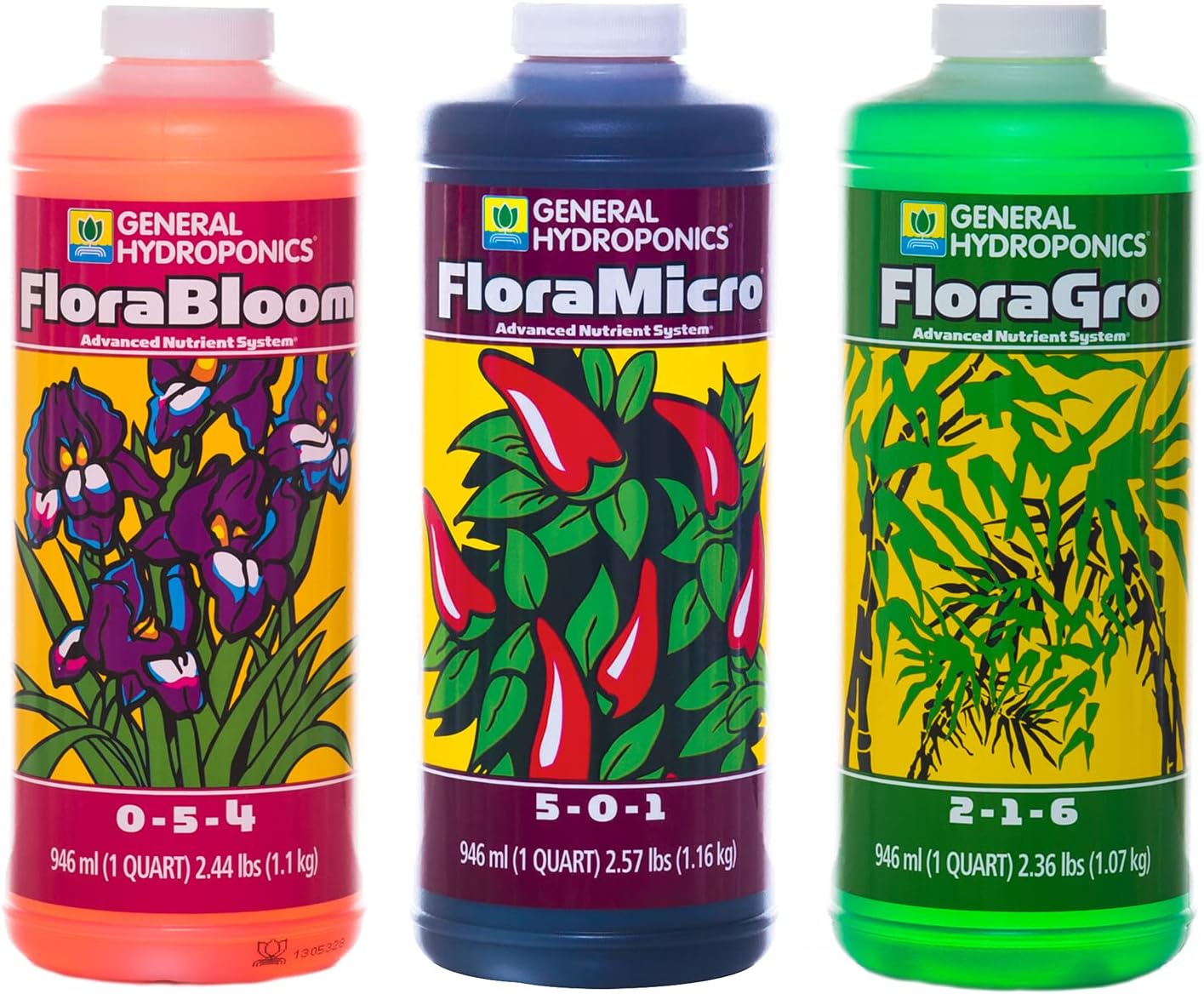
General Hydroponics Flora Series 3-Part Nutrient System (FloraMicro, FloraGro, FloraBloom) — 1 qt. bottles
| Unit Count | 96 Fluid Ounces |
|---|---|
| Item Form | Liquid |
| Specific Uses For Product | Plant Growth, Seed Development, Foliar Feedings |
| Mixing Ratio | 2:1:6 |
The Flora Series is a classic three-part hydroponic nutrient set—FloraMicro, FloraGro, and FloraBloom—formulated to deliver primary, secondary, and trace nutrients throughout a crop cycle. You mix the concentrated liquids into a reservoir, starting with FloraMicro then adding FloraGro and/or FloraBloom as needed, which lets you tailor the N-P-K balance for vegetative growth or flowering. For hydroponic lettuce this gives precise control over nitrogen for leaf development and the ability to dial back bloom-specific elements. The product is liquid ready-to-use concentrates with clear mixing guidance and a simple 2:1:6 mixing ratio listed for common recipes. Practical benefits include flexibility to custom-blend recipes for seedlings, vegetative growth, or foliar feedings and consistent micronutrient delivery from the Micro component. Limitations are typical for a multi-part system: it requires measuring and mixing each feed, monitoring reservoir EC and pH separately, and it is not a single-solution fertilizer so beginners must follow label instructions to avoid imbalance or runoff concerns.
Best for: Growers who want precise nutrient control for hydroponic lettuce and are comfortable measuring and mixing feeds to tune nitrogen levels for leafy growth.
Less Ideal for: Casual growers or beginners who prefer a single-step, no-mix fertilizer or who do not monitor reservoir chemistry regularly.
- Complete three-part formula covers macro and micronutrients
- Flexible mixing lets you adjust N-P-K for vegetative or bloom phases
- Liquid concentrate is easy to dissolve into a reservoir for regular feedings
- Includes guidance for seedling mixes and foliar feedings
- Requires manual measuring and separate mixing of three components
- User must monitor and adjust reservoir pH and EC; not a plug-and-play single bottle
Verdict: Choose this three-part Flora Series when you need flexible, precise nutrient control for consistently healthy hydroponic lettuce.
General Hydroponics Flora Series 3-Part Nutrient System, 1 qt Bottles
| Item Form | Liquid |
|---|---|
| Specific Uses For Product | Hydroponics |
| Included Components | FloraGro, FloraMicro, FloraBloom |
| Liquid Volume | 32 fluid ounces |
| Mixing Ratio | 1:1:1 |
The General Hydroponics Flora Series is a classic 3-part liquid nutrient system formulated to cover plants from seedling through flowering in hydroponic setups. You start with a reservoir of water and add FloraMicro first, then FloraGro and/or FloraBloom according to the growth stage and the recommended 1:1:1 mixing guidance. FloraMicro supplies nitrogen, calcium, and trace minerals, FloraGro boosts structural and vegetative growth with extra nitrogen and potassium, and FloraBloom supplies phosphorus, potassium, magnesium, and sulfur to support flowering and fruit development. The concentrate format gives you flexibility to tweak ratios for different crops or growth phases, and the 32 fl oz total volume is enough for multiple reservoir mixes. Important limitations are that you must monitor pH and EC separately and adjust quantities to your specific crop and system because the formula is not a single-solution feed for every situation. Users should also follow mixing order and dilution carefully to avoid nutrient lockup. For growers who want a proven, adjustable baseline nutrient program, Flora Series delivers practical, predictable results.
Best for: Growers who want a flexible, proven nutrient baseline for hydroponic systems and who prefer to tune feed ratios for both vegetative growth and flowering.
Less Ideal for: Beginners looking for a single-bottle, no-measure feed or growers who want a pre-mixed solution with automated dosing and monitoring built in.
- Complete three-part formula that covers macro and micronutrients for all growth stages
- Concentrated liquid bottles allow flexible ratio adjustments for different crops and growth phases
- Clear mixing order and 1:1:1 mixing guidance simplify initial setup
- Widely used, time-tested formulation with trace minerals and calcium included
- Requires separate pH and EC monitoring and adjustments for optimal results
- Not a one-step feed so it needs measuring and mixing for each reservoir
Verdict: Choose this if you want a versatile, time-tested three-part nutrient system that you can adjust across vegetative and flowering stages for hydroponic plants.
Haligo A&B Hydroponic Nutrient Solution (800 ml total, 8-pack dosing bottles)

| Item Form | Liquid |
|---|---|
| Specific Uses For Product | Root Development |
| Target Species | Herb |
| Liquid Volume | 800 centiliters |
| Mixing Ratio | 1:1 |
This Haligo A&B hydroponic nutrient is a two-part liquid fertilizer intended for indoor hydroponic systems such as Aerogarden and similar countertop growers. You mix measured amounts of part A and part B into water (manufacturer recommends 5 ml of each per 1 L) and add the solution to your reservoir on a regular feeding schedule. The product ships as multiple small dosing bottles totaling 800 ml and includes a dispensing cup for accurate measuring. Its pH-balanced, fully water-soluble formulation is targeted at root development and herb growth, which helps plants absorb nutrients efficiently in soilless setups. The compact bottles and clear mixing ratio make it easy to dose consistently, useful for growers who track feedings and want predictable results. Important limitations are that it is designed as a general A&B formula rather than a crop-specific recipe, so heavy-feeding vegetables or large systems may need higher volumes or supplemental formulations, and safety precautions are required when handling concentrated liquid nutrients.
Best for: Buyers who run small to medium indoor hydroponic systems and value predictable, easy-to-measure feedings to keep herbs and small vegetables healthy.
Less Ideal for: Growers managing large commercial systems or specialty crops that require tailored nutrient regimens should consider higher-volume or crop-specific nutrient programs instead.
- Two-part A&B formula tailored for hydroponics for balanced nutrient delivery
- Clear mixing ratio and included dispensing cup for consistent, easy dosing
- pH-balanced and fully water-soluble for efficient nutrient uptake in soilless systems
- Packaged as multiple small bottles that make regular feedings convenient and reduce waste
- General-purpose formulation may not meet the higher nutrient demands of large or heavy-producing hydroponic crops
- Product labeling requires careful handling and safety precautions due to concentrated liquid ingredients
Verdict: A practical two-part, pH-balanced A&B nutrient that makes accurate, repeatable feedings easy for small indoor hydroponic setups.
Awesome Plant Hydroponic Plant Food A&B (6-pack, 600 ml total)

| Item Form | Liquid |
|---|---|
| Application Method | Mix into hydroponic water system |
| Target Species | Herb |
| Liquid Volume | 100 ml |
| Number of Packs | 6 |
This two-part hydroponic nutrient kit supplies concentrated liquid A and B formulas designed for small indoor systems like counter-top gardens. The bottles are small with a built-in cap measure, so you dose directly into the water reservoir according to the label and the product is intended to last several months on 5 L systems. The formula includes macronutrients, Cal‑Mag and a pH buffering component which helps stabilize water chemistry and supports faster germination and leafy growth for herbs, salad greens and many vegetables. Practical benefits include easy dosing, long shelf life and explicit guidance for reducing strength during germination. Limitations are that this is sold as small consumer bottles rather than bulk concentrate, so frequent refills may be necessary for larger or multiple systems, and no detailed N-P-K breakdown is provided on the listing which makes precise nutrient management or heavy feeding strategies harder for advanced users.
Best for: Home growers who want an affordable, ready-to-use nutrient solution for small countertop hydroponic gardens and prioritize ease of dosing and food-safe formulation.
Less Ideal for: Commercial growers or hobbyists running multiple or large reservoirs who need bulk concentrates or full nutrient analysis for fine-tuned feeding strategies.
- Two-part A&B formula with Cal‑Mag and pH buffering for more stable water chemistry
- Small measured-cap bottles make dosing simple for beginners
- Formulated for edible plants so it is suitable for herbs and salad greens
- Compact pack intended to cover several months for a single 5 L home unit
- No nutrient analysis (N‑P‑K) shown on the product page for precise tuning
- Small bottle sizes mean more frequent purchases or storage management for larger setups
Verdict: An easy, budget-minded two-part nutrient set that simplifies feeding small home hydroponic gardens for herbs and salad greens.
Jack's Nutrients Two‑Part Hydroponic Fertilizer Bundle (Part A + Cal Nit Part B)

| Item Form | Powder |
|---|---|
| Mixing Ratio | 1:256 |
| Unit Count | 70.4 Ounce |
| Number of Packs | 2 |
This bundle pairs Jack’s Part A (balanced macro, secondary and micronutrients) with Cal Nit Part B (calcium and nitrate) as a water‑soluble powder system intended for continuous liquid feed programs in hydroponics. You mix the powders to the manufacturer’s 1:256 guideline to create concentrated stock solutions that dilute into multiple gallons of feed water. In practice Part A promotes root and leaf development in early stages while the Cal Nit Part B supplies readily available calcium and nitrate to support stronger foliage and stress resistance later on. The powders are highly soluble and suitable for steady nutrient delivery in recirculating or drip hydro setups. The main limitations are that it is a base two‑part program so pH and EC still need regular monitoring and you may need additional supplements for specific micronutrient or bloom requirements. Packaging is bulk powder which is economical but requires careful measuring and storage to keep mixes consistent.
Best for: A grower who values a proven, consistent nutrient program for hydroponic lettuce and wants a straightforward two‑part solution they can rely on for steady vegetative growth and calcium uptake.
Less Ideal for: Growers looking for an all‑in‑one bloom or specialty formula or those who prefer ready‑to‑use liquid feeds rather than powdered concentrates.
- Two‑part system separates calcium to avoid precipitation and delivers both general nutrition and calcium when used together
- Water‑soluble powder yields concentrated stock solutions for economical mixing
- Formulated for continuous liquid feed so it integrates with recirculating hydroponic setups
- Includes micronutrients in Part A to support early vegetative growth
- Requires regular pH and electrical conductivity monitoring for best results
- Does not include specific bloom boosters or specialty microelements that some crops may need
Verdict: Choose this two‑part Jack’s bundle when you want a dependable, soluble hydroponic feeding system that delivers balanced vegetative nutrition plus a dedicated calcium source for consistent lettuce growth.
TPS Nutrients Liquid Plant Food for AeroGarden and Hydroponics, 8 oz

| Item Form | Liquid |
|---|---|
| Specific Uses For Product | Plant Growth, Root Development |
| Target Species | Herb, Vegetable |
| Mixing Ratio | 5 mL (1 tsp) per quart of feedwater |
| Unit Count | 8 Fluid Ounces |
This 8 oz liquid plant food provides concentrated, reservoir-safe nutrition intended for AeroGarden and comparable hydroponic units. It is used by mixing the recommended 5 mL per quart of feedwater into the system reservoir on a regular feeding schedule to supply macro and micronutrients for herbs, greens, and other compact edible plants. Notable features include a liquid formulation that dissolves easily, a focus on root development, and explicit compatibility with indoor hydroponic gardens. In practice it simplifies feeding for small indoor crops because a measured teaspoon per quart is straightforward to dose and store. Important limitations are the small bottle size, which will require frequent repurchasing for larger or multiple units, and the need to follow dilution directions carefully to avoid overfeeding. Safety handling is necessary because the concentrate should be kept away from children and pets. For risk-averse growers, the product’s clear mixing ratio and hydroponic focus make predictable feeding simple, but you should track reservoir concentrations rather than guessing frequency or volume adjustments.
Best for: Buyers who want a simple, low-risk feeding routine for indoor green onions and other small edible hydroponic crops and prefer clear dosing instructions they can follow reliably.
Less Ideal for: Growers managing large hydroponic setups, outdoor beds, or those who need a detailed NPK profile for tailored nutrient programs should look for larger or fully specified concentrates.
- Designed specifically for AeroGarden and similar hydroponic systems for straightforward compatibility
- Liquid formula mixes easily for even nutrient distribution in the reservoir
- Clear mixing ratio (5 mL per quart) simplifies dosing and repeatable feeding
- Targets root development and steady growth for herbs and vegetables
- Small 8 oz bottle may not last long for multiple or larger units
- No full nutrient analysis or NPK breakdown provided on the product listing
Verdict: A compact, easy-to-dose liquid fertilizer that makes predictable feeding of indoor green onions simple and low risk.
Ahopegarden 800ml A&B Hydroponic Nutrients Liquid Plant Food

| Item Form | Liquid |
|---|---|
| Specific Uses For Product | Hydroponic Nutrients, Plant Growth, Root Development, Seed Development |
| Target Species | Vegetables, Fruits, Flowers |
| Liquid Volume | 800 ml |
| Mixing Ratio | 1:1 (5ml A + 5ml B per 1L then use 1:200) |
This two-part Ahopegarden hydroponic nutrient comes as an 800 ml concentrate intended to feed plants through every growth stage in indoor hydroponic systems. You mix 5 ml of Solution A and 5 ml of Solution B into 1 L of water (a 1:200 working ratio) and dose that solution to your reservoir; the product separates incompatible minerals across two bottles to keep the formula stable and bioavailable. In practice it is easy to use for beginners thanks to clear directions and a marked cap for measuring, and the complete A&B formula means you do not need multiple specialty bottles for veg versus bloom phases. The concentrate should support many refill cycles, which helps stretch value for budget-minded growers. Limitations are typical of concentrated A&B systems: you must keep the two parts separate until mixing and follow the dosing precisely to avoid nutrient imbalance, and no N-P-K breakdown or micronutrient list is provided on the label for fine-tuning advanced nutrient programs.
Best for: Growers who want an affordable, all-in-one hydroponic nutrient that is easy to measure and stretches across multiple refill cycles for year-round indoor vegetables and herbs.
Less Ideal for: Advanced hobbyists who need exact N-P-K and micronutrient specifications or growers running specialized nutrient regimens will want a product with full analytical data.
- Large 800 ml concentrate provides enough solution for multiple grow cycles
- Two-part A&B formulation keeps incompatible minerals separate for stable potency
- Simple, marked cap and clear mixing instructions make it beginner-friendly
- Marketed as complete full-cycle feed suitable for vegetables, fruits, and flowers
- Label does not list a detailed N-P-K or full micronutrient breakdown for precision feeding
- Requires careful mixing of two parts and accurate dosing to avoid imbalance
Verdict: Ahopegarden's 800 ml A&B concentrate is a budget-friendly, easy-to-use complete feed that stretches across many hydroponic cycles for reliable full-cycle indoor growing.
Choosing the Right Fertilizer for Hydroponic Lettuce: Key Factors to Consider
Nutrient Ratio and Macronutrient Needs
Lettuce grown hydroponically needs a nutrient profile skewed toward nitrogen for leaf production, with adequate potassium and moderate phosphorus. The right NPK ratio affects leaf size, texture, and head formation; too much nitrogen can create floppy, weak tissue while too little slows growth. Consider fertilizers that list clear NPK values and, where possible, formulations labeled for leafy greens.
In practice you will also adjust concentration by electrical conductivity. Start at conservative EC levels for seedlings and increase as plants mature. A fertilizer that provides transparent macronutrient data lets you fine-tune nutrition without guesswork.
Solubility and Reservoir Clarity
Hydroponic systems rely on fully soluble fertilizers. Products that leave residues or form particulates can clog pumps, drip emitters, and air stones, and make accurate EC readings difficult. Look for fertilizers described as water-soluble or formulated for hydroponic use and check whether they require separate A and B components to avoid precipitation.
Good solubility also simplifies daily maintenance. If a fertilizer dissolves readily at typical reservoir temperatures and concentrations, you will spend less time filtering and more time tending plants.
pH Buffering and EC Stability
Lettuce prefers a slightly acidic to neutral root environment. Fertilizers that cause large pH swings force frequent correction and can stress delicate lettuce roots. Evaluate how a fertilizer affects pH and whether it contains components that stabilize EC between water changes.
A formulation that keeps EC consistent helps you maintain predictable nutrient uptake. If a fertilizer tends to drive EC down or up rapidly, plan for closer monitoring and more frequent reservoir adjustments.
Micronutrients and Trace Elements
Leafy greens show micronutrient deficiencies quickly, with symptoms like chlorosis, cupping, or spotting. A good hydroponic fertilizer supplies iron, manganese, zinc, boron, copper, and molybdenum in bioavailable forms. Some formulations include chelated iron to prevent iron lockout at higher pH levels.
Even when macros are correct, missing or insoluble micronutrients will degrade leaf quality. Choose fertilizers that list trace elements and their forms so you can anticipate whether supplemental microfeeding may be necessary.
Concentration, Packaging, and Ease of Dosing
Concentrated liquid or dry fertilizers affect how you measure and store product. Highly concentrated solutions reduce storage space but require precise dosing to avoid overfeeding. Multi-part kits that split incompatible salts into separate bottles reduce precipitation risk but add steps to mixing.
Packaging that includes a clear dosing chart for EC or ppm makes daily maintenance easier. For small growers, smaller bottles or soluble powders that dissolve cleanly minimize waste if you only run a few heads of lettuce at a time.
Safety and Handling for Home Hydroponics
Fertilizers are concentrated chemical solutions and may irritate skin or eyes if spilled. Consider safety information, whether gloves or goggles are recommended, and how easy the product is to clean up. Child-safe caps and clear labeling help if the hydroponic setup is in a garage or indoor space.
Also consider environmental handling: spills and disposal of old reservoir water should follow local guidelines. Choosing a product with straightforward mixing instructions reduces the risk of accidental over-concentration.
Vegetative Cycle Feeding Schedule
Lettuce moves quickly from seedling to harvest, so a simple feeding schedule keeps nutrition in step with growth. Start seedlings at lower concentration and raise EC as leaves develop, following the nutrient supplier's recommended range for leafy greens. Frequent small water changes or top-offs help keep nutrient ratios balanced and reduce buildup of unwanted ions.
Pay attention to visual cues like leaf color and turgor. Pale or yellowing leaves often indicate low nitrogen or iron; tip burn and marginal browning can point to inconsistent calcium or high EC. Adjust concentration gradually rather than large jumps to avoid shocking roots.
- Seedlings: low EC, gentle nutrient concentration
- Young rosettes: modest EC increase and steady monitoring
- Pre-harvest: maintain consistent EC and avoid sudden nutrient swings
Mixing Best Practices
Dissolve fertilizers in warm water and add them to the reservoir slowly while circulating. If the fertilizer is multi-part, add parts in the recommended order to prevent precipitation. Use a separate measuring container to keep reservoir water clean and accurate.
Always measure EC and pH after mixing and after the solution has fully circulated. Record baseline readings so you can spot trends between changes. Strain or filter water if you see particulates before they reach pumps or emitters.
- Use lukewarm water to speed dissolution
- Add concentrates to water, not water to concentrates
- Mix multi-part systems in separate containers if instructed
Adjusting Nutrition for Varieties and Growing Conditions
Different lettuce varieties vary in vigor and leaf thickness. Butterhead types may need slightly different potassium and calcium balances than crisphead varieties. Likewise, greenhouse conditions with higher light and temperature increase nutrient uptake and evaporation, requiring closer EC control.
When seedlings are crowded or under heat stress, reduce concentration and increase air circulation. Under intense lighting you may raise nutrient concentration slightly, but always monitor for signs of burn or deficiency.
- Monitor microclimate: light, temperature, and humidity affect uptake
- Adjust EC gradually when changing environmental conditions
- Tailor micronutrient supplements if specific deficiency symptoms appear
Preventing Common Nutrient Problems
Early detection and routine maintenance prevent most nutrient issues. Keep a log of EC, pH, and visual plant checks to spot trends before they become severe. Regular partial reservoir replacements prevent ion accumulation and keep ratios stable.
If you see signs like pale leaves, stunting, or tip burn, cross-check pH and EC first. Often correcting pH or diluting the solution can resolve symptoms without drastic changes to the fertilizer program.
- Keep spare pH and EC meters and calibrate them regularly
- Schedule regular partial reservoir flushes
- Use chelated micros if iron or trace issues recur
Scaling From Home to Small Commercial Systems
As you scale up, small differences in fertilizer solubility and dosing accuracy become magnified. Systems running dozens or hundreds of heads need consistent mixing protocols and automated monitoring to maintain uniformity across channels. Evaluate how a fertilizer performs when mixed in larger volumes and whether it requires any special equipment.
Larger operations benefit from concentrated formulas and clear dosing charts compatible with automated dosing pumps. For hobbyists moving to larger systems, test a fertilizer in a smaller reservoir first to ensure it behaves predictably when scaled.
- Test mixes at the scale you intend to run
- Consider compatibility with dosing pumps and automation
- Monitor for buildup in plumbing and filters when scaling up
How We Chose the Best Fertilizer for Hydroponic Lettuce
We started by focusing on fertilizers formulated or commonly used for leafy hydroponic crops and then applied practical, gardener-centered filters. Key evaluation criteria included nutrient balance and ratios important to lettuce growth, solubility and ease of mixing so solutions stay clear and predictable, and stability of pH and electrical conductivity during a typical 7 to 14 day grow cycle. We also looked at micronutrient completeness because deficiencies show quickly in lettuce leaves, and packaging or concentration that affects dosing accuracy and waste. Finally, we considered safety and handling notes relevant to home and small-scale growers. We excluded products intended primarily for flowering or fruiting crops unless they had a clear leafy-cycle formulation. Blended soil fertilizers and organic solids that require composting or microbial breakdown were not considered because they do not dissolve reliably in hydroponic reservoirs. The result is a selection focused on soluble, easy-to-dose fertilizers that meet lettuce nutrient needs while minimizing common hydroponic pitfalls.
FAQ
What EC range is best for hydroponic lettuce?
Lettuce typically thrives in a moderate EC range. Seedlings start lower and mature heads prefer higher EC within the leafy greens range. Exact numbers vary by variety and system, so start conservative and increase while monitoring plant response.
Can I use a single-part fertilizer for hydroponics?
Single-part fertilizers can be convenient, but some salts may precipitate in concentrated solutions. Multi-part systems avoid incompatible salts mixing directly, which can reduce clogging. Single-part formulas designed for hydroponics that list full solubility are acceptable for many growers.
How often should I change the reservoir for lettuce?
Many growers replace or partially refresh their reservoir every 7 to 14 days depending on crop density and evaporation. Frequent partial changes help maintain stable nutrient ratios and prevent buildup of unwanted ions.
Do I need to add calcium separately for hydroponic lettuce?
Some complete fertilizers include enough calcium for lettuce, but deficiencies can appear quickly. If you see tip burn or poor leaf strength, consider a calcium supplement that is compatible with your fertilizer mixing routine.
How important are micronutrients for leafy greens?
Micronutrients are critical. Iron, manganese, and zinc are commonly limiting in hydroponics, and deficiencies show rapidly in leaf color and vigor. Choosing a fertilizer with chelated micros or adding a targeted micro mix can prevent these issues.
Final Verdict
Choose a fertilizer that matches the fast, leafy needs of hydroponic lettuce: clear solubility, a nitrogen-forward macronutrient balance, stable pH behavior, and a complete micronutrient profile. Prioritize fertilizers that make dosing straightforward and that maintain reservoir clarity to reduce maintenance. Balance convenience against control. Hobby growers often favor easy-to-dissolve, single-bottle solutions for simplicity, while larger setups may prefer multi-part systems that prevent precipitation. Focus on consistency, monitor EC and pH, and adjust slowly to keep lettuce crisp and productive.
