

Note: This article contains affiliate links. If you click on these links and make a purchase, I may earn a small commission at no extra cost to you. This helps support my research and content. Read my full affiliate disclosure here.
Spring is the time lawns wake from winter dormancy and need the right nutrient boost to green up without spiking growth too fast. Choosing the right fertilizer for lawn in spring affects how quickly grass recovers, how deep roots develop, and how often you need to mow and water. This guide covers seven top options suited to spring needs, shortlisted for different turf types and maintenance styles. We evaluate each pick on nutrient balance, release method, and ease of application so you can pick a product that matches your lawn care schedule and local growing conditions.
Top Picks at a Glance
| Best Overall The best all-around choice for most situations | Scotts Turf Builder Starter Food for New Grass, 15 lb |  |
| Best Quality Built to a higher standard if you want something more solid | The Andersons Professional PGF Complete 16-4-8 Lawn Fertilizer with Humic DG |  |
| Best Value The sweet spot between price and what you get | GreenView Lawn Food 22-0-4 Granular Fertilizer, 48 lb Bag |  |
| Best Budget The cheapest option that still gets the job done reliably | Greenview Starter Fertilizer 10-18-10, 8 lb bag |  |
| Highest Rated A top-rated pick with lots of positive feedback | Espoma Turf‑Tone Lawn Starter Organic Fertilizer, 30 lb |  |
| Most Popular A crowd favorite that many people choose with confidence | Scotts Green Max Lawn Food (covers 5,000 sq. ft.) |  |
| Best Seller A high-volume bestseller chosen again and again | Scotts Turf Builder Lawn Food, 12.5 lb |  |
Scotts Turf Builder Starter Food for New Grass, 15 lb

| Formula (NPK) | 24-25-4 |
|---|---|
| Application method | spreader |
| Specific uses | Starting |
| Coverage | 5000 square feet |
| Item form | Powder |
Scotts Turf Builder Starter Food for New Grass is a granular starter fertilizer designed for use when planting seed, sod, plugs, or sprigs. With a 24-25-4 NPK ratio it supplies high phosphate to encourage root establishment and is intended to be applied twice: at planting and again 2 to 4 weeks later. Typical use is with a broadcast or drop spreader following the package spreader settings, then keeping the soil surface moist until seedlings reach about 2 inches. Practical benefits include targeted nutrition that helps seedlings establish faster and thicker growth compared with unfed seed, and a coverage claim of up to 5,000 sq ft from a 15 lb bag which suits small to mid-size lawns. Limitations are that it is a starter formula only so you will need to switch to a maintenance lawn food after about eight weeks, and correct spreading and watering are important for results. Also it is a powdered/granular product so application can produce dust and requires careful cleanup to avoid runoff.
Best for: Homeowners planting a new lawn, overseeding, or laying sod who want a proven starter fertilizer to encourage quick root establishment and thicker turf in spring.
Less Ideal for: Someone looking for an all-season maintenance fertilizer or a one-step product for weed control and feeding throughout the year should consider a different product.
- High phosphate 24-25-4 formula formulated to boost root development for new grass
- Designed for two easy applications to support the first 2–4 weeks of establishment
- Covers up to 5,000 sq ft per 15 lb bag, suitable for small to mid-size lawns
- Can be applied immediately before or after planting and is safe for all grass types
- Starter-specific formula requires switching to a maintenance fertilizer after initial establishment
- Requires a spreader and correct settings for even application
- Granular form can create dust and needs cleanup to prevent runoff
Verdict: Choose this starter fertilizer if you need a focused, high-phosphate feed to establish new grass quickly and build strong roots in spring.
The Andersons Professional PGF Complete 16-4-8 Lawn Fertilizer with Humic DG

| Item Form | Granules |
|---|---|
| Specific Uses For Product | Soil Conditioning |
| Target Species | lawn grasses |
| Mixing Ratio | 4-1-2 ratio |
This granular 16-4-8 fertilizer is built for spring performance, delivering a mix of quick- and slow-release nitrogen so turf gets an immediate green-up followed by sustained feeding for up to eight weeks. The product is applied with a broadcast or drop spreader at recommended settings and should be watered in lightly to activate the Humic DG and move particles into the soil. Notable features include super-fine granules for uniform coverage, added iron and micronutrients for deeper color, and a humic component that supports soil conditioning. In practice the fertilizer produces steady growth without a sharp flush, reduces patchy results when spread evenly, and the mix of nutrient sources makes it useful for both quick color improvement and maintaining vigor. Important limitations are that it is a granular product requiring a spreader and careful overlap to avoid stripes, it is not formulated for use in California, and safety precautions are necessary to avoid skin or eye irritation when handling.
Best for: Experienced homeowners or lawn care enthusiasts who prioritize consistent, performance-driven spring green-up and are comfortable using a spreader and following label directions.
Less Ideal for: Casual gardeners who want a no-measure, low-effort option or anyone restricted by California regulations should consider a different product.
- Balanced 16-4-8 N-P-K with both quick- and slow-release nitrogen for immediate and extended feeding
- Super-fine granules promote even distribution and reduce streaking when applied properly
- Includes iron and micronutrients to improve color and turf health
- Humic DG component helps move nutrients into the soil and supports soil conditioning
- Requires a spreader and careful application technique to avoid uneven coverage
- Not available for sale in California
- Can irritate skin, eyes, or respiratory tract if proper protective gear is not used
Verdict: Choose this fertilizer when you want a performance-focused spring treatment that gives immediate color boost and steady feeding over several weeks.
GreenView Lawn Food 22-0-4 Granular Fertilizer, 48 lb Bag

| NPK | 22-0-4 |
|---|---|
| Form | Granules |
| Coverage | 15,000 sq. ft. |
| Application | Broadcast or drop spreader |
GreenView Lawn Food is a large-format granular fertilizer formulated to promote deeper roots and quicker spring green-up for established lawns. It combines readily available nitrogen with a controlled-release MESA nitrogen technology so you get an initial boost plus up to eight weeks of sustained feeding. Apply with a broadcast or drop spreader at the recommended rate and water in to activate nutrients; the zero-phosphate 22-0-4 formula is suitable for regular maintenance in regions where phosphate is restricted. Practical benefits include stronger drought tolerance from improved root development, consistent color without excessive top growth, and broad coverage from a single 48 lb bag. Limitations to note are that it is intended for broadcast application on growing turf rather than starter use for new seed or specialized turf nutrition programs, and the large bag is best suited to medium or large lawns since storage and precise small-lawn dosing can be awkward. Follow local guidelines and spreader calibration to avoid overapplication.
Best for: Homeowners who want an efficient, low-maintenance spring feeding that promotes root strength and sustained color across medium to large established lawns and who prioritize predictable results over specialized nutrient programs.
Less Ideal for: People establishing new lawns from seed or sod, or those needing a custom nutrient plan for problem turf should consider starter or specialty fertilizers instead.
- MESA controlled-release nitrogen provides an initial feed plus up to eight weeks of sustained nutrition
- High nitrogen 22-0-4 formulation supports faster spring green-up and stronger root development
- Designed for broadcast or drop spreader use to cover large areas efficiently
- Zero-phosphate formula complies with phosphate restrictions and reduces risk to waterways
- Not formulated as a starter fertilizer for new seed or sod
- Large 48 lb bag can be awkward to handle and may be oversized for very small lawns
Verdict: A practical spring maintenance fertilizer that delivers fast green-up and eight weeks of controlled-release feeding for established lawns.
Greenview Starter Fertilizer 10-18-10, 8 lb bag

| NPK | 10-18-10 |
|---|---|
| Form | Granules |
| Application method | Broadcast or drop spreader |
| Coverage | 2,500 sq. ft. |
Greenview Starter Fertilizer is a granular 10-18-10 starter mix designed for one-time use when seeding new lawns or repairing bare spots. You apply it with a broadcast or drop spreader just before or after spreading seed, lightly rake it into the topsoil, then sow seed as usual. The formula emphasizes phosphorus to support root and seed development while combining immediately available and time‑released nitrogen to keep seedlings fed for up to eight weeks. In practice it covers roughly 2,500 square feet per 8 pound bag, so a single bag will handle small yards, patches, or starter strips without repeated applications. Because it is a purpose-built starter, it simplifies timing and avoids unnecessary nutrient blends for new turf. Limitations are that it is intended for initial establishment only rather than routine feeding of mature lawns, and users must follow safety directions and avoid hand spreading; larger areas will require multiple bags or a different product sized for broader coverage.
Best for: Buyers who need an economical, single-application starter fertilizer to establish new turf or repair bare spots on small to modest lawns and who prioritize straightforward use over multi-application programs.
Less Ideal for: Homeowners managing large lawns who prefer a single bulk purchase or those looking for an all-season maintenance fertilizer rather than a one-time starter product.
- Starter-focused 10-18-10 NPK boosts root and seed development
- Contains both immediate and controlled-release nitrogen for up to eight weeks of feeding
- Granular form works with standard broadcast or drop spreaders for even application
- Covers about 2,500 sq. ft. per bag, suitable for small lawns or repair jobs
- Formulated for initial establishment only and not intended as a regular maintenance fertilizer
- 8 lb bag may require multiple purchases for medium to large lawns
Verdict: A budget-friendly starter fertilizer that gives new grass seed the phosphorus and staged nitrogen it needs to establish quickly on small to mid‑size lawns.
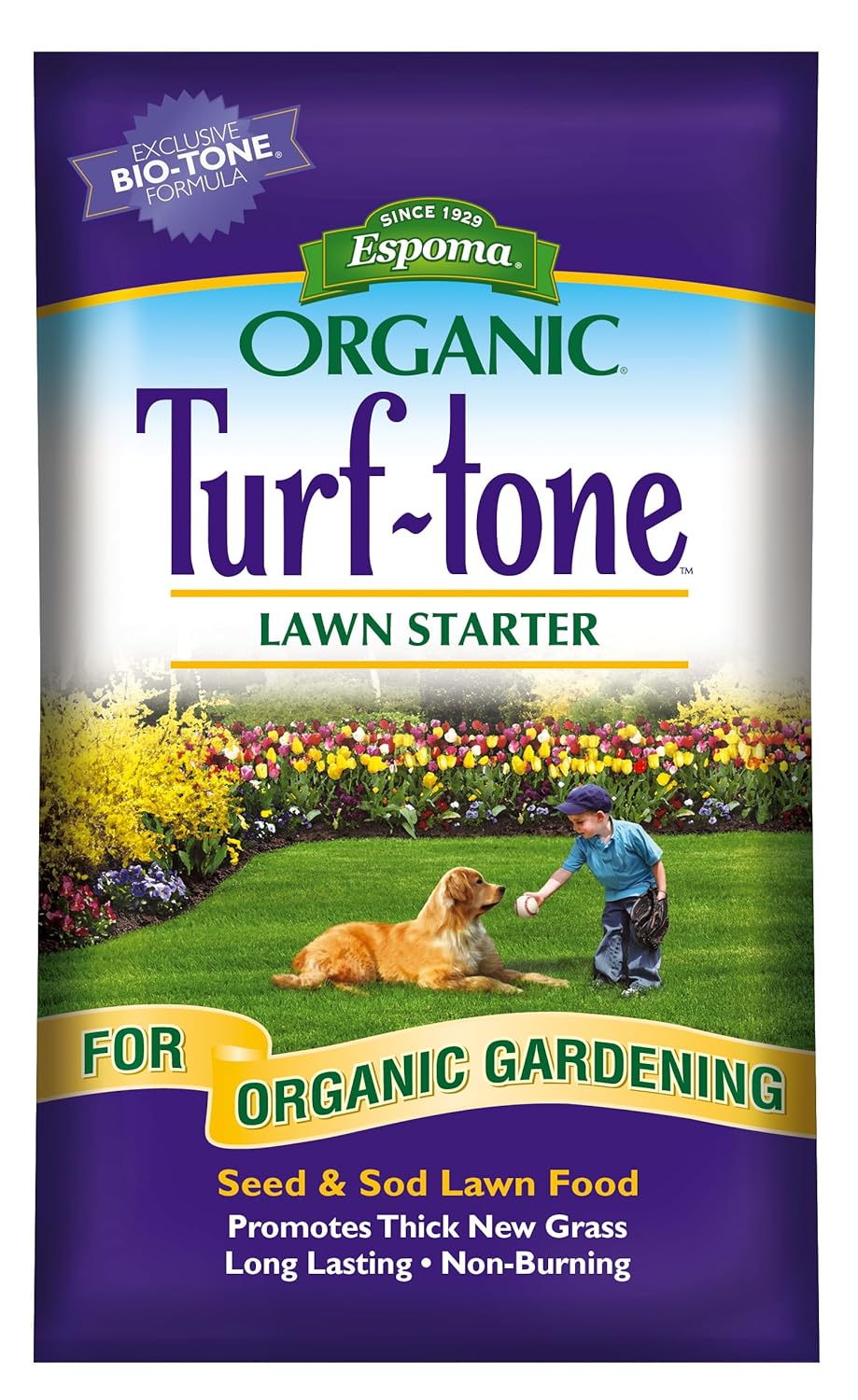
Espoma Turf‑Tone Lawn Starter Organic Fertilizer, 30 lb
| Item Form | Granules |
|---|---|
| Application Method | Drop or broadcast spreader |
| Target Species | Lawn Grass |
| Mixing Ratio | 4:6:3 |
Espoma Turf‑Tone Lawn Starter is an organic granular fertilizer designed for establishing new turf, overseeding, or after laying sod. It supplies a 4-6-3 balance of nutrients with long‑lasting nitrogen, phosphorus to encourage root development, and the brand's Bio‑Tone biological formula to support soil biology. You apply it with a drop or broadcast spreader; a 30 lb bag is labeled to cover up to 3,000 sq. ft., making it suitable for medium lawn areas. The product uses feather meal and poultry manure as ingredient sources, so nutrient release is slower and steadier than quick‑release synthetics, which helps reduce burn risk and supports steady root growth during spring establishment. Limits to be aware of are the slower nutrient availability compared with water‑soluble starters and the organic odor some users may notice; also it requires an appropriate spreader and correct application rate to get even coverage. For spring lawn startups this gives a dependable, low‑risk nutrient boost while improving soil biology over time.
Best for: Homeowners preparing lawns in spring who prioritize reliable, low‑risk establishment and want an organic product that supports soil biology during seeding, overseeding, or sod installation.
Less Ideal for: People who need rapid greening or immediate nutrient uptake for corrective applications or who prefer synthetic, quick‑release fertilizers for instant results.
- Organic formula with Bio‑Tone supports soil biology and long‑term soil health
- Balanced 4-6-3 analysis targets root development for new seed and sod
- Granular form works with standard drop or broadcast spreaders for even application
- Slow‑release nutrient sources reduce burn risk compared with fast‑release fertilizers
- Slower nutrient availability than water‑soluble starters, so results are not immediate
- Uses animal‑based materials that can produce an odor during and after application
Verdict: A dependable organic starter fertilizer for spring lawn establishment that promotes root development and soil health without the burn risk of fast‑release products.
Scotts Green Max Lawn Food (covers 5,000 sq. ft.)

| Item Form | Granules |
|---|---|
| Coverage | 5000 square feet |
| Specific Uses For Product | Lawn |
| Target Species | lawn grass |
Scotts Green Max is a granular lawn food formulated to feed turf and produce noticeably greener color within days thanks to a 2-in-1 formula that includes 5% iron. It is applied with a broadcast or drop spreader at the label-recommended settings and can be used on any grass type in spring, summer, or fall. The product is guaranteed not to stain concrete when used as directed and allows people and pets to re-enter the lawn immediately after application, which makes cleanup and routine use straightforward. Practical benefits include broad 5,000 sq ft coverage from a single bag and easy activation by lightly watering after spreading for faster visible results. Limitations to consider are that it is a straight lawn food rather than a weed-and-feed product, so it will not control broadleaf weeds, and users should follow spreader settings carefully to avoid uneven application or overfeeding. Follow safety directions to keep it away from children and avoid eye contact.
Best for: Homeowners who want quick visual improvement in lawn color and prefer a proven, easy-to-apply granular fertilizer as part of a seasonal spring feeding routine.
Less Ideal for: People who need simultaneous weed control or prefer liquid or organic fertilizers should consider alternative products tailored to those needs.
- Includes 5% iron for faster, deeper greening visible in about three days
- Covers up to 5,000 square feet from one bag, suitable for small to medium lawns
- Formulated granules that can be applied with common Scotts spreader settings
- Guaranteed not to stain concrete when used as directed and safe to re-enter lawn immediately after application
- Does not include herbicide so it will not control weeds
- Requires a spreader and correct calibration to avoid uneven coverage
Verdict: Choose this if you want a straightforward, fast-acting granular lawn food that reliably deepens green color across a 5,000 sq ft lawn in spring.
Scotts Turf Builder Lawn Food, 12.5 lb

| Item Form | Powder |
|---|---|
| Specific Uses For Product | Lawn |
| Coverage | 5,000 sq. ft. |
| Mixing Ratio | 32:0:4 |
Scotts Turf Builder Lawn Food is a straightforward granular fertilizer designed to thicken and green lawns across all grass types. You apply it with a broadcast or drop spreader (Scotts gives specific spreader settings) to either a wet or dry lawn, then water in lightly if you want faster results. Its nutrient formulation builds stronger, deeper roots and improves the turf's ability to absorb water and nutrients, which helps lawns recover from seasonal stress and green up in spring. The bag size covers about 5,000 square feet, so it is convenient for small to medium yards and for following a regular seasonal feeding schedule. Limitations to note are that it is a general lawn food without weed control or insect ingredients, and repeat applications are needed through the season for sustained effect. Also it is granular powder, so proper spreader calibration and cleanup of spills are necessary to avoid uneven feeding or runoff near hard surfaces.
Best for: Homeowners who want a reliable, easy-to-use spring fertilizer to promote greener, stronger turf without pesticides and who plan routine seasonal feeding.
Less Ideal for: People seeking an all-in-one product that kills weeds or controls insects or those with very large lawns who prefer bulk commercial-size bags.
- Works on all common grass types and can be applied in spring, summer, or fall
- Builds stronger, deeper roots to improve drought and nutrient uptake
- Clear spreader settings provided for easy, even application
- Covers approximately 5,000 sq. ft., suitable for small to medium yards
- Does not include weed control or insect protection
- Needs repeated seasonal applications to maintain results
- Granular form requires careful spreading and cleanup to avoid streaks
Verdict: A dependable, easy-to-apply spring lawn food that strengthens roots and greens turf for small to medium yards.
Choosing the Right Fertilizer for Lawn in Spring: Key Factors to Consider
Nutrient Ratio and Timing
The N-P-K ratio determines what the fertilizer does first in spring. Higher nitrogen encourages fast green-up and more top growth, while phosphorus and potassium support root establishment and stress tolerance. For spring applications you want a ratio that supplies a modest to moderate dose of nitrogen combined with enough secondary nutrients to address any soil deficiencies.
Timing matters because early application to cold soil can be wasted or cause uneven uptake. Apply when soil temperatures consistently reach the range where grass resumes active growth. Splitting the spring program between an initial lighter application and a later maintenance dose can reduce stress on the turf and lower the risk of excessive thatch buildup.
Release Technology
Release technology determines how quickly nutrients become available. Quick-release fertilizers give rapid green-up but can cause a flush of growth that requires more mowing and water. Slow-release or controlled-release formulations supply nitrogen over several weeks and reduce leaching risk and nutrient burn. A mix of soluble and slow-release nitrogen often offers the best compromise for spring: enough immediate effect to revive grass without forcing overly rapid top growth.
Consider the labels that describe coated granules, polymer coatings, or naturally slow-release sources. These details help predict how the lawn will respond over the first one to three months after application.
Application Method and Equipment
Granular fertilizers applied with a broadcast or drop spreader are common for lawns and simplify coverage, while liquid options allow faster uptake and are useful for early-season foliar feeding. Choose a product that matches the equipment you already own or plan to use. Spreaders calibrated to the product reduce uneven application, which otherwise causes patchy growth.
Also think about convenience: pre-measured hose-end or soluble packets save time, whereas bulk bags may require extra handling. Consider how easy the product is to store and whether it clumps in humid conditions, which affects consistent application.
Turf Species Compatibility
Different grass species respond differently to spring feeding. Cool-season grasses have a spring growth peak and benefit from earlier applications, while warm-season grasses may still be coming out of dormancy and need gentler dosing. Match the fertilizer program to your turf type and local climate to avoid pushing the grass at the wrong time.
If you maintain a mix of species or have patchy areas, choose a formulation that is broadly compatible or plan spot treatments so each area receives the appropriate nutrient balance.
Soil Test and Local Conditions
A soil test reveals baseline nutrient levels and pH, helping you avoid unnecessary phosphorus or potassium. Using test data prevents overapplication and the downstream problems of runoff. Spring is also a season of variable rainfall; heavy spring rains increase the risk of nutrient loss, so prefer products with some slow-release component in such climates.
Adjust rates based on soil texture too. Sandy soils leach nutrients faster and often need smaller, more frequent applications, while clay soils hold nutrients longer and may need lower overall rates.
Environmental Impact and Regulations
Consider runoff risk, buffer zones near water, and any local restrictions on certain fertilizer types or application timing. Products with reduced soluble nitrogen fractions and controlled-release technology lower the chance of nutrient runoff into waterways. Always follow municipal guidelines on fertilizer timing and prohibited ingredients.
Selecting a formulation with clear label instructions and guidance on buffer distances helps you apply responsibly and reduces regulatory risk while protecting nearby aquatic ecosystems.
When to Apply in Spring
Aim to apply fertilizer when soil temperatures regularly exceed the threshold at which your turf resumes active growth. For cool-season grasses this is often early to mid-spring, while warm-season lawns usually benefit from a slightly later application after green-up begins.
Avoid feeding during extended cold spells or when heavy rains are forecast. Early-season application is about timing not speed: a well-timed modest dose produces healthier recovery than an oversized early application that washes away or forces weak top growth.
- Check soil temperature with a probe or local extension recommendations
- Delay if persistent wet weather or freezing nights are expected
- Consider a light initial feeding followed by a maintenance application
How Much Nitrogen to Apply
Recommended nitrogen rates vary by turf type and local guidance, but spring applications should avoid excessive single-dose nitrogen. A moderate rate that supports green-up without driving a heavy growth surge is usually best.
If you use a fertilizer with both soluble and slow-release nitrogen, calculate total seasonal nitrogen and split the program. This reduces mowing frequency spikes and limits nutrient loss.
- Base rates on soil test results and turf species
- Prefer split applications for sandy soils or high rain areas
- Follow label rates and adjust for slow-release fraction
Starter Vs Maintenance Feeding
Starter fertilizers are higher in phosphorus to support root development and suit new lawns or overseeding projects. For established lawns in spring, maintenance formulations with balanced nitrogen and some slow-release content are typically more appropriate.
Only use higher-phosphorus starters when soil tests or recent seeding justify them. Overuse of phosphorus can be wasteful and environmentally harmful if not needed.
- Reserve starter blends for new sod or seed
- Use maintenance blends for established turf recovery
- Confirm phosphorus needs with a soil test
Watering After Application
How and when you irrigate after applying fertilizer affects uptake and runoff. Light irrigation can help granules move from leaf blades into the root zone and reduce burn risk, but heavy watering immediately after application increases leaching risk.
Follow label guidance: many products recommend a brief watering-in, while others designed for foliar uptake should be applied before a dry period. Adjust your irrigation schedule to match the fertilizer's release profile.
- Apply light irrigation to move nutrients into soil unless label advises otherwise
- Avoid heavy runoff-producing irrigation following application
- Consider local rainfall forecasts when planning application day
Managing Patchy Lawns and High-Use Areas
For lawns with thin patches or high-traffic zones, consider spot treatments or slightly different rates targeted to those areas. Overapplying a uniform rate to address small problem spots can lead to excessive growth elsewhere.
Combine corrective cultural measures such as aeration, overseeding, or soil amendments with a targeted fertilization plan to improve results without blanket overapplication.
- Spot-treat thin or compacted areas based on need
- Pair fertilizer with aeration and overseeding when repairing patches
- Adjust mower height and watering to support recovery
How We Chose the Best Fertilizer for Lawn in Spring
We focused on fertilizers that are appropriate for spring lawn care and filtered candidates by the nutrient profile, release behavior, application ease, turf compatibility, and environmental considerations. We prioritized products with clear guaranteed analysis that match common spring objectives: a controlled nitrogen boost for green-up, adequate phosphorus or potassium when soil tests indicate the need, and a release technology that limits rapid flushes of growth. We also considered application formats and spreader compatibility to ensure home gardeners can apply treatments accurately. Exclusions included specialty formulations intended only for overseeding, pesticide-fertilizer mixes, or products designed exclusively for non-turf ornamentals. We also excluded granular blends that require complex custom mixing and any options lacking transparent nutrient labeling. The shortlist favors balanced spring approaches: quick-available nitrogen for recovery plus slow-release fractions for sustained growth, reasonable solubility for foliar or soil uptake, and clear instructions that reduce the chance of overapplication.
FAQ
Can I apply spring fertilizer before the grass is fully green?
Often it is best to wait until turf shows signs of active growth because cold soil reduces nutrient uptake. A light application just as green-up begins gives better results than feeding dormant grass.
Is slow-release fertilizer always better for spring feeding?
Slow-release reduces leaching and provides steady nutrition, but a mix of quick and slow-release nitrogen can offer rapid green-up while sustaining growth. The best choice depends on rainfall patterns and how quickly you want visible results.
How does soil testing change my spring fertilizer plan?
Soil tests reveal nutrient deficiencies and pH issues so you can avoid unnecessary phosphorus or potassium. Testing lets you tailor the N-P-K ratio and overall rate rather than guessing, which improves results and reduces environmental risk.
Will early spring fertilization increase mowing needs?
Yes, fertilizers that provide a large soluble nitrogen spike will accelerate top growth and increase mowing frequency. Choosing products with a controlled-release fraction or splitting applications helps moderate the mowing burden.
Can I use liquid fertilizers for early spring applications?
Liquid fertilizers deliver nutrients quickly and can be effective for early-season foliar feeding. They are best used when you need rapid green-up, but you should follow with a slow-release granular product for longer-term nutrition.
Final Verdict
Prioritize a spring fertilizer program that matches your turf species, soil test results, and local weather. Favor formulations that balance immediate nitrogen for green-up with a slow-release component to sustain growth and limit nutrient loss. Adjust rates and timing based on soil texture and rainfall patterns, and pair feeding with proper watering and cultural practices to improve recovery. A sensible spring fertilizer approach reduces stress on the lawn and lowers environmental risk. Focus on nutrient balance, release control, and application accuracy to choose the option that delivers healthy early-season growth without creating extra work or runoff problems.
