

Note: This article contains affiliate links. If you click on these links and make a purchase, I may earn a small commission at no extra cost to you. This helps support my research and content. Read my full affiliate disclosure here.
Picking the right fertilizer for Monstera matters because these popular houseplants respond quickly to both underfeeding and overfeeding. You want a product that encourages big, healthy leaves without causing salt buildup or burning tender roots. This guide covers seven shortlisted fertilizers that suit Monstera care across common growing setups, from bright windowsills to lower-light corners. We evaluated each option for the nutrient balance it provides, how easy it is to apply, and how well it fits routine Monstera maintenance. Read on to understand the practical differences so you can match a feeding plan to your plant and schedule.
Top Picks at a Glance
| Best Overall The best all-around choice for most situations | Miracle-Gro Indoor Plant Food for Tropicals, 8 fl. oz. (2-Pack) |  |
| Best Quality Built to a higher standard if you want something more solid | BLESS YOUR SOIL Big Green Leaves Indoor Plant Food, 1 lb Concentrated Powder |  |
| Best Value The sweet spot between price and what you get | Purived 16 oz All-Purpose Liquid Plant Fertilizer |  |
| Best Budget The cheapest option that still gets the job done reliably | Farmer's Secret Tropical Houseplant Booster (4 oz) |  |
| Highest Rated A top-rated pick with lots of positive feedback | Growth Technology GT Foliage Focus Liquid Plant Food (250 mL) |  |
| Most Popular A crowd favorite that many people choose with confidence | TPS NUTRIENTS Monstera Liquid Plant Food, 8 oz |  |
Miracle-Gro Indoor Plant Food for Tropicals, 8 fl. oz. (2-Pack)

| Item Form | Liquid |
|---|---|
| Application Method | Directly to soil or mixed with water |
| Target Species | Tropical Plants |
| Mixing Ratio | 4 pumps:1 quart of water |
This liquid plant food is formulated specifically for tropical indoor houseplants like monstera, palms, pothos and croton and arrives as two 8 fl. oz. bottles. It can be applied directly to potting soil or mixed (4 pumps per quart) and used when you water, with a recommended reapplication every two weeks. The formula highlights added potassium to encourage lush green foliage, and the pump dosing makes it simple to use for both small and larger pots. In practice it is convenient for a regular feeding routine and pairs well with a quality indoor potting mix to maintain vigor between repots. Limitations to note are its low stated coverage so frequent reapplication is expected for larger collections, and liquid fertilizers require consistent scheduling compared with slow-release options. Also the product is focused on tropical houseplants so it is not a one-size-fits-all fertilizer for every indoor species.
Best for: Houseplant owners who want an easy, regular feeding routine to keep monsteras and other tropicals green and vigorous without complex mixing or measurement.
Less Ideal for: Growers who prefer long-acting granular or spike fertilizers or who need a single formula for widely different indoor plant types.
- Formulated for tropical houseplants with added potassium to support lush foliage
- Flexible application: use directly on soil or dilute with water for routine watering
- Pump dispenser and clear mixing ratio simplify dosing for different pot sizes
- Comes as a two-bottle bundle so you get extra product for continued feeding
- Described coverage is low so larger collections will need more frequent purchases or applications
- Not designed as a universal indoor fertilizer so uncommon species may need a different formula
Verdict: A simple, potassium-forward liquid feed that makes regular fortnightly feeding of monsteras and other tropical houseplants fast and reliable.
BLESS YOUR SOIL Big Green Leaves Indoor Plant Food, 1 lb Concentrated Powder

| NPK Ratio | 12-4-8 |
|---|---|
| Item Form | Powder |
| Application Method | Soil drench, foliar feed, hydroponic systems |
| Unit Count | 16 Ounce |
| Included Components | Measuring scoop |
Big Green Leaves is a dry, water‑soluble houseplant fertilizer designed to drive vigorous leaf growth on tropical foliage plants. Its 12-4-8 NPK formula delivers high nitrogen for bigger, greener leaves while potassium and phosphorus support plant strength and roots. The powder dissolves instantly and comes with a pre‑measured teaspoon scoop; one 1 lb pouch claims to make roughly 90 gallons of solution, so it is much more concentrated and space‑efficient than bottled liquids. Sea kelp and a chelated micronutrient blend supply hormones and trace elements that aid leaf expansion and long‑term soil biology, and the manufacturer lists compatibility with soil, soilless mixes, hydroponics, LECA and foliar feeding. Practical benefits for Monstera growers include faster foliage development and less frequent purchases thanks to the concentrate. Important limitations: the formula is focused on leafy growth and is not recommended for cacti, succulents, or high‑phosphorus flowering mixes, and aggressive feeding schedules can overstimulate plants in low light or winter. Follow the mixing and frequency guidance for steady results.
Best for: Someone growing Monstera or other tropical leafy houseplants who prioritizes fast, visible foliage growth and efficient, season‑long feeding without frequent rebuys.
Less Ideal for: Growers whose primary focus is flowering, succulents, or very low‑light plants that need minimal fertilization should look at formulas aimed at those needs.
- High nitrogen 12-4-8 formula tailored for vigorous foliage and stem growth
- Contains sea kelp and chelated micronutrients to support leaf expansion and nutrient uptake
- Dry concentrate dissolves instantly and yields a large volume of solution for good value per gallon
- Versatile application: soil drench, foliar spray, hydroponic and LECA compatibility
- Resealable pouch and pre-measured scoop simplify mixing and storage
- Focused on leafy tropicals so not suitable for cacti, succulents, or plants needing high phosphorus
- Concentrated formula requires careful dosing to avoid overfeeding in low light or dormant seasons
Verdict: If you want concentrated, foliage‑driven results for Monstera and other tropical houseplants, this powder delivers strong, cost‑effective growth support.
Purived 16 oz All-Purpose Liquid Plant Fertilizer

| Item Form | Liquid |
|---|---|
| Specific Uses For Product | Houseplant Fertilizer |
| Application Method | soil drench, foliar feed, full & semi hydroponics |
| Liquid Volume | 16 fluid ounces |
| Mixing Ratio | 320:1 |
Purived 16 oz All-Purpose Liquid Plant Fertilizer is a concentrated liquid feed intended for regular feeding of houseplants like Monstera. One 16 oz bottle mixes to about 50 gallons at the manufacturer ratio, so a small capful per gallon provides a balanced mix of macronutrients and trace elements for soil drenches, foliar sprays, and both full and semi-hydroponic systems. In practice it is easy to use: measure a capful into a gallon of water and apply during routine watering or as a light foliar mist. The formula lists NPK plus boron, iron, magnesium and other micronutrients that support leaf growth and green color. Practical benefits include wide compatibility with different feeding methods and long shelf life. Important limitations are that the label gives a single mixing ratio so you may need to adjust frequency or dilution for young plants or sensitive species, and the product requires careful handling and storage to keep away from children and pets. For Monstera growers it functions as a straightforward, all-purpose feed when used as part of a regular fertilizing schedule.
Best for: Buyers who want a convenient, concentrated all-purpose feed to maintain healthy Monstera foliage and who plan to follow a regular feeding routine.
Less Ideal for: People who prefer slow-release granular fertilizers or who need very specific NPK ratios tailored to flowering or heavy bloom targets.
- Highly concentrated so one bottle makes about 50 gallons of ready-to-use solution
- Suitable for soil drench, foliar feeding, and hydroponic setups
- Includes both macronutrients and a broad range of micronutrients beneficial for foliage
- Easy to measure and apply with a simple cap-to-gallon mixing instruction
- Single recommended mixing ratio may require user adjustment for seedlings or plants prone to fertilizer burn
- Contains concentrated nutrients that must be stored and handled carefully out of reach of children and pets
Verdict: A small, concentrated liquid fertilizer that delivers broad nutrient coverage for Monstera and other houseplants while stretching a single bottle into many gallons of feed.
Farmer's Secret Tropical Houseplant Booster (4 oz)

| Item Form | Liquid |
|---|---|
| Specific Uses For Product | Tropical Houseplants |
| Application Method | Drip Top |
| Mixing Ratio | 10 drops per quart or 1/2 teaspoon per gallon |
| Liquid Volume | 118 ml |
Farmer's Secret Tropical Houseplant Booster is a small, highly concentrated liquid fertilizer intended for tropical houseplants such as monstera, fiddle leaf fig, and zz plants. You dilute it very sparingly (10 drops per quart or 1/2 teaspoon per gallon) and apply it on a weekly schedule or every other watering in winter; it can also be used as a foliar spray. The drip-top bottle makes dosing low-mess and convenient for small watering cans. Its formulation includes nitrogen, phosphorus sources and micronutrients like zinc that support leaf growth and overall vigor, so you can expect steadier growth and richer foliage when used regularly. Because one 4 oz bottle makes up to 48 gallons, it is economical for growers who want frequent light feedings without storing multiple products. Limitations are its small bottle size for heavy feeders and the need to follow dilution closely since the concentrate is strong; it is not a slow-release granular alternative for hands-off regimes.
Best for: A cost-conscious houseplant owner growing monstera and other tropical foliage who prefers regular liquid feedings and wants an easy, low-waste dosing method.
Less Ideal for: People who prefer single-application granular or slow-release fertilizers or those managing very large collections where larger-volume concentrates are more convenient.
- Very concentrated so one bottle treats a large number of waterings
- Drip-top applicator enables easy, low-mess dosing
- Formulated for tropical houseplants with macronutrients and micronutrients
- Can be applied as a foliar spray or in soil waterings
- Small bottle may require frequent replacement for large collections
- Requires careful dilution because the product is strong
Verdict: If you want an inexpensive, easy-to-dilute liquid feed to keep monstera leaves lush, this super-concentrated booster stretches far and delivers regular nutrients with minimal fuss.
Growth Technology GT Foliage Focus Liquid Plant Food (250 mL)

| Item Form | Liquid |
|---|---|
| Specific Uses For Product | Soil / Hydroponics / Semi Hydro / Foliar Spray |
| Application Method | Foliar Spray |
| Target Species | Houseplants, Leafy Tropical |
| Liquid Volume | 250 ml |
Growth Technology GT Foliage Focus is a liquid concentrate designed to support leafy tropicals like monstera by supplying macronutrients and trace elements in an easy-to-use, pH‑buffered solution. It is mixed at low milliliter-per‑liter rates for routine feeding: lower dilutions for soil and potting mixes and slightly stronger mixes for hydroponic or semi‑hydro systems. Typical use is adding the recommended dose to your watering can and feeding with every watering or applying as a foliar spray for faster leaf uptake. The formula lists nitrate‑nitrogen, potassium, calcium, magnesium, and trace elements, so it supports steady chlorophyll production and robust foliage when used consistently. Practical benefits include clear dosing guidelines, compatibility across growing media, and a compact bottle that fits on a shelf or in a small greenhouse. Limitations are the small 250 mL size for growers who feed many plants frequently and the need to flush monthly to avoid salt buildup if used with each watering.
Best for: Buyers who prioritize consistent, reliable feeding routines for monstera and other leafy tropicals and want a single product that works across soil and hydro systems.
Less Ideal for: Large-scale growers or collectors who prefer bulk concentrates or an all-in-one slow-release option should consider larger-volume or alternative delivery formats.
- pH‑buffered, ready-to-dilute liquid formula for straightforward mixing
- Clear dosing guidance for soil, hydroponic, semi‑hydro and foliar use
- Contains macronutrients and trace elements targeted at leafy tropicals
- Small concentrated bottle is convenient for home and small greenhouse setups
- Only 250 mL volume may require frequent repurchasing for larger collections
- Requires monthly flushing to manage mineral salt buildup
Verdict: A reliable, pH‑buffered liquid feed that makes steady, cross‑media nourishment simple for monstera and other leafy indoor plants.
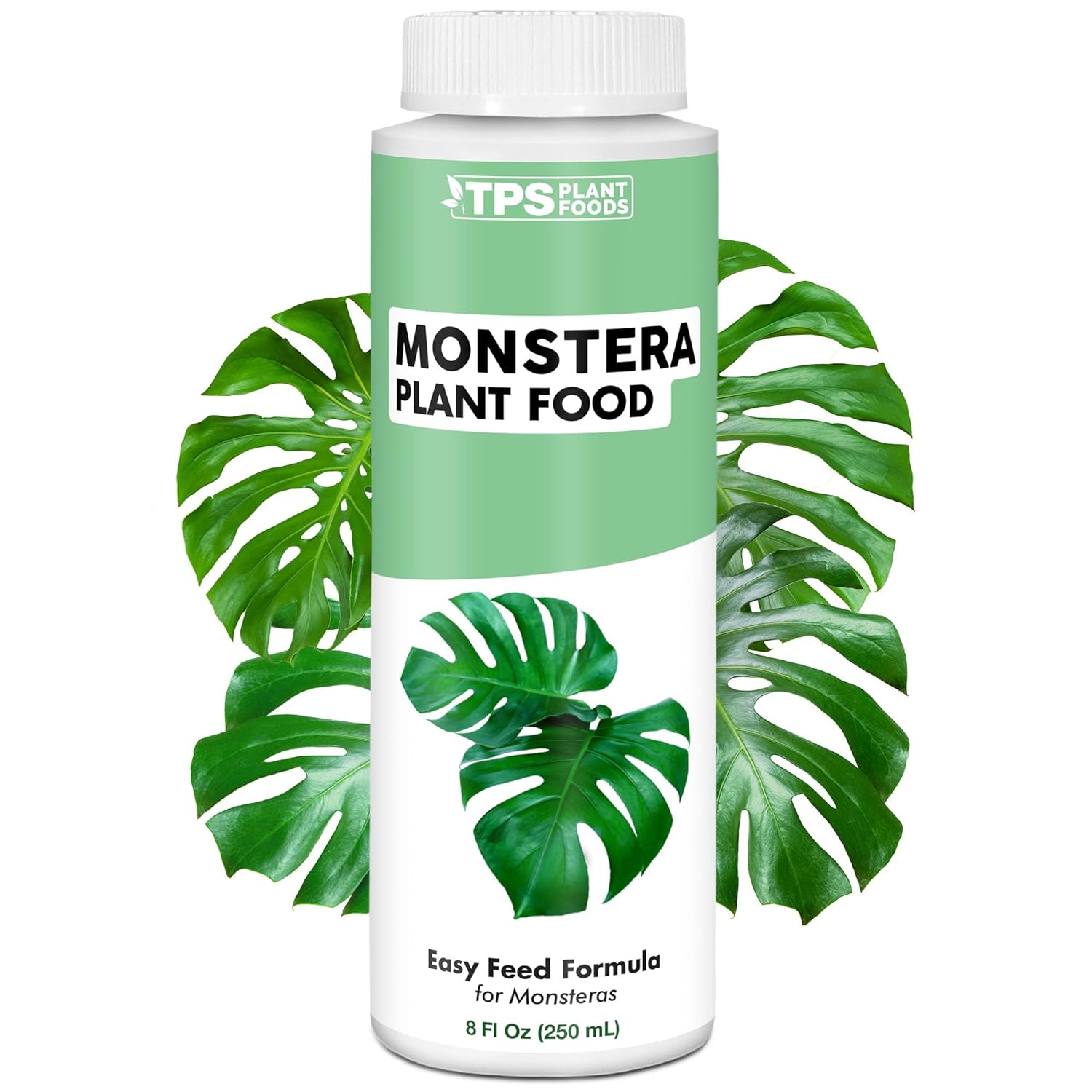
TPS NUTRIENTS Monstera Liquid Plant Food, 8 oz
| Item Form | Liquid |
|---|---|
| Application Method | Mix with water and apply to plant |
| Target Species | Monstera |
| Mixing Ratio | 1:32 |
| Unit Count | 8 Fluid Ounces |
This liquid Monstera fertilizer is a concentrated, kelp-enriched formula designed to be mixed with water at a 1:32 ratio and applied to container-grown tropical houseplants. In everyday use you dilute the 8 ounce bottle to make multiple feedings, which makes it convenient for regular maintenance of foliage and root health. The label highlights faster absorption, support for new leaf and stem growth, and ingredients aimed at stronger roots and deeper leaf color. Practical benefits include targeted nutrition for Monstera varieties, easy mixing and application, and a small bottle that stores easily for apartment or desk plants. Limitations are its small unit size if you have many plants and the need to follow the mixing ratio precisely to avoid overfeeding. There is no detailed N-P-K breakdown visible, so buyers who want exact macronutrient numbers or a granular feeding schedule may need to contact the brand or compare products with full nutrient labels.
Best for: Buyers who prioritize reliable, plant-specific nutrition for indoor Monsteras and want an easy-to-mix liquid feed to support fuller foliage and healthier roots.
Less Ideal for: Growers who need detailed N-P-K analytics, professional growers with large numbers of plants, or those who prefer slow-release granular fertilizers.
- Formulated specifically for Monstera and tropical houseplants
- Kelp-enriched, fast-absorbing liquid that supports foliage and root development
- Concentrated 1:32 mixing ratio lets a small bottle treat multiple feedings
- Easy to store and apply for indoor pots and decorative planters
- No explicit N-P-K or full nutrient breakdown provided on the listing
- 8 fl oz size may require frequent repurchasing for larger collections
Verdict: A compact, easy-to-mix liquid fertilizer tailored for Monstera owners who want faster-absorbing, kelp-enriched nutrition for healthier leaves and roots.
Choosing the Right Fertilizer for Monstera: Key Factors to Consider
Nutrient Ratio and Stage-Appropriate Feeding
Monstera benefits from a balanced nutrient ratio that leans slightly toward nitrogen during active leaf expansion. A fertilizer labeled with an N-P-K ratio appropriate for foliage growth helps produce larger, greener leaves. During repotting or when plants are dormant, you may want to reduce feed strength or use a maintenance formulation to avoid forcing weak, tender growth.
Understanding the ratio on the label lets you adjust application frequency and dilution. For seedlings and young plants, gentler, lower-concentration feedings are safer. Mature Monsteras with vigorous new growth can tolerate higher nitrogen within recommended dilution ranges.
Micronutrients and Trace Elements
Trace elements like iron, magnesium, and manganese are essential for Chlorophyll production and correct leaf color in Monsteras. A fertilizer that includes chelated iron or magnesium can prevent yellowing that looks like under-watering but is actually a deficiency.
Micronutrients are typically needed in much smaller amounts than N-P-K, but their absence shows up quickly in container-grown plants. Look for complete formulations if your potting mix does not already contain a long-lasting, balanced reserve of trace elements.
Application Method and Frequency
How a fertilizer is applied affects both convenience and uptake. Water-soluble concentrates and ready-to-use liquid formulas let you feed during normal watering and are easy to dose. Granular or slow-release options can reduce application frequency but may make precise control harder, especially in shallow indoor pots.
Consider how often you want to fertilize. If you prefer monthly maintenance during the growing season, a slow-release pellet that lasts several months can be useful. If you like to fine-tune feeding with each watering, a water-soluble or liquid feed is preferable.
Salt Buildup and Root Health
Container plants are vulnerable to salt accumulation from repeated fertilizing. Excess soluble salts can burn roots and reduce water uptake, causing leaf browning or edge crisping. Choosing formulations with lower salt index or applying weaker solutions more often reduces that risk.
Regular leaching with plain water and repotting into fresh mix when salts build up are important cultural practices. If you keep plants in decorative cachepots without drainage, select feeds and application rates that minimize salt concentration.
Compatibility With Potting Mix and Water Quality
Not all fertilizers behave the same in different potting media. Some mixes retain nutrients better, while others flush them quickly. The interaction between fertilizer type and your specific potting mix influences how often you need to feed and how quickly nutrients become available.
Water quality matters too. Hard water contributes minerals that can change soil chemistry and interact with fertilizers, sometimes requiring adjustments to feeding frequency or choice of formulation.
Growth Goals and Seasonal Timing
Decide whether you want to maximize leaf size, encourage steady maintenance, or focus on root development when selecting a fertilizer. During spring and summer, you may choose products that support active growth. In autumn and winter, a reduced feeding schedule or maintenance-strength formulation helps prevent weak, elongated growth.
Seasonal adjustments reduce stress on plants and align nutrient availability with the plant's natural cycles, improving overall health and appearance.
Choosing Between Liquid, Granular, and Slow-Release Feeds
Liquid fertilizers dissolve quickly and are taken up rapidly by roots and foliage. They are ideal when you want immediate nutrient availability and the ability to fine-tune feeding strength with each watering. Liquid options work well for growers who check plants frequently and want to respond to visible signs of deficiency.
Granular and slow-release feeds reduce how often you need to apply fertilizer. They are convenient for busy plant owners but require attention to application rate and pot size. Slow-release granules are useful when you want predictable, steady nutrient release, but they may be less suitable in small or top-heavy pots where mixing and distribution are irregular.
- Use liquids for quick adjustments and foliar feeding
- Choose slow-release for low-maintenance feeding cycles
- Account for pot size and drainage when applying granules
Dosing Strategies for Different Pot Sizes
Small pots heat and dry faster, concentrating nutrients more quickly than larger containers. Use weaker solutions and shorter feeding intervals for small pots to avoid salt stress. In larger pots, nutrients dilute in a bigger soil volume, so you can often use standard dilution but may need to fertilize more frequently during peak growth.
Always start with the lowest recommended dose and watch new growth and leaf edges for signs of overfeeding. Adjust gradually rather than making large jumps in concentration.
- Reduce strength in small or shallow pots
- Start low and increase slowly based on plant response
How to Prevent and Fix Salt Build-Up
Salt buildup reveals itself as white crust on the soil surface, brown leaf tips, or reduced vigor. The simplest prevention is periodic deep watering until water drains freely from the pot to leach excess salts. For plants in non-draining decorative pots, remove them from the outer container and flush the root ball in the sink.
If salts have already accumulated, repotting into fresh mix and cleaning roots of compacted residue can restore health. After repotting, resume a gentler feeding schedule and monitor closely for recovery.
- Leach soils monthly during active growth
- Repot when salts are visible or plant decline continues
Adjusting Feeding for Light Levels and Growth Rate
Monstera in bright, indirect light will grow faster and need more frequent feeding than the same plant in lower light. Tailor feeding to growth rate: increase frequency during active growth and reduce or pause when new growth slows. Overfeeding a slow-growing plant often leads to weak, leggy new shoots.
Watch leaf production and internode spacing as practical indicators. If the plant produces few or small leaves despite regular watering, a nutrient adjustment may be necessary.
- Feed more in bright, active growth conditions
- Reduce feeding in low light or during dormancy
Safe Feeding Practices Around Pets and Children
Many common fertilizers contain salts and compounds that can irritate pets if ingested. Store products out of reach and consider formulations with lower acute toxicity if pets or small children spend time near plants. Always follow label safety instructions for handling and clean up spills promptly.
If using foliar sprays, apply when pets and people are not in the area and allow leaves to dry before allowing contact. Consider barrier placements or elevated shelving to limit accidental ingestion.
- Store fertilizer safely and follow label precautions
- Use pet-safer formulations and avoid foliar sprays in high-traffic areas
How We Chose the Best Fertilizer for Monstera
We focused on attributes that affect Monstera growth and owner experience in everyday indoor conditions. Primary evaluation criteria included nutrient ratio and bioavailability, because the right balance of nitrogen, phosphorus, and potassium plus micronutrients shapes leaf size and stem strength. Application method and convenience were assessed to reflect how easily houseplant keepers can apply feedings during regular care. Salt buildup risk and soluble salt management were considered to avoid root burn for containers and limited-drain setups. Compatibility with common potting mixes and ability to support both active growth and maintenance phases were reviewed. Environmental safety and pet-friendly formulation notes were included where relevant. We excluded products designed only for outdoor landscapes, slow-release formulations that release over multiple years, and specialty blends intended solely for flowering or fruiting plants. The shortlist emphasizes fertilizers that are practical for Monstera's foliage-driven growth and indoor container culture.
FAQ
How often should I fertilize my Monstera?
It depends on the fertilizer type and light conditions. During active growth, many growers feed every two to four weeks with a diluted liquid feed or use slow-release products applied per label timing. In lower light or winter, reduce frequency or pause feeding.
Can I use a general houseplant fertilizer for Monstera?
Often a balanced general houseplant fertilizer works fine, especially if it includes micronutrients. Choose a formula suited to foliage growth and adjust strength to the plant's response rather than assuming standard dosing.
What are signs of overfertilizing a Monstera?
Look for leaf tip browning, brown patches, slow growth, or a white crust on the soil surface. These indicate salt buildup and root stress. Leach the soil by flushing with water and cut back on feeding frequency and strength.
Should I fertilize newly repotted Monstera?
If you repotted into nutrient-rich fresh potting mix, wait several weeks before resuming a regular fertilizer schedule to avoid excess nutrients. If the new mix is lean, start with a reduced-strength feed after the plant shows signs of active new growth.
Is foliar feeding helpful for Monstera?
Foliar feeding can supply quick trace elements and correct certain deficiencies, but it is not a complete replacement for root feeding. Use foliar sprays sparingly and only with diluted solutions to avoid leaf damage.
Final Verdict
Choosing the right fertilizer for Monstera comes down to matching the formulation and application style to your plant's light, pot size, and growth goals. Prioritize a nutrient ratio that supports foliage growth, complete micronutrients to prevent leaf discoloration, and an application method you will follow consistently. Balance feeding frequency with regular leaching to prevent salt buildup. Focus on what you can manage reliably: a liquid feed for precise control or a moderate slow-release option for lower maintenance. Adjust strength and timing with the seasons and watch plant responses to find the best routine.
