

Note: This article contains affiliate links. If you click on these links and make a purchase, I may earn a small commission at no extra cost to you. This helps support my research and content. Read my full affiliate disclosure here.
Getting the first few weeks right after planting makes a big difference for long-term plant health. When you choose the right fertilizer for new plants, you help young roots expand faster, reduce transplant shock, and encourage steady leaf and shoot growth without burning delicate tissues. This guide shortlists seven top options suited for newly installed seedlings, transplants, and recently moved shrubs or perennials. We evaluated each option on how well it supports root development, nutrient balance, and practical application in typical home garden situations. Read on to see which types and features matter most when feeding new plantings.
Top Picks at a Glance
| Best Overall The best all-around choice for most situations | Miracle-Gro Quick Start Planting & Transplant Starting Solution, 48 fl. oz. |  |
| Best Quality Built to a higher standard if you want something more solid | Osmocote Smart-Release Plant Food Plus, 2 lb |  |
| Best Value The sweet spot between price and what you get | Purived All-Purpose Liquid Houseplant Fertilizer, 16 fl oz (Makes 50 Gallons) |  |
| Best Budget The cheapest option that still gets the job done reliably | TPS NUTRIENTS Seedling Fertilizer Liquid Plant Food, 8 oz |  |
| Highest Rated A top-rated pick with lots of positive feedback | Espoma Organic Bio-Tone Starter Plus 4-3-3 Organic Starter Plant Food, 8 lb |  |
| Most Popular A crowd favorite that many people choose with confidence | Bonide Root & Grow Concentrate 32 oz |  |
| Best Seller A high-volume bestseller chosen again and again | TPS Nutrients Indoor Plant Food Liquid Fertilizer, 8 fl oz |  |
Miracle-Gro Quick Start Planting & Transplant Starting Solution, 48 fl. oz.

| Item Form | Liquid |
|---|---|
| Application Method | Mix with water and pour around new plantings |
| Target Species | For all flowers, vegetables, trees, shrubs, transplants and seedlings |
| Mixing Ratio | Fill cap to 1st line and mix with 1 gallon of water |
Miracle-Gro Quick Start is a liquid transplant starter formulated to give newly planted seedlings, transplants, and container plants an early nutrient boost. You measure the concentrate with the cap, dilute it in a gallon of water, and pour the solution around new plantings at the time of transplant and again after seven days. Notable features include a 4-12-4 NPK ratio tuned for root development and an easy cap-measure system that makes dosing straightforward for casual gardeners. In practice it helps settle soil around roots and jumpstarts root growth, which can lead to quicker establishment and earlier blooming compared with unfed plants. The product is best used as a short-term starter feed before switching to a regular feeding schedule. Limitations are that it is a concentrated liquid that requires careful dilution and is intended specifically for starting and transplanting rather than as a long-term sole fertilizer solution.
Best for: Gardeners who want a simple, dependable starter feed to help newly planted seedlings and transplants establish quickly and reduce transplant shock.
Less Ideal for: Gardeners looking for a long-term all-in-one fertilizer or a ready-to-use product for continuous feeding should consider a different formulation.
- Formula targets root development with a higher middle number (4-12-4) appropriate for transplants
- Liquid concentrate is easy to mix using the cap measurement and a watering can
- Works on a wide range of plants including flowers, vegetables, trees, shrubs, transplants and seedlings
- Simple two-application schedule (at planting and seven days later) makes it beginner-friendly
- Designed as a starter treatment so you need a separate regular fertilizer program afterward
- Requires accurate dilution to avoid overfeeding new plants
Verdict: Use this liquid starter solution when planting or transplanting to encourage faster root establishment and reduce transplant shock.
Osmocote Smart-Release Plant Food Plus, 2 lb

| Item Form | Granules |
|---|---|
| Application Method | Sprinkle |
| Target Species | All plants |
| Mixing Ratio | 1 capful (3 tbsp) per 2 gal or 4 sq ft |
Osmocote Smart-Release Plant Food Plus is a granular, resin-coated fertilizer designed to deliver steady nutrition to a wide range of plants for up to six months from a single application. You use it by sprinkling the measured scoop into the top inch or two of potting mix or garden soil, watering it in, and reapplying roughly every six months. The coated granules control nutrient release so plants receive a slow, consistent feed rather than a quick spike, which is useful for new transplants and establishing root systems. It is labeled for virtually all plant types and both container and in-ground use, and the manufacturer backs a no-burn pledge when directions are followed. Practical benefits include long-lasting feed that reduces reapplication frequency and easy application without mixing liquid fertilizer. Limitations are that coverage from a 2 lb container is modest and you must follow the mixing rate carefully for small indoor plants, since the outdoor rate is higher and indoor applications require halving the dose.
Best for: Gardeners focused on steady, reliable nutrition for establishing new plants who prefer low-maintenance, infrequent feeding schedules.
Less Ideal for: Growers who need fast-acting liquid feeds for emergency nutrient corrections or who manage very large beds where bulk quantities are required.
- Long continuous release up to six months reduces reapplication frequency
- Works with a wide range of plant types and growing situations including containers and in-ground beds
- Resin-coated granules provide controlled nutrient delivery to avoid fertilizer spikes
- No-burn pledge when used as directed gives added protection for tender new plants
- 2 lb container covers a limited area so frequent repurchase may be needed for larger gardens
- Granular application requires measuring and incorporation into soil rather than quick foliar feeding
Verdict: Choose this product when you want dependable, low-maintenance, long-lasting nutrition to help new plants establish without frequent feeding.
Purived All-Purpose Liquid Houseplant Fertilizer, 16 fl oz (Makes 50 Gallons)

| Item Form | Liquid |
|---|---|
| Application Method | soil drench, foliar feed, full & semi hydroponics |
| Target Species | Houseplants |
| Mixing Ratio | 320:1 |
Purived All-Purpose Liquid Houseplant Fertilizer is a concentrated 16 fl oz bottle that mixes 1 cap per gallon to treat up to 50 gallons of water. It is formulated for indoor potted plants and supports multiple application methods including soil drench, foliar spray, and full or semi-hydroponics, so you can use the same product whether you water, mist, or run nutrient solutions. The formula lists primary macronutrients and a range of micronutrients, which helps correct common deficiencies and supports steady growth when used at the recommended dilution. Practical benefits include an easy-to-follow mixing ratio, an odorless solution that is simple to store, and broad compatibility with different feeding routines. Important limits are that the label gives no N-P-K percentages, so precise nutrient planning for sensitive seedlings or specialty plants is not possible, and safety precautions mean you must handle and store it carefully. For new plants, start at or below the recommended dilution and observe growth before increasing frequency.
Best for: Buyers who want a versatile, no-fuss fertilizer for establishing and maintaining new houseplants and who value a single product that works across watering, misting, and basic hydroponic setups.
Less Ideal for: Growers who need exact N-P-K formulations for seedlings, specialty plants, or strict hydroponic nutrient regimens should consider a product with full nutrient breakdown and concentration details.
- Very concentrated so one bottle treats up to 50 gallons, reducing repurchase frequency
- Suitable for multiple application methods: soil drench, foliar feed, and hydroponics
- Includes a range of micronutrients in addition to primary NPK components
- Simple, clear mixing ratio (320:1) that is easy to follow
- No N-P-K ratio listed on the product information, limiting precise nutrient management
- Requires careful handling and storage due to safety warnings
Verdict: A concentrated, easy-to-use all-purpose fertilizer that covers feeding, foliar, and basic hydroponic needs for new houseplants.
TPS NUTRIENTS Seedling Fertilizer Liquid Plant Food, 8 oz

| Item Form | Liquid |
|---|---|
| Specific Uses For Product | Vegetables, Herbs, Flowers, Houseplants |
| Coverage | Medium |
| Liquid Volume | 8 fluid ounces |
TPS NUTRIENTS Seedling Fertilizer is a mild liquid feed designed for seed starting trays, pots, and young transplants. Applied weekly according to directions, it supplies starter nutrients that encourage root establishment and early shoot growth, which can reduce transplant shock and help seedlings take up water and nutrients more effectively. Its formulation is aimed at delicate sprouts so it is easy to use on vegetables, herbs, flowers and houseplants without overwhelming tender tissue. The 8 ounce bottle is convenient for hobby growers and small batches of seedlings, and the liquid form makes measuring and mixing straightforward. Important limitations are the small unit size, which means frequent repurchase for larger operations, and that it is a general starter feed rather than a full-growth fertilizer, so you will need to switch to a different formulation as plants mature. Follow safety guidance to keep it away from children and pets and rinse after accidental contact.
Best for: Buyers starting seeds or raising small batches of transplants who want an easy-to-use, gentle starter feed that supports healthy roots and reduces transplant stress.
Less Ideal for: Growers producing large numbers of seedlings, commercial nurseries, or those who want a single fertilizer to feed plants through all growth stages should consider larger or multi-stage formulas.
- Gentle liquid formula suitable for delicate seedlings and transplants
- Promotes root development and early shoot growth to reduce transplant shock
- Suitable for indoor and outdoor use across vegetables, herbs, flowers and houseplants
- Easy to measure and mix for weekly applications
- Small 8 fl oz bottle may not last for larger seedling batches or repeated seasons
- Not formulated as an all-stage fertilizer so a different product is needed as plants mature
Verdict: A gentle, easy-to-use starter liquid that helps seedlings establish strong roots and handle transplanting well.
Espoma Organic Bio-Tone Starter Plus 4-3-3 Organic Starter Plant Food, 8 lb

| Item Form | Granules |
|---|---|
| Application Method | Mix with soil |
| Coverage | Medium |
| Unit Count | 128 Ounce |
Espoma Bio-Tone Starter Plus is a granular, organic starter fertilizer designed for use at planting or transplanting to encourage faster root development and better establishment. It is mixed into backfill soil or potting mixes so beneficial bacteria, humates, and both endo and ecto mycorrhizae are placed in the root zone where they can help plants access water and nutrients. Typical uses include mixing into flower beds, bulbs, potting mixes, and before seeding or sodding new lawns. The 4-3-3 nutrient analysis with added calcium and organic ingredients supports steady early growth without synthetic salts. Because it is granular and labeled for mixing with soil, it is easy to apply accurately at planting time, but it is not a quick foliar booster and will not replace later seasonal feeding. For gardeners who prefer certified organic inputs and want to reduce transplant loss, this product provides a straightforward, soil-focused way to improve establishment, though repeat feeding with other products may be needed as plants mature.
Best for: Gardeners who prioritize reliable, organic establishment of new plants and want a product that supports root development and soil biology at planting time.
Less Ideal for: Growers needing a fast foliar feed, quick leaf green-up, or an all-in-one ongoing fertilizer solution for mature plants should consider supplemental products.
- Formulated specifically for planting and transplanting to encourage root establishment
- Contains both endo and ecto mycorrhizae plus beneficial bacteria to boost soil biology
- Organic ingredients and approved for organic gardening
- Granular form that mixes with soil for precise placement in the root zone
- Not intended as a foliar or quick‑acting feed so visible aboveground response can be slower
- Single application at planting may not supply nutrients for later growth stages
Verdict: Choose this organic starter fertilizer when you want a dependable soil‑placed product that helps new plants establish stronger roots and healthier soil biology.
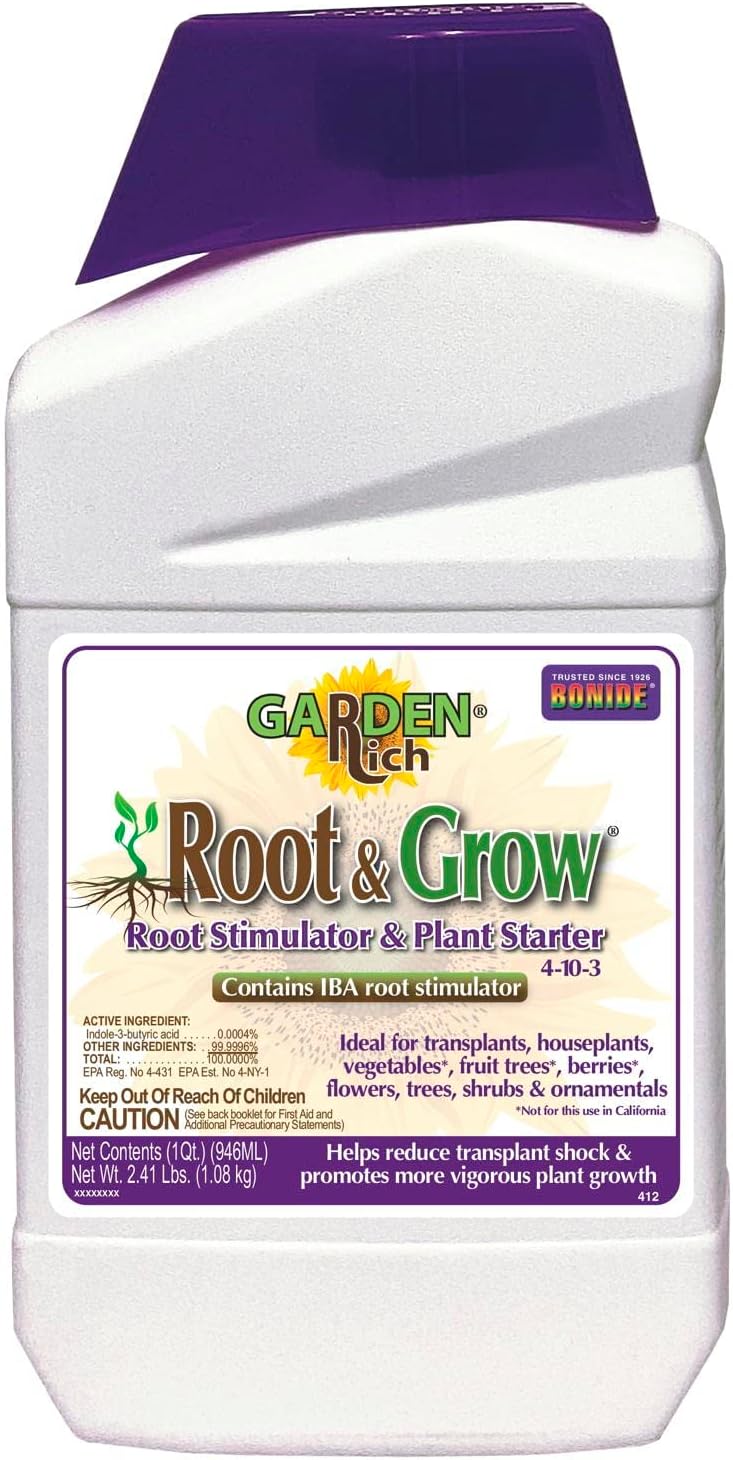
Bonide Root & Grow Concentrate 32 oz
| Item Form | Liquid |
|---|---|
| Specific Uses For Product | Root Development |
| Application Method | Pouring directly onto the soil and roots |
| Target Species | fruit, vegetables, flowers, trees, and bedding plants |
| Mixing Ratio | 4:10:3 |
Bonide Root & Grow is a concentrated liquid root stimulator designed for use when seeding, transplanting, or establishing new plants. You dilute the concentrate per the label and pour the solution onto the soil and root zone to deliver Indole-3-butyric acid (IBA) together with a 4-10-3 N-P-K formula. In practice it helps promote quicker root initiation after transplanting and supports early vigor in vegetables, fruit trees, ornamentals, and bedding plants. The product is easy to mix, covers medium areas from a single 32 oz bottle, and combines rooting hormone benefits with modest phosphorus-rich fertilizer to jump-start establishment. Important limits are that it is a targeted transplant aid rather than a complete long-term feeding program and it contains a synthetic rooting hormone that requires following safety and label directions. For gardeners focused on faster root set and reduced transplant shock, it is a practical addition to planting routines, but it should be used as directed and alongside regular soil care.
Best for: Gardeners who prioritize minimizing transplant shock and want a proven, hormone-based product to speed root establishment for new plants and transplants.
Less Ideal for: Those seeking an all-purpose, season-long fertilizer or organic-only gardeners who avoid synthetic rooting hormones should consider other products.
- Contains IBA rooting hormone to stimulate early root formation
- Combined 4-10-3 fertilizer formulation helps jump-start establishment
- Concentrated liquid mixes instantly for easy application to roots and soil
- Suitable for a wide range of plants including vegetables, fruit trees, flowers, and bedding plants
- Designed for transplant/rooting support rather than long-term fertilization
- Requires careful dilution and adherence to label safety directions
Verdict: Use this concentrated IBA formula when planting or transplanting to speed root formation and reduce transplant shock for faster establishment.
TPS Nutrients Indoor Plant Food Liquid Fertilizer, 8 fl oz

| Item Form | Liquid |
|---|---|
| Specific Uses For Product | Plant Food |
| Application Method | Watering can |
| Unit Count | 8 Fluid Ounces |
| Mixing Ratio | 2:1 (oz/gallon) or 1:64 (tbsp/gallon) |
This 8 oz TPS Nutrients Indoor Plant Food is a liquid concentrate designed to mix with water and feed houseplants during regular watering. You dilute it using the supplied mixing ratio and apply with a watering can for weekly or routine feedings. The formula emphasizes foliage health and new growth and includes kelp to support root development and nutrient uptake, so it is practical for common indoor varieties such as pothos, monstera, snake plants and peace lilies. Because it is a liquid concentrate it is easy to measure and delivers consistent doses when mixed correctly, which helps reduce the risk of overfeeding. Important limitations are its small 8 ounce size and medium coverage, so frequent repurchasing or multiple bottles may be needed for larger collections. Also it requires careful following of the mixing directions to avoid concentration mistakes that could harm sensitive plants.
Best for: Buyers who prefer a simple, low-risk feeding routine for houseplants and value reliable, easy-to-mix liquid fertilizer for steady foliage and root development.
Less Ideal for: Large collections, hobbyists who need precise N-P-K control, or growers seeking extended coverage per purchase should look for larger or formulation-specific options.
- Liquid concentrate mixes easily for consistent dosing with a watering can.
- Kelp-enriched formula supports root health and nutrient uptake.
- Gentle formula intended for weekly feeding of a wide range of indoor plant varieties.
- Clear mixing ratio provided for straightforward use.
- Small 8 fl oz bottle gives only medium coverage and may require frequent repurchase.
- No specific N-P-K breakdown listed on product details for precise nutrient planning.
Verdict: A compact, easy-to-use liquid fertilizer that lets cautious plant owners add consistent weekly nutrition to indoor plants with minimal fuss.
Choosing the Right Fertilizer for New Plants: Key Factors to Consider
Nutrient Ratio and Phosphorus Content
Young plants often need a nutrient profile that favors root development over rapid top growth. A fertilizer with moderate nitrogen and adequate phosphorus helps roots establish without producing excessive tender foliage that the root system cannot support.
Phosphorus values in many labels are shown as the middle number in an N-P-K trio. For new plantings, look for balanced starters or slightly elevated middle numbers, but avoid extremely high concentrations that raise burn risk. Remember that available phosphorus also depends on soil pH, so consider a soil test for long-term beds where repeat plantings are planned.
Formulation and Application Method
How a fertilizer is applied affects how quickly nutrients reach roots and how easy it is to avoid overfeeding. Water-soluble and liquid starter feeds deliver nutrients rapidly and are easier to dilute for seedlings or small transplants. Controlled-release granules give a steadier supply over weeks and reduce the chance of missed applications but may release slowly in cool soils.
Consider the planting situation: containers and small seedlings benefit from diluted liquids, while newly planted shrubs or landscape groups may do better with a lightly incorporated granular starter that supplies nutrients over several weeks. Clear dosing instructions and compatible equipment are important for safe application.
Salt Index and Burn Potential
Fertilizers vary in salt concentration, which correlates with the risk of burning tender root tissue. High-salt synthetic feeds applied too strong can dehydrate roots and damage young plants. Organic or low-salt starter options typically present lower burn risk but sometimes provide nutrients more slowly.
When working with new plantings, err on the side of lower concentrations and apply at recommended rates or below. Rinse or water in lightly after application when appropriate to help settle salts away from delicate roots.
Compatibility With Soil and Potting Mix
Soil texture, organic matter, and pH affect nutrient availability and how a fertilizer behaves. In heavy clays, nutrients can bind and become less available; in light potting mixes, nutrients can leach quickly. Choose a product that matches the medium you use and account for existing fertility from compost or slow-release amendments.
If you recently amended a bed with compost or used a precharged potting mix, you may need a lighter starter feed. In poor, sandy soils consider a fertilizer that offers both immediate and sustained nutrient release to support establishment.
Specific Plant Needs and Stage
Different plant groups and planting stages have distinct requirements. Seedlings and very small transplants need very dilute feeds and gentle formulas. Newly planted trees and shrubs need root-focused support and sometimes a single starter application, while vegetable transplants can tolerate slightly higher nitrogen for leaf development, depending on crop type.
Always match the fertilizer choice and timing to the plant type and growth stage. When planting mixed beds, favor a balanced approach that supports a range of species without fueling one at the expense of another.
Environmental and Handling Considerations
Think about runoff, safe storage, and ease of handling when selecting a product. Fast-release soluble fertilizers can contribute to nutrient runoff if overapplied, so for sensitive sites choose controlled-release or organic options. Packaging that limits spills and clear measurement markers reduce waste and accidental overfeeding.
Also consider safety around children and pets. Some concentrated starters require careful storage and handling; choose a formulation and container that fit your garden habits and safety needs.
When to Apply Fertilizer After Planting
Timing matters more than the exact product in many cases. For bare-root transplants and newly set seedlings, wait until the plant shows signs of active growth before applying a starter feed unless the label explicitly states immediate use. Roots need time to reorient in their new soil, and immediate heavy feeding can stress them.
For container-grown transplants moved into the ground, a light application at planting can be helpful if mixed into the backfill at safe rates. For established seedlings set into flats or pots, begin with low-dose liquid feeds two to three weeks after roots have settled.
- Delay strong feeds until new root growth is visible
- Use diluted liquids for small seedlings and frequent shallow waterings
- Incorporate low-rate granules around larger transplants with care
Liquid Vs Granular: Practical Pros and Cons
Liquid fertilizers act quickly and are easy to dilute, which is ideal for delicate transplants and container plants. They let you respond fast to nutrient deficiency signs, but frequent applications can be required and there is more risk of accidental overfeeding.
Granular and slow-release products reduce application frequency and are forgiving when you miss a feeding. They can be mixed into planting holes or broadcast around new shrubs. However, in cool soils they may not release nutrients quickly enough for a very slow-establishing specimen.
- Liquid: fast, precise dilution, higher application frequency
- Granular: longer action, less frequent feeding, variable release by temperature
How Soil Tests Guide Starter Feed Choices
A basic soil test can prevent unnecessary applications and guide whether a phosphorus-rich starter is truly needed. Many garden soils already have adequate phosphorus, and adding more will not speed establishment. Tests help you balance nutrients correctly and avoid long-term buildup.
If testing is not feasible, consider the planting history. Recently amended beds or areas with heavy past fertilizer use may need gentler starters, while newly prepared poor soils may benefit from a more complete starter that provides both macro and micronutrients.
- Soil tests reveal baseline nutrient levels and pH
- Adjust starter choices when prior amendments are known
Practical Tips for Applying Starter Fertilizers
Measure carefully and follow dilution guidance, especially with concentrates. Apply fertilizers at plant-root depth when using granules and water them in so nutrients reach the root zone. For liquids, use a watering can or injector to deliver even, light doses.
Avoid placing granules directly against stems or roots. Spread them evenly around the root zone and lightly work them into the soil surface. Keep an eye on new growth over the following weeks; yellowing or stunted shoots can signal over- or underfeeding.
- Use precise measuring tools and labeled containers
- Water in granular applications to move nutrients into the root zone
- Start at or below recommended rates for the first application
Organic Options and Soil Health
Organic starter choices often release nutrients more slowly and contribute to long-term soil structure and microbial life. They tend to carry lower burn risk and improve water-holding and nutrient cycling over time, which is beneficial for establishing plantings in the long run.
Consider combining a gentle organic amendment with a light, soluble starter when rapid early growth is desired. This hybrid approach gives immediate nutrients without sacrificing the soil-building benefits of organic matter.
- Organic starters support soil biology and reduce burn risk
- Combine rapid-acting feeds with organic matter for balanced results
How We Chose the Best Fertilizer for New Plants
Our selection focused on fertilizers and feeding products that specifically support the vulnerable establishment phase after planting. We prioritized formulas with gentle nutrient ratios and a clear emphasis on phosphorus or root-supporting elements, but also looked at complete nutrient blends for mixed plantings. Application method was a key filter: granular, water-soluble, and liquid starters were all considered, provided they offered clear dosing guidance for seedlings and transplants. We also scored products for burn risk and ease of use, since over-concentrated starters or confusing instructions are common sources of harm to new plants. Longevity of action and compatibility with common garden soils and container media were evaluated so options work for both in-ground beds and pots. Exclusions included items aimed only at mature plants, specialty mixes for uncommon crops, and formulations with unclear nutrient labeling. The result is a shortlist of options that balance root establishment, predictable nutrient delivery, and low handling risk for home gardeners.
FAQ
How soon after planting should I use a starter fertilizer?
Often it is best to wait until the plant shows active new growth, usually one to three weeks after planting. For very small seedlings, start with very dilute liquid feeds two weeks later. Avoid heavy feeding immediately unless the product specifically states it is safe at planting.
Can I use the same fertilizer for containers and in-ground plantings?
It depends. Containers typically need more frequent, lighter feedings and a fertilizer formulated for pot culture, while in-ground plantings can use granules or longer-lasting formulations. Match concentration and frequency to the planting medium to avoid leaching or burn.
Is a phosphorus-rich starter always necessary for new plants?
Not always. Phosphorus supports root growth, but many soils already contain sufficient phosphorus. A soil test will show whether additional phosphorus is needed. If unsure, choose a balanced or gentle starter to avoid unnecessary buildup.
How can I tell if I overfertilized a new planting?
Signs include leaf scorch, browning or crisping at leaf edges, wilting despite adequate water, or a sudden slowdown in growth. If overfertilization is suspected, flush the root zone with water to dilute salts and hold off on further feeding until recovery is evident.
Are organic starters better for young plants?
Organic starters reduce burn risk and build soil health, which benefits long-term establishment. However, they release nutrients more slowly, so gardeners seeking rapid early growth might pair organics with a light, soluble feed for immediate support.
How often should I follow up after the initial starter application?
Follow-up timing depends on formulation. Liquid starters may need repeated light feeds every one to three weeks, while controlled-release granules can last several months. Monitor growth and foliage color to decide when the next feeding is needed.
Final Verdict
Choosing the right fertilizer for new plants means balancing root support with low burn risk and an application method that matches your planting situation. Prioritize formulations that encourage root development, offer clear dosing guidance, and fit the soil or container medium you are using. Tradeoffs are inevitable: liquids give fast results but require more attention, while granules reduce reapplication but may act slowly in cool conditions. Focus on the criteria outlined here and you can confidently pick a starter approach that promotes steady establishment and long-term vigor.
