

Note: This article contains affiliate links. If you click on these links and make a purchase, I may earn a small commission at no extra cost to you. This helps support my research and content. Read my full affiliate disclosure here.
Getting seed to sprout quickly and establish a dense turf matters more than a single fast green-up when you are starting a lawn. The right fertilizer for newly seeded lawn helps seeds germinate, feeds tiny roots without burning them, and supports even coverage across the yard. In this guide we narrowed the field to six top options suited to freshly sown turf, focusing on nutrient ratios, release type, and ease of use in real garden conditions. Read on to understand what to expect from each style of starter fertilizer and which performance factors we prioritized.
Top Picks at a Glance
| Best Overall The best all-around choice for most situations | Scotts Turf Builder Triple Action Built for Seeding, 4.3 lb |  |
| Best Quality Built to a higher standard if you want something more solid | The Andersons Premium New Lawn Starter Fertilizer (20-27-5) – 18 lb, Covers up to 5,000 sq ft |  |
| Best Value The sweet spot between price and what you get | Jonathan Green Veri-Green Starter Fertilizer for Seeding & Sodding (12-18-8) — 5,000 Sq Ft |  |
| Best Budget The cheapest option that still gets the job done reliably | Greenview Starter Fertilizer 10-18-10, 8 lb bag |  |
| Highest Rated A top-rated pick with lots of positive feedback | Espoma Turf-Tone Lawn Starter Organic Fertilizer, 30 lb |  |
| Most Popular A crowd favorite that many people choose with confidence | Scotts Turf Builder Starter Food for New Grass, 3 lb |  |
Scotts Turf Builder Triple Action Built for Seeding, 4.3 lb

| Item Form | Granules |
|---|---|
| Coverage | 1,000 sq. ft. |
| Target Species | Lawn Grass |
| Mixing Ratio | 21:22:4 |
Scotts Turf Builder Triple Action Built for Seeding is a granular, combined weed preventer and starter fertilizer formulated for newly seeded, overseeded, or newly planted lawns. You apply it to a dry lawn when temperatures are between 60°F and 90°F, lightly water to activate, and follow watering guidance to keep seed and soil moist until seedlings reach about 2 inches. The formula prevents common annual and some broadleaf weeds such as crabgrass and dandelion for up to six weeks without damaging new grass, while delivering nutrients that encourage quicker, thicker establishment and better tolerance to heat and drought. Practical use benefits include clear coverage guidance (1,000 sq. ft. per 4.3 lb bag) and recommended spreader settings for Scotts broadcast and drop spreaders, which simplifies application for DIYers. Limitations are that it will not kill existing weeds and only protects for several weeks, so follow-up weed control or additional feedings may be needed for long-term maintenance. Also it is intended for listed grass types, so check compatibility before use.
Best for: Homeowners planting new lawns or overseeding who want a single product that both protects seedlings from common weed pressure and supplies starter nutrients for quicker establishment.
Less Ideal for: People looking to remove established weeds or those with grass types not listed on the label should choose a different targeted herbicide or fertilizer option.
- Combined weed preventer and fertilizer designed for use when seeding new lawns
- Prevents crabgrass, dandelion, and other listed weeds for up to six weeks without harming new grass
- Feeds and helps jump-start grass seed to establish thicker and quicker
- Clear application instructions and spreader settings for easy DIY use
- Does not kill existing weeds so problem patches need separate treatment
- Protective effect is temporary and may require additional weed control later
Verdict: A convenient, dual-action granular product that helps newly seeded lawns establish faster while preventing common seedling-stage weeds for several weeks.
The Andersons Premium New Lawn Starter Fertilizer (20-27-5) – 18 lb, Covers up to 5,000 sq ft

| Item Form | Granules |
|---|---|
| Specific Uses For Product | Lawn |
| Coverage | 5000 |
| Mixing Ratio | 20:27:5 |
| Target Species | Lawn grasses |
This starter fertilizer is designed specifically for establishing new turf and makes practical sense for anyone seeding or laying sod. It delivers a high phosphorus content to support root development, plus a blend of quick- and slow-release nitrogen that gives seedlings an early boost and continued feeding over several weeks. The granules also include trace iron for deeper greening and are intended to be worked into the soil 2 to 3 inches before seeding or sodding. Typical use is in spring or fall applications over up to 5,000 square feet; follow the directions to keep soil consistently moist until germination. The product is straightforward to apply with a broadcast spreader and offers coverage appropriate for medium-sized yards. Limitations are that it is a single-purpose starter formula rather than an all-season lawn program and will need follow-up feeding as the lawn matures. Also users must handle it with care to avoid contact with skin and eyes.
Best for: Buyers seeding or sodding a new lawn who prioritize strong early root development and steady early growth for quicker establishment.
Less Ideal for: Homeowners looking for a year-round maintenance fertilizer or those who want a single product to feed an established lawn through all seasons.
- High phosphorus (20-27-5) supports strong root development for new seedlings
- Blend of quick- and slow-release nitrogen gives both immediate green-up and sustained feeding
- Covers up to 5,000 sq ft, suitable for medium-sized lawns
- Contains 1% iron for improved turf color during establishment
- Formulated for establishment only so additional fertilizer is required as the lawn matures
- Must be incorporated into soil and kept moist for best results, adding labor and watering needs
Verdict: Choose this starter fertilizer when you need a phosphorus-rich, quick-plus-sustained feeding formula to establish new grass quickly and reliably.
Jonathan Green Veri-Green Starter Fertilizer for Seeding & Sodding (12-18-8) — 5,000 Sq Ft

| N-P-K Ratio | 12-18-8 |
|---|---|
| Form | Granules |
| Application Method | Spreader |
| Coverage | 5,000 sq ft |
| Target Uses | Seeding and sodding |
Jonathan Green Veri-Green Starter Fertilizer is a granular 12-18-8 formula designed to be applied the same day you seed or sod to encourage faster germination and stronger root development. It is meant for spring or fall use and spreads with a rotary, drop, or hand-held spreader to give full coverage of up to 5,000 sq ft from the 15 lb bag. Notable features include a high phosphorus content to support early root growth, 25% slow-release nutrition for extended feeding of seedlings, and added humates to improve nutrient availability in the soil. In practice it helps new grass establish more quickly and withstand early stress while feeding for up to about two months. The product is straightforward to use during a seeding or sodding session, but it is a targeted starter fertilizer rather than an all-season maintenance feed so you will need a follow-up program for ongoing lawn nutrition and weed control. Also, it is formulated for general turf and does not replace soil testing when addressing specific nutrient imbalances.
Best for: Buyers who want a practical, no-nonsense starter fertilizer to give new seed or sod a faster, more reliable start and who plan to follow up with routine lawn care.
Less Ideal for: Homeowners looking for an all-in-one seasonal program or those needing fertilizer tailored to a diagnosed soil deficiency should consider other products or testing first.
- High phosphorus N-P-K (12-18-8) to promote germination and strong root formation
- Contains about 25% slow-release nutrition to feed seedlings for up to two months
- Includes humates to improve nutrient availability and soil uptake
- Easy to apply with rotary, drop, or hand-held spreaders and intended for same-day seeding or sodding use
- Formulated specifically as a starter fertilizer and not intended as a season-long maintenance product
- No soil test guidance included so additional testing may be needed for nutrient-specific corrections
Verdict: A straightforward, phosphorus-rich starter fertilizer that reliably speeds germination and root establishment for newly seeded or sodded lawns.
Greenview Starter Fertilizer 10-18-10, 8 lb bag

| NPK ratio | 10-18-10 |
|---|---|
| Form | Granules |
| Application method | Broadcast or drop spreader |
| Coverage | 2,500 sq. ft. |
Greenview Starter Fertilizer is a one-time-use granular starter fertilizer designed to be applied when seeding new lawn areas or filling bare spots. It contains a high-phosphorus 10-18-10 formula with both immediate-release and controlled-release nitrogen, so it supports germination, root development, and steady feeding during the first weeks of growth. You apply it with a broadcast or drop spreader, lightly rake it into the topsoil, then sow seed over the treated area. The product covers about 2,500 square feet per 8 pound bag and is intended to provide up to eight weeks of nutrient release. Practical benefits include improved seedling vigor and simpler timing since it combines root-focused nutrients with extended nitrogen release. Limitations are that it is formulated specifically for initial seeding rather than routine lawn maintenance and the single-use application means you may need a different product for follow-up feeding or for small patches where measuring small amounts precisely is harder.
Best for: Home gardeners seeding new lawns or repairing larger bare spots who want a focused starter fertilizer that simplifies establishing seedlings and roots.
Less Ideal for: Gardeners looking for a product to use as routine maintenance feed or those who only need a very small amount for tiny patches should consider alternative products.
- High phosphorus content to support seed germination and root development.
- Includes both immediate-release and controlled-release nitrogen for steady feeding up to eight weeks.
- Formulated for easy application with a broadcast or drop spreader.
- Covers approximately 2,500 sq. ft. per bag, suitable for modest lawn projects.
- Designed as a one-time starter application and not intended for ongoing lawn feeding cycles.
- Bag size may be large for very small patch repairs where precise small-quantity application is needed.
Verdict: Choose this product when you need a dedicated starter fertilizer that promotes germination and root development while feeding new grass for the first eight weeks.
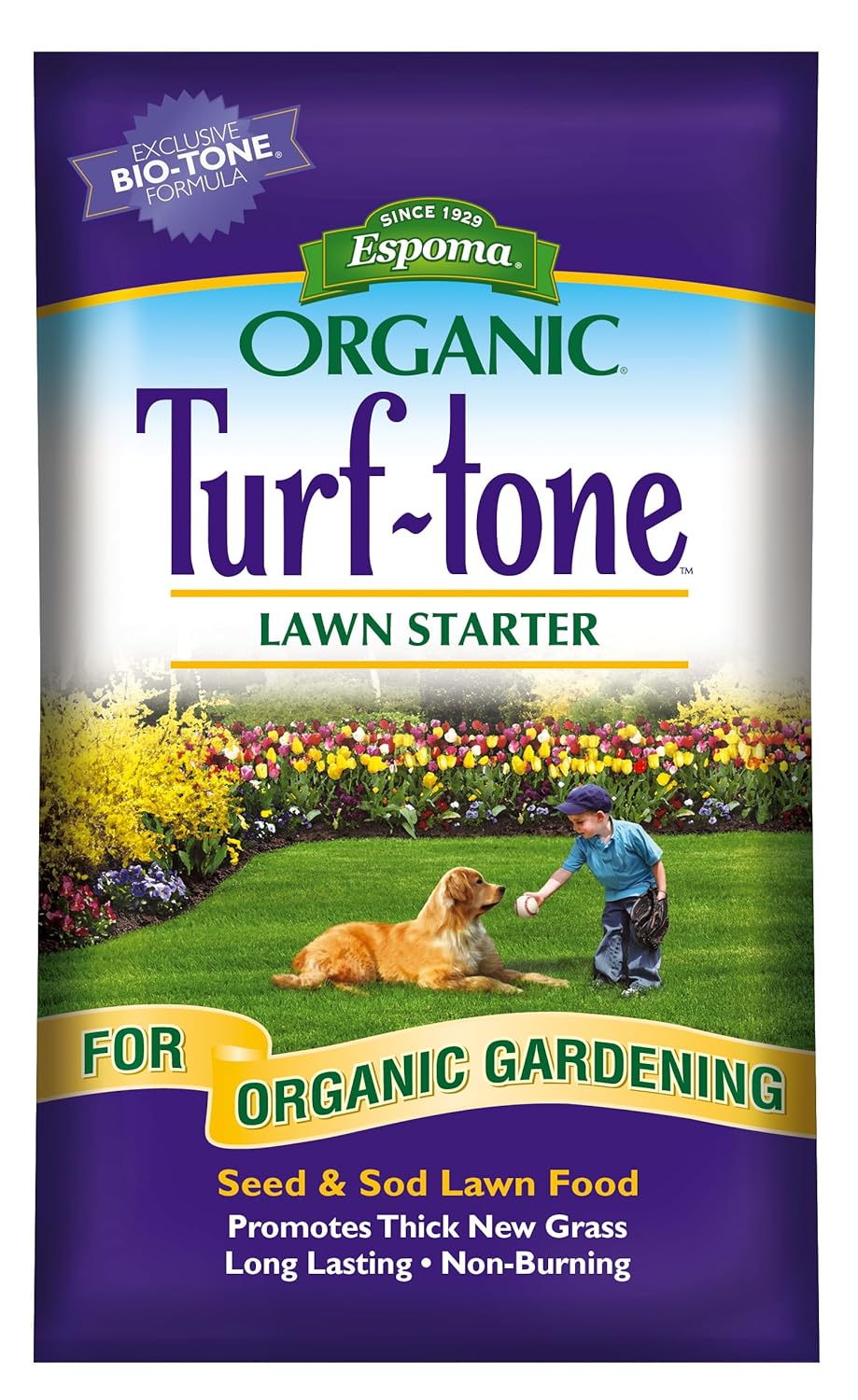
Espoma Turf-Tone Lawn Starter Organic Fertilizer, 30 lb
| Item Form | Granules |
|---|---|
| Application Method | Apply with a drop or broadcast spreader. |
| Target Species | Lawn Grass |
| Mixing Ratio | 4:6:3 |
This granular lawn starter from Espoma is designed specifically to support newly seeded or sodded lawns by supplying a balanced 4-6-3 nutrient ratio with long-lasting nitrogen and added Bio-tone. It is applied with a drop or broadcast spreader and covers up to 3,000 sq ft from the 30 lb bag, making it practical for small to medium yards. The formula includes feather meal and poultry manure, which release nutrients more slowly than synthetic starters and help build soil biology over time. That organic approach reduces the risk of burning delicate seedlings and supports steady root development, though nutrient release can be slower in cool soils. Use it at seeding or when overseeding to give young grass an initial phosphorus boost for root establishment. The main trade-off is the slower, biologically driven nutrient delivery compared with fast-release synthetic starters, so expect gentler, longer-term results rather than an immediate green-up.
Best for: Buyers who prioritize consistent, low-risk establishment of new grass and want an organic starter that supports soil health during seed germination or sod installation.
Less Ideal for: If you need rapid, immediate green-up or are treating large commercial turf areas that require quick results, a fast-release synthetic starter would be a better choice.
- Balanced 4-6-3 starter formula tailored for new lawns
- Organic ingredients (feather meal, poultry manure) that support soil biology
- Applied with common drop or broadcast spreaders for easy use
- 30 lb bag covers up to 3,000 sq ft, suitable for small to medium lawns
- Organic, slow-release nutrients mean slower visible green-up compared with synthetic starters
- Not formulated for immediate foliar feeding or rapid color correction
Verdict: Choose this organic 4-6-3 starter if you want a reliable, low-burn fertilizer that promotes steady root establishment for newly seeded or sodded lawns.
Scotts Turf Builder Starter Food for New Grass, 3 lb

| Formula (N-P-K) | 24-25-4 |
|---|---|
| Form | Granules |
| Coverage | 1,000 |
| Specific Uses | Seed development, root soil conditioning |
Scotts Turf Builder Starter Food is a granular starter fertilizer designed specifically for new lawns, seedings, sod, plugs, or sprigs. It supplies a high-phosphate 24-25-4 formula intended to fuel early root development so seedlings establish more quickly and produce thicker turf. Typical use is at planting and again 2 to 4 weeks later; one 3 lb bag covers about 1,000 sq ft and is applied with a broadcast or drop spreader at the manufacturer settings. The practical benefit is faster visible growth and stronger roots during the crucial first 2 to 4 weeks, which can cut down on reseeding and help young grass compete with weeds. It is safe for all grass types when used as directed and pairs well with regular watering to keep seedbeds moist. Limitations are predictable: the small bag covers only modest areas so larger lawns need multiple bags, and it is a starter formula rather than an all-season fertilizer so you will switch to maintenance feeds after establishment. Follow label safety and application rates to avoid overapplication near plants, children, or pets.
Best for: Homeowners planting or reseeding small to medium lawns who want a focused starter feed to speed root and blade establishment and prefer products with a proven track record.
Less Ideal for: Large-property owners or contractors who need bulk coverage or an all-in-one seasonal fertilizer should consider larger commercial sizes or maintenance formulas instead.
- High-phosphate 24-25-4 formula that supports early root development
- Clear application schedule (apply at planting and again 2–4 weeks later) for predictable results
- Suitable for seed, sod, plugs, and all grass types so it fits most new-lawn situations
- Small 3 lb bag only covers about 1,000 sq ft so it is not economical for large lawns
Verdict: Use this high-phosphate starter formula when planting new grass to accelerate root development and get a thicker lawn faster.
Choosing the Right Fertilizer for Newly Seeded Lawn: Key Factors to Consider
Nutrient Ratio for Germination
The balance of nitrogen, phosphorus, and potassium drives how seed and young roots behave. Phosphorus promotes root development and is often emphasized in starter mixes, but excessive nitrogen can push top growth before roots are ready and raise the risk of burn. Look for labels that offer slightly higher phosphorus relative to nitrogen or explicitly state a starter formulation. A predictable, labeled ratio lets you match application rates to the seeding rate and soil test results.
Testing or amending based on soil nutrient levels helps avoid over-application. If you already have phosphorus-rich soil, a lower-phosphorus starter or a gentler water-soluble option will protect seedlings while still supporting establishment.
Salt Index and Seedling Safety
New grass seedlings are much more sensitive to soluble salts than mature turf. High salt fertilizers can inhibit germination or scorch tiny roots. The salt index or the relative salt content listed on some technical sheets gives you a sense of seedling risk, and water-soluble products with low salt ratings are safer for immediate post-seeding use.
Granular products vary in how quickly salts concentrate at the soil surface after watering. A product that advertises low burn potential or that is designed for seedbeds reduces the chance you will need to re-seed due to fertilizer damage.
Release Type and Feeding Duration
Release profile matters because it determines how long seedlings get steady nutrition without repeated applications. Quick-release, water-soluble fertilizers give a fast nutrient pulse that helps germination but may require follow-up feeds. Slow-release or controlled-release formulations deliver consistent nutrient availability over several weeks, reducing the need to reapply but sometimes providing a weaker initial push for germination.
Choose a release type based on how often you are willing to fertilize and your local germination window. In cool, slow-germinating conditions a gentler, longer-release option often prevents nutrient swings that can stress young grass.
Application Method and Uniformity
How easily you can apply the fertilizer directly affects success. Seedbed applications benefit from uniform spreaders or hose-end sprayers for liquids. Granular products should be easy to broadcast evenly at low rates without causing clumping that leads to patchy growth. Liquid starters allow precise, even coverage but require mixing and immediate use.
Consider the tools you already own: a handheld spreader can manage small yards, while larger areas benefit from a broadcast spreader. For tight spaces or uneven ground, a liquid or water-soluble concentrate can give better control.
Compatibility with Seeding Practices
Match the fertilizer to how you seed. If you are drilling or using slice seeding, you may want lower-salt, granular starters that sit in the soil and feed roots. For top-seeding or overseeding, water-soluble starters or light, fine granular products that mix well with topsoil or compost can give better contact with seed.
Think about timing too: some gardeners apply starter at seeding while others wait until tiny shoots emerge. Choose a fertilizer labeled for use at seeding if you plan to apply at the same time as seed placement.
Bag Size, Coverage, and Job Scale
Buy an amount that matches the size of the job to avoid storing opened material for long periods. Large bags reduce cost per square foot but can be hard to store and may degrade if exposed to moisture. Small bags reduce waste for patch jobs. Coverage information on the label tells you how much area a bag will treat at the recommended seeding rate.
Consider whether you will need multiple applications; choosing a product with a convenient bag size that aligns with your application frequency simplifies planning and reduces leftover storage concerns.
When to Apply Starter Fertilizer
Apply starter fertilizer at or just before seeding in most cases to supply immediate nutrients that help root formation. If soil is extremely dry, lightly water before seeding so the fertilizer will not sit on a hydrophobic surface and lose contact with seed.
If you are uncertain about soil fertility, a soil test before seeding lets you fine-tune the starter rate. For overseeding thin turf, applying a light starter at the same time as seed generally gives better germination than waiting until shoots appear.
- Apply at seeding when soil moisture is adequate
- Adjust timing based on soil test and local climate
- For very sandy soils, prefer lower rates or slow-release types
Liquid Vs Granular Starters: Practical Tradeoffs
Liquid and water-soluble starters provide quick, uniform nutrient delivery and are easy to apply evenly across irregular areas. They are ideal for small lawns and spot seeding where precision matters. The downside is they require mixing, immediate use, and often do not provide extended feeding.
Granular starters are convenient for larger areas and often contain slow-release components that feed over weeks. Choose fine, evenly sized granules to avoid uneven distribution and look for products labeled safe for use at seeding to reduce burn risk.
- Liquids: fast, uniform, good for small or patch jobs
- Granular: convenient, longer feeding, better for larger areas
- Consider water capacity and spreader settings when using granules
Adjusting Rates by Soil Type and Climate
Soil texture affects nutrient retention and seedling tolerance. Sandy soils leach nutrients quickly and may benefit from split applications or products with some slow-release fraction. Heavy clay soils retain nutrients and moisture longer, so use conservative starter rates to avoid salt buildup.
Local climate also changes how seedlings respond. In cool, wet springs, germination can be slow so prefer gentler, longer-lasting nutrition. In hot, fast-germinating conditions, a quicker nutrient pulse can accelerate establishment but may require careful watering to prevent scorch.
- Sandy soils: consider split feeding or slow-release blends
- Clay soils: reduce application rate and monitor moisture
- Cool climates: conservative steady feeding; warm climates: short pulse with careful watering
Watering After Application
Immediate light watering after applying starter fertilizer helps move nutrients into the seed zone and reduces surface salt concentration. Avoid heavy runoff; the aim is gentle, frequent moisture that keeps the seedbed consistently damp until seedlings establish.
Adjust watering frequency with weather and soil. If rain is expected, delay application until you can control post-application moisture. Overwatering can displace seed or cause crusting; under-watering will stall germination regardless of starter choice.
- Light, frequent watering moves nutrients into the root zone
- Avoid heavy watering that causes runoff or crusting
- Delay application if heavy rain is forecast
Using Starter Fertilizer with Soil Amendments
Combining starter fertilizers with compost or topsoil can improve seed-to-soil contact and create a more forgiving environment for germination. Compost provides organic matter that retains moisture and buffers nutrient release, while a light starter supplies the immediate macronutrients seeds need.
When mixing amendments, calculate the combined nutrient contribution to avoid overfeeding. Organic amendments may supply slow, background nutrition so pair them with lower-rate starters when possible.
- Compost improves moisture retention and seed contact
- Recalculate nutrient inputs when combining amendments
- Use lower starter rates with nutrient-rich topdressings
How We Chose the Best Fertilizer for Newly Seeded Lawn
We focused on products and formulations that address the specific needs of freshly sown turf rather than established lawns. Selection began with fertilizer types designed or commonly recommended for seed establishment: high-phosphorus starter blends where appropriate, low-salt water-soluble mixes, and slow-release formulations that provide steady nutrition without pushing delicate seedlings into stress. We evaluated each option across concrete dimensions that matter in the garden: nutrient ratio appropriate for germination, salt index and seedling safety, consistency of spread or application, water solubility or release profile, and package size that fits typical seeding jobs. We excluded fertilizers formulated only for established turf, products with unclear nutrient guarantees, and specialty amendments intended solely for soil pH correction. Also omitted were blends that rely on very high nitrogen or herbicide combinations that can harm new seedlings. The final picks emphasize predictable germination support, practical application methods for homeowners, and measurable product specs that gardeners can verify on labels.
FAQ
Can I apply starter fertilizer at the same time I seed?
Yes, many starter fertilizers are intended for use at seeding and give seeds immediate access to nutrients. Use products labeled safe for newly sown turf and follow recommended low application rates to avoid burn.
How long after seeding should I expect to fertilize again?
It depends on the release profile. Quick-release starters may require a follow-up feeding four to six weeks after germination. Slow-release starters can supply nutrients for six to eight weeks or more. Monitor shoot color and growth before applying additional fertilizer.
Is phosphorus always necessary in a starter fertilizer?
Phosphorus supports root development and is common in starter mixes, but its necessity depends on existing soil phosphorus levels. A soil test will show whether supplemental phosphorus is needed; many regions restrict or recommend targeted use based on soil tests.
Will a starter fertilizer prevent weeds from invading newly seeded areas?
Starter fertilizer feeds all seedlings, including weeds. Some products combine preemergent herbicides for established turf, but those are not suitable for newly seeded lawns. Use clean seedbed practices and monitor for weeds rather than relying on fertilizer to control them.
Can I use an all-purpose lawn fertilizer on new seed?
All-purpose lawn fertilizers often have higher nitrogen and salt content that can stress new seedlings. If you use a general-purpose product, choose the lowest safe rate and ensure it is labeled for use with new seed to reduce burn risk.
Final Verdict
Prioritize seedling safety, a starter nutrient balance that encourages root development, and an application method you can execute evenly across the seeded area. Accept the tradeoff between a fast nutrient pulse and longer-lasting feeding when picking a release type, and adjust rates to local soil and climate conditions. With attention to salt index, application uniformity, and timing, you can select a fertilizer that helps seed germinate quickly and establishes strong roots for a healthy lawn.
