

Note: This article contains affiliate links. If you click on these links and make a purchase, I may earn a small commission at no extra cost to you. This helps support my research and content. Read my full affiliate disclosure here.
Getting fertilizer right during the first weeks after planting sets the tone for a tomato crop. Young tomato plants need a gentle but complete nutrient boost to develop sturdy stems, a healthy root system, and steady leaf growth without salt stress or excessive foliage at the expense of root development. This guide examines seven top options suited for new tomato plants and explains how each type supports transplant success and early development. We shortlisted products based on nutrient profile, application method, and seedling-safe concentration so you can pick a solution that matches your planting style and container or in-ground setup.
Top Picks at a Glance
| Best Overall The best all-around choice for most situations | Miracle-Gro Water Soluble Tomato Plant Food, 3 lb |  |
| Best Quality Built to a higher standard if you want something more solid | FoxFarm Grow Big Liquid Plant Food, 6-4-4 Quart Concentrate |  |
| Best Value The sweet spot between price and what you get | Dr. Earth Organic Tomato, Vegetable & Herb Fertilizer (64 oz) |  |
| Best Budget The cheapest option that still gets the job done reliably | Jobe's Tomato Fertilizer Spikes, 18 Count |  |
| Highest Rated A top-rated pick with lots of positive feedback | Espoma Organic Tomato-tone 3-4-6 Organic Fertilizer (4 lb, Pack of 2) |  |
| Most Popular A crowd favorite that many people choose with confidence | Miracle-Gro Water Soluble All Purpose Plant Food, 3 lb |  |
| Best Seller A high-volume bestseller chosen again and again | Miracle-Gro Shake 'N Feed Tomato, Fruit & Vegetable Plant Food (1 lb) |  |
Miracle-Gro Water Soluble Tomato Plant Food, 3 lb

| Item Form | Liquid |
|---|---|
| Application Method | Water Soluble |
| Specific Uses For Product | Plant Food |
| Target Species | Great for use on all vegetables |
| Mixing Ratio | 18:18:21 |
This Miracle-Gro water-soluble tomato plant food is a ready-to-mix fertilizer intended for outdoor vegetable gardens and containers. It dissolves easily in a watering can or can be applied with a hose-end Garden Feeder, delivering an 18-18-21 NPK balance that supports foliage, flowering, and fruit set. Typical use is every 7 to 14 days during the growing season; for outdoor vegetables the label recommends about one tablespoon per gallon of water so you can feed while you water. The product’s strengths are fast availability to plants and convenient application options, which help encourage bigger, more bountiful fruit compared to unfed plants. Practical limitations are that it is a general vegetable formula rather than a pepper-specific blend and regular applications are required to maintain results; gardeners who prefer slow-release or organic fertilizers will need a different product. The box size covers a substantial garden area, making it suitable for season-long feeding if you follow the directions.
Best for: Gardeners who want a straightforward, reliable fertilizer to boost yield across a variety of vegetables and who prefer quick, water-applied feedings during the growing season.
Less Ideal for: Growers seeking an organic, slow-release, or pepper-specific micronutrient formula should consider other options.
- Balanced 18-18-21 NPK supports foliage, blooms, and fruit development
- Water-soluble formula mixes quickly for immediate plant uptake
- Works with watering can or Miracle-Gro Garden Feeder for flexible application
- Covers a large garden area from a single 3 lb box
- Not formulated specifically for bell peppers so lacks crop-tailored micronutrient tuning
- Requires frequent feeding every 1 to 2 weeks rather than a single slow-release application
Verdict: A practical, fast-acting water-soluble fertilizer that reliably boosts vegetable and pepper production when fed every 7 to 14 days.
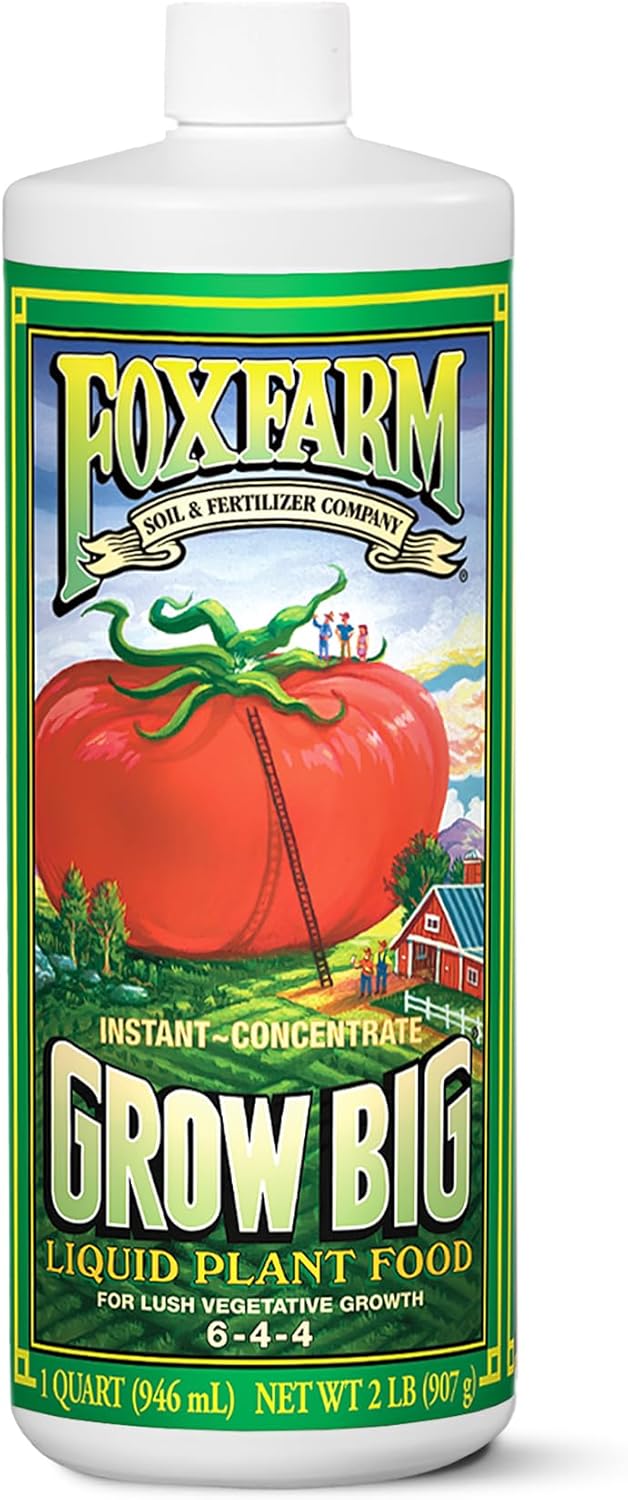
FoxFarm Grow Big Liquid Plant Food, 6-4-4 Quart Concentrate
| N-P-K | 6-4-4 |
|---|---|
| Form | Liquid concentrate |
| Unit count | 32 Fluid Ounces |
| Mixing ratio | 2-3 teaspoons per gallon |
FoxFarm Grow Big is a water-soluble concentrate designed to boost vegetative growth and speed nutrient uptake in vegetable gardens and ornamentals. Mixed at 2 to 3 teaspoons per gallon, it can be applied through watering or foliar feeding to quickly deliver nitrogen-focused nutrition that supports larger plants and stronger stems. The low pH formula helps keep micronutrients stable so feedings remain effective, and the quart concentrate covers repeated applications for a small plot or a set of containers. Practical benefits include clear mixing instructions, versatility for both indoor and outdoor use, and a fast-acting effect when plants need a growth push. Limitations to note are the higher nitrogen emphasis, which favors leaf and stem growth over bloom or fruit set, and the presence of phosphorus in the formula that may be restricted in some local lawn rules. For gardeners who prioritize consistent, predictable feedings, this product is straightforward to measure and integrate into a regular watering schedule.
Best for: Gardeners who want a reliable, easy-to-dose liquid fertilizer to encourage rapid vegetative growth in vegetable beds, containers, and established plants and who value predictable results from each feeding.
Less Ideal for: Growers focused primarily on maximizing flowering or fruit set who need a bloom-boosting formula or those working under strict phosphorus-use restrictions in their area.
- Concentrated liquid formula for fast nutrient uptake and quick visible response
- Low pH formulation helps maintain micronutrient stability during storage and application
- Versatile application by watering or foliar feeding for indoor and outdoor use
- Clear mixing ratio (2–3 teaspoons per gallon) simplifies repeatable feedings
- Nutrient ratio (6-4-4) emphasizes vegetative growth rather than flowering or fruit production
- Contains phosphorus which may be restricted by local regulations for turf or non-agricultural use
Verdict: Choose this concentrate when you want a dependable, fast-acting liquid feed to promote vigorous leafy and structural growth in a vegetable garden.
Dr. Earth Organic Tomato, Vegetable & Herb Fertilizer (64 oz)

| Unit Count | 64 Ounce |
|---|---|
| Item Form | Granules |
| Specific Uses For Product | Organic |
| Target Species | Herb |
| Coverage | Medium |
This granular organic fertilizer is designed to boost vegetable and herb production by supplying balanced nutrients and soil biology support. It is typically broadcast into beds, mixed into potting mixes, or applied at planting and midseason for a nutritional lift; the manufacturer recommends reapplying every six weeks for containers. Notable features include a fully organic ingredient list, fast but sustained nutrient release, and a blend of probiotic microbes plus ecto and endo mycorrhizae intended to improve nutrient uptake and drought tolerance. In practice that means healthier root systems and potentially better yields and flavor in crops like cucumbers when used as part of an organic program. Limitations are that it is a medium coverage product in a 64 ounce bag so larger plots will need more frequent purchases, and it contains phosphorus so local runoff rules should be checked before use. Follow the directions for pH and application timing to avoid overapplication in small containers.
Best for: Gardeners who prioritize organic soil health and want a single, biology‑focused fertilizer to support vegetables like cucumbers in beds or containers.
Less Ideal for: Large‑scale growers seeking a bulk, high‑coverage fertilizer or those who must avoid phosphorus due to local regulations should consider other options.
- 100 percent organic formula suitable for certified organic gardens
- Contains beneficial microbes and eight strains of mycorrhizae to support root health and nutrient uptake
- Granular form releases nutrients quickly and continues feeding for several months
- Works for beds, raised planters and containers and can be used at planting, transplanting or midseason
- Bag is medium coverage so not economical for very large vegetable plots
- Includes phosphorus which may be restricted in some local jurisdictions
Verdict: Choose this product if you want an organic, microbe‑rich granular fertilizer that supports root health and steady feeding for cucumber and other vegetable plantings.
Jobe's Tomato Fertilizer Spikes, 18 Count

| Unit Count | 18 Count |
|---|---|
| NPK | 6-18-6 |
| Application Method | Insert spikes around the plants |
| Target Species | Tomato |
Jobe's Tomato Fertilizer Spikes are simple root-feeding sticks designed to deliver balanced nutrients directly to tomato roots over several weeks. Use one or more spikes inserted into the soil around each plant at planting or early in the season and the slow-release formula releases phosphate-heavy nutrition aimed at supporting flowering and fruit set. The pre-measured spikes eliminate guesswork and reduce mess compared with granular or liquid feeds, and the waterproof pouch helps keep leftovers dry. Practical benefits include targeted feeding that is less likely to wash away and an easy schedule—reapply roughly every eight weeks during the growing season. Limitations are that spikes provide a fixed NPK (6-18-6) so you cannot fine-tune ratios mid-season, and the fixed dose may not match very large or very small plants exactly. Also phosphorus-containing fertilizers are regulated in some areas, so check local guidance before use.
Best for: Gardeners who want a low-effort, no-mess way to support tomato flowering and fruiting and who prefer simple, periodic feeding over frequent applications.
Less Ideal for: Growers who need precise control over nutrient ratios, those managing large-scale production, or gardeners in jurisdictions restricting phosphorus use.
- Slow-release spikes deliver nutrients directly to the root zone for up to eight weeks
- Pre-measured sticks remove mixing and measuring errors and reduce mess
- High phosphorus (18) supports flower development and fruit set
- Waterproof resealable packaging keeps unused spikes dry
- Fixed 6-18-6 formula does not allow adjusting nutrient ratios for specific plant needs
- Single-dose spikes may be too strong or too weak for unusually large or small plants
Verdict: An easy, budget-friendly root-feeding option that reliably boosts tomato flowering and fruit set with pre-measured slow-release spikes.
Espoma Organic Tomato-tone 3-4-6 Organic Fertilizer (4 lb, Pack of 2)

| Item Form | Powder |
|---|---|
| Specific Uses For Product | Gardening,Organic |
| Coverage | Full |
| Target Species | Tomatoes |
Espoma Tomato-tone is a ready-to-use organic fertilizer designed specifically to support tomato fruiting rather than excessive leaf growth. It contains a 3-4-6 N-P-K analysis and 8% calcium, which helps reduce blossom end rot when applied to soil around the plant drip line and watered in. Use it every two weeks during the growing season for potted tomatoes and other vegetables; the product is labeled for organic gardening and requires no on-site mixing. Practical benefits include consistent nutrient delivery tailored to fruit set, built-in calcium for common tomato disorders, and the convenience of a powder/granular form that is simple to apply in containers. Limitations are that feeding frequency and exact rates must be followed to avoid over-application in small pots, and as an organic product it releases nutrients more slowly than synthetic quick-release formulas. This fertilizer is best when paired with good potting mix and regular watering practices to get reliable, fruit-focused results in container tomato production.
Best for: Home gardeners who prioritize steady, reliable fruit production in potted tomatoes and prefer an organic, low-maintenance feeding plan.
Less Ideal for: Gardeners who need very fast, immediate nutrient boosts or who want an all-in-one liquid feed system for frequent foliar feeding.
- Formulated for tomatoes with a 3-4-6 N-P-K ratio to encourage blooms and fruit production.
- Contains 8% calcium to help prevent blossom end rot, a common issue for tomato growers.
- Ready-to-use granular/powder form requires no mixing and is easy to apply around container plants.
- Certified for organic gardening, suitable for organic potted vegetable production.
- Slower nutrient release compared with synthetic quick-release fertilizers, so results are not instantaneous.
- Regular biweekly applications are recommended which requires consistent attention for container plants.
Verdict: Choose this organic tomato fertilizer if you want a reliable, fruit-focused feed with built-in calcium to reduce blossom end rot in potted tomatoes.
Miracle-Gro Water Soluble All Purpose Plant Food, 3 lb

| Item Form | Powder |
|---|---|
| Application Method | Mix with water in a watering can |
| Fertilizer Analysis (N‑P‑K) | 24-8-16 |
| Unit Count | 48 Ounce |
| Coverage | Feeds approximately 1,200 sq. ft. |
Miracle‑Gro Water Soluble All Purpose Plant Food is a powdered NPK 24‑8‑16 formula that dissolves in water to give plants a quick nutrient boost. You mix measured scoops into a watering can and apply to the soil at the base of plants every 7–14 days for outdoor use or every 14 days for houseplants. Notable features include a high nitrogen content for leafy growth, compatibility with containers and in‑ground beds, and guidance for use with a Miracle‑Gro Garden Feeder for larger areas. In practical terms this is a fast‑acting feed that encourages bigger, greener foliage and works well in regular maintenance of perennials like hostas. Limitations are that it is a fast‑release fertilizer rather than a slow‑release option, so it requires regular reapplication and careful measuring to avoid overfeeding. Also, the 24‑8‑16 balance is geared toward vegetative growth, so it is not optimized if you want to prioritize flowering or bloom boosting.
Best for: Buyers who want a reliable, fast‑acting feed to maintain lush, leafy perennials and container plants and who value proven products with broad user endorsement.
Less Ideal for: Gardeners seeking a single, long‑lasting granular fertilizer or a bloom‑focused formula should consider alternative slow‑release or high‑phosphorus products.
- Water‑soluble powder mixes easily for quick uptake by roots
- High nitrogen formula promotes robust leafy growth ideal for shade plants
- Clear mixing and application instructions for both indoor and outdoor use
- Suitable for containers and in‑ground gardens and compatible with garden feeders
- Requires frequent applications so it is not a low‑maintenance, slow‑release option
- High nitrogen ratio is less suitable when the primary goal is more flowers than foliage
Verdict: A fast‑acting, water‑soluble fertilizer that reliably produces bigger, greener hosta leaves when used as directed.
Miracle-Gro Shake 'N Feed Tomato, Fruit & Vegetable Plant Food (1 lb)

| Item Form | Granules |
|---|---|
| Target Species | Tomato, Fruit & Vegetable Plant Food |
| Unit Count | 16 Ounce |
| Item Type Name | Continuous Release Plant Food Plus Calcium |
| Coverage | Full |
Miracle-Gro Shake 'N Feed Tomato, Fruit & Vegetable is a granular, continuous-release fertilizer aimed at vegetable gardens and container-grown edibles. You apply it dry to the soil surface or mix it into potting mix at planting, then water to activate feeding that lasts up to three months. The formula includes natural ingredients that feed soil microbes and added calcium to strengthen cell walls and reduce common calcium-related disorders in fruiting crops. For container cucumbers this product provides steady nutrition without weekly liquid feeding and is simple to dose at planting or between seasons. Limitations include the fixed N-P-K profile and that it is not water-soluble for immediate foliar feeding, so rapid correction of major nutrient deficiencies will require a soluble supplement. It also requires correct incorporation or surface application and watering to avoid uneven distribution in small pots. Overall it is a low-effort option to keep container cucumbers producing through a season when used alongside regular watering and good potting mix.
Best for: Gardeners who want a low-maintenance fertilizing routine for container-grown cucumbers and value steady month-to-month feeding over frequent liquid feeds.
Less Ideal for: Growers who need rapid correction of a diagnosed nutrient deficiency or who prefer precise, water-soluble dosing for each watering cycle.
- Continuous-release granules feed plants for up to three months reducing application frequency
- Contains calcium to help prevent blossom end rot and improve fruit quality
- Formulated for fruits and vegetables and suitable for both in-ground and container use
- Feeds soil microbes via natural ingredients which can improve root health and nutrient availability
- Not water-soluble so it will not correct acute nutrient deficiencies quickly
- Fixed formulation may not match specific soil test recommendations for containers
Verdict: A convenient, slow-release granular feed that keeps container cucumbers nourished for months with minimal fuss.
Choosing the Right Fertilizer for New Tomato Plants: Key Factors to Consider
Nutrient Ratio for Young Plants
Young tomato plants need a nutrient ratio that promotes root growth and steady leaf development without pushing excessive leafy growth. That typically means a moderate nitrogen level balanced with adequate phosphorus to encourage root establishment and available potassium to support cell function. High-nitrogen mixes designed for heavy vegetative growth can cause leggy, weak stems in seedlings and divert energy away from root development.
When evaluating labels, look for clearly stated N-P-K percentages and brief guidance for seedling or transplant use. Products that include a separate 'starter' or 'transplant' rate are easier to dose correctly for young plants. Understanding the ratio helps you adjust application frequency and concentration to match your soil or potting mix fertility.
Solubility and Immediate Availability
New tomato roots are small and benefit from nutrients that are immediately available or quickly soluble in the root zone. Water-soluble fertilizers and liquid concentrates deliver nutrients fast and are easier to dilute accurately for seedlings. Granular or slow-release products can work if they are labeled for early-season use and break down predictably, but many slow-release formulas release too slowly for a newly established plant that needs an early boost.
Consider how quickly you need the nutrients to act. For transplants showing slow growth or pale leaves, a soluble feed gives faster correction. In containers, solubility matters even more because the root zone is limited and salts can concentrate.
Application Method and Flexibility
Different gardeners use different planting methods, from cell trays and pots to in-ground beds and direct-transplanting. A fertilizer that offers multiple application methods-root drench, foliar spray, transplant dip, and granular topdressing-gives you flexibility as the plants grow. Transplant dips or starter solutions can reduce transplant shock, while regular root drenches help maintain nutrient levels in the first weeks.
If you prefer low-labor routines, choose a product with clear instructions for slow-release or one-time starter applications. If you manage many seedlings or use greenhouse starts, concentrate on formulations that are easy to mix and measure accurately for repeated feedings.
Risk of Salt Buildup and Plant Safety
Seedlings are sensitive to high soluble salt levels, which can cause root burn and stunted growth. Fertilizers with high salt index or unclear dilution instructions increase the risk of damaging new transplants. Products that recommend very dilute rates for young plants or provide explicit guidance for container versus in-ground use reduce this risk.
Gardeners using pots or small containers should prefer feeds with low salt risk and flush media periodically. For bare-ground transplants, moderate-strength starter solutions are usually safe when applied as directed. Always follow the dilution guidance for seedlings rather than rates intended for mature plants.
Micronutrients and Chelation
While N-P-K gets most attention, micronutrients such as magnesium, calcium, and iron affect early tomato health and reduce issues like blossom drop or patchy leaf color. Some starter fertilizers include chelated micronutrients that remain available across a range of soil pH levels. For new tomato plants, access to these elements supports steady growth and helps prevent deficiencies that are harder to correct later in the season.
If your soil test shows adequate micronutrients, a basic starter feed may suffice. If uncertain, a balanced starter formula that lists key micronutrients provides insurance during the critical establishment phase.
Label Clarity and Dosing Instructions
Clear, specific dosing instructions reduce mistakes that can harm seedlings. Labels that list dilution rates per gallon, per liter, or per plant and give separate guidance for seedlings, transplants, and mature plants are easier to use. When instructions are vague or use only broad categories, gardeners often under- or over-apply.
Practical labeling also covers frequency and compatible application methods. If a product lacks seedling-specific directions, treat it cautiously or choose one with explicit guidance to avoid accidental over-fertilization.
When to Feed New Tomato Plants
Timing feeds correctly helps young tomatoes allocate energy to roots instead of excessive foliage. Start with a gentle feed one to two weeks after transplanting, once roots have begun to reestablish and the plant shows active leaf growth. Avoid heavy feeding immediately at transplant to reduce salt stress.
After the initial starter feed, continue with light, regular applications every one to two weeks using a dilute liquid or soluble formulation, or follow the manufacturer timetable for a low-concentration slow-release product. Watch foliage and overall vigor to fine-tune frequency.
- Apply a transplant dip or root drench if plants show transplant shock.
- Delay full-strength feeding until plants have several sets of true leaves.
- Flush containers if salts build up and leaf edges brown.
How Soil and Potting Mix Change Your Choice
Soil fertility and media affect how quickly fertilizers act and how often you need to reapply. Rich, amended garden soil often requires only a light starter feed, while sterile potting mixes lack nutrients and benefit from a soluble starter solution. In containers, nutrients leach with each watering so more frequent dilute feeds are common.
If you know your soil test results, match the fertilizer choice to deficiencies. In unknown soils, choose a balanced starter feed with modest N-P-K and micronutrients to avoid dramatic swings in nutrient availability.
- Use water-soluble feeds for inert mixes and pots.
- Use lower-dose granular starters in fertile ground.
- Adjust frequency based on observed growth rather than a fixed calendar.
Starter Techniques Beyond Regular Feeding
Transplant dips, root-soaking solutions, and gentle foliar feeds are practical starter techniques. A quick dip at planting helps coat roots in available phosphorus and reduces initial transplant stress. Foliar feeding can correct minor deficiencies quickly, but it should not replace root-applied nutrients for long-term establishment.
Combine techniques conservatively: use one transplant dip at planting followed by routine diluted root feeds. Avoid repeated concentrated foliar sprays on very young foliage.
- Transplant dip for immediate root support.
- Regular root drenches for ongoing nutrient supply.
- Foliar sprays as a supplemental corrective tool only.
Organic Versus Synthetic Options for Starters
Both organic and synthetic starters can work for new tomato plants, but they behave differently. Synthetic soluble fertilizers act quickly and are easy to measure at low concentrations for seedlings. Organic options release nutrients more slowly and also supply carbon and microbial food that benefits medium-term soil health.
For immediate correction or quick establishment, many gardeners prefer a soluble synthetic starter. For a more gradual, soil-building approach, an organic starter or liquid seaweed blend can reduce stress and add beneficial microbes. Your management style and timeline determine which approach is best.
- Choose soluble synthetics for fast, controllable feeding.
- Choose organics for gradual release and soil biology support.
- Mixing types is possible but requires cautious dosing to avoid over-application.
Signs Your Starter Program Is Working
Healthy new tomato plants show steady leaf expansion, deepening leaf color, and firm stems. Root health can be inferred from vigor and uptake; plants that quickly recover from light stress or resume growth after transplant are likely receiving adequate nutrients. Conversely, yellowing between veins, slow new growth, or burned leaf edges suggest nutrient imbalance or salt stress.
Adjust concentration and frequency if you see stress signs. Often reducing concentration and increasing frequency prevents toxicity while maintaining nutrient supply. Pair visual monitoring with occasional soil or media testing for best results.
- Look for firm stems and uniform green leaves.
- Watch for salt-burned margins and reduce feed strength if present.
- Use root-zone moistening rather than heavy top-watering shortly after feeding.
How We Chose the Best Fertilizer for New Tomato Plants
We used practical, garden-focused filters to narrow candidate fertilizers suited specifically for new tomato plants. First, we prioritized nutrient profile details that matter in the early growth stages: moderate nitrogen levels, adequate phosphorus for root establishment, and available potassium for overall vigor. Second, we favored formulations with predictable release or clear dilution instructions so beginners can avoid burn. Third, application flexibility mattered: options that work for pots, open beds, and transplant dips scored higher. Fourth, we looked for evidence of soluble and readily available nutrient forms that young roots can access quickly. We excluded any products labeled only for mature fruiting or ornamental use where concentrations or additives could overstimulate foliage or harm seedlings. Finally, we considered packaging and label clarity as a proxy for ease of use in real garden situations. These criteria align with our scoring metrics and reflect outcomes gardeners track during the first six weeks after planting.
FAQ
How soon after transplanting should I start fertilizing new tomato plants?
Start with a gentle feed one to two weeks after transplanting, once the plant shows active leaf growth. Immediate heavy feeding can stress young roots, so use a dilute solution or a transplant-specific rate.
Can I use a general all-purpose fertilizer on new tomato seedlings?
Often you can, but check the label for seedling or transplant rates and the N-P-K ratio. Choose a general fertilizer only if it provides a balanced, moderate nitrogen level and clear dilution instructions for young plants.
Are liquid feeds better than granular starters for pots?
Liquid feeds are usually more predictable in containers because they deliver nutrients directly to a small root zone and are easy to dilute. Granular starters can work if formulated for early season use, but they may release unevenly in small pots.
Should I include micronutrients when feeding new tomato plants?
Micronutrients like calcium and magnesium help prevent early deficiencies that can affect growth and fruit set later. A starter with listed micronutrients or occasional supplementation can be beneficial, especially in uncertain soils.
Will foliar feeding replace root applications for seedlings?
No. Foliar feeding can correct minor deficiencies quickly, but root-applied nutrients provide the sustained supply young plants need. Use foliar sprays as a supplement, not a replacement.
How can I avoid fertilizer burn on small transplants?
Avoid high-strength solutions and follow seedling-specific dilution rates. Use smaller, more frequent feedings rather than infrequent strong doses and flush container media if salts accumulate.
Final Verdict
Choose a starter fertilizer that balances moderate nitrogen with adequate phosphorus and available potassium, and prefer soluble or clearly labeled formulations for new tomato plants. Match the application method to your planting system-dips and root drenches for transplants, dilute liquid feeds for containers, and carefully timed granular starters for in-ground beds. Prioritize label clarity and low salt risk to avoid burn, and adjust frequency based on visible growth and media type. With the right starter approach you will improve transplant survival and set up stronger plants for the season ahead.
