

Note: This article contains affiliate links. If you click on these links and make a purchase, I may earn a small commission at no extra cost to you. This helps support my research and content. Read my full affiliate disclosure here.
Getting zoysia sod to knit quickly and develop a deep root system depends heavily on the fertilizer you choose. With newly laid zoysia, the wrong nutrient ratio or an overly aggressive application can stress the grass or burn delicate roots, while a well-timed, balanced fertilizer encourages tillering and strong soil contact. This guide highlights seven top fertilizer options suited for new zoysia sod and explains the practical reasons each type made our shortlist. We look at starter nutrient mixes, slow-release options, application ease, and safety for tender turf so you can pick a feeding plan that helps your sod establish with fewer setbacks.
Top Picks at a Glance
| Best Overall The best all-around choice for most situations | Lawn Synergy Starter Fertilizer 15-20-10 (18 lb) for New Seed & Sod |  |
| Best Quality Built to a higher standard if you want something more solid | The Andersons Premium New Lawn Starter Fertilizer (20-27-5) — 18 lb, covers up to 5,000 sq ft |  |
| Best Value The sweet spot between price and what you get | Jonathan Green Veri-Green Starter Fertilizer for Seeding & Sodding (12-18-8) — 5,000 sq ft |  |
| Best Budget The cheapest option that still gets the job done reliably | Central Sod Starter Fertilizer 10-10-10, Covers 600 sq ft |  |
| Highest Rated A top-rated pick with lots of positive feedback | The Andersons EcoFusion Starter Biosolid Fertilizer 16-21-4 with Iron, 18 lb |  |
| Most Popular A crowd favorite that many people choose with confidence | Scotts Turf Builder Starter Food for New Grass, 15 lb. |  |
| Best Seller A high-volume bestseller chosen again and again | Simple Lawn Solutions Growth Booster Liquid Lawn Fertilizer (32 oz) with Humic Acid, Hose-End Sprayer |  |
Lawn Synergy Starter Fertilizer 15-20-10 (18 lb) for New Seed & Sod

| Mixing Ratio | 15:20:10 |
|---|---|
| Item Form | Granules |
| Specific Uses For Product | Plant Growth, Root Development, Seed Development |
| Coverage | Up to 4,500 sq.ft. |
This 15-20-10 starter fertilizer is designed specifically for establishing new grass from seed or fresh sod and is a sensible choice for Zoysia sod establishment. It combines a slow-release XCU polymer/sulfur-coated nitrogen for steady feeding with ammonium sulfate for an early color and quick response, plus micronutrients to support stress tolerance during establishment. Use it with a broadcast or rotary spreader at the recommended rate (about 5 lb per 1,000 sq ft) either before or immediately after laying sod, and water lightly to move nutrients into the root zone. The granules are described as easy to spread, which helps achieve uniform coverage. Important practical limits are that it is a professional-grade formulation so protective handling is advised and the bag covers a limited area relative to large properties, so multiple bags may be required for bigger yards. For a homeowner aiming for reliable, steady nutrition during the first weeks of Zoysia establishment, this product offers a balanced, turf-focused starter approach.
Best for: Homeowners installing new Zoysia sod or overseeding small to medium lawns who want a balanced starter fertilizer that promotes strong root establishment and steady early growth.
Less Ideal for: Large properties where a single application needs to cover many acres or users who prefer purely organic fertilizers or ready-to-use liquid starters.
- Balanced 15-20-10 NPK ratio supplies extra phosphorus to encourage root development in new sod
- XCU slow-release nitrogen provides up to about 10 weeks of steady nutrient release
- Includes ammonium sulfate for quicker early green-up and visible color
- Micronutrients included to support stress tolerance and uniform establishment
- Granular prill flows smoothly through spreaders for even application
- Professional-grade handling recommended which requires protective gear during application
- 18 lb bag covers a modest area so multiple bags may be needed for larger lawns
Verdict: A balanced starter formula that gives new Zoysia sod steady, establishment-focused nutrition with a mix of slow-release and quick-release nitrogen.
The Andersons Premium New Lawn Starter Fertilizer (20-27-5) — 18 lb, covers up to 5,000 sq ft

| Item Form | Granules |
|---|---|
| Specific Uses For Product | Lawn |
| Coverage | 5000 |
| Mixing Ratio | 20:27:5 |
The Andersons Premium New Lawn Starter (20-27-5) is a granular starter fertilizer designed for establishing new turf, including seeded lawns and sod. It supplies a high phosphorus ratio to encourage root development, combines quick- and slow-release nitrogen for both an initial growth boost and sustained feeding, and includes micronutrients plus 1% iron to enhance greening. Typical use is worked into the topsoil 2 to 3 inches before seeding or laying sod, then kept moist until seedlings establish. For zoysia sod, the strong phosphorus and balanced feeding support rapid root take and early vigor, which helps the grass knit in faster. The product covers up to 5,000 square feet per 18 pound bag, so one bag suits moderate-sized yards. Limitations are that it is a single-application bag sized for a specific coverage and it requires proper incorporation and watering to avoid uneven results. Users should follow safety directions to avoid skin or eye contact when handling granular fertilizer.
Best for: Homeowners installing new zoysia sod who prioritize rapid root establishment and early turf vigor and who are prepared to follow incorporation and watering instructions.
Less Ideal for: People looking for a general maintenance fertilizer for established lawns or those who want liquid products or ready-to-use slow-release programs without soil incorporation.
- High phosphorus formulation (20-27-5) targeted for strong root development in new turf
- Blend of quick- and slow-release nitrogen provides immediate green-up and longer feeding
- Contains micronutrients and 1% iron for deeper greening
- Granular form and directions allow incorporation into soil before seeding or laying sod
- Single 18 lb bag covers up to 5,000 sq ft so larger areas require multiple bags
- Must be worked into the soil and kept moist after application for best results
Verdict: Choose this starter fertilizer when you need a phosphorus-forward, quick-plus-sustained feeding formula to help new zoysia sod establish strong roots quickly.
Jonathan Green Veri-Green Starter Fertilizer for Seeding & Sodding (12-18-8) — 5,000 sq ft

| N-P-K | 12-18-8 |
|---|---|
| Form | Granules |
| Application method | Rotary, drop, or hand-held spreader |
| Coverage | 5,000 sq ft |
| Target use | Seeding and sodding |
Jonathan Green Veri-Green Starter Fertilizer is a granular starter feed designed for use the same day you seed or lay sod to help new grass establish faster. Its 12-18-8 N-P-K and humates focus on root development and nutrient availability, so seedlings germinate quicker and develop deeper roots. Apply with a rotary, drop, or handheld spreader at seeding in spring or fall; one 15 lb bag treats about 5,000 sq ft. The product feeds for up to two months and includes slow-release nutrition to sustain early growth without repeated applications. Practical benefits include clear directions for starter use, compatibility with standard spreaders, and a formula that targets the crucial early root and shoot growth stage. Limitations are that it is a short-term starter fertilizer rather than a season-long feed and it must be applied at the time of seeding or sodding to be effective, so timing is important for best results.
Best for: Gardeners installing new warm-season sod who prioritize a reliable, targeted starter that improves germination and root strength and want a straightforward product that integrates with standard spreading tools.
Less Ideal for: Homeowners looking for a season-long or all-purpose fertilizer for established lawns or for those who need a single product to cover multiple feedings across the season.
- High phosphorus 12-18-8 formula specifically encourages root development and faster germination
- Includes humates and 25% slow-release nutrition to improve nutrient availability and sustain early growth
- Designed for use the same day as seeding or sodding and compatible with common spreaders
- Covers up to 5,000 sq ft from a single 15 lb bag, useful for medium lawns
- Provides up to about two months of feed so additional fertilization is needed later in the season
Verdict: Choose this starter fertilizer when you want a focused, easy-to-apply formula to speed germination and build strong roots during zoysia sod installation.
Central Sod Starter Fertilizer 10-10-10, Covers 600 sq ft

| Item Form | Granules |
|---|---|
| Application Method | spread |
| Coverage | 600 square feet |
| Mixing Ratio | 10-10-10 |
| Target Species | grass |
This Central Sod 10-10-10 starter fertilizer is designed specifically for use when installing new sod or seeding and is sold in single bags that cover 600 square feet. It comes as quick-release granules intended to be broadcast or rotary-spread across soil before laying sod, so nutrients are immediately available to young roots without needing to incorporate the product into the soil. The balanced N-P-K makes it safe for both warm- and cool-season grasses and the packaging size matches a standard pallet of sod, which helps avoid waste for common small installations. Practical benefits include easy measuring, straightforward application with a spreader, and enough coverage for one typical pallet so you do not overbuy for a modest area. Limitations are that the formula is a general-purpose starter rather than a specialty feed for zoysia-specific needs, and being quick-release it does not provide extended feeding over many weeks.
Best for: Homeowners installing a single pallet or similarly sized area of new sod who want an affordable, easy-to-apply starter fertilizer and prefer to buy a single bag sized to the job.
Less Ideal for: People managing large lawns who need extended-release feeding schedules or those seeking a fertilizer custom-formulated for a specific soil test or zoysia-only nutrient program.
- Premeasured coverage sized to treat 600 square feet, matching a standard sod pallet
- Balanced 10-10-10 formulation suitable for both seed and sod establishment
- Quick-release granules provide immediately available nutrients to new roots
- Simple application with a rotary or broadcast spreader
- Quick-release nutrients do not provide long-term feeding
- Not tailored to soil-specific needs or zoysia-specific formulations
Verdict: A budget-friendly, correctly sized 10-10-10 starter fertilizer that gives newly laid zoysia sod immediate nutrients and no-fuss application for a single 600 sq ft pallet.
The Andersons EcoFusion Starter Biosolid Fertilizer 16-21-4 with Iron, 18 lb

| NPK | 16-21-4 |
|---|---|
| Form | Granules |
| Micronutrients | Copper, Manganese, Zinc |
| Iron | 5% Iron |
| Coverage | 5000 sqft. |
The Andersons EcoFusion Starter 16-21-4 is a starter fertilizer designed specifically for establishing new lawns and renovating turf. It delivers both quick- and slow-release nitrogen so grass gets an immediate boost and sustained feeding over several weeks, and it includes phosphorus for root development plus micronutrients copper, manganese, zinc, and 5% iron to promote deep greening. Typical use is a broadcast application with a spreader to cover up to 5,000 square feet, followed by light irrigation to move granules into the soil and repeating every 4 to 6 weeks during the growing season if needed. Practical benefits for new zoysia sod include stronger early root establishment from phosphorus and prolonged nitrogen availability that reduces the need for very frequent reapplications. Limitations are that it is a granular, biosolid-based product that requires correct spreader settings and timing to avoid runoff and that label directions must be followed for safety and local regulations. It is not intended for immediate foliar feeding or for use where biosolid restrictions apply.
Best for: Buyers who want a dependable starter fertilizer to establish new warm-season turf and prefer a product that offers immediate greening plus sustained nutrition over several weeks.
Less Ideal for: Homeowners seeking a liquid foliar feed or an organic-certified amendment should consider alternative products; also avoid if local rules restrict biosolid fertilizers.
- Formulated as a starter fertilizer with phosphorus to support root establishment
- Blend of quick- and slow-release nitrogen for immediate and sustained feeding
- Includes micronutrients and 5% iron for deeper greening of turf
- Coverage advertised up to 5,000 sq ft per 18 lb bag for single-pass applications
- Granular biosolid product requires correct spreader calibration and timing to avoid wash-off
- Not suitable where biosolid fertilizers are restricted or prohibited
Verdict: Choose EcoFusion Starter when you need a reliable, professional-grade granular starter that promotes root establishment and sustained greening for new zoysia sod.
Scotts Turf Builder Starter Food for New Grass, 15 lb.

| Formula (NPK) | 24-25-4 |
|---|---|
| Application method | spreader |
| Coverage | 5000 square feet |
| Item form | Powder |
Scotts Turf Builder Starter Food for New Grass is a granular starter fertilizer designed to boost root development when planting seed, sod, plugs, or sprigs. You apply it with a broadcast or drop spreader at planting and again 2–4 weeks later; the product’s 24-25-4 NPK delivers a high phosphate dose aimed at early root growth. In practice it makes seeding and sodding simpler because it is safe for all grass types and comes with spreader settings and coverage guidance for a 15 lb. bag that covers 5,000 square feet. The powder form distributes evenly through common spreaders and the manufacturer guidance to water and keep soil moist helps seedlings establish. Limitations are that it is a short-term starter feed rather than an ongoing maintenance fertilizer, so you need to switch to a maintenance program after establishment, and extra care is required to avoid applying near storm drains or over-application on small patches.
Best for: Homeowners installing new zoysia sod or overseeding who prioritize proven, widely used starter nutrition and want clear instructions to get young turf established safely.
Less Ideal for: Gardeners looking for a long-term fertilization product or a slow-release all-season program should consider maintenance fertilizers instead.
- High-phosphate 24-25-4 formula to encourage early root development
- Clear application guidance and spreader settings for easy, even coverage
- Covers a large area from a single 15 lb. bag (up to 5,000 sq. ft.)
- Safe for all grass types and suitable for seed, sod, plugs, and sprigs
- Designed only as an initial starter feed so it must be followed by regular lawn food for ongoing nutrition
Verdict: A high-phosphate starter fertilizer that gives newly planted zoysia sod a reliable, fast root-strengthening boost to speed establishment.
Simple Lawn Solutions Growth Booster Liquid Lawn Fertilizer (32 oz) with Humic Acid, Hose-End Sprayer
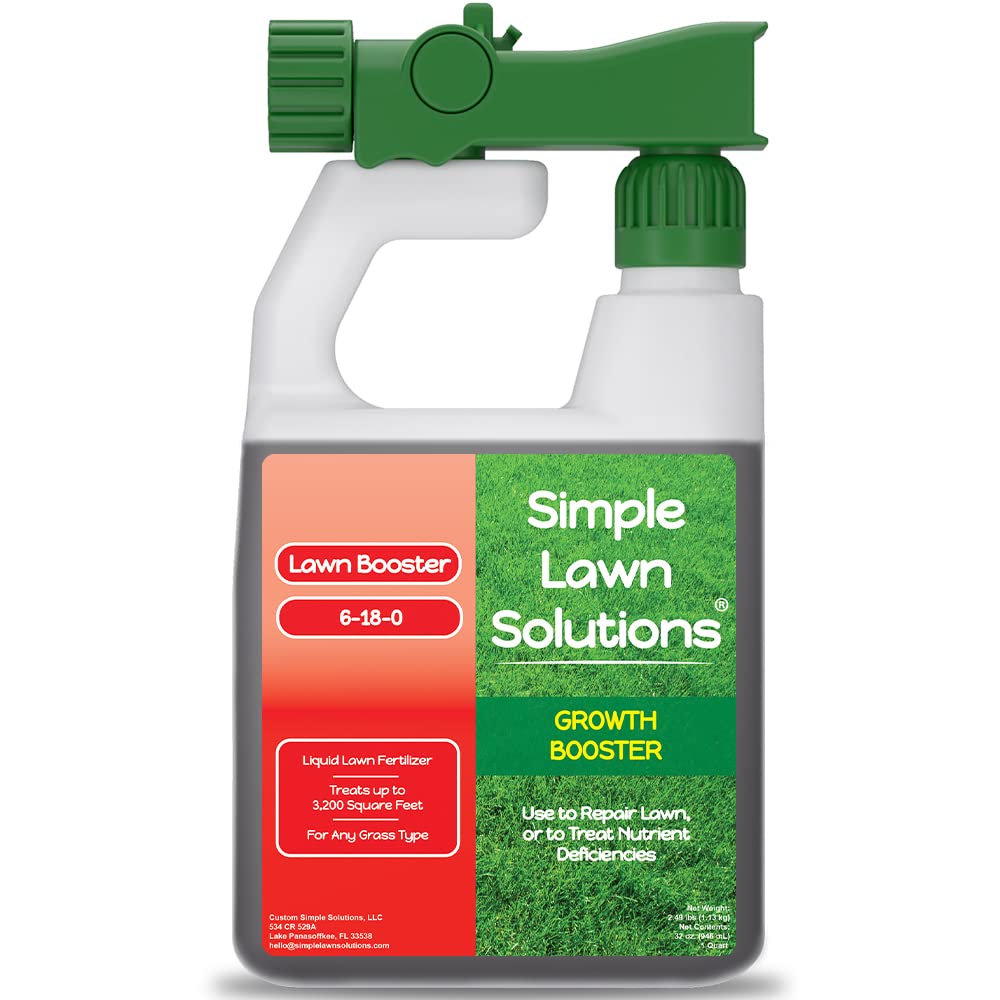
| Item Form | Liquid |
|---|---|
| Specific Uses For Product | Establishing lawn with sod or seed, Boosting vertical and lateral growth, Addressing phosphorus nutrient deficiencies |
| Application Method | Spray |
| Coverage | 3,200 square feet |
| Mixing Ratio | 6:18 |
This ready-to-use hose-end fertilizer is designed to speed establishment of new sod and seed by combining 6% nitrogen, 18% phosphorus and humic acid in a liquid concentrate. You attach the included sprayer to a garden hose and apply across the lawn; the label says one bottle covers about 3,200 sq ft and the product is intended for all grass types. In practice the high phosphorus helps seedlings and new zoysia sod develop stronger roots while the nitrogen supports green-up and shoot growth, and the humic acid can improve nutrient uptake in many soils. The convenience of a premixed spray makes application fast and reduces measurement errors compared with granular blends. Important limitations are that it is a starter/boost product rather than an all-season feed and it contains a specific nutrient ratio, so lawns needing a different balance will require a different product. Also as a liquid concentrate the coverage and dilution must be followed closely to avoid uneven results.
Best for: Homeowners installing new zoysia sod who prefer a simple, low-risk starter treatment to promote root establishment and faster green-up without mixing granular fertilizers.
Less Ideal for: People managing large lawns who need season-long feeding plans or gardeners who prefer to match fertilizer to specific soil test results.
- Ready-to-spray hose-end applicator for quick, low-effort coverage
- High phosphorus formulation that supports root development in new sod and seed
- Contains humic acid to aid nutrient uptake and soil mineral availability
- Covers up to 3,200 square feet per bottle, suitable for modest lawn areas
- Formulated primarily as a starter booster rather than a balanced season-long fertilizer
- Fixed N-P ratio may not match every soil test recommendation
- Liquid concentrate requires careful dilution/application to ensure even coverage
Verdict: A convenient hose-end starter fertilizer that helps new zoysia sod establish faster by delivering extra phosphorus and humic acid with minimal mixing.
Choosing the Right Fertilizer for New Zoysia Sod: Key Factors to Consider
Nutrient Ratio and Timing
New zoysia sod benefits from a nutrient profile that prioritizes root development and tillering. A starter fertilizer for sod typically has moderate nitrogen and a measurable amount of phosphorus to encourage root growth. Too much quick-release nitrogen early on can push excessive top growth at the expense of roots and increase the risk of burn if the turf is not well watered.
Timing matters because newly laid sod needs an initial feeding to stimulate root contact with the soil, but follow-up applications should be tuned to growth rate and seasonal temperature. For warm-season grasses like zoysia, schedule initial feeding once the sod has settled and been watered adequately, then plan a second application several weeks later if turf response shows it is needed.
Release Mechanism
How a fertilizer releases nutrients determines both safety and convenience. Water-soluble starters provide a quick nutrient boost but can create a higher immediate salt load on new turf. Coated or polymer-controlled slow-release granules deliver nitrogen gradually, lowering burn risk and extending feed intervals.
Consider the establishment window for zoysia: a product with a predictable 6 to 8 week release can reduce the need for repeated light applications. Conversely, if you need an immediate greening response for appearance or to support rapid tillering, a blend that mixes an available fraction with a slow-release fraction can offer both immediate and persistent nutrition.
Salt Index and Root Safety
Salt index measures how likely a fertilizer is to draw moisture from plant roots and cause burn. New sod has limited root contact and a higher sensitivity to salts, so low-salt formulations are safer. Look for products that specify a low salt index or that are marketed for starter applications and sod.
If you must use a higher-salinity feed, reduce the rate and increase watering to flush salts away from the root zone. Proper watering after application is a key mitigation step to protect delicate new roots and ensure nutrients move into the soil rather than concentrating at the surface.
Application Method and Equipment Compatibility
Think about how you will apply the fertilizer across the newly sodded area. Granular starter fertilizers that work with broadcast spreaders allow even coverage on larger yards, while hose-end or liquid options are often easier for small patches or irregular shapes. Each method has tradeoffs: liquids can give fast, uniform coverage but may require a tank and calibration; granules are convenient but need careful calibration and overlap control.
Choose a product that matches the equipment you own or are willing to use, and make sure instructions include recommended spreader settings for sod installation rates. Ease of measurement and clear label directions reduce the chance of overapplication that could harm the sod.
Coverage and Application Rates
New sod needs precisely measured applications to avoid underfeeding or burn. The fertilizer label should provide coverage information specific to the product's nutrient concentration and recommended pounds per 1,000 square feet for sod establishment. Products that offer clear calibration charts or a simple coverage table make it easier to calculate how much to apply across a given area.
When calculating rates, account for dilution if you are mixing with water for liquid application. It is safer to err on the side of slightly lower initial rates and reapply based on turf response than to overapply at the first feeding.
Soil Testing and pH Considerations
Soil condition under the sod affects how fertilizer behaves. A simple soil test before or shortly after sodding can reveal phosphorus availability and pH levels that alter nutrient uptake. If soil pH is off for warm-season grasses, certain nutrients become less available, so an otherwise balanced starter may not be fully effective.
Adjustments to pH or targeted amendments should be made based on testing rather than guesswork. Many establishment fertilizers assume average soil conditions, so if your soil is distinctly acidic or alkaline, address that with lime or sulfur treatments at rates recommended by a soil report.
When to Apply Fertilizer After Laying Zoysia Sod
Apply the first fertilizer once the sod has established good soil contact and you have watered it enough that excess surface water has drained away. That is often within one to two weeks of installation, depending on weather and how well the sod was set onto the soil.
Avoid fertilizing immediately after laying if the sod appears stressed or if roots are not in contact with the soil. A short delay allows you to confirm that the turf is settling and reduces the chance of concentrating salts on an already fragile root system.
- Initial application typically within 7 to 14 days, depending on conditions
- Water thoroughly after application to move nutrients into the root zone
- Monitor for signs of burn or excessive top growth and adjust the second feeding accordingly
Watering Strategy to Support Fertilizer Uptake
Watering is critical after you fertilize new sod. Light, frequent irrigation helps move soluble nutrients into the soil and keeps salts from building at the root surface. For granular products, follow label directions for post-application irrigation amounts to activate the fertilizer.
Once roots begin to establish, transition to deeper, less frequent watering to encourage deeper rooting. That change should be gradual and aligned with turf response rather than arbitrary calendar dates.
- Light irrigation immediately after application to dissolve and carry nutrients
- Gradually shift to deeper watering as roots develop
- Avoid overwatering that creates anaerobic soil pockets under the sod
Foliar Feeds and Micronutrients: When They Help
Foliar applications can quickly correct visual micronutrient deficiencies or provide a temporary greening effect without adding bulk salts to the soil. They are not a substitute for a balanced starter fertilizer but can complement it when magnesium, iron, or trace elements are limiting.
Use foliar sprays sparingly on new sod. Because leaves on newly established turf are thin, dilution and gentle application help avoid leaf scorch. Use foliar feeds as a targeted fix rather than the primary establishment nutrition strategy.
- Good for correcting specific visible deficiencies
- Apply in cooler parts of the day to reduce leaf burn risk
- Do not rely on foliar feeds in place of N-P-K starter programs
Interpreting Early Growth Signals
Watch the sod for tiller development, uniform rooting, and color as indicators of successful establishment. Even, steady growth with no patchy discoloration usually means your feeding and watering are on track. Excessive rapid top growth may indicate too much available nitrogen, while pale or thin turf can signal underfeeding or poor phosphorus availability.
When diagnosing issues, consider environmental stressors like heat, drought, pests, or poor soil contact before assuming the fertilizer is at fault. Adjust feeding rates based on observed growth and the season rather than sticking rigidly to a calendar.
- Tiller production and even rooting are positive signs
- Pale color may indicate insufficient starter phosphorus or iron
- Patchiness usually traces to poor soil contact, pests, or uneven application
Safety and Environmental Considerations
Apply fertilizers responsibly to prevent runoff into waterways. Avoid fertilizing when heavy rain is forecast and follow label runoff prevention recommendations. Proper timing and calibrated rates reduce nutrient loss and environmental impact.
When working with new sod, take care to store and handle fertilizers safely to prevent accidental spills. Use recommended application equipment and clean spreaders as directed to avoid cross-contamination between products.
- Do not apply before heavy rain to minimize runoff
- Use precise calibration to avoid overapplication
- Store fertilizers in a dry, secure place away from children and pets
How We Chose the Best Fertilizer for New Zoysia Sod
We focused on fertilizers that help the unique establishment needs of new zoysia sod. Criteria emphasized nutrient ratios that support root growth and tillering, specifically moderate starter nitrogen combined with available phosphorus and adequate potassium to support stress tolerance. We prioritized formulations with predictable release patterns, such as coated slow-release granules or well-balanced water-soluble starters, because release behavior strongly affects burn risk and consistent uptake during the first 6 to 12 weeks. Application practicality was another filter: products had to be suitable for common lawn spreaders or hose-end applicators and include clear instructions for newly installed sod. We vetted product safety features such as low salt index and tolerance guidance for warm-season turf to reduce early-season stress. Packaging and measured coverage guidance were considered to reduce overapplication errors. We excluded specialty amendments that do not provide balanced N-P-K or that are solely micronutrient foliar feeds, since these do not address the primary establishment needs. We also excluded products aimed only at long-established lawns rather than sod establishment.
FAQ
How soon after laying zoysia sod should I apply starter fertilizer?
Usually apply a starter once the sod has good soil contact and has been watered enough that excess surface moisture has subsided, often within 7 to 14 days. If the sod looks stressed, delay feeding slightly until it shows signs of settling.
Should I use a slow-release or quick-release fertilizer on new zoysia sod?
A blend that combines an available fraction with slow-release nitrogen often works best: it gives an initial boost without creating a large immediate salt load, while the slow-release portion supports steady growth. Pure quick-release products increase burn risk if not watered properly.
Can too much fertilizer harm newly installed zoysia sod?
Yes. Overapplication, especially of high-soluble nitrogen, can burn tender roots and cause excessive top growth at the expense of rooting. Always follow label rates for sod establishment and water after application to reduce salt buildup.
Do I need a soil test before choosing a fertilizer for new sod?
A soil test is helpful but not always required. A basic test can reveal pH and phosphorus status that influence starter needs. If you suspect extreme pH or low nutrient levels, test and amend accordingly before or shortly after sodding.
Are foliar micronutrient sprays useful on new zoysia sod?
Foliar sprays can correct visible micronutrient deficiencies quickly but are not a substitute for starter N-P-K. Use them sparingly and as a supplement when specific deficiencies like iron or magnesium are evident.
How should I adjust watering after fertilizing new zoysia sod?
Irrigate lightly and frequently immediately after applying fertilizer to dissolve granules and move nutrients into the root zone. As roots develop, transition to deeper, less frequent watering to encourage deeper rooting.
Final Verdict
Prioritize a fertilizer that supplies a starter nutrient balance with a moderate nitrogen fraction, available phosphorus, and a predictable release pattern to protect delicate roots while encouraging tiller and root development. Match the product to your application equipment and follow label rates carefully, using post-application watering to minimize burn risk. Balancing immediate nutrient availability with controlled release is the best way to help new zoysia sod establish efficiently. Focus on root safety, clear coverage guidance, and sensible timing to make a confident choice for your lawn.
