

Note: This article contains affiliate links. If you click on these links and make a purchase, I may earn a small commission at no extra cost to you. This helps support my research and content. Read my full affiliate disclosure here.
When you are raising cuttings or starting seeds, the wrong feed can stunt roots or push weak, leggy shoots. Choosing a fertilizer for propagation matters because young plants have different nutrient needs than established specimens. The right formula supports root initiation, builds sturdy stems, and reduces transplant shock without burning delicate tissues. This guide covers seven shortlisted options that perform well in propagation settings. We evaluate each pick using practical criteria gardeners care about, including nutrient balance, application method, and safety for tender roots. Read on to find which style of fertilizer will fit your propagation workflow.
Top Picks at a Glance
| Best Overall The best all-around choice for most situations | Southside Plants Root Drops Liquid Rooting Hormone (4 oz) |  |
| Best Quality Built to a higher standard if you want something more solid | Clonex Rooting Gel High-Performance Rooting Compound, 100 ml |  |
| Best Value The sweet spot between price and what you get | Bonide Root & Grow Concentrate 32 oz |  |
| Best Budget The cheapest option that still gets the job done reliably | Garden Safe TakeRoot Rooting Hormone Powder, 2 oz |  |
| Highest Rated A top-rated pick with lots of positive feedback | Herrdemia 3-in-1 Rooting Powder (IBA + NAA + Mycorrhizae) |  |
| Most Popular A crowd favorite that many people choose with confidence | SUPERthrive Plant Vitamin Solution with Kelp, Liquid Concentrate, 4 fl oz |  |
| Best Seller A high-volume bestseller chosen again and again | Clonex Clone Solution Propagation Nutrient, 1 Quart |  |
Southside Plants Root Drops Liquid Rooting Hormone (4 oz)

| Item Form | Liquid |
|---|---|
| Specific Uses For Product | Cuttings in water, soil, or newly transferred to soil |
| Application Method | Drops |
| Unit Count | 4 Ounce |
| Target Species | Houseplants |
Southside Plants Root Drops is a concentrated liquid rooting hormone designed to speed and strengthen root formation for indoor plant propagation. It is applied as drops — for water propagation the recommended dose is two drops per cup — and the product is also intended for use when transplanting cuttings into soil or soilless media such as LECA or sphagnum moss. The formula lists 0.025% indole butyric acid plus vitamins and lanolin-based proprietary components, which makes it more comparable to liquid hormone treatments than to powders or gels. Practical benefits include easy, mess-free dosing, suitability across multiple substrates, and a small bottle that lasts because of the low dose. Limitations are that the concentration is fixed so you cannot adjust strength beyond changing dose, and the product is aimed at houseplants rather than outdoor or edible crops. For growers focused on efficient, repeatable propagation this is a simple, usable option; those needing broad agricultural use or adjustable formulations should consider alternatives.
Best for: Buyers who prioritize efficient, low-waste propagation for houseplants and want a hassle-free liquid option that performs across water and soilless setups.
Less Ideal for: Growers who need adjustable-strength rooting solutions or products formulated for large-scale outdoor or edible crop propagation should look elsewhere.
- Concentrated liquid formula that requires only a few drops per propagation session
- Works across multiple media: water, soil, LECA and sphagnum moss
- Includes vitamins and lanolin-based ingredients intended to promote stronger, healthier roots
- Dropper bottle enables clean, mess-free application
- Fixed formulation with a single listed concentration limits ability to fine-tune hormone strength
- Product labeling and ingredients list use proprietary terms so exact composition beyond active IBA percentage is limited
Verdict: A compact, easy-to-use liquid rooting hormone that speeds and supports houseplant propagation across water and soilless media.
Clonex Rooting Gel High-Performance Rooting Compound, 100 ml

| Item Form | Gel |
|---|---|
| Application Method | Dip |
| Specific Uses For Product | Gardening, Propagation |
| Liquid Volume | 100 ml |
Clonex Rooting Gel is a tenacious, water-based rooting compound designed for dipping cuttings to speed root initiation. You apply it by dipping the cut end into the gel, then place the treated cutting into your chosen rooting medium and keep it warm and moist. The gel formula adheres to tissue so it stays in contact longer than powders or liquids, delivering a measured dose of IBA and nutrients that encourage consistent root development across many soft-tissue plant types. For growers focused on reliable, repeatable propagation results the product is easy to use, stores compactly, and is widely trusted by nurseries. Important limitations are that root timing still depends on species and environment, and a 100 ml bottle suits moderate use but may be small for large-scale commercial propagation. It is best paired with good sanitation, a stable humidity environment, and appropriate rooting media to get the strongest results.
Best for: Growers who prioritize predictable, high-performance propagation and want a proven rooting compound that gives repeatable results for soft-tissue cuttings.
Less Ideal for: Casual gardeners who rarely propagate and prefer single-use powders or non-hormonal methods, or operations that need bulk quantities for very large-scale propagation.
- Gel formulation adheres to cuttings for prolonged contact and effective delivery of rooting hormones
- Contains IBA and additional nutrients formulated to encourage root initiation and development
- Simple dip application that integrates easily into standard propagation workflows
- Trusted formulation used by hobbyists and commercial growers for consistent results
- 100 ml bottle may be insufficient for very large propagation runs
- Effectiveness still depends on plant species and environmental conditions
Verdict: Choose Clonex Rooting Gel when you want a proven, professional-grade gel that reliably accelerates rooting for soft-tissue cuttings.
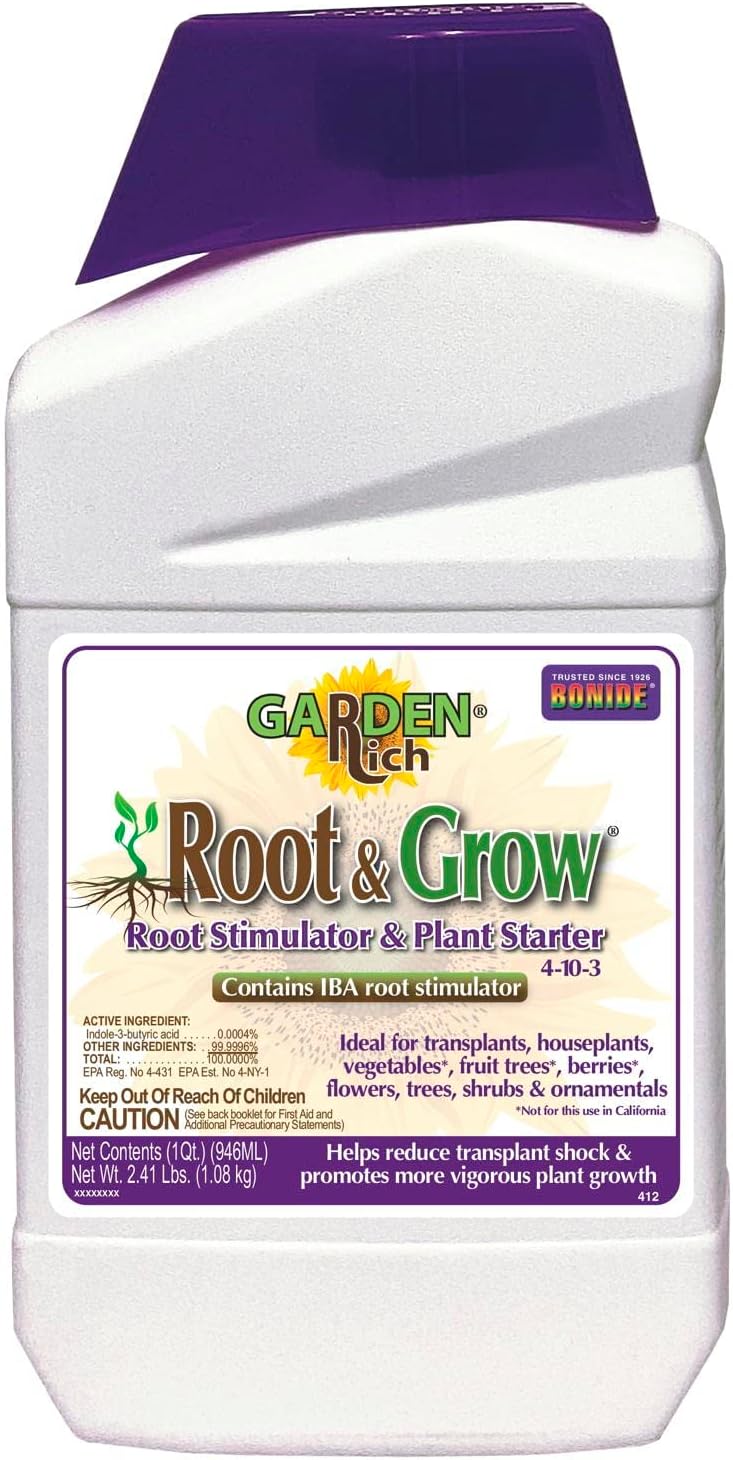
Bonide Root & Grow Concentrate 32 oz
| Item Form | Liquid |
|---|---|
| Specific Uses For Product | Root Development |
| Application Method | Pouring directly onto the soil and roots |
| Target Species | fruit, vegetables, flowers, trees, and bedding plants |
| Mixing Ratio | 4:10:3 |
Bonide Root & Grow is a liquid concentrate designed for use when seeding or transplanting to speed early root formation and help plants establish. You dilute the concentrate per label instructions and pour the solution onto soil and roots when potting seedlings, transplanting plugs, or setting out young vegetables and ornamentals. Notable features include an active IBA rooting hormone and a 4-10-3 nutrient ratio that supplies extra phosphorus to support root growth. In practice it can reduce transplant shock and promote quicker, stronger root systems, which is useful for both container-grown seedlings and recently set out bedding plants. Because it is a concentrate, a single 32 oz bottle yields multiple applications, which stretches a limited budget. Important limitations are that it is a specialized root stimulator rather than an all-purpose feed for ongoing growth and it requires careful dilution and label compliance to avoid overapplication.
Best for: Buyers wanting an affordable, concentrated product to give seedlings and recent transplants a stronger start and who prioritize preventing transplant shock over routine feeding.
Less Ideal for: Gardeners looking for a general weekly fertilizer or a balanced feed for mature plants should choose a different product.
- Contains IBA rooting hormone to stimulate root initiation
- 4-10-3 fertilizer ratio provides extra phosphorus for root development
- Concentrated 32 oz bottle yields many applications, good for tight budgets
- Easy to apply by diluting and pouring directly onto soil and roots
- Formulated mainly for root stimulation so not ideal as a regular all-purpose feed
- Requires careful mixing and label reading to use safely and effectively
Verdict: A budget-friendly concentrated root stimulator that helps seedlings and transplants establish faster by combining IBA with a phosphorus‑rich fertilizer.
Garden Safe TakeRoot Rooting Hormone Powder, 2 oz

| Item Form | Powder |
|---|---|
| Specific Uses For Product | Root Development |
| Coverage | Medium |
| Target Species | African violets, roses, poinsettias, philodendrons, geraniums, coleus, woody ornamentals |
Garden Safe TakeRoot is a simple powdered rooting hormone intended for gardeners who propagate cuttings of houseplants and ornamentals. You dip or dust freshly cut stems in the powder before inserting them into your chosen medium to improve the chance of root formation. The formulation targets root development and is marketed for a range of plants from African violets to woody ornamentals, so it is useful for both soft-stem and harder-to-root species. The small 2-ounce unit is easy to store and lasts for many propagation sessions when used sparingly. Practical benefits include clearer application than liquids and reduced waste because the powder clings to the cutting. Limitations are its small pack size if you propagate large numbers at once and the lack of a built-in applicator or measuring guidance, which means beginners should follow general propagation best practices to avoid overuse.
Best for: Gardeners who propagate occasionally and want a low-cost, easy-to-use rooting aid to improve success with cuttings of common ornamentals.
Less Ideal for: Commercial propagators or hobbyists who root large batches frequently should choose a larger supply or concentrated liquid system for faster dosing and scale.
- Powder form clings to cuttings for targeted application and minimal waste
- Suitable for a wide range of ornamentals including African violets and woody plants
- Small 2-ounce container stores easily and lasts for multiple uses when used sparingly
- Helps increase successful rooting compared with untreated cuttings
- Small pack may require frequent replacement for heavy propagators
- No applicator or dosing instructions included, which can confuse new users
Verdict: A budget-friendly powdered rooting hormone that reliably improves propagation success for occasional home gardeners.
Herrdemia 3-in-1 Rooting Powder (IBA + NAA + Mycorrhizae)

| Item Form | Powder |
|---|---|
| Application Method | dip or mix with water |
| Specific Uses For Product | Root Development, plant propagation |
| Target Species | Houseplants |
| Unit Count | 1.1 Ounce |
This rooting powder is designed to accelerate root initiation and improve survival of cuttings across soil and hydroponic systems. It is typically used as a dip for soil propagation or dissolved in water for water and LECA propagation; the package includes mixing ratios and step-by-step directions. The formula combines IBA for feeder roots, NAA for a strong central root, and R. irregularis mycorrhizae to extend nutrient uptake, plus adjuncts such as seaweed extract and chitosan to reduce stress and protect cut sites. Practical benefits include faster visible rooting in 1–2 weeks in many species, compatibility with popular houseplants and woody cuttings, and an estimated high coverage per bottle suited to repeated propagation projects. Important limitations are the need to follow the dosage carefully because overuse can inhibit rooting, and the product is a concentrated chemical powder that requires careful handling and must be kept away from children and pets. Overall it is a reliable option for gardeners who want consistent rooting performance when propagating a variety of plants.
Best for: Buyers who prioritize dependable, repeatable propagation results and want a single product that works across soil and water systems for houseplants and woody cuttings.
Less Ideal for: Gardeners who prefer purely organic, food-safe options or who will not follow precise dosing and safety precautions should consider alternative gentler methods.
- Broad-spectrum formula combining IBA, NAA, and mycorrhizae for stronger, more complete root systems
- Works in both soil and water propagation and is compatible with hydroponic media like LECA
- Includes practical directions and mixing ratios for dips and water solutions
- High estimated coverage per bottle suitable for many cuttings or repeated propagation sessions
- Concentrated formula requires precise dosing since overuse can suppress rooting
- Contains active ingredients that are hazardous if swallowed or inhaled and must be stored safely
Verdict: Choose this powder when you want a single, lab-tested rooting hormone that reliably speeds and strengthens root formation across soil and water propagation.
SUPERthrive Plant Vitamin Solution with Kelp, Liquid Concentrate, 4 fl oz

| Item Form | Liquid |
|---|---|
| Specific Uses For Product | Root Development |
| Application Method | Dilute in water |
| Target Species | All Variety of Greenery for Home Gardeners and Professionals Alike |
SUPERthrive is a small, concentrated liquid vitamin solution formulated to support root development and reduce transplant shock when added to water or fertilizer. You dilute it into irrigation or transplant mixes and apply it at the recommended low dosage; the product is marketed for use with both outdoor and indoor plants, trees, and seedlings. Notable features include its kelp-enriched formula and non-toxic, plant-focused ingredients that aim to restore vigor and encourage stronger roots. In practical use it is easy to mix and very economical because a little goes a long way, making it convenient for routine maintenance, transplanting, or seed starting. Important limitations are that it is a vitamin solution rather than a complete fertilizer so it should be used alongside regular fertilization when feeding established outdoor beds; also the small 4 fl oz bottle is concentrated but will require careful measuring and storage to keep potency. For risk-averse gardeners it offers a familiar, widely used option to support young or stressed plants without harsh chemicals.
Best for: Gardeners who prioritize safe, gentle support for transplants and young outdoor plants and want an easy-to-use additive that reduces shock and encourages root development.
Less Ideal for: Gardeners wanting an all-in-one granular or liquid fertilizer to meet macro nutrient needs for large established beds should look for a balanced fertilizer instead.
- Concentrated formula yields many treatments from a small bottle
- Kelp-enriched vitamin solution supports root vigor and reduces transplant shock
- Non-toxic ingredients suitable for use around ornamental beds and young plants
- Simple to apply by diluting into water or adding to fertilizer mixes
- Not a complete fertilizer so it must be paired with regular nutrient feeding for mature outdoor plants
- Small bottle size may require frequent replacement for large gardens
Verdict: Use SUPERthrive when transplanting or starting plants outdoors to reduce shock and strengthen roots with a safe, concentrated kelp vitamin solution.
Clonex Clone Solution Propagation Nutrient, 1 Quart

| Item Form | Liquid |
|---|---|
| Specific Uses For Product | Root Development, Cloning |
| Coverage | Medium |
| Unit Count | 32 Fluid Ounces |
| Mixing Ratio | 1:0.4 |
Clonex Clone Solution is a concentrated liquid nutrient designed for use during cloning and the seedling stage to encourage root initiation and early vegetative growth. It is typically mixed to the recommended ratio and applied as a medium soak or added to irrigation once roots begin to form, and it is compatible with Clonex rooting gel and mist as part of a propagation routine. Notable features include a formulation aimed at root development, inclusion of Vitamin B1 to reduce transplant shock, and a high concentration that lets you treat multiple batches from a single quart. In practice the solution makes it easy to give cuttings a dedicated feed that supports faster, more robust root systems, which can reduce losses during propagation. Important limitations are that it is a single-purpose propagation nutrient rather than an all-in-one grow fertilizer and users should follow safety guidance and dilution instructions carefully because it is concentrated and can harm skin or contaminate waterways if mishandled.
Best for: Growers who prioritize reliable, low-risk propagation results and want a purpose-built nutrient to improve rooting success in cuttings and young plants.
Less Ideal for: Gardeners looking for an all-purpose fertilizer for mature plants or those who prefer entirely organic or granular feeding programs.
- Formulated specifically to promote root development in cuttings and seedlings
- Concentrated liquid lets a single quart treat many propagation cycles
- Contains Vitamin B1 and root-enhancing agents to reduce transplant shock
- Compatible with Clonex rooting gel and mist for a complete propagation system
- Focused on early-stage propagation and not intended as a full-season feed
- Concentrated formula requires careful dilution and safe handling
Verdict: Choose this concentrated, propagation-focused nutrient when you want a dependable product to speed and strengthen root development in cuttings and seedlings.
Choosing the Right Fertilizer for Propagation: Key Factors to Consider
Nutrient Ratio and Concentration
Young plants need a nutrient profile that supports root initiation and steady vegetative growth rather than heavy flowering. A slightly higher middle number, phosphorus, can aid root development, but excessive phosphorus is rarely necessary in sterile seed starts. Too-high nitrogen levels can produce floppy, weak stems that collapse when transplanted.
Concentration matters because propagation usually relies on diluted feeds. Products labeled for use at high dilution give you control; concentrated formulas risk accidental overfeed that damages delicate roots. Look for clear dilution instructions and conservative recommended rates for seedlings and cuttings.
Salt Index and Root Safety
Fertilizer salts draw moisture; high salt fertilizers can desiccate very small roots or cause leaf-tip burn. In propagation, a low salt index or products marketed as seed-start or houseplant-safe are safer bets. Even slow-release granules can be too strong if placed close to a seed or cutting stem.
Consider the substrate moisture management too. If you use fine seed mixes that dry quickly, an overly salty feed will concentrate and harm roots. Choosing a fertilizer with a reputation for gentle action reduces the risk of losing a tray of seedlings to burn or delayed rooting.
Application Method and Precision
Propagation tasks demand precision. Liquid concentrates and water-soluble powders allow easy dial-back of strength, making them good for repeated light feedings. Foliar sprays can help with nutrient uptake for some species, but foliar feeding alone rarely supplies enough phosphorus for root development.
Granular slow-release products are convenient but harder to place safely in small cells and can release unevenly in a warm greenhouse. Consider how you water and whether you need a product that mixes cleanly into a watering can, a sprayer, or a propagation tray irrigation system.
Compatibility With Propagation Media
Seed-starting mixes, coir, and sphagnum-based media are low in nutrients and retain water differently. A fertilizer that dissolves and disperses evenly works best with these lightweight mixes. Some feeds interact poorly with alkaline or high-salt water, causing precipitation or uneven nutrient availability.
If you reuse media or add perlite and vermiculite, pick a fertilizer known to perform across these substrates. That helps maintain consistent nutrient delivery whether you are using peat-based trays or soilless mixes in individual pots.
Rate of Action and Timing
Propagation benefits from predictable timing: a gentle feed schedule that supports root formation and then builds foliage. Fast-acting liquid feeds can show results within days, useful for cuttings that need a quick stimulus. Slow-release options provide steady background nutrition but may be too slow for the critical first two weeks of rooting.
Think about your propagation rhythm. If you check trays daily and can feed frequently, a dilute liquid is flexible. If hands-off care or long intervals between feedings are required, a mild slow-release might reduce the risk of nutrient gaps without overloading roots.
Mixing, Storage, and Shelf Life
Propagators often buy smaller quantities and keep stock in a greenhouse or shed. Products that stay stable after opening, resist clumping, and mix without leaving residue in nozzles will save time and frustration. Powders that cake in humid environments or liquids that oxidize quickly force frequent repurchases.
Clear labeling for storage conditions and a straightforward mixing ratio help maintain consistent feed strength across batches. Also consider whether leftover solution can be stored safely or should be mixed fresh for each use.
When To Start Feeding Seedlings and Cuttings
Begin feeding after the first true leaves appear on seedlings or once a cutting shows root hairs and accepts a light tug. Too-early feeding risks burning very small roots or encouraging tender tissue that is prone to collapse.
For most seed-starts, a half-strength liquid feed every 7 to 10 days is a conservative approach. For actively rooting cuttings, slightly more frequent dilute feeds can encourage faster root development without overwhelming the plant.
- Wait for true leaves or visible root development before regular feeding
- Use diluted solutions to reduce burn risk
- Increase frequency gradually as plants mature
Mixing Best Practices for Clean, Consistent Feeds
Always follow the manufacturer dilution for seedlings when provided, and err lower if you are unsure. Dissolve powders fully in warm water and strain if particulates could clog fine irrigation lines.
Label mixed solution with concentration and date. Most dilute solutions are best used within a week; discard any that smell sour or show growth. Clean sprayer and watering can internals between uses to prevent buildup.
- Warm water dissolves powders faster
- Label and date mixed feed
- Rinse application equipment after each use
Adjusting Feed for Different Plant Types
Succulent cuttings and some woody shrubs need much lighter feeding than vegetable seedlings. Match the feed strength to species sensitivity: lower strength and frequency for succulents, slightly bolder but still diluted rates for vigorous annuals.
Hard-to-root species benefit from a focus on root-safe formulations and minimal disturbance. For delicate natives, prioritize low-salt, slow-release or extremely dilute liquid options to avoid shocking tender roots.
- Use gentler feeds for succulents and natives
- Vegetable and herb seedlings can tolerate slightly higher, but still dilute, feeds
- Research species-specific sensitivity when available
Troubleshooting Common Propagation Feeding Issues
Yellowing between veins or tip burn can indicate overfeeding or salt buildup. Flush the substrate with clean water and reduce feed strength. If growth is leggy with pale leaves, a modestly higher nitrogen in a diluted feed may help.
If roots fail to form despite feeding, reassess moisture, light, and temperature before altering fertilizer. Often cultural conditions, not nutrients, are the root cause of failed propagation attempts.
- Flush and reduce strength for salt-related damage
- Check cultural conditions if roots are not forming
- Keep records of feed strength and frequency to identify patterns
Safe Storage and Handling in the Greenhouse
Store concentrates in a cool, dry place away from direct sunlight and out of reach of pets and children. Avoid freezing temperatures and prolonged heat exposure, which can degrade some formulations.
Keep powders sealed to prevent caking. Dispose of any solution that develops an off-odor or visible microbial growth. Use personal protective equipment when handling concentrated products to avoid skin or eye contact.
- Store in a cool, dry, labeled container
- Seal powders after each use
- Wear gloves and eye protection with concentrates
How We Chose the Best Fertilizer for Propagation
We focused on fertilizers that support the earliest stages of plant life: seed starting, rooting cuttings, and initial potting-on. Selection prioritized formulas and formats that deliver usable levels of nitrogen, phosphorus, and potassium appropriate for seedlings and young roots, and that avoid excessive salts that can cause tip burn. We also considered application methods that are common in propagation setups such as diluted liquid feeds, water-soluble powders, and gentle slow-release options compatible with trays and small pots. Key evaluation criteria included nutrient ratio and concentration, ease and precision of application, safety for tender roots (low salt index, low burn risk), and compatibility with common propagation media and watering routines. Practical gardener concerns like scent, storage stability, and whether the product mixes cleanly were also weighed. We excluded high-strength turf or mature-tree fertilizers, formulations meant only for foliar bloom boosting, and products requiring complex equipment to apply. The remaining items reflect choices that suit frequent propagation tasks in a greenhouse, indoor seed tray, or shaded nursery bench.
FAQ
How often should I feed new seedlings?
Often a half-strength feed every 7 to 10 days is enough. Frequency depends on species and media-light, leached mixes may need slightly more frequent, dilute feeds.
Can I use regular houseplant fertilizer for propagation?
Sometimes, but only if it can be safely diluted to a low strength and has a low salt index. Avoid full-strength houseplant feeds on seedlings or fresh cuttings.
Should I fertilize cuttings before they form roots?
No. Apply fertilizer sparingly only after root hairs appear and the cutting shows signs of growth. Early feeding risks burning tender tissues and can inhibit root initiation.
What if my seedlings show tip burn or leaf curl?
Tip burn often signals overfeeding or salt accumulation. Flush the substrate with clean water, reduce feed concentration, and hold off on feeding until plants recover.
Is foliar feeding useful during propagation?
Foliar sprays can supplement nutrients, especially micronutrients, but they rarely replace a light root feed for root stimulation. Use foliar applications sparingly and avoid wetting leaves overnight.
How do I choose between liquid and slow-release fertilizers?
Choose liquids if you want precise, adjustable dosing and fast action. Slow-release options are handy for less frequent attention but can be harder to position safely in small cells.
Final Verdict
For propagation, prioritize fertilizers and application methods that protect tender roots while encouraging steady, balanced growth. Focus on low-salt formulas, clear dilution guidance, and delivery formats that match how often you can feed and inspect trays. Decide whether you need fast-acting liquids for quick root stimulation or gentler slow-release options for lower-maintenance workflows. Keep notes on strength and frequency so you can repeat successful outcomes or adjust when problems arise.
