

Note: This article contains affiliate links. If you click on these links and make a purchase, I may earn a small commission at no extra cost to you. This helps support my research and content. Read my full affiliate disclosure here.
Reseeding a patchy or thin lawn is one of the most cost-effective ways to restore turf, but success starts with the right fertilizer. The wrong blend can burn delicate seedlings or encourage weeds instead of grass. This guide focuses on fertilizers formulated specifically for reseeding lawn situations, where early root development, gentle nutrient ratios, and predictable release are critical. We shortlisted six top-performing options suited for different sowing conditions and maintenance approaches. Each pick was evaluated on factors gardeners care about, such as nutrient balance for seedlings, ease of application, and compatibility with seeding methods. Read on for practical guidance that helps you pick the right fertilizer for your reseeding project and get seedlings established quickly.
Top Picks at a Glance
| Best Overall The best all-around choice for most situations | Simple Lawn Solutions Growth Booster Liquid Fertilizer (32 oz) with Humic Acid, Hose-End Sprayer |  |
| Best Quality Built to a higher standard if you want something more solid | The Andersons Premium New Lawn Starter Fertilizer (20-27-5), 18 lb |  |
| Best Value The sweet spot between price and what you get | GreenView Solutions Starter Fertilizer, 16 lb bag |  |
| Best Budget The cheapest option that still gets the job done reliably | ferti-lome New Lawn Starter Fertilizer 9-13-7, 4 lb |  |
| Highest Rated A top-rated pick with lots of positive feedback | Scotts Turf Builder Starter Food for New Grass, 15 lb |  |
| Most Popular A crowd favorite that many people choose with confidence | Simple Lawn Solutions 3-18-18 Liquid Lawn Food (32 oz) with Hose-End Sprayer |  |
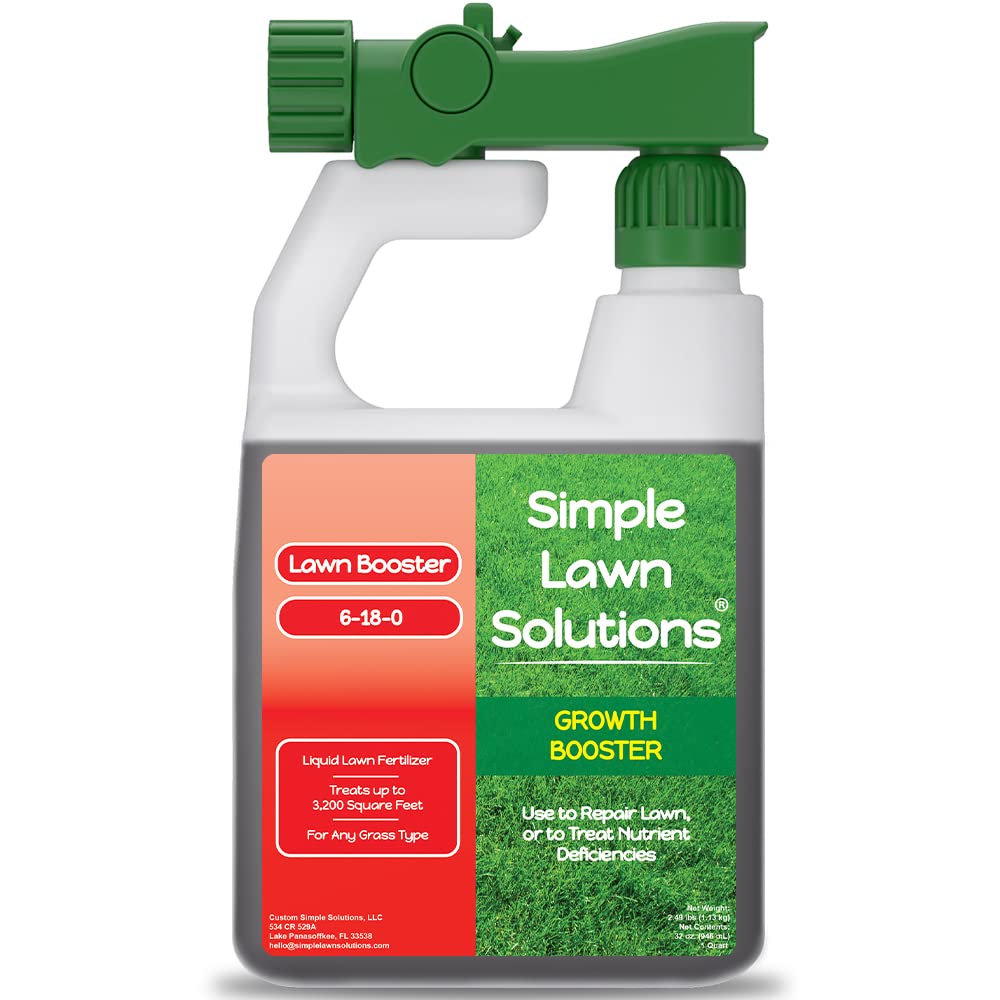
Simple Lawn Solutions Growth Booster Liquid Fertilizer (32 oz) with Humic Acid, Hose-End Sprayer
| Item Form | Liquid |
|---|---|
| Specific Uses For Product | Establishing lawn with sod or seed, Boosting vertical and lateral growth, Addressing phosphorus nutrient deficiencies |
| Application Method | Spray |
| Coverage | 3,200 square feet |
| Target Species | all grass types |
This ready-to-use growth booster is designed for establishing new lawns and encouraging faster vertical and lateral turf growth. It attaches to a hose-end sprayer and covers up to 3,200 square feet per bottle, so application is quick for medium-sized yards and for seeding or sodding jobs. The formula supplies nitrogen and a relatively high phosphorus percentage to promote seedling vigor and root development, while added humic acid helps improve nutrient availability in the soil. Practical benefits include easy hose connection, suitability for all common grass types, and a concentrate strength aimed at early-stage establishment. Limitations to note are that the product is focused on growth stimulation and phosphorus support rather than long-term balanced feeding, so it works best as a starter or boost rather than a standalone seasonal program. Users should follow the mixing directions carefully and pair this with a regular lawn food if longer-term fertility is needed.
Best for: Gardeners who want a simple, fast solution to establish new seed or sod and to accelerate early root and shoot growth without complex mixing or equipment.
Less Ideal for: Lawn owners seeking a full-season fertilizer program or those managing very large lawns where a concentrated bulk product and repeated coverage are needed.
- Ready-to-use hose-end sprayer for fast, even application over lawns
- High phosphorus content improves seedling vigor and root establishment
- Includes humic acid to enhance nutrient uptake and soil mineral availability
- Covers up to 3,200 square feet per bottle, suitable for medium yards
- Suitable for all common grass types and for both sod and seed
- Formulation is aimed at early growth and does not replace a complete seasonal fertilizer program
- Bottle volume may be small for larger properties requiring multiple applications
Verdict: A quick, hose-end starter booster that speeds root and seedling development for new lawns and repairs.
The Andersons Premium New Lawn Starter Fertilizer (20-27-5), 18 lb

| Item Form | Granules |
|---|---|
| Specific Uses For Product | Lawn |
| Coverage | 5000 |
| Mixing Ratio | 20:27:5 |
This starter fertilizer is made specifically for establishing new lawns and is formulated to encourage seedling vigor and root development. You apply it before seeding or laying sod, working it into the top few inches of soil and keeping the area moist until germination. The 20-27-5 analysis means it supplies extra phosphorus for strong root growth while the blend of quick- and slow-release nitrogen gives an initial boost and continued feeding. It also includes micronutrients and a small amount of iron for improved greening. The granular form and 5,000 sq ft coverage make it practical for mid-sized yards, and directions note it is best used in spring or fall when conditions favor establishment. Important limitations are that it must be incorporated into soil and kept moist for best results and that it is a starter product rather than a routine maintenance fertilizer, so additional feedings will be needed later in the season.
Best for: Homeowners installing new sod or seed who want a purpose-built starter fertilizer to encourage fast germination and strong root establishment.
Less Ideal for: Those looking for an all-season maintenance fertilizer or a liquid feed system should consider other products tailored to ongoing lawn care or different application methods.
- High phosphorus ratio to promote root development in new lawns
- Combination of quick- and slow-release nitrogen for both immediate and sustained feeding
- Granular form with coverage up to 5,000 sq ft simplifies application for mid-sized yards
- Includes micronutrients and 1% iron for healthier, deeper greening
- Designed as a starter product so it does not replace regular maintenance fertilization
Verdict: Choose this starter fertilizer when you need a phosphorus-rich, granular product to jump-start root development and establishment in new lawns.
GreenView Solutions Starter Fertilizer, 16 lb bag

| NPK | 10-18-10 |
|---|---|
| Form | Granules |
| Specific Uses | Root Development, Seed Development |
| Target Species | Lawn Grass |
| Unit Count | 256 Ounce |
GreenView Solutions Starter Fertilizer is a granular starter fertilizer designed for establishing new lawns and repairing bare spots. It delivers a 10-18-10 NPK blend with an emphasis on phosphorus to speed root development and improve seedling establishment. You typically apply it after seeding and then water it in; the product is slow-release and claims up to eight weeks of feeding so you do not need frequent reapplications during early establishment. Notable features include a high phosphorus content for root growth, slow-release nitrogen for steady top growth, and a formula without microplastic coatings. In practice this means stronger initial root systems and more consistent, manageable shoot growth while seedlings take hold. Limitations are that it is formulated specifically as a starter rather than a long-term maintenance fertilizer and coverage is oriented around the stated area per bag, so planning how much you need matters for larger areas. For builders of a new zoysia lawn or for repairing patches, it provides targeted early-season nutrition to help turf establish more reliably.
Best for: Homeowners planting or repairing zoysia who want a focused, low-maintenance starter feed to build strong roots and reduce the need for frequent early applications.
Less Ideal for: Gardeners looking for an all-season fertilizer program or those who need a product formulated for mature, established turf should consider a balanced maintenance fertilizer instead.
- High phosphorus (18%) formulation to encourage quick root establishment and stronger seedlings
- Slow-release nitrogen that feeds up to eight weeks, reducing the need for repeated early applications
- Granular form is easy to broadcast over seeded areas and bare spots
- No microplastic coatings, offering a more sustainable slow-release option
- Intended as a starter fertilizer not a season-long maintenance product
- Single bag size may require multiple bags for larger lawns
Verdict: If you are establishing zoysia or repairing bare spots, this high-phosphorus starter gives focused early nutrition to build strong roots and simplify early care.
ferti-lome New Lawn Starter Fertilizer 9-13-7, 4 lb

| Mixing Ratio | 9:13:7 |
|---|---|
| Item Form | Granules |
| Specific Uses For Product | Lawn |
| Application Method | Spread |
| Coverage | 1 |
ferti-lome New Lawn Starter is a simple granular starter fertilizer formulated with a 9-13-7 N-P-K ratio to support root development for newly seeded or sodded lawns. It is applied with a drop or broadcast spreader at 4 lbs per 1,000 sq ft and can be worked into the top 2–3 inches of soil or applied directly with seed or immediately after laying sod. The product covers small to medium areas from a single 4 lb bag and contains readily identifiable nutrients that encourage root establishment before vigorous top growth begins. Practical benefits include straightforward instructions, compatibility with common spreaders, and measurable coverage for targeted reseeding patches. Limitations are its small bag size which means multiple bags for larger lawns and that it is a single-purpose starter product rather than an all-season maintenance fertilizer, so you will need follow-up applications to sustain growth after establishment.
Best for: Buyers looking to reseed or sod small patches on a tight budget who want a straightforward starter fertilizer that is easy to apply and focused on establishment.
Less Ideal for: Homeowners with large lawns who prefer an all-in-one seasonal fertilizer or those who want slow-release, long‑term feeding in a single product.
- Starter-specific 9-13-7 N-P-K ratio to encourage root development and sod establishment.
- Granular form works with standard drop or broadcast spreaders for even application.
- Clear application rate and directions make it easy for DIY reseeding projects.
- 4 lb bag covers only small areas so larger lawns require multiple purchases.
- Not formulated as a long-term maintenance fertilizer so follow-up feeding is necessary.
Verdict: A simple, budget-friendly starter fertilizer that gives new seed and sod the nutrient boost needed for root establishment.
Scotts Turf Builder Starter Food for New Grass, 15 lb

| Item Form | Powder |
|---|---|
| Application Method | spreader |
| Specific Uses For Product | Starting |
| Coverage | 5000 square feet |
| Mixing Ratio | 24-25-4 |
Scotts Turf Builder Starter Food for New Grass is a powder starter fertilizer with a 24-25-4 NPK formulated specifically for new lawns. It is applied with a broadcast or drop spreader at planting and again 2 to 4 weeks later to encourage root development and faster, thicker turf. The high phosphate content is intended to fuel early root growth, which helps seedlings and newly laid sod establish more reliably than seed alone. Practical benefits include clear application guidance for Scotts spreaders, coverage of roughly 5,000 square feet per 15 lb bag, and compatibility with all grass types. Users should plan two timed applications and maintain consistent watering until seedlings are 2 inches tall, so it works best for owners willing to follow a short feeding schedule. Limitations are that it is a starter-only formula meant for initial establishment rather than ongoing maintenance and that proper spreader settings and watering are important for results, otherwise performance will be diminished.
Best for: Homeowners starting a lawn or reseeding patches who want a proven, easy-to-follow starter fertilizer to improve root establishment and germination success.
Less Ideal for: Gardeners looking for a year-round fertilizer or a combined weed-and-feed product should consider maintenance blends or targeted weed control options instead.
- High phosphate 24-25-4 formula designed to promote early root development
- Covers up to 5,000 sq. ft. per 15 lb bag, suitable for modest lawns
- Clear instructions for spreader settings and a recommended two-application schedule
- Safe for use on any grass type and applicable to seed, sod, plugs, or sprigs
- Starter-only formula so you must switch to a maintenance fertilizer after establishment
- Requires careful spreading and consistent watering to realize the claimed results
Verdict: Use this starter fertilizer if you want a straightforward, phosphate-rich feed to help new seed or sod establish stronger roots and fill in faster.
Simple Lawn Solutions 3-18-18 Liquid Lawn Food (32 oz) with Hose-End Sprayer

| Item Form | Liquid |
|---|---|
| Specific Uses For Product | Lawn |
| Application Method | Spray |
| Coverage | 3,200 square feet |
| Target Species | all grass types |
This 3-18-18 liquid lawn food is designed to boost root development and overall turf hardiness by delivering a high-phosphorus, high-potassium feed in a ready-to-apply hose-end format. You typically mix and spray it on actively growing lawns to help establish new turf, correct phosphorus or potassium deficiencies, or support lawns facing environmental stress. The included hose-end sprayer simplifies application and the stated coverage of 3,200 square feet per bottle makes it practical for medium-sized yards. Because the formula is low in nitrogen it will not drive excessive top growth, which is useful when you want roots and stress tolerance rather than rapid shoot development. Limitations to consider are that visible improvements from phosphorus and potassium can be subtle and slow to appear, and the product is intended for use only on actively growing grass so timing matters. For a long-term fertility program you will still want to use it alongside a regular lawn fertilizer schedule tailored to your soil test results.
Best for: Homeowners who prioritize strengthening roots and establishing new or stressed lawns and who want a simple, ready-to-use liquid treatment that fits into a practical lawn care routine.
Less Ideal for: Gardeners seeking a fast green-up or rapid top growth response or those who need an all-in-one high-nitrogen feeding for frequent mowing cycles.
- High phosphorus and potassium ratio supports root establishment and turf hardiness
- Comes with an attached hose-end sprayer for easy, even application
- Covers up to 3,200 square feet per bottle when applied with the included sprayer
- Low nitrogen formula reduces excessive top growth while focusing on root development
- Effects from phosphorus and potassium are often subtle and not immediately visible
- Intended for use only on actively growing turf so seasonal timing is important
Verdict: Choose this product if your main goal is to build stronger roots and improve turf establishment with a convenient hose-end liquid feed.
Choosing the Right Fertilizer for Reseeding Lawn: Key Factors to Consider
Nutrient Ratio and Starter Nitrogen
Seedlings need a milder nitrogen dose than established grass. A starter fertilizer typically has a balanced N-P-K that favors phosphorus and includes modest nitrogen to support leaf growth without forcing excessive top growth that weakens roots.
Choosing the right ratio matters because too much nitrogen can scorch young blades or drive fragile shoots to grow faster than their roots can support. Look for formulations that specify they are starter blends or list lower soluble nitrogen values when you plan to seed directly against fertilizer.
Phosphorus Content for Root Development
Phosphorus plays a key role in root initiation and early development. For reseeding, an available form of phosphorus at the correct rate can encourage robust root systems that anchor seedlings and improve drought tolerance later.
Be mindful of local regulations about phosphorus use. Where allowed, a starter that provides a modest, readily available phosphorus dose at seeding time can make a noticeable difference in establishment speed, but it is not a substitute for good seed-to-soil contact and consistent moisture management.
Release Type and Nutrient Availability
Whether a fertilizer is water-soluble or slow-release affects how quickly seedlings can access nutrients. Soluble starters deliver rapid nourishment, which is helpful during the first few weeks, while slow-release or controlled-release components provide a steadier supply and reduce the need for repeat applications.
Your choice should reflect your watering routine and how long you want a single application to last. Fast-acting products can be paired with a short follow-up schedule, while slow-release works well when regular refeeding is impractical.
Application Method and Ease
How you apply fertilizer influences seedling success. Granular products need even spreading to avoid hot spots, while soluble powders or liquids require accurate mixing and even irrigation to distribute nutrients. Ease of use affects both accuracy and the risk of over- or under-applying.
Consider what tools you already own. If you use a handheld spreader or broadcast spreader, choose a granule size and formulation compatible with that equipment. If you prefer drench applications, look for clear mix-rate instructions and predictable soluble behavior.
Salt Index and Seedling Safety
Young grass is sensitive to salt and high-solute fertilizers that draw moisture away from germinating seed. A low salt index formulation reduces burn risk and helps maintain consistent moisture around seeds and tiny roots.
Review product guidance for safe distances between seed and fertilizer and whether products are rated for topdressing over seed or require incorporation. Choosing seed-friendly options lowers the chances of setbacks from fertilizer injury.
Compatibility With Seeding Technique
Different seeding methods – broadcast, slit seeding, or overseeding – interact with fertilizer differently. A product safe for topdressing is useful for broadcast seeding, while formulations intended for contact with seed are better when mixing seed and fertilizer or using slit seeding.
Think about whether you will rake seed into the soil, use a slit seeder, or simply spread seed on the surface. Match the fertilizer's recommended application method to your seeding technique to ensure effective nutrient delivery without harming seed or seedlings.
Timing and Weather for Best Reseeding Results
Seed germination and fertilizer uptake both depend heavily on temperature and soil moisture. For cool-season grasses, aim to seed when soil temperatures consistently fall into the recommended range for that species so seedlings can grow before extreme heat or cold. Warm-season varieties have their own window when soil is warm enough for rapid germination.
Apply starter fertilizer at the time of seeding or immediately after ensuring good seed-to-soil contact. Avoid fertilizing if heavy rain is expected, which can wash soluble nutrients away, or during drought when seedlings cannot access moisture needed to take up fertilizer.
- Water lightly and frequently until seedlings establish, then reduce frequency and deepen watering.
- Avoid seeding and fertilizing before predicted heavy downpours to prevent nutrient loss.
- Match timing to grass type and local climate for most reliable germination.
Preparing the Seedbed
Successful reseeding begins with preparing a firm, fine seedbed that ensures seed contact with soil. Remove debris, thatch, and large clods so seed rests near the soil surface. Good contact improves water access and helps seedlings use starter nutrients effectively.
If you plan to incorporate fertilizer into the topsoil, mix it lightly into the top half-inch to an inch. For surface-applied starters, follow guidance about whether the product is safe to apply directly over seed or if a light raking is recommended.
- Rake or dethatch to expose mineral soil where possible.
- Roll or tamp lightly to create an even surface without compacting.
- Consider a thin layer of screened compost or topsoil to improve seed-to-soil contact and moisture retention.
Water Management During Establishment
Maintaining consistent moisture is usually the single most important cultural factor after fertilizer choice. Small seeds dry quickly and cannot access fertilizer if the seedbed is dry. Start with short, frequent waterings multiple times daily to keep the topsoil moist but not waterlogged.
As seedlings develop roots, gradually lengthen irrigation events and reduce frequency to encourage deeper root growth. Proper watering also reduces the risk of fertilizer burn by ensuring nutrients stay dissolved and available rather than concentrated in pockets.
- Avoid puddling; aim for even, gentle moisture.
- Monitor for crusting on the soil surface and break crusts gently if they form.
- Transition to deeper, less frequent watering once seedlings are several inches tall.
Starter Fertilizer Vs Ongoing Feedings
A starter fertilizer is formulated to help seedlings through the first few weeks, but it is not a complete long-term feeding plan. After initial establishment, young turf benefits from follow-up applications timed to promote root and shoot development without overfeeding.
Plan a phased approach: initial starter at seeding, then a balanced follow-up nutrient application several weeks later once seedlings are actively putting on growth. The exact timing depends on growth rate, weather, and the fertilizer's release profile.
- Use fast-acting starter feeds for immediate nutrient needs, then switch to slow-release products for maintenance.
- Avoid high-nitrogen boosts too early; they can favor blade growth over root strengthening.
- Observe turf color and growth to decide when to apply subsequent feedings.
Environmental and Regulatory Considerations
Many regions regulate phosphorus application to protect waterways. Check local rules before choosing a starter high in phosphorus. Where restrictions apply, focus on soil testing and cultural practices to improve rooting instead of relying on added phosphorus.
Also consider runoff risk and avoid applying fertilizer before heavy rains. Use recommended rates and avoid excess application to minimize environmental impact while still giving seedlings what they need.
- Perform a soil test when possible to tailor fertilizer needs.
- Follow local guidance on phosphorus use and buffer zones near water.
- Use conservative application rates and proper timing to reduce runoff.
How We Chose the Best Fertilizer for Reseeding Lawn
We prioritized fertilizers that support seed germination and young turf development rather than formulations meant only for established lawns. Key evaluation criteria included nutrient ratio and starter nitrogen geared to seedlings, the presence and proportion of phosphorus for root initiation, and whether the product provides a gentle, low-burn formulation suitable for direct seed contact. We also considered release type because soluble starters offer quick uptake while slow-release options reduce frequent reapplications and nutrient swings. Application practicality was another filter: we looked at how easy a product is to spread accurately with common spreaders or by hand, plus clear instructions for mixing and timing relative to seeding. Safety and turf health mattered too, including any guidance on salt index or burn risk and compatibility with overseeding or slit-seeding techniques. Products were excluded if their formulation was solely for mature turf recovery, contained high soluble salts unsuited for new seedlings, or lacked clear application guidance for reseeding scenarios. In short, we selected fertilizers that balance seedling-safe nutrient levels, clear application guidance, suitable release characteristics, and practical use in common home seeding methods.
FAQ
When should I apply fertilizer relative to seeding?
Usually apply starter fertilizer at the time of seeding or immediately after, following the product instructions. This ensures nutrients are available as soon as seedlings emerge, but avoid applying highly soluble fertilizers directly on seed unless the product specifically states it is seed-safe.
Can I use a regular lawn fertilizer when reseeding?
Regular lawn fertilizers designed for established turf often have higher nitrogen and salt content that can harm seeds. It is better to use a starter formulation or one labeled safe for reseeding to reduce burn risk and match seedling nutrient needs.
How much fertilizer do new seedlings actually need?
New seedlings need modest nutrient support focused on phosphorus for roots and lower soluble nitrogen. Exact amounts depend on the product and soil fertility. When in doubt, follow label seeding instructions or reduce the normal established-turf rate to avoid overapplying.
Is phosphorus necessary for all reseeding projects?
Phosphorus helps root development but local regulations and existing soil P levels affect whether you should add it. A soil test will tell you if phosphorus is deficient; otherwise choose a starter that provides a moderate, appropriate phosphorus dose rather than a heavy application.
How often should I water after applying starter fertilizer?
Water lightly and frequently to keep the seedbed consistently moist until seedlings germinate. Once grass has several true leaves, shift to less frequent, deeper waterings. Proper moisture ensures seedling uptake of applied nutrients and reduces localized fertilizer concentration that could cause burn.
Can I overseed an existing lawn and use starter fertilizer safely?
Yes, overseeding with starter fertilizer is common, but choose a formulation rated for topdressing or overseeding. Ensure even application and consider reducing the rate used on bare-ground reseeding to avoid creating concentrated nutrient pockets on established turf.
Final Verdict
Choosing the right fertilizer for reseeding lawn means prioritizing seedling-safe nutrient ratios, appropriate phosphorus for rooting when allowed, and a release profile that matches your watering and maintenance routine. Application method and timing are just as important as the formulation itself because even a well-balanced starter can hurt seedlings if applied incorrectly. Focus on formulations that minimize burn risk, offer clear seeding instructions, and fit your seeding technique. By aligning fertilizer choice with good seedbed preparation, consistent moisture, and sensible follow-up feedings, you give new grass the best chance to establish quickly and develop into a healthy, resilient lawn.
