

Note: This article contains affiliate links. If you click on these links and make a purchase, I may earn a small commission at no extra cost to you. This helps support my research and content. Read my full affiliate disclosure here.
Laying new sod in spring gives you a head start on a thick, healthy lawn, but the right fertilizer determines how quickly those plugs or rolls take hold. You want a product that encourages vigorous root development without burning young turf, supplies balanced nutrients, and matches the pace you want from the establishment period. This guide covers seven shortlisted fertilizers chosen for new sod in spring, explaining how each supports rooting, shoot growth, and soil microbial activity. We evaluated nutrient composition and release behavior alongside application ease and safety for tender grass so you can pick the best fit for your site.
Top Picks at a Glance
| Best Overall The best all-around choice for most situations | Scotts Turf Builder Liquid Starter Lawn Food, 32 fl. oz. |  |
| Best Quality Built to a higher standard if you want something more solid | The Andersons EcoFusion Starter 16-21-4 Biosolid Fertilizer (18 lb) |  |
| Best Value The sweet spot between price and what you get | Jonathan Green Veri-Green Starter Fertilizer for Seeding & Sodding (12-18-8) — 5,000 sq ft |  |
| Best Budget The cheapest option that still gets the job done reliably | Greenview Starter Fertilizer 10-18-10, 8 lb (covers 2,500 sq. ft.) |  |
| Highest Rated A top-rated pick with lots of positive feedback | Espoma Turf-Tone Lawn Starter Organic 4-6-3 Fertilizer, 30 lb |  |
| Most Popular A crowd favorite that many people choose with confidence | Scotts Turf Builder Starter Food for New Grass, 15 lb |  |
| Best Seller A high-volume bestseller chosen again and again | Simple Lawn Solutions Growth Booster Liquid Fertilizer (32 oz) with Humic Acid, Hose-End Sprayer |  |
Scotts Turf Builder Liquid Starter Lawn Food, 32 fl. oz.

| Item Form | Liquid |
|---|---|
| Specific Uses For Product | Lawn Grass Seedling Establishment |
| Target Species | Lawn Grass |
| Unit Count | 32 Fluid Ounces |
This Scotts Turf Builder Liquid Starter Lawn Food is a hose-end liquid fertilizer designed for new lawns and sod establishment. With a 7-12-15 NPK formulation it emphasizes phosphorus to promote early root development while nitrogen greens and potassium boosts turf resilience. Typical use is simple: connect the reusable applicator to a garden hose, spray after seedlings or newly laid sod show initial growth, and repeat weekly for three feedings over three weeks; one 32 fl. oz. bottle treats about 600 sq. ft. for the recommended schedule. Notable features include a translucent bottle so you can see application progress and a reusable sprayer that works with refill bottles to reduce waste. The practical benefit is fast, low-effort feeding that combines watering and nutrient delivery in under 10 minutes. Limitations are the small coverage per bottle relative to large yards and that the product is formulated specifically as a starter feed, so you will need a different maintenance fertilizer once the sod is established.
Best for: Homeowners installing new sod or seed this spring who want a quick, low-effort starter feed to encourage root establishment and early green-up.
Less Ideal for: People managing large properties who need wide coverage per application or gardeners seeking an all-season lawn fertilizer who do not want to change products after establishment.
- Starter-focused 7-12-15 NPK promotes root development for new grass
- Hose-end applicator combines watering and feeding for quick 10-minute application
- Translucent bottle lets you monitor remaining product and application
- Reusable sprayer reduces single-use plastic by working with refills
- Covers only about 600 sq. ft. per bottle on the three-feed schedule, so not cost-effective for large lawns
- Meant only for establishment phase so you must switch products for ongoing lawn care
Verdict: Use this bottle-and-hose starter feed when you want a fast, easy way to get new sod or seedlings rooted and greening in early spring.
The Andersons EcoFusion Starter 16-21-4 Biosolid Fertilizer (18 lb)

| Item Form | Granules |
|---|---|
| Specific Uses For Product | Plant Growth, Soil Conditioning |
| Coverage | 5000 sqft. |
| Target Species | Lawns |
The Andersons EcoFusion Starter 16-21-4 is designed as a performance-focused starter fertilizer to help new sod establish quickly while promoting deep greening. It delivers a blend of quick- and slow-release nitrogen for immediate green-up plus sustained feeding, with phosphorus to support root development and 5% iron for darker color. The granulated formula includes micronutrients copper, manganese, and zinc to address common turf nutrient gaps. Typical use is during sod installation or renovation; follow spreader settings on the label, apply to dry foliage, water lightly to move particles into the soil, and reapply every 4 to 6 weeks if needed based on tissue or soil tests. Practical benefits are stronger root establishment, faster visual recovery, and reduced need for separate iron applications. Limitations are that it is a concentrated starter product intended for turf—it is not a complete seasonal program by itself and should be used in accordance with soil test recommendations and application timing to avoid runoff or overapplication.
Best for: Gardeners and contractors installing sod or renovating lawns who prioritize fast establishment and strong early root growth and want a single starter product that also improves turf color.
Less Ideal for: Homeowners seeking an all-season fertilizer plan or products for ornamentals and broad garden use should consider a different, more general-purpose fertilizer.
- Combines quick- and slow-release nitrogen for immediate green-up and sustained feeding
- Contains phosphorus to support root development during sod establishment
- Includes 5% iron for deeper greening without a separate iron product
- Contains additional micronutrients (copper, manganese, zinc) to correct common turf deficiencies
- Formulated specifically for turf starter use so it is not a full-season maintenance program
Verdict: Choose this product when you need a professional-grade starter fertilizer that speeds sod establishment and delivers immediate plus sustained feeding.
Jonathan Green Veri-Green Starter Fertilizer for Seeding & Sodding (12-18-8) — 5,000 sq ft

| Item Form | Granules |
|---|---|
| Application Method | Spreader |
| Mixing Ratio | 12:18:8 |
| Specific Uses For Product | Lawn |
| Coverage | Full |
Jonathan Green Veri-Green is a starter lawn fertilizer formulated specifically for seeding, overseeding, and sodding. With an N-P-K of 12-18-8 and granule form, it is applied the same day as seed or sod using a rotary, drop, or hand-held spreader. The high phosphorus content promotes quicker germination and stronger root development, and added humates help nutrient availability in the soil. It feeds new seedlings for up to about two months, which reduces the need for immediate follow-up feeds while young grass establishes. Practical benefits for overseeding include faster green-up and improved early vigor that helps seedlings better withstand variable spring or fall conditions. Limitations to note are that it is a starter formula, not a long-season lawn feed or weed control product, so you will still need a regular maintenance program after the establishment period. Also it must be applied when seeding in spring or fall and does not replace specific post-emergent treatments or soil amendments if your soil is deficient in other nutrients or pH balance.
Best for: Buyers who prioritize efficient overseeding results and want a targeted starter fertilizer that speeds germination and root establishment for new or thinned lawns.
Less Ideal for: Gardeners looking for an all-season lawn fertilizer, combined weed-and-feed solution, or a product to correct long-term soil pH or macronutrient deficiencies should consider alternative or complementary products.
- High phosphorus 12-18-8 formula to encourage germination and root development
- Contains humates to improve nutrient availability and efficiency in the soil
- Granular form works with rotary, drop, or hand-held spreaders for even application
- Feeds new seedlings for up to two months, reducing need for immediate repeat applications
- Starter-specific formula that is not intended as a season-long fertilizer or weed control
- Recommended use limited to spring or fall seeding and same-day application
Verdict: Choose this high-phosphorus starter fertilizer when overseeding to speed germination and build stronger roots so new grass establishes faster.
Greenview Starter Fertilizer 10-18-10, 8 lb (covers 2,500 sq. ft.)

| Item Form | Granules |
|---|---|
| Application Method | broadcast or drop spreader |
| Coverage | 2,500 sq. ft. |
| Specific Uses For Product | Plant Growth, Root Development, Seed Development, Soil Conditioning |
| Mixing Ratio | 10-18-10 |
Greenview Starter Fertilizer is formulated for establishing new lawns and repairing bare spots by supplying a high-phosphorus blend that encourages root development and seed germination. It is broadcast or drop-spreader friendly and intended to be applied just before or after seeding, then lightly raked into the topsoil so seed can make contact with nutrients. The mix delivers both immediate and time-released nitrogen for up to eight weeks of feeding, which helps young grass get through the critical first mows. Practical benefits include clear application guidance and coverage sized to treat roughly 2,500 square feet from an 8 pound bag, making it convenient for small yards and patch jobs. Limitations are that it is designed as a one-time starter application rather than an ongoing lawn program, and users must avoid hand spreading and follow safety storage recommendations. Also it does not replace post-establishment fertilization or weed control once the lawn is mature.
Best for: Budget-minded gardeners establishing a new lawn or repairing small bare spots who want a straightforward, single-application starter fertilizer that covers a modest area.
Less Ideal for: Homeowners managing large lawns who need multi-application programs or combined weed-and-feed products should consider larger-capacity or more comprehensive lawn fertilizers.
- High phosphorus ratio (10-18-10) to support seed germination and root development
- Includes both quick-release and time-release nitrogen for continuous feeding up to eight weeks
- Formulated for use with broadcast or drop spreaders for even application
- Covers about 2,500 sq. ft. from a single 8 lb bag, useful for small lawns and spot repairs
- Intended as a single starter application and not a complete ongoing fertilization program
- Not suitable for hand spreading and requires care in storage and handling
Verdict: A simple, budget-friendly starter fertilizer that delivers a high-phosphorus 10-18-10 formula and short-term feeding to help new grass seedlings establish quickly.
Espoma Turf-Tone Lawn Starter Organic 4-6-3 Fertilizer, 30 lb

| Item Form | Granules |
|---|---|
| Application Method | Apply with a drop or broadcast spreader. |
| Target Species | Lawn Grass |
| Mixing Ratio | 4:6:3 |
Espoma Turf-Tone Lawn Starter is an organic granular starter fertilizer designed for establishing new turf, overseeding, or laying sod. It is applied with a drop or broadcast spreader and supplies a 4-6-3 ratio that emphasizes phosphorus for root development while providing long-lasting nitrogen and Espoma's Bio-tone formula to support early growth. Practical benefits include organic nutrient sources such as feather meal and poultry manure, predictable coverage for moderate-sized yards, and simple application instructions tailored to new turf situations. For reliability-minded buyers this product reduces the risk of starter burn that can come from high-soluble synthetic starters and supports steady root establishment. Limitations are that it is a starter formula intended for new or recently seeded turf rather than routine maintenance feeding, and application timing and rates matter to avoid wasting product. Expect good early root development on warm-season grasses when used as directed, but plan a separate maintenance program for long-term fertility needs.
Best for: Homeowners installing new turf, overseeding thin areas, or laying sod who prioritize dependable, gentler organic nutrition that supports early root development.
Less Ideal for: People looking for an all-season maintenance fertilizer or quick greening treatments for established lawns should choose a regular maintenance formula instead.
- Organic ingredients (feather meal and poultry manure) that feed soil biology
- Starter-specific 4-6-3 analysis to promote root establishment and early growth
- Applied with standard drop or broadcast spreaders for even coverage
- Formulated to reduce risk of seedling burn compared with high-salt synthetic starters
- Designed for new lawns and overseeding rather than ongoing maintenance feeding
Verdict: A reliable organic starter fertilizer that helps new or overseeded lawns establish strong roots without the harshness of high-salt synthetic starters.
Scotts Turf Builder Starter Food for New Grass, 15 lb

| Item Form | Powder |
|---|---|
| Application Method | spreader |
| Specific Uses For Product | Starting |
| Coverage | 5000 square feet |
| Mixing Ratio | 24-25-4 |
Scotts Turf Builder Starter Food for New Grass is a powder starter fertilizer with a 24-25-4 NPK formulated specifically for new lawns. It is applied with a broadcast or drop spreader at planting and again 2 to 4 weeks later to encourage root development and faster, thicker turf. The high phosphate content is intended to fuel early root growth, which helps seedlings and newly laid sod establish more reliably than seed alone. Practical benefits include clear application guidance for Scotts spreaders, coverage of roughly 5,000 square feet per 15 lb bag, and compatibility with all grass types. Users should plan two timed applications and maintain consistent watering until seedlings are 2 inches tall, so it works best for owners willing to follow a short feeding schedule. Limitations are that it is a starter-only formula meant for initial establishment rather than ongoing maintenance and that proper spreader settings and watering are important for results, otherwise performance will be diminished.
Best for: Homeowners starting a lawn or reseeding patches who want a proven, easy-to-follow starter fertilizer to improve root establishment and germination success.
Less Ideal for: Gardeners looking for a year-round fertilizer or a combined weed-and-feed product should consider maintenance blends or targeted weed control options instead.
- High phosphate 24-25-4 formula designed to promote early root development
- Covers up to 5,000 sq. ft. per 15 lb bag, suitable for modest lawns
- Clear instructions for spreader settings and a recommended two-application schedule
- Safe for use on any grass type and applicable to seed, sod, plugs, or sprigs
- Starter-only formula so you must switch to a maintenance fertilizer after establishment
- Requires careful spreading and consistent watering to realize the claimed results
Verdict: Use this starter fertilizer if you want a straightforward, phosphate-rich feed to help new seed or sod establish stronger roots and fill in faster.
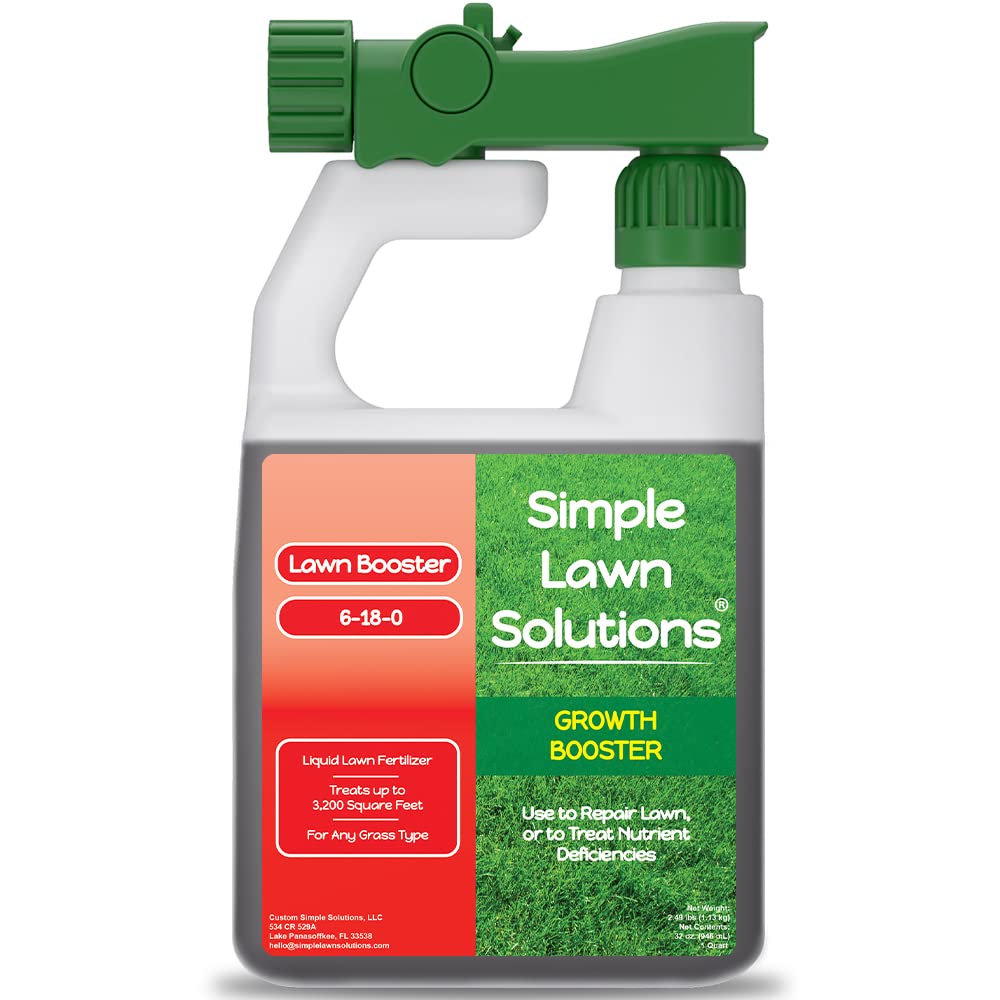
Simple Lawn Solutions Growth Booster Liquid Fertilizer (32 oz) with Humic Acid, Hose-End Sprayer
| Item Form | Liquid |
|---|---|
| Specific Uses For Product | Establishing lawn with sod or seed, Boosting vertical and lateral growth, Addressing phosphorus nutrient deficiencies |
| Application Method | Spray |
| Coverage | 3,200 square feet |
| Target Species | all grass types |
This ready-to-use growth booster is designed for establishing new lawns and encouraging faster vertical and lateral turf growth. It attaches to a hose-end sprayer and covers up to 3,200 square feet per bottle, so application is quick for medium-sized yards and for seeding or sodding jobs. The formula supplies nitrogen and a relatively high phosphorus percentage to promote seedling vigor and root development, while added humic acid helps improve nutrient availability in the soil. Practical benefits include easy hose connection, suitability for all common grass types, and a concentrate strength aimed at early-stage establishment. Limitations to note are that the product is focused on growth stimulation and phosphorus support rather than long-term balanced feeding, so it works best as a starter or boost rather than a standalone seasonal program. Users should follow the mixing directions carefully and pair this with a regular lawn food if longer-term fertility is needed.
Best for: Gardeners who want a simple, fast solution to establish new seed or sod and to accelerate early root and shoot growth without complex mixing or equipment.
Less Ideal for: Lawn owners seeking a full-season fertilizer program or those managing very large lawns where a concentrated bulk product and repeated coverage are needed.
- Ready-to-use hose-end sprayer for fast, even application over lawns
- High phosphorus content improves seedling vigor and root establishment
- Includes humic acid to enhance nutrient uptake and soil mineral availability
- Covers up to 3,200 square feet per bottle, suitable for medium yards
- Suitable for all common grass types and for both sod and seed
- Formulation is aimed at early growth and does not replace a complete seasonal fertilizer program
- Bottle volume may be small for larger properties requiring multiple applications
Verdict: A quick, hose-end starter booster that speeds root and seedling development for new lawns and repairs.
Choosing the Right Fertilizer for New Sod in Spring: Key Factors to Consider
Nutrient Ratio for Establishment
New sod needs a nutrient balance that encourages roots first, then steady shoot growth. A starter fertilizer typically has elevated phosphorus relative to maintenance products because phosphorus supports root cell division and development. Too much nitrogen early can force leaf growth at the expense of roots and increase the risk of transplant shock.
When evaluating labels, look for a formulation that provides a clear establishment profile rather than a high overall nitrogen number. That balance matters because established sod with good rooting will require different maintenance feeding later in the season.
Release Type and Feeding Schedule
How a fertilizer releases nutrients-quickly, slowly, or a mix-affects root development and the number of pass-throughs you need. A soluble or water-soluble portion gives an initial nutrient surge to support early rooting, while controlled-release components maintain steady availability so young turf does not get a single flush of growth and then starve.
Consider products that combine immediate and slow-release carriers so you can plan a predictable feeding schedule during the first 6 to 10 weeks after installation, reducing the chance of burn or uneven growth.
Application Method and Spreadability
Uniform coverage is essential for even establishment. Granular fertilizers meant for drop or broadcast spreaders must flow predictably and match common spreader settings. Liquid or water-soluble fertilizers allow more even distribution for small or irregular areas but require mixing and careful calibration.
For large lawns, compatibility with standard broadcast spreaders saves time. For seedier or patch installations, liquid applications or soluble concentrates let you target edges, seams, and tricky shapes without overapplying.
Salt Index and Turf Safety
Young sod is sensitive to soluble salts, which can draw moisture away from roots and cause burn. A low salt index and clear label guidance reduce the risk of damaging tender turf. Products with high soluble salt content may need dilution, split applications, or avoidance on sandy, drought-prone soils.
Check product directions for specific caution notes about new installations and follow recommended watering after application to help dissolve and move nutrients into the root zone safely.
Micronutrients and Soil Biology
Micronutrients like iron, manganese, and zinc support chlorophyll production and stress tolerance during establishment. Some fertilizers also include or promote beneficial soil microbes, which can speed organic matter breakdown and nutrient cycling around new roots.
If your soil test shows micronutrient deficiencies, choose a product that supplies what is lacking. In healthy soils, formulations that support microbial life will help young sod access native nutrients more effectively.
Timing Relative to Weather and Watering
Spring conditions vary: cool, wet springs slow nutrient uptake, while warm, dry spells increase burn risk. Timing applications to coincide with active root growth and reliable moisture helps maximize uptake and minimizes stress. Applying fertilizer right before a forecasted rain can aid incorporation, but heavy downpours can wash soluble nutrients away.
Plan initial feeding for a period of moderate soil temperature and ensure you can water consistently after application to move nutrients into the root zone. Adjust timing if unusual weather patterns appear during the establishment window.
When to Apply Fertilizer During Spring Installation
Apply a starter-strength feeding at the time of installation or within the first week to give roots immediate access to phosphorus and accessible nitrogen. If sod was installed onto cool or wet soil, delay the largest portion of nitrogen until soil temperatures rise and roots are actively growing to avoid pushing too much top growth before roots anchor.
Follow-up applications depend on the fertilizer release profile. With mixed-release products, a single follow-up feeding at 6 to 8 weeks is often sufficient. With fast-release-only formulations, plan for more frequent light applications to maintain steady availability while avoiding concentration spikes.
- Initial application: at installation or within 7 days
- Follow-up: timed to release type, typically 4-8 weeks
- Water-in after application to move nutrients into the root zone
Preparing Soil and Testing Before Fertilizing
A basic soil test helps identify pH and any nutrient deficiencies so you can choose the correct fertilizer profile and avoid unnecessary applications. Soil pH influences nutrient availability and the effectiveness of starter blends. Adjust pH before installation if significant liming or sulfur additions are needed, because dramatic pH changes after sod is laid can stress new turf.
Amending soil with organic matter before sod improves moisture retention and biological activity, reducing the need for high fertilizer rates. If you cannot test, choose a balanced starter and plan a soil test after the first growing season to refine ongoing maintenance.
- Test pH and phosphorus levels before installation when possible
- Work in organic matter during site prep for better moisture and biology
- Avoid heavy soil amendments immediately after laying sod
Watering Strategy to Support Fertilized New Sod
Watering and fertilizing go hand in hand. After applying fertilizer, water lightly to move soluble nutrients into the root zone without creating runoff. For the first two weeks, frequent shallow watering helps sod establish contact with the soil. As roots penetrate deeper, shift to deeper, less frequent irrigation to encourage root growth.
If a product recommends immediate irrigation to reduce burn risk, follow that guideline. In dry spring conditions, plan irrigation so the new turf never dries out completely, which reduces nutrient uptake and increases stress.
- Light water-in immediately after application
- Maintain consistent soil moisture during first 2 weeks
- Gradually transition to deeper watering as roots establish
Organic Vs Synthetic Options for New Sod
Organic fertilizers release nutrients more slowly and build soil structure and biology over time. They are gentler on new sod but may not provide the quick phosphorus pulse some installers prefer. Synthetic starters often deliver a predictable nutrient package and can include controlled-release nitrogen to balance early and ongoing needs.
Consider site goals when choosing. If you want faster visible green-up and are confident in irrigation and application control, a synthetic starter or mixed-release product can be effective. If soil health and long-term biology are priorities, an organic or organo-mineral blend can support both roots and soil life, though you may need to manage expectations about immediate green-up.
- Organics: gentler, support soil biology, slower nutrient delivery
- Synthetics: predictable results, can include quick phosphorus and controlled nitrogen
- Blends: aim to combine immediate and longer-term benefits
Common Application Mistakes to Avoid
Overapplying fertilizer is a frequent cause of burn and uneven establishment. Follow label rates scaled to the area and turf type. Uneven spreading leads to patchy growth; calibrate your spreader or use liquid methods for tricky shapes. Applying high-nitrogen maintenance fertilizers intended for established lawns can force top growth before roots are ready.
Skipping water-in steps or applying right before extreme heat can also stress sod. Finally, treating new sod the same as established turf ignores its unique needs; reduce rates and choose starter-appropriate products to protect the young grass.
- Do not use high-rate maintenance feeds at installation
- Calibrate spreaders and check coverage patterns
- Always water in soluble applications as directed
How We Chose the Best Fertilizer for New Sod in Spring
We focused on fertilizers that support rapid root establishment and safe shoot growth specific to newly installed sod in spring. Key evaluation criteria included nutrient ratio and starter macronutrients to ensure appropriate nitrogen, phosphorus, and potassium levels for establishment; release type to judge whether nutrients are delivered quickly, steadily, or both; application method and spreader compatibility because even coverage is critical for young turf; and formulation safety for tender sod, including salt index and burn risk. We also considered soil biology support and any included micronutrients that aid root development. Products that required specialized equipment or posed elevated burn risk were excluded. Our shortlist favors formulations that balance an early pulse of phosphorus for roots with controlled nitrogen delivery to avoid excessive top growth before roots anchor. Labels, typical application guidance, and gardener experience informed our choices rather than single-source claims or transient availability.
FAQ
How soon after laying sod should I apply fertilizer?
Apply a starter or establishment feeding at installation or within the first week. If soil is very cool or wet, delay heavy nitrogen until roots show active growth to avoid excessive top growth.
Can I use the same fertilizer I use on established lawns?
Usually not. Maintenance fertilizers often have higher nitrogen and lower phosphorus than starter blends, which can encourage leaf growth over roots. Use a product formulated for establishment during the first several weeks.
Is it better to use liquid or granular fertilizer on new sod?
Both work. Liquids give even coverage and are useful for small or irregular areas. Granular products are convenient for larger lawns and work well if spreader settings are calibrated. Choose based on area size and how evenly you can apply the product.
How does weather affect fertilizer timing for new sod?
Cool, wet springs slow uptake so hold off on large nitrogen doses until soils warm. Applying before light rain can aid incorporation, but heavy downpours risk runoff. Ensure you can water after application when conditions are dry.
Should I worry about fertilizer burn on new sod?
Yes. New sod is sensitive to soluble salts. Use low-salt starters or controlled-release formulations and water in after application to reduce burn risk. Avoid high-rate, high-nitrogen products on newly installed turf.
Do organic starters provide enough phosphorus for root development?
Organic starters tend to release phosphorus more slowly and may not produce the same immediate root stimulus as soluble starters. They do support soil biology and long-term health, so choose based on whether quick rooting or soil-building is your priority.
Final Verdict
For new sod in spring, prioritize root-supportive nutrient balance, an appropriate release profile, and safe application practices. Opt for a starter that supplies accessible phosphorus and a measured supply of nitrogen, or a mixed-release product that gives an initial boost followed by steady feeding. Match the product to your watering ability, soil conditions, and establishment timeline. Ultimately, choosing the right fertilizer means balancing faster green-up with protecting tender roots. If you want quicker rooting, favor a starter profile with low burn risk and plan follow-up feeds based on release type and observed root development.
