

Note: This article contains affiliate links. If you click on these links and make a purchase, I may earn a small commission at no extra cost to you. This helps support my research and content. Read my full affiliate disclosure here.
If you care for a compact lawn or a handful of garden beds, the right fertilizer spreader saves time and keeps applications even. Small yards benefit from tools sized to the space: lighter weight for easier pushing, smaller hoppers to avoid waste, and finer spread control so you do not over-apply near borders or plants. This guide covers six shortlisted fertilizer spreaders selected for small-yard use and explains the features that matter for tidy, efficient feeding. Below you will find the criteria we used to evaluate each option and practical notes to help you match a spreader to your yard layout and maintenance routine.
Top Picks at a Glance
| Best Overall The best all-around choice for most situations | Brinly 5 lb. Handheld Broadcast Spreader |  |
| Best Value The sweet spot between price and what you get | PERSZEN Handheld 3-in-1 Spreader for Seed, Fertilizer and Ice Melt (84 oz) |  |
| Best Budget The cheapest option that still gets the job done reliably | CHAPIN 8740A 64 oz Hand Shaker Spreader |  |
| Highest Rated A top-rated pick with lots of positive feedback | Scotts Whirl Hand-Powered Spreader |  |
| Most Popular A crowd favorite that many people choose with confidence | Scotts Turf Builder EdgeGuard Mini Broadcast Spreader |  |
| Best Seller A high-volume bestseller chosen again and again | Spot Spreader Hand Spreader Shaker (up to 80 oz) |  |
Brinly 5 lb. Handheld Broadcast Spreader

| Capacity | 5 lb / 0.5 gal / 2 L |
|---|---|
| Use cases | Seed, fertilizer, ice melt, salt |
| Spread distance | Up to 5 ft (variable) |
| Construction | Poly hopper with enclosed gears and steel-plated hardware |
The Brinly 5 lb. handheld spreader is built for quick, accurate spot work around walkways, flower beds, and small lawns. You fill the funnel-shaped hopper by scooping, use the ergonomic trigger and extra-long crank to broadcast material, and adjust the flow gate knob to control spread rate and distance (manufacturer claims up to about 5 feet). The reinforced contoured lip makes loading easier than a flat-top shaker, and the rotary broadcast design gives a more even distribution than hand-scattering. Tough poly construction, enclosed gears, and steel-plated hardware make it feel durable for repeated seasonal use, and the 5 lb capacity keeps the tool light while covering small plots. It is not intended for large lawns where a wheeled spreader is faster, and very fine powders may need careful flow adjustment to avoid clumping. For targeted de-icing, spot-seeding, and small-scale fertilizing this spreader balances control and durability in a compact package.
Best for: Buyers who prioritize precise, reliable performance for spot-seeding, small-plot fertilizing, or targeted de-icing and who want a durable handheld tool rather than a larger wheeled spreader.
Less Ideal for: Not a good fit for users needing to cover large lawns quickly or landscapers who prefer high-capacity wheeled spreaders for commercial work.
- Compact 5 lb capacity is easy to carry and ideal for spot work
- Funnel-shaped hopper and contoured lip speed filling and reduce spills
- Adjustable flow gate and ergonomic trigger provide good control over spread rate
- Rotary broadcast design yields more even distribution than hand-shaking
- Durable poly hopper with enclosed gears and steel-plated hardware for season-to-season use
- Small capacity makes it inefficient for large lawns or full-property coverage
- May require careful adjustment for very fine or damp materials to prevent clogging
Verdict: If you need a compact, durable handheld spreader that delivers controlled, even broadcasts for spot-seeding and small-area fertilizing, this Brinly 5 lb model is a practical choice.
PERSZEN Handheld 3-in-1 Spreader for Seed, Fertilizer and Ice Melt (84 oz)

| Capacity | 84 oz (2.5 L) |
|---|---|
| Flow settings | 3 (small, medium, large) |
| Material | Plastic |
The PERSZEN handheld spreader is a simple, multi-use tool for small to medium lawns and driveways. It holds about 84 ounces of material and offers three flow settings so you can switch between fine seed, granular fertilizer, and ice-melt salt without swapping tools. The plastic construction keeps it light and corrosion-resistant against fertilizers and salt, and the ergonomic non-slip handle plus included scoop make filling and carrying straightforward. In practice it delivers even coverage when set correctly, and the larger hopper reduces refill frequency compared with very small hand spreaders. The main compromises are that plastic parts are less impact-resistant than metal and the manual control can require a steady walk and occasional calibration for very coarse or very fine materials. For routine seasonal tasks where portability and minimal storage are priorities, this spreader is an efficient, no-frills choice.
Best for: Buyers who want a compact, easy-to-store spreader that handles seasonal tasks efficiently and values portability and straightforward operation over heavy-duty construction.
Less Ideal for: People who need a heavy-duty, long-lasting metal spreader for very large properties or commercial use should look at larger tow-behind or metal broadcast models.
- Three adjustable flow settings for matching different material sizes
- Large 84 oz hopper reduces the need for frequent refills
- Lightweight, rust-resistant plastic construction for easy handling
- Ergonomic non-slip handle and included scoop improve usability
- Plastic construction is less durable against impacts than metal alternatives
- Manual flow control needs careful walking speed to ensure perfectly even coverage
Verdict: A practical, lightweight 3-in-1 handheld spreader that makes seasonal seed, fertilizer, and ice-melt tasks quicker with minimal storage and fuss.
CHAPIN 8740A 64 oz Hand Shaker Spreader

| Capacity | 1.8 kg |
|---|
The CHAPIN 8740A is a straightforward hand shaker that makes targeted spreading tasks quick and low-effort. Fill the 64-ounce poly bottle through a wide screw-top, select one of three lid openings by twisting for fine, medium, or wide flow, and apply product with one hand while walking small areas like sidewalks, steps, lawn patches or garden beds. The large handle and glove-friendly design make scooping and pouring easier in cold weather. Because it uses no motors or complex parts it is extremely durable and inexpensive to maintain, and it can stand upright on a shelf even with material inside. The trade-offs are its manual operation and limited reach compared with broadcast or wheeled push spreaders, so it is best for spot jobs rather than treating an entire lawn. Plastic construction keeps it lightweight but means it is less robust than metal tools for heavy-duty commercial use.
Best for: Small‑scale homeowners or renters who need an affordable, no-fuss tool for spot seeding, fertilizing, or deicing around walkways and small lawn areas.
Less Ideal for: Those who need to cover large lawns, commercial properties, or want a precise motorized broadcast spreader for even whole‑lawn applications.
- High 64-ounce capacity reduces refills for small jobs
- Three twist-select lid openings for fine, medium and wide distribution
- Large, glove-friendly handle that is easy to scoop and operate one-handed
- Simple, no-maintenance plastic design that stores upright with contents inside
- Manual operation limits speed and is inefficient for large yards
- Plastic construction is less durable under heavy commercial use
Verdict: A cheap, durable hand shaker perfect for budget-minded gardeners who need an easy, no-frills tool for spot spreading tasks.
Scotts Whirl Hand-Powered Spreader

| Material Type | Metal, Plastic |
|---|---|
| Handle Material | Rubber |
| Capacity Coverage | Up to 1,500 sq. ft. |
| Additional Features | Adjustable Arm Support, Smooth Even Coverage |
The Scotts Whirl is a compact, hand-powered spreader built for small lawns and spot treatments. It comes ready to use and is designed to distribute grass seed, granular fertilizer, ice melt, or salt with an agitator that promotes smooth, even coverage. Its adjustable arm support and light weight make it comfortable for short jobs like overseeding patches, treating narrow strips, or spreading ice melt on walkways. Because it is hand-held and intended for up to 1,500 square feet, it delivers control and reduced waste compared with tossing product by hand. The main limitation is capacity and speed: for larger lawns you will need a wheeled spreader or multiple refills, and fine-tuning the setting for very light seed rates can take a few test passes. Materials are basic metal and plastic with a rubber handle, so it is practical for seasonal use rather than heavy commercial work.
Best for: Homeowners with small lawns or those who need precise control for patch seeding, fertilizing, or winter ice-melting, who prioritize reliability and simplicity over high capacity.
Less Ideal for: Owners of medium to large lawns who need fast coverage or professional users who require higher durability and throughput.
- Compact handheld design ideal for small yards and spot treatments
- Engineered to deliver smooth, even product coverage across application area
- Adjustable arm support increases comfort during use
- Ready to use out of the box with simple hand-powered operation
- Limited capacity suitable only up to about 1,500 sq. ft., requiring frequent refills for larger lawns
- Not ideal for high-volume or commercial spreading tasks
Verdict: A simple, reliable handheld spreader that gives risk-averse homeowners controlled, even application for small lawns and spot jobs.
Scotts Turf Builder EdgeGuard Mini Broadcast Spreader
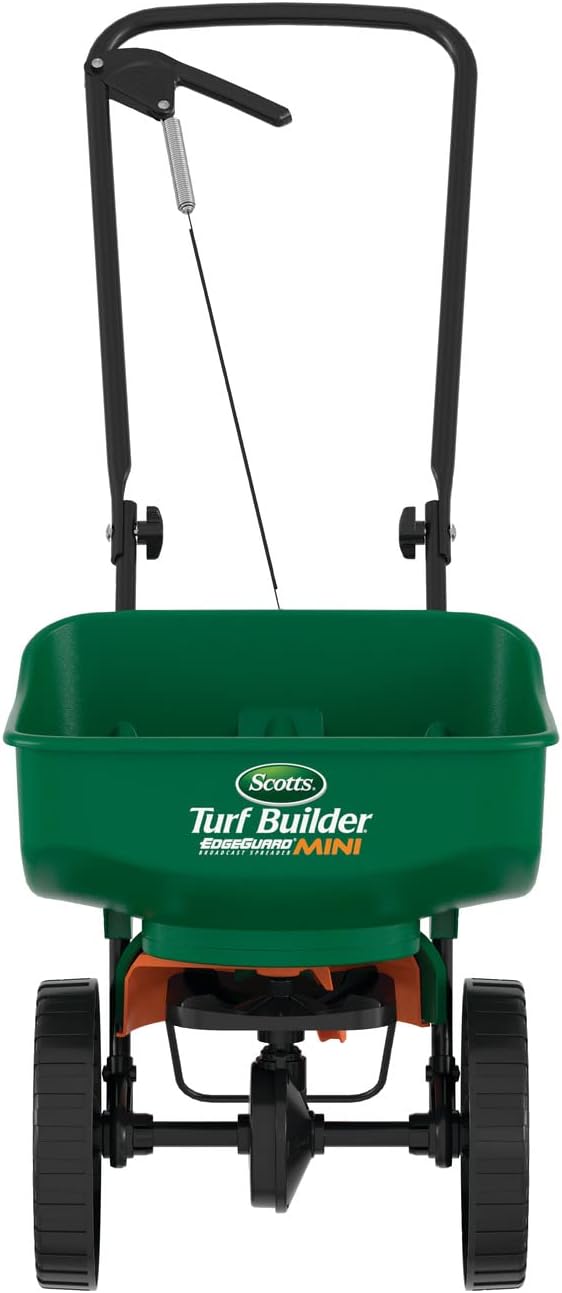
| Capacity | Up to 5,000 sq. ft. |
|---|---|
| Usage | Applies fertilizer, seed, granular weed control, salt, ice melt |
| Features | EdgeGuard side shield; dual-bladed agitator; fold-down handle |
The Scotts Turf Builder EdgeGuard Mini is a ready-to-use broadcast spreader aimed at smaller lawns and targeted spot work. It comes pre-calibrated so you set the dial to the recommended setting, pour in fertilizer, seed, ice melt, or granular weed control, and walk the lawn for even coverage. The hopper and dual-bladed agitator are redesigned to funnel product smoothly and reduce clogging, while open-spoke wheels and a fold-down handle make it easy to maneuver and store. Scotts' EdgeGuard feature blocks product on the right side of the pattern, which helps avoid deposits on sidewalks and landscape beds when edging. Capacity is geared to yards up to about 5,000 sq ft, so it handles typical small properties without being bulky. The main limitations are its smaller coverage area and basic mechanical design compared with larger, more precise spreaders, so it may require more passes on bigger lawns and offers fewer fine-control adjustments for professional users.
Best for: Buyers who want a simple, reliable spreader for small to medium yards and who prioritize ease of use and avoiding overspread onto hard surfaces.
Less Ideal for: Professional landscapers or owners of large properties who need higher capacity and finer control should consider larger commercial-style spreaders.
- Pre-calibrated and ready to use for quick setup
- EdgeGuard side shield reduces product on driveways and sidewalks
- Redesigned hopper and dual-blade agitator for consistent flow
- Fold-down handle and compact size for easy storage and maneuvering
- Smaller capacity suited for lawns up to about 5,000 sq ft so larger lawns need more refills or a larger spreader
- Limited fine adjustment compared with premium or professional models
Verdict: A user-friendly mini broadcast spreader that delivers even coverage for small lawns while keeping product off sidewalks and driveways.
Spot Spreader Hand Spreader Shaker (up to 80 oz)
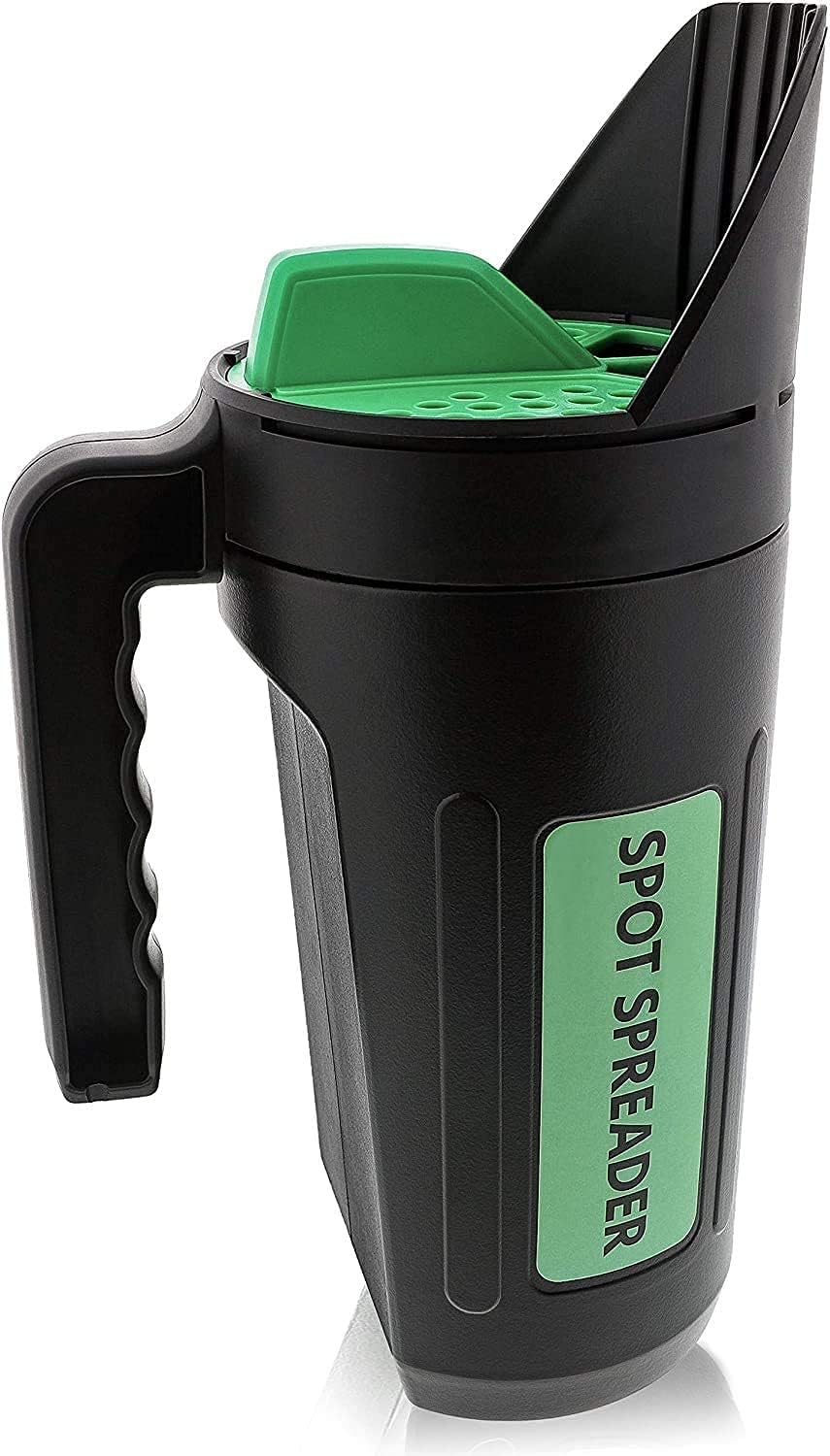
| Unit Count | 80 Ounce |
|---|---|
| Indoor Outdoor Usage | Outdoor |
| Other Special Features of the Product | Lightweight |
| Plant or Animal Product Type | Shrub & Hedge |
The Spot Spreader is a simple, handheld shaker designed to make targeted spreading of seed, salt, ice melt and granular fertilizer easier for small yards and walkways. You pour material into the screw-top reservoir, choose one of the adjustable openings, and walk while shaking to distribute product where you need it. Its lightweight construction and molded handle make it easy to carry and control for short jobs, and the 80 ounce capacity cuts down on trips back to the bag for small lawns or a driveway. The multiple opening sizes let you match flow to different granule sizes, reducing clumping and overspread compared with unregulated pouring. Expect plastic construction rather than metal durability; it performs best for seasonal or occasional use rather than heavy commercial work. For very large lawns or if you need a uniform broadcast at high speed, a crank or tow-behind spreader will be faster and more consistent.
Best for: Buyers who want a simple, low-effort tool to apply seed, salt or fertilizer around a small yard, driveway, or garden and who prioritize predictable, low-risk results over speed.
Less Ideal for: People with large properties or professional landscapers who need fast, uniform coverage and higher-duty equipment should consider larger crank or tow-behind spreaders instead.
- Handheld, lightweight design that is easy to carry and control for small jobs
- 80 oz capacity reduces refills during typical small-yard tasks
- Multiple adjustable openings accommodate different granule sizes
- Screw-top container stores material securely between uses
- All-plastic construction is less durable under heavy commercial use
- Not suited for quickly covering large lawns compared with broadcast or tow spreaders
Verdict: A compact, easy-to-use handheld spreader that lets homeowners accurately apply seed, salt or fertilizer around small yards without fuss.
Choosing the Right Fertilizer Spreader for Small Yards: Key Factors to Consider
Spread Pattern Precision
How uniformly fertilizer granules leave the spreader affects both plant health and product efficiency. A narrow, inconsistent pattern can create streaks and require overlap, while a consistent pattern reduces missed zones. In small yards you often work close to borders and ornamentals, so precise lateral control cuts down on accidental over-application.
Ask whether the distributor uses a broadcast rotor, drop plate, or variable aperture. Each delivers material differently and responds differently to walking speed and ground contour. Favor designs with adjustable deflectors or documented pattern widths so you can dial in coverage for narrow strips and tight corners.
Hopper Capacity and Weight
Hopper size matters differently in a small yard than in a large one. A huge hopper reduces refills but adds bulk and makes control harder when turning or working near beds. A modest-capacity hopper matched to your lawn size typically keeps the unit light enough to maneuver and easier to store.
Consider how full weight feels when you lift or tilt the spreader to get through gates or into sheds. Also think about refill frequency: multiple small refills may be acceptable if they let you handle the spreader comfortably and avoid spill-prone overfills.
Maneuverability and Footprint
Maneuverability is about wheel size, handle ergonomics, and the overall footprint. Smaller yards have more obstacles per square foot: planters, pathways, trees, and edges. A compact spreader that turns easily and has a narrow wheelbase will let you work closer to edges without damaging turf or plants.
Check how the handle height and grip affect your walking posture, and whether wheels can traverse uneven turf without bogging down. If you need to use the spreader on patios or tight strips, a wheel design that resists track marks and allows precise placement is helpful.
Calibration and Rate Control
Accurate rate control ensures you apply the correct amount of fertilizer per square foot. Different fertilizers and amendments have varying granule sizes and flow characteristics, so reliable calibration settings and clear markings are important. For small yards, being able to reduce the flow for narrow passes or detailed work near beds is often more important than a high maximum output.
Look for simple, repeatable adjustment mechanisms and clear guidance on settings for common products. Features like easy-to-access levers, indexed settings, or included calibration charts simplify seasonal applications and reduce guesswork.
Ease of Cleaning and Compatibility
Residual fertilizer can corrode metal parts and contaminate future applications, so a spreader that is easy to empty and rinse will last longer. Removable hopper liners, smooth interior surfaces, and accessible discharge areas make cleanup simpler. For small yards where you may switch between lawn fertilizer and granular plant food, cleaning is essential to prevent nutrient imbalances or burning.
Also check whether the spreader accepts a range of granular sizes and formulations. Versatile units let you spread lawn fertilizer, seed mixes, and ice-melt products without needing a separate tool.
Storage and Build Durability
Storage space is often limited in small-yard homes, so a compact or foldable spreader is easier to stow. Materials matter too: UV-stabilized plastics resist cracking, and coated metals resist rust when stored in a damp shed. A well-built frame with corrosion-resistant fasteners prolongs serviceable life even if the spreader sits outside between uses.
Consider how the unit is disassembled or folded for winter storage and whether small parts are easy to keep track of. A spreader that survives seasonal use with minimal maintenance fits well into a small-yard maintenance routine.
Best Spreader Types for Tight Spaces
Not all spreaders behave the same in a small yard. Walk-behind rotary spreaders deliver wider coverage and are good for short lawns, but they can be harder to use near edges. Drop spreaders offer precise placement and minimize drift near beds, making them a smart choice for narrow strips and planting borders.
Choose a type based on how much edge work you have. If your yard includes many flower beds or narrow pathways, prioritize a unit that lets you switch between broadcast and drop or that offers adjustable deflectors for close work.
- Drop-style discs for precise, low-drift applications
- Compact broadcast rotors for quicker passes on open patches
- Versatile units with adjustable deflectors for mixed-use yards
Calibrating Your Spreader for Accurate Rates
Calibration keeps you from over- or under-feeding. Start by reading the fertilizer label for the recommended pounds per 1,000 square feet, then follow the spreader's calibration procedure to match that rate. Use a small test area and measure output to confirm the setting before treating the whole yard.
In small yards, adjust for walking speed: a wobbly pace or frequent stops will change coverage. Walk at a consistent rate during calibration and mark your passes so you can repeat the same pattern during application.
- Use labeled calibration charts or perform a catch-can test
- Match settings to granule size listed on the product packaging
- Make small adjustments and re-test rather than making large jumps
Working Near Beds, Paths, and Landscaping
Protecting beds and ornamental plants means controlling spread and drift. For narrow margins, consider a spreader with a shutoff lever or a deflector that lets you stop flow instantly when crossing sensitive areas. When passing mulch beds, angle the spreader so material lands on lawn rather than being tossed into planting soil.
Hand-held or backpack options can be useful for spot treatments around delicate plants, but for most small lawns a lightweight walk-behind unit offers a good balance of speed and control.
- Shutoff mechanisms prevent accidental application into beds
- Work with the wind, or choose calm days to avoid drift
- Use edging passes to keep fertilizer off hard surfaces
Seasonal Maintenance and Storage Tips
After each application, empty leftover product back into a sealed container if still usable. Rinse the hopper and spreader mechanism to remove residue; dried fertilizer can clog openings and corrode metal parts. Allow components to dry before storing to slow corrosion and mold growth.
Store the spreader in a dry, sheltered spot and, if space is limited, opt for models with removable handles or fold-flat designs. Perform a quick pre-season check for wheel wear, loose fasteners, and calibration consistency to avoid surprises when you need to feed the lawn.
- Rinse and dry hopper after use
- Store indoors or under cover if possible
- Check calibration and wheel condition each spring
Safety and Environmental Considerations
Using the correct rate and avoiding application onto pavement protects waterways from runoff and prevents unnecessary nutrient loading. Sweep excess granules off driveways and sidewalks back onto the lawn to reduce waste and pollution risk. Consider using slow-release or plant-specific formulations to lower the chance of leaching in compact soils.
Wear gloves when handling fertilizers, and keep children and pets away from treated areas for the time indicated on product labels. Proper storage in labeled, sealed containers also reduces accidental misuse.
- Avoid applying before heavy rain to reduce runoff
- Sweep off hard surfaces to prevent contamination
- Follow label re-entry times for safety
How We Chose the Best Fertilizer Spreader for Small Yards
We focused on attributes that matter in tight spaces and repeat seasonal feedings. Key evaluation criteria included spread pattern precision, because even distribution prevents burn spots and wasted product; hopper capacity relative to small-yard workloads, to balance fewer refills with lighter handling; unit weight and maneuverability, which affect how easy the tool is to push, tow, or lift when working around flower beds, fences, and pathways; and calibration and control options, which let you adjust rate for different fertilizer granule sizes and turf needs. We also considered construction durability for outdoor storage, ease of cleaning to avoid cross-contamination between products, and compatibility with common granular fertilizers and lawn amendments. Units that required complex assembly, used uncommon calibration methods, or lacked clear spread-rate guidance were excluded. The final shortlist emphasizes practical usability in small yards rather than large-scale capacity or heavy-duty commercial features.
FAQ
What spreader type is best for a tiny lawn with lots of garden beds?
Drop spreaders or compact broadcast units with deflectors are usually best because they allow precise placement and reduce drift into beds. They let you control lateral spread so you can work close to borders without over-applying.
How often should I calibrate a spreader for seasonal use?
Calibrate at least once each season and whenever you change fertilizer types. Calibration also makes sense after wheel replacements or if you notice streaking, since settings can shift with wear or repairs.
Can I use one spreader for fertilizer, seed, and ice melt?
Many spreaders accept different granular products, but flow characteristics vary by product. Clean the hopper thoroughly between uses and check the manufacturer's guidance on compatible granule sizes to avoid clogging or inconsistent distribution.
Is a lighter spreader always better for a small yard?
Not always. Lighter units are easier to handle but may have smaller hoppers requiring more refills. Balance weight against capacity and stability; a slightly heavier unit with good maneuverability can be easier to control on uneven ground.
How do I avoid fertilizer getting on sidewalks and driveways?
Reduce spread width near hard surfaces, use a deflector or shutoff when crossing, and sweep any stray granules back onto the lawn. Applying on calm days and keeping passes parallel to edges helps minimize blow-off.
Final Verdict
For small yards, prioritize spreader control and maneuverability over maximum capacity. Precise spread patterns, reliable calibration, and a hopper size that keeps the unit light enough to handle will usually serve you better than a large, heavy model. Consider how often you want to refill, whether you need drop-style accuracy near beds, and how you will store the tool between seasons. With those tradeoffs in mind, you can choose a compact spreader that makes feeding efficient, tidy, and repeatable.
