

Note: This article contains affiliate links. If you click on these links and make a purchase, I may earn a small commission at no extra cost to you. This helps support my research and content. Read my full affiliate disclosure here.
Getting foliar feeding right can make a big difference for tomato plants, especially when soil problems or rapid nutrient needs limit yield. Foliar fertilizer addresses deficiencies quickly by delivering nutrients directly to leaves and flowers, helping with fruit set, stress recovery, and correcting micronutrient shortages. This guide looks at six shortlisted foliar fertilizers suited for tomatoes, chosen for practical garden use across containers, raised beds, and in-ground plantings. We evaluate nutrient formulas, how easy each is to mix and apply, and how predictable the results are under common garden conditions. Read on to understand which foliar approach fits your growing style and timing needs.
Top Picks at a Glance
| Best Overall The best all-around choice for most situations | Neptune's Harvest Organic Tomato & Vegetable Liquid Fertilizer (2-4-2) – 1 Gallon |  |
| Best Quality Built to a higher standard if you want something more solid | FoxFarm Grow Big Liquid Plant Food, 6-4-4 Quart Concentrate |  |
| Best Value The sweet spot between price and what you get | Farmer's Secret Tomato Booster Liquid Fertilizer (8 oz) |  |
| Best Budget The cheapest option that still gets the job done reliably | Fert Spray Tomato & Blossom Set, 8 fl oz liquid |  |
| Most Popular A crowd favorite that many people choose with confidence | GS Plant Foods Liquid Fish & Kelp Fertilizer (1 Gallon) |  |
| Best Seller A high-volume bestseller chosen again and again | Botanicare Cal‑Mag Plus Calcium, Magnesium and Iron Supplement (Quart) |  |
Neptune's Harvest Organic Tomato & Vegetable Liquid Fertilizer (2-4-2) – 1 Gallon

| Item Form | Liquid |
|---|---|
| Specific Uses For Product | Soil Conditioning |
| Application Method | Dilute in water and apply to soil or foliage |
| Target Species | Vegetables, Houseplants |
| Mixing Ratio | Outdoor 1/8 cup per gallon; Houseplants 1 tablespoon per gallon |
Neptune's Harvest Tomato & Vegetable 2-4-2 is a one-gallon liquid plant food designed for regular feeding of vegetable gardens and potted plants. It is used diluted in water as a soil drench or foliar spray and the label gives clear mix rates for outdoor plants and houseplants. The formula combines fish, seaweed, molasses, humates, yucca extract, biological microbes, and liquid calcium to deliver nitrogen, phosphorus, and potassium along with micronutrient support. In practice that means faster leaf growth, stronger stems and more active root zones when fed every one to two weeks outdoors or weekly on houseplants. The product is easy to apply, versatile across containers and in-ground beds, and leans organic so it is friendly for home gardens. Limitations are that the NPK is moderate rather than high strength, so gardeners wanting rapid, high-nitrogen pushes or bloom-boosting formulas may need a complementary product; occasional odor from the fish-based ingredients is normal. For balanced vegetable feeding this performs as a dependable, soil-building liquid feed.
Best for: Gardeners who want a balanced, natural liquid feed for vegetables and mixed container plantings and who prioritize steady growth and improved soil biology over aggressive, high-strength feeding.
Less Ideal for: Growers who need aggressive high-nitrogen feeds, intensive bloom stimulants, or an odorless synthetic fertilizer for sensitive indoor situations should consider alternatives.
- Organic blend with fish, seaweed, molasses, humates, and liquid calcium for broad nutrient and soil biology support
- Clear mixing ratios for both outdoor vegetables and houseplants for straightforward application
- Versatile use as a soil drench or foliar feed for containers and garden beds
- Supports root development and foliage vigor, which can improve yields and plant resilience
- Moderate NPK (2-4-2) may be insufficient for gardeners seeking rapid heavy-feeding or specialized bloom boosters
- Fish-based formula can produce an odor during handling or after application
Verdict: A reliable organic liquid fertilizer that delivers balanced nutrition and soil-building ingredients ideal for steady, healthy vegetable and container plant growth.
FoxFarm Grow Big Liquid Plant Food, 6-4-4 Quart Concentrate
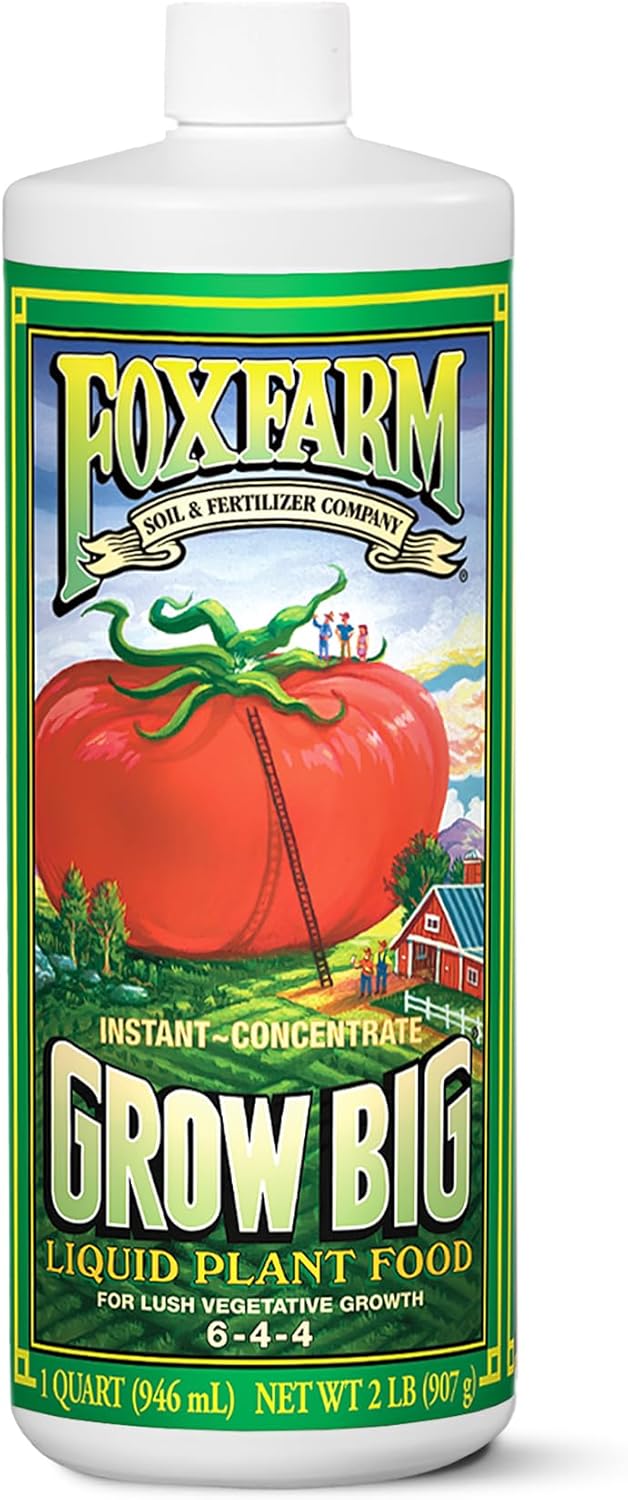
| N-P-K | 6-4-4 |
|---|---|
| Form | Liquid concentrate |
| Unit count | 32 Fluid Ounces |
| Mixing ratio | 2-3 teaspoons per gallon |
FoxFarm Grow Big is a water-soluble concentrate designed to boost vegetative growth and speed nutrient uptake in vegetable gardens and ornamentals. Mixed at 2 to 3 teaspoons per gallon, it can be applied through watering or foliar feeding to quickly deliver nitrogen-focused nutrition that supports larger plants and stronger stems. The low pH formula helps keep micronutrients stable so feedings remain effective, and the quart concentrate covers repeated applications for a small plot or a set of containers. Practical benefits include clear mixing instructions, versatility for both indoor and outdoor use, and a fast-acting effect when plants need a growth push. Limitations to note are the higher nitrogen emphasis, which favors leaf and stem growth over bloom or fruit set, and the presence of phosphorus in the formula that may be restricted in some local lawn rules. For gardeners who prioritize consistent, predictable feedings, this product is straightforward to measure and integrate into a regular watering schedule.
Best for: Gardeners who want a reliable, easy-to-dose liquid fertilizer to encourage rapid vegetative growth in vegetable beds, containers, and established plants and who value predictable results from each feeding.
Less Ideal for: Growers focused primarily on maximizing flowering or fruit set who need a bloom-boosting formula or those working under strict phosphorus-use restrictions in their area.
- Concentrated liquid formula for fast nutrient uptake and quick visible response
- Low pH formulation helps maintain micronutrient stability during storage and application
- Versatile application by watering or foliar feeding for indoor and outdoor use
- Clear mixing ratio (2–3 teaspoons per gallon) simplifies repeatable feedings
- Nutrient ratio (6-4-4) emphasizes vegetative growth rather than flowering or fruit production
- Contains phosphorus which may be restricted by local regulations for turf or non-agricultural use
Verdict: Choose this concentrate when you want a dependable, fast-acting liquid feed to promote vigorous leafy and structural growth in a vegetable garden.
Farmer's Secret Tomato Booster Liquid Fertilizer (8 oz)

| Item Form | Liquid |
|---|---|
| Specific Uses For Product | Tomato Plant Care |
| Target Species | Tomato |
| Mixing Ratio | 1:48 |
This concentrated tomato booster is designed to feed tomato plants throughout their life cycle with a formula developed by agronomists. It is supplied as an 8 oz liquid concentrate that you dilute (manufacturer directions: two teaspoons per gallon or mixing ratio 1:48) and apply weekly as a foliar spray or soil drench. The 3-8-7 N-P-K balance emphasizes phosphorus and potassium to support flowering and fruit development, and the label notes added humic acid, iron and calcium to help nutrient uptake and reduce common blossom-end issues. Because it is highly concentrated one small bottle produces many gallons of feed, which makes it convenient for someone managing a few seedlings up through established plants. Important limits: the product lists only primary ingredients without specific micronutrient concentrations, and safety guidance means you must measure carefully to avoid overfeeding sensitive seedlings. It is best used as part of a regular, measured feeding schedule rather than a one-time corrective treatment.
Best for: Gardeners who want an efficient, repeatable feeding plan for tomato seedlings and progressing plants and who prioritize measured, agronomist-developed formulations over ad hoc feeding.
Less Ideal for: Growers needing a complete guaranteed micronutrient analysis or those who prefer granular slow-release fertilizers for hands-off feeding.
- Super-concentrated formula yields many gallons from one 8 oz bottle
- N-P-K ratio (3-8-7) targets flowering and fruit set for tomatoes
- Includes humic acid plus iron and calcium to aid nutrient uptake and reduce common deficiencies
- Works as foliar spray or soil drench for flexible application
- No full breakdown of micronutrient concentrations is provided on the label
- Small bottle can lead to measurement errors if you do not use accurate measuring tools
Verdict: A small, super-concentrated liquid made to deliver targeted phosphorus and potassium support for tomatoes on a weekly feeding schedule.
Fert Spray Tomato & Blossom Set, 8 fl oz liquid
| Item Form | Liquid |
|---|---|
| Specific Uses For Product | Plant Growth |
| Application Method | spray |
| Coverage | Medium |
| Liquid Volume | 8 fluid ounces |
This ready-to-use foliar spray is designed to help tomato blossoms set and to promote earlier, fuller fruit development. You spray it directly on leaves and flowers, which makes application quick and easy for small beds, containers, or greenhouse-grown plants. The formula contains a natural growth regulator reported to improve blossom set so more flowers turn into fruit, and it claims faster ripening by up to a few weeks. Its 8-ounce bottle is convenient for targeted use and pairs well with a hand sprayer or fertigation injector. Practical benefits include reduced flower drop in cool or uneven weather and a simple mixing-free application at the labeled ratio. Limitations are that it is a small ready-to-use volume for larger plantings and the product focuses on setting and growth rather than complete nutrition, so you will still need a balanced fertilizer program for overall plant health.
Best for: Buyers growing tomatoes in small plots, containers, or hobby greenhouses who want an easy-to-use foliar product to improve blossom set and boost fruit quality without complex mixing.
Less Ideal for: Growers managing large vegetable beds or commercial plantings who need bulk coverage or a complete nutrient program.
- Ready-to-use foliar spray for simple, no-mixing application
- Formulated to improve blossom set and increase fruit development in tomatoes
- Works well for targeted treatment on individual plants, containers, or greenhouse setups
- Small 8 fl oz bottle may require frequent replacement for larger gardens
Verdict: A compact, ready-to-use foliar spray that makes improving tomato blossom set and fruit development quick and easy for small-scale growers.
GS Plant Foods Liquid Fish & Kelp Fertilizer (1 Gallon)

| Item Form | Liquid |
|---|---|
| Application Method | foliar spray or soil drench |
| Liquid Volume | 128 fluid ounces |
| Mixing Ratio | 1:128 (Indoor), 1:64 (Outdoor) |
GS Plant Foods Liquid Fish & Kelp is an organic, cold-processed concentrate intended to feed garden plants via soil drenches or foliar sprays. It mixes at recommended rates (about 2 fl oz per gallon for outdoor use) and supplies natural compounds from fresh fish hydrolysate and Ascophyllum nodosum kelp that support root strength, microbial activity, and nutrient uptake. Typical use is every 2–4 weeks on vegetables, flowers, shrubs, lawns, and even houseplants at a weaker indoor dilution. Notable features are its OMRI listing for organic growing, dual application method (foliar or drench), and a large 1 gallon volume that covers multiple feedings. Because it is a biological product, results accumulate over weeks as soil life and plant physiology respond rather than giving an immediate synthetic nutrient spike. Some gardeners may notice an initial odor and will need to follow mixing and application rates carefully to avoid overapplication. The product is straightforward to handle and pairs well with a regular feeding schedule for growers focused on improving soil biology and long-term plant performance.
Best for: Gardeners who prioritize plant performance through soil biology and want an organic, repeatable feeding program for vegetables, ornamentals, and turf.
Less Ideal for: People seeking rapid, high-analysis synthetic nutrient boosts or immediate visible change after a single application should consider a different product.
- OMRI-listed organic formula suitable for certified organic gardens
- Dual application as foliar spray or soil drench for flexible use
- Made from fish hydrolysate and North Atlantic kelp to support soil biology and root development
- Large 1 gallon concentrate provides many feedings for home gardens and hobby farms
- Biological, slow-acting nutrition that does not provide immediate synthetic nutrient spikes
- May have a noticeable fishy odor on mixing
Verdict: Buy this if you want an OMRI-listed, kelp-and-fish concentrate that builds soil biology and long-term plant performance rather than quick synthetic results.
Botanicare Cal‑Mag Plus Calcium, Magnesium and Iron Supplement (Quart)

| NPK | 2-0-0 |
|---|---|
| Active nutrients | Calcium, Magnesium, Iron |
| Intended use | Soil, containers, coco, hydroponics |
| Application | Mix with watering or foliar spray |
Botanicare Cal‑Mag Plus is a fortified liquid supplement designed to correct calcium, magnesium, and iron deficiencies that commonly affect fruiting plants. It mixes with irrigation water or can be applied as a foliar spray, making it suitable for in‑ground tomatoes, container plants, coco coir, and small hydro setups. The 2‑0‑0 NPK formula focuses on secondary nutrients rather than primary feeding, so it is intended to supplement, not replace, a complete fertilizer program. Practical benefits include easy mixing with every watering, clearer prevention of blossom end rot and leaf interveinal chlorosis when calcium and magnesium are limiting, and a foliar option for quicker symptom relief. Limitations are that it does not provide significant NPK macronutrients, requires regular use for ongoing correction, and must be handled carefully because it contains concentrated nitrates and EDTA‑iron. For risk‑averse gardeners, following recommended dilutions and avoiding overapplication will minimize plant or foliage stress.
Best for: Tomato growers who prioritize preventing blossom end rot and correcting interveinal chlorosis and who prefer a supplemental product to add to an existing feeding regimen.
Less Ideal for: Growers looking for an all‑in‑one complete fertilizer or those who want a single product to supply full NPK needs for mature tomato feeding cycles.
- Targets calcium, magnesium, and iron deficiencies with a concentrated formulation.
- Works as both a root drench and foliar spray for faster correction of foliar symptoms.
- Suitable for soil, container, coco coir, and hydroponic systems, offering versatile use.
- Mixes with each watering so it can be integrated into routine feeding schedules.
- Does not supply primary NPK macronutrients so it must be used alongside a base fertilizer.
- Contains concentrated nitrates and chelated iron so safe handling and accurate dosing are required.
Verdict: Use Cal‑Mag Plus when you need a reliable supplemental source of calcium, magnesium, and iron to prevent common tomato disorders while keeping your existing fertilizer program intact.
Choosing the Right Foliar Fertilizer for Tomatoes: Key Factors to Consider
Nutrient Composition and Label Clarity
Tomatoes benefit from a mix of macronutrients and specific micronutrients at different stages. A foliar product should list N-P-K ratios and state the forms of nutrients present, such as chelated iron or soluble calcium. Clear labels let you match a product to the plant stage – higher nitrogen early for foliage, and balanced or potassium-forward mixes during fruiting.
A transparent ingredient panel also reveals whether nutrients are in foliar-available forms. Avoid products that hide active ingredients behind vague marketing terms. Knowing exact concentrations helps you calculate safe dilutions and avoid overfeeding, which can burn leaves or disrupt blossom set.
Concentration and Dilution Guidance
Foliar fertilizers vary widely in concentration, and the safe working strength for leaves is often much lower than for soil-applied fertilizers. Reliable products provide explicit dilution rates per gallon or liter and specify how often to apply during vegetative growth and fruiting.
Proper dilution reduces the risk of leaf scorch and ensures uniform coverage. If instructions are missing or ambiguous, the product is harder to use safely, especially for beginners. Look for guidance that addresses temperature and sunlight conditions, since spraying in high heat can increase phytotoxic risk.
Micronutrient Profile for Tomato Disorders
Tomatoes commonly show deficiency symptoms that respond well to foliar feeding, including yellowing from iron or manganese shortage and blossom-end rot connected to calcium issues. A good foliar fertilizer will include or allow supplementation with key micronutrients like calcium, magnesium, iron, manganese, boron, and zinc.
Pay attention to the forms of these micronutrients. Chelated or water-soluble forms are typically more readily taken up through leaf tissue. Products that provide a broad, balanced micronutrient profile reduce the need for multiple separate sprays.
Sprayer Compatibility and Particle Size
Gardeners use pump sprayers, hose-end sprayers, and handheld misting bottles to apply foliar feeds. The product should dissolve or suspend cleanly without clogging nozzles. Fine spray droplets improve leaf coverage and absorption but can also drift, so nozzle selection matters.
Check whether a product recommends filtering or settling before use and whether it advises against certain nozzle types. Compatibility with standard garden sprayers makes application quicker and less likely to produce uneven results.
Timing and Frequency of Applications
Foliar feeding is most effective when done under the right conditions: cooler parts of the day, not directly in strong sun, and during active growth or when deficiency symptoms are present. The product should provide stage-specific timing such as early vegetative, pre-bloom, and fruit development windows.
Frequency guidelines matter because excessive foliar feeding can cause buildup or leaf damage. Effective products balance how often to spray with recommended concentrations so you can correct issues without stressing plants.
Safety and Phytotoxicity Risk
Plants can react negatively to overly concentrated sprays or to certain ingredient combinations. A safe foliar fertilizer will warn about temperature limits, sunlight exposure during application, and incompatible tank mixes. It should also include first-aid and storage guidance.
Understanding phytotoxic risk helps you avoid foliar scorch and protects pollinators and beneficial insects. Products that specify safe use around blooms and flowering periods are preferable for tomato growers who want to preserve fruit set and pollination activity.
When Foliar Feeding Helps Most
Foliar feeding works best as a rapid corrective tool rather than a primary nutrition strategy. Use it when plants show specific deficiency symptoms, when root uptake is limited by cold or waterlogged soil, or to give a short-term boost during flowering and fruit set. Because foliar sprays bypass the soil, they can correct micronutrient shortages within days instead of weeks.
Reserve foliar applications for targeted interventions and follow label directions closely. Regular heavy use of foliar fertilizers instead of correcting soil fertility can mask underlying problems and increase the need for future sprays.
- Effective for correcting micronutrient shortages quickly
- Useful when root uptake is impaired by weather or soil issues
- Best as a supplement to, not a replacement for, soil fertility management
Applying Foliar Feed Safely
Spray in the cooler parts of the day, early morning or late afternoon, to reduce evaporation and leaf scorch. Aim for thorough but gentle coverage of both upper and lower leaf surfaces, since many stomata and entry points are on the undersides.
Avoid spraying during extreme heat, direct midday sun, or when heavy rain is expected within 24 hours. Always follow dilution instructions exactly and start with the lower end of recommended concentrations if you are uncertain.
- Check weather forecast and avoid windy conditions to reduce drift
- Wear gloves and eye protection, and keep pets and children away during application
- Rinse sprayers thoroughly after use to prevent residue buildup
Mixing and Tank-Mix Considerations
Not all foliar fertilizers mix well with pesticides, fungicides, or other nutrient products. Read compatibility notes and perform a small jar test before combining materials to check for precipitation or separation. Some chelated nutrients can complex with other inputs and reduce availability.
Layer additions in the tank carefully: typically add water first, then water-soluble powders or liquids, and add surfactants last. If the product calls for a specific pH range, test and adjust accordingly to keep nutrients in a foliar-available form.
- Do a compatibility test before full-tank mixing
- Follow manufacturer order of mixing to avoid clogs and precipitation
- Adjust spray pH if recommended for better uptake
Foliar Feeding for Container and Small-Space Tomatoes
Container-grown tomatoes often show nutrient swings faster than in-ground plants because pots hold less soil and nutrients are used up quickly. Foliar applications can correct short-term deficiencies and keep plants productive between soil fertilizer schedules.
Use lower concentrations on containers and increase frequency rather than strength if plants need repeated boosting. Regular monitoring and light foliar feeding can prevent stress that reduces fruit size and flavor.
- Prefer frequent, lighter sprays for potted plants
- Combine foliar feed with a balanced container fertilizer plan
- Watch for salt buildup in potting mix and flush if necessary
Interpreting Deficiency Symptoms
Leaf yellowing, interveinal chlorosis, stunted new growth, and blossom-end rot are common signs that foliar nutrients can address. Iron and manganese deficiencies often show as new-leaf yellowing while calcium-related blossom-end rot appears at fruit ends. Correct diagnosis matters because foliar calcium will not fix a nitrogen shortage, and vice versa.
When in doubt, test soil or tissue if possible. Use foliar feeding as a targeted, short-term fix while making longer-term soil amendments to address root uptake problems.
- Match symptom with likely nutrient to avoid unnecessary sprays
- Use tissue tests for persistent or unclear deficiencies
- Adjust irrigation and soil management alongside foliar treatments
How We Chose the Best Foliar Fertilizer for Tomatoes
We selected products based on criteria that matter in everyday tomato growing rather than marketing claims. Our main filters favored formulations with clear, complete labels showing N-P-K and micronutrient content, plus guidance on safe dilution rates for tomatoes. We prioritized products that work well in common garden situations: container and raised-bed culture, open-ground gardens, and greenhouse settings. We evaluated ease of application, including how formulations mix with water, compatibility with common sprayers, and instructions for foliar timing. Safety and phytotoxicity risk were considered by checking recommended dilution ranges and usage notes for flowering and fruiting stages. Persistence and uptake were judged by ingredient form and gardener reports on how quickly deficiencies corrected after application. We excluded products lacking transparent ingredient lists, those formulated only for large-scale agriculture without home-garden instructions, and any materials that require specialist equipment or licensing. The result is a set of options focused on clear labels, practical dilution instructions, foliar-friendly nutrient forms, and real-world handling for tomato growers.
FAQ
How often should I foliar feed tomato plants?
Frequency depends on product concentration and plant needs. Often gardeners apply a light foliar spray every 7 to 14 days during active growth or when correcting deficiencies. Follow label guidance and prefer lower concentrations with repeat applications rather than a single heavy spray.
Can foliar feeding prevent blossom-end rot?
Foliar calcium can help reduce blossom-end rot in some cases by supplying calcium directly to developing fruit, but it does not replace proper soil moisture management. Blossom-end rot often stems from inconsistent watering or poor root uptake, so address irrigation and soil conditions alongside foliar calcium.
Is it safe to foliar feed while tomatoes are flowering?
Yes, but take care to use recommended dilutions and spray during cooler times to avoid damaging blooms. Avoid products that advise against use during flowering, and minimize disruption to pollinators by applying in early morning or late evening when pollinator activity is lower.
Will foliar feeding replace soil fertilization?
No. Foliar feeding is a supplemental technique for rapid correction of deficiencies or short-term boosts. Long-term plant health and sustained yields depend on balanced soil fertility and good root health.
Can I mix foliar fertilizer with pesticides or fungicides?
Sometimes, but compatibility varies. Always check product labels and perform a small jar test to ensure no precipitation or reaction occurs. If unsure, apply separately and rinse equipment between uses to prevent harmful interactions.
Final Verdict
Prioritize clear labels, appropriate dilution guidance, and micronutrient coverage when choosing a foliar fertilizer for tomatoes. Use foliar feeding as a targeted, short-term tool to correct deficiencies, support fruit set, or help plants recover from stress. Balance foliar interventions with sound soil management and irrigation practices to achieve consistent yields without risking leaf damage. When in doubt, choose the gentler application schedule: lower concentrations applied more often reduce phytotoxic risk while providing steady nutrient support. Focus on the specific deficiency you are correcting and follow safety and mixing guidance to keep tomato plants productive and healthy.
